By Che’ Blackmon, DBA Candidate | Founder & CEO, Che’ Blackmon Consulting
✨ Introduction: The New Reality of Leadership
The workplace has changed. Today’s leaders navigate teams that span continents, cultures, and communication styles. Whether your organization operates across international borders or serves a diverse local community, cross-cultural competence has become essential for effective leadership. This is not merely about being polite or politically correct. It is about building the kind of purposeful culture that drives results.
As I discuss in High-Value Leadership: Transforming Organizations Through Purposeful Culture, leaders who understand the intersection of culture and performance create environments where every team member can contribute their best work. Cross-cultural competence amplifies this principle by ensuring that cultural differences become sources of strength rather than barriers to success.
🔍 Understanding Cross-Cultural Competence
Cross-cultural competence refers to the ability to understand, communicate with, and effectively interact with people across cultures. It involves awareness of your own cultural worldview, knowledge of different cultural practices and worldviews, and the skills to bridge differences respectfully and productively.
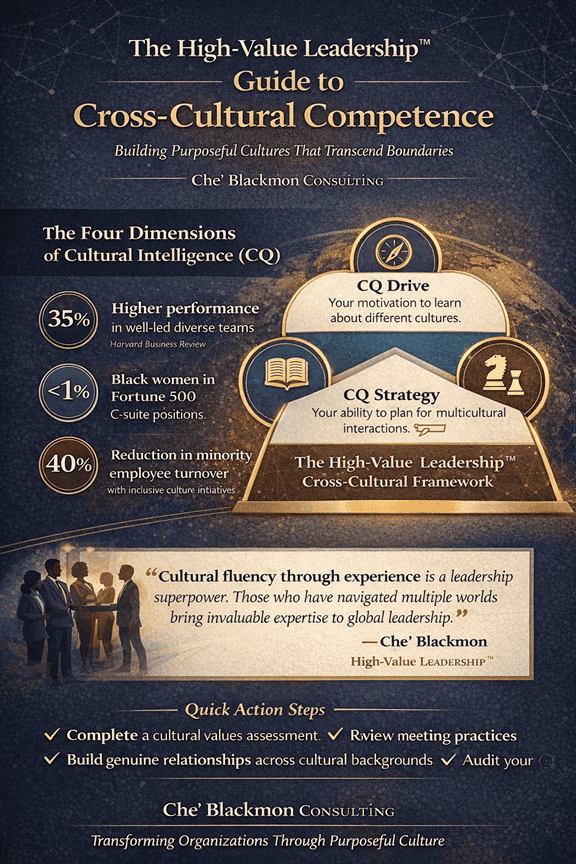
Research from the Harvard Business Review indicates that culturally diverse teams outperform homogeneous ones by up to 35% when led effectively. However, the same research shows that poorly managed diverse teams underperform significantly. The difference lies in leadership competence.
The Four Dimensions of Cultural Intelligence
Dr. Soon Ang and Dr. Linn Van Dyne’s research on Cultural Intelligence (CQ) identifies four key capabilities. First, CQ Drive represents your motivation and interest in learning about different cultures. Second, CQ Knowledge encompasses your understanding of cultural similarities and differences. Third, CQ Strategy involves your ability to plan for multicultural interactions. Fourth, CQ Action reflects your capability to adapt behavior appropriately in different cultural contexts.
👩🏾💼 The Overlooked Perspective: Black Women in Global Leadership
Discussions about cross-cultural competence often focus on national cultures while overlooking the unique experiences of those who navigate multiple cultural identities daily. Black women in corporate spaces, for instance, bring invaluable perspectives to global leadership conversations.
In Rise & Thrive: A Black Woman’s Blueprint for Leadership Excellence, I explore how Black women have historically developed sophisticated cultural navigation skills out of necessity. These skills, including code-switching, reading organizational dynamics, and building coalitions across differences, translate directly into cross-cultural leadership capabilities.
McKinsey’s research on diversity in leadership consistently shows that companies with diverse leadership teams, including representation of Black women at senior levels, demonstrate stronger financial performance and innovation. Yet Black women remain severely underrepresented in global leadership roles, holding less than 1% of C-suite positions in Fortune 500 companies.
Leveraging Lived Experience as Leadership Capital
Leaders from traditionally overlooked backgrounds often possess what I call “cultural fluency through experience.” Having navigated predominantly white corporate spaces while maintaining connections to their communities of origin, these leaders develop nuanced abilities to bridge cultural gaps, recognize unspoken dynamics, and create inclusive environments.
Organizations seeking to build cross-cultural competence should recognize and leverage this expertise rather than expecting assimilation. When Black women and other underrepresented leaders are empowered to lead authentically, they model the kind of cultural bridge-building that global organizations require.
📊 Case Studies: Cross-Cultural Leadership in Action
Case Study 1: Manufacturing Meets Global Markets
Consider a mid-sized automotive supplier that expanded operations to include facilities in Mexico and partnerships in Germany. Initially, the company experienced significant friction. American managers interpreted Mexican colleagues’ relationship-building communication style as inefficient. German partners found American directness abrasive.
The turning point came when leadership invested in cross-cultural training and, critically, elevated leaders from each location into strategic decision-making roles. By creating space for different communication styles and decision-making approaches, the company reduced conflict, improved supplier relationships, and increased production efficiency by 22% within 18 months.
Case Study 2: Healthcare System Transformation
A regional healthcare system serving a rapidly diversifying patient population struggled with patient satisfaction scores and staff turnover. Exit interviews revealed that employees from minority backgrounds felt their cultural insights were dismissed, while patients reported feeling misunderstood by care providers.
The organization implemented a comprehensive culture transformation initiative. This included elevating diverse voices into leadership councils, creating cultural liaison positions, and revising hiring practices to value cultural competence alongside clinical skills. Within two years, patient satisfaction scores increased by 15%, and staff turnover among minority employees dropped by 40%.
🛠️ Building Your Cross-Cultural Competence: Practical Strategies
In Mastering a High-Value Company Culture, I outline principles for creating organizational cultures that bring out the best in people. These principles apply directly to cross-cultural leadership.
Strategy 1: Develop Cultural Self-Awareness
Before you can effectively lead across cultures, you must understand your own cultural programming. Examine your assumptions about time, hierarchy, communication, and conflict. Consider how your background shapes what you consider “professional” or “appropriate.” Many workplace norms that seem universal are actually culturally specific.
Action Step: Complete a cultural values assessment such as the Intercultural Development Inventory or CQ Assessment. Reflect on three situations where your cultural assumptions may have influenced your leadership decisions.
Strategy 2: Practice Active Cultural Learning
Cross-cultural competence requires ongoing education. Study the cultural backgrounds of your team members and stakeholders. Learn about communication styles, decision-making preferences, and values that may differ from your own. Approach this learning with humility and genuine curiosity rather than treating it as a checklist exercise.
Action Step: Identify one cultural group you work with regularly but know little about. Commit to learning about their cultural context through reading, conversation, and observation. Seek out content created by members of that community rather than outside observers.
Strategy 3: Create Inclusive Communication Practices
Effective cross-cultural leaders adapt their communication styles while creating space for diverse communication preferences. This means being explicit about expectations rather than assuming shared understanding, allowing multiple channels for input, and recognizing that silence may indicate disagreement or contemplation depending on cultural context.
Action Step: Review your team meeting practices. Do they favor those comfortable with verbal debate? Add written input options, structured reflection time, and alternative ways for team members to contribute ideas.
Strategy 4: Build Diverse Leadership Pipelines
Organizations cannot develop cross-cultural competence through training alone. They must ensure that leadership teams reflect the diversity of their workforce, customer base, and global reach. This requires intentional efforts to identify, develop, and promote leaders from underrepresented backgrounds, including Black women and other traditionally overlooked groups.
Action Step: Audit your organization’s leadership pipeline. Where are the gaps in representation? What barriers exist for advancement? Create specific initiatives to address these gaps with accountability measures and timelines.

📈 Current Trends and Best Practices
The landscape of cross-cultural leadership continues to evolve. Several trends are shaping best practices in this field.
Remote Work and Virtual Teams. The shift to remote and hybrid work has intensified the need for cross-cultural competence. Leaders now manage teams they may never meet in person, across multiple time zones and cultural contexts. Research from GitLab and Buffer indicates that successful remote teams prioritize explicit communication, documentation, and asynchronous work practices that accommodate different working styles and schedules.
Intersectionality in Leadership Development. Progressive organizations recognize that cultural identity is multifaceted. Effective cross-cultural development programs address intersectionality, understanding that a Black woman executive, a first-generation college graduate manager, or an LGBTQ+ team leader from a conservative region each bring unique perspectives and face distinct challenges.
Data-Driven Culture Assessment. Leading organizations use analytics to measure cultural competence and inclusion. This includes tracking promotion rates across demographic groups, analyzing engagement survey results by cultural background, and monitoring retention patterns. Data provides accountability and helps identify systemic barriers that individual good intentions cannot overcome.
Psychological Safety as Foundation. Research by Dr. Amy Edmondson and others demonstrates that psychological safety, the belief that one can speak up without punishment or humiliation, is essential for cross-cultural teams to thrive. Creating environments where team members can bring their authentic cultural selves without fear enables the innovation and collaboration that diverse teams promise.
💡 Actionable Takeaways
To strengthen your cross-cultural leadership competence, focus on these key actions:
1. Commit to Self-Examination. Regularly assess your own cultural biases and assumptions. Seek feedback from colleagues with different backgrounds about how your leadership style lands across cultures.
2. Invest in Relationships. Build genuine connections with team members from different cultural backgrounds. Move beyond surface-level interactions to understand their perspectives, values, and experiences.
3. Amplify Overlooked Voices. Actively create space for Black women, people of color, and other traditionally marginalized groups to contribute and lead. Recognize that their cultural navigation expertise is an organizational asset.
4. Adapt Your Leadership Style. Develop flexibility in how you communicate, make decisions, and provide feedback. What works in one cultural context may not work in another.
5. Make Systemic Changes. Individual competence matters, but sustainable change requires systemic attention to policies, practices, and structures that may inadvertently disadvantage certain cultural groups.
6. Measure and Adjust. Track outcomes related to cultural competence and inclusion. Use data to identify what is working and what needs adjustment.
🎯 Conclusion: Leadership That Transcends Boundaries
Cross-cultural competence is not an optional skill for today’s leaders. It is fundamental to building the high-value organizational cultures that drive sustainable success. When leaders embrace cultural differences as opportunities rather than obstacles, they unlock innovation, engagement, and performance that homogeneous thinking cannot achieve.
For those who have been traditionally overlooked in leadership conversations, particularly Black women navigating corporate spaces, know that your cultural fluency is a superpower. Your experience bridging worlds, adapting to different contexts, and bringing your full self despite resistance positions you uniquely for the global leadership challenges ahead.
The path forward requires both individual growth and organizational transformation. As I emphasize throughout my work, purposeful culture does not happen by accident. It requires intentional leadership, consistent action, and unwavering commitment to bringing out the best in every person, regardless of their cultural background.
❓ Discussion Questions for Reflection
1. What cultural assumptions have you brought into leadership situations that you later recognized were not universal? How did this recognition change your approach?
2. How does your organization currently leverage the cultural expertise of Black women and other traditionally overlooked leaders? What opportunities exist to do this more effectively?
3. Think about a cross-cultural conflict or misunderstanding you have witnessed. What cultural factors may have contributed to the disconnect? How might a culturally competent leader have approached the situation differently?
4. What barriers exist in your organization that may prevent culturally diverse leaders from advancing into senior positions? What specific steps could address these barriers?
5. How can you personally commit to growing your cross-cultural competence over the next six months? What specific learning activities and relationship-building efforts will you pursue?
🚀 Your Next Steps
Building cross-cultural competence is a journey, not a destination. Start where you are, commit to growth, and take consistent action. Whether you are an emerging leader seeking to develop your capabilities or an executive aiming to transform your organizational culture, the time to begin is now.
Consider exploring additional resources such as Mastering a High-Value Company Culture and High-Value Leadership: Transforming Organizations Through Purposeful Culture for deeper insights into building cultures where all people thrive. For Black women and other leaders from traditionally overlooked backgrounds, Rise & Thrive: A Black Woman’s Blueprint for Leadership Excellence offers specific guidance for navigating corporate spaces while leading authentically.
🤝 Partner with Che’ Blackmon Consulting
Ready to transform your organization’s culture and develop cross-cultural leadership capabilities? Che’ Blackmon Consulting offers fractional HR leadership, culture transformation consulting, and executive coaching designed to create workplaces where every person can contribute their best work.
📧 Email: admin@cheblackmon.com
📞 Phone: 888.369.7243
🌐 Website: cheblackmon.com
Let’s build purposeful cultures together. ✨
#HighValueLeadership #CrossCulturalCompetence #GlobalLeadership #DiversityAndInclusion #CultureTransformation #BlackWomenInLeadership #LeadershipDevelopment #WorkplaceCulture #InclusiveLeadership #HRLeadership #OrganizationalCulture #ExecutiveLeadership #CulturalIntelligence #PurposefulCulture #WomenInLeadership