Why the leadership capabilities that got you here won’t get you there—and what to develop instead
The manufacturing plant manager had twenty-three years of experience. He knew production systems intimately, could diagnose equipment issues by sound alone, and had relationships with every supplier in the region. By traditional measures, he was an exceptional leader.
Yet his team was hemorrhaging talent. Younger workers stayed an average of fourteen months before leaving. When HR finally conducted exit interviews systematically, the feedback was consistent: “He manages machines better than he manages people.”
This leader possessed deep technical expertise—the skills that earned him promotion in 2010. But the leadership capabilities required in 2026 are fundamentally different. Technical mastery alone no longer defines effective leadership. The skills gap isn’t just about workers lacking capabilities. It’s about leaders lacking the skills their organizations desperately need for what’s coming next.
The Skills Gap Nobody’s Talking About 🔍
Most discussions about skills gaps focus on frontline workers: not enough data analysts, insufficient cybersecurity professionals, inadequate AI literacy. These gaps are real and consequential.
But there’s a parallel skills gap in leadership that’s equally urgent and far less acknowledged. Leaders promoted for their technical expertise, operational knowledge, or functional mastery now face challenges their previous success didn’t prepare them for: leading through ambiguity, managing distributed teams, navigating rapid technological change, building inclusive cultures, developing talent in areas they’ve never worked, and making decisions with incomplete information in compressed timeframes.
The leadership playbook from 2015—or even 2020—is already obsolete. The playbook for 2026 requires capabilities many current leaders haven’t developed because they’ve never needed them before.
A technology company discovered this gap the expensive way. They promoted their best software engineers into management roles, assuming technical excellence would translate to leadership effectiveness. Within eighteen months, they had a retention crisis. Their most talented engineers were leaving, citing “terrible managers who treat us like code to be debugged rather than people to be developed.”
The promoted engineers weren’t failing because they were bad people. They were failing because they possessed 2015 skills in roles requiring 2026 capabilities.
Understanding the 2026 Leadership Landscape 🌐
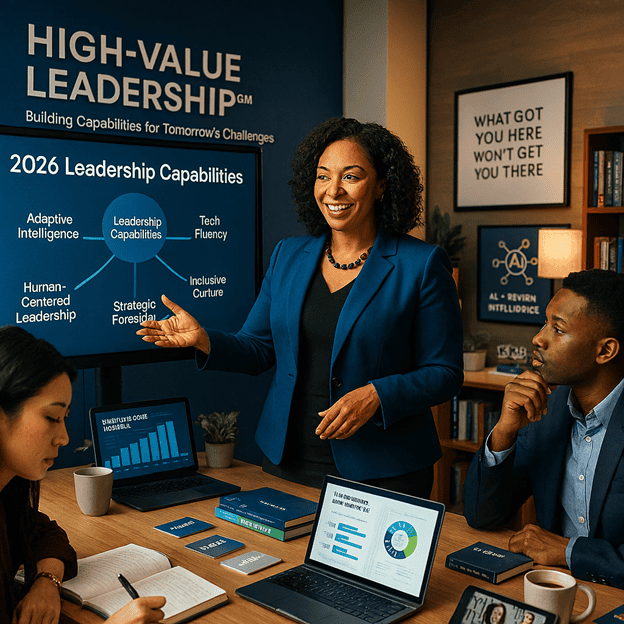
As I discuss in High-Value Leadership: Transforming Organizations Through Purposeful Culture, the context in which leadership happens has transformed fundamentally. Leaders who succeed in 2026 will master capabilities that fall into five essential categories: adaptive intelligence, human-centered leadership, technological fluency, inclusive culture-building, and strategic foresight.
These aren’t soft skills or nice-to-haves. They’re competitive necessities. Organizations led by people who’ve developed these capabilities will outperform, out-innovate, and out-recruit those that haven’t.
What makes 2026 different?
Pace of change: The time between “new technology emerges” and “it fundamentally changes how we work” has collapsed from years to months. Leaders must learn, adapt, and guide their teams through continuous transformation rather than managing stable operations punctuated by occasional change.
Distributed everything: Remote and hybrid work aren’t temporary responses to a pandemic—they’re permanent features of the employment landscape. Leadership that depends on physical presence and direct observation no longer functions.
Talent power shift: In many sectors, talented people have more options than available positions. Leaders can’t rely on authority or scarcity to retain people. They must create environments people actively choose rather than grudgingly tolerate.
Transparency and accountability: Social media, employer review sites, and internal communication platforms mean leadership behavior becomes visible immediately. Toxic leaders who once operated with impunity now get exposed and held accountable.
Demographic transformation: The workforce is increasingly diverse across every dimension—race, gender, age, nationality, neurodiversity, work style preferences. Leadership approaches designed for homogeneous teams fail spectacularly with diverse ones.
The Five Critical Leadership Capability Clusters for 2026 🎯
1. Adaptive Intelligence: Learning at the Speed of Change 🧠
Adaptive intelligence is the capacity to learn quickly, unlearn outdated approaches, and apply new knowledge in unfamiliar contexts. It’s not about having all the answers—it’s about asking better questions and updating your thinking as new information emerges.
Traditional leadership rewarded confidence and decisive action. Adaptive intelligence requires something different: intellectual humility, curiosity, and comfort with uncertainty.
There was a healthcare organization whose senior leadership team averaged twenty-six years of industry experience. Their deep expertise had always been their competitive advantage. Then telehealth, AI diagnostics, and patient data analytics transformed their industry in thirty-six months.
Their expertise became a liability. They kept trying to apply solutions that worked in 2018 to problems that didn’t exist until 2024. Meanwhile, competitors with less experience but greater adaptability captured market share by experimenting, learning, and iterating rapidly.
Adaptive intelligence in practice:
Questioning assumptions: Regularly examining whether your mental models still match reality. The manufacturing leader who assumes “people want stability and clear hierarchy” might miss that younger workers actually value autonomy and purpose over predictability.
Learning from failure: Treating mistakes as data rather than disasters. Creating psychological safety where failed experiments generate insights rather than punishment.
Seeking diverse perspectives: Actively gathering input from people with different backgrounds, experiences, and viewpoints—especially those who see things you don’t.
Updating beliefs: Being willing to say “I was wrong” or “my thinking has changed” without viewing it as weakness. Adaptive leaders change their minds when evidence warrants it.
Experimenting intelligently: Testing new approaches on small scales, learning from results, and adjusting before full implementation.
As I outline in Mastering a High-Value Company Culture, high-value cultures are built by leaders who model continuous learning rather than pretending to know everything.
2. Human-Centered Leadership: Beyond Managing Productivity 💚
Human-centered leadership recognizes that people aren’t resources to be optimized—they’re complex humans with needs, aspirations, challenges, and lives outside work. This capability involves understanding motivation, building psychological safety, developing talent, and creating conditions where people can contribute their best work.
The shift here is profound. Industrial-era leadership focused on extracting maximum output. Knowledge-era leadership requires cultivating discretionary effort, creativity, and engagement—things that can’t be commanded or extracted.
A financial services company had always measured manager effectiveness through productivity metrics: transactions processed, sales closed, projects completed. These metrics showed their managers were highly effective.
Then they started measuring differently: employee engagement, retention, promotion rates of team members, innovation from teams, psychological safety scores. Under these measures, many “effective” managers looked terrible. They hit numbers by burning people out, micromanaging relentlessly, and creating fear-based cultures that drove away top talent.
Human-centered leadership capabilities:
Psychological safety creation: Building environments where people can speak up, take risks, admit mistakes, and challenge ideas without fear of humiliation or retaliation. Research by Dr. Amy Edmondson shows this is the foundation of high-performing teams.
Coaching orientation: Shifting from “telling people what to do” to “asking questions that help people think through problems themselves.” Developing people rather than just directing them.
Emotional intelligence: Understanding your own emotions and their impact, reading others’ emotional states accurately, and managing interpersonal dynamics skillfully. This isn’t touchy-feely softness—it’s strategic leadership capability.
Inclusive decision-making: Involving people in decisions that affect them, considering diverse perspectives before concluding, and explaining reasoning transparently. People support what they help create.
Work-life integration support: Recognizing that people’s capacity to contribute at work is affected by what’s happening in their lives, and creating flexibility that allows people to manage both effectively.
3. Technological Fluency: Leading in an AI-Augmented World 🤖
Leaders in 2026 don’t need to code (though it doesn’t hurt). They need sufficient technological fluency to understand how technology can enhance their operations, make informed decisions about technology investments, and lead teams through technological transformation.
This gap is particularly acute among leaders who built their careers before digital transformation accelerated. Many lack basic understanding of AI, automation, data analytics, or digital workflows—yet they’re making strategic decisions about these technologies.
There was a manufacturing company whose executive team averaged fifty-four years old with an average of twenty-eight years in the industry. When their technology director proposed implementing predictive maintenance AI, leadership dismissed it as “not how we do things here.”
A competitor implemented similar technology, reduced unplanned downtime by 67%, and captured contracts the first company had held for decades. By the time leadership recognized their mistake, they’d lost both market position and their best young engineers, who left for companies “actually living in the 21st century.”
Technological fluency for leaders:
Understanding AI capabilities and limitations: Knowing what AI can do well (pattern recognition, prediction, automation of routine tasks) and what it can’t (true creativity, ethical reasoning, complex human judgment). Leaders need enough knowledge to ask intelligent questions about AI proposals.
Data literacy: Understanding how to interpret data, recognize patterns, question methodology, and make data-informed (not data-driven) decisions. Leaders who can’t read analytics dashboards effectively are flying blind.
Automation strategy: Identifying which work should be automated to free humans for higher-value activities versus which work requires human judgment, creativity, or relationship-building.
Cybersecurity awareness: Understanding basic security principles, recognizing social engineering attempts, and creating security-conscious cultures. Leaders often represent the weakest link in cybersecurity.
Digital communication effectiveness: Leading effectively through video, chat, asynchronous communication, and collaboration platforms. Physical presence leadership skills don’t automatically translate.
4. Inclusive Culture-Building: Creating Belonging for Everyone 🌈
Inclusive culture-building is the capability to create environments where diverse people feel genuinely valued, can contribute authentically, and have equitable opportunities to succeed and advance. This goes far beyond diversity metrics or compliance training.
As I detail in Rise & Thrive: A Black Woman’s Blueprint for Leadership Excellence, Black women and other marginalized groups navigate corporate environments that weren’t designed with them in mind. Leaders who can’t recognize and address this reality will lose diverse talent to competitors who can.
The business case is unambiguous: McKinsey research consistently shows that companies with diverse leadership teams outperform homogeneous ones on profitability, innovation, and decision quality. Yet many organizations struggle to translate diversity into actual inclusion—and the gap shows up in their results.
There was a technology company that proudly announced they’d achieved 40% women in technical roles—well above industry average. Leadership celebrated their diversity success.
Then women started leaving at twice the rate of men. Exit interviews revealed that while the company recruited women effectively, it failed to create inclusive culture. Women reported being talked over in meetings, having ideas attributed to male colleagues, facing stricter performance standards, and being excluded from informal networks where real decisions happened.
The company had achieved representation without inclusion—and it cost them dearly in turnover, reputation, and lost innovation.
Inclusive culture-building capabilities:
Recognizing bias patterns: Understanding how unconscious bias shows up in decisions about hiring, promotion, recognition, project assignment, and performance evaluation. Leaders who can’t see bias can’t address it.
Creating equitable systems: Designing processes that produce fair outcomes rather than relying on “treating everyone the same” in systems built around dominant group norms.
Amplifying marginalized voices: Actively ensuring that people who are often overlooked or talked over get heard. This means intervening when interruptions happen, attributing ideas correctly, and creating multiple pathways for input.
Addressing microaggressions: Recognizing and interrupting subtle behaviors that communicate “you don’t belong here”—whether race-based, gender-based, or targeting other identities.
Sponsoring diverse talent: Using your organizational power to advocate for people who lack access to informal networks and opportunities. Mentorship is nice; sponsorship advances careers.
Cultural intelligence: Understanding how different cultural backgrounds shape communication styles, work approaches, and definitions of professionalism. What reads as “confidence” in one cultural context might be considered arrogant in another.
5. Strategic Foresight: Seeing Around Corners 🔮
Strategic foresight is the capability to anticipate emerging trends, understand their potential implications, and position your organization to capitalize on opportunities while mitigating risks. It’s pattern recognition applied to the future.
This doesn’t mean predicting the future accurately—that’s impossible. It means developing multiple scenarios, staying attuned to weak signals that suggest directional change, and maintaining strategic flexibility to pivot as circumstances evolve.
Leaders promoted for operational excellence often struggle here. They’re brilliant at optimizing current operations but less skilled at questioning whether current operations will remain relevant.
Strategic foresight capabilities:
Trend scanning: Systematically monitoring developments in technology, demographics, regulation, customer preferences, and competitive landscape. Not just reading industry publications but connecting dots across domains.
Scenario planning: Developing multiple plausible future scenarios and stress-testing strategies against each. This builds organizational agility and reduces vulnerability to unexpected disruption.
Systems thinking: Understanding how different parts of complex systems interact, recognizing unintended consequences, and identifying leverage points for intervention.
Risk intelligence: Distinguishing between risks worth taking and risks that could destroy the organization. Understanding that avoiding all risk is itself risky in changing environments.
Strategic resource allocation: Balancing investment between optimizing current operations and building capabilities for future needs. Leaders often over-invest in present while under-investing in future.
The Traditionally Overlooked: Barriers Facing Black Women Leaders 🚧
Black women face compounded barriers in developing and demonstrating leadership capabilities. Research by Catalyst and others consistently shows they receive less developmental feedback, fewer stretch assignments, less executive sponsorship, and more scrutiny for mistakes than white colleagues.
This creates a vicious cycle: Black women get fewer opportunities to develop and demonstrate emerging leadership capabilities, then face criticism for lacking capabilities they’ve been systematically denied opportunities to build.
Specific barriers affecting Black women’s leadership development:
The “Prove It Again” Penalty: Black women must repeatedly demonstrate competence that’s assumed in white colleagues. A white male leader who proposes an innovative approach is “visionary.” A Black woman proposing the same thing must provide extensive justification and still faces skepticism.
Exclusion from Development Opportunities: High-potential programs, executive coaching, stretch assignments, and other development opportunities disproportionately go to people who “look like leaders”—which often means white men. Black women get excluded from the very experiences that build leadership capabilities.
Style Policing: Black women face impossible standards around leadership presence and communication. Be too direct and you’re “aggressive.” Too collaborative and you “lack executive presence.” The feedback focuses on style rather than capability development.
Lack of Sponsorship: Black women are often over-mentored but under-sponsored. They receive advice but not advocacy. Development requires someone with organizational power actively creating opportunities—and Black women disproportionately lack sponsors.
Invisible Labor Tax: Black women often shoulder enormous amounts of DEI work, cultural translation, and emotional labor supporting other people of color—without recognition, compensation, or time to develop other leadership capabilities.
There was a financial services company where a talented Black woman consistently received performance reviews praising her “potential” while white male peers with equivalent performance received stretch assignments, executive coaching, and promotions. After five years, she’d been “high potential” without ever receiving opportunities to develop that potential. She left for a competitor who actually invested in her development.
Her departure cost the company a future executive—and they never understood why.
Closing Your Leadership Skills Gap: A Development Framework 📚
Step 1: Honest Self-Assessment (Month 1)
Most leaders overestimate their capabilities in areas where they’re actually weak. Effective development starts with honest assessment.
Assessment methods:
- 360-degree feedback from direct reports, peers, and supervisors
- Leadership competency assessments focused on 2026 capabilities
- Anonymous team surveys about psychological safety, inclusion, and development
- Review of your team’s outcomes: retention, engagement, promotion rates, innovation metrics
- Comparison of your self-perception against how others experience your leadership
Critical questions:
- How comfortable am I with ambiguity and rapid change?
- Do my direct reports feel psychologically safe challenging my ideas?
- Can I articulate how AI might transform our industry in the next three years?
- What percentage of my team represents diverse backgrounds, and what’s their experience?
- When did I last significantly change my mind about something important?
Step 2: Prioritized Development Planning (Months 2-3)
You can’t develop everything simultaneously. Prioritize based on:
- Urgency: Which gaps create immediate risks or missed opportunities?
- Leverage: Which capabilities, once developed, enable multiple other improvements?
- Organizational need: Which capabilities does your organization most urgently need from leadership?
Create a development plan that includes:
- Specific capabilities to develop
- Measurable indicators of progress
- Learning methods (formal training, coaching, experiential learning, peer learning)
- Timeline and milestones
- Resources required
- Accountability mechanisms
Step 3: Multi-Modal Learning (Ongoing)
Different capabilities require different development approaches:
Formal learning: Courses, certifications, workshops, conferences. Best for: technical knowledge, frameworks, research-based insights. Limitation: doesn’t automatically translate to practical application.
Experiential learning: Stretch assignments, rotations, projects outside your expertise. Best for: building confidence, applying concepts in real situations, discovering what you don’t know. Limitation: requires organizational support and tolerance for learning mistakes.
Coaching: One-on-one work with executive coaches who provide accountability, perspective, and targeted development. Best for: behavioral change, overcoming specific challenges, developing self-awareness. Limitation: expensive and requires leader’s genuine commitment.
Peer learning: Action learning sets, leadership cohorts, peer consultation groups. Best for: learning from others facing similar challenges, building support networks, gaining diverse perspectives. Limitation: quality depends on peer group composition and facilitation.
Feedback integration: Regular solicitation and integration of feedback from team, peers, and supervisors. Best for: understanding impact, tracking progress, course-correcting quickly. Limitation: requires psychological safety and honest feedback culture.
Step 4: Practice with Feedback Loops (Months 4-12)
Developing capabilities requires deliberate practice—not just doing things, but doing things with attention to improvement and incorporating feedback.
For adaptive intelligence: Take on a project outside your expertise area. Document your assumptions, test them, update your thinking as you learn. Ask someone to observe and provide feedback on how you approach unfamiliar challenges.
For human-centered leadership: Implement weekly one-on-ones focused on development rather than status updates. Ask team members what they need to succeed. Solicit feedback on your effectiveness as a coach and developer.
For technological fluency: Commit to understanding one emerging technology deeply each quarter. Read beyond surface-level articles. Talk to technical experts. Experiment with tools yourself.
For inclusive culture-building: Track your meeting dynamics. Who speaks? Who gets interrupted? Whose ideas get implemented? Intervene when you notice patterns. Seek feedback from marginalized team members about their experience.
For strategic foresight: Develop quarterly “what if” scenarios with your team. Monitor trends systematically. Review your predictions quarterly to calibrate your pattern recognition.
Step 5: Measure Progress and Adjust (Quarterly Reviews)
Development without measurement is hope, not strategy.
Leading indicators (behaviors):
- Frequency of seeking feedback and diverse perspectives
- Time spent in development activities versus operational firefighting
- Quality of questions asked in leadership meetings
- Interventions when bias or exclusion surfaces
- Experiments attempted and learning documented
Lagging indicators (outcomes):
- Team engagement and retention trends
- Diversity in promotions and high-profile assignments from your teams
- Innovation and problem-solving quality
- Feedback from 360 assessments over time
- Your team’s capability development and advancement
Case Study: Manufacturing Leader’s Transformation Journey 🏭
A plant manager at a Michigan automotive supplier had built his career on technical expertise and operational excellence. He knew every machine, every process, every efficiency metric. His plant ran like clockwork.
But his turnover was 31%—nearly double the company average. His engagement scores were consistently the lowest in the organization. His team delivered results through compliance, not commitment.
When confronted with this data, his initial response was defensive: “People are too sensitive now. When I came up, you just did your job.”
The wake-up moment: His best engineer—a Black woman with remarkable talent—resigned to join a competitor. In her exit interview, she said something that stopped him: “You’re brilliant with machines. But you’ve never once asked me what I want to learn, where I want to grow, or what challenges I’m facing. I’m not a machine to be optimized.”
He could have dismissed this feedback. Instead, it cracked something open. He realized his leadership skills were fifteen years obsolete.
His development journey:
Months 1-3: Assessment and Planning
- 360-degree feedback (painful but illuminating)
- Engagement with executive coach
- Reading: leadership books focused on human-centered approaches
- Honest conversations with HR about his gaps
- Development plan focusing on human-centered leadership and inclusive culture-building
Months 4-9: Active Development
- Weekly one-on-ones with direct reports focused on their development, not just status
- Deliberate practice asking questions instead of giving answers
- Attendance at workshop on unconscious bias and inclusive leadership
- Monthly meetings with diverse employees to understand their experience
- Feedback solicitation: “How am I doing as your leader? What should I do differently?”
Months 10-18: Integration and Refinement
- Implementation of team psychological safety practices
- Sponsorship of two high-potential women of color for leadership development
- Redesign of meeting practices to ensure equitable participation
- Regular “learning out loud” with team about his development journey
- Peer coaching arrangement with another leader working on similar development
Results after 18 months:
- Turnover dropped from 31% to 14%
- Engagement scores increased by 34 percentage points
- His plant became preferred assignment for early-career engineers
- Three team members promoted to leadership roles (including two women of color)
- Plant productivity increased 11% as engagement drove discretionary effort
Most significantly: He changed from someone who managed machines that happened to involve people to someone who developed people who happened to work with machines.
His technical expertise remained valuable. But he’d added the human-centered and inclusive leadership capabilities required for 2026.
The Organizational Responsibility: Creating Development Infrastructure 🏢
Individual leader development is necessary but insufficient. Organizations must create infrastructure that supports widespread leadership capability building.
Essential organizational elements:
Leadership competency models aligned with 2026 needs: Update what you evaluate and promote. If your leadership competencies were written in 2010, they’re obsolete. Explicitly include adaptive intelligence, human-centered leadership, technological fluency, inclusive culture-building, and strategic foresight.
Equitable access to development: High-potential programs, executive coaching, stretch assignments, and other development opportunities must be distributed equitably across demographics. Audit your development investments by race and gender. Address disparities.
Psychological safety for learning: Leaders can’t develop new capabilities if admitting gaps or making learning mistakes threatens their careers. Create cultures where development is expected and supported rather than viewed as weakness.
Time and resources for development: If you claim leadership development is important but don’t allocate time and budget, you’re lying. Leaders need protected time for learning and resources for development activities.
Accountability for capability building: Include leadership development in performance evaluations and promotion decisions. Leaders should be evaluated on their own development and their effectiveness developing others.
Diverse leadership representation: People need to see leadership that looks like them to envision themselves in leadership. Homogeneous leadership teams signal who belongs and who doesn’t.
Research-Backed Best Practices 📊
Organizations successfully closing leadership skills gaps share common practices:
Continuous learning culture: Deloitte research shows that organizations with strong learning cultures are 92% more likely to innovate and 52% more productive. Leadership development isn’t episodic training—it’s embedded in organizational DNA.
Coaching and mentorship systems: Research by the International Coach Federation demonstrates that organizations with robust coaching cultures report stronger financial performance and leadership bench strength.
Action learning approaches: Studies by the Center for Creative Leadership show that experiential learning—applying concepts in real situations with coaching and feedback—produces more lasting behavioral change than classroom training alone.
Diverse development cohorts: Harvard Business Review research indicates that diverse peer learning groups produce better outcomes than homogeneous ones. Different perspectives enhance everyone’s learning.
Measurement and iteration: Organizations that systematically measure development outcomes and adjust approaches based on data achieve better results than those relying on anecdotal evidence.
Common Development Pitfalls to Avoid ⚠️
Assuming technical expertise translates to leadership capability: Your best engineer, salesperson, or analyst may not be your best leader. Promote based on leadership capability, not just functional excellence.
One-and-done training mentality: Sending leaders to a workshop doesn’t develop capabilities. Development requires sustained effort, practice, feedback, and refinement over time.
Ignoring systemic barriers: Individual development can’t overcome organizational systems that prevent capability application. If you develop inclusive leadership capabilities but your promotion system remains biased, nothing changes.
Treating development as remediation: Development should be positioned as investment in high-potential leaders, not punishment for deficiency. The best athletes have coaches; so should the best leaders.
Neglecting the middle: Organizations often focus development resources on senior executives or high-potentials while neglecting mid-level managers who have enormous impact on culture and operations.
Failing to address toxic high performers: Leaders who deliver results through toxic methods teach everyone that outcomes matter more than how you achieve them. No amount of development for others overcomes this cultural message.
Moving Forward: Your Leadership Development Action Plan 🎯
Within 30 Days:
- Complete honest self-assessment using 360 feedback and team surveys
- Identify your top three capability gaps for 2026 leadership
- Research development resources (coaches, programs, learning cohorts)
- Allocate time and budget for sustained development
- Share development commitment with your team to create accountability
Within 90 Days:
- Engage coach or development partner for sustained support
- Begin one significant experiential learning opportunity
- Establish feedback mechanisms to track progress
- Join peer learning group focused on 2026 leadership capabilities
- Implement one new practice in each of your development areas
Within One Year:
- Complete formal assessment of progress against development goals
- Document learning and share with others to reinforce integration
- Sponsor or mentor others in their development journey
- Advocate for organizational investment in leadership capability building
- Set next-level development goals for continued growth
Discussion Questions for Leadership Teams 💭
- If we’re honest, which 2026 leadership capabilities are most lacking in our organization? What’s the cost of this gap?
- How equitably are development opportunities distributed across our leadership population? What patterns emerge when we disaggregate by demographics?
- What leadership capabilities did we value in 2015 that may actually be liabilities in 2026? What sacred cows do we need to slaughter?
- How does our promotion process account for 2026 leadership capabilities versus legacy technical or operational skills?
- What barriers prevent our diverse talent—particularly Black women and other marginalized groups—from accessing development opportunities and demonstrating leadership capability?
- What percentage of our leadership development resources go toward capability building versus remediation? Should this balance shift?
- If we developed every leader’s adaptive intelligence, human-centered leadership, technological fluency, inclusive culture-building, and strategic foresight—what would become possible for our organization?
Next Steps: Partner with Che’ Blackmon Consulting for Leadership Capability Building ✨
The skills gap in leadership is real, urgent, and solvable. But it requires honest assessment, sustained development, and organizational commitment to building capabilities that most leaders haven’t needed until now.
Che’ Blackmon Consulting offers:
Leadership Capability Assessments: Comprehensive evaluation of individual and organizational leadership capabilities aligned with 2026 requirements, including 360-degree feedback and team effectiveness measures.
Executive Coaching: One-on-one coaching focused on developing adaptive intelligence, human-centered leadership, inclusive culture-building, and strategic foresight capabilities.
Leadership Development Programs: Cohort-based learning experiences that combine conceptual frameworks, experiential application, peer learning, and sustained practice with feedback.
Organizational Culture Transformation: Systematic work to create infrastructure that supports continuous leadership development, equitable opportunities, and high-value culture.
Fractional CHRO Services: Strategic HR leadership to build talent development systems, leadership pipelines, and organizational capabilities for sustainable competitive advantage.
As a doctoral candidate in Organizational Leadership and founder of Che’ Blackmon Consulting, I bring both cutting-edge research and practical implementation experience to help you build leadership capabilities for the challenges ahead.
The question isn’t whether leadership requirements have changed—they demonstrably have. The question is whether you’ll develop the capabilities to meet them.
Your competitors are investing in leadership capability building. Are you?
📧 admin@cheblackmon.com
📞 888.369.7243
🌐 cheblackmon.com
Let’s build the leadership capabilities your organization needs for 2026 and beyond.
Che’ Blackmon is a doctoral candidate in Organizational Leadership, founder and CEO of Che’ Blackmon Consulting, and author of “High-Value Leadership: Transforming Organizations Through Purposeful Culture,” “Mastering a High-Value Company Culture,” and “Rise & Thrive: A Black Woman’s Blueprint for Leadership Excellence.” She brings 24+ years of progressive HR leadership experience helping organizations develop leadership capabilities that drive sustainable competitive advantage.
#LeadershipDevelopment #SkillsGap #FutureOfLeadership #HighValueLeadership #LeadershipSkills #ExecutiveLeadership #OrganizationalDevelopment #TalentDevelopment #InclusiveLeadership #AdaptiveLeadership #LeadershipTransformation #BlackWomenInLeadership #EmotionalIntelligence #StrategicLeadership #CultureTransformation #HRLeadership #PeopleFirst #LeadershipCapabilities #WorkforceDevelopment #Leadership2026