By Che’ Blackmon, DBA Candidate | Founder & CEO, Che’ Blackmon Consulting
What if the best investment you could make in your organization’s success was investing in your own wellness? Not the wellness programs with free fruit baskets or yoga mats gathering dust in the break room. I’m talking about the real, transformative kind of wellness that starts at the top. The kind that ripples through every level of your company and shows up in your bottom line.
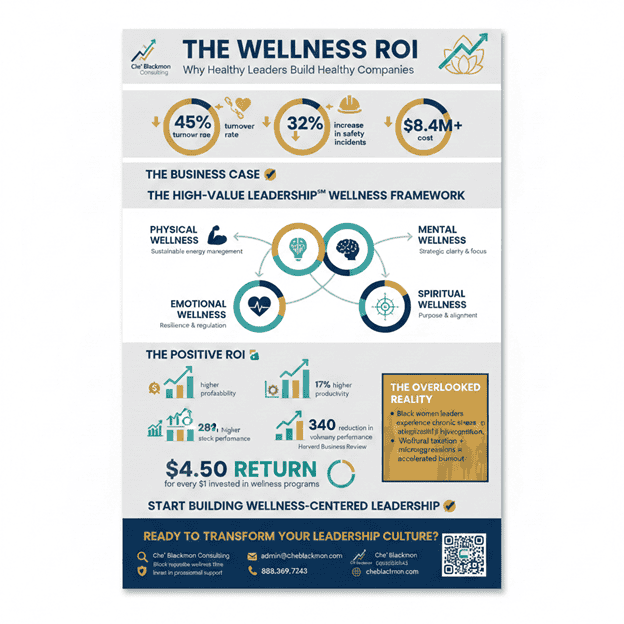
Here’s a truth many executives resist: your personal wellness directly impacts organizational performance. When leaders are depleted, disengaged, or running on fumes, their teams feel it. When leaders thrive, organizations flourish. The data is clear. Companies with healthy, engaged leaders see 21% higher profitability and 17% higher productivity than those led by burned out, chronically stressed executives.
Yet leadership wellness remains one of the most overlooked drivers of organizational success. This oversight is even more pronounced for traditionally overlooked leaders, particularly Black women executives who navigate unique stressors including cultural taxation, microaggressions, and the exhausting labor of being “the only one” in the room. The cost of ignoring leadership wellness? Billions in lost productivity, failed culture transformation initiatives, and talented leaders walking out the door.
The Hidden Cost of Unhealthy Leadership 📉💸
Leadership wellness isn’t a luxury. It’s a business imperative. When executives neglect their physical, mental, and emotional health, the consequences cascade throughout the organization in measurable ways.
Consider the manufacturing company where the executive team prided themselves on being “available 24/7” and working through weekends. On the surface, this looked like dedication. In reality, they were modeling unsustainable behaviors that employees replicated throughout the organization. Within eighteen months, the company faced turnover rates exceeding 45%, safety incidents increased by 32%, and employee engagement scores plummeted to the bottom quartile. The direct costs? Over $8.4 million in recruitment, training, workers’ compensation claims, and lost productivity.
The research backs this up. Studies show that stressed leaders make poorer decisions, struggle with emotional regulation, and create environments where psychological safety diminishes. Their teams experience higher rates of burnout, increased conflict, and decreased innovation. The irony? Leaders often believe they’re demonstrating commitment through self-sacrifice when they’re actually undermining the very outcomes they’re trying to achieve.
The Unique Burden for Traditionally Overlooked Leaders 🎯
For Black women in leadership, the wellness equation includes additional variables that many organizations fail to acknowledge. Research from the American Psychological Association reveals that Black women executives experience chronic stress at rates significantly higher than their white counterparts, driven by persistent workplace discrimination, lack of mentorship and sponsorship, and the pressure to represent an entire demographic while navigating predominantly white, male corporate spaces.
These leaders face what researchers call “John Henryism,” a pattern of high effort coping with chronic stressors that leads to accelerated wear and tear on the body and mind. They work twice as hard to receive half the recognition. They carry the invisible weight of being scrutinized more intensely, having their competence questioned more frequently, and managing the emotional labor of making others comfortable with their presence in leadership.
The cost is staggering. Not just to these talented leaders who deserve better, but to organizations losing brilliant minds, innovative thinking, and leadership capacity they desperately need. When companies ignore these realities, they lose not only individual leaders but entire communities of potential talent who see the burnout patterns and opt out before even entering the pipeline.
Understanding True Leadership Wellness 🧠❤️
Leadership wellness goes far beyond the absence of illness or the presence of a gym membership. It encompasses the complete integration of physical vitality, mental clarity, emotional resilience, and spiritual grounding that enables leaders to show up as their best selves consistently.
In my work developing High-Value Leadership frameworks, I’ve identified four critical dimensions that healthy leaders actively cultivate:
- Physical Wellness: Not just exercise, but sustainable energy management, quality sleep, proper nutrition, and the ability to recognize and respond to your body’s signals before they become crises.
- Mental Wellness: Cognitive capacity for strategic thinking, decision-making under pressure, creative problem-solving, and the mental spaciousness to see beyond immediate firefighting.
- Emotional Wellness: Self-awareness, emotional regulation, empathy, the ability to navigate difficult conversations, and resilience in the face of setbacks without bypassing genuine processing of challenges.
- Spiritual Wellness: Connection to purpose, alignment with values, meaning-making in work, and the capacity to maintain perspective during turbulent times.
These dimensions don’t exist in isolation. They interact and reinforce each other. A leader who consistently sleeps four hours a night will struggle with emotional regulation. An executive disconnected from their deeper purpose will find it difficult to inspire others authentically. Leaders who ignore their mental health needs will eventually hit walls that impact every aspect of their leadership effectiveness.
The Measurable ROI of Leader Wellness 📊✨
Let’s talk numbers because that’s the language that gets attention in boardrooms. Organizations that prioritize leadership wellness see returns that go straight to the bottom line.
Research from the Harvard Business Review demonstrates that companies with wellness-focused leadership development programs experience 28% higher stock performance over time compared to industry peers. Deloitte’s research shows organizations with strong wellness cultures report 11% higher revenue growth and are 2.5 times more likely to be high-performing organizations.
But the returns extend beyond financial metrics. There was a healthcare organization struggling with physician burnout rates exceeding 60%, threatening both patient care quality and accreditation status. When they implemented a comprehensive leadership wellness initiative starting with their C-suite and cascading through medical directors, the transformation was remarkable. Within two years, physician burnout dropped to 28%, patient satisfaction scores increased by 17 points, and medical error rates decreased by 41%. The financial impact? A positive ROI of $4.50 for every dollar invested in the wellness program.
The Ripple Effect on Organizational Culture 🌊
Healthy leaders create healthy cultures. When executives model sustainable work practices, prioritize recovery and renewal, and demonstrate vulnerability around their own wellness journeys, they give permission for everyone else to do the same.
Consider the technology company where the CEO openly shared their commitment to therapy, regular exercise, and unplugging on weekends. This transparency shifted the entire organizational narrative around wellness from weakness to wisdom. Middle managers felt empowered to set boundaries. Individual contributors stopped glorifying overwork. The company saw voluntary turnover drop by 34%, engagement scores rise to the 87th percentile, and innovation metrics improve significantly as people had the mental and emotional capacity to think creatively rather than simply react to constant urgency.
The data is unequivocal. Organizations with healthy leaders experience lower healthcare costs, reduced absenteeism, higher retention rates, stronger employer brands, and more resilient teams capable of navigating uncertainty without fracturing. These outcomes don’t happen by accident. They result from intentional choices that leaders make about how they steward their own wellness and model those practices throughout the organization.
Practical Strategies for Leadership Wellness 🔧💡
Understanding the importance of leadership wellness matters little without practical application. Here are evidence-based strategies that high-performing leaders use to maintain their wellness while driving organizational results.
Build Non-Negotiable Wellness Routines ⏰
Healthy leaders treat wellness activities with the same commitment they give to board meetings or strategic planning sessions. These aren’t items that get bumped when calendars fill up. They’re foundational practices that enable everything else.
Start with sleep. Research consistently shows that leaders who prioritize seven to eight hours of quality sleep demonstrate better judgment, improved emotional regulation, and enhanced creative problem-solving. Block your sleep schedule like you block meeting time. Protect it fiercely.
Movement matters. This doesn’t require marathon training or extreme fitness regimens. It means regular physical activity that gets your heart rate up, reduces stress hormones, and clears mental fog. Whether it’s walking, swimming, dancing, or strength training, find what you enjoy and do it consistently. Schedule it. Show up for it. Model it for your team.
Mindfulness and meditation practices offer another powerful tool. Even ten minutes daily of focused breathing, meditation, or mindful reflection can significantly reduce stress, improve focus, and enhance decision-making capacity. Leaders who maintain these practices report greater clarity, better emotional regulation, and improved ability to stay present during challenging conversations.
Create Boundaries That Serve You and Your Organization 🛡️
Boundaries aren’t barriers to productivity. They’re enablers of sustainable high performance. Leaders who establish and maintain clear boundaries around their time, energy, and availability create space for recovery, reflection, and renewal.
This means learning to say no strategically. Not every meeting requires your presence. Not every decision needs your input. Not every crisis demands your personal intervention. Trust your team. Delegate meaningfully. Create space in your calendar for deep work, strategic thinking, and restoration.
Technology boundaries matter too. The expectation of constant availability destroys wellness and models unsustainable practices for your entire organization. Establish clear communication protocols. Define true emergencies versus things that can wait. Turn off notifications during focused work time and personal time. Your team will adapt, and they’ll appreciate the permission to do the same.
Invest in Professional Support 🤝
High-performing athletes have coaches, trainers, nutritionists, and sports psychologists supporting their performance. Why should high-performing leaders be any different? Professional support isn’t admission of weakness. It’s strategic investment in your most important asset: yourself.
Therapy and counseling provide invaluable support for processing stress, developing emotional intelligence, and maintaining mental health. Executive coaching offers outside perspective, accountability, and strategic guidance for both professional development and personal wellness. Peer support groups connect you with other leaders navigating similar challenges, reducing isolation and providing community.
For Black women leaders especially, finding culturally competent support makes a significant difference. Therapists, coaches, and mentors who understand the unique challenges of navigating corporate spaces as a Black woman can provide validation, strategies, and support that generic programs miss entirely. Don’t settle for support that doesn’t truly see and understand your experience.
Cultivate Authentic Connection and Community 👥💖
Leadership can be lonely, particularly at senior levels. Isolation erodes wellness, increases stress, and limits perspective. Intentionally building and maintaining authentic connections becomes essential for sustained leadership effectiveness.
This includes personal relationships outside of work that remind you of your identity beyond your title. Friendships that have nothing to do with business deals or networking. Family time that’s truly present and engaged. Community involvement that connects you to purpose larger than quarterly earnings.
It also means fostering genuine connection within your professional sphere. Building relationships with peers based on mutual support rather than competition. Creating space for vulnerable conversations about the real challenges of leadership. Finding or creating communities where you can be fully yourself without performance or pretense.

Building Organizational Systems That Support Leader Wellness 🏢🌟
Individual leader wellness practices matter, but they’re not enough. Organizations must create systems and structures that support rather than undermine leadership wellness.
Redesign How Leadership Work Gets Done 🔄
Many organizations structure leadership roles in ways that guarantee burnout. Unrealistic spans of control, constant context switching, back-to-back meetings with no processing time, expectation of immediate responses to all communications. These aren’t signs of importance. They’re design flaws.
Organizations serious about leader wellness audit how leadership work actually happens. They examine meeting cultures and eliminate wasteful gatherings. They create focused time blocks for strategic thinking. They establish communication protocols that respect recovery time. They distribute decision-making authority so everything doesn’t bottleneck at the top.
One professional services firm reduced executive meetings by 40% through rigorous evaluation of whether gatherings actually required executive presence or could be handled differently. They implemented “focus Fridays” where no meetings were scheduled, giving leaders uninterrupted time for deep work. Within six months, leader satisfaction scores increased by 31%, and strategic initiative completion rates improved by 27%.
Make Wellness Part of Leadership Development 📚
Leadership development programs typically focus on strategy, finance, operations, and people management. Rarely do they address the personal sustainability required to lead effectively over time. This gap sets leaders up for failure.
Progressive organizations integrate wellness into leadership development from the start. They teach new leaders about energy management, stress physiology, and the neuroscience of decision-making. They provide training on emotional intelligence, self-awareness, and resilience building. They normalize conversations about mental health, work-life integration, and sustainable performance.
This proves particularly critical for developing diverse leadership pipelines. When organizations equip Black women and other traditionally overlooked leaders with not just technical skills but also tools for managing the unique stressors they face, retention and advancement improve dramatically. Development programs that acknowledge and address these realities, rather than pretending everyone faces identical challenges, create pathways for diverse talent to not just survive but thrive in leadership roles.
Measure and Reward Sustainable Leadership 📈
What gets measured gets managed. What gets rewarded gets repeated. If organizations want healthy leadership, they must measure wellness indicators and build them into performance evaluation and compensation systems.
This includes tracking leader burnout indicators, team engagement scores, voluntary turnover rates in leader’s organizations, and sustainability metrics like vacation usage and reasonable working hours. It means evaluating leaders not just on what results they achieve but how they achieve them. Leaders who drive results through unsustainable practices that burn out their teams should not be rewarded the same as leaders who deliver outcomes while building healthy, engaged, resilient teams.
Recognition and advancement criteria should explicitly include modeling healthy leadership practices. Taking vacation time should be celebrated, not stigmatized. Setting boundaries should be seen as mature leadership, not lack of commitment. Leaders who invest in their wellness and create cultures where others can do the same deserve promotion over those who achieve short-term gains through long-term destructive practices.
The Future of Leadership Wellness 🚀🔮
The pandemic fundamentally shifted conversations about work, wellness, and sustainability. Leaders who emerged from that crucible understand that the old playbook of sacrificing health for results no longer works, if it ever truly did. The future belongs to organizations that integrate wellness into their leadership DNA.
We’re seeing emergence of predictive analytics that identify burnout risk before it becomes crisis. AI-powered tools that help leaders optimize their schedules for energy and effectiveness rather than simply cramming in maximum commitments. Virtual reality applications for stress management and mindfulness practice. Wearable technology that provides real-time biofeedback on stress physiology.
But technology alone won’t solve this. The real shift requires cultural transformation that values human sustainability as much as quarterly performance. It demands courage from leaders to model different ways of working. It necessitates organizations making hard choices to support leader wellness even when it conflicts with short-term convenience or traditional expectations.
For organizations committed to diversity, equity, and inclusion, leader wellness must be a central component of those efforts. You cannot build truly inclusive cultures while ignoring the disproportionate wellness burdens placed on Black women and other marginalized leaders. Real DEI work addresses not just representation but also the conditions that enable diverse leaders to sustain their careers and thrive long-term.
The Investment That Pays Dividends 💰🌈
Leadership wellness isn’t self-indulgence. It’s strategic imperative. The leaders who will navigate the complexity and uncertainty ahead are those who have cultivated the physical vitality, mental clarity, emotional resilience, and spiritual grounding to sustain themselves and their teams through whatever comes.
Organizations that invest in leadership wellness see measurable returns in every metric that matters: financial performance, employee engagement, innovation capacity, retention rates, and competitive positioning. They build cultures where people want to work, not just because of what they do but because of how they do it.
The question isn’t whether your organization can afford to prioritize leadership wellness. The question is whether you can afford not to. Because the leaders you’re burning out today are the ones you’ll desperately need tomorrow. The culture you’re creating through unsustainable leadership practices today will determine whether you can attract and retain the talent you need to compete in the future.
Healthy leaders build healthy companies. It’s time we started acting like we believe it.
Reflection Questions for Your Leadership Team 💭🗣️
- What leadership wellness practices are we currently modeling, and what message do those practices send to our organization?
- How do our organizational systems and structures support or undermine leadership sustainability?
- What wellness burdens do our traditionally overlooked leaders carry that we haven’t acknowledged or addressed?
- If we measured the ROI of our current leadership wellness investments, what would the numbers reveal?
- What would need to change in our culture for sustainable leadership practices to become the norm rather than the exception?
- How are we integrating wellness into our leadership development programs and succession planning?
- What specific commitments are we willing to make as a leadership team to prioritize our own wellness and model healthy practices?
Next Steps: Building Your Wellness-Centered Leadership Culture 🎯
For Individual Leaders:
- Conduct a personal wellness audit across all four dimensions: physical, mental, emotional, and spiritual. Identify your biggest gaps and commit to one actionable change in each area.
- Schedule non-negotiable wellness activities in your calendar for the next month and protect them as fiercely as you protect board meetings.
- Identify one boundary you need to establish or reinforce to protect your wellness and communicate it clearly to your team this week.
- Research and reach out to at least three professional support resources (therapist, coach, peer group) that could support your wellness journey.
For Organizations:
- Assess your current leadership wellness initiatives. Are they cosmetic (fruit baskets) or substantive (systemic support)? Identify gaps and develop a comprehensive strategy.
- Audit how leadership work actually gets done in your organization. Where are the design flaws that guarantee burnout? Create an action plan to address the top three.
- Review your leadership development programs and performance evaluation criteria. Are you teaching and rewarding sustainable leadership or inadvertently promoting destructive practices?
- Establish baseline wellness metrics for your leadership team and set targets for improvement. Include these in your organizational scorecard alongside traditional performance measures.
- Specifically examine the wellness burdens placed on your traditionally overlooked leaders. Develop targeted support systems that address their unique challenges rather than pretending one size fits all.
Partner with Che’ Blackmon Consulting 🤝✨
Building a wellness-centered leadership culture requires more than good intentions. It demands strategic expertise, proven frameworks, and ongoing support. At Che’ Blackmon Consulting, we specialize in helping organizations transform their leadership cultures through our proprietary High-Value Leadership methodology.
Our fractional HR and culture transformation services include:
- Leadership wellness assessments and strategic planning
- Culture transformation initiatives that prioritize sustainable leadership
- AI-powered predictive analytics for identifying wellness risks before they become crises
- Executive coaching for sustainable high performance
- Leadership development programs that integrate wellness from the ground up
- Specialized support for organizations committed to creating environments where traditionally overlooked leaders thrive
Whether you’re a small business looking to build a healthy leadership culture from the start or an established organization ready to transform unsustainable practices, we have solutions tailored to your needs.
Ready to Build Healthier Leadership? 🌟
Let’s talk about creating a leadership wellness strategy that drives real results.
📧 admin@cheblackmon.com
📞 888.369.7243
🌐 cheblackmon.com
—
Che’ Blackmon, DBA Candidate, is the Founder & CEO of Che’ Blackmon Consulting, a fractional HR and culture transformation consultancy serving organizations across Michigan and beyond. With over 24 years of progressive HR leadership experience, she specializes in helping companies build High-Value Cultures where leaders and teams thrive sustainably. She is the author of “High-Value Leadership: Transforming Organizations Through Purposeful Culture,” “Mastering a High-Value Company Culture,” and “Rise & Thrive: A Black Woman’s Blueprint for Leadership Excellence.”
#LeadershipWellness #ExecutiveHealth #HighValueLeadership #OrganizationalCulture #LeadershipDevelopment #WellnessROI #SustainableLeadership #BlackWomenLeaders #DiversityAndInclusion #CultureTransformation #ExecutiveCoaching #LeadershipExcellence #WorkplaceWellbeing #HealthyLeadership #CorporateWellness #InclusiveLeadership #LeadershipMindset #OrganizationalWellness #ProfessionalDevelopment #LeadershipMatters
