

📚 By Che’ Blackmon, DBA Candidate | Founder & CEO, Che’ Blackmon Consulting
🎯 Introduction: The Quarter Is Ending. Is Your Culture on Track?
As we approach the end of the first quarter, leaders everywhere are reviewing financial targets, sales pipelines, and operational dashboards. But how many are pausing to evaluate something equally critical: the health of their organizational culture? Culture is not a static initiative that launches once and runs on autopilot. It is a living, breathing ecosystem that requires consistent attention, honest assessment, and intentional recalibration.
In Mastering a High‑Value Company Culture, I explored the foundational truth that culture is the lifeblood of any organization. It summarizes the values, beliefs, attitudes, and behaviors that define the environment where people work. When leaders invest in culture strategically, organizations see measurable returns: higher engagement, stronger retention, accelerated innovation, and improved customer satisfaction. When they neglect it, even the most talented teams begin to fracture.
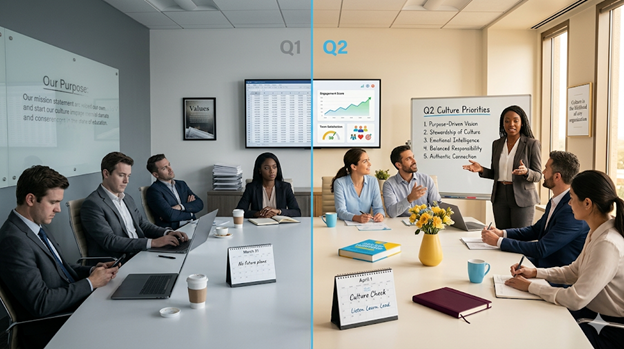
The transition from Q1 to Q2 presents a natural inflection point. Goals have been tested against reality. Team dynamics have been stress tested. And the patterns that will define your culture for the rest of the year are already forming. This is the ideal moment to conduct a deliberate culture check, not to assign blame or generate anxiety, but to ensure your organization is building on a foundation of purpose, trust, and shared accountability.
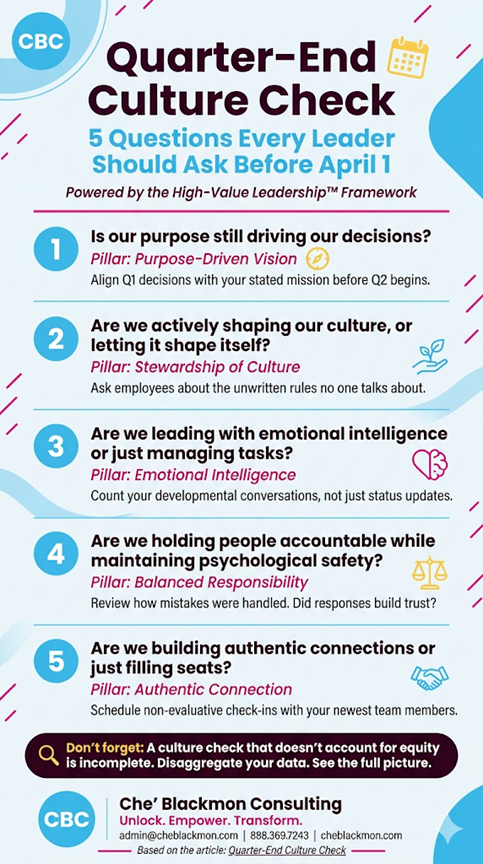
The five questions outlined below are drawn from the High‑Value Leadership™ framework, which I introduced in High‑Value Leadership: Transforming Organizations Through Purposeful Culture. Each question aligns with one of the five pillars of that framework: Purpose‑Driven Vision, Stewardship of Culture, Emotional Intelligence, Balanced Responsibility, and Authentic Connection. Together, they offer a practical and thorough lens for evaluating where your culture stands today and where it needs to go tomorrow.
❓ Question 1: Is Our Purpose Still Driving Our Decisions?
Pillar: Purpose‑Driven Vision
Every organization begins the year with a stated mission, a set of strategic objectives, and a vision for where it wants to be. But by March, something subtle often happens. The day to day operational pressure begins to overshadow the “why” behind the work. Decisions that should be guided by mission and values start to be driven by urgency, convenience, or simply “the way things have always been done.”
In High‑Value Leadership, I describe Purpose‑Driven Vision as the leader’s ability to birth and deliver a strong “why” that inspires action. Simon Sinek’s enduring insight that organizations must “start with why” remains one of the most relevant leadership principles of our time. When that “why” fades from daily decision making, culture begins to drift.
There was a mid‑size manufacturing company that opened the year with an ambitious employee engagement strategy. Their stated purpose was to create a workplace where every associate felt valued and empowered to contribute ideas. By mid‑March, leadership meetings had become consumed by production metrics and cost reduction targets, with no time reserved for engagement updates or employee feedback review. Purpose had been replaced by pressure.
💡 Actionable Takeaway:
Before Q2 begins, schedule a 30 minute leadership alignment session focused solely on this question: “Does our most recent major decision reflect our stated purpose?” If the answer is unclear or uncomfortable, it is a signal to recalibrate. Review your mission statement alongside your Q1 decisions and look for alignment gaps.
❓ Question 2: Are We Actively Shaping Our Culture, or Letting It Shape Itself?
Pillar: Stewardship of Culture
One of the most consequential truths in organizational development is this: culture will form whether you design it intentionally or not. In the absence of deliberate shaping, culture defaults to the behaviors that are tolerated, the narratives that go unchallenged, and the values that are modeled (or contradicted) by those in power.
In Mastering a High‑Value Company Culture, I wrote extensively about the contrast between leaders who actively steward their culture and those who allow it to evolve unchecked. I shared the story of two operations managers at the same plant: one who embodied high‑value leadership through consistency, respect, and clear communication; and another whose passive aggressive behaviors and misaligned incentives eroded trust across the organization. Both were technically competent. But only one built a culture worth working in.
A recent Gallup study confirms that manager behavior is the single most significant factor in employee engagement, accounting for up to 70% of the variance in team engagement scores. This means that culture is not shaped by posters on the wall or values listed on a website. It is shaped by what leaders do every day.
For traditionally overlooked populations, particularly Black women in corporate spaces, the absence of intentional culture stewardship has outsized consequences. In Rise & Thrive: A Black Woman’s Blueprint for Leadership Excellence, I highlighted the reality that Black women hold just 4% of C‑suite positions and 1.4% of executive and senior level roles in Fortune 500 companies. When culture is left unmanaged, the biases, microaggressions, and inequities that already exist tend to deepen rather than diminish. Intentional stewardship is not optional; it is the difference between inclusion as a value and inclusion as a practice.
💡 Actionable Takeaway:
Conduct a brief “culture audit” by asking three to five employees at different levels this question: “What is one unwritten rule in our organization that everyone knows but no one talks about?” The answers will reveal the gap between your intended culture and your actual culture. Address the most common themes in a transparent leadership communication before Q2 kicks off.
❓ Question 3: Are We Leading with Emotional Intelligence or Just Managing Tasks?
Pillar: Emotional Intelligence
The pace of Q1 often rewards task completion over human connection. Leaders who began the year with intentions of checking in with their teams, offering mentorship, and creating space for honest dialogue may find that those commitments quietly slipped away as deadlines intensified. When this happens, leaders are not leading; they are simply managing.
Daniel Goleman’s foundational research on emotional intelligence demonstrates that self‑awareness, empathy, and relational management are not “soft” skills; they are critical leadership competencies that directly impact team performance and organizational outcomes. In High‑Value Leadership, I positioned Emotional Intelligence as a core pillar because I have seen, across more than two decades in manufacturing, automotive, healthcare, nonprofit, and professional services environments, that the leaders who create lasting cultural impact are those who understand people as deeply as they understand processes.
There was a healthcare organization that struggled with high turnover among frontline staff. When leadership finally conducted exit interviews with genuine curiosity rather than defensiveness, a pattern emerged: employees did not feel “heard.” They had raised concerns about scheduling fairness, workload distribution, and recognition, but leadership had treated these as operational issues rather than emotional ones. When the incoming director began holding monthly listening sessions with no agenda other than understanding, turnover dropped by nearly 20% within two quarters.
This matters acutely for professionals who are already navigating invisible workloads. In Rise & Thrive, I discussed the concept of “double jeopardy” that Black women face in professional settings: the cognitive and emotional labor required to manage both racial and gender bias while simultaneously performing at the highest level. Leaders who lack emotional intelligence often fail to see this additional burden, which means they also fail to create the conditions under which all employees, not just the most visible ones, can thrive.
💡 Actionable Takeaway:
Before April 1, send your leadership team a one‑question self assessment: “In the past 90 days, how many one on one conversations have I had with my direct reports that focused on their development, concerns, or career aspirations rather than status updates?” If the number is low, prioritize building human connection into your Q2 leadership rhythm. Consider adopting a structured monthly check in template that includes at least one question about well being and professional growth.
❓ Question 4: Are We Holding People Accountable While Maintaining Psychological Safety?
Pillar: Balanced Responsibility
Accountability without safety creates fear. Safety without accountability creates complacency. High‑value leaders understand that both must coexist for a culture to be truly effective.
Amy Edmondson’s research on psychological safety, which has become one of the most cited frameworks in organizational science, shows that the highest performing teams are those where members feel safe to take risks, admit mistakes, and raise concerns without fear of punishment. At the same time, Patty McCord’s work in Powerful reminds us that maintaining high standards is not the enemy of a healthy culture; it is a prerequisite for one.
In High‑Value Leadership, I described Balanced Responsibility as the ability to maintain high standards while cultivating an environment that feels psychologically safe. This is one of the most difficult leadership balances to strike, particularly in high‑pressure industries like manufacturing and automotive where results are measured in real time and margins for error are slim.
There was a quick‑service organization that had built a reputation for operational excellence, but employee satisfaction scores were consistently low. The root cause was not the standards themselves; it was how they were enforced. Mistakes were met with public correction rather than private coaching. Employees learned to hide problems rather than surface them. When the leadership team shifted to a model of accountable coaching, where expectations remained high but feedback was delivered with respect and developmental intent, both performance metrics and engagement scores improved simultaneously.
For Black women and other traditionally overlooked professionals, the absence of psychological safety is not merely uncomfortable; it is career limiting. When the cost of speaking up is perceived to be higher than the cost of staying silent, organizations lose access to perspectives that could drive innovation, prevent errors, and strengthen decision making.
💡 Actionable Takeaway:
Ask your leadership team to evaluate the last three instances where an employee made a mistake or raised a concern. How was each situation handled? Were responses consistent across levels and demographics? Use this review to identify whether your accountability practices are building trust or eroding it. If patterns of inequity emerge, address them directly in Q2 leadership development programming.
❓ Question 5: Are We Building Authentic Connections or Just Filling Seats?
Pillar: Authentic Connection
The final question in this quarter‑end culture check may be the most telling. Are the relationships within your organization real, or are they transactional? Do leaders know their people, or do they simply know their people’s output?
John Maxwell’s principle that “people don’t care how much you know until they know how much you care” is not a motivational platitude. It is supported by decades of research linking relational trust to organizational performance. In High‑Value Leadership, I identified Authentic Connection as the fifth pillar because it is the element that gives the other four pillars their staying power. Purpose without connection is just a slogan. Accountability without connection feels punitive. Emotional intelligence without connection becomes performative.
There was an automotive supplier that invested heavily in diversity hiring, successfully increasing representation at the mid management level. However, within 18 months, a significant portion of newly hired diverse leaders had left the organization. Exit data revealed a consistent theme: they did not feel a sense of belonging. They had been recruited but not integrated. Their managers had not invested in building genuine relationships with them, and mentorship or sponsorship opportunities were largely extended through informal networks that favored those who already “fit in.”
In Rise & Thrive, I addressed this challenge directly, noting that Black women who attain leadership positions often face what researchers call the “glass cliff” phenomenon, being promoted into high‑risk roles during times of organizational crisis while simultaneously lacking the relational support systems that their peers take for granted. Authentic connection is the antidote to this isolation. It is what transforms diversity from a metric into a lived experience.
💡 Actionable Takeaway:
Before Q2 begins, identify three employees who have been with your organization for less than one year, particularly those from historically underrepresented backgrounds. Schedule a casual, non evaluative conversation with each of them. Ask about their onboarding experience, whether they feel connected to their team, and what would make them want to stay long term. Use these insights to inform your retention and engagement strategies for the remainder of the year.
🔍 The Overlooked Factor: Why Culture Checks Must Center Equity
A quarter‑end culture check that does not account for equity is incomplete. Organizations often measure culture through aggregate engagement scores and satisfaction surveys, but these tools can mask significant disparities in experience across demographics.
McKinsey’s 2024 “Women in the Workplace” report continues to document that women of color, and Black women in particular, report markedly different workplace experiences than their white counterparts. They are more likely to have their competence questioned, to feel isolated from social networks, and to experience being the “only one” in meetings and decision making spaces. These experiences do not show up in company wide averages, but they are defining the culture for a significant portion of your workforce.
In my consulting practice with Che’ Blackmon Consulting, I work with organizations to disaggregate their culture data by demographic groups so they can see the full picture. The results are often eye opening. An organization that believes its culture is strong may discover that the experience is vastly different depending on who you ask. This kind of insight is not a reason for discouragement; it is a roadmap for targeted, meaningful improvement.
As I wrote in Rise & Thrive, “It is not our differences that divide us. It is our inability to recognize, accept, and celebrate those differences.” A truly high‑value culture does not simply tolerate diversity; it actively creates the conditions under which every person, regardless of background, can contribute fully and be recognized for that contribution.
📈 Current Trends Reinforcing the Need for Culture Accountability
Several trends in the current business environment make this quarter‑end culture check more urgent than ever.
The Return to Office Debate: As more organizations mandate or encourage in‑person work, leaders must be especially attentive to how these transitions impact different groups. Employees with caregiving responsibilities, those with disabilities, and professionals who found that remote work reduced their exposure to microaggressions all experience these transitions differently. A culture check should include questions about whether return to office policies are being implemented equitably.
AI and Workforce Transformation: The rapid adoption of artificial intelligence is reshaping job roles, creating anxiety about displacement, and demanding new skills. Leaders who are not proactively communicating about AI’s impact on their workforce are allowing fear and misinformation to fill the vacuum. Culture checks should assess whether employees feel informed and supported as technology reshapes their work.
The Evolving DEI Landscape: Regardless of where your organization stands on the broader societal conversation about diversity, equity, and inclusion, the internal expectation from employees, particularly those from marginalized communities, has not diminished. A 2025 Pew Research Center study found that the majority of workers still believe their employers should be doing more to promote fairness and inclusion in the workplace. Leaders who treat equity as a trend rather than a value risk losing the trust and talent of their most underrepresented team members.
Mental Health and Well Being: The World Health Organization’s recognition of burnout as an occupational phenomenon has prompted organizations to rethink how they support employee well being. A quarter‑end culture check should include an honest assessment of whether leadership is modeling sustainable work habits and whether mental health resources are accessible, not just available.
📋 Quick Reference: Your Q1 Culture Check Summary
Question 1 (Purpose‑Driven Vision): Is our purpose still driving our decisions?
Question 2 (Stewardship of Culture): Are we actively shaping our culture, or letting it shape itself?
Question 3 (Emotional Intelligence): Are we leading with emotional intelligence or just managing tasks?
Question 4 (Balanced Responsibility): Are we holding people accountable while maintaining psychological safety?
Question 5 (Authentic Connection): Are we building authentic connections or just filling seats?
💬 Discussion Questions for Your Leadership Team
Use these questions to facilitate a leadership roundtable, strategy meeting, or team development session as you transition into Q2:
1. If a new employee joined your team today, what would they observe about your culture within the first week? Would that observation align with your values statement?
2. Which voices in your organization are consistently present in decision making conversations, and which are absent? What is the impact of that imbalance?
3. Think about a recent mistake made by someone on your team. How was it handled? Did the response build trust or diminish it?
4. What is one “unwritten rule” in your organization that may be undermining your stated values?
5. How are you personally investing in the development and belonging of someone who does not look like you, think like you, or come from the same background as you?
6. If you disaggregated your engagement data by race, gender, tenure, and level, what story would that data tell? Have you looked?
✅ Next Steps: Moving from Reflection to Action
Reflection without action is just conversation. Here are concrete steps you can take before the first week of Q2:
Week 1: Conduct a leadership alignment session using the five questions above. Document where your culture is strong and where it needs attention.
Week 2: Gather employee perspectives through listening sessions, anonymous surveys, or skip‑level conversations. Prioritize hearing from historically underrepresented team members.
Week 3: Identify two to three specific culture commitments for Q2. Assign ownership, define success metrics, and communicate them transparently to the organization.
Week 4: Begin implementing your Q2 culture plan and schedule a mid‑quarter check in to assess progress.
📚 Further Reading from Che’ Blackmon
For a deeper exploration of the concepts discussed in this article, the following resources from Che’ Blackmon offer comprehensive frameworks, real world examples, and actionable strategies:
Mastering a High‑Value Company Culture — A practical guide to building, maintaining, and evolving the culture that defines your organization’s success.
High‑Value Leadership: Transforming Organizations Through Purposeful Culture — An in‑depth exploration of the five pillars of High‑Value Leadership™ and how they drive lasting cultural transformation.
Rise & Thrive: A Black Woman’s Blueprint for Leadership Excellence — A strategic guide designed for Black women navigating corporate leadership with authenticity, resilience, and purpose.
🚀 Ready to Transform Your Culture? Let’s Talk.
Whether you are navigating a cultural transition, preparing for growth, or seeking to create an environment where every employee can contribute fully, Che’ Blackmon Consulting offers fractional HR leadership and culture transformation services tailored to your organization’s unique needs.
With over 24 years of progressive HR leadership spanning manufacturing, automotive, healthcare, nonprofit, quick‑service, and professional services industries, Che’ Blackmon brings a practitioner’s depth and a scholar’s rigor to every engagement.
📧 admin@cheblackmon.com
📞 888.369.7243
© 2026 Che’ Blackmon Consulting. All rights reserved.
High‑Value Leadership™ is a trademark of Che’ Blackmon Consulting.
#HighValueLeadership #CultureTransformation #HRLeadership #OrganizationalCulture #LeadershipDevelopment #QuarterEndReview #FractionalHR #InclusiveLeadership #BlackWomenLead #WorkplaceCulture #EmployeeEngagement #CheBlackmonConsulting #PurposeDrivenLeadership #PsychologicalSafety #DEI #TalentRetention #CultureMatters #HRStrategy #AuthenticLeadership #LeadershipCoaching