


By Che’ Blackmon, DBA Candidate | Founder & CEO, Che’ Blackmon Consulting
cheblackmon.com
🎯 Introduction: The Promise and the Peril
Artificial intelligence is no longer a futuristic concept reserved for tech companies and science fiction. It is here, embedded in the tools HR professionals use every single day. From screening resumes to predicting employee turnover, AI is reshaping how organizations find, develop, and retain talent. The question is no longer whether AI will transform human resources. The question is whether we will allow it to transform human resources ethically.
That distinction matters more than most leaders realize. When implemented thoughtfully, AI can reduce administrative burdens, surface hidden talent, and create more equitable workplaces. When deployed carelessly, it can amplify the very biases it was supposed to eliminate, silently filtering out qualified candidates and reinforcing systemic inequities that have plagued corporate spaces for decades.
In my book Mastering a High‑Value Company Culture, I wrote that culture is the lifeblood of any organization. Technology does not replace that lifeblood. It either strengthens it or it poisons it. There is no neutral ground. Every algorithm, every automated workflow, and every AI powered decision reflects the values of the people and systems that created it. As HR leaders, we must ensure those values align with the high‑value cultures we are working so hard to build.
This article explores the ethical dimensions of AI in HR, examines how these technologies disproportionately affect traditionally overlooked populations (most specifically Black women in corporate spaces), and provides actionable strategies for leveraging AI as a tool for empowerment rather than exclusion.

🤖 The Current Landscape: AI in HR by the Numbers
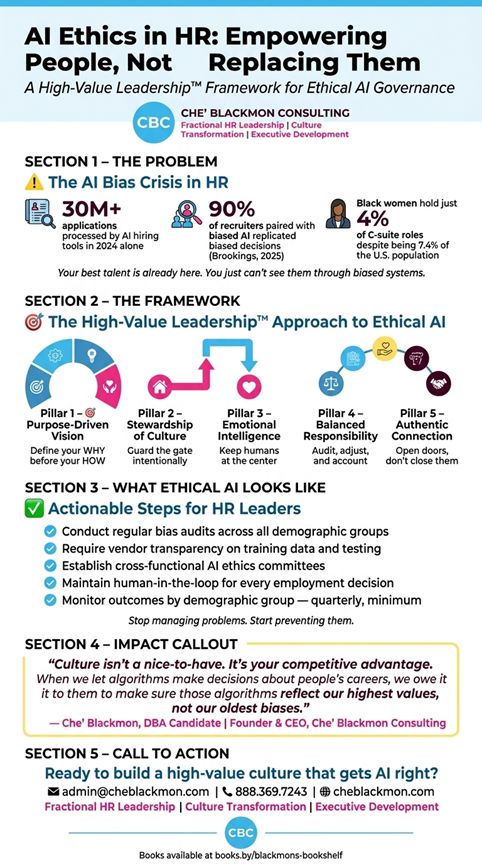
The adoption of AI in human resources has accelerated dramatically. Over half of U.S. companies now invest in AI based recruiting tools, and AI powered hiring platforms processed over 30 million applications in 2024 alone. These systems handle resume screening, candidate scoring, interview scheduling, employee engagement analytics, and even performance prediction.
The regulatory landscape is shifting just as quickly. New York City’s Local Law 144 requires annual independent bias audits for automated employment decision tools. California’s Civil Rights Council regulations, effective since October 2025, make it unlawful to use automated decision systems that discriminate based on protected characteristics. The Colorado AI Act, taking effect in June 2026, mandates rigorous impact assessments for high risk AI systems. Illinois House Bill 3773, effective January 2026, requires employers to notify candidates whenever AI is used in employment decisions.
The message from legislators is clear: the era of unregulated AI in employment is over. And for those of us in HR leadership, this is not a threat. It is a call to lead.
⚠️ The Hidden Danger: When Algorithms Inherit Our Biases
Here is a truth that many technology vendors would rather not discuss openly. AI systems are only as fair as the data they are trained on. When that training data reflects decades of discriminatory hiring patterns, the resulting algorithms do not eliminate bias. They automate it. They scale it. And they give it a veneer of objectivity that makes it even harder to challenge.
Consider the widely cited case of a major technology company that developed an AI recruiting tool only to discover it systematically penalized resumes containing the word “women’s” (as in “women’s basketball team” or “women’s leadership council”). The tool had been trained on ten years of hiring data that reflected a predominantly male workforce, and it learned to replicate that pattern with ruthless efficiency.
Research published in PNAS Nexus in 2025 brought even more troubling findings to light. A large scale experiment evaluating five leading AI models found that these systems systematically disadvantaged Black male applicants even when qualifications were identical to other candidates. Separate Stanford research discovered that AI resume screening tools gave older male candidates higher ratings than both female and younger candidates when all resumes were generated from the same underlying data.
A 2025 Brookings Institution study revealed something equally concerning: when human recruiters collaborated with racially biased AI models, they could not adequately identify or mitigate the bias that had seeped into their own decision making. In scenarios where the AI reinforced stereotypes favoring white candidates for high status roles, respondents selected majority white candidates over 90% of the time. The AI did not just make biased decisions on its own. It contaminated the judgment of the humans working alongside it.
“A faster biased decision is still a biased decision.” This reality demands that HR leaders approach AI adoption with both enthusiasm and vigilance.
👑 The Overlooked Impact: Black Women in the Algorithm’s Blind Spot
The conversation about AI bias in HR cannot be complete without addressing how these systems uniquely affect those who have been historically marginalized. Black women in corporate spaces experience what scholars call “double jeopardy,” navigating bias related to both race and gender simultaneously. When AI systems enter the equation, that jeopardy can multiply.
In Rise & Thrive: A Black Woman’s Blueprint for Leadership Excellence, I wrote extensively about how Black women hold just 4% of C‑suite positions, 1.6% of VP roles, and 1.4% of executive or senior level positions in Fortune 500 companies despite making up approximately 7.4% of the U.S. population. These numbers are not the result of insufficient ambition or inadequate qualifications. They are the product of systemic barriers including hiring bias, limited access to influential networks, and workplace cultures that were never designed with Black women in mind.
Now imagine layering AI on top of these existing disparities. When an algorithm is trained on historical hiring data from an organization that has rarely promoted Black women into senior roles, what pattern does it learn? It learns to replicate that exclusion. It learns that the “ideal candidate” looks, sounds, and presents like the people who have historically held those roles. It penalizes difference rather than recognizing it as the leadership asset it truly is.
There was a company that implemented an AI driven performance evaluation system intended to create more objectivity in its promotion process. On the surface, the system appeared race and gender neutral. But the metrics it prioritized (executive visibility scores, cross functional project leadership, and senior sponsor endorsements) were all areas where Black women consistently had less access due to existing structural inequities. The algorithm did not create new bias. It codified the old bias into a system that now appeared scientifically validated.
As I emphasized in High‑Value Leadership: Transforming Organizations Through Purposeful Culture, authentic leadership means bringing your whole self to your role. When AI systems implicitly reward conformity to a narrow professional prototype, they penalize the very authenticity that makes diverse leadership transformative. Code switching excellence, pattern recognition born from navigating bias, crisis management expertise developed through lived experience: these are leadership superpowers that no algorithm currently knows how to measure or value.
✅ Empowerment Over Replacement: The High‑Value Approach to AI
So how do we get this right? The answer lies in a principle I have built my entire consulting practice around: people first, always. In Mastering a High‑Value Company Culture, I wrote that employees are not resources; they form the lifeblood of your organization. That truth does not change because a new technology has arrived. If anything, it becomes more important.
A High‑Value approach to AI in HR rests on five pillars that mirror the High‑Value Leadership™ framework:
🎯 1. Purpose Driven Vision: Define Your “Why” Before Your “How”
Before selecting any AI tool, organizations must articulate why they are adopting it and whose interests it serves. Is the goal to process applications faster, or is it to ensure every qualified candidate receives fair consideration? These are fundamentally different objectives that lead to fundamentally different outcomes. Purpose driven AI adoption starts with asking what kind of culture you are trying to build, not what kind of efficiency you are trying to gain.
🏠 2. Stewardship of Culture: Guard the Gate Intentionally
HR leaders are the stewards of organizational culture. That stewardship now extends to the digital tools that shape employee experiences. Every AI system should be evaluated through a cultural lens: Does this tool align with our stated values? Does it support the inclusive environment we are building? Does it treat every candidate and employee with the dignity they deserve? Stewardship means refusing to implement technology simply because it is available and instead demanding that it meets the standard of the culture you are cultivating.
❤️ 3. Emotional Intelligence: Keep Humans at the Center
AI excels at processing data. It does not understand context, nuance, or the human stories behind the numbers. A resume gap might represent a caregiving responsibility, a health challenge, or a period of entrepreneurial pursuit. An unconventional career path might reflect extraordinary adaptability. Emotional intelligence in AI governance means ensuring that human judgment remains the final authority on decisions that shape people’s lives and livelihoods.
⚖️ 4. Balanced Responsibility: Audit, Adjust, and Account
Balanced responsibility requires organizations to take ownership of the outcomes their AI systems produce. This means conducting regular bias audits across demographic groups, maintaining transparency about when and how AI is used, and creating accessible channels for candidates and employees to challenge automated decisions. Leading organizations are establishing cross functional AI ethics committees that include HR, legal, technology, and employee representatives to provide ongoing oversight.
🤝 5. Authentic Connection: Technology Should Open Doors, Not Close Them
The ultimate measure of any AI system in HR is whether it expands opportunity or narrows it. Authentic connection means using technology to reach candidates who might otherwise be overlooked, to surface talent from non traditional backgrounds, and to create pathways that have not existed before. When AI is deployed in service of authentic connection, it becomes a tool for building the diverse, dynamic, purpose driven organizations that our workplaces so desperately need.
📋 Practical Case Studies: Lessons from the Field
🟢 Case Study 1: The Resume Screen That Screened Out Talent
A midsize manufacturing company implemented an AI resume screening tool to handle a surge in applications. Within six months, the hiring team noticed a troubling trend: the diversity of their candidate slates had decreased significantly despite receiving applications from a more diverse pool than ever before. An internal audit revealed that the AI was deprioritizing candidates who attended Historically Black Colleges and Universities (HBCUs), had gaps in employment (disproportionately affecting women and caregivers), or used language patterns more common among bilingual applicants. The company paused the tool, retrained it with a more representative dataset, and implemented mandatory human review for all candidates flagged for rejection. Within one quarter, their candidate diversity returned to and exceeded previous levels.
🟢 Case Study 2: AI as an Equity Accelerator
A regional healthcare system took a different approach entirely. Before deploying any AI tools, leadership convened a cross functional team that included frontline employees, union representatives, and members of their employee resource groups. Together, they established clear equity benchmarks that any AI tool would need to meet. They selected a platform specifically because it included built in bias detection and allowed real time monitoring of outcomes by demographic group. The result was a 34% improvement in diverse candidate slates while maintaining quality of hire standards. More importantly, candidate satisfaction scores increased by 28% once transparency features were fully implemented. Candidates reported feeling more respected by a process that was upfront about how technology was being used.
🟢 Case Study 3: Correcting AI Driven Performance Reviews
A professional services firm discovered that its AI enhanced performance evaluation system was consistently rating employees from underrepresented backgrounds lower than their peers, even when objective output metrics were comparable. Investigation revealed that the system weighted “executive presence” as a key competency, and this subjective metric was being scored by managers who held unconscious biases about what executive presence looked like. The firm revised its competency model, replaced subjective metrics with measurable outcomes, retrained managers on equitable evaluation practices, and recalibrated its AI system. The following review cycle showed a measurable reduction in rating disparities across all demographic groups.
🛠️ Actionable Takeaways: What HR Leaders Can Do Right Now
The following strategies represent best practices that every HR leader can begin implementing today, regardless of organization size or industry:
🔍 For Your Organization
- Conduct a comprehensive AI inventory. Document every tool in your HR technology stack that uses artificial intelligence, machine learning, or automated decision making. Many organizations are surprised to discover how many AI powered features are embedded in tools they already use.
- Require vendor transparency. Before purchasing or renewing any AI powered HR tool, demand documentation of training data composition, bias testing results, and ongoing audit protocols. If a vendor cannot or will not provide this information, that is a significant red flag.
- Establish an AI ethics committee. Create a cross functional oversight body that includes representatives from HR, legal, IT, and your employee resource groups. This committee should review all AI tools before implementation and conduct quarterly reviews of outcomes.
- Implement human in the loop protocols. Ensure that no employment decision (hiring, promotion, termination, or performance rating) is made solely by an automated system. Define clear protocols for when human judgment must override algorithmic recommendations.
- Monitor outcomes by demographic group. Track the impact of AI tools on different populations. If your AI resume screener is advancing 60% of white candidates to the interview stage but only 35% of Black candidates, you have a problem that needs immediate attention.
🙋 For the Traditionally Overlooked: Especially Black Women Navigating AI Driven Processes
- Know your rights. Several jurisdictions now require employers to disclose when AI is being used in employment decisions. In New York City, employers must provide notice and share bias audit results. Understanding these protections empowers you to advocate for yourself.
- Request transparency. You have the right to ask whether AI was used in evaluating your application or performance. If an employer cannot explain how a decision was made, that opacity itself may be worth questioning.
- Document your qualifications comprehensively. AI systems often rely on keyword matching and pattern recognition. Ensure your resume and professional profiles include industry standard terminology, measurable achievements, and clearly articulated competencies.
- Build and leverage your network. AI can screen you out, but relationships can bring you in. The power of authentic connection, sponsors who advocate for you in rooms you have not yet entered, remains one of the most effective tools for career advancement.
- Remember your value. As I wrote in Rise & Thrive, your lived experiences have cultivated extraordinary resilience, adaptability, and social intelligence. These are leadership superpowers. No algorithm diminishes your worth.
🏢 For Organizational Culture
- Align AI adoption with your stated values. If your organization claims to value diversity, equity, and inclusion, your AI tools must demonstrably support those values. There is no room for cognitive dissonance between what we say and what our systems do.
- Train managers on AI literacy. Managers who use AI powered tools need to understand how those tools work, what their limitations are, and when to exercise independent judgment. AI literacy is no longer optional for people leaders.
- Create feedback loops. Give candidates and employees accessible channels to report concerns about AI driven decisions. Use that feedback to continuously improve your systems and processes.
- Lead publicly. Share your organization’s AI ethics commitments externally. Transparency builds trust with candidates, employees, customers, and communities.
📊 Expert Insights and Current Research
The research is both sobering and instructive. A 2025 study published in PNAS Nexus examined five leading large language models used in hiring contexts and found that all five exhibited measurable bias based on the gender and racial signals embedded in candidate names, even when qualifications were identical. The study’s authors emphasized that intersectionality, rigorous testing, and human oversight are essential to reducing algorithmic harm.
The Brookings Institution’s 2025 research demonstrated that AI does not just make biased decisions in isolation. It actively influences the humans who work alongside it, making them more likely to replicate biased patterns even after the AI is removed from the process. This finding challenges the common assumption that “human in the loop” safeguards are sufficient on their own.
A 2026 HRD America report captured the emerging consensus among industry leaders: HR is uniquely positioned to lead the effort to reduce algorithmic bias and to define the checkpoints where human judgment and empathy must override an algorithm’s output. The report emphasized that HR professionals must evolve from being consumers of AI technology to being the primary stewards of its ethical implementation.
The regulatory trajectory is unmistakable. The EU AI Act classifies employment related AI as high risk, requiring strict data governance, accuracy testing, and human oversight. The EEOC has already settled its first AI hiring discrimination lawsuit. Organizations that treat ethical AI as a compliance checkbox rather than a strategic priority will find themselves at a growing competitive and legal disadvantage.
💡 The High‑Value Leadership™ Perspective
Throughout High‑Value Leadership: Transforming Organizations Through Purposeful Culture, I explore how authentic, values driven leadership transforms organizations from the inside out. AI ethics in HR is not a separate conversation from culture transformation. It is the same conversation, amplified by technology.
When we talk about Purpose Driven Vision, we are talking about leaders who refuse to adopt technology without first asking who it serves and who it might harm. When we talk about Stewardship of Culture, we are talking about HR professionals who evaluate every tool through the lens of the inclusive environment they are building. When we talk about Emotional Intelligence, we are insisting that empathy and human judgment remain central to decisions that affect people’s careers. When we talk about Balanced Responsibility, we are demanding accountability, transparency, and the courage to pause when something is not right. And when we talk about Authentic Connection, we are affirming that technology’s highest purpose is to open doors that have been closed for too long.
This is what it means to use AI ethically. Not to fear it. Not to adopt it blindly. But to govern it with the same intentionality, courage, and commitment to people that defines High‑Value Leadership at its best.
❓ Discussion Questions
Use these questions for team meetings, leadership development sessions, or personal reflection:
- Does your organization currently use AI in any aspect of the employee lifecycle? If so, do you know how those tools make their decisions?
- Have you ever audited your AI tools for disparate impact across different demographic groups? What did you find, or what do you expect you might find?
- How does your organization balance the efficiency AI provides with the need for human judgment in employment decisions?
- In what ways might AI be reinforcing existing structural barriers for traditionally overlooked populations in your workplace?
- What would it look like to apply the five pillars of the High‑Value Leadership™ framework to your organization’s AI governance strategy?
- How can you personally advocate for more transparent and equitable use of AI in your workplace, regardless of your title or position?
🚀 Next Steps: From Awareness to Action
Knowledge without action is just information. Here are your next steps:
- Share this article with your HR team, your leadership, and anyone involved in technology decisions at your organization.
- Request an AI audit of your organization’s HR technology stack within the next 90 days.
- Identify one AI tool in your current workflow and evaluate it against the five pillars of the High‑Value Leadership™ framework.
- Start the conversation. Whether it is a lunch and learn, a team meeting, or a one on one with your CHRO, begin advocating for ethical AI governance in your organization.
- Invest in your own development. Explore the resources below and consider how you can deepen your understanding of AI ethics in HR.
📬 Ready to Build a High‑Value Culture That Gets AI Right?
At Che’ Blackmon Consulting, we partner with organizations to transform their cultures from the inside out. Whether you need fractional HR leadership, culture assessment, AI ethics strategy, or leadership development, we bring 30+ years of experience and a proven framework to help your people and your organization thrive.
Explore our resources:
- 📖 Mastering a High‑Value Company Culture
- 📖 High‑Value Leadership: Transforming Organizations Through Purposeful Culture
- 📖 Rise & Thrive: A Black Woman’s Blueprint for Leadership Excellence
- 🎓 High‑Value Leadership Intensive (Waitlist): https://adept-solutions-llc-2.kit.com/147712ac25
- 🎧 Unlock, Empower, Transform Podcast
- 📰 The Blackmon Brief Newsletter
All books available at: https://books.by/blackmons‑bookshelf
📧 admin@cheblackmon.com | 📞 888.369.7243 | 🌐 cheblackmon.com
Let’s build workplaces where both people and organizations flourish.
© 2026 Che’ Blackmon Consulting. All rights reserved. This article may be shared with proper attribution.
#AIinHR #EthicalAI #HighValueLeadership #HRLeadership #CultureTransformation #AIBias #DiversityEquityInclusion #BlackWomenLead #FractionalCHRO #HRTech #PeopleFirst #TalentManagement #LeadershipDevelopment #WorkplaceCulture #FutureOfWork #InclusiveLeadership #AICompliance #HRStrategy #BlackWomenInBusiness #CheBlackmonConsulting