By Che’ Blackmon, DBA Candidate | Founder & CEO, Che’ Blackmon Consulting
Author of High‐Value Leadership, Mastering a High‐Value Company Culture & Rise & Thrive
💡 Let’s Be Honest: Nobody Taught You This in School
You went to school, earned your degree, sharpened your skills, and showed up to the workplace ready to contribute. Then, somewhere between your first team meeting and your first performance review, you realized something unsettling: the rules of the game were never written down.
Office politics. Just hearing those two words makes most people cringe. It conjures images of backstabbing, favoritism, gossip, and manipulation. And for many professionals, especially Black women and other traditionally overlooked groups, the terrain of office politics can feel less like a game and more like a minefield.
But here is the truth that changed my entire approach to organizational culture: office politics is not optional. It exists in every workplace, in every industry, at every level. The question is not whether politics exists. The question is whether you will learn to navigate it with integrity, or let it navigate you.
This article is your survival guide. Whether you are a new professional finding your footing, a mid career leader seeking the next level, or an executive trying to build a healthier culture, this guide will equip you with the practical strategies to thrive in politically charged environments without compromising who you are.
🔍 Section 1: Understanding Office Politics (It’s Not What You Think)
Redefining the Term
Office politics, at its core, is simply the way power, influence, and relationships operate within an organization. That is it. It is the informal network of decision making that runs alongside the official org chart. It is who gets heard in meetings, whose ideas get funded, who receives mentorship, and whose contributions are celebrated versus overlooked.
In Mastering a High‐Value Company Culture, I write extensively about the invisible systems that shape organizational life. Culture is not just what a company puts on its website. It is what happens when leadership is not watching. And office politics is one of the most powerful forces shaping that reality.
📊 What the Research Says
A 2023 study published by the Harvard Business Review found that 93% of employees believe office politics exist in their workplace, yet fewer than 25% feel equipped to navigate them effectively. The gap between awareness and capability is enormous, and it disproportionately affects people who were never given access to the unwritten playbook.
Research from McKinsey’s Women in the Workplace 2023 report reinforces what many of us already know: Black women are significantly less likely to have sponsors (not just mentors, but sponsors) who advocate for their advancement behind closed doors. When the political landscape requires someone in the room to say your name with conviction, the absence of sponsorship is not a minor inconvenience. It is a career limiting reality.
✨ Politics Is Not the Problem. Toxic Politics Is.
There is an important distinction to draw here. Healthy organizational politics involves building genuine relationships, advocating for your work and your team, and understanding how decisions are made so you can be part of the conversation. Toxic politics, on the other hand, involves manipulation, exclusion, dishonesty, and hoarding of information.
High value leaders, as I describe in High‐Value Leadership: Transforming Organizations Through Purposeful Culture, do not avoid politics altogether. They transform the political environment by leading with transparency, accountability, and genuine care for people. That is the standard we should aspire to.
🎯 Section 2: Why Avoidance Is Not a Strategy
If you are someone who says, “I just put my head down and do good work,” this section is especially for you.
The belief that excellent work speaks for itself is one of the most dangerous myths in professional life. It sounds noble. It feels righteous. And in a perfect world, it would be true. But organizations are run by people, and people are influenced by relationships, visibility, and perception just as much as they are by performance metrics.
🚨 The Cost of Opting Out
Consider this scenario. There was a company where a senior operations manager consistently delivered outstanding results. She exceeded her KPIs every quarter, solved problems before they became crises, and earned the deep respect of her direct reports. Yet year after year, she was passed over for promotion in favor of colleagues whose results were objectively less impressive but whose visibility within the executive suite was far greater.
What happened? She had opted out of the political landscape. She did not attend optional leadership meetings. She did not build relationships with decision makers outside her direct chain of command. She assumed her work was enough. It was not.
This story repeats itself across industries, and it repeats with particular frequency for Black women and other professionals from traditionally overlooked backgrounds. In Rise & Thrive: A Black Woman’s Blueprint for Leadership Excellence, I address this pattern directly. The systems were not designed with us in mind, but that does not mean we are powerless within them. It means we must be strategic, intentional, and unapologetically visible.
📋 The Visibility Gap
A 2024 Lean In study revealed that Black women are 1.5 times more likely than white women to report that their contributions go unrecognized at work. Additionally, they are significantly more likely to experience the “only” phenomenon, where they are the sole person of their race and gender in the room. Being the “only” adds an extra layer of political complexity because every action is scrutinized, every misstep feels amplified, and the emotional labor of navigating these dynamics is constant and exhausting.
Avoidance is not neutrality. In the context of office politics, silence is a position, and it is rarely one that works in your favor.
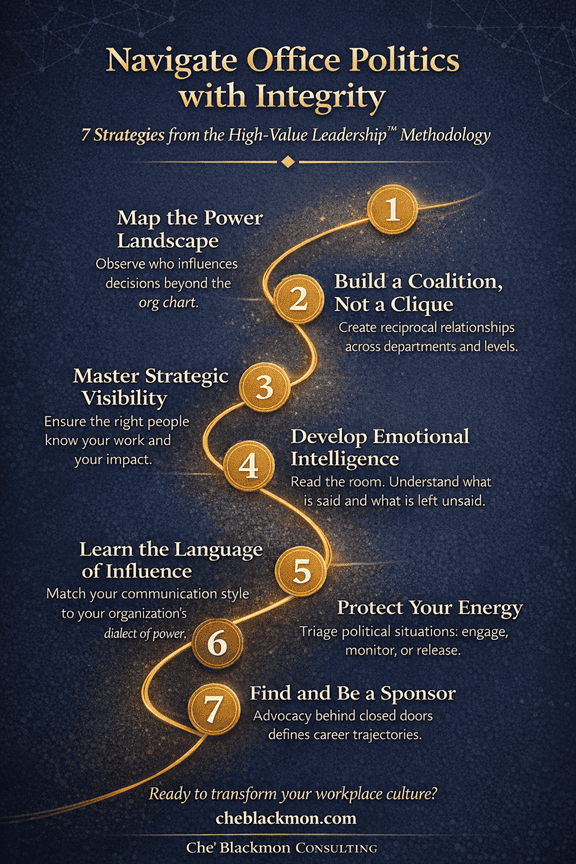
🛠️ Section 3: The Survival Toolkit – 7 Strategies for Navigating Office Politics with Integrity
1️⃣ Map the Power Landscape
Every organization has a formal structure and an informal one. The formal structure is the org chart. The informal structure is the web of influence, trust, and information flow that actually drives decisions.
Actionable Step: Spend two weeks observing. Who do leaders consult before making decisions? Whose opinions carry weight in meetings even when they are not the most senior person present? Who controls access to information or resources? Write these observations down. This is your political map, and it is one of the most valuable tools you can develop.
2️⃣ Build a Coalition, Not a Clique
Relationships are the currency of influence. But there is a critical difference between building a broad coalition of trusted colleagues and retreating into a small, insular group. Cliques breed suspicion. Coalitions build organizational strength.
Actionable Step: Identify three to five people across different departments, levels, and backgrounds with whom you can build genuine, reciprocal relationships. Offer value before asking for it. Share information, make introductions, and celebrate their wins publicly.
3️⃣ Master the Art of Strategic Visibility
Visibility does not mean self promotion. It means ensuring that the right people know about your work, your expertise, and your aspirations. There is nothing arrogant about wanting your contributions to be seen.
Actionable Step: Start a practice of sending brief, regular updates to your manager and key stakeholders. Keep them factual and concise. Include impact metrics where possible. Frame your work in terms of organizational outcomes, not personal achievement. For example, instead of saying “I completed the project,” say “The new process reduced turnaround time by 30%, supporting our Q3 efficiency goals.”
4️⃣ Develop Your Emotional Intelligence
Political navigation requires reading the room. It requires understanding not just what people say, but what they mean, what they fear, and what they need. Emotional intelligence is the foundation of effective political navigation.
According to Daniel Goleman, whose research has shaped the field of emotional intelligence in leadership, leaders with high EQ outperform their peers by an average of 20% in performance outcomes. The ability to regulate your own emotions while accurately reading others is not a “soft skill.” It is a leadership superpower.
Actionable Step: After every significant meeting or interaction, ask yourself three questions. What emotions were present in the room? What was left unsaid? What does this tell me about the priorities and concerns of the people involved? This practice builds your political awareness exponentially over time.
5️⃣ Learn the Language of Influence
Every organization has its own dialect of power. Some companies value data driven arguments. Others respond to storytelling. Some prioritize consensus building while others reward decisiveness. Understanding the communication style that resonates with your organization’s decision makers is essential.
Actionable Step: Study how successful leaders in your organization communicate. Pay attention to the structure of their presentations, the language they use in emails, and the way they frame proposals. Adapt your communication style to meet decision makers where they are, while remaining authentic to your own voice.
6️⃣ Protect Your Energy and Set Boundaries 🔋
Political navigation is exhausting, especially when you are also managing the additional weight of being underestimated, stereotyped, or overlooked. You cannot pour from an empty cup, and you cannot fight every battle.
Actionable Step: Develop a personal “political triage” system. Categorize situations into three buckets: (1) must engage because it directly impacts your career, your team, or your values, (2) should monitor because it may become relevant, and (3) release because it does not serve you and engaging will only drain your energy. This framework helps you focus your political capital where it matters most.
7️⃣ Find and Be a Sponsor
Mentors advise you. Sponsors advocate for you when you are not in the room. The difference between the two can define the trajectory of a career.
In Rise & Thrive, I emphasize that sponsorship is particularly vital for Black women, who are often excluded from the informal networks where sponsorship relationships naturally develop. But sponsorship is a two way street. As you rise, you have a responsibility to sponsor others, particularly those from backgrounds that are traditionally underrepresented.
Actionable Step: Identify one person in a position of influence who has demonstrated genuine investment in your growth. Build the relationship intentionally over time by delivering excellent work, seeking their counsel, and being transparent about your career goals. Simultaneously, identify one person who is earlier in their career whom you can begin to sponsor.

🏢 Section 4: The Organizational Responsibility
Let us be clear: the burden of navigating office politics should not rest solely on the shoulders of individual employees. Organizations have a profound responsibility to create cultures where political maneuvering is not required for basic fairness, where advancement is transparent, and where every voice is genuinely valued.
📈 Building a High Value Culture
This is the heart of the work I do through Che’ Blackmon Consulting and the foundation of Mastering a High‐Value Company Culture. A truly high value culture is one where:
| ✅ Transparency | Decision making processes are clear and accessible to all employees, not just those with inside connections. |
| ✅ Equity | Advancement criteria are explicit, consistently applied, and regularly audited for bias. |
| ✅ Belonging | Every employee, regardless of background, feels psychologically safe to speak up, challenge ideas, and be their authentic self. |
| ✅ Accountability | Leaders at every level are held to the same standards they expect from their teams. |
| ✅ Recognition | Contributions are acknowledged based on impact, not proximity to power. |
When organizations invest in building these cultural foundations, the need for individuals to navigate toxic politics diminishes significantly. The playing field becomes more level, and the energy that employees would have spent on political survival gets redirected toward innovation, collaboration, and growth.
💪 Section 5: A Special Note for Black Women in Corporate Spaces
If you are a Black woman reading this, I want to speak to you directly for a moment.
You are not imagining it. The political terrain is different for you. Research consistently confirms what you have experienced in conference rooms, performance reviews, and hallway conversations. You face a unique intersection of racial and gender bias that creates what scholars call a “double bind,” where you are simultaneously held to higher standards and given less grace for mistakes.
A 2023 report by the National Partnership for Women and Families found that Black women earn 67 cents for every dollar earned by white, non Hispanic men. That pay gap is not just a compensation issue. It is a reflection of systemic political dynamics within organizations that undervalue the contributions of Black women at every level.
“Your presence in the room is not an accident. It is an achievement. And your ability to thrive in that room is not about changing who you are. It is about understanding the environment and using your power strategically.”
This is precisely why I wrote Rise & Thrive: A Black Woman’s Blueprint for Leadership Excellence. Because general career advice, while helpful, does not always account for the specific challenges that Black women face. You deserve guidance that speaks to your experience, validates your reality, and equips you with strategies that work within the world as it is while you help build the world as it should be.
Five Power Moves for Black Women Navigating Office Politics 👑
🔹 Document Everything. Keep a running record of your accomplishments, your contributions to team projects, and any feedback you receive. This is not paranoia. It is professional self preservation.
🔹 Cultivate Your Inner Circle Wisely. Seek out trusted allies, both within and outside your organization, who understand the unique dynamics you navigate. Community is not a luxury. It is a necessity.
🔹 Negotiate from Data, Not Emotion. When advocating for yourself, lead with impact data and market benchmarks. Prepare thoroughly and practice with trusted advisors so that your confidence is rooted in preparation.
🔹 Reject the Superwoman Complex. You do not have to be twice as good to earn half the recognition. That narrative, while born from real experience, can lead to burnout. Give yourself permission to be excellent without being exhausted.
🔹 Amplify Other Black Women. When you gain influence, use it. Recommend other Black women for opportunities, invite them into rooms they have been excluded from, and publicly champion their expertise. Collective advancement is the most powerful form of political strategy.
📊 Section 6: Current Trends Shaping Office Politics in 2025 and Beyond
🤖 The Rise of AI and Its Political Implications
As artificial intelligence transforms the workplace, new political dynamics are emerging. Decisions about which roles are augmented, which are automated, and who controls AI driven processes are deeply political. Employees who understand AI and can articulate its value are gaining significant organizational influence, while those who resist it risk being marginalized in the conversation.
Organizations that approach AI implementation transparently and inclusively, rather than allowing it to be driven by a small, insular group, will create healthier political environments and better outcomes for all employees.
🏠 Hybrid Work and the New Proximity Bias
The shift to hybrid and remote work has fundamentally reshaped office politics. Proximity bias, where employees who are physically present in the office receive more opportunities and visibility, has become one of the most significant political challenges of this era. Research from Stanford University’s Nick Bloom has shown that remote workers are 50% less likely to receive promotions compared to their in office counterparts, even when performance is equivalent.
For Black women and other traditionally overlooked professionals, this presents a complex calculus. Remote work may offer relief from daily microaggressions and the emotional tax of being the “only,” but it may also reduce the visibility that is essential for advancement. There is no one size fits all answer, but awareness of this dynamic is critical for making informed career decisions.
🌐 The Growing Demand for Authentic Leadership
One of the most encouraging trends in organizational leadership is the growing demand for authenticity. Employees, particularly younger generations, are increasingly unwilling to tolerate leaders who operate through manipulation and opacity. They want leaders who are transparent, values driven, and genuinely invested in the wellbeing of their teams. This is the essence of what I call High‐Value Leadership, and it represents a fundamental shift in the political expectations of the modern workplace.
✅ Section 7: Your Action Plan – Starting Monday
Knowledge without action is just trivia. Here is your week by week plan for putting these strategies into practice.
📅 Week 1: Observe and Map. Spend this week mapping the informal power structure of your organization. Identify the key influencers, the decision making patterns, and the communication channels that matter most. Write it down.
📅 Week 2: Connect and Build. Reach out to one new person outside your immediate team. Have a genuine conversation about their work, their challenges, and their goals. Plant the seed of a coalition.
📅 Week 3: Speak Up and Be Seen. Volunteer for a visible project or initiative. Share an insight in a meeting that demonstrates your expertise. Send an update to your manager that highlights your recent impact.
📅 Week 4: Reflect and Refine. Review what you have learned. What surprised you about the political landscape? Where do you need to invest more energy? What boundaries do you need to strengthen? Adjust your approach accordingly.
💬 Discussion Questions for Teams and Individuals
Whether you are reflecting on your own, journaling, or facilitating a team conversation, these questions are designed to deepen your understanding and inspire action.
1. What is one political dynamic in your current workplace that you have been avoiding? What would it look like to engage with it strategically rather than ignore it?
2. Think about a time when someone’s advocacy (or lack thereof) directly impacted your career. What did that experience teach you about the power of sponsorship?
3. How does your organization’s culture reward visibility? Are those rewards distributed equitably, or do certain groups have more natural access to visibility opportunities?
4. In what ways can you begin to sponsor or advocate for a colleague from a traditionally overlooked background this month?
5. If you could change one thing about the political culture of your workplace, what would it be? What is one step you can take to begin that change?
🚀 Next Steps: Let’s Transform Your Workplace Together
Office politics does not have to be a source of dread. With the right strategies, the right mindset, and the right support, you can navigate any organizational environment with confidence and integrity.
At Che’ Blackmon Consulting, we partner with organizations and leaders to build high value cultures where politics serve the mission, not undermine it. Whether you need fractional HR leadership, culture transformation consulting, or keynote speaking that moves your team to action, we are here to help.
| 🌟 Ready to Build a High‐Value Culture? Connect with Che’ Blackmon Consulting today. 📧 admin@cheblackmon.com 📞 888.369.7243 🌐 cheblackmon.com |
📚 Explore Che’’s Books:
High‐Value Leadership: Transforming Organizations Through Purposeful Culture
Mastering a High‐Value Company Culture
Rise & Thrive: A Black Woman’s Blueprint for Leadership Excellence
Because you deserve a workplace where your talent is recognized, your voice is valued, and your potential is limitless. ✨
#OfficePolitics #WorkplaceCulture #LeadershipDevelopment #HighValueLeadership #BlackWomenInLeadership #CorporateSurvivalGuide #CareerStrategy #WorkplaceEquity #WomenInLeadership #ProfessionalGrowth #CultureTransformation #BlackWomenAtWork #ExecutivePresence #SponsorshipMatters #EmotionalIntelligence #StrategicVisibility #LeadershipTips #CheBlackmonConsulting #RiseAndThrive #PurposefulCulture

Leave a Reply