By Che’ Blackmon, DBA Candidate | Founder & CEO, Che’ Blackmon Consulting
Valentine’s Day often brings to mind romantic relationships, chocolates, and roses. Yet there’s another kind of love that deserves equal celebration: the professional bonds that transform ordinary workplaces into extraordinary teams. When we talk about High-Value Leadership™, we’re talking about creating environments where people genuinely care about each other’s success, where trust runs deep, and where the collective achievement matters more than individual glory. This is workplace love in its truest, most professional form.
For Black women navigating corporate spaces, these team relationships carry particular weight. We often enter environments where we’re the “only” or among very few. The quality of our workplace relationships directly impacts our ability to thrive, advance, and bring our authentic selves to work. When teams operate with genuine care and mutual support rather than superficial tolerance, everything changes. As I explore in “Rise & Thrive: A Black Woman’s Blueprint for Leadership Excellence,” authentic connection in professional settings isn’t a nice-to-have; it’s essential for sustainable success.
This Love Day, let’s celebrate the teams that make work worth it. The colleagues who challenge us to grow, the leaders who clear paths for our advancement, the peers who cover our backs during difficult seasons, and the direct reports who remind us why leadership matters. These relationships form the foundation of high-value cultures where both people and organizations flourish together.
The Love That Drives Performance 💪
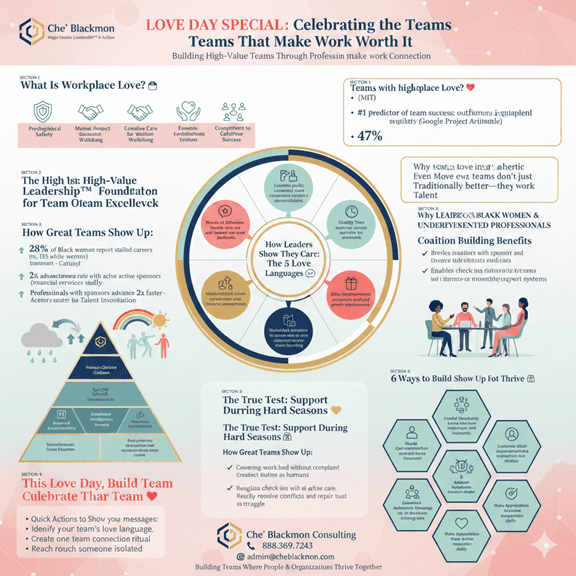
When we talk about workplace love, we’re not discussing inappropriate office romances or forced friendships. We’re describing something far more powerful: psychological safety, mutual respect, genuine care for colleagues’ wellbeing, and commitment to collective success. This kind of professional love transforms organizational performance in measurable ways.
Research from MIT’s Human Dynamics Laboratory found that the single most important predictor of team productivity is how team members interact. Teams with high-quality connections (characterized by mutual trust, positive regard, and emotional carrying capacity) consistently outperform teams with equivalent talent but lower-quality relationships. Google’s famous Project Aristotle reached similar conclusions: psychological safety, the feeling that you can take interpersonal risks without fear of punishment or embarrassment, matters more than individual intelligence or expertise.
There was a technology company struggling with innovation despite hiring brilliant engineers. Their technical capabilities were impressive, but their culture was cutthroat and competitive. Engineers hoarded information, avoided asking for help, and rarely collaborated across specialties. Leadership decided to intentionally build what they called “caring culture” through structured team-building, vulnerability exercises, and reward systems that prioritized collective achievement. Within eighteen months, innovation metrics improved 47%. Employee retention among top performers increased by 33%. The difference wasn’t new talent; it was new relationships characterized by genuine professional care and mutual support.
As I discuss in “High-Value Leadership: Transforming Organizations Through Purposeful Culture,” authentic connection is one of the five pillars of High-Value Leadership™. Leaders who build real relationships at all levels of the organization create cultures where people feel seen, valued, and motivated to contribute their best work. This isn’t soft skill fluff; it’s strategic wisdom backed by decades of organizational research and real-world results.
When Teams Become Family (The Good Kind) 👨👩👧👦
The phrase “we’re like family” can trigger warranted skepticism in workplace contexts. Too often it’s used to justify unreasonable demands or boundary violations. However, there’s a healthy version of workplace family that deserves celebration: teams that show up for each other during difficult times, celebrate each other’s victories, hold space for vulnerability, and commit to each other’s growth and development.
Think about the teams where people genuinely look out for one another. The colleague who notices you’re overwhelmed and quietly redistributes work. The manager who remembers your parent is ill and gives you flexibility without requiring you to ask. The peer who celebrates your promotion even though they wanted it too. The direct report who tells you honestly when your leadership approach isn’t working. These behaviors reflect professional love: choosing the other person’s wellbeing and success even when it’s inconvenient or difficult.
For Black women in corporate spaces, finding this kind of team feels particularly precious. Research from Catalyst shows that Black women face unique challenges including higher rates of being mistaken for administrative staff, having their authority questioned, and receiving less credit for collaborative work. In teams characterized by genuine care and respect, these microaggressions decrease significantly. Colleagues actively interrupt bias, share credit generously, and create space for Black women’s voices and leadership. The difference between working on a team that tolerates you and one that genuinely values you is profound.
There was a healthcare organization that implemented “care pods” where small cross-functional teams met weekly not to discuss work tasks but to check in on each other’s wellbeing, share challenges, and offer support. Initially met with skepticism, these pods became sacred space where staff could be honest about struggles with burnout, family challenges, or professional frustrations. The organization tracked outcomes and found that units with highly engaged care pods had 28% lower turnover, 35% higher patient satisfaction scores, and significantly better staff resilience metrics during the pandemic. The investment in professional care paid measurable dividends.
The Leadership Love Language 💼
Just as Gary Chapman’s “Five Love Languages” describes how people express and receive love in romantic relationships, there are distinct ways leaders demonstrate professional care and teams experience feeling valued. Understanding these leadership love languages helps us both give and receive appreciation more effectively.
Words of Affirmation
Some team members thrive on verbal recognition and specific feedback. They need to hear “that presentation was excellent” or “your analysis changed my thinking.” For Black women, who often receive less recognition than similarly performing peers, words of affirmation carry extra weight. Specific, public acknowledgment of contributions combats invisibility and validates expertise. High-value leaders master the art of meaningful affirmation that goes beyond generic praise to recognize specific contributions and their impact.
Acts of Service
Actions speak louder than words for many professionals. Leaders who demonstrate care through service might clear obstacles blocking their team’s progress, take administrative burdens off someone’s plate, or personally advocate for resources the team needs. There was a director who noticed her team spending hours on manual data compilation. Rather than simply acknowledging their frustration, she worked with IT to automate the process, freeing up twenty hours weekly for more strategic work. Her team felt profoundly valued because she invested her political capital and time in solving their problem.
Quality Time
In our calendars-packed work culture, giving someone your undivided attention is a powerful expression of care. Leaders who practice the quality time love language schedule regular one-on-ones and actually show up present, phones down, listening actively. They create space for career development conversations that aren’t rushed. They remember what team members shared previously and follow up. For professionals from underrepresented backgrounds, having a leader who consistently makes time signals that your development matters and your perspective is valued.
Gifts (Opportunities)
In professional contexts, gifts take the form of opportunities: the chance to lead a high-visibility project, an invitation to present to executives, sponsorship for a development program, or a stretch assignment that builds new capabilities. Leaders who understand this love language actively look for opportunities to give their team members experiences that accelerate growth. They think strategically about who would benefit from which opportunity and make intentional matches. As I emphasize in “Mastering a High-Value Company Culture,” investing in people’s development is how you build sustainable high-value cultures.
Physical Touch (Professional Boundaries)
In workplace contexts, this translates to appropriate expressions of human connection and solidarity: the fist bump after a big win, the supportive hand on a shoulder during a difficult moment, or the team huddle before a major presentation. These gestures must always respect professional boundaries and individual comfort levels, but for some people, appropriate physical expressions of solidarity strengthen team bonds. The key is reading cues, respecting boundaries, and never making physical contact a requirement for belonging.
Understanding your own leadership love language and those of your team members creates more effective appreciation. When recognition doesn’t land, it’s often not lack of effort but mismatch in language. The leader who gives public praise to someone who values quality time might miss the mark. The team member who needs words of affirmation might not fully receive acts of service. High-value leaders learn to express care in the languages their team members understand and value.
Breaking Isolation: Coalition Building as Love in Action 🤝
For professionals from traditionally overlooked backgrounds, particularly Black women, workplace isolation is more than uncomfortable; it’s career limiting. When you’re the only person who looks like you in meetings, when your experiences go unrecognized, when you lack advocates who understand your challenges, professional growth becomes exponentially harder. Coalition building, the intentional formation of supportive professional relationships, is love in action.
Research from the Center for Talent Innovation shows that Black women are more likely than any other group to report feeling stalled in their careers, with 28% saying their career advancement has stalled compared to 13% of white women. This stalling isn’t due to lack of ambition or capability; it’s often due to lack of sponsorship, advocacy, and coalitions. When organizations build cultures where coalition formation is encouraged and supported, everyone benefits but the impact on underrepresented professionals is transformative.
There was a financial services firm that deliberately created “advocacy circles” where senior leaders committed to actively sponsoring emerging talent from underrepresented backgrounds. Unlike traditional mentoring, which is often passive, sponsorship requires active advocacy: recommending people for opportunities, using social capital to open doors, and sharing institutional knowledge that helps navigate organizational politics. The firm tracked outcomes and found that professionals with active sponsors advanced to leadership positions at twice the rate of those without. More importantly, participants reported feeling genuinely supported and valued rather than isolated and invisible.
In “Rise & Thrive,” I discuss the critical importance of building strategic alliances and finding your people in corporate spaces. This isn’t about networking for superficial gain; it’s about finding genuine professional relationships that sustain you through challenges, celebrate your wins, and help you navigate organizational complexities. When Black women support each other rather than competing for limited seats, when allies use their privilege to create opportunities, when leaders actively work to break isolation, that’s workplace love manifesting as tangible career impact.
Tough Love: Feedback as Care 📝
True professional love includes tough conversations. The colleague who tells you when your presentation missed the mark. The leader who gives you critical feedback on a project. The peer who lets you know your approach is creating unintended problems. These honest conversations, delivered with care and respect, are profound expressions of professional love because they prioritize your growth over comfort.
However, research shows significant disparities in how feedback is delivered across demographic groups. Black women are more likely to receive vague feedback, personality-based criticism rather than behavior-specific guidance, and evaluation that questions their capability rather than addressing specific performance issues. When feedback is delivered with genuine care for development rather than as criticism or dismissal, it transforms from potentially harmful to profoundly helpful.
High-Value Leadership™ emphasizes balanced accountability: maintaining high standards within psychologically safe environments. This means giving honest feedback while also creating conditions where people can receive it constructively. The leader who says “I care about your success too much to let this slide” before difficult feedback signals that the conversation comes from care rather than criticism. The peer who follows tough feedback with “How can I support you in addressing this?” demonstrates that honesty and support aren’t contradictory.
There was a manufacturing company that implemented “growth conversations” replacing traditional performance reviews. These quarterly dialogues focused on development rather than evaluation, with structured frameworks ensuring feedback was specific, actionable, and delivered with genuine care for growth. Managers received training on delivering feedback without bias and creating psychological safety. The company tracked results and found that engagement scores improved 31%, internal mobility increased 42%, and employees consistently rated these conversations as more valuable than previous review processes. The shift from evaluative to developmental feedback, grounded in genuine care for people’s growth, transformed how the organization approached talent development.
Celebrating Wins Together: The Joy of Collective Success 🎉
One of the clearest indicators of healthy team relationships is how people respond to each other’s successes. In competitive cultures characterized by scarcity mindset, one person’s win feels like another’s loss. In high-value cultures built on genuine professional care, celebrating others’ victories comes naturally because collective success matters more than individual glory.
When a colleague gets promoted, do people genuinely celebrate or quietly resent? When a team member wins an award, does the team share pride or feel overlooked? When someone lands a major account, does everyone feel the victory or just the individual? These questions reveal the quality of professional relationships and the health of organizational culture. Teams that genuinely love and support each other experience collective joy in individual triumphs.
For Black women whose successes are often minimized or attributed to factors other than capability and hard work, having colleagues who genuinely celebrate achievements matters enormously. When your team makes your promotion their win, when your presentation success feels like a collective triumph, when your award is celebrated as team validation, you experience true belonging. This celebratory culture doesn’t happen automatically; it requires intentional cultivation by leaders committed to abundance thinking and collective success.
There was a consulting firm that created “win walls” in every department where team members posted not just client victories but also personal professional achievements, colleague recognitions, and team milestones. During monthly gatherings, teams celebrated these wins together, with colleagues sharing what others’ successes meant to them. This practice normalized celebration, made recognition collective rather than hierarchical, and built cultures where people genuinely wanted each other to succeed. The firm found that teams with highly engaged win walls had stronger collaboration metrics, better client satisfaction scores, and lower voluntary turnover. The practice of collective celebration strengthened professional bonds and reinforced that everyone’s success matters.

When Teams Carry Each Other: Support During Hard Seasons 🌧️
The truest test of team relationships comes during difficult seasons. When someone faces personal crisis, health challenges, family emergencies, or professional setbacks, how does the team respond? In transactional workplace cultures, people are on their own during hard times. In high-value cultures characterized by genuine professional care, teams show up for each other when it matters most.
This support takes many forms. Colleagues quietly covering responsibilities so someone can attend to family needs. Teams rallying to help a struggling member meet deadlines. Leaders creating flexibility during personal crises without requiring detailed justification. Peers checking in regularly during difficult periods not to gossip but to offer genuine support. These acts of professional solidarity strengthen bonds and create cultures where people feel safe being human.
For Black women who often feel pressure to appear strong and invulnerable at work, having teams that create space for vulnerability and struggle is particularly valuable. Research shows that Black women face “strong Black woman” stereotypes that make showing weakness feel risky. When teams normalize struggle and create genuine support systems, these stereotypes lose their power. People can be honest about challenges without fear of being perceived as weak or less capable.
There was a technology company where an engineer faced a family medical crisis requiring frequent absences over several months. Rather than treating this as a performance problem, the team restructured responsibilities, created backup systems, and maintained full salary and benefits throughout the crisis. Team members sent regular messages of support, covered workload without complaint, and celebrated when the crisis resolved and the engineer returned. Years later, this engineer became one of the company’s most loyal and productive contributors, and the story of how the team showed up became part of organizational lore about what their culture values. The investment in caring for people during hard times paid dividends in loyalty, engagement, and cultural strength.
Building the Kind of Team Culture Worth Celebrating 🏗️
Creating teams characterized by genuine professional care and mutual support doesn’t happen accidentally. It requires intentional cultivation by leaders committed to High-Value Leadership™ principles. Here are practical strategies for building cultures where workplace relationships thrive:
Model Vulnerability and Authenticity
Leaders set the tone for team relationships. When leaders share appropriate struggles, admit mistakes, and show humanity, they give permission for others to do the same. This doesn’t mean oversharing or making yourself the center of attention; it means being genuine about challenges and showing that perfection isn’t required. As I discuss in my work on High-Value Leadership™, authentic connection starts with leaders willing to be real.
Create Structured Opportunities for Connection
Don’t leave relationship building to chance. Create regular opportunities for team members to connect as humans, not just as functional roles. This might include team lunches without work agendas, walking meetings, virtual coffee chats, or structured sharing time in team meetings. The key is making connection an expected part of team culture rather than an afterthought.
Reward Collaborative Behavior
What gets recognized gets repeated. If you only celebrate individual achievement, you’ll get individual competitors. If you recognize and reward people who help others succeed, share knowledge generously, and prioritize team wins, you’ll build collaborative cultures. Make supporting colleagues a valued and visible part of what success looks like in your organization.
Address Relationship Damage Quickly
When team relationships fracture due to conflict, misunderstanding, or breach of trust, address it promptly. Unresolved relationship damage festers and spreads, poisoning team culture. High-value leaders facilitate difficult conversations, help people repair breaches, and sometimes make tough decisions about team members whose behavior damages relationships beyond repair.
Build Inclusive Practices That Combat Isolation
For professionals from underrepresented backgrounds, feeling included and valued requires intentional practice. This means ensuring all voices are heard in meetings, distributing high-visibility opportunities equitably, interrupting bias when it occurs, and creating formal structures like employee resource groups or mentoring programs that combat isolation. In “Rise & Thrive,” I outline specific strategies for creating inclusive environments where Black women and other traditionally overlooked professionals can thrive.
Make Appreciation a Regular Practice
Don’t wait for Valentine’s Day or annual reviews to express appreciation. Build regular practices of recognition and gratitude into team rhythms. This might include starting meetings with appreciations, creating channels for peer recognition, or establishing rituals that normalize expressing thanks and acknowledging contributions. When appreciation becomes routine rather than rare, it strengthens relationship bonds and reinforces positive culture.
Key Takeaways 🔑
As we celebrate Love Day, let’s honor the professional relationships that make work meaningful and productive:
- Workplace love, defined as genuine care, mutual respect, and commitment to collective success, drives measurable performance improvements including higher innovation, better retention, and increased productivity.
- High-quality team relationships characterized by psychological safety and authentic connection create environments where everyone, particularly traditionally overlooked professionals, can thrive.
- Leaders demonstrate care through different “love languages” including words of affirmation, acts of service, quality time, meaningful opportunities, and appropriate professional connection.
- Coalition building and active sponsorship combat isolation for Black women and other underrepresented professionals, creating tangible career advancement opportunities.
- Honest feedback delivered with genuine care for development, rather than criticism, accelerates growth and strengthens professional relationships.
- Teams that celebrate collective success and support each other during difficult seasons build bonds that enhance both individual wellbeing and organizational performance.
- Creating cultures worth celebrating requires intentional leadership practices including modeling vulnerability, creating connection opportunities, rewarding collaboration, and addressing relationship damage promptly.
Discussion Questions 💭
Reflect on these questions individually or discuss them with your team:
- Think about a team or colleague that made work feel meaningful. What specific behaviors or qualities created that experience? How might you cultivate those same qualities in your current professional relationships?
- Which “leadership love language” (words, actions, time, opportunities, appropriate connection) do you most value receiving? Which do you default to giving? Is there a mismatch that might be affecting your relationships?
- For leaders: How does your team celebrate individual and collective wins? Are celebrations authentic and inclusive, or do they feel performative or leave people out?
- For professionals from underrepresented backgrounds: Do you have genuine allies and sponsors who actively advocate for you? If not, what would it take to build those coalitions? If yes, how might you pay that forward?
- How does your organization handle difficult seasons when team members face personal or professional challenges? Does the culture create space for vulnerability and support, or is there pressure to hide struggle?
- What’s one concrete practice you could implement in the next month to strengthen professional relationships on your team?
Next Steps: Expressing Professional Appreciation 👣
This Love Day, move beyond reflection to action. Here are specific ways to express professional appreciation and strengthen team relationships:
Write Three Specific Thank You Messages: Identify three colleagues, direct reports, or leaders who have impacted your professional life. Write specific, detailed messages explaining exactly what they did that mattered and how it affected you or the organization. Be concrete rather than generic. Send these messages this week.
Identify Your Team’s Love Language: Pay attention to how your team members respond to different forms of appreciation. Do they light up at public recognition or prefer private feedback? Do they value time investment or tangible opportunities? Adjust your appreciation style to match what each person values.
Create a Team Ritual: Propose one small ritual that builds team connection. This might be starting meetings with appreciations, establishing weekly coffee chats, creating a recognition channel, or implementing “win of the week” sharing. Start small and build consistency.
Reach Out to Someone Isolated: Think about colleagues who might feel isolated or overlooked in your organization, particularly those from underrepresented backgrounds. Reach out with genuine interest in their experience and perspective. Offer specific support if appropriate, or simply listen and validate.
Audit Your Team Culture: If you’re a leader, conduct an honest assessment of your team’s relationship health. Do people support each other or compete? Is vulnerability safe or risky? Are celebrations authentic and inclusive? Identify one area for improvement and create a specific action plan.
Be the Support You Wish You Had: Think about what you wish colleagues had done for you during challenging times. Commit to being that person for others. Look for opportunities to cover workload, offer flexibility, or simply check in with genuine care when someone is struggling.
Final Thoughts 💡
This Love Day, as candy hearts and roses dominate the cultural conversation, let’s also celebrate the professional love that sustains us: the teams that make hard work feel meaningful, the colleagues who see our potential and help us reach it, the leaders who invest in our growth, and the cultures where everyone can bring their authentic selves and thrive.
These relationships aren’t fluffy feel-good extras; they’re the foundation of high-performing organizations. When we invest in building genuine professional care, mutual respect, and collective commitment, we create cultures where innovation flourishes, people stay and grow, and work feels like something more than just a paycheck. We create environments worthy of celebration not just on Valentine’s Day but every day.
For Black women and other professionals from traditionally overlooked backgrounds, these relationships are particularly crucial. They’re the difference between surviving and thriving, between feeling isolated and feeling genuinely valued, between stalled careers and accelerated advancement. When organizations get team relationships right, when they build cultures characterized by authentic care and mutual support, everyone benefits but the impact on those who have historically been marginalized is transformative.
As I’ve learned through twenty-four years of building and transforming organizational cultures, the teams that make work worth it aren’t accidents. They’re the result of intentional leadership, consistent practice, and genuine commitment to each other’s success. They reflect High-Value Leadership™ principles in action: purpose-driven vision, stewardship of culture, emotional intelligence, balanced accountability, and authentic connection.
So this Love Day, take time to appreciate the teams that make your work meaningful. Express gratitude to colleagues who show up for you. Commit to being the kind of team member others are grateful to work with. And if you’re a leader, dedicate yourself to building cultures where genuine professional care thrives and everyone can bring their best selves to work.
The teams worth celebrating are the ones we intentionally create through daily choices to care, support, challenge, and champion each other. That’s the kind of workplace love that deserves recognition every single day.
Ready to Build Teams That Thrive? 🌟
At Che’ Blackmon Consulting, we specialize in transforming organizational cultures and building high-value teams where genuine professional care drives measurable results. Whether you’re looking to:
- Strengthen team relationships and build psychological safety
- Create inclusive cultures where diverse talent thrives
- Develop leadership capabilities that foster authentic connection
- Transform competitive dynamics into collaborative partnerships
- Build strategic HR infrastructure that supports relational culture
We bring over two decades of progressive HR leadership experience combined with cutting-edge research in organizational transformation. Our High-Value Leadership™ methodology has helped organizations across industries build cultures where both people and businesses flourish together.
Let’s talk about how to build teams worth celebrating in your organization. We offer complimentary consultation calls to explore your needs and discuss how we can support your culture transformation journey.
Contact Che’ Blackmon Consulting Today:
📧 Email: admin@cheblackmon.com
📞 Phone: 888.369.7243
🌐 Website: cheblackmon.com
About the Author 👩🏾💼
Che’ Blackmon is the Founder and CEO of Che’ Blackmon Consulting, a Michigan-based fractional HR and culture transformation consultancy. With 24+ years of progressive HR leadership experience across manufacturing, automotive, healthcare, and professional services sectors, she has consistently delivered measurable results including 9% engagement increases, 60% safety improvements, and successful culture transformations for organizations ranging from startups to Fortune 500 companies.
Currently pursuing a Doctor of Business Administration (DBA) in Organizational Leadership at National University, Che’ is developing Michigan’s first AI-powered culture transformation platform that predicts employee turnover 3-6 months in advance. Her dissertation research focuses on AI-enhanced predictive analytics for culture transformation and employee retention.
Che’ is the published author of three books on leadership and organizational culture: “High-Value Leadership: Transforming Organizations Through Purposeful Culture,” “Mastering a High-Value Company Culture,” and “Rise & Thrive: A Black Woman’s Blueprint for Leadership Excellence.” She hosts the twice-weekly podcast “Unlock, Empower, Transform with Che’ Blackmon” and the “Rise & Thrive” YouTube series.
Her work focuses on creating high-value cultures where both people and organizations thrive, with particular attention to advancing opportunities for Black women and other traditionally overlooked professionals in corporate spaces.
#LoveDay #ValentinesDay #TeamAppreciation #WorkplaceCulture #HighValueLeadership #TeamExcellence #LeadershipDevelopment #PsychologicalSafety #TeamLove #OrganizationalCulture #ProfessionalAppreciation #EmployeeEngagement #TeamSuccess #LeadershipMatters #CelebrateTeams

Leave a Reply