A High-Value Leadership Perspective on Sustainable Performance
Leadership is exhausting.
There, I said it. Not the motivational poster version you see plastered across LinkedIn feeds. The real, bone tired, Sunday evening dread kind of exhausting that creeps in when you’ve been running on empty for so long that you can’t remember what full feels like. If you’re reading this and nodding along, you’re not alone. Energy depletion among leaders has reached epidemic proportions, and it’s affecting not just performance metrics, but the very fabric of organizational culture and the personal wellbeing of those who lead.
The question isn’t whether leaders are losing energy. The question is: where is it going, and how do we get it back? 💡

🔍 The Hidden Energy Drains: What the Research Reveals
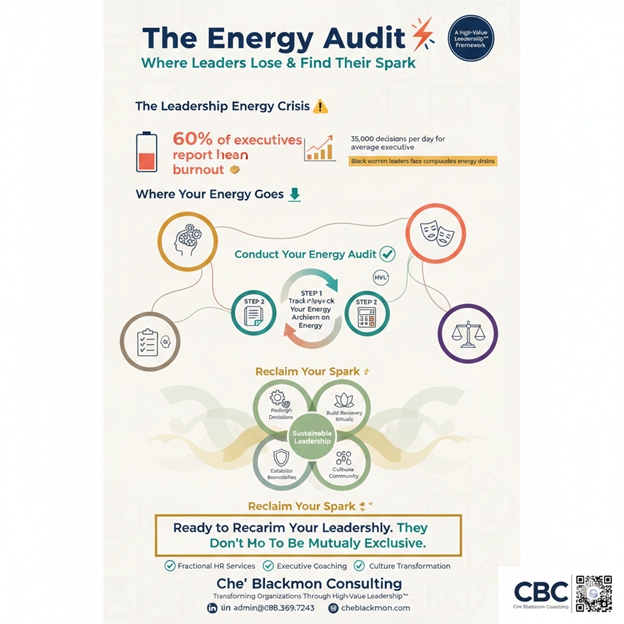
Recent studies from the Harvard Business Review paint a sobering picture. Over 60% of executives report feeling burned out, and the numbers are even more staggering for leaders who navigate the additional weight of being traditionally overlooked in corporate spaces. For Black women in leadership, the energy tax is compounded by what researchers call “emotional labor,” the invisible work of managing perceptions, code switching, and proving competence in environments that weren’t built with them in mind.
Energy depletion doesn’t happen in a vacuum. It accumulates through a series of micro moments that, individually, seem manageable. Collectively, they create a deficit that no amount of weekend rest can repair. Consider these common energy drains that leaders face daily:
Decision Fatigue and Cognitive Overload
The average executive makes over 35,000 decisions per day. Each decision, no matter how small, depletes a finite cognitive resource. When you’re already operating in spaces where every move is scrutinized more heavily, that number multiplies. You’re not just deciding on strategy or budget allocations; you’re constantly calculating the perception of each choice.
Misaligned Values and Cultural Dissonance
There’s an energy leak that happens when your personal values clash with organizational culture. When you have to suppress your authentic self to fit into corporate norms, when you’re the only voice advocating for equity in rooms full of people who view it as a checkbox rather than a commitment, you’re burning fuel that should be powering innovation and growth. This is particularly acute for Black women leaders who often find themselves as the “only” or one of few, navigating cultures that were not designed with their leadership styles, communication preferences, or lived experiences in mind.
Invisible Labor and Unrecognized Contributions
The work that doesn’t show up in job descriptions but somehow always lands on your desk. Mentoring junior colleagues. Smoothing over team conflicts. Being voluntold for diversity initiatives while your peers focus solely on revenue generating work. This invisible labor drains energy while rarely adding to your advancement or recognition.
Constant Performance Pressure and Imposter Syndrome
When you’re operating in spaces where people like you have historically been excluded, there’s an unspoken pressure to be exceptional at all times. Mistakes that would be learning opportunities for others become proof that you don’t belong. This hypervigilance is exhausting. It creates a perpetual state of stress that depletes energy reserves faster than any strategic initiative or operational challenge.
💸 The Cost of Running on Empty
Energy depletion isn’t just a personal problem. It’s an organizational crisis that manifests in tangible, measurable ways. When leaders run on empty, the ripple effects touch every corner of the enterprise.
There was a company in the manufacturing sector that lost a brilliant VP of Operations within 18 months of her appointment. On paper, she had everything: impressive credentials, strategic vision, and the operational expertise to transform their supply chain. What the exit interview revealed was more nuanced. She was exhausted. Not from the work itself, but from the constant need to prove her worth in ways her male counterparts never had to. She left not because she couldn’t do the job, but because the energy required to do it while managing bias, microaggressions, and isolation was unsustainable.
The company didn’t just lose a talented executive. They lost institutional knowledge, strategic relationships, and a pipeline of diverse talent who saw in her departure a signal about their own futures. The cost of replacing her ran into seven figures when you factor in recruitment, onboarding, lost productivity, and the projects that stalled in her absence. More significantly, they lost credibility in their diversity and inclusion commitments.
The organizational costs of leadership energy depletion include decreased decision quality, reduced innovation and creative problem solving, higher turnover among high performers, cultural erosion and disengagement, missed strategic opportunities, and damaged employer brand and recruitment challenges. These aren’t abstract concepts. They show up in quarterly earnings, employee engagement scores, and talent retention metrics.
📊 Conducting Your Energy Audit: A Framework for Leaders
An energy audit for leaders mirrors the process organizations use to identify inefficiencies in their operations. Instead of examining electrical systems and HVAC units, you’re examining how you allocate your most precious resource: your energy. This isn’t about working harder or finding more hours in the day. It’s about working smarter and being intentional about where your energy goes.
Step One: Track Your Energy Expenditures
For one week, keep a simple energy journal. Not a detailed log of every minute, but a general accounting of what gives you energy and what depletes it. At the end of each day, ask yourself three questions. What activities today left me energized? What activities left me drained? What surprised me about my energy patterns?
Pay particular attention to the activities that drain you but that you feel obligated to continue. These are your prime candidates for elimination, delegation, or redesign. For Black women leaders, this often includes activities related to being the diversity representative, informal mentorship that isn’t valued or compensated, and managing others’ comfort with your presence in leadership spaces.
Step Two: Identify Your Energy Architecture
Everyone has a unique energy architecture, the patterns and rhythms that govern when you’re at your best. Some leaders are morning people who tackle complex decisions before noon. Others hit their stride in the afternoon. Understanding your architecture allows you to structure your day for maximum effectiveness.
Examine your calendar through an energy lens. Are you scheduling high stakes meetings during your lowest energy periods? Are you filling your peak hours with administrative tasks that could be batched or delegated? Are you building in recovery time between energy intensive activities, or are you scheduling back to back meetings that leave no room for processing or renewal?
Step Three: Calculate Your Return on Energy
Just as organizations calculate ROI for financial investments, leaders need to calculate return on energy for their activities. Not everything that feels productive is actually moving you or your organization forward. Some activities are energy vampires disguised as important work.
Create three categories for your activities: high energy investment, high return activities; necessary but energy draining activities; and low return energy drains. The goal isn’t to eliminate all energy draining activities. Some are unavoidable parts of leadership. The goal is to be conscious about which drains are necessary and which are habits or obligations that no longer serve you or your organization.
⚙️ Strategic Energy Management: From Audit to Action
Understanding where your energy goes is only half the battle. The real transformation happens when you redesign how you work, lead, and show up in ways that honor your energy architecture while meeting organizational demands.
Redesign Your Decision Making Process
Decision fatigue is real and cumulative. Combat it by creating decision frameworks that reduce the cognitive load of routine choices. Establish clear criteria for common decisions so you’re not reinventing the wheel each time. Delegate decisions that don’t require your specific expertise or authority. Batch similar decisions together rather than switching contexts throughout the day.
A technology executive shared her strategy of implementing “decision free Fridays” where she avoids making any major decisions, using the day instead for strategic thinking and planning. This single change improved not only her decision quality on other days, but also her overall wellbeing.
Build Energy Recovery Into Your Rhythm
You can’t sprint a marathon. Leadership is a long game that requires intentional recovery. This isn’t about bubble baths and self care platitudes. It’s about building recovery mechanisms into your regular rhythm that allow you to sustain high performance over time.
Recovery looks different for different people, but research points to several effective strategies. Physical movement breaks between meetings. Dedicated think time that isn’t interrupted by pings and notifications. Clear boundaries between work and personal time, even when working remotely. Micro breaks throughout the day, not just at lunch. Regular check ins with trusted advisors or coaches who can provide perspective. Time in community with people who share your lived experience and understand the unique challenges you face.
Create Boundaries That Honor Your Energy
For leaders who are used to being accessible, available, and always on, boundary setting can feel uncomfortable. For Black women leaders, it can feel particularly risky given the stereotypes about being difficult or not being team players. Yet boundaries aren’t walls that keep people out. They’re guidelines that protect your ability to show up fully and effectively.
Start by identifying your non negotiables. These are the boundaries that protect your core energy reserves. They might include no meetings before 9am or after 5pm, no work emails on weekends, dedicated time for strategic thinking that can’t be interrupted, or limits on travel commitments. Communicate these boundaries clearly and consistently. Model them for your team to create a culture where sustainable performance is valued over performative busyness.
🌟 The Unique Energy Dynamics for Black Women in Leadership
Let’s address what often goes unsaid in mainstream leadership development. The energy equation looks different when you’re navigating leadership while Black and female. The tax on your energy isn’t just about the work itself but about the context in which you’re doing it.
Research from the Center for Talent Innovation found that Black professionals are more likely than their white counterparts to report feeling stalled in their careers, being on guard to protect against bias, and needing to work harder than their peers to achieve the same level of recognition. Each of these experiences represents a significant energy drain that compounds over time.
The Code Switching Tax
Code switching, the practice of adjusting your language, behavior, and appearance to fit into predominantly white professional spaces, is exhausting. It requires constant vigilance and self monitoring. You’re not just thinking about what to say; you’re calculating how it will be received, whether it reinforces or contradicts stereotypes, and what the political ramifications might be.
A senior director at a Fortune 500 company described it as “wearing a mask that you can never quite take off, even when you get home.” The energy required to maintain that mask, day after day, year after year, is staggering. And unlike other forms of professional stress, there’s no relief valve because the triggers aren’t isolated incidents but the ambient conditions of the environment itself.
The Credibility Gap
Studies consistently show that Black women in leadership positions face a credibility gap that their white male counterparts don’t encounter. Your expertise is questioned more frequently. Your decisions are second guessed more openly. Your authority is challenged more readily. Each incident might seem small, but the cumulative effect is significant energy depletion.
This credibility gap means you often need to work twice as hard to get half the credit. You come over prepared to meetings. You document everything meticulously. You build coalitions more carefully. You navigate politics more strategically. All of this is energy intensive work that should be going into innovation, strategy, and growth.
The Isolation Factor
Being the only one or one of few creates a unique form of isolation that drains energy in ways that are hard to articulate to people who haven’t experienced it. You don’t have the natural allies and informal networks that form organically among majority group members. You can’t assume anyone understands the nuances of your experience without extensive explanation. You bear the burden of representation, knowing that your actions will be generalized to your entire demographic.
This isolation affects everything from strategic decision making to simple workplace interactions. When you don’t have trusted peers who share your perspective, you’re processing challenges in isolation. When you don’t see yourself reflected in senior leadership, you’re charting a path with no map. This solo navigation is exhausting in ways that compound over time.
🛠️ Building a Sustainable Leadership Practice
Sustainable leadership isn’t about finding a magic formula that eliminates stress or makes challenges disappear. It’s about developing practices and support systems that allow you to navigate the demands of leadership without depleting yourself in the process.
Cultivate Your Kitchen Cabinet
Every leader needs a kitchen cabinet, a small group of trusted advisors who can provide honest feedback, strategic perspective, and emotional support. This isn’t your official board of directors or your executive team. This is your personal advisory group, the people who have your back and your best interests at heart.
For Black women leaders, this cabinet ideally includes other Black women who understand the unique dynamics you face. People who can validate your experiences, share strategies that worked for them, and remind you that you’re not alone or crazy when you encounter situations that others might dismiss. These relationships are not just nice to have; they’re essential for sustainable performance.
Develop Your Energy Rituals
High performing athletes have pre game rituals that prepare them mentally and physically for competition. Leaders need similar rituals that signal to their bodies and minds when it’s time to perform and when it’s time to recover. These rituals create structure and predictability in otherwise chaotic schedules.
Your energy rituals might include a morning routine that sets your intention for the day, transition rituals between work and home that create psychological separation, weekly planning sessions that align your calendar with your energy architecture, monthly reviews where you assess what’s working and what needs adjustment, or quarterly retreats for deep reflection and strategic thinking.
Invest in Professional Development That Energizes
Not all professional development is created equal when it comes to energy. Generic leadership programs that don’t acknowledge or address the unique challenges faced by Black women leaders can actually be depleting. You spend energy translating their content to your context, managing the microaggressions that inevitably arise, and explaining your perspective to people who may not be ready to hear it.
Seek out development opportunities that energize rather than drain you. Programs designed for and by people who share your lived experience. Executive coaching with someone who understands the intersection of race and gender in leadership. Communities and networks where you can show up authentically without having to code switch or self censor.
🏢 The Organizational Imperative: Creating Cultures That Sustain Leaders
While individual energy management is crucial, we can’t ignore the organizational conditions that either support or undermine leader sustainability. Organizations that want to retain their best leaders, particularly those from traditionally underrepresented groups, must create cultures that recognize and address the unique energy drains these leaders face.
This isn’t about special treatment. It’s about equitable treatment that accounts for the different challenges different leaders face. When organizations fail to do this, they lose talented leaders not because those leaders can’t handle the work, but because the energy required to navigate bias, isolation, and constant credibility questioning is unsustainable.
Audit Your Culture for Energy Equity
Organizations need to conduct their own energy audits, examining where systemic issues create unnecessary drains on leaders from underrepresented groups. This includes examining meeting cultures that require everyone to be on all the time, recognition systems that overlook invisible labor, advancement criteria that privilege certain styles and backgrounds, informal networks that exclude diverse leaders, and workload distribution that disproportionately assigns diversity and inclusion work to people of color.
Provide Real Support, Not Performative Programs
Many organizations have diversity and inclusion initiatives that look good on paper but provide little real support for leaders navigating challenging environments. Real support includes executive sponsorship from senior leaders who use their political capital to advocate for diverse leaders, affinity groups with budget and influence, not just permission to meet, flexible work arrangements that account for different needs and circumstances, professional development that addresses the specific challenges diverse leaders face, and clear pathways for advancement that don’t require assimilation.
Measure What Matters
If leader sustainability and energy aren’t measured, they won’t be managed. Organizations should track retention rates disaggregated by race and gender, time to promotion for diverse leaders compared to their peers, participation in high visibility projects and opportunities, engagement scores among different demographic groups, and exit interview themes related to culture and belonging.
These metrics reveal whether your organization is creating conditions that support all leaders or whether some leaders are having to work significantly harder than others to achieve the same outcomes.
🚀 Moving Forward: From Depletion to Renewal
Finding your spark again isn’t about a single intervention or magic solution. It’s about making intentional, strategic choices about how you lead, where you invest your energy, and what you’re willing to stop doing. It’s about recognizing that sustainable leadership isn’t weakness; it’s wisdom.
For Black women leaders especially, reclaiming your energy is an act of resistance against systems that expect you to work twice as hard for half the recognition. It’s a commitment to showing up powerfully without burning out completely. It’s honoring your brilliance by protecting the energy that fuels it.
The energy audit is your starting point. It’s the moment you stop accepting exhaustion as the price of leadership and start designing a leadership practice that honors both your ambition and your humanity. You deserve to lead powerfully and live fully. The two don’t have to be mutually exclusive.
✅ Actionable Takeaways
Conduct a week long energy audit tracking what energizes and depletes you daily. Identify your peak performance times and restructure your calendar accordingly. Calculate return on energy for your current commitments and eliminate low value drains. Establish three non negotiable boundaries that protect your core energy reserves. Build a kitchen cabinet of trusted advisors who understand your unique challenges. Create daily transition rituals between high energy work and recovery time. Invest in professional development designed for leaders who share your lived experience. Audit your organization’s culture for energy equity and advocate for systemic changes.
💭 Discussion Questions
What activities in your current role give you energy versus drain your energy? How might your energy equation differ from colleagues who don’t share your identity or background? What boundaries would you need to establish to protect your peak performance capacity? In what ways does your organization’s culture support or undermine sustainable leadership? What would change if you prioritized energy sustainability as much as productivity? How can you build community with other leaders who understand your unique challenges? What invisible labor are you carrying that should be recognized, compensated, or redistributed? What would it look like to lead powerfully while also protecting your wellbeing?
🎯 Next Steps: Partner with Che’ Blackmon Consulting
If you’re ready to reclaim your leadership energy and build a sustainable high value practice, Che’ Blackmon Consulting can help. As a Doctoral Candidate in Organizational Leadership with over two decades of progressive HR leadership experience, Che’ Blackmon specializes in culture transformation and leadership development that honors the unique experiences of traditionally overlooked leaders.
Through fractional HR services, executive coaching, and organizational culture audits, CBC helps leaders and organizations create the conditions for sustainable high performance. Our approach combines strategic HR expertise with deep understanding of the intersectional challenges that Black women and other underrepresented leaders face in corporate spaces.
Whether you need individual coaching to conduct your energy audit and redesign your leadership practice, team development to build more inclusive and energizing cultures, or organizational consulting to address systemic energy drains, we’re here to support your journey from depletion to renewal.
Let’s Talk About Your Leadership Energy 💫
📧 admin@cheblackmon.com
📞 888.369.7243
🌐 cheblackmon.com
Your energy is your leadership currency. Invest it wisely. Protect it fiercely. Renew it regularly.
#Leadership #ExecutiveLeadership #LeadershipDevelopment #BlackWomenLeaders #WomenInLeadership #ExecutiveBurnout #LeadershipEnergy #SustainableLeadership #HighValueLeadership #CultureTransformation #DiversityAndInclusion #ExecutiveCoaching #WorkplaceCulture #LeadershipCoaching #BlackExcellence #ProfessionalDevelopment #HRLeadership #OrganizationalCulture #LeadershipStrategy #ExecutivePresence

Leave a Reply