By Che’ Blackmon, DBA Candidate | Founder & CEO, Che’ Blackmon Consulting
Every spring, professional athletes gather for one purpose: to sharpen skills, realign with team goals, rebuild chemistry, and eliminate the habits that held them back the season before. Spring training is not glamorous. It is deliberate, repetitive, and often uncomfortable. Yet it is the foundation of every championship run.
Leaders need spring training too.
As we move into a new quarter, organizations everywhere are assessing where they stand. Q2 presents a pivotal window. The early optimism of January has worn off. The energy of a new year has either taken root or faded. And for many companies, the gap between where they intended to be and where they actually are is becoming uncomfortably clear.
This is your moment to step into the training room.
In my work as a culture transformation consultant and through the frameworks I have developed in High-Value Leadership: Transforming Organizations Through Purposeful Culture, Mastering a High-Value Company Culture, and Rise & Thrive: A Black Woman’s Blueprint for Leadership Excellence, one truth has emerged with consistent clarity: organizations do not transform on their own. Leaders do. And the best leaders treat every quarter as an opportunity to re-examine, retool, and recommit.
This article is your playbook for doing exactly that.

⚾ Why Q2 Is Your Most Strategic Quarter
Most strategic plans are written in the fourth quarter and launched with fanfare in January. By Q2, the adrenaline has settled. Budgets have been tested. Teams have shown their real dynamics. And the data does not lie.
According to research from McKinsey & Company, fewer than one-third of organizational transformations succeed. The most common culprits are not poor strategy but poor execution, misaligned teams, and leaders who fail to sustain momentum. Q2 is the quarter where that momentum is either lost or locked in.
Think of it this way: in baseball, spring training is not the season but it absolutely determines the season. The teams that use preseason to drill fundamentals, repair weak spots, and build genuine cohesion are the ones raising trophies in October. Leaders who treat Q2 as a sprint rather than preparation for the championship run will almost always fall short.
This quarter matters. Prepare accordingly.
📊 The State of the Workforce: What the Data Is Telling Us
Before leaders can train effectively, they need an honest assessment of the playing field. The current workforce landscape demands attention to several converging trends.
🔍 Trend 1: Employee Engagement Remains a Critical Challenge
Gallup’s State of the Global Workplace report consistently shows that only about 23% of employees worldwide are engaged at work. This means that the overwhelming majority of people in any given organization are either quietly disengaged or actively working against organizational goals. That is not a human resources problem. It is a leadership problem.
High-value leaders, as I outline in High-Value Leadership: Transforming Organizations Through Purposeful Culture, do not simply manage tasks. They build cultures where people feel seen, valued, and connected to purpose. Engagement is not a benefit or a perk. It is the direct outcome of how leaders show up every single day.
🤖 Trend 2: AI Integration Is Accelerating, and People Are Scared
Artificial intelligence is no longer a future concern. It is reshaping workflows, eliminating redundancies, and creating entirely new roles in real time. The Society for Human Resource Management reports that more than 40% of workers are worried about AI affecting their jobs. Leaders who ignore that fear are creating a culture of anxiety rather than innovation.
Your spring training must include conversations about AI. Not to pacify employees but to involve them in the transition. The organizations that are thriving in this environment are the ones where leaders have demystified the technology and positioned their teams as partners in the process, not casualties of it.
💬 Trend 3: Psychological Safety Is the New Competitive Advantage
Harvard Business School professor Amy Edmondson has spent decades researching what separates high-performing teams from average ones. Her conclusion is consistent: psychological safety, the belief that one will not be punished for speaking up, is the single most important factor in team performance.
And yet most organizations have a long way to go. A 2023 survey by the Center for Creative Leadership found that nearly half of employees do not feel comfortable raising concerns to their managers. If your team cannot tell you the truth, you are leading with a blindfold on.
Spring training for leaders means creating the conditions where honest dialogue becomes the norm, not the exception.
🎯 The High-Value Leadership Framework: Your Training Playbook
Spring training without a framework is just exercise. Purposeful preparation requires a structure. The High-Value Leadership™ methodology I have developed centers on five core pillars. Each one is a station in your leadership training camp.
Pillar 1 🏆 Purpose-Driven Vision
Great leaders do not just communicate what needs to get done. They articulate why it matters. Simon Sinek’s foundational research shows that teams who understand the purpose behind their work consistently outperform those who do not. In Mastering a High-Value Company Culture, I describe culture as the lifeblood of any organization. Purpose is the heartbeat that keeps it alive.
There was a manufacturing company that was facing high turnover and low morale despite competitive pay. After working through a leadership assessment, it became clear that frontline employees had almost no visibility into how their work connected to the company’s mission. Once leadership made purpose visible through regular town halls, transparent communication, and meaningful recognition, the culture began to shift. Turnover dropped. Productivity climbed. And it started not with a new HR policy but with a leader willing to tell the real story of why the work mattered.
“Culture is the lifeblood of any organization. Purpose is the heartbeat that keeps it alive.” — Che’ Blackmon
Pillar 2 🧐 Emotional Intelligence in Action
Daniel Goleman’s research established that emotional intelligence accounts for nearly 90% of what distinguishes top performers from their peers with similar technical skills. Self-awareness, self-regulation, empathy, motivation, and social skill are not soft skills. They are power skills, and they are the difference between leaders who build loyalty and those who burn through talent.
Q2 is the perfect time to take your EQ temperature. Are you regulating your stress well? Are you genuinely listening before responding? Are you curious about your team’s experience or just reporting out results? These are not comfortable questions. They are necessary ones.
Pillar 3 🤝 Authentic Connection at Every Level
John Maxwell has long taught that leadership is influence, nothing more and nothing less. And influence is built on relationships. High-value leaders do not manage from a distance. They are present, intentional, and genuinely interested in the humans they lead.
This does not require hours of one-on-one time with every direct report. It requires consistency. A brief, genuine check-in. Remembering details. Following through on commitments. Being present in a meeting rather than half-present behind a screen. Small, repeated actions compound over time into trust.
Pillar 4 ⚖️ Balanced Accountability
High standards and psychological safety are not opposites. They coexist in high-performing cultures. The best leaders hold their teams to rigorous expectations while simultaneously creating an environment where mistakes are learning opportunities rather than career-ending events.
Netflix’s Patty McCord described this dynamic in her book Powerful: organizations that treat employees as capable adults and hold them accountable accordingly attract and retain top talent. The key is that accountability must be paired with clarity. People cannot meet a standard they do not fully understand.
Pillar 5 🌍 Culture as a Strategic Asset
Culture is not the result of a few perks and a nicely worded mission statement. It is built through thousands of daily decisions: who gets promoted, whose ideas get heard, how conflict is handled, what behaviors are rewarded, and what behaviors are quietly tolerated. In Mastering a High-Value Company Culture, I make the case that intentional culture is not a nice-to-have. It is a strategic imperative.
Your spring training must include a culture audit. Not a survey that gets filed away but a real reckoning with what your culture is producing right now and whether it is aligned with where you want to go.
💎 Centering the Traditionally Overlooked: The Business Case for Inclusion
No conversation about leadership development is complete without addressing who has historically been excluded from it. For too long, the image of a leader has been narrow, and the pipeline of leadership training, sponsorship, and opportunity has reflected that narrowness.
The data on Black women in corporate America is sobering. According to LeanIn.Org, Black women are significantly underrepresented at every level of corporate leadership, from manager to the C-suite. They are more likely to have their ideas dismissed, less likely to have sponsors who advocate for them, and more likely to face the compounded burden of both racial and gender bias in performance evaluations.
In Rise & Thrive: A Black Woman’s Blueprint for Leadership Excellence, I speak directly to the experience of navigating a workplace that was not designed with you in mind. What researchers describe as “double jeopardy” refers to the unique intersection of race and gender bias that Black women experience simultaneously. It is not theoretical. It is the daily reality of being the only one in the room, of having your competence questioned before it is demonstrated, and of carrying an invisible tax on your time and energy that your peers do not pay.
| 📊 The Numbers Do Not Lie Black women hold approximately 4% of C-suite positions, 1.6% of VP roles, and 1.4% of executive-level positions in Fortune 500 companies — despite making up 7.4% of the U.S. population. This is a leadership development gap, not a talent gap. Source: McKinsey & Company, LeanIn.Org |
Spring training for leaders must be explicitly designed to close these gaps. Here is what that looks like in practice.
1. Examine Your Promotion Process with an Equity Lens 🔍
There was an organization where HR data revealed that women of color were advancing at a significantly slower rate than white peers with comparable performance ratings. The issue was not in the formal criteria. It was in the informal conversations that happened before promotion committees convened. The leaders who spoke up for candidates were speaking up for people they knew well, and they knew well the people who looked like them, socialized with them, and reminded them of themselves.
Audit your talent pipeline. Look at who is being developed, who is being sponsored, and who is being overlooked. Then ask why.
2. Create Sponsorship, Not Just Mentorship 🏆
Mentorship tells someone what to do. Sponsorship opens the door and says your name when you are not in the room. Research from the Center for Talent Innovation shows that Black women are twice as likely to have a mentor and half as likely to have a sponsor compared to white male peers. That gap is consequential. Sponsors accelerate careers in ways that mentors cannot.
If you are in a position of influence, use it. Use it deliberately and consistently for the people who have historically been passed over.
3. Normalize Feedback for Everyone 🗣️
One of the most insidious forms of workplace inequity is the withholding of honest feedback from employees of color. Research from Lean In and McKinsey shows that Black women are less likely to receive the kind of direct, actionable feedback that leads to growth. Often, well-intentioned managers soften feedback out of discomfort, leaving Black women without the information they need to advance.
Feedback is not punitive. It is a form of investment. Every employee deserves the honest, developmental feedback that leads to real growth.
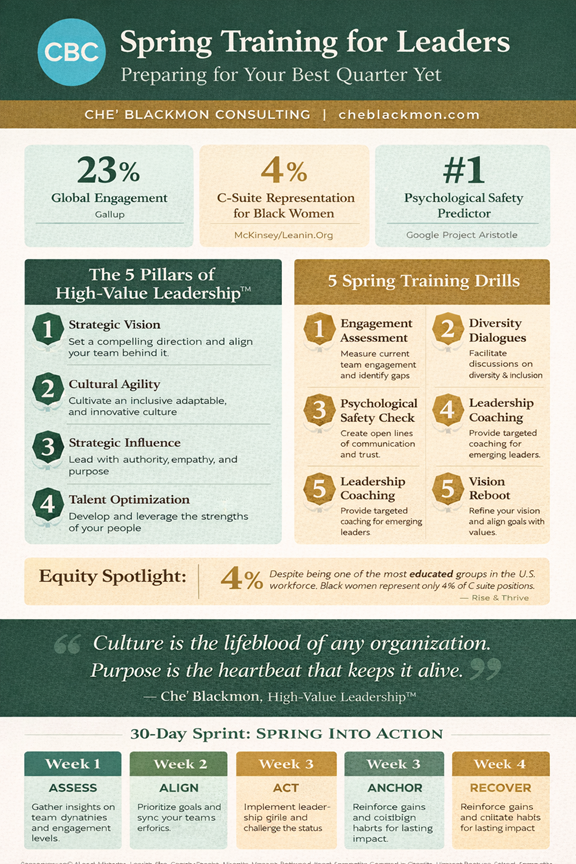
📋 Spring Training Drills: Actionable Takeaways for Leaders
The following are your core training drills for Q2. These are not aspirational ideals. They are concrete, executable actions that you can begin this week.
Drill 1: Conduct a Mid-Cycle Culture Audit 🤔
Do not wait for your annual engagement survey. Conduct a quick, focused listening session with your team. Ask three simple questions:
- What is working well right now that we should protect?
- What is holding us back that we should address?
- What do you need from me as your leader that you are not currently getting?
Then listen. Do not defend. Do not explain. Just listen. What you hear will be more valuable than any survey data.
Drill 2: Realign on Goals Together 🎯
Pull out your Q1 commitments and review them openly with your team. Celebrate what was accomplished. Acknowledge what missed the mark without assigning blame. Then collaboratively adjust the Q2 plan based on what the data and the team’s experience are telling you.
Shared ownership of the plan produces shared accountability for the outcome. Leaders who hand down targets from above without consultation are operating a command-and-control model that today’s workforce will not sustain.
Drill 3: Invest in One Person’s Development This Quarter 🌱
Identify one emerging leader on your team, particularly someone who is often overlooked, and make a deliberate investment in their development. Connect them to a stretch assignment. Introduce them to your network. Advocate for them in a meeting where they are not present.
One intentional act of sponsorship per quarter adds up over time. It builds loyalty. It builds bench strength. And it builds the kind of inclusive culture that attracts top talent.
Drill 4: Block Time for Your Own Growth 📚
Leaders who are not growing are slowly falling behind. This quarter, commit to a learning goal. Read one book that challenges your current thinking. Attend a leadership workshop. Engage a coach or consultant who will tell you the truth about your blind spots.
Continuous growth is not optional for high-value leaders. It is foundational.
Drill 5: Build in Reflection Time 🧘
The best athletes do not train without reviewing game film. The best leaders do not lead without reflection. Carve out fifteen to thirty minutes weekly, not monthly, to assess your leadership. What went well? What would you do differently? Where did you operate from your values and where did you compromise them?
Reflection without action is daydreaming. Action without reflection is chaos. The combination is mastery.
💡 Expert Insights: What the Research Is Telling Leaders Right Now
The convergence of research from organizational psychology, leadership science, and workforce analytics is pointing in a clear direction. Leaders who will thrive in the next decade share a common set of characteristics that look very different from the command-and-control models of the past.
Brené Brown’s research on vulnerability in leadership reveals that the most trusted leaders are not the ones who project infallibility. They are the ones who are willing to say, “I do not have all the answers, and I need your help.” That kind of courage is not weakness. It is the foundation of genuine team trust.
Research from Google’s Project Aristotle, which studied hundreds of internal teams over several years, found that psychological safety was the number one predictor of team effectiveness. Not individual brilliance. Not technical expertise. Psychological safety. The willingness to take interpersonal risks, to ask questions, to admit mistakes, and to offer new ideas without fear of ridicule or punishment.
And Gallup’s decades of research on the manager-employee relationship confirm what any honest employee will tell you: people do not leave companies. They leave managers. The investment organizations make in manager development is the highest-return investment they can make.
“People don’t leave companies. They leave managers. Investing in leader development is the highest-return investment an organization can make.”
🏆 A Case Study in Culture Transformation
There was a regional healthcare organization grappling with high nurse turnover, declining patient satisfaction scores, and a middle management team that was burned out and disengaged. The executive team had tried every structural fix: new scheduling software, updated benefits packages, revised onboarding protocols. Nothing moved the needle.
What was missing was not a better system. It was better leadership.
When the organization committed to a comprehensive leadership development initiative rooted in the High-Value Leadership™ framework, the results were notable. Middle managers were trained in emotional intelligence and feedback delivery. Town halls became two-way conversations rather than executive monologues. A formal sponsorship program was created to develop underrepresented employees, including Black women who had been in the organization for years without a clear path forward.
Within twelve months, voluntary turnover in the nursing staff declined meaningfully. Employee engagement scores improved. And several of the employees in the sponsorship program had been promoted into roles that expanded their scope of influence.
The culture did not change because the environment changed. It changed because the leaders changed.
📝 The Rise and Thrive Principle: Leading While Fully Yourself
For Black women in leadership, spring training carries an additional dimension. It includes the intentional work of deciding, again and again, to show up fully as yourself in spaces that have not always welcomed your wholeness.
In Rise & Thrive: A Black Woman’s Blueprint for Leadership Excellence, I write about the tax that code-switching, over-explaining, and shrinking to fit an uninclusive culture places on Black women professionals. That tax is real. It drains energy, creativity, and resilience. And it costs organizations the full benefit of the talent they claim to have hired.
Spring training for Black women leaders means something specific. It means reassessing which rooms deserve your energy and which do not. It means building a personal board of advisors who reflect where you want to go, not just where you have been. It means protecting your peace as a professional strategy, not a luxury.
And for organizations, it means creating the conditions that make it possible for Black women to lead without the constant overhead of proving their right to be there. That starts at the top. It starts with leaders who are willing to examine their own biases and do the work of creating genuinely inclusive cultures, not just diverse headcounts.
🤔 Discussion Questions for Leaders
Use these questions individually or with your leadership team as part of your Q2 spring training conversations:
- When did you last have a genuinely honest conversation with your team about what is and is not working? What made that conversation possible, or what has made it difficult?
- Who on your team is thriving, and who is struggling? What do you actually know about why, and what have you done in response?
- If you audited your organization’s promotion and development decisions over the last two years, would the outcomes reflect your stated commitment to equity? What would the data show?
- What is one leadership habit you know is holding your team back? What would it take for you to change it this quarter?
- Who are you actively sponsoring right now? If the answer is no one, who could you start sponsoring this week?
- What does your team’s culture actually reward, meaning what behaviors get recognized, celebrated, or repeated? Is that aligned with your stated values?
📋 Next Steps for Your Q2 Preparation
Spring training does not happen on its own. Here is a structured thirty-day plan to launch your best quarter yet.
- Week 1 – Assess: Conduct a listening session with your team. Review Q1 results honestly. Identify one cultural gap and one leadership habit you want to address.
- Week 2 – Align: Reconnect the team around purpose. Revisit goals and co-create the Q2 plan. Identify the emerging leader you will sponsor this quarter.
- Week 3 – Act: Launch your development investment. Begin your weekly reflection practice. Have one feedback conversation you have been putting off.
- Week 4 – Anchor: Build the structures that will sustain the momentum. Schedule regular check-ins. Create accountability mechanisms that the team owns, not just you.
Then do it again next quarter. High-value leadership is not a one-time effort. It is a sustained practice.
🌱 Ready to Build Your High-Value Culture?
Che’ Blackmon Consulting partners with organizations ready to move from intentions to transformation. Whether you are a mid-market company navigating growth, a leadership team in need of a culture reset, or a Black woman leader ready to rise without shrinking, we have a solution designed for you.
Our signature High-Value Leadership™ consulting services and the High-Value Leadership Intensive course are built from over 24 years of real-world experience transforming culture across manufacturing, healthcare, automotive, and professional services sectors.
Your best quarter starts with one conversation.
📧 admin@cheblackmon.com 📞 888.369.7243 🌐 cheblackmon.com
About the Author
Che’ Blackmon is the Founder and CEO of Che’ Blackmon Consulting (CBC), a Michigan-based culture transformation consultancy. She is a DBA candidate in Organizational Leadership at National University, where her dissertation research focuses on AI-enhanced predictive analytics for culture transformation and employee turnover prevention. With more than 24 years of progressive HR leadership experience across manufacturing, automotive, healthcare, and professional services, Che’ is the author of three published works: High-Value Leadership: Transforming Organizations Through Purposeful Culture, Mastering a High-Value Company Culture, and Rise & Thrive: A Black Woman’s Blueprint for Leadership Excellence. She hosts the podcast Unlock, Empower, Transform with Che’ Blackmon and the Rise & Thrive YouTube series. Learn more at cheblackmon.com.
#LeadershipDevelopment, #HighValueLeadership, #CultureTransformation, #SpringTraining, #Q2Goals, #EmployeeEngagement, #BlackWomenLead, #InclusiveLeadership, #HRLeadership, #WorkplaceCulture, #PurposeDrivenLeadership, #OrganizationalDevelopment, #FractionalHR, #CheBlackmon, #UnlockEmpowerTransform

Leave a Reply