

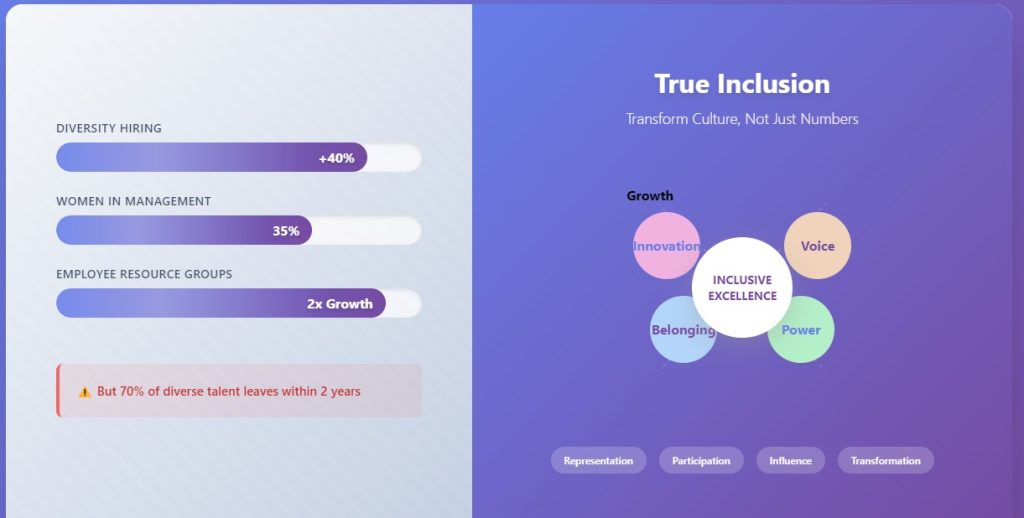
The numbers look impressive on paper. “We’ve increased diverse hiring by 40%!” “Women now represent 35% of our management!” “Our employee resource groups have doubled in size!”
Yet something’s wrong.
Despite hitting diversity targets, your organization still hemorrhages Black women within 18 months. Meetings remain dominated by the same voices. Innovation feels stagnant. And that carefully crafted diversity report can’t explain why your “diverse” leadership team still thinks, acts, and decides remarkably alike.
Here’s the uncomfortable truth: you can have diversity without inclusion, but you cannot have excellence without both.
The Metrics Trap: When Numbers Lie
Most organizations approach diversity like a math problem. Hit the percentages. Check the boxes. Publish the report. But as I’ve observed throughout my twenty-plus years transforming organizational cultures, diversity metrics without inclusive culture is like planting seeds in concrete—nothing grows.
Consider the tech company that proudly achieved 30% female representation in engineering. Within two years, 70% of those women had left. The problem wasn’t the hiring; it was what happened after. The culture remained unchanged—same communication styles rewarded, same after-work bonding rituals, same unwritten rules about who gets heard.
In “Mastering a High-Value Company Culture,” I emphasized that culture is the lifeblood of any organization. When that culture excludes—even unintentionally—diversity becomes a revolving door rather than a competitive advantage.
The Real Cost of Fake Inclusion
McKinsey’s 2023 research reveals the gap:
- Companies in the top quartile for gender diversity are 25% more likely to have above-average profitability
- BUT only when coupled with inclusive practices
- Without inclusion, diverse teams actually perform 15% worse than homogeneous ones due to unmanaged conflict
For Black women specifically, the statistics are sobering:
- 75% report having to prove themselves more than peers
- 54% experience being mistaken for someone more junior
- Only 1 in 4 feel they can bring their authentic selves to work
Understanding True Inclusion: Beyond the Surface
True inclusion isn’t about tolerance—it’s about transformation. It requires fundamentally reshaping how your organization operates, decides, and values contribution.
The Inclusion Framework That Works
Level 1: Representation (Diversity) Bodies in seats. Different faces in spaces. Important but insufficient.
Level 2: Participation (Voice) Everyone speaks, but are they heard? Many organizations stall here.
Level 3: Influence (Power) Diverse perspectives actually shape decisions and direction.
Level 4: Transformation (Evolution) The organization itself changes, becoming stronger through inclusion.
Most organizations celebrate reaching Level 1, struggle at Level 2, and never attempt Levels 3 or 4. This is why their diversity initiatives fail.
The Black Woman’s Experience: A Litmus Test for Inclusion
Want to know if your organization has achieved true inclusion? Look at the experience of Black women. As I discuss in “Rise & Thrive,” Black women navigate the intersection of race and gender, making them the canaries in the coal mine of organizational culture.
When Black women thrive in your organization—genuinely thrive, not just survive—you’ve created something special. When they leave, they’re telling you something your metrics won’t: your inclusion is performative, not transformative.
Case Study: Microsoft’s Evolution
Microsoft’s transformation under Satya Nadella provides a masterclass in moving beyond metrics to meaning. They didn’t just hire more diverse talent; they fundamentally changed their culture:
Before (Diversity Without Inclusion):
- Competitive ranking system that rewarded individual achievement
- “Know-it-all” culture that silenced different perspectives
- High diverse talent turnover despite recruitment success
After (True Inclusive Leadership):
- Collaborative evaluation emphasizing team success
- “Learn-it-all” culture that values diverse thinking
- Black women in leadership roles increased 3x with retention above 90%
The key? They changed systems, not just statistics.
Building Inclusive Leadership Culture: The Blueprint
1. Audit Your Invisible Architecture
Every organization has invisible architecture—unwritten rules that determine who succeeds. Map yours:
Communication Patterns:
- Who gets interrupted most? (Research shows Black women are interrupted 2.8x more often)
- Whose ideas need “validation” from others to be accepted?
- Which communication styles are labeled “professional”?
Decision-Making Processes:
- Where do real decisions happen? (Formal meetings or golf courses?)
- Who has access to decision-makers?
- How are different viewpoints weighted?
Advancement Pathways:
- What experiences are deemed “essential” for promotion?
- Who gets stretch assignments?
- How is “potential” defined and identified?
2. Redesign for Inclusion
Once you see the invisible, you can redesign it:
Inclusive Meeting Practices:
- Rotate meeting leadership
- Implement “no interruption” rules with enforcement
- Use written input before verbal discussion
- Credit ideas explicitly to their originators
Equitable Decision Systems:
- Require diverse decision-making teams
- Document decision criteria transparently
- Create multiple input channels
- Measure decision quality, not just speed
Advancement Equity:
- Define objective promotion criteria
- Track stretch assignment distribution by demographics
- Create sponsorship programs (not just mentorship)
- Eliminate “culture fit” in favor of “culture add”
3. Measure What Matters
Move beyond headcount to meaningful metrics:
Inclusion Indicators:
- Speaking time distribution in meetings
- Idea attribution accuracy
- Promotion velocity by demographic
- Stay interview insights (not just exit data)
Cultural Health Metrics:
- Psychological safety scores by demographic
- Belonging index variations
- Code-switching frequency reports
- Energy expenditure on cultural navigation
Innovation Outcomes:
- Ideas generated by diverse vs. homogeneous teams
- Implementation rate of diverse perspectives
- Market insights from diverse viewpoints
- Customer satisfaction across demographics
The Leadership Imperative: Personal Transformation
In “High-Value Leadership,” I emphasize that transformation begins with leaders. You cannot create what you don’t embody.
The Inclusive Leader’s Journey
Stage 1: Awareness Recognizing your own biases and blind spots. This is uncomfortable but essential.
Stage 2: Education Learning about different experiences and perspectives. Reading, listening, engaging.
Stage 3: Action Making visible changes to your leadership practice. Sponsoring differently. Listening differently. Deciding differently.
Stage 4: Advocacy Using your power to change systems. Challenging exclusionary practices. Creating new norms.
Stage 5: Accountability Measuring your impact. Accepting feedback. Continuous improvement.
Personal Inclusion Practices
Daily Actions:
- Amplify underrepresented voices in every meeting
- Question “how we’ve always done it”
- Seek input from those least like you
- Notice who’s missing from discussions
Weekly Practices:
- Review speaking time in your meetings
- Connect with someone outside your usual circle
- Sponsor someone who doesn’t look like you
- Challenge one exclusionary norm
Monthly Commitments:
- Assess your team’s inclusion metrics
- Seek feedback on your inclusive leadership
- Learn about a different cultural perspective
- Celebrate inclusive behaviors publicly
Transforming Systems, Not Just Statistics
True inclusion requires systemic change. Here’s how to architect it:
Hiring for Addition, Not Fit
Traditional: “They need to fit our culture” Inclusive: “What can they add to make us stronger?”
Example: Instead of asking “Would I want to have a beer with this person?” ask “What perspective or experience would they bring that we currently lack?”
Performance Through Inclusion Lens
Traditional: Individual achievement metrics Inclusive: Collaborative success indicators
- How well does this person elevate others?
- What diverse perspectives do they integrate?
- How do they bridge differences?
- What inclusive practices do they model?
Promotion with Purpose
Traditional: Subjective potential assessments Inclusive: Transparent capability frameworks
Create clear rubrics that value:
- Cross-cultural communication
- Inclusive team building
- Diverse network cultivation
- Systemic thinking
The Business Case That Matters
Yes, inclusion drives profit—Boston Consulting Group found that companies with above-average diversity scores have 19% higher innovation revenues. But the real case goes deeper:
Innovation Acceleration: Inclusive teams solve problems faster because they consider more options.
Risk Mitigation: Diverse perspectives identify blind spots before they become crises.
Market Intelligence: Inclusive organizations understand diverse markets authentically.
Talent Magnetism: True inclusion becomes self-reinforcing, attracting top talent.
Resilience Building: Inclusive cultures adapt better to change because they’re already flexible.
Red Flags: Signs Your Inclusion Is Performative
- Diverse hires cluster at lower levels
- “Culture fit” remains a hiring criterion
- Same voices dominate discussions
- Diversity fatigue among majority groups
- Black women and other minorities report exhaustion
- Innovation feels forced rather than flowing
- Employee resource groups lack budget or influence
- Leaders can’t name specific inclusive actions they’ve taken
Green Flags: Signs of True Inclusion
- Diverse talent seeks you out
- Meetings sound different—more voices, richer dialogue
- “Bad ideas” lead to breakthrough innovations
- Conflict becomes productive rather than destructive
- Retention equalizes across demographics
- Customer insights surprise you
- Energy increases rather than depletes
- Stories of belonging outnumber stories of bias
Your 30-Day Inclusion Acceleration Plan
Week 1: Assess Reality
- Conduct meeting audits for participation patterns
- Survey psychological safety by demographic
- Map your organization’s invisible architecture
- Identify three specific exclusionary practices
Week 2: Design Changes
- Create inclusive meeting protocols
- Develop transparent decision criteria
- Design equitable advancement pathways
- Build measurement systems
Week 3: Implement Pilots
- Test new meeting formats
- Practice inclusive decision-making
- Launch sponsorship initiatives
- Begin collecting inclusion data
Week 4: Scale and Sustain
- Share early wins
- Address resistance directly
- Expand successful practices
- Commit to long-term change
The Role of Black Women in Transformation
Organizations serious about inclusion should center Black women’s experiences—not as charity, but as strategy. When you design for those navigating the most complex challenges, you create solutions that benefit everyone.
This means:
- Seeking their input (and paying for it)
- Protecting their energy (stop making them fix your culture for free)
- Amplifying their innovations
- Following their leadership
Discussion Questions for Leadership Teams
- What’s the difference between our diversity metrics and our inclusion reality?
- How would our organization change if Black women held 30% of senior leadership positions and thrived there?
- What invisible rules in our organization would shock an outsider?
- Which of our “best practices” actually exclude diverse talent?
- How do we currently measure inclusion beyond headcount?
- What would need to change for diverse talent to stop code-switching?
- If we’re honest, does our organization want true inclusion or just better metrics?
Your Next Steps
Today:
- Observe one meeting through an inclusion lens
- Notice who speaks most and least
- Identify one exclusionary practice you can change
This Week:
- Conduct a team inclusion assessment
- Have three conversations with people unlike you
- Challenge one “way we’ve always done it”
This Month:
- Implement one systemic change
- Measure its impact
- Share learnings broadly
- Commit to the next change
The Transformation Imperative
Diversity without inclusion is not just ineffective—it’s exhausting for those carrying the weight of being “diverse.” True inclusion transforms organizations from the inside out, creating environments where excellence emerges from every corner, not just familiar ones.
The choice is clear: continue performing diversity theater with impressive metrics and disappointing results, or commit to the harder work of building truly inclusive leadership culture.
Ready to Move Beyond Metrics to Meaning?
At Che’ Blackmon Consulting, we help organizations transform diversity initiatives into inclusive excellence. We don’t just help you count different people—we help you create cultures where different people count.
Our approach includes:
- Comprehensive inclusion audits beyond traditional metrics
- Invisible architecture mapping and redesign
- Inclusive leadership development programs
- Systemic transformation strategies
- Measurement frameworks for true inclusion
Stop exhausting your diverse talent with performative inclusion. Start building cultures where everyone—especially traditionally overlooked talent—can thrive.
📧 Email: admin@cheblackmon.com
📞 Call: 888.369.7243
🌐 Visit: www.cheblackmon.com
Special Offer: Schedule an Inclusion Reality Check—a frank assessment of where your organization truly stands beyond the metrics. First 10 organizations this quarter receive a customized inclusion roadmap.
Remember: You can hit every diversity target and still fail at inclusion. True excellence requires both.
#DiversityAndInclusion #InclusiveLeadership #DEI #WorkplaceCulture #BlackWomenInLeadership #OrganizationalCulture #TalentRetention #InclusionMatters #LeadershipDevelopment #DiversityMetrics #CultureTransformation #EquityInBusiness #PsychologicalSafety #BelongingAtWork #SystemicChange