Blog

🔭 Future-Focused Leadership: Balancing Today’s Needs with Tomorrow’s Vision

By Che’ Blackmon, DBA Candidate | Founder & CEO, Che’ Blackmon Consulting

There is a tension at the center of every leader’s daily reality. The phone is ringing about this quarter’s numbers. The team is waiting on a decision. A key employee just resigned. And somewhere in the back of a leader’s mind, underneath all of it, lives the question that does not have a deadline but carries the highest stakes: where are we actually going?

This is the fundamental challenge of future-focused leadership. Not the challenge of having a vision. Most leaders have a vision. The real challenge is building organizations that can execute on the present without sacrificing the future, that can solve today’s problems without creating tomorrow’s crises, and that can develop people for roles that do not yet exist while honoring the people doing the work that exists right now.

It is a balancing act. And it is one of the most consequential skills in modern leadership.

This article draws on the principles in High-Value Leadership: Transforming Organizations Through Purposeful Culture, Mastering a High-Value Company Culture, and Rise & Thrive: A Black Woman’s Blueprint for Leadership Excellence to give leaders a practical, grounded, and research-backed framework for leading with one eye on today and both eyes on what comes next.

Because organizations that only manage the present will always be surprised by the future. And organizations led by high-value leaders will be the ones who designed it.

🏗️ The Architecture of Future-Focused Leadership

Future-focused leadership is not a personality type. It is not reserved for visionaries with bold ten-year plans or founders disrupting entire industries. It is a set of deliberate practices available to every leader who chooses to cultivate them, from the frontline supervisor managing a team of six to the chief executive leading an organization of thousands.

At its core, future-focused leadership is the discipline of operating with dual awareness: full presence in the challenges of today and genuine investment in building the capabilities, culture, and clarity the organization will need tomorrow. Neither dimension can be sacrificed for the other. A leader who is entirely present-focused builds a responsive team that runs out of road. A leader who is entirely future-focused builds an inspiring vision that never gets off the ground.

Research from the Harvard Business Review confirms that the most effective leaders operate in what researchers call the “ambi-temporal” zone, demonstrating the ability to simultaneously manage current operational demands while developing future organizational capacity. This is not multitasking. It is a structured approach to organizational leadership that requires both intentionality and infrastructure.

In High-Value Leadership: Transforming Organizations Through Purposeful Culture, the five pillars of the High-Value Leadership™ methodology provide the foundation for this dual awareness. Purpose-Driven Vision gives the leader the north star. Emotional Intelligence gives the leader the capacity to lead people through ambiguity. Authentic Connection builds the trust that sustains an organization through uncertainty. Balanced Accountability ensures that standards are maintained even when the path forward is not yet clear. And Culture as Strategy ensures that every decision, near-term and long-term, is made in service of the organization’s highest values.

Together these five pillars do not just define great leadership. They define future-ready leadership.

“Organizations that only manage the present will always be surprised by the future. High-value leaders design what comes next.” — Che’ Blackmon, High-Value Leadership™

📈 Why the Present and Future Are Not Competing Priorities

One of the most persistent and damaging myths in organizational leadership is the idea that leaders must choose between managing today and building for tomorrow. This framing produces leaders who feel perpetually behind because they believe that tending to operational demands means they are neglecting strategic development, and vice versa.

The reality is more nuanced and far more hopeful. The present and the future are not competing priorities. They are expressions of the same organizational purpose operating at different time horizons. When a leader makes a hiring decision today, that decision shapes what the organization is capable of in three years. When a leader invests in psychological safety today, that investment produces the innovation the organization will depend on next year. When a leader develops a high-potential employee today, that investment creates the next generation of organizational leadership.

Deloitte’s Global Human Capital Trends research consistently identifies organizational agility as one of the top requirements for business survival in the current economic environment. Agility, however, is not the ability to react quickly to the present. It is the capacity to have built, in advance, the people, the culture, and the processes needed to respond intelligently to whatever comes next. Agility is future-focused leadership made operational.

🔄 The Integration Imperative

The leaders who navigate this balance most effectively are those who have learned to see every present-day decision as a future-building opportunity. This does not require ignoring urgency. It requires reframing how urgency is understood.

There was a nonprofit organization navigating a leadership transition at the same time it was facing a funding shortfall. The new executive director could have spent all of her energy on the immediate crisis. Instead, she used the transition period to do something that felt counterintuitive in the moment: she slowed down to get honest about the organization’s culture, its values, and the kind of leadership it needed to thrive not just through the crisis but beyond it. She restructured meetings to include a standing agenda item called “What are we building toward?” even when the immediate pressure was “How do we make payroll?” That practice became the discipline that eventually carried the organization into its strongest fundraising year on record.

The present crisis did not disappear. It was resolved precisely because leadership never stopped building for the future while managing it.

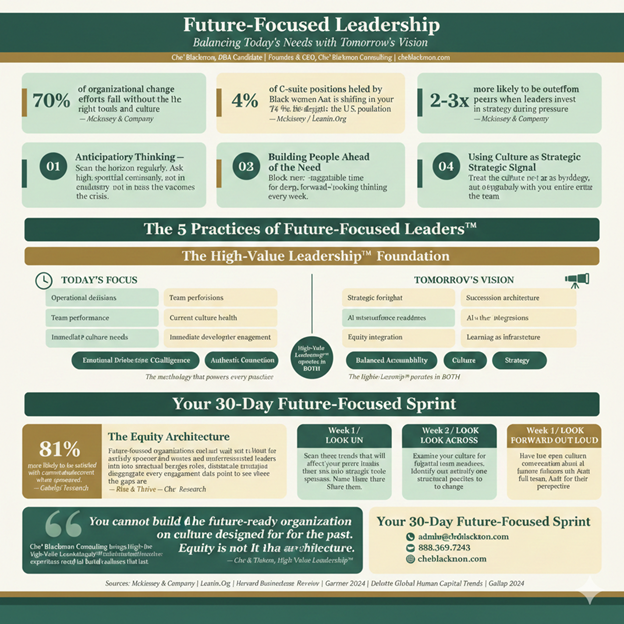
💡  Research Spotlight McKinsey & Company’s research on organizational resilience found that companies that continued strategic investment during periods of economic pressure outperformed their peers by 2 to 3 times over the following economic cycle. Resilience is not the ability to survive a crisis. It is the discipline of building during one.

🚀 The Five Practices of Future-Focused Leaders

Future-focused leadership is not an abstract philosophy. It is a set of specific, learnable practices that leaders can develop and embed into their daily leadership rhythms. The five practices below represent the intersection of research on strategic leadership, the High-Value Leadership™ methodology, and the practical realities of leading organizations through complexity.

01Practicing Anticipatory Thinking Anticipatory thinking is the disciplined habit of scanning the horizon before the horizon becomes the crisis. It means regularly asking: what is shifting in our industry, our workforce, and our competitive environment that we are not yet paying attention to? Leaders who practice this habit use tools like environmental scanning, trend analysis, scenario planning, and structured futures conversations to move from reactive to proactive. The goal is not to predict the future with certainty. It is to be surprised less often.
02Building People Ahead of the Need The most common version of this mistake is waiting until a leadership gap is visible before investing in the people who could fill it. Future-focused leaders develop talent continuously, not in response to vacancies. They identify high-potential team members, invest in their growth, create visibility for their capabilities, and sponsor them into stretch roles before those roles become critical. This practice transforms talent development from a reactive HR function into a strategic organizational asset.
03Protecting Strategic Thinking Time This practice sounds simple and is among the hardest to maintain. Future-focused leaders deliberately protect blocks of time for deep, forward-looking thinking that are not available for meetings, operational problem-solving, or email. Research from Microsoft’s Work Trend Index found that leaders who blocked protected time for strategic thinking reported significantly higher confidence in their organization’s direction and significantly lower decision fatigue. The future does not get built during back-to-back meetings. It gets built in the quiet spaces leaders choose to protect.
04Using Culture as a Strategic Signal Culture is the single most powerful signal an organization sends about its future priorities. When leaders invest in culture, they are not just making the present more pleasant. They are building the organizational architecture that will determine what the organization is capable of achieving. As Mastering a High-Value Company Culture establishes, culture is the lifeblood of any organization. Future-focused leaders treat culture not as a byproduct of strategy but as strategy itself.
05Leading Through Transparent Communication Nothing erodes future orientation faster than a communication vacuum. When leaders fail to articulate where the organization is headed and why, people fill the silence with speculation, anxiety, and self-protective behavior. Future-focused leaders communicate about the future regularly, honestly, and in the language of shared purpose. They acknowledge uncertainty without retreating from vision. They tell people not just what is happening but what it means and where it leads.

🌎 Current Trends Reshaping the Future of Leadership

Future-focused leadership does not happen in a vacuum. It happens in the context of powerful forces reshaping what organizations are, what they require, and what leadership must become to meet those requirements. Three trends in particular are redefining the leadership mandate right now.

🤖 Artificial Intelligence and the Augmented Organization

Artificial intelligence is not a future development in organizational life. It is a present reality changing how work is done, who does it, and what human leaders need to focus on. Gartner’s 2024 research found that 76 percent of HR leaders reported that their managers were overwhelmed by the scope of expanding responsibilities, and AI integration is a primary driver of that expansion.

Future-focused leaders are distinguishing themselves not by their technical expertise in AI but by their clarity about what AI cannot replace: judgment, empathy, contextual understanding, and the human capacity to build trust. The leaders who are winning in this environment are those who are investing in the skills that AI augments rather than replicates, and building organizational cultures where humans and technology are genuinely complementary rather than competing.

The equity dimension of AI adoption also demands leadership attention. Research from the Brookings Institution has identified that the workers most vulnerable to AI-related job displacement are disproportionately workers of color and women. Future-focused leaders who are also equity-conscious leaders are asking now, not later, how their AI adoption strategy will affect the most vulnerable members of their workforce and what investment they are making to ensure the benefits of AI are broadly shared.

👥 The Multi-Generational Workforce

For the first time in history, many organizations are managing workforces that span five distinct generations, from Baby Boomers in senior roles to Generation Z entering the workforce with fundamentally different expectations about work, leadership, and organizational purpose. This is not primarily a management challenge. It is a culture challenge.

Gallup’s 2024 State of the Global Workplace report found that employees’ expectations for meaningful work, manager quality, and organizational values alignment have reached an all-time high across every generation. The generational gap is not primarily about technology or communication style. It is about what people need to find their work meaningful and their leadership trustworthy.

Future-focused leaders are building cultures sophisticated enough to honor those shared needs while remaining flexible enough to meet them in different ways. They are asking not just “How do we manage this generation?” but “What are all of our people trying to tell us about what leadership needs to become?

🌍 The Equity Imperative in Strategic Planning

Organizational equity is no longer a values statement. It is a business strategy and a competitive advantage. Research from McKinsey consistently shows that organizations in the top quartile for gender and racial diversity are significantly more likely to outperform their peers financially. The pipeline of diverse talent is there. The leadership investment in creating pathways for that talent has, in most organizations, not kept pace.

Future-focused leaders understand that building an organization capable of thriving in an increasingly diverse market and workforce requires building an internal culture that reflects, develops, and advances diverse talent. This is not altruism. It is organizational intelligence.

“You cannot build a future-ready organization on a culture designed for the past. Equity is not the destination. It is the architecture.” — Aligned with High-Value Leadership™ — Culture as Strategy`

💎 The Unique Position of Black Women in Future-Focused Leadership

Any honest conversation about the future of leadership must include an honest conversation about who has historically been excluded from that future. And among the groups most consequentially excluded from strategic leadership in corporate America, Black women occupy a category that demands specific attention.

The data from LeanIn.Org and McKinsey’s 2023 Women in the Workplace report is stark and familiar. Black women hold 4 percent of C-suite positions despite making up approximately 7.4 percent of the U.S. population. Their representation decreases at every level of advancement from entry-level management through executive leadership. And research from Catalyst documents that Black women are more likely than any other demographic group to report that their leadership potential is underestimated, that their ideas are credited to others, and that their advancement is blocked by structural barriers rather than individual performance.

This is not a future problem. It is a present one with future consequences. Organizations that continue to exclude Black women from strategic leadership are building the future with a fraction of their available intelligence, perspective, and capability.

🔑 The Strategic Value of What Has Been Excluded

In Rise & Thrive: A Black Woman’s Blueprint for Leadership Excellence, the argument is made with both data and conviction: Black women do not just deserve seats at the table. They bring a perspective, a resilience, and a relational intelligence that has been refined by navigating environments not designed for their success. That navigation is not incidental experience. It is leadership development of the most demanding kind.

Research from the Center for Talent Innovation found that Black women are among the most ambitious employees in the American workforce. They are more likely than their white counterparts to want to advance to senior leadership. They are more likely to pursue graduate education and professional development. And they are more likely to leave organizations that fail to recognize and invest in their ambition, at significant cost to those organizations.

Future-focused organizations are recognizing this equation before talent walks out the door. They are building sponsorship programs specifically designed to accelerate Black women through the leadership pipeline. They are examining the structural barriers in their promotion processes. They are disaggregating engagement and advancement data to see where the gaps are and taking genuine accountability for closing them.

🏆 What Future-Focused Leadership Looks Like for Black Women Themselves

For Black women currently navigating corporate environments while also building leadership capability and managing the additional cognitive load that comes with being among the “only ones” in the room, future-focused leadership has a personal dimension that generic leadership development frameworks rarely address.

It means claiming the strategic value of the perspective you have earned. The ability to read a room, to build trust across difference, to persist with integrity under pressure: these are not soft skills. They are advanced leadership capabilities that most executive development programs take years to produce in leaders who never had to develop them in survival conditions.

It means building strategic visibility deliberately, not waiting to be noticed but architecting the conditions under which your contributions are seen, credited, and advanced. As Rise & Thrive frames it: the goal is not just to have a seat at the table. The goal is to understand the architecture of the table well enough to rebuild it.

And it means finding and building the community of sponsors, mentors, peers, and advocates who make the long game survivable. Research consistently shows that the single highest-impact career accelerator for Black women in corporate environments is sponsorship, not mentorship. A mentor advises. A sponsor opens doors. Future-focused Black women leaders are actively identifying and cultivating sponsors who will use their influence on their behalf.

📊 The Data That Demands Action Catalyst research found that Black women who had a sponsor were 81% more likely to be satisfied with their career advancement than those without one. Sponsorship during the formative stages of a career can close the structural gaps that performance alone cannot bridge. If your organization does not have a formal sponsorship program, it is building its future without half of its available leadership talent.

🧭 Building a Future-Focused Culture: The Organization’s Role

Individual future-focused leadership is necessary. It is not sufficient. The most capable, vision-driven, equity-committed leader in an organization will be limited by an organizational culture that does not support future orientation at the structural level. Building a future-focused organization requires embedding future orientation into the culture itself.

Mastering a High-Value Company Culture makes the case that culture is not the product of good intentions or leadership speeches. It is the product of consistent behaviors, aligned systems, and structural reinforcement over time. A future-focused culture is built through the same deliberate mechanisms.

🏛️ Structural Practices of Future-Focused Organizations

Strategic Foresight as a Standing Practice 🔭

Future-focused organizations do not just conduct strategic planning annually. They build foresight into their regular operating cadence. Quarterly environmental scans, standing agenda items for emerging trends, scenario planning exercises, and structured conversations about organizational futures are embedded into the leadership rhythm. The future is not a once-a-year conversation. It is a continuous one.

Succession Architecture Built Before the Need 🏗️

Organizations that invest in succession planning before they have a crisis to manage are building the most important form of organizational resilience: leadership continuity. This means identifying the critical roles across the organization, assessing who is being developed to fill them, creating active development plans for high-potential candidates, and tracking progress with the same rigor as financial metrics. It also means examining who is absent from those succession pools and why.

Learning as a Strategic Investment 📚

The LinkedIn Workplace Learning Report consistently identifies continuous learning culture as one of the top predictors of organizational resilience. Organizations that invest in learning are not just keeping their people current. They are building the adaptive capacity that makes organizational evolution possible. Future-focused organizations budget for learning the way they budget for infrastructure because it is infrastructure.

Feedback Loops That Actually Inform the Future 🔄

Future-focused organizations have mechanisms for bringing frontline intelligence into strategic decision-making. They recognize that the people closest to the work often see the future most clearly: what customers are asking for, what processes are breaking down, what capabilities are missing. Creating genuine feedback loops, not performance reviews or engagement surveys that get filed away, but real mechanisms for organizational intelligence to flow upward, is one of the highest-leverage investments a future-focused culture can make.

🏆 A Case Study in Future-Focused Leadership

There was a regional financial services firm that had operated successfully for several decades with a leadership team that was almost entirely homogeneous, senior, and deeply embedded in the practices that had produced past success. The firm was profitable. It was also falling behind. Younger clients were choosing competitors with more digitally agile service models. The pipeline of mid-level talent was leaking. And the leadership team, for all its experience, had almost no representation from the communities that made up the growing majority of its client base.

A new chief people officer arrived with a mandate that was simultaneously operational and strategic: stabilize talent retention and build a leadership pipeline for the next decade. Her approach was precisely future-focused in the way this article defines it.

She began not by reorganizing or restructuring but by diagnosing. She commissioned a culture assessment that revealed a fundamental misalignment: the firm’s stated values emphasized innovation and client-centricity, but its actual practices rewarded tenure and conformity. The future it said it wanted and the present it was actually building were not the same organization.

From that diagnosis she built a three-year talent strategy that did two things simultaneously. It addressed the present by redesigning onboarding and early career development programs that had a 40 percent dropout rate in the first eighteen months. And it invested in the future by creating a formal sponsorship program specifically targeting high-potential employees from underrepresented backgrounds, including several Black women in analytical and client service roles who had strong performance records and no organizational visibility.

Three years later, the firm had reduced early-career attrition by more than half. Two of the women from the sponsorship cohort had moved into director-level roles. And the leadership team had its first two members from communities of color in the firm’s history, both of whom were credited with leading the digital transformation of the firm’s client engagement model.

The present and the future had been built at the same time. Neither was sacrificed for the other. And the firm’s most important competitive assets going forward were the people they had almost let walk out the door.

“Future-focused leadership is not about predicting what comes next. It is about building organizations worthy of the people who will lead them there.” — Che’ Blackmon

📋 Actionable Takeaways for Leaders at Every Level

Future-focused leadership is not a transformation that happens overnight. It is a direction that is chosen and then reinforced through practice. The following takeaways are designed to be applicable regardless of your current role, your organization’s size, or the urgency of the present demands you are navigating.

01Audit Your Calendar Your calendar is the most honest map of your actual priorities. How much time do you spend reacting versus building? Block one hour per week as non-negotiable strategic thinking time. Protect it. Name it. Treat it with the same seriousness as your most important client meeting. That one hour, maintained consistently over a year, will produce more organizational value than the vast majority of meetings it replaces.
02Name Your Horizon Clarity about the future begins with being specific about what future you are building toward. Not a tagline. An actual, honest articulation of what this organization is trying to become in three to five years and why that matters. If you cannot articulate it clearly, you cannot lead toward it. If your team cannot articulate it, they are not building toward it either.
03Identify the Three People You Are Building Look at your team right now. Who are the three people with the highest potential for the next level of leadership? Are you actively investing in their development? Do they have sponsors who are advocating for them in rooms they are not yet in? If you cannot name them immediately, that gap is one of the most important future-focused investments you can make right now.
04Ask the Equity Question Every Time Every decision about talent, about culture, and about organizational direction should be accompanied by the equity question: who benefits from this decision and who is disadvantaged by it? Not because equity is a constraint on strategy. Because organizations that build equity into their strategic architecture have access to the full breadth of human capability. Those that do not are building the future with one hand tied behind their back.
05Tell the Future Story Now Do not wait until the strategy is perfect to communicate it. People cannot orient themselves toward a destination that has not been named. Talk about the future of your organization openly, honestly, and regularly. Include your team in shaping it. The act of naming the future together is itself a future-building practice. It creates shared ownership of a direction rather than employee compliance with a plan.

🤔 Discussion Questions

Use these questions individually or with your leadership team to deepen your practice of future-focused leadership.

  1. What is the ratio of time your leadership team currently spends on operational management versus strategic development? Is that ratio intentional, and if not, what would you change it to?
  2. Who are the people in your organization with the highest future leadership potential? What structured investment is being made in their development, and who is sponsoring their advancement?
  3. What signals from your external environment, your workforce, and your industry are you currently paying insufficient attention to? What would it take to make anticipatory thinking a regular practice in your leadership?
  4. When you disaggregate your succession planning data by race and gender, what does it reveal? If your future leadership pipeline does not reflect the diversity of your workforce and the communities you serve, what is the first structural change you need to make?
  5. How clearly can you articulate your organization’s future direction in language your entire team would recognize and believe? What is the gap between the future you say you are building and the present you are actually constructing?
  6. For Black women and other underrepresented leaders reading this article: what does your organization’s future currently offer you? And what would you need to see, structurally, to believe it is being built with you rather than around you?

📋 Next Steps: Your 30-Day Future-Focused Leadership Sprint

The distance between reading and leading is action. Here is a four-week plan to begin practicing future-focused leadership immediately, regardless of where you are starting from.

Week 1Look Up Dedicate one hour to an honest environmental scan of your industry. What are three trends that will materially affect your organization in the next three years? Write them down. Share them with your leadership team. Begin the conversation about what they require.
Week 2Look In Conduct a talent audit focused on the future. Who are the three highest-potential people on your team? Who is sponsoring them? What development investment is currently in place? Identify the single most important gap and commit to a concrete action to begin closing it.
Week 3Look Across Examine your culture for future-readiness. Review how decisions are currently made, how feedback flows, how learning is resourced, and how succession is planned. Identify the one cultural practice that most limits your organization’s future orientation and propose one structural change.
Week 4Look Forward Out Loud Communicate about the future with your full team. Not a polished presentation. An honest, open conversation about where you are going, what you are building, and what their role is in shaping it. Ask for their perspective. Listen without defensiveness. The future belongs to everyone who helps build it.

🌱 Ready to Lead Into the Future?

Che’ Blackmon Consulting partners with organizations and leaders committed to building cultures that are not just strong today but genuinely ready for tomorrow. Through the High-Value Leadership™ methodology, fractional HR leadership, and culture transformation consulting, we bring the frameworks, the expertise, and the equity-centered perspective to help you build organizations that last.

The future of your organization is being built right now. The question is whether you are building it on purpose.

📧 admin@cheblackmon.com     📞 888.369.7243     🌐 cheblackmon.com

About the Author

Che’ Blackmon is the Founder and CEO of Che’ Blackmon Consulting (CBC), a Michigan-based culture transformation consultancy. She is a DBA Candidate in Organizational Leadership at National University, with dissertation research focused on AI-enhanced predictive analytics for culture transformation and employee turnover prevention. With more than 24 years of progressive HR leadership experience across manufacturing, automotive, healthcare, and professional services, Che’ is the published author of High-Value Leadership: Transforming Organizations Through Purposeful Culture, Mastering a High-Value Company Culture, and Rise & Thrive: A Black Woman’s Blueprint for Leadership Excellence. She hosts the podcast Unlock, Empower, Transform with Che’ Blackmon and the Rise & Thrive YouTube series. Learn more at cheblackmon.com.

#FutureFocusedLeadership, #HighValueLeadership, #LeadershipDevelopment, #CultureTransformation, #StrategicLeadership, #OrganizationalChange, #WorkplaceCulture, #BlackWomenLead, #InclusiveLeadership, #HRLeadership, #SuccessionPlanning, #EmployeeEngagement, #FractionalHR, #CheBlackmon, #UnlockEmpowerTransform

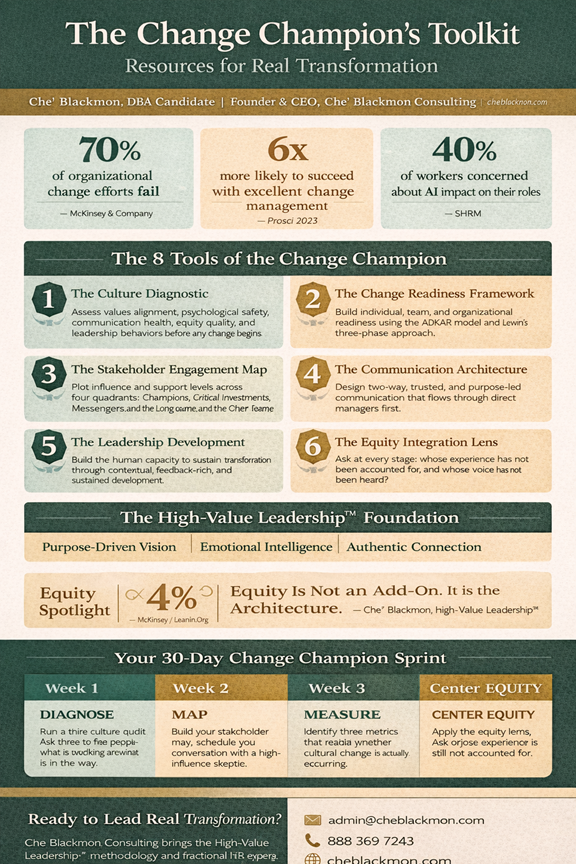
🛠️ The Change Champion’s Toolkit: Resources for Real Transformation

By Che’ Blackmon, DBA Candidate | Founder & CEO, Che’ Blackmon Consulting

Real organizational transformation is one of the most misunderstood and mismanaged challenges in business today. Most leaders know change is necessary. Many have the vision. Far fewer have the practical resources, the structured approach, and the cultural competency to make that change last.

Change is not a project with a start date and an end date. It is a sustained shift in the way an organization thinks, behaves, and measures success. And the person standing at the front of that shift, the one making the case, absorbing the resistance, and keeping the momentum alive when the excitement fades, is the Change Champion.

You may already be that person. Or you may be building toward it. Either way, this article is your toolkit.

Drawing from the frameworks I developed in High-Value Leadership: Transforming Organizations Through Purposeful Culture, Mastering a High-Value Company Culture, and Rise & Thrive: A Black Woman’s Blueprint for Leadership Excellence, this piece gives you the tangible, research-grounded, and practically tested resources you need to lead transformation that actually sticks. We will examine the tools, the mindsets, the data, and the human elements that separate performative change from transformative change.

Because in organizations where the culture is alive and people are seen, change does not have to be forced. It becomes the natural outcome of great leadership.

🌊 What Real Transformation Actually Requires

Before we talk about tools, we have to tell the truth about transformation. The research is sobering. McKinsey & Company reports that approximately 70 percent of organizational change efforts fail. Not because the strategy was wrong. Not because the budget was insufficient. Because leaders underestimated the human dimension of change.

Dr. John Kotter, whose eight-step model for leading change has guided organizations for decades, argues that the single greatest reason transformation initiatives collapse is a failure to create a strong enough guiding coalition early in the process. Change does not succeed because of announcements. It succeeds because of sustained, committed, culturally aligned leadership at every level of the organization.

In Mastering a High-Value Company Culture, the core premise is clear: culture is the lifeblood of any organization. And that premise becomes most urgent during times of change. When an organization is in transition, culture is either a tailwind accelerating the effort or a headwind pushing against everything the leadership team is trying to accomplish.

Real transformation requires three things that no technology, no consultant, and no training program can substitute for. It requires genuine leadership commitment, not just executive sponsorship on paper. It requires authentic employee involvement, not just communication cascades. And it requires a clear-eyed understanding of the cultural terrain the organization is navigating.

The tools in this article are designed to strengthen all three.

“Culture is either the wind at your back or the wall in your way. Real transformation begins with knowing which one you are dealing with.” — Che’ Blackmon

📊 Tool 1: The Culture Diagnostic

You cannot transform what you have not honestly assessed. A culture diagnostic is the starting point of every meaningful change effort, and it is also the step that most organizations rush past or skip entirely.

A culture diagnostic is not the same as an employee satisfaction survey, though surveys can be one input. A true diagnostic asks deeper questions. It examines the values that are espoused versus the values that are actually practiced. It looks at communication patterns, decision-making processes, how conflict is handled, who gets promoted, whose voices are amplified, and whose concerns are dismissed. It reveals the invisible architecture of the organization, the unwritten rules that govern behavior far more powerfully than any handbook or policy document.

🔍 What to Assess in a Culture Diagnostic

The most effective culture diagnostics examine the following dimensions. Each one reveals a different layer of the organizational culture and together they form a complete picture of what transformation is up against.

01Values Alignment Do employees know the organization’s stated values? More importantly, do they believe those values are actually practiced by leadership? A gap between stated and lived values is one of the most reliable predictors of disengagement and turnover.
02Psychological Safety Can people speak truth without fear of consequences? Harvard professor Amy Edmondson’s research has shown that psychological safety is the bedrock of high-performing teams. If your culture punishes honest feedback, your transformation effort will be built on sand.
03Communication Health How does information flow in your organization? From the top down only? Is frontline knowledge making its way back to decision-makers? Organizations where information travels in one direction are almost always underperforming their potential.
04Equity and Inclusion Quality Are all employees experiencing the culture the same way? Invariably they are not. Disaggregating engagement data by race, gender, department, and tenure reveals the gaps that aggregate scores obscure.
05Leadership Behaviors What behaviors does leadership model daily? Research consistently shows that employees watch leadership behavior far more closely than they listen to leadership messaging. Culture is what leaders do, not what they say.

There was a professional services firm that had invested significantly in a new culture initiative built around their stated values of integrity, innovation, and inclusion. Engagement scores were flat. Turnover among high performers was rising. When leadership finally commissioned a real culture diagnostic rather than another engagement survey, the results were revelatory. Employees rated integrity highly in leadership communication but poorly in promotion decisions. Innovation was celebrated in town halls but penalized in day-to-day interactions when ideas challenged the status quo. And inclusion scores among employees of color were dramatically lower than among white employees, a gap the aggregate reporting had been masking for years.

The diagnostic did not solve those problems. But it gave leadership, for the first time, an honest map of the terrain. And that map made real transformation possible.

🛠️  Actionable Takeaway Commission or conduct a culture diagnostic before launching any major change initiative. Include both quantitative data (survey scores, turnover rates, promotion patterns) and qualitative data (focus groups, one-on-one listening sessions, open-ended questions). Disaggregate every data point by demographic. What you find in the gaps is where the work is.

🧠 Tool 2: The Change Readiness Framework

Once you know what the culture is, the next question is whether the organization is ready to change it. Change readiness is not the same as change willingness. People may intellectually agree that change is necessary and emotionally resist it at the same time. That is not hypocrisy. It is human nature.

Kurt Lewin’s foundational change model identifies three phases of transformation: unfreezing the current state, moving to the desired state, and refreezing new behaviors into the culture. The unfreezing phase is the most underinvested and the most critical. It is where leaders must create the cognitive and emotional case for change before the structural and operational changes begin.

A change readiness framework helps leaders assess and build readiness at three levels: individual, team, and organizational. Each level requires different interventions, different communication strategies, and different timelines.

📋 The Three Levels of Change Readiness

Individual Readiness 🧑

Individual readiness centers on the ADKAR model, developed by Jeff Hiatt of Prosci, which identifies five building blocks of successful individual change. Awareness of the need for change. Desire to support the change. Knowledge of how to change. Ability to demonstrate new skills and behaviors. And Reinforcement to sustain the change. When individuals are missing any one of these building blocks, the change fails at the human level regardless of what the organizational chart says.

Team Readiness 🤝

Team readiness is assessed through examining team dynamics, trust levels, and the clarity of team roles within the change initiative. Teams that lack psychological safety will resist change not because they oppose the direction but because the environment does not feel safe enough to take the risks that change requires. High-value leaders invest in team readiness by building trust before asking for transformation.

Organizational Readiness 🏛️

Organizational readiness examines structure, capacity, and systems. Does the organization have the resources, the governance, and the management infrastructure to support the change? Are incentive systems aligned with the desired new behaviors or are they quietly rewarding the old ones? Organizations often announce values-based culture shifts while continuing to promote and reward leaders whose behaviors directly contradict those values. That misalignment kills transformation every time.

💡  Research Spotlight Prosci’s 2023 Benchmarking Report found that projects with excellent change management practices were six times more likely to meet or exceed objectives. The difference was not in the quality of the change plan. It was in how thoroughly leaders invested in preparing people for the change before it launched.

🗣️ Tool 3: The Stakeholder Engagement Map

Every transformation effort has stakeholders. Not all of them are equal in their influence, and not all of them are visible in the organizational chart. A stakeholder engagement map is a strategic tool that gives Change Champions a clear picture of who holds formal and informal power in the organization, what each stakeholder’s current posture toward the change is, and what it will take to move them from resistance or neutrality to active support.

The most effective engagement maps plot stakeholders on two dimensions: their level of influence over the change and their current level of support for it. This creates four quadrants that require four different engagement strategies.

🗺️ The Four Quadrant Engagement Model

High Influence, High Support: Your Champions 🏆

These are the people you protect and leverage. They are already with you. Your job is to give them the platform, the resources, and the visibility to amplify the change on your behalf. One vocal champion in the right room is worth a hundred carefully crafted communications.

High Influence, Low Support: Your Critical Investment ⚠️

This is where your strategic energy belongs. These are the people who can stop the change or accelerate it. Understand their concerns. Meet with them directly and genuinely. Listen more than you talk. Often, resistance from high-influence stakeholders is not about the destination but about the process: they do not feel heard, consulted, or respected in how the change is being led.

Low Influence, High Support: Your Messengers 📣

These individuals may not have formal authority but they have credibility with their peers. They are often frontline employees, informal leaders, and trusted voices in the hallways and break rooms where real opinions are formed. Invest in these people. Equip them with information and involve them in the design of change. They will carry the message further and more authentically than any top-down communication campaign.

Low Influence, Low Support: Your Long Game ⏳

Do not ignore this quadrant, but do not overinvest here early. Focus on shifting the broader culture through the first three quadrants first. As the culture shifts and the change gains momentum, many in this quadrant will move on their own.

There was a manufacturing company that launched a workplace safety transformation after a series of near-miss incidents. Leadership developed a comprehensive program, communicated it extensively, and trained every employee. Six months in, safety incident rates had not improved. A stakeholder mapping exercise revealed the problem. Two of the most respected supervisors on the plant floor, people with enormous informal influence over the hourly workforce, were in the high influence and low support quadrant. They believed the initiative was management performance theater rather than genuine concern for worker safety. Once leadership engaged them directly, involved them in redesigning key elements of the program, and gave them formal roles in the rollout, the entire dynamic shifted. Within two quarters, safety metrics improved significantly.

The program did not change. The stakeholder engagement strategy did.

🛠️  Actionable Takeaway Before your next change initiative launches, build your stakeholder map. Identify every person with formal or informal influence. Assess their current support level honestly. Then create individualized engagement plans for your high-influence stakeholders before you launch broadly. The conversations you have in the planning stage will determine the outcomes in the execution stage.

📚 Tool 4: The Communication Architecture

Poor communication is cited in virtually every study of failed organizational change as a primary contributing factor. And yet most change communication is not really communication at all. It is announcement. It is information transfer. It is leadership talking at people rather than talking with them.

A communication architecture is a deliberate system for designing and delivering change messages that create clarity, build trust, and invite participation. It is not a communication plan in the traditional sense, which typically maps messages to milestones. It is a framework for how communication happens throughout the entire transformation journey.

📡 The Five Principles of Transformative Communication

Principle 1: Lead with the Why 🎯

Simon Sinek’s research on the power of purpose is directly applicable to change communication. Before employees can commit to a new direction, they need to understand why it matters. Not why it matters to the organization’s strategic objectives, but why it matters to them, to their work, to their teams, and to the people they serve. The why is the engine of transformation. Every communication should return to it.

Principle 2: Make It Two-Way 🔄

Genuine communication includes listening. Town halls where executives present and employees politely sit are not communication. They are performance. The organizations that lead change effectively create real feedback loops: listening sessions, anonymous input channels, manager-facilitated team discussions, and skip-level conversations. They then demonstrate that they heard by adjusting based on what they learned. That responsiveness is what builds trust.

Principle 3: Communicate Through Trusted Voices 🧑‍🤝‍🧑

Employees believe their direct manager far more than they believe the CEO. Research from Edelman’s Trust Barometer consistently shows that an employee’s direct supervisor is among the most trusted sources of information in any organization. Change communication strategies that rely primarily on executive messaging and skip the middle layer are structurally flawed. Equip managers first. Make them believers and ambassadors before the organization-wide communication begins.

Principle 4: Communicate Early, Often, and Honestly 🕒

The vacuum created by insufficient communication is not neutral. It is filled immediately by rumor, speculation, and fear. Over-communicate during change. And when you do not have all the answers, communicate that honestly. Nothing builds trust during uncertainty like a leader who says clearly: here is what we know, here is what we are still working through, and here is when we will update you again.

Principle 5: Celebrate Progress Publicly 🎉

Change is exhausting. The people carrying it forward need to see that it is working. Celebrate early wins publicly and specifically. Name the people who contributed. Connect the milestone to the larger purpose. Recognition during change is not just motivational. It is evidence that the transformation is real and that leadership notices who is showing up for it.

💼 Tool 5: The Leadership Development Investment

You cannot transform an organization without transforming its leaders. This is the truth that organizational change theory acknowledges and organizational change practice consistently underinvests in.

In High-Value Leadership: Transforming Organizations Through Purposeful Culture, the case is made at length that leadership development is not a training event. It is an ongoing investment in the human capacity to create and sustain high-performing cultures. The five pillars of the High-Value Leadership™ methodology, purpose-driven vision, emotional intelligence, authentic connection, balanced accountability, and culture as strategy, are not competencies that can be checked off a list. They are developed over time through reflection, feedback, practice, and coaching.

Organizations that launch transformation initiatives without investing in the leadership capacity required to sustain them are setting themselves up for the 70 percent failure rate McKinsey documents. Leadership development is not a support activity for change. It is the change.

🌱 What Meaningful Leadership Development Looks Like

Meaningful leadership development during transformation has four components that distinguish it from traditional training programs.

01It is contextual Development is tied directly to the specific change the organization is navigating, not generic leadership competencies disconnected from the work at hand. Leaders are learning skills and frameworks they need to apply today, not in some abstract future scenario.
02It includes honest feedback Leaders receive real, actionable feedback about how their current behaviors are supporting or undermining the transformation. This requires psychological safety within the leadership team itself, which is often the most important and most neglected investment an organization can make.
03It is sustained over time A two-day leadership retreat does not develop leaders. It introduces concepts. Sustained development requires ongoing coaching, peer accountability, and structured opportunities to practice new behaviors and reflect on the results.
04It models what the culture is trying to become If the transformation is aimed at building a more inclusive, psychologically safe, and purpose-driven culture, the leadership development experience must itself be inclusive, psychologically safe, and purpose-driven. You cannot develop leaders through experiences that contradict the values you are trying to build.

💎 Tool 6: The Equity Integration Lens

No toolkit for organizational transformation is complete without a tool specifically designed to address what has historically been the most overlooked dimension of change: who benefits from the transformation and who gets left behind in it.

Research from McKinsey, Deloitte, and the Harvard Business Review consistently shows that change initiatives that do not explicitly account for equity in their design produce outcomes that widen existing gaps rather than close them. This is not because change champions intend to create inequitable outcomes. It is because systems that are not intentionally designed for equity default to replicating the inequities already built into the organization.

The equity integration lens is a practice of asking, at every stage of the change process, whose experience has not been accounted for, whose voice has not been heard, and whose barriers have not been addressed. It is not a checkbox. It is a discipline.

📌 The Specific Impact on Black Women in Corporate Spaces

In Rise & Thrive: A Black Woman’s Blueprint for Leadership Excellence, the experience of Black women navigating organizational change is examined with particular care. And the pattern that emerges is both consistent and consequential.

When organizations undergo transformation, Black women are disproportionately affected in several ways that standard change management frameworks do not address. They are more likely to have their ideas for change dismissed before they reach decision-makers. They are more likely to be assigned the implementation labor of change without being given the authority or the credit that should accompany it. They are more likely to experience the psychological burden of advocating for equity within a change process that does not explicitly center it. And they are less likely to be in the rooms where the key decisions about the change are being made.

📊 The Data Behind the Experience According to LeanIn.Org and McKinsey’s 2023 Women in the Workplace report, Black women are the most underrepresented group in corporate America’s management pipeline. They are also the group that reports the highest levels of interest in advancement, meaning the gap is not one of aspiration. It is one of access, structure, and organizational design. Any transformation that does not address this gap is, by definition, incomplete.

There was a technology company that launched a high-profile culture transformation centered on the theme of bringing your whole self to work. The initiative received strong executive support and was broadly communicated as a commitment to inclusion. Twelve months later, exit interviews revealed that the initiative had not improved retention among Black women employees. In fact, it had declined slightly. When leadership examined the data more closely, they discovered that the bring your whole self messaging had not been accompanied by any structural change to how performance was evaluated, how promotions were decided, or how complaints about bias were handled. The invitation to be authentic had been extended without any of the structural protections that make authenticity safe.

The lesson is not that the initiative was wrong. The lesson is that cultural transformation requires both messaging and mechanism. The equity integration lens ensures that the mechanisms are built into the transformation design from the beginning, not added as an afterthought.

🔑 What Equity Integration Looks Like in Practice

Disaggregate Your Data 📊

Every engagement score, every retention rate, every promotion statistic should be broken down by race, gender, tenure, and department. Aggregate data hides the most important stories. When you see the gaps, you know exactly where to focus the transformation.

Include Equity in the Change Charter 📝

The documents that formally govern the transformation initiative should include explicit equity goals, measurable outcomes, and accountable owners. If equity does not appear in the change charter, it will not appear in the results.

Create Structural Sponsorship 🏆

Transformation creates visibility and opportunity. Ensure that Black women and other underrepresented professionals are actively sponsored into the roles, committees, and conversations that shape how the change unfolds. Sponsorship during change is not tokenism. It is organizational intelligence. You need the perspective of everyone the transformation will affect.

Audit the Process, Not Just the Outcomes 🔍

Equity audits should examine not just whether outcomes are equitable but whether the process of change itself is equitable. Who was consulted in the design phase? Whose needs shaped the implementation timeline? Who was given resources and whose resource requests were denied? Equitable outcomes require equitable processes.

“Transformation that does not ask who is being left out is not transformation at all. It is reorganization with better branding.” — Che’ Blackmon

📲 Tool 7: The Digital and AI Integration Strategy

We are living through one of the most significant technological transformations in the history of work. Artificial intelligence is reshaping workflows, eliminating roles, creating new ones, and generating both opportunity and anxiety at every level of organizations. For Change Champions, the integration of AI into organizational culture is not a future agenda item. It is a present and urgent challenge.

The Society for Human Resource Management reports that more than 40 percent of workers express concern about AI’s impact on their jobs. That anxiety, left unaddressed, becomes a cultural force that slows every other transformation effort the organization is attempting. When people are afraid, they do not innovate. They protect. They resist. They disengage.

The digital and AI integration strategy is a tool for giving leaders a structured approach to managing this dimension of change in a way that is transparent, human-centered, and equitable.

🤖 Three Principles for Human-Centered AI Integration

Involve Before You Deploy 🤝

Organizations that involve employees in the evaluation and design of AI tools before deployment consistently achieve better adoption rates and lower anxiety levels than those that simply announce new systems. This is not primarily about employee buy-in as a tactic. It is about organizational intelligence. The people doing the work know where AI will genuinely help and where it will create new problems. Their knowledge makes the implementation better.

Communicate the Why and the What Next 🎯

When AI eliminates or significantly changes a role, the organization has an obligation to communicate not just that the change is happening but what support will be provided for the people affected. Reskilling investments, internal mobility programs, and transition timelines are not optional in a human-centered AI strategy. They are the baseline.

Watch the Equity Implications Closely 👁️

Research from the Brookings Institution and the National Bureau of Economic Research shows that the roles most vulnerable to displacement by AI are disproportionately held by workers of color and women. Change Champions must apply the equity integration lens with particular intensity to AI transformation to ensure that the efficiency gains of technology adoption are not built on the disproportionate displacement of the organization’s most vulnerable employees.

💡  Current Trend Watch Gartner’s 2024 HR Technology research identifies AI-augmented HR analytics as one of the fastest-growing areas of investment in organizational development. Forward-thinking organizations are using predictive analytics not just to identify at-risk talent but to identify culture transformation opportunities before disengagement becomes turnover. This is the intersection of AI and culture strategy that Che’ Blackmon Consulting is actively building toward.

📏 Tool 8: The Measurement and Momentum System

Transformation without measurement is aspiration. Change Champions need a measurement system that tracks not just whether the outputs of change are being delivered but whether the cultural shift the change is intended to produce is actually occurring.

Most organizational measurement systems are output-focused. They count the number of training sessions completed, the policies updated, the communications sent. These are process measures, and they are necessary. But they are not sufficient. The measure that matters most in cultural transformation is behavioral change: are people actually leading and working differently than they were before?

📊 Building a Transformation Scorecard

An effective transformation scorecard includes measures across four categories. Each category captures a different dimension of whether the change is producing the culture it was designed to create.

01Lagging Indicators These are outcome measures that tell you whether the transformation achieved its intended results: employee engagement scores, voluntary turnover rates, promotion equity ratios, customer satisfaction, and financial performance. These move slowly and reflect the cumulative effect of everything else.
02Leading Indicators These are early-warning and early-confirmation measures that tell you whether the transformation is on track before the lagging indicators move: manager feedback quality scores, psychological safety assessments, frequency of cross-functional collaboration, and rate of idea generation and implementation.
03Behavioral Indicators These are direct observations of whether leaders and employees are demonstrating the behaviors the transformation requires: participation rates in listening sessions, the degree to which decisions reflect the new values, how conflict is being handled, and whether previously silenced voices are now being heard.
04Equity Indicators These are disaggregated measures that reveal whether the transformation is producing equitable outcomes across demographic groups: promotion rates by race and gender, pay equity progress, representation in high-visibility roles and projects, and differential engagement scores by employee group.

The momentum system is the accountability structure that keeps the measurement alive and action-oriented. Regular transformation reviews at the leadership team level, where scorecard data is reviewed honestly and without defensiveness, create the rhythm of accountability that sustains change over time. Without this rhythm, transformation becomes a series of one-time events rather than a sustained cultural evolution.

🛠️  Actionable Takeaway Build your transformation scorecard before your change initiative launches. Identify at least two measures in each of the four categories. Assign ownership for each measure. Set up a 90-day cadence of leadership review. When the data shows the change is not landing as intended, treat that as intelligence rather than failure and adjust accordingly.

🏆 A Case Study in Toolkit Application

There was a regional healthcare system facing simultaneous pressure from three directions: accelerating regulatory requirements, a wave of post-pandemic leadership departures, and deeply declining morale scores across nursing and administrative staff. The executive team recognized that the situation demanded more than operational fixes. It required genuine culture transformation.

They began with Tool 1: a comprehensive culture diagnostic that revealed three critical findings. First, frontline staff did not believe leadership was honest with them during difficult periods. Second, employees of color, particularly Black women in nursing leadership, reported significantly lower scores on belonging and advancement fairness than their white peers. Third, the middle management layer was both the most overwhelmed and the most under-supported group in the organization.

Using the Change Readiness Framework, leadership identified that the organization was high on organizational willingness to change but low on individual readiness, particularly among middle managers who were being asked to lead a transformation they had not been adequately prepared to lead.

The Stakeholder Engagement Map revealed two chief nursing officers whose informal influence across the system was enormous. Both were initially in the skeptical quadrant. Once they were brought into the design process as genuine partners rather than recipients of the plan, their posture shifted and their influence became one of the transformation’s greatest assets.

The Communication Architecture was redesigned to flow through direct managers first, with executive messaging following rather than leading. A monthly listening forum was established where any employee could raise concerns directly with the transformation steering committee.

Equity integration was written into the transformation charter with specific measurable commitments around representation in leadership development programs, promotion rate equity, and disaggregated engagement reporting.

Twelve months in, voluntary turnover in nursing had declined. Engagement scores improved most sharply among employees of color. And three of the Black women in nursing leadership had been promoted into expanded roles, two of whom had been explicitly identified and sponsored through the transformation’s equity initiative.

The transformation was not finished. It rarely is. But it was real. And it was measurable. And it was built on a toolkit rather than a hope.

“Transformation is not an event. It is a practice. And the organizations that sustain it are the ones that invest in the tools, not just the timeline.”

🤔 Discussion Questions

Use these questions individually or with your leadership team to deepen your engagement with the ideas in this article.

  1. If you commissioned an honest culture diagnostic in your organization today, what do you think it would reveal that your current data is not showing you? What would you be most afraid to find?
  2. Who are the high-influence, low-support stakeholders in your organization’s most important current change effort? What is the honest story of why they are not yet with you, and what would it take to genuinely engage them?
  3. How does your organization’s communication during change compare to the five principles described in this article? Where is the biggest gap?
  4. When your organization disaggregates engagement and advancement data by race and gender, what does it reveal? If you have not done this, what is preventing it?
  5. Which of the eight tools in this article is most urgently needed in your organization right now? What is the first concrete step you could take this week to begin applying it?
  6. How are Black women and other underrepresented professionals currently experiencing your organization’s culture transformation efforts? Do you know? And if not, what does it say that you do not?

📋 Next Steps for Change Champions

Knowing the tools is only the beginning. Application is where transformation happens. Here is a structured 30-day next step plan to move from reading to leading.

Week 1Diagnose Select one area of your culture or one change initiative currently underway and conduct a mini culture audit. Ask three to five employees directly: what is working about how we are leading this change, and what is getting in the way? Listen without defending.
Week 2Map Build a stakeholder map for your current or upcoming change effort. Be honest about who is not yet with you and why. Schedule a one-on-one conversation with at least one high-influence, low-support stakeholder before the week is out.
Week 3Measure Identify the three metrics that would most honestly tell you whether your transformation is producing real cultural change rather than just activity. If your current measurement system does not include those metrics, propose adding them.
Week 4Center Equity Review your current change initiative through the equity integration lens. Ask explicitly: whose experience is not yet being accounted for? What structural change would need to happen for this transformation to produce genuinely equitable outcomes? Bring that question to your next leadership conversation.

🌱 Ready to Lead Real Transformation?

Che’ Blackmon Consulting partners with organizations ready to move from aspirational change to measurable transformation. Through the High-Value Leadership™ methodology and fractional HR consulting services, we bring the tools, the expertise, and the cultural competency to help you build something that lasts.

Whether you are navigating a culture reset, a leadership development investment, or an equity-centered transformation initiative, the conversation starts with one question: what does your organization need to truly thrive?

Let’s answer that question together.

📧 admin@cheblackmon.com     📞 888.369.7243     🌐 cheblackmon.com

About the Author

Che’ Blackmon is the Founder and CEO of Che’ Blackmon Consulting (CBC), a Michigan-based culture transformation consultancy. She is a DBA Candidate in Organizational Leadership at National University, where her dissertation research focuses on AI-enhanced predictive analytics for culture transformation and employee turnover prevention. With more than 24 years of progressive HR leadership experience across manufacturing, automotive, healthcare, and professional services, Che’ is the published author of High-Value Leadership: Transforming Organizations Through Purposeful Culture, Mastering a High-Value Company Culture, and Rise & Thrive: A Black Woman’s Blueprint for Leadership Excellence. She hosts the podcast Unlock, Empower, Transform with Che’ Blackmon and the Rise & Thrive YouTube series. Learn more at cheblackmon.com.

#ChangeManagement, #HighValueLeadership, #CultureTransformation, #OrganizationalChange, #LeadershipDevelopment, #ChangeChampion, #WorkplaceCulture, #BlackWomenLead, #InclusiveLeadership, #HRLeadership, #PurposeDrivenLeadership, #EmployeeEngagement, #FractionalHR, #CheBlackmon, #UnlockEmpowerTransform
🌱 Spring Training for Leaders: Preparing for Your Best Quarter Yet

By Che’ Blackmon, DBA Candidate | Founder & CEO, Che’ Blackmon Consulting

Every spring, professional athletes gather for one purpose: to sharpen skills, realign with team goals, rebuild chemistry, and eliminate the habits that held them back the season before. Spring training is not glamorous. It is deliberate, repetitive, and often uncomfortable. Yet it is the foundation of every championship run.

Leaders need spring training too.

As we move into a new quarter, organizations everywhere are assessing where they stand. Q2 presents a pivotal window. The early optimism of January has worn off. The energy of a new year has either taken root or faded. And for many companies, the gap between where they intended to be and where they actually are is becoming uncomfortably clear.

This is your moment to step into the training room.

In my work as a culture transformation consultant and through the frameworks I have developed in High-Value Leadership: Transforming Organizations Through Purposeful Culture, Mastering a High-Value Company Culture, and Rise & Thrive: A Black Woman’s Blueprint for Leadership Excellence, one truth has emerged with consistent clarity: organizations do not transform on their own. Leaders do. And the best leaders treat every quarter as an opportunity to re-examine, retool, and recommit.

This article is your playbook for doing exactly that.

⚾ Why Q2 Is Your Most Strategic Quarter

Most strategic plans are written in the fourth quarter and launched with fanfare in January. By Q2, the adrenaline has settled. Budgets have been tested. Teams have shown their real dynamics. And the data does not lie.

According to research from McKinsey & Company, fewer than one-third of organizational transformations succeed. The most common culprits are not poor strategy but poor execution, misaligned teams, and leaders who fail to sustain momentum. Q2 is the quarter where that momentum is either lost or locked in.

Think of it this way: in baseball, spring training is not the season but it absolutely determines the season. The teams that use preseason to drill fundamentals, repair weak spots, and build genuine cohesion are the ones raising trophies in October. Leaders who treat Q2 as a sprint rather than preparation for the championship run will almost always fall short.

This quarter matters. Prepare accordingly.

📊 The State of the Workforce: What the Data Is Telling Us

Before leaders can train effectively, they need an honest assessment of the playing field. The current workforce landscape demands attention to several converging trends.

🔍 Trend 1: Employee Engagement Remains a Critical Challenge

Gallup’s State of the Global Workplace report consistently shows that only about 23% of employees worldwide are engaged at work. This means that the overwhelming majority of people in any given organization are either quietly disengaged or actively working against organizational goals. That is not a human resources problem. It is a leadership problem.

High-value leaders, as I outline in High-Value Leadership: Transforming Organizations Through Purposeful Culture, do not simply manage tasks. They build cultures where people feel seen, valued, and connected to purpose. Engagement is not a benefit or a perk. It is the direct outcome of how leaders show up every single day.

🤖 Trend 2: AI Integration Is Accelerating, and People Are Scared

Artificial intelligence is no longer a future concern. It is reshaping workflows, eliminating redundancies, and creating entirely new roles in real time. The Society for Human Resource Management reports that more than 40% of workers are worried about AI affecting their jobs. Leaders who ignore that fear are creating a culture of anxiety rather than innovation.

Your spring training must include conversations about AI. Not to pacify employees but to involve them in the transition. The organizations that are thriving in this environment are the ones where leaders have demystified the technology and positioned their teams as partners in the process, not casualties of it.

💬 Trend 3: Psychological Safety Is the New Competitive Advantage

Harvard Business School professor Amy Edmondson has spent decades researching what separates high-performing teams from average ones. Her conclusion is consistent: psychological safety, the belief that one will not be punished for speaking up, is the single most important factor in team performance.

And yet most organizations have a long way to go. A 2023 survey by the Center for Creative Leadership found that nearly half of employees do not feel comfortable raising concerns to their managers. If your team cannot tell you the truth, you are leading with a blindfold on.

Spring training for leaders means creating the conditions where honest dialogue becomes the norm, not the exception.

🎯 The High-Value Leadership Framework: Your Training Playbook

Spring training without a framework is just exercise. Purposeful preparation requires a structure. The High-Value Leadership™ methodology I have developed centers on five core pillars. Each one is a station in your leadership training camp.

Pillar 1 🏆 Purpose-Driven Vision

Great leaders do not just communicate what needs to get done. They articulate why it matters. Simon Sinek’s foundational research shows that teams who understand the purpose behind their work consistently outperform those who do not. In Mastering a High-Value Company Culture, I describe culture as the lifeblood of any organization. Purpose is the heartbeat that keeps it alive.

There was a manufacturing company that was facing high turnover and low morale despite competitive pay. After working through a leadership assessment, it became clear that frontline employees had almost no visibility into how their work connected to the company’s mission. Once leadership made purpose visible through regular town halls, transparent communication, and meaningful recognition, the culture began to shift. Turnover dropped. Productivity climbed. And it started not with a new HR policy but with a leader willing to tell the real story of why the work mattered.

“Culture is the lifeblood of any organization. Purpose is the heartbeat that keeps it alive.” — Che’ Blackmon

Pillar 2 🧐 Emotional Intelligence in Action

Daniel Goleman’s research established that emotional intelligence accounts for nearly 90% of what distinguishes top performers from their peers with similar technical skills. Self-awareness, self-regulation, empathy, motivation, and social skill are not soft skills. They are power skills, and they are the difference between leaders who build loyalty and those who burn through talent.

Q2 is the perfect time to take your EQ temperature. Are you regulating your stress well? Are you genuinely listening before responding? Are you curious about your team’s experience or just reporting out results? These are not comfortable questions. They are necessary ones.

Pillar 3 🤝 Authentic Connection at Every Level

John Maxwell has long taught that leadership is influence, nothing more and nothing less. And influence is built on relationships. High-value leaders do not manage from a distance. They are present, intentional, and genuinely interested in the humans they lead.

This does not require hours of one-on-one time with every direct report. It requires consistency. A brief, genuine check-in. Remembering details. Following through on commitments. Being present in a meeting rather than half-present behind a screen. Small, repeated actions compound over time into trust.

Pillar 4 ⚖️ Balanced Accountability

High standards and psychological safety are not opposites. They coexist in high-performing cultures. The best leaders hold their teams to rigorous expectations while simultaneously creating an environment where mistakes are learning opportunities rather than career-ending events.

Netflix’s Patty McCord described this dynamic in her book Powerful: organizations that treat employees as capable adults and hold them accountable accordingly attract and retain top talent. The key is that accountability must be paired with clarity. People cannot meet a standard they do not fully understand.

Pillar 5 🌍 Culture as a Strategic Asset

Culture is not the result of a few perks and a nicely worded mission statement. It is built through thousands of daily decisions: who gets promoted, whose ideas get heard, how conflict is handled, what behaviors are rewarded, and what behaviors are quietly tolerated. In Mastering a High-Value Company Culture, I make the case that intentional culture is not a nice-to-have. It is a strategic imperative.

Your spring training must include a culture audit. Not a survey that gets filed away but a real reckoning with what your culture is producing right now and whether it is aligned with where you want to go.

💎 Centering the Traditionally Overlooked: The Business Case for Inclusion

No conversation about leadership development is complete without addressing who has historically been excluded from it. For too long, the image of a leader has been narrow, and the pipeline of leadership training, sponsorship, and opportunity has reflected that narrowness.

The data on Black women in corporate America is sobering. According to LeanIn.Org, Black women are significantly underrepresented at every level of corporate leadership, from manager to the C-suite. They are more likely to have their ideas dismissed, less likely to have sponsors who advocate for them, and more likely to face the compounded burden of both racial and gender bias in performance evaluations.

In Rise & Thrive: A Black Woman’s Blueprint for Leadership Excellence, I speak directly to the experience of navigating a workplace that was not designed with you in mind. What researchers describe as “double jeopardy” refers to the unique intersection of race and gender bias that Black women experience simultaneously. It is not theoretical. It is the daily reality of being the only one in the room, of having your competence questioned before it is demonstrated, and of carrying an invisible tax on your time and energy that your peers do not pay.

📊 The Numbers Do Not Lie Black women hold approximately 4% of C-suite positions, 1.6% of VP roles, and 1.4% of executive-level positions in Fortune 500 companies — despite making up 7.4% of the U.S. population. This is a leadership development gap, not a talent gap. Source: McKinsey & Company, LeanIn.Org

Spring training for leaders must be explicitly designed to close these gaps. Here is what that looks like in practice.

1. Examine Your Promotion Process with an Equity Lens 🔍

There was an organization where HR data revealed that women of color were advancing at a significantly slower rate than white peers with comparable performance ratings. The issue was not in the formal criteria. It was in the informal conversations that happened before promotion committees convened. The leaders who spoke up for candidates were speaking up for people they knew well, and they knew well the people who looked like them, socialized with them, and reminded them of themselves.

Audit your talent pipeline. Look at who is being developed, who is being sponsored, and who is being overlooked. Then ask why.

2. Create Sponsorship, Not Just Mentorship 🏆

Mentorship tells someone what to do. Sponsorship opens the door and says your name when you are not in the room. Research from the Center for Talent Innovation shows that Black women are twice as likely to have a mentor and half as likely to have a sponsor compared to white male peers. That gap is consequential. Sponsors accelerate careers in ways that mentors cannot.

If you are in a position of influence, use it. Use it deliberately and consistently for the people who have historically been passed over.

3. Normalize Feedback for Everyone 🗣️

One of the most insidious forms of workplace inequity is the withholding of honest feedback from employees of color. Research from Lean In and McKinsey shows that Black women are less likely to receive the kind of direct, actionable feedback that leads to growth. Often, well-intentioned managers soften feedback out of discomfort, leaving Black women without the information they need to advance.

Feedback is not punitive. It is a form of investment. Every employee deserves the honest, developmental feedback that leads to real growth.

📋 Spring Training Drills: Actionable Takeaways for Leaders

The following are your core training drills for Q2. These are not aspirational ideals. They are concrete, executable actions that you can begin this week.

Drill 1: Conduct a Mid-Cycle Culture Audit 🤔

Do not wait for your annual engagement survey. Conduct a quick, focused listening session with your team. Ask three simple questions:

  1. What is working well right now that we should protect?
  2. What is holding us back that we should address?
  3. What do you need from me as your leader that you are not currently getting?

Then listen. Do not defend. Do not explain. Just listen. What you hear will be more valuable than any survey data.

Drill 2: Realign on Goals Together 🎯

Pull out your Q1 commitments and review them openly with your team. Celebrate what was accomplished. Acknowledge what missed the mark without assigning blame. Then collaboratively adjust the Q2 plan based on what the data and the team’s experience are telling you.

Shared ownership of the plan produces shared accountability for the outcome. Leaders who hand down targets from above without consultation are operating a command-and-control model that today’s workforce will not sustain.

Drill 3: Invest in One Person’s Development This Quarter 🌱

Identify one emerging leader on your team, particularly someone who is often overlooked, and make a deliberate investment in their development. Connect them to a stretch assignment. Introduce them to your network. Advocate for them in a meeting where they are not present.

One intentional act of sponsorship per quarter adds up over time. It builds loyalty. It builds bench strength. And it builds the kind of inclusive culture that attracts top talent.

Drill 4: Block Time for Your Own Growth 📚

Leaders who are not growing are slowly falling behind. This quarter, commit to a learning goal. Read one book that challenges your current thinking. Attend a leadership workshop. Engage a coach or consultant who will tell you the truth about your blind spots.

Continuous growth is not optional for high-value leaders. It is foundational.

Drill 5: Build in Reflection Time 🧘

The best athletes do not train without reviewing game film. The best leaders do not lead without reflection. Carve out fifteen to thirty minutes weekly, not monthly, to assess your leadership. What went well? What would you do differently? Where did you operate from your values and where did you compromise them?

Reflection without action is daydreaming. Action without reflection is chaos. The combination is mastery.

💡 Expert Insights: What the Research Is Telling Leaders Right Now

The convergence of research from organizational psychology, leadership science, and workforce analytics is pointing in a clear direction. Leaders who will thrive in the next decade share a common set of characteristics that look very different from the command-and-control models of the past.

Brené Brown’s research on vulnerability in leadership reveals that the most trusted leaders are not the ones who project infallibility. They are the ones who are willing to say, “I do not have all the answers, and I need your help.” That kind of courage is not weakness. It is the foundation of genuine team trust.

Research from Google’s Project Aristotle, which studied hundreds of internal teams over several years, found that psychological safety was the number one predictor of team effectiveness. Not individual brilliance. Not technical expertise. Psychological safety. The willingness to take interpersonal risks, to ask questions, to admit mistakes, and to offer new ideas without fear of ridicule or punishment.

And Gallup’s decades of research on the manager-employee relationship confirm what any honest employee will tell you: people do not leave companies. They leave managers. The investment organizations make in manager development is the highest-return investment they can make.

“People don’t leave companies. They leave managers. Investing in leader development is the highest-return investment an organization can make.”

🏆 A Case Study in Culture Transformation

There was a regional healthcare organization grappling with high nurse turnover, declining patient satisfaction scores, and a middle management team that was burned out and disengaged. The executive team had tried every structural fix: new scheduling software, updated benefits packages, revised onboarding protocols. Nothing moved the needle.

What was missing was not a better system. It was better leadership.

When the organization committed to a comprehensive leadership development initiative rooted in the High-Value Leadership™ framework, the results were notable. Middle managers were trained in emotional intelligence and feedback delivery. Town halls became two-way conversations rather than executive monologues. A formal sponsorship program was created to develop underrepresented employees, including Black women who had been in the organization for years without a clear path forward.

Within twelve months, voluntary turnover in the nursing staff declined meaningfully. Employee engagement scores improved. And several of the employees in the sponsorship program had been promoted into roles that expanded their scope of influence.

The culture did not change because the environment changed. It changed because the leaders changed.

📝 The Rise and Thrive Principle: Leading While Fully Yourself

For Black women in leadership, spring training carries an additional dimension. It includes the intentional work of deciding, again and again, to show up fully as yourself in spaces that have not always welcomed your wholeness.

In Rise & Thrive: A Black Woman’s Blueprint for Leadership Excellence, I write about the tax that code-switching, over-explaining, and shrinking to fit an uninclusive culture places on Black women professionals. That tax is real. It drains energy, creativity, and resilience. And it costs organizations the full benefit of the talent they claim to have hired.

Spring training for Black women leaders means something specific. It means reassessing which rooms deserve your energy and which do not. It means building a personal board of advisors who reflect where you want to go, not just where you have been. It means protecting your peace as a professional strategy, not a luxury.

And for organizations, it means creating the conditions that make it possible for Black women to lead without the constant overhead of proving their right to be there. That starts at the top. It starts with leaders who are willing to examine their own biases and do the work of creating genuinely inclusive cultures, not just diverse headcounts.

🤔 Discussion Questions for Leaders

Use these questions individually or with your leadership team as part of your Q2 spring training conversations:

  • When did you last have a genuinely honest conversation with your team about what is and is not working? What made that conversation possible, or what has made it difficult?
  • Who on your team is thriving, and who is struggling? What do you actually know about why, and what have you done in response?
  • If you audited your organization’s promotion and development decisions over the last two years, would the outcomes reflect your stated commitment to equity? What would the data show?
  • What is one leadership habit you know is holding your team back? What would it take for you to change it this quarter?
  • Who are you actively sponsoring right now? If the answer is no one, who could you start sponsoring this week?
  • What does your team’s culture actually reward, meaning what behaviors get recognized, celebrated, or repeated? Is that aligned with your stated values?

📋 Next Steps for Your Q2 Preparation

Spring training does not happen on its own. Here is a structured thirty-day plan to launch your best quarter yet.

  1. Week 1 – Assess: Conduct a listening session with your team. Review Q1 results honestly. Identify one cultural gap and one leadership habit you want to address.
  2. Week 2 – Align: Reconnect the team around purpose. Revisit goals and co-create the Q2 plan. Identify the emerging leader you will sponsor this quarter.
  3. Week 3 – Act: Launch your development investment. Begin your weekly reflection practice. Have one feedback conversation you have been putting off.
  4. Week 4 – Anchor: Build the structures that will sustain the momentum. Schedule regular check-ins. Create accountability mechanisms that the team owns, not just you.

Then do it again next quarter. High-value leadership is not a one-time effort. It is a sustained practice.

🌱 Ready to Build Your High-Value Culture?

Che’ Blackmon Consulting partners with organizations ready to move from intentions to transformation. Whether you are a mid-market company navigating growth, a leadership team in need of a culture reset, or a Black woman leader ready to rise without shrinking, we have a solution designed for you.

Our signature High-Value Leadership™ consulting services and the High-Value Leadership Intensive course are built from over 24 years of real-world experience transforming culture across manufacturing, healthcare, automotive, and professional services sectors.

Your best quarter starts with one conversation.

📧 admin@cheblackmon.com     📞 888.369.7243     🌐 cheblackmon.com

About the Author

Che’ Blackmon is the Founder and CEO of Che’ Blackmon Consulting (CBC), a Michigan-based culture transformation consultancy. She is a DBA candidate in Organizational Leadership at National University, where her dissertation research focuses on AI-enhanced predictive analytics for culture transformation and employee turnover prevention. With more than 24 years of progressive HR leadership experience across manufacturing, automotive, healthcare, and professional services, Che’ is the author of three published works: High-Value Leadership: Transforming Organizations Through Purposeful Culture, Mastering a High-Value Company Culture, and Rise & Thrive: A Black Woman’s Blueprint for Leadership Excellence. She hosts the podcast Unlock, Empower, Transform with Che’ Blackmon and the Rise & Thrive YouTube series. Learn more at cheblackmon.com.

#LeadershipDevelopment, #HighValueLeadership, #CultureTransformation, #SpringTraining, #Q2Goals, #EmployeeEngagement, #BlackWomenLead, #InclusiveLeadership, #HRLeadership, #WorkplaceCulture, #PurposeDrivenLeadership, #OrganizationalDevelopment, #FractionalHR, #CheBlackmon, #UnlockEmpowerTransform
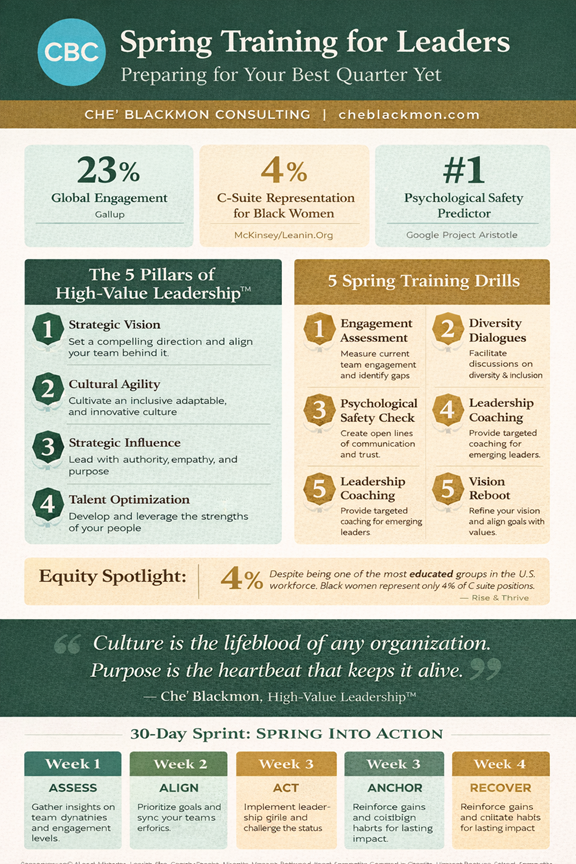
The Self-Care Strategy: It’s Not Selfish, It’s Strategic 🌟

By Che’ Blackmon, DBA Candidate | Founder & CEO, Che’ Blackmon Consulting

Introduction: Redefining Self-Care for High Performers 💪

Let’s address the elephant in the room. When you hear “self-care,” what comes to mind? Bubble baths? Spa days? Perhaps a guilty feeling that you should be doing something more productive? For too long, self-care has been marketed as indulgence, something we squeeze in between meetings when we have a spare moment. This framing is not only incomplete. It is dangerously wrong.

The truth is that self-care is not a luxury. It is infrastructure. Just as a building requires a solid foundation to stand, leaders require sustainable practices to perform at their highest level. Without intentional self-care, burnout is not a possibility. It is an inevitability.

In my book High-Value Leadership: Transforming Organizations Through Purposeful Culture, I explore how the most effective leaders understand that their capacity to serve others depends on their commitment to sustaining themselves. This is not selfish thinking. This is strategic thinking. And for those of us who have been conditioned to put everyone else first, it might just be the most revolutionary act of leadership we ever embrace.

The Business Case for Self-Care 📊

If you need permission to prioritize your wellbeing, let the data provide it. The World Health Organization has classified burnout as an occupational phenomenon, and research consistently demonstrates its devastating impact on both individuals and organizations. According to Gallup’s 2024 workplace research, burned out employees are 63% more likely to take a sick day, 2.6 times more likely to actively seek a new job, and 23% more likely to visit the emergency room.

The cost to organizations is staggering. The American Institute of Stress estimates that workplace stress costs U.S. employers over $300 billion annually in absenteeism, turnover, diminished productivity, and medical costs. But here is what those numbers do not capture: the loss of innovation, creativity, and human potential that occurs when talented professionals are running on empty.

There was a healthcare organization that noticed a troubling pattern among their leadership team. High performers were leaving at alarming rates, citing exhaustion and lack of work-life balance. Exit interviews revealed a culture where leaders felt they could not take time for themselves without appearing uncommitted. The organization implemented a comprehensive wellness initiative that included protected personal time, mental health resources, and leadership modeling of healthy boundaries. Within 18 months, leadership turnover decreased by 41% and employee engagement scores increased by 27%.

The lesson is clear. When leaders take care of themselves, organizations thrive. When they do not, everyone suffers.

The Unique Burden: Self-Care for Black Women in Leadership ✊🏾

Any honest conversation about self-care must acknowledge that the need for it, and the barriers to practicing it, are not distributed equally. For Black women in corporate spaces, the conversation around self-care carries additional weight and complexity.

The “Strong Black Woman” Trap

In my e-book Rise & Thrive: A Black Woman’s Blueprint for Leadership Excellence, I address the cultural conditioning that makes self-care particularly challenging for Black women. The “Strong Black Woman” archetype, while born from genuine resilience and survival, has evolved into an expectation that we must be superhuman, never tired, never struggling, always capable of taking on more.

Research from the National Institutes of Health confirms what many Black women already know: the pressure to appear strong and invulnerable contributes to higher rates of stress-related health conditions, including hypertension, cardiovascular disease, and depression. A 2023 study in the Journal of Black Psychology found that Black women who endorsed the Strong Black Woman schema reported significantly higher levels of emotional suppression and lower levels of self-care engagement.

The Double Shift of Emotional Labor

Black women in corporate environments often perform a “double shift” of emotional labor. The first shift involves the standard demands of leadership: making decisions, managing teams, navigating organizational politics. The second shift involves managing the perceptions and comfort of others, code-switching, responding to microaggressions, serving as the unofficial diversity educator, and constantly proving competence in spaces that may question it by default.

This additional labor is exhausting and largely invisible. It is not captured in job descriptions or performance reviews, yet it consumes significant energy and bandwidth. McKinsey’s Women in the Workplace 2023 report found that Black women are more likely than any other group to report feeling “on guard” at work and less likely to feel they can bring their whole selves to their professional environment.

Reclaiming Rest as Resistance

For Black women, self-care is not just personal wellness. It is an act of resistance against systems that have historically demanded our labor without regard for our wellbeing. Tricia Hersey, founder of The Nap Ministry, frames rest as a form of reparations and resistance. While this may sound provocative, the underlying message is profound: choosing to care for ourselves in a world that often devalues us is a radical and necessary act.

This does not mean that self-care should fall solely on individual shoulders. Organizations have a responsibility to create environments where all employees, particularly those who carry additional burdens, can thrive without sacrificing their health. But while we work toward systemic change, individual self-care practices remain essential for survival and success.

The Strategic Self-Care Framework 🛠️

Moving from concept to practice requires a framework. Strategic self-care is intentional, proactive, and aligned with your values and goals. It is not reactive pampering when you are already depleted. It is consistent investment in your capacity to lead, create, and serve.

Pillar 1: Physical Restoration 🏃‍♀️

Your body is the vehicle through which you do everything else. Physical self-care includes adequate sleep (the research is clear that seven to nine hours is non-negotiable for cognitive function), regular movement, proper nutrition, and preventive healthcare. For leaders, this also means paying attention to ergonomics, taking breaks during the workday, and not treating your body as an afterthought to your ambitions.

Practical application: Block “non-negotiable” time in your calendar for physical activity, just as you would block time for an important meeting. Treat medical appointments as mandatory, not optional. Create environmental cues that support healthy choices, such as keeping water at your desk and healthy snacks accessible.

Pillar 2: Emotional Processing 💭

Leadership is emotionally demanding. You absorb the stress of your team, navigate conflict, make difficult decisions, and often cannot fully express your own struggles to those you lead. Emotional self-care involves creating space to process these experiences rather than simply pushing through them.

This might include journaling, therapy or coaching, conversations with trusted peers, or simply allowing yourself to feel rather than immediately problem-solve. For Black women and other traditionally overlooked professionals, finding spaces where you can be fully yourself without code-switching or managing others’ perceptions is particularly important.

Practical application: Identify your “processing practices,” the specific activities that help you metabolize emotional experiences. Schedule regular check-ins with a therapist, coach, or trusted confidant. Build relationships with peers who share similar experiences and can provide genuine understanding.

Pillar 3: Mental Renewal 🧠

Cognitive fatigue is real. Decision fatigue is real. The constant demands on your attention in the modern workplace deplete mental resources that must be replenished. Mental self-care involves protecting your cognitive capacity through boundaries, focus time, and activities that restore rather than deplete mental energy.

Practical application: Implement “focus blocks” where you work without interruption on cognitively demanding tasks. Practice single-tasking rather than multitasking. Create technology boundaries, such as no email after certain hours or device-free weekends. Engage in activities that provide mental rest, whether that is reading for pleasure, creative hobbies, or time in nature.

Pillar 4: Spiritual Connection 🙏

Spiritual self-care does not necessarily mean religion, though for many it does. It refers to practices that connect you to something larger than yourself and provide meaning and purpose. This might include meditation, prayer, time in nature, creative expression, or community involvement.

In Mastering a High-Value Company Culture, I discuss how purpose-driven cultures outperform those focused solely on metrics. The same principle applies to individuals. Leaders who maintain connection to their deeper “why” are more resilient, more motivated, and more effective than those operating on willpower alone.

Practical application: Clarify your personal purpose and values. Build regular practices that connect you to this purpose. Surround yourself with community that shares and reinforces your values. Make time for activities that fill your soul, not just your schedule.

Pillar 5: Social Nourishment 🤝

Humans are social beings, and meaningful connection is essential for wellbeing. Yet leadership can be isolating. The higher you rise, the fewer peers you have, and the more carefully you must manage relationships with those who report to you. Social self-care involves intentionally cultivating relationships that nourish rather than drain you.

Practical application: Audit your relationships. Identify those that energize you and those that deplete you. Invest more in the former and set boundaries with the latter. Seek out communities of like-minded leaders who understand your challenges. Prioritize quality time with loved ones who know you beyond your professional role.

Current Trends: How Leading Organizations Support Self-Care 📈

The most forward-thinking organizations recognize that employee wellbeing is not separate from business success. It is foundational to it. Here are some current best practices being implemented by industry leaders.

Mental Health as a Core Benefit

According to the Society for Human Resource Management, 91% of organizations now offer some form of mental health coverage, up from 76% five years ago. Leading companies are going beyond basic EAP programs to provide comprehensive mental health support, including therapy coverage, meditation apps, mental health days, and manager training on supporting employee wellbeing.

Flexible Work as Wellness

The shift to hybrid and remote work has opened new possibilities for work-life integration. Organizations are recognizing that flexibility itself is a form of self-care support, allowing employees to manage their energy, attend to personal responsibilities, and work during their most productive hours. The key is implementing flexibility equitably so that all employees, including those in traditionally overlooked groups, feel empowered to use it.

Leadership Modeling

Perhaps the most powerful trend is senior leaders openly modeling self-care practices. When executives take vacation, set boundaries on after-hours communication, and speak openly about their own wellbeing practices, it creates permission for everyone else to do the same. There was a technology company whose CEO began ending team meetings by sharing his own self-care practice for the week. This simple act normalized the conversation and resulted in measurable increases in employee use of wellness benefits.

Case Study: Transformation Through Strategic Self-Care 📖

There was a manufacturing company in the Midwest facing a crisis of leadership burnout. Three senior leaders had resigned within six months, all citing exhaustion and unsustainable workloads. The remaining leadership team was stretched thin, and the culture had become one of constant firefighting rather than strategic growth.

Rather than simply hiring replacements and continuing the same pattern, the company took a different approach. They conducted a thorough assessment of workloads, decision-making processes, and cultural expectations. What they found was a system that inadvertently punished self-care: leaders who took time off returned to overwhelming backlogs, those who set boundaries were perceived as less committed, and there were no structural supports for sustainable work practices.

The company implemented comprehensive changes. They redistributed responsibilities to eliminate single points of failure. They established coverage systems so that leaders could truly disconnect during time off. They trained all managers on recognizing and preventing burnout. They created accountability for sustainable work practices, including incorporating wellbeing metrics into performance evaluations.

The results were transformative. Within two years, leadership turnover dropped by 58%, employee engagement scores rose by 34%, and the company saw a 23% improvement in productivity metrics. Most importantly, leaders reported feeling capable of performing at their best because they finally had the support to sustain themselves.

Overcoming Internal Resistance to Self-Care 🚧

Understanding the importance of self-care is one thing. Actually practicing it is another. Most high-achieving professionals have internalized beliefs that make self-care feel uncomfortable or even wrong. Recognizing these internal barriers is the first step to overcoming them.

“I Don’t Have Time”

This is the most common objection, and it is usually a prioritization issue rather than a time issue. We make time for what we value. If self-care consistently falls off your schedule, it is worth examining whether you truly believe in its importance or whether you are still treating it as optional. Consider this: you will make time for self-care now, or you will make time for illness later. The choice is yours.

“Others Need Me”

Yes, others need you. But they need the best version of you, not a depleted, resentful, burned-out version. As flight attendants remind us, you must secure your own oxygen mask before assisting others. Your capacity to help anyone depends on your capacity to sustain yourself. Taking care of yourself is not abandoning others. It is ensuring you can show up for them fully.

“It Feels Selfish”

Self-care is not selfish. It is strategic stewardship of your most valuable resource: yourself. Would you call it selfish for a surgeon to rest before a complex operation? Would you call it selfish for an athlete to recover between competitions? Your leadership requires the same respect for human limits and the same commitment to sustainable performance.

“I’ll Rest When I Reach My Goal”

This is a dangerous myth. There will always be another goal, another milestone, another demand. If you condition yourself to postpone self-care until some future achievement, you will never practice it. Sustainable success requires sustainable practices now, not someday.

Actionable Takeaways: Your Self-Care Strategy ✅

Strategic self-care requires planning and commitment. Here are concrete steps you can implement immediately.

Today: Identify one self-care practice you have been neglecting and schedule it in your calendar for this week. Treat it as non-negotiable.

This week: Conduct a personal energy audit. Track when you feel energized versus depleted throughout your days. Look for patterns and identify changes you can make.

This month: Establish one new boundary that protects your wellbeing. This might be no email after 7 PM, a weekly lunch break away from your desk, or saying no to one commitment that does not align with your priorities.

This quarter: Build a self-care support system. Identify a therapist, coach, or accountability partner who can help you maintain your practices. Find a community of peers who understand your challenges.

Ongoing: Review and adjust your self-care practices regularly. As your life and responsibilities evolve, your self-care needs will evolve too. Build reflection into your routine.

Discussion Questions for Reflection 💬

Use these questions to deepen your thinking about self-care and its role in your leadership.

1. What messages about self-care did you receive growing up? How do those messages influence your current practices?

2. When you are at your best as a leader, what self-care practices are usually in place? What is typically missing when you are struggling?

3. What internal beliefs or external pressures make self-care difficult for you? What would it take to challenge those barriers?

4. How does your organization’s culture support or undermine employee wellbeing? What changes would make the biggest difference?

5. If you fully embraced self-care as strategic rather than selfish, what would change about how you lead?

Next Steps: Committing to Your Wellbeing 🌱

Reading about self-care is not the same as practicing it. The ideas in this article will only create change if you take action. Start small, but start today. Choose one practice, one boundary, one commitment to yourself, and honor it. Build from there.

Remember that self-care is not a destination. It is a practice. Some weeks will be better than others. The goal is not perfection but consistency over time. When you fall off track, simply begin again without judgment. Every moment is a new opportunity to choose yourself.

For leaders and organizations committed to building cultures where self-care is valued and supported, professional guidance can accelerate progress and ensure sustainability. Culture change is complex work, and having an experienced partner can make the difference between good intentions and lasting transformation.

Ready to Build a Culture That Values Wellbeing? 🤝

Che’ Blackmon Consulting partners with organizations to create high-value cultures where leaders and teams can thrive sustainably. With over 24 years of progressive HR leadership experience and ongoing doctoral research focused on culture transformation, we bring both practical expertise and evidence-based insights to every engagement.

Let’s explore how we can support your journey to strategic self-care and sustainable leadership.

📧 Email: admin@cheblackmon.com

📞 Phone: 888.369.7243

🌐 Website: cheblackmon.com

About the Author 👩🏾‍💼

Che’ Blackmon is the Founder and CEO of Che’ Blackmon Consulting, a Michigan based fractional HR and culture transformation consultancy. With over 24 years of progressive HR leadership experience across manufacturing, automotive, healthcare, and professional services sectors, Che’ brings deep expertise in building high-value organizational cultures where both people and performance thrive.

She is currently pursuing a Doctor of Business Administration (DBA) in Organizational Leadership, with dissertation research focused on AI-enhanced predictive analytics for culture transformation and employee turnover prevention.

Che’ is the author of three books on leadership and organizational culture: High-Value Leadership: Transforming Organizations Through Purposeful Culture, Mastering a High-Value Company Culture, and Rise & Thrive: A Black Woman’s Blueprint for Leadership Excellence. She hosts the twice-weekly podcast “Unlock, Empower, Transform with Che’ Blackmon” and creates content through her “Rise & Thrive” YouTube series.

© 2025 Che’ Blackmon Consulting. All rights reserved.

#SelfCareStrategy #StrategicSelfCare #LeadershipWellness #BurnoutPrevention #HighValueLeadership #SustainableSuccess #BlackWomenInLeadership #ExecutiveWellbeing #WorkLifeIntegration #BoundariesAreLeadership #RestIsProductive #MentalHealthAtWork #LeadershipDevelopment #ThriveNotSurvive #WellnessAtWork

Building Resilient Teams: Beyond Bounce-Back to Bounce-Forward 🚀

By Che’ Blackmon, DBA Candidate | Che’ Blackmon Consulting

Introduction: Rethinking What Resilience Really Means 💡

When we talk about resilient teams, most leaders think about bouncing back from adversity. They imagine employees who can weather the storm, recover from setbacks, and return to baseline performance. While this perspective has value, it fundamentally limits what your team can achieve. True resilience is not about returning to where you were before. It is about using challenges as springboards to reach new heights.

In my book Mastering a High-Value Company Culture, I explore how organizations can build cultures that do not merely survive disruption but thrive because of it. This concept of “bouncing forward” transforms adversity from a threat into an opportunity for growth, innovation, and sustainable competitive advantage.

The difference between bounce-back and bounce-forward organizations is profound. Bounce-back teams aim to restore normalcy. Bounce-forward teams aim to emerge stronger, wiser, and more connected than before. Which type of team are you building?

Understanding the Shift: From Reactive to Proactive Resilience 🔄

Traditional resilience models focus on reaction. Something bad happens and the team responds. This approach, while necessary, keeps organizations perpetually in defense mode. They wait for crises, address them as they come, and hope for the best. This cycle is exhausting and unsustainable.

Research from the Harvard Business Review (2023) reveals that organizations practicing proactive resilience strategies outperform their reactive counterparts by 34% in employee engagement metrics and 28% in overall productivity. These findings underscore a critical truth: resilience is not just about surviving tough times. It is about building the capacity to anticipate, adapt, and advance.

As I discuss in High-Value Leadership: Transforming Organizations Through Purposeful Culture, purposeful leadership requires a shift in mindset. Leaders must move from asking “How do we recover?” to asking “How do we grow through this?” This single question reframes every challenge as a development opportunity.

The Foundation of Bounce-Forward Teams 🏗️

1. Psychological Safety as the Cornerstone

Amy Edmondson’s groundbreaking research on psychological safety has transformed how we understand high-performing teams. Teams where members feel safe to take risks, voice concerns, and admit mistakes consistently outperform those operating in fear-based environments. But psychological safety does not happen by accident. It requires intentional cultivation.

Consider a manufacturing company that experienced a significant quality control failure. In many organizations, the response would be to assign blame, implement punitive measures, and move on. Instead, this company chose a different path. Leadership gathered the team, acknowledged the failure openly, and asked a powerful question: “What can this teach us?” The result was not just a fix for the immediate problem but a complete overhaul of their quality assurance processes that reduced defects by 47% over the following year.

2. Purpose-Driven Connection

Teams that understand their “why” possess an internal compass that guides them through uncertainty. Purpose creates resilience because it provides meaning beyond the immediate task. When team members connect their daily work to a larger mission, setbacks become temporary obstacles rather than insurmountable barriers.

Gallup’s 2024 State of the Global Workplace report found that employees who strongly agree their organization’s purpose makes their job feel important are 4.2 times more likely to be engaged at work. Engagement, in turn, serves as a buffer against burnout and a catalyst for innovative problem-solving during difficult times.

3. Adaptive Leadership at Every Level

Bounce-forward resilience cannot be mandated from the top alone. It requires distributed leadership where every team member feels empowered to adapt, innovate, and lead within their sphere of influence. This democratization of leadership accelerates organizational response times and leverages the collective intelligence of the entire workforce.

The Unique Resilience Journey: Impact on Traditionally Overlooked Professionals ✊🏾

Any honest conversation about building resilient teams must address a fundamental truth: not all team members start from the same place. Traditionally overlooked professionals, particularly Black women in corporate spaces, often navigate additional layers of challenge that their counterparts do not face. Understanding this reality is not about creating division. It is about creating genuine equity in how we support our teams.

The Double Bind of Resilience Expectations

In my e-book Rise & Thrive: A Black Woman’s Blueprint for Leadership Excellence, I explore the complex dynamics Black women face in professional environments. Research from LeanIn.Org and McKinsey’s Women in the Workplace 2023 report confirms what many Black women already know: they are more likely to have their competence questioned, experience microaggressions, and feel they cannot bring their full selves to work.

This creates a double bind when it comes to resilience. Black women are often expected to be inherently strong and resilient (the “Strong Black Woman” trope) while simultaneously receiving less organizational support to build and maintain that resilience. They are asked to bounce back from challenges that their colleagues may never encounter, all while maintaining the same performance standards.

Moving from Survival to Thriving

True bounce-forward organizations recognize these disparities and take concrete action. They do not ask traditionally overlooked employees to simply “be resilient” in the face of systemic challenges. Instead, they address the systems themselves. This includes examining hiring practices, promotion pathways, mentorship opportunities, and everyday workplace interactions for bias and exclusion.

There was a professional services firm that noticed a troubling pattern: their Black female employees were leaving at higher rates than any other demographic group, despite strong performance reviews. Rather than attributing this to individual choices, leadership conducted listening sessions and anonymous surveys. What they discovered was a culture where Black women felt unseen, unsupported, and unable to advance. The company implemented targeted mentorship programs, revised their promotion criteria for objectivity, and created affinity groups. Within 18 months, retention among Black female employees improved by 62%, and overall employee engagement scores rose across the organization.

Creating Inclusive Resilience Frameworks

Building resilient teams requires recognizing that resilience itself must be inclusive. This means creating environments where all employees, regardless of their background, have equal access to the resources, relationships, and opportunities that foster growth. It means ensuring that when we discuss “bouncing forward,” we are not inadvertently placing additional burdens on those who already carry more.

Practical Strategies for Building Bounce-Forward Teams 🛠️

Strategy 1: Implement “After Action Learning” Sessions

Replace traditional post-mortems with forward-focused learning sessions. After any significant project, challenge, or change, gather your team to answer three questions: What happened? What did we learn? How will this make us better? The emphasis on the third question shifts the conversation from analysis to action.

Strategy 2: Build “Challenge Capital”

Just as organizations build financial reserves, bounce-forward teams intentionally build challenge capital. This includes cross-training team members so knowledge is distributed, maintaining documentation of processes and lessons learned, and cultivating relationships with external partners who can provide support during difficult times.

Strategy 3: Practice Micro-Resilience Daily

Resilience is not built only in major crises. It is developed through daily practices that strengthen the team’s adaptive capacity. Encourage team members to step outside their comfort zones regularly, celebrate small wins, and practice reframing negative situations. These micro-moments of resilience compound over time into substantial organizational capability.

Strategy 4: Create Equity-Centered Support Systems

Recognize that different team members may need different types of support to thrive. This is not about giving some employees advantages over others. It is about ensuring everyone has what they need to contribute their best. For traditionally overlooked professionals, this might include mentorship from leaders who understand their unique challenges, advocacy in rooms where decisions are made, and genuine opportunities for advancement.

Strategy 5: Lead with Vulnerability and Authenticity

Leaders set the tone for how teams handle adversity. When leaders model vulnerability by admitting their own challenges and sharing how they have grown through difficulties, they give permission for the entire team to do the same. This authenticity builds trust and creates space for honest conversations about what is and is not working.

Current Trends and Best Practices in Team Resilience 📊

The landscape of organizational resilience continues to evolve, shaped by technological advances, changing workforce expectations, and lessons learned from recent global disruptions. Several trends are particularly relevant for leaders committed to building bounce-forward teams.

AI-Enhanced Predictive Analytics

Forward-thinking organizations are using artificial intelligence to predict potential challenges before they become crises. This includes analyzing engagement data to identify early signs of burnout, tracking communication patterns to detect emerging team conflicts, and monitoring industry trends to anticipate market shifts. This proactive approach allows teams to address issues while they are still manageable.

Hybrid Work and Distributed Resilience

The shift to hybrid and remote work has fundamentally changed how teams build and maintain resilience. Organizations are discovering that resilience in distributed environments requires intentional effort to maintain connection, clear communication protocols, and new approaches to recognizing and supporting team members who may be struggling. The Society for Human Resource Management (SHRM) reports that 76% of HR professionals believe developing resilience strategies for hybrid teams is a top priority for 2025.

Mental Health Integration

The conversation around workplace mental health has shifted from stigmatized whispers to strategic priority. Best-in-class organizations are integrating mental health support into their resilience frameworks, recognizing that individual wellbeing and team performance are inseparable. This includes providing access to mental health resources, training managers to recognize signs of distress, and creating cultures where seeking help is viewed as strength rather than weakness.

Case Study: A Manufacturing Company’s Transformation 📈

There was a mid-sized manufacturing company in the Midwest that faced a perfect storm of challenges: supply chain disruptions, labor shortages, and increased competition from overseas. Traditional approaches would have focused on cost-cutting and survival. Instead, leadership chose to view this moment as an opportunity for transformation.

The company implemented a comprehensive bounce-forward strategy. First, they invested in cross-training programs so every team member could fill multiple roles. This not only addressed the labor shortage but also gave employees new skills and career pathways. Second, they created innovation teams charged with finding creative solutions to supply chain challenges. These teams were explicitly empowered to fail fast and learn faster. Third, they revised their leadership development program to emphasize adaptive leadership and inclusive practices.

Within two years, this company had not just survived the crisis but had emerged as a market leader. Employee engagement scores rose by 41%, voluntary turnover dropped by 33%, and productivity increased by 27%. Most importantly, the company had built a culture capable of facing future challenges with confidence rather than fear.

Measuring Team Resilience: Beyond Traditional Metrics 📐

What gets measured gets managed. To build bounce-forward teams, leaders need metrics that capture adaptive capacity, not just static performance. Consider tracking recovery time (how quickly your team returns to full productivity after a disruption), innovation rate (how many new ideas emerge during and after challenges), learning velocity (how quickly lessons are identified and implemented), and equity indicators (ensuring all team members are growing through challenges equally).

Regular pulse surveys can capture team sentiment and identify emerging issues before they become critical. Exit interviews and stay interviews provide qualitative data on what is working and what needs improvement. The key is to use these metrics not as report cards but as learning tools that inform continuous improvement.

Actionable Takeaways: Your Bounce-Forward Action Plan ✅

Building bounce-forward teams requires commitment and intentionality. Here are concrete steps you can implement immediately.

This week: Have a conversation with your team about the difference between bouncing back and bouncing forward. Ask them which mindset currently dominates your culture.

This month: Conduct an honest assessment of psychological safety on your team. Use anonymous surveys or bring in a neutral facilitator to get candid feedback.

This quarter: Implement “After Action Learning” sessions for all major projects or challenges. Document the insights and track how they influence future approaches.

This year: Develop comprehensive support systems that recognize and address the unique challenges faced by traditionally overlooked team members. Measure and track equity in access to resources and opportunities.

Ongoing: Model vulnerability as a leader. Share your own growth journey and create space for others to do the same.

Discussion Questions for Your Team 💬

Use these questions to spark meaningful conversations about resilience within your organization.

1. When our team faces a setback, do we focus primarily on recovering to where we were or on finding ways to grow beyond our previous capacity?

2. How safe do team members feel to admit mistakes, voice concerns, or propose unconventional ideas? What evidence supports this assessment?

3. Are there team members who consistently seem to carry heavier burdens or face greater challenges than others? What can we do to address these inequities?

4. What was the most significant challenge our team faced in the past year? Looking back, how did that challenge make us better?

5. If a new team member joined tomorrow, how would they describe our culture’s approach to handling adversity?

Next Steps: Your Journey to Bounce-Forward Excellence 🌟

Building bounce-forward resilience is not a one-time initiative. It is an ongoing commitment to growth, learning, and intentional culture development. The organizations that thrive in the coming years will be those that view every challenge as an opportunity to emerge stronger.

Start where you are. Use the strategies and questions in this article to assess your current state and identify areas for growth. Remember that progress, not perfection, is the goal. Every step toward a more resilient culture is a step toward sustainable success.

For those ready to take their resilience journey to the next level, professional guidance can accelerate your progress and help you avoid common pitfalls. A skilled culture transformation partner can provide objective assessment, proven frameworks, and accountability to ensure your initiatives translate into real results.

Ready to Build a Bounce-Forward Culture? 🤝

Che’ Blackmon Consulting specializes in helping organizations transform their cultures from reactive to proactive, from surviving to thriving. With over 24 years of progressive HR leadership experience and ongoing doctoral research focused on AI-enhanced culture transformation, we bring both practical expertise and cutting-edge insights to every engagement.

Let’s discuss how we can help you build the resilient, high-value culture your organization deserves.

📧 Email: admin@cheblackmon.com

📞 Phone: 888.369.7243

🌐 Website: cheblackmon.com

About the Author 👩🏾‍💼

Che’ Blackmon is the Founder and CEO of Che’ Blackmon Consulting, a Michigan based fractional HR and culture transformation consultancy. With over 24 years of progressive HR leadership experience across manufacturing, automotive, healthcare, and professional services sectors, Che’ brings deep expertise in building high-value organizational cultures. She is currently pursuing a Doctor of Business Administration (DBA) in Organizational Leadership, with dissertation research focused on AI-enhanced predictive analytics for culture transformation and employee turnover prevention.

Che’ is the author of three books on leadership and organizational culture: High-Value Leadership: Transforming Organizations Through Purposeful Culture, Mastering a High-Value Company Culture, and Rise & Thrive: A Black Woman’s Blueprint for Leadership Excellence. She hosts the twice-weekly podcast “Unlock, Empower, Transform with Che’ Blackmon” and creates content through her “Rise & Thrive” YouTube series.

#HighValueLeadership #TeamResilience #BounceForward #LeadershipDevelopment #CultureTransformation #HRLeadership #OrganizationalCulture #BlackWomenInLeadership #ExecutiveCoaching #WorkplaceWellbeing #TeamBuilding #FractionalHR #LeadershipTips #EmployeeEngagement #ThriveNotSurvive

© 2025 Che’ Blackmon Consulting. All rights reserved.

⚡ The Energy Audit: Where Leaders Lose (and Find) Their Spark ⚡

A High-Value Leadership Perspective on Sustainable Performance

Leadership is exhausting.

There, I said it. Not the motivational poster version you see plastered across LinkedIn feeds. The real, bone tired, Sunday evening dread kind of exhausting that creeps in when you’ve been running on empty for so long that you can’t remember what full feels like. If you’re reading this and nodding along, you’re not alone. Energy depletion among leaders has reached epidemic proportions, and it’s affecting not just performance metrics, but the very fabric of organizational culture and the personal wellbeing of those who lead.

The question isn’t whether leaders are losing energy. The question is: where is it going, and how do we get it back? 💡

🔍 The Hidden Energy Drains: What the Research Reveals

Recent studies from the Harvard Business Review paint a sobering picture. Over 60% of executives report feeling burned out, and the numbers are even more staggering for leaders who navigate the additional weight of being traditionally overlooked in corporate spaces. For Black women in leadership, the energy tax is compounded by what researchers call “emotional labor,” the invisible work of managing perceptions, code switching, and proving competence in environments that weren’t built with them in mind.

Energy depletion doesn’t happen in a vacuum. It accumulates through a series of micro moments that, individually, seem manageable. Collectively, they create a deficit that no amount of weekend rest can repair. Consider these common energy drains that leaders face daily:

Decision Fatigue and Cognitive Overload

The average executive makes over 35,000 decisions per day. Each decision, no matter how small, depletes a finite cognitive resource. When you’re already operating in spaces where every move is scrutinized more heavily, that number multiplies. You’re not just deciding on strategy or budget allocations; you’re constantly calculating the perception of each choice.

Misaligned Values and Cultural Dissonance

There’s an energy leak that happens when your personal values clash with organizational culture. When you have to suppress your authentic self to fit into corporate norms, when you’re the only voice advocating for equity in rooms full of people who view it as a checkbox rather than a commitment, you’re burning fuel that should be powering innovation and growth. This is particularly acute for Black women leaders who often find themselves as the “only” or one of few, navigating cultures that were not designed with their leadership styles, communication preferences, or lived experiences in mind.

Invisible Labor and Unrecognized Contributions

The work that doesn’t show up in job descriptions but somehow always lands on your desk. Mentoring junior colleagues. Smoothing over team conflicts. Being voluntold for diversity initiatives while your peers focus solely on revenue generating work. This invisible labor drains energy while rarely adding to your advancement or recognition.

Constant Performance Pressure and Imposter Syndrome

When you’re operating in spaces where people like you have historically been excluded, there’s an unspoken pressure to be exceptional at all times. Mistakes that would be learning opportunities for others become proof that you don’t belong. This hypervigilance is exhausting. It creates a perpetual state of stress that depletes energy reserves faster than any strategic initiative or operational challenge.

💸 The Cost of Running on Empty

Energy depletion isn’t just a personal problem. It’s an organizational crisis that manifests in tangible, measurable ways. When leaders run on empty, the ripple effects touch every corner of the enterprise.

There was a company in the manufacturing sector that lost a brilliant VP of Operations within 18 months of her appointment. On paper, she had everything: impressive credentials, strategic vision, and the operational expertise to transform their supply chain. What the exit interview revealed was more nuanced. She was exhausted. Not from the work itself, but from the constant need to prove her worth in ways her male counterparts never had to. She left not because she couldn’t do the job, but because the energy required to do it while managing bias, microaggressions, and isolation was unsustainable.

The company didn’t just lose a talented executive. They lost institutional knowledge, strategic relationships, and a pipeline of diverse talent who saw in her departure a signal about their own futures. The cost of replacing her ran into seven figures when you factor in recruitment, onboarding, lost productivity, and the projects that stalled in her absence. More significantly, they lost credibility in their diversity and inclusion commitments.

The organizational costs of leadership energy depletion include decreased decision quality, reduced innovation and creative problem solving, higher turnover among high performers, cultural erosion and disengagement, missed strategic opportunities, and damaged employer brand and recruitment challenges. These aren’t abstract concepts. They show up in quarterly earnings, employee engagement scores, and talent retention metrics.

📊 Conducting Your Energy Audit: A Framework for Leaders

An energy audit for leaders mirrors the process organizations use to identify inefficiencies in their operations. Instead of examining electrical systems and HVAC units, you’re examining how you allocate your most precious resource: your energy. This isn’t about working harder or finding more hours in the day. It’s about working smarter and being intentional about where your energy goes.

Step One: Track Your Energy Expenditures

For one week, keep a simple energy journal. Not a detailed log of every minute, but a general accounting of what gives you energy and what depletes it. At the end of each day, ask yourself three questions. What activities today left me energized? What activities left me drained? What surprised me about my energy patterns?

Pay particular attention to the activities that drain you but that you feel obligated to continue. These are your prime candidates for elimination, delegation, or redesign. For Black women leaders, this often includes activities related to being the diversity representative, informal mentorship that isn’t valued or compensated, and managing others’ comfort with your presence in leadership spaces.

Step Two: Identify Your Energy Architecture

Everyone has a unique energy architecture, the patterns and rhythms that govern when you’re at your best. Some leaders are morning people who tackle complex decisions before noon. Others hit their stride in the afternoon. Understanding your architecture allows you to structure your day for maximum effectiveness.

Examine your calendar through an energy lens. Are you scheduling high stakes meetings during your lowest energy periods? Are you filling your peak hours with administrative tasks that could be batched or delegated? Are you building in recovery time between energy intensive activities, or are you scheduling back to back meetings that leave no room for processing or renewal?

Step Three: Calculate Your Return on Energy

Just as organizations calculate ROI for financial investments, leaders need to calculate return on energy for their activities. Not everything that feels productive is actually moving you or your organization forward. Some activities are energy vampires disguised as important work.

Create three categories for your activities: high energy investment, high return activities; necessary but energy draining activities; and low return energy drains. The goal isn’t to eliminate all energy draining activities. Some are unavoidable parts of leadership. The goal is to be conscious about which drains are necessary and which are habits or obligations that no longer serve you or your organization.

⚙️ Strategic Energy Management: From Audit to Action

Understanding where your energy goes is only half the battle. The real transformation happens when you redesign how you work, lead, and show up in ways that honor your energy architecture while meeting organizational demands.

Redesign Your Decision Making Process

Decision fatigue is real and cumulative. Combat it by creating decision frameworks that reduce the cognitive load of routine choices. Establish clear criteria for common decisions so you’re not reinventing the wheel each time. Delegate decisions that don’t require your specific expertise or authority. Batch similar decisions together rather than switching contexts throughout the day.

A technology executive shared her strategy of implementing “decision free Fridays” where she avoids making any major decisions, using the day instead for strategic thinking and planning. This single change improved not only her decision quality on other days, but also her overall wellbeing.

Build Energy Recovery Into Your Rhythm

You can’t sprint a marathon. Leadership is a long game that requires intentional recovery. This isn’t about bubble baths and self care platitudes. It’s about building recovery mechanisms into your regular rhythm that allow you to sustain high performance over time.

Recovery looks different for different people, but research points to several effective strategies. Physical movement breaks between meetings. Dedicated think time that isn’t interrupted by pings and notifications. Clear boundaries between work and personal time, even when working remotely. Micro breaks throughout the day, not just at lunch. Regular check ins with trusted advisors or coaches who can provide perspective. Time in community with people who share your lived experience and understand the unique challenges you face.

Create Boundaries That Honor Your Energy

For leaders who are used to being accessible, available, and always on, boundary setting can feel uncomfortable. For Black women leaders, it can feel particularly risky given the stereotypes about being difficult or not being team players. Yet boundaries aren’t walls that keep people out. They’re guidelines that protect your ability to show up fully and effectively.

Start by identifying your non negotiables. These are the boundaries that protect your core energy reserves. They might include no meetings before 9am or after 5pm, no work emails on weekends, dedicated time for strategic thinking that can’t be interrupted, or limits on travel commitments. Communicate these boundaries clearly and consistently. Model them for your team to create a culture where sustainable performance is valued over performative busyness.

🌟 The Unique Energy Dynamics for Black Women in Leadership

Let’s address what often goes unsaid in mainstream leadership development. The energy equation looks different when you’re navigating leadership while Black and female. The tax on your energy isn’t just about the work itself but about the context in which you’re doing it.

Research from the Center for Talent Innovation found that Black professionals are more likely than their white counterparts to report feeling stalled in their careers, being on guard to protect against bias, and needing to work harder than their peers to achieve the same level of recognition. Each of these experiences represents a significant energy drain that compounds over time.

The Code Switching Tax

Code switching, the practice of adjusting your language, behavior, and appearance to fit into predominantly white professional spaces, is exhausting. It requires constant vigilance and self monitoring. You’re not just thinking about what to say; you’re calculating how it will be received, whether it reinforces or contradicts stereotypes, and what the political ramifications might be.

A senior director at a Fortune 500 company described it as “wearing a mask that you can never quite take off, even when you get home.” The energy required to maintain that mask, day after day, year after year, is staggering. And unlike other forms of professional stress, there’s no relief valve because the triggers aren’t isolated incidents but the ambient conditions of the environment itself.

The Credibility Gap

Studies consistently show that Black women in leadership positions face a credibility gap that their white male counterparts don’t encounter. Your expertise is questioned more frequently. Your decisions are second guessed more openly. Your authority is challenged more readily. Each incident might seem small, but the cumulative effect is significant energy depletion.

This credibility gap means you often need to work twice as hard to get half the credit. You come over prepared to meetings. You document everything meticulously. You build coalitions more carefully. You navigate politics more strategically. All of this is energy intensive work that should be going into innovation, strategy, and growth.

The Isolation Factor

Being the only one or one of few creates a unique form of isolation that drains energy in ways that are hard to articulate to people who haven’t experienced it. You don’t have the natural allies and informal networks that form organically among majority group members. You can’t assume anyone understands the nuances of your experience without extensive explanation. You bear the burden of representation, knowing that your actions will be generalized to your entire demographic.

This isolation affects everything from strategic decision making to simple workplace interactions. When you don’t have trusted peers who share your perspective, you’re processing challenges in isolation. When you don’t see yourself reflected in senior leadership, you’re charting a path with no map. This solo navigation is exhausting in ways that compound over time.

🛠️ Building a Sustainable Leadership Practice

Sustainable leadership isn’t about finding a magic formula that eliminates stress or makes challenges disappear. It’s about developing practices and support systems that allow you to navigate the demands of leadership without depleting yourself in the process.

Cultivate Your Kitchen Cabinet

Every leader needs a kitchen cabinet, a small group of trusted advisors who can provide honest feedback, strategic perspective, and emotional support. This isn’t your official board of directors or your executive team. This is your personal advisory group, the people who have your back and your best interests at heart.

For Black women leaders, this cabinet ideally includes other Black women who understand the unique dynamics you face. People who can validate your experiences, share strategies that worked for them, and remind you that you’re not alone or crazy when you encounter situations that others might dismiss. These relationships are not just nice to have; they’re essential for sustainable performance.

Develop Your Energy Rituals

High performing athletes have pre game rituals that prepare them mentally and physically for competition. Leaders need similar rituals that signal to their bodies and minds when it’s time to perform and when it’s time to recover. These rituals create structure and predictability in otherwise chaotic schedules.

Your energy rituals might include a morning routine that sets your intention for the day, transition rituals between work and home that create psychological separation, weekly planning sessions that align your calendar with your energy architecture, monthly reviews where you assess what’s working and what needs adjustment, or quarterly retreats for deep reflection and strategic thinking.

Invest in Professional Development That Energizes

Not all professional development is created equal when it comes to energy. Generic leadership programs that don’t acknowledge or address the unique challenges faced by Black women leaders can actually be depleting. You spend energy translating their content to your context, managing the microaggressions that inevitably arise, and explaining your perspective to people who may not be ready to hear it.

Seek out development opportunities that energize rather than drain you. Programs designed for and by people who share your lived experience. Executive coaching with someone who understands the intersection of race and gender in leadership. Communities and networks where you can show up authentically without having to code switch or self censor.

🏢 The Organizational Imperative: Creating Cultures That Sustain Leaders

While individual energy management is crucial, we can’t ignore the organizational conditions that either support or undermine leader sustainability. Organizations that want to retain their best leaders, particularly those from traditionally underrepresented groups, must create cultures that recognize and address the unique energy drains these leaders face.

This isn’t about special treatment. It’s about equitable treatment that accounts for the different challenges different leaders face. When organizations fail to do this, they lose talented leaders not because those leaders can’t handle the work, but because the energy required to navigate bias, isolation, and constant credibility questioning is unsustainable.

Audit Your Culture for Energy Equity

Organizations need to conduct their own energy audits, examining where systemic issues create unnecessary drains on leaders from underrepresented groups. This includes examining meeting cultures that require everyone to be on all the time, recognition systems that overlook invisible labor, advancement criteria that privilege certain styles and backgrounds, informal networks that exclude diverse leaders, and workload distribution that disproportionately assigns diversity and inclusion work to people of color.

Provide Real Support, Not Performative Programs

Many organizations have diversity and inclusion initiatives that look good on paper but provide little real support for leaders navigating challenging environments. Real support includes executive sponsorship from senior leaders who use their political capital to advocate for diverse leaders, affinity groups with budget and influence, not just permission to meet, flexible work arrangements that account for different needs and circumstances, professional development that addresses the specific challenges diverse leaders face, and clear pathways for advancement that don’t require assimilation.

Measure What Matters

If leader sustainability and energy aren’t measured, they won’t be managed. Organizations should track retention rates disaggregated by race and gender, time to promotion for diverse leaders compared to their peers, participation in high visibility projects and opportunities, engagement scores among different demographic groups, and exit interview themes related to culture and belonging.

These metrics reveal whether your organization is creating conditions that support all leaders or whether some leaders are having to work significantly harder than others to achieve the same outcomes.

🚀 Moving Forward: From Depletion to Renewal

Finding your spark again isn’t about a single intervention or magic solution. It’s about making intentional, strategic choices about how you lead, where you invest your energy, and what you’re willing to stop doing. It’s about recognizing that sustainable leadership isn’t weakness; it’s wisdom.

For Black women leaders especially, reclaiming your energy is an act of resistance against systems that expect you to work twice as hard for half the recognition. It’s a commitment to showing up powerfully without burning out completely. It’s honoring your brilliance by protecting the energy that fuels it.

The energy audit is your starting point. It’s the moment you stop accepting exhaustion as the price of leadership and start designing a leadership practice that honors both your ambition and your humanity. You deserve to lead powerfully and live fully. The two don’t have to be mutually exclusive.

✅ Actionable Takeaways

Conduct a week long energy audit tracking what energizes and depletes you daily. Identify your peak performance times and restructure your calendar accordingly. Calculate return on energy for your current commitments and eliminate low value drains. Establish three non negotiable boundaries that protect your core energy reserves. Build a kitchen cabinet of trusted advisors who understand your unique challenges. Create daily transition rituals between high energy work and recovery time. Invest in professional development designed for leaders who share your lived experience. Audit your organization’s culture for energy equity and advocate for systemic changes.

💭 Discussion Questions

What activities in your current role give you energy versus drain your energy? How might your energy equation differ from colleagues who don’t share your identity or background? What boundaries would you need to establish to protect your peak performance capacity? In what ways does your organization’s culture support or undermine sustainable leadership? What would change if you prioritized energy sustainability as much as productivity? How can you build community with other leaders who understand your unique challenges? What invisible labor are you carrying that should be recognized, compensated, or redistributed? What would it look like to lead powerfully while also protecting your wellbeing?

🎯 Next Steps: Partner with Che’ Blackmon Consulting

If you’re ready to reclaim your leadership energy and build a sustainable high value practice, Che’ Blackmon Consulting can help. As a Doctoral Candidate in Organizational Leadership with over two decades of progressive HR leadership experience, Che’ Blackmon specializes in culture transformation and leadership development that honors the unique experiences of traditionally overlooked leaders.

Through fractional HR services, executive coaching, and organizational culture audits, CBC helps leaders and organizations create the conditions for sustainable high performance. Our approach combines strategic HR expertise with deep understanding of the intersectional challenges that Black women and other underrepresented leaders face in corporate spaces.

Whether you need individual coaching to conduct your energy audit and redesign your leadership practice, team development to build more inclusive and energizing cultures, or organizational consulting to address systemic energy drains, we’re here to support your journey from depletion to renewal.

Let’s Talk About Your Leadership Energy 💫

📧 admin@cheblackmon.com

📞 888.369.7243

🌐 cheblackmon.com

Your energy is your leadership currency. Invest it wisely. Protect it fiercely. Renew it regularly.

#Leadership #ExecutiveLeadership #LeadershipDevelopment #BlackWomenLeaders #WomenInLeadership #ExecutiveBurnout #LeadershipEnergy #SustainableLeadership #HighValueLeadership #CultureTransformation #DiversityAndInclusion #ExecutiveCoaching #WorkplaceCulture #LeadershipCoaching #BlackExcellence #ProfessionalDevelopment #HRLeadership #OrganizationalCulture #LeadershipStrategy #ExecutivePresence