

“If you want to go fast, go alone. If you want to go far, go together.” – African Proverb
When Denise realized that waiting for a traditional sponsor was costing her valuable career momentum, she made a strategic pivot that changed everything. Instead of hoping for one senior executive to champion her advancement, she intentionally built what she called her “Personal Board of Directors”—a diverse group of advisors who collectively provided the guidance, advocacy, and opportunities that traditional sponsorship models had failed to deliver.
Within 18 months, Denise had secured two promotions, launched a successful cross-functional initiative, and positioned herself as a thought leader in her industry. The secret wasn’t finding the perfect sponsor—it was creating a strategic ecosystem of support that worked even when traditional power structures didn’t.
For Black women navigating corporate environments where sponsorship relationships remain elusive, building a Personal Board of Directors offers a powerful alternative strategy. This approach recognizes a fundamental truth: waiting for someone else to open doors often means standing outside while opportunities pass by. Instead, we can strategically assemble the resources, relationships, and advocacy we need to create our own pathways to success.
Why Traditional Sponsorship Often Falls Short
The Scarcity Problem
Traditional sponsorship models assume that senior leaders have both the capacity and inclination to invest significantly in others’ careers. For Black women, this assumption frequently breaks down. Research from Lean In and McKinsey shows that while 73% of white women report having senior advocates, only 58% of Black women can say the same.
The numbers reveal a harsh reality: there simply aren’t enough traditional sponsors available, willing, or positioned to support all the talented Black women who deserve advancement. This scarcity creates bottlenecks that slow career progression and limit opportunities for entire generations of leaders.
The Comfort Zone Challenge
Sponsorship relationships often develop naturally through shared experiences, similar backgrounds, and personal comfort. Since senior leadership remains predominantly white and male, these organic connections frequently exclude Black women who don’t share those commonalities.
In “High-Value Leadership: Transforming Organizations Through Purposeful Culture,” I discussed how authentic leadership thrives when diverse perspectives are valued. Yet many potential sponsors struggle to see beyond their comfort zones to recognize and champion talent that doesn’t mirror their own experience.
The Risk-Reward Imbalance
Traditional sponsors put their reputation on the line when advocating for protégés. Some potential sponsors perceive greater risk in championing Black women due to unconscious biases about leadership potential or concerns about organizational resistance to diversity advancement.
This risk-averse mindset creates a catch-22: Black women need sponsorship to prove their leadership capabilities, but potential sponsors want proof of those capabilities before providing sponsorship.
The Personal Board of Directors Model
Redefining Career Support
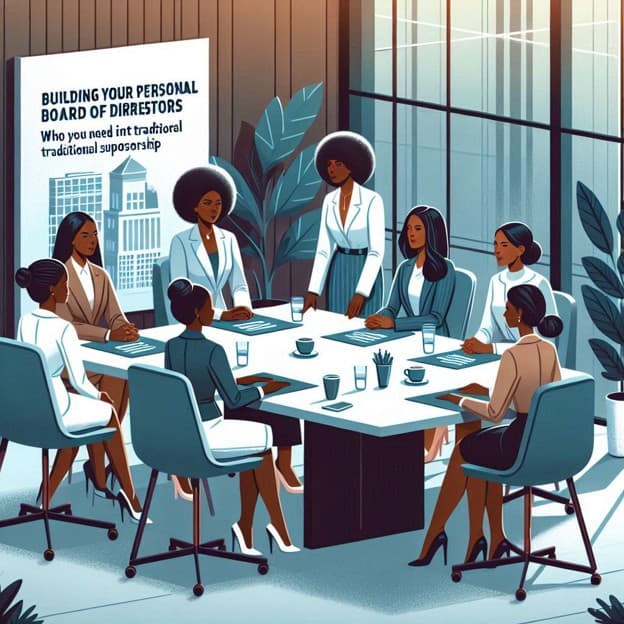
Think of your career as a corporation where you serve as CEO. Like any successful organization, you need a board of directors—strategic advisors who provide diverse expertise, open different doors, and collectively guide your growth and decision-making.
Unlike traditional sponsorship, which relies on one powerful relationship, the Personal Board of Directors model distributes support across multiple relationships, reducing risk while increasing opportunities and perspectives.
The Strategic Advantage
This approach offers several key advantages:
Diversified Risk: No single relationship can derail your advancement Multiple Perspectives: Different advisors bring unique insights and experiences Expanded Networks: Each board member opens access to their professional connections Comprehensive Support: Various needs are met by different specialists Sustainable Growth: Less dependent on individual personalities or organizational changes
As I emphasized in “Mastering a High-Value Company Culture,” sustainable success requires building systems rather than relying on individual relationships. The Personal Board of Directors model embodies this principle by creating a robust support ecosystem.
The Essential Board Positions
1. The Strategic Advisor
Role: Provides big-picture career guidance and industry insight Background: Senior executive with deep industry experience Value: Helps you understand market trends, identify growth opportunities, and make strategic career decisions
Case Study: Maya, a Black woman technology director, cultivated a Strategic Advisor relationship with a retired CTO from a Fortune 500 company. While he couldn’t directly influence her current organization, his industry insights helped Maya anticipate market shifts, position herself for emerging opportunities, and make strategic moves that accelerated her career trajectory.
How to Engage:
- Share your long-term career vision and ask for strategic feedback
- Request insight on industry trends and their career implications
- Seek guidance on positioning yourself for future opportunities
- Ask for introductions to other strategic thinkers in your field
2. The Internal Champion
Role: Advocates for you within your current organization Background: Influential leader in your company with decision-making power Value: Creates opportunities, provides organizational intelligence, and advocates in closed-door meetings
Practical Example: Keisha identified her Internal Champion in the VP of Operations, someone who valued her project management expertise. While not a traditional sponsor relationship, he consistently included her in strategic initiatives, recommended her for cross-functional teams, and spoke positively about her contributions in leadership meetings.
Cultivation Strategy:
- Demonstrate value through exceptional work on shared initiatives
- Provide unique insights and solutions to their challenges
- Be a reliable resource they can count on for important projects
- Make their success easier through your contributions
3. The Industry Connector
Role: Opens doors to external opportunities and relationships Background: Well-networked professional with broad industry connections Value: Provides access to opportunities outside your current organization
Real-World Impact: When Jasmine’s advancement stalled at her current company, her Industry Connector—a Black woman partner at a professional services firm—introduced her to three different organizations seeking diverse leadership talent. Within six months, Jasmine had secured a senior role with a 40% salary increase.
Engagement Approach:
- Be genuinely interested in their work and industry perspective
- Offer to make introductions from your network when appropriate
- Attend industry events they recommend or co-sponsor
- Provide market intelligence and insights from your unique vantage point
4. The Skills Coach
Role: Helps develop specific competencies and capabilities Background: Expert in areas where you need growth (communication, negotiation, technical skills) Value: Provides targeted development to overcome specific advancement barriers
Development Focus Areas:
- Executive presence and communication skills
- Negotiation and influence techniques
- Industry-specific technical competencies
- Leadership and management capabilities
- Cultural navigation and political acumen
5. The Truth-Teller
Role: Provides honest feedback and constructive challenge Background: Trusted colleague or advisor who knows you well Value: Helps identify blind spots, development areas, and improvement opportunities
This person serves as your mirror, helping you see yourself as others do and providing the honest feedback necessary for growth. They’re comfortable having difficult conversations and committed to your success even when it means challenging your assumptions.
6. The Opportunity Scout
Role: Identifies and shares advancement opportunities Background: Someone with visibility into job openings, projects, and career opportunities Value: Ensures you hear about opportunities early and can position yourself competitively
Strategic Value: Research shows that 70% of jobs are never publicly posted. Your Opportunity Scout helps you access this hidden job market and positions you for opportunities before they become competitive.
7. The Cultural Navigator
Role: Helps navigate organizational culture and politics Background: Someone who understands your organization’s unwritten rules and power dynamics Value: Provides insider knowledge about decision-making processes, key stakeholders, and cultural norms
Particularly Important for Black Women: Cultural navigation support is crucial for Black women who often must decode organizational cultures that weren’t designed with their success in mind.
Strategic Assembly and Management
Building Your Board
Phase 1: Assessment and Mapping (Months 1-2)
Current Relationship Inventory:
- Map existing professional relationships
- Identify which board roles are already filled (partially or completely)
- Assess relationship strength and mutual value exchange
- Identify gaps in your support ecosystem
Needs Analysis:
- Define your career goals and advancement timeline
- Identify specific barriers or challenges you face
- Determine what types of support would be most valuable
- Prioritize board positions based on your immediate needs
Phase 2: Strategic Recruitment (Months 3-6)
Target Identification:
- Research potential board members for each role
- Look for individuals with relevant expertise and networks
- Consider both internal and external candidates
- Prioritize relationship quality over title or position
Value Proposition Development:
- Define what you bring to each potential relationship
- Identify ways you can add value to their work or goals
- Prepare clear requests that make engagement easy
- Focus on mutual benefit rather than one-way support
Phase 3: Relationship Cultivation (Months 7-12)
Systematic Engagement:
- Develop regular communication schedules with each board member
- Provide updates on your progress and challenges
- Seek their input on decisions and opportunities
- Share relevant industry insights or connections
Value Delivery:
- Consistently follow through on commitments
- Provide useful information, introductions, or assistance
- Celebrate their successes and acknowledge their support
- Make their participation meaningful and appreciated
Board Management Best Practices
Regular Communication Maintain consistent contact without overwhelming busy schedules:
- Monthly updates via email for most board members
- Quarterly deeper conversations with strategic advisors
- Ad hoc consultation on specific decisions or opportunities
- Annual “board meeting” to review progress and adjust relationships
Clear Expectations Define mutual expectations to ensure productive relationships:
- Be specific about the type of support you’re seeking
- Communicate your availability to provide value in return
- Establish boundaries around time commitment and frequency
- Clarify confidentiality expectations and information sharing
Systematic Documentation Track relationships and interactions to maximize value:
- Maintain contact information and communication preferences
- Document advice received and actions taken
- Track introductions made and opportunities shared
- Note ways you’ve provided value to each board member
Current Trends and Evolution
Digital-First Board Building
Modern technology creates unprecedented opportunities for building Personal Boards of Directors that transcend geographic and organizational boundaries.
LinkedIn Strategy: Use strategic LinkedIn engagement to build relationships with potential board members:
- Share thoughtful commentary on their posts
- Offer relevant insights and resources
- Request virtual coffee meetings for genuine relationship building
- Participate in their professional content and discussions
Virtual Mentorship Platforms: Leverage platforms that connect professionals for mentorship and advisory relationships:
- Industry-specific mentoring programs
- Alumni association connections
- Professional association mentoring initiatives
- Cross-company leadership development programs
The Rise of Peer Advisory Models
Forward-thinking professionals are increasingly turning to peer advisory relationships as part of their Personal Board of Directors.
Peer Learning Circles: Groups of professionals at similar levels who meet regularly to share challenges, insights, and opportunities. These relationships provide mutual support and collective problem-solving capability.
Cross-Industry Exchanges: Building board relationships with professionals from different industries brings fresh perspectives and innovative solutions to career challenges.
Integration with Dave Ulrich’s Stakeholder Value Framework
Dave Ulrich’s evolution toward “stakeholder value” creation provides a framework for understanding how Personal Boards of Directors create value beyond individual career advancement.
When we apply Ulrich’s “human capability” model (talent + leadership + organization + HR function) to Personal Board of Directors:
Talent Development: Board members help develop specific capabilities and competencies Leadership Enhancement: Different advisors contribute to various aspects of leadership development Organizational Understanding: Cultural navigators and internal champions provide organizational intelligence Strategic Integration: The collective board helps integrate career advancement with broader business value creation
This framework positions Personal Board of Directors not as self-serving career advancement but as strategic capability development that benefits multiple stakeholders.
Case Study: The Ecosystem Approach at Global Financial Services
When Tamara Johnson, a Black woman finance manager at Global Financial Services, realized that traditional sponsorship wasn’t working for her, she decided to implement the Personal Board of Directors model systematically.
Initial Assessment
Tamara’s analysis revealed:
- Strong technical skills but limited visibility with senior leadership
- Excellent performance reviews but slow advancement compared to peers
- Limited network outside her immediate function
- Unclear understanding of promotion criteria and organizational politics
Strategic Board Assembly
Over 12 months, Tamara strategically built her Personal Board of Directors:
The Strategic Advisor: A retired CFO from her industry who provided market insights and career guidance during monthly coffee meetings.
The Internal Champion: A VP from another division who valued Tamara’s analytical capabilities and began including her in cross-functional strategic projects.
The Industry Connector: A Black woman executive from a peer organization who opened doors to external opportunities and industry networks.
The Skills Coach: A communication consultant who helped Tamara develop executive presence and presentation skills.
The Truth-Teller: A trusted peer who provided honest feedback about Tamara’s interpersonal effectiveness and leadership style.
The Opportunity Scout: An executive recruiter who kept Tamara informed about market opportunities and helped her understand her competitive positioning.
The Cultural Navigator: A senior manager who helped Tamara understand the unwritten rules of advancement at her organization.
Implementation Strategy
Structured Engagement: Tamara created a systematic approach to board management:
- Weekly touchpoints with one board member
- Monthly progress updates to all board members
- Quarterly “board meetings” to review strategy and adjust approaches
- Annual relationship review and refresh process
Value Exchange: Tamara ensured mutual benefit in all relationships:
- Provided market intelligence to her Strategic Advisor
- Supported her Internal Champion’s initiatives with high-quality analysis
- Made strategic introductions for her Industry Connector
- Served as a case study client for her Skills Coach’s methodology
Results After 18 Months
The Personal Board of Directors approach delivered significant results:
Career Advancement: Tamara received two promotions, advancing from Manager to Director level in 18 months Compensation Growth: Her salary increased by 35% through promotions and market adjustments Network Expansion: Her professional network grew from 50 to over 200 strategic relationships Industry Recognition: She was selected for a prestigious industry leadership program Internal Influence: Her visibility and influence within the organization increased dramatically
Key Success Factors
Tamara’s success demonstrated several critical factors:
Systematic Approach: Treating board building as a strategic initiative rather than ad hoc relationship development Mutual Value: Ensuring all relationships provided value to both parties Diverse Perspectives: Including board members from different backgrounds, levels, and functions Consistent Engagement: Maintaining regular contact and communication with all board members Strategic Patience: Building relationships over time rather than expecting immediate results
Overcoming Implementation Challenges
Challenge 1: Time Management
The Problem: Maintaining multiple advisory relationships can be time-intensive The Solution: Create efficient systems for communication and engagement
- Use group emails for general updates
- Schedule recurring monthly coffee meetings
- Leverage technology for virtual meetings and updates
- Focus on quality interactions rather than frequency
Challenge 2: Relationship Balance
The Problem: Ensuring mutual value in relationships with senior professionals The Solution: Develop clear value propositions for each relationship
- Share industry insights and market intelligence
- Provide different perspectives on their challenges
- Make strategic introductions within your network
- Offer specialized skills or knowledge they need
Challenge 3: Authenticity Concerns
The Problem: Worry about appearing transactional or manipulative The Solution: Focus on genuine relationship building and mutual interest
- Start with authentic interest in their work and perspective
- Share your genuine challenges and seek their input
- Be transparent about your career goals and how they might help
- Express gratitude and celebrate their successes
Challenge 4: Board Member Availability
The Problem: Senior professionals have limited time for advisory relationships The Solution: Make engagement easy and valuable
- Come prepared to meetings with specific questions and requests
- Provide clear, concise updates on your progress
- Respect their time by being punctual and organized
- Follow up on their advice and report back on outcomes
Advanced Board Strategies
The Advisory Board Meeting
Once annually, consider convening your Personal Board of Directors for a virtual or in-person advisory session:
Agenda Framework:
- Career progress review and achievements
- Current challenges and obstacles
- Strategic opportunities and decisions
- Request for specific advice and input
- Ways to add value to board members’ work
Benefits:
- Demonstrates your systematic approach to career development
- Allows board members to interact and potentially help each other
- Creates a forum for comprehensive strategic planning
- Shows appreciation for their collective contribution
Board Evolution and Succession
Personal Boards of Directors should evolve as your career progresses:
Regular Assessment: Annually review board composition and effectiveness Strategic Additions: Add new members as your needs and goals change Graceful Transitions: Thank and transition board members whose advice is no longer needed Paying It Forward: Begin serving on others’ boards as you advance in your career
Cross-Organizational Board Building
Consider building board relationships beyond your current employer:
Industry Associations: Engage with leaders in professional organizations Alumni Networks: Leverage educational and previous employer connections Community Organizations: Build relationships through civic and community involvement Board Service: Seek opportunities to serve on nonprofit or corporate boards
Measuring Board Effectiveness
Quantitative Metrics
Track concrete outcomes that demonstrate board impact:
- Number of new opportunities identified or accessed
- Career advancement velocity (promotions, role changes)
- Salary and compensation growth
- Network expansion and relationship development
- Speaking, writing, or recognition opportunities
Qualitative Indicators
Monitor subjective improvements in your career journey:
- Increased confidence in career decision-making
- Enhanced understanding of industry dynamics
- Improved navigation of organizational politics
- Greater clarity about career goals and pathways
- Stronger sense of professional community and support
Board Member Satisfaction
Regularly assess the mutual value of board relationships:
- Are board members engaged and responsive?
- Do they proactively share opportunities and insights?
- Are they willing to make introductions and advocate?
- Do they seem to value the relationship and your contributions?
- Are they invested in your success and growth?
The Future of Personal Board Development
AI-Enhanced Board Building
Emerging technologies will increasingly support Personal Board of Directors development:
- AI-powered relationship mapping to identify potential board members
- Automated opportunity matching based on your goals and board members’ networks
- Communication scheduling and relationship management tools
- Performance analytics to optimize board composition and engagement
Global and Virtual Board Models
Remote work normalization creates opportunities for truly global Personal Boards of Directors:
- International perspective from advisors across different markets
- Cross-cultural insights for global leadership development
- 24/7 support through advisors in different time zones
- Access to expertise regardless of geographic constraints
Integrated Career Ecosystems
The future will likely see more integrated approaches to career development:
- Organizational support for employees building Personal Boards of Directors
- Formal recognition of advisory relationship value
- Integration between internal mentoring and external board building
- Corporate partnerships with board development platforms and services
Converting to Action: Your 90-Day Quick Start
Days 1-30: Assessment and Planning
Week 1: Complete relationship inventory and needs assessment Week 2: Research potential board members for priority positions Week 3: Develop value propositions and outreach strategies Week 4: Begin reaching out to potential board members
Days 31-60: Relationship Building
Week 5-6: Conduct initial meetings with potential board members Week 7: Refine your board composition based on initial responses Week 8: Begin regular communication and engagement patterns
Days 61-90: Board Activation
Week 9-10: Start leveraging board relationships for specific needs Week 11: Evaluate early effectiveness and adjust approaches Week 12: Plan for sustained board development and management
Conclusion: Taking Control of Your Career Destiny
Building a Personal Board of Directors represents a fundamental shift from waiting for sponsorship to creating the support ecosystem you need for success. This approach acknowledges that traditional models don’t always work for Black women while providing a practical alternative that leverages relationship diversity, shared value creation, and strategic career planning.
As I emphasized in “Rise & Thrive: A Black Woman’s Blueprint for Leadership Excellence,” our success is most sustainable when we create systems rather than depending on individual relationships or organizational goodwill. The Personal Board of Directors model embodies this principle by building a robust support network that can weather organizational changes, personality conflicts, and shifting priorities.
The beauty of this approach lies not just in its practical effectiveness but in its empowerment philosophy. Instead of positioning yourself as someone who needs help, you become someone who creates value through strategic relationships. Instead of waiting for doors to open, you build keys that work across multiple doors.
Remember, every successful leader has advisors, counselors, and supporters who contribute to their success. The difference is that many have built these relationships organically over time or inherited them through social and professional networks. By intentionally building your Personal Board of Directors, you’re creating the same strategic advantage deliberately and systematically.
The journey of building and managing a Personal Board of Directors requires investment, patience, and strategic thinking. But the alternative—waiting for traditional sponsorship that may never come—costs far more in terms of lost opportunities, delayed advancement, and unrealized potential.
Your career is too important to leave to chance. Take control by building the advisory ecosystem that will guide, support, and accelerate your journey to leadership excellence.
Discussion Questions and Next Steps
For Individual Career Planning:
- Which of the seven board positions do you currently have filled, and which are gaps in your support system?
- What unique value could you offer to potential board members that would make advisory relationships mutually beneficial?
- How might you systematically approach building relationships with potential board members in your industry?
For Organizational Development:
- How could your organization support employees in building Personal Boards of Directors as a complement to internal mentoring programs?
- What policies or practices might inadvertently discourage employees from building external advisory relationships?
- How could Personal Board of Directors models be integrated into your leadership development strategy?
For Career Transition Planning:
- How might your Personal Board of Directors need to evolve as your career goals and challenges change?
- What board positions would be most critical during career transitions or industry changes?
- How could you maintain board relationships across job changes and career pivots?
Next Steps:
- Complete the relationship inventory and needs assessment outlined in the 90-day quick start guide
- Identify 3-5 potential board members for the positions most critical to your current career needs
- Develop specific value propositions for each potential board relationship
- Create a systematic approach for board member outreach and relationship building
- Establish measurement criteria to track the effectiveness of your Personal Board of Directors
Ready to transform your career trajectory by building a strategic support ecosystem that works when traditional models don’t? The framework outlined here provides the foundation, but your success depends on taking systematic action to build and maintain these crucial relationships.
📞 Ready to unlock your authentic leadership advantage? Contact: admin@cheblackmon.com | Call: 888.369.7243
Get the Complete Blueprint Master the frameworks from this week’s articles with “Rise & Thrive: A Black Woman’s Blueprint for Leadership Excellence” – your strategic guide to authentic leadership that drives results.
🔗 Get Your Copy: https://adept-solutions-llc-2.kit.com/products/rise-thrive-a-black-womans-bluepri
Join the Academy Want deeper transformation? Join the waitlist for Rise & Thrive Academy – the premier leadership development experience for Black women ready to leverage their authentic advantage.
🔗 Join the Waitlist: https://adept-solutions-llc-2.kit.com/6b1638bc22
#BlackWomenInLeadership #PersonalBoardOfDirectors #CareerStrategy #WomenInBusiness #ProfessionalDevelopment #Leadership #Mentorship #CareerAdvancement #BlackExcellence #ExecutivePresence #WomenEmpowerment #CareerGrowth