The Money Conversation: Talking Compensation Without Awkwardness 💰

By Che’ Blackmon, Founder & CEO, Che’ Blackmon Consulting


Let’s be honest: most of us would rather discuss almost anything else—our weekend plans, the weather, even politics—before we willingly talk about money at work. Yet compensation conversations are the cornerstone of professional growth, organizational fairness, and personal financial security. The awkwardness surrounding these discussions isn’t just uncomfortable; it’s costly, particularly for those already navigating systemic barriers in corporate spaces.

Why the Silence Costs Us All

The reluctance to discuss compensation stems from deeply rooted cultural taboos, power dynamics, and fear of professional consequences. We’ve been socialized to believe that talking about money is impolite, greedy, or unprofessional. This silence, however, perpetuates pay inequities and keeps talented professionals from achieving their full earning potential.

Consider this: women earn approximately 84 cents for every dollar earned by men, and Black women earn just 67 cents for every dollar earned by white, non-Hispanic men. These gaps don’t narrow by accident. They persist because of the very awkwardness we’re addressing—the discomfort that prevents honest dialogue about what we’re worth and what we’re paid.

In High-Value Leadership: Transforming Organizations Through Purposeful Culture, I discuss how transformational leaders create environments where difficult conversations become catalysts for positive change. Compensation transparency is one of those conversations. When organizations cultivate cultures that normalize these discussions, everyone benefits—from entry-level employees to the C-suite.

The Cultural Conditioning That Keeps Us Quiet 🤫

From childhood, many of us receive mixed messages about money. “Don’t ask people what they make.” “Be grateful for what you have.” “Asking for more seems greedy.” These well-intentioned lessons create professional adults who struggle to advocate for their worth.

For Black women and other traditionally overlooked professionals, these challenges compound. Research shows that Black women face unique stereotyping when negotiating—they’re often perceived as “aggressive” or “difficult” for demonstrating the same assertiveness that earns white male colleagues respect. This double standard creates a minefield: speak up and risk being labeled; stay silent and accept less than you deserve.

A major technology company discovered this firsthand when conducting an internal pay equity audit. They found that their highest-performing Black female engineers were consistently paid 12-18% less than their male counterparts with identical experience and performance ratings. The disparity wasn’t intentional; it resulted from years of those women avoiding compensation conversations out of fear, while their male colleagues negotiated freely and frequently.

Breaking the Awkwardness: A Framework for Success ✨

1. Prepare With Data, Not Emotion

The most effective compensation conversations are grounded in market research, performance metrics, and tangible contributions. Before initiating the discussion, gather:

  • Industry salary benchmarks for your role, experience level, and geographic location
  • Documentation of your achievements: quantifiable results, completed projects, exceeded targets
  • Expansion of responsibilities you’ve taken on since your last compensation review
  • Market movement: how your industry and role have evolved

This preparation transforms the conversation from personal (“I need more money”) to professional (“Based on market data and my contributions, here’s the compensation alignment I’m seeking”).

2. Choose Timing Strategically

There’s an art to when you raise compensation discussions. Optimal times include:

  • Annual review cycles (but don’t wait for your manager to initiate)
  • After completing a significant project or achievement
  • When taking on expanded responsibilities
  • During market shifts that affect your role’s value

One mid-sized manufacturing organization implemented quarterly “career conversations” separate from performance reviews. This normalized ongoing dialogue about growth, development, and compensation, removing much of the tension from annual review discussions.

3. Frame the Conversation Properly

Language matters enormously. Compare these approaches:

Less Effective: “I really need a raise. My rent went up and things are expensive.”

More Effective: “I’d like to discuss compensation alignment. Based on my research, professionals in similar roles with comparable experience are earning 15-20% more. Given my contributions to the recent product launch and the expanded team leadership I’ve assumed, I believe a salary adjustment to [specific number] reflects market value and my impact.”

The second approach is professional, data-driven, and positions you as someone who understands their value and the broader market context.

4. Practice the Uncomfortable Silence

After stating your case, stop talking. The silence will feel unbearable, but resist the urge to fill it with justifications, apologies, or backtracking. This is where many professionals—especially women—undermine their own negotiations by talking themselves down from their initial request.

There was a company whose HR director noticed a pattern: male candidates averaged 23 seconds of silence after stating their salary expectations, while female candidates averaged 7 seconds before adding qualifiers like “but I’m flexible” or “that might be too high.” Those extra 16 seconds of confidence translated to an average difference of $8,400 in starting salaries.

Special Considerations for Black Women and Traditionally Overlooked Professionals 🎯

In Rise & Thrive: A Black Woman’s Blueprint for Leadership Excellence, I address the unique navigation required when you’re breaking barriers while building your career. Compensation conversations require additional strategic thinking when you’re already managing stereotypes and biases.

The Preparation Tax

Black women often need to be twice as prepared to be considered equally credible. While this reality is frustrating, acknowledging it allows you to plan accordingly:

  • Anticipate potential objections and prepare responses
  • Bring documentation that white colleagues might not need
  • Have external validation ready (market studies, competitive offers, industry benchmarks)
  • Consider having allies or mentors review your approach beforehand

The Collaboration Strategy

Building coalitions with other professionals navigating similar challenges creates strength in numbers. When multiple team members approach leadership about compensation equity concerns—backed by data—it’s harder to dismiss as individual complaints.

A healthcare organization faced this when six Black women in their nursing leadership team simultaneously requested compensation reviews. Rather than approaching individually (where concerns might be deflected), they presented collective data showing systematic pay disparities. The organization conducted a comprehensive audit and implemented corrective adjustments within 90 days.

The Documentation Discipline

Keep meticulous records of your accomplishments, contributions, and any verbal commitments about compensation. Documentation protects you and provides irrefutable evidence when memories become selective.

Creating a Culture That Welcomes These Conversations 🏢

As a doctoral candidate researching organizational transformation and someone who has spent over two decades in progressive HR leadership, I’ve seen how the right culture changes everything. Organizations serious about equity must actively cultivate environments where compensation conversations are normalized, not penalized.

In Mastering a High-Value Company Culture, I outline how purposeful culture transformation requires intentional systems and practices. Here’s how organizations can reduce awkwardness around compensation:

Implement Transparent Salary Bands

When employees understand the compensation range for their role and what it takes to progress, mystery and guesswork disappear. Buffer, Whole Foods, and others have pioneered radical transparency, publishing salaries internally or even publicly.

Train Managers in Compensation Conversations

Most managers receive little training in discussing money. They’re as uncomfortable as employees, which creates defensive, awkward exchanges. Investing in manager development around compensation discussions improves outcomes for everyone.

Conduct Regular Pay Equity Audits

Proactive organizations don’t wait for problems to surface. They regularly analyze compensation data by gender, race, and other demographics, addressing disparities before they become legal or reputational issues.

Establish Clear Compensation Philosophies

When organizations articulate how they determine pay—market positioning, internal equity, performance impact—employees have a framework for understanding their compensation and requesting adjustments.

A regional financial services company implemented these practices after discovering their employee engagement scores around “fair compensation” were 30 points below industry benchmarks. Within 18 months of creating transparency, conducting audits, and training managers, those scores increased by 28 points, and voluntary turnover decreased by 34%.

The Script: What to Actually Say 📝

Let’s get practical. Here are frameworks for different compensation scenarios:

Requesting a Raise During Your Review:

“Thank you for the positive feedback on my performance this year. I’d like to discuss compensation. Based on my contributions—specifically [achievement 1], [achievement 2], and [achievement 3]—along with market research showing similar roles in our industry range from $X to $Y, I’m requesting a salary adjustment to $[specific amount]. This aligns with both my performance and market value. What are your thoughts?”

Addressing a Pay Disparity You’ve Discovered:

“I’ve become aware of compensation differences between my role and similar positions. I’d like to understand our compensation philosophy and discuss alignment. My research indicates [provide specific data]. Can we schedule time to review my compensation in relation to internal equity and market rates?”

Negotiating a New Job Offer:

“I’m excited about this opportunity. Based on my experience, the responsibilities we’ve discussed, and market rates for this role, I was expecting compensation in the range of $X to $Y. Is there flexibility in the current offer?”

Following Up After a “No”:

“I appreciate you considering my request. Can you help me understand what specific criteria or accomplishments would support a compensation increase? I’d like to establish clear goals we can revisit in [timeframe].”

When the Answer is No: Strategic Next Steps 🚀

Not every compensation request results in immediate salary increases. How you handle “no” determines your long-term success:

  1. Request Specificity: “What exactly would need to change for this conversation to have a different outcome?”
  2. Establish Timeline: “When can we revisit this discussion? What milestones should I focus on?”
  3. Explore Alternatives: If base salary isn’t negotiable, consider bonuses, additional PTO, professional development funds, flexible work arrangements, or expanded responsibilities that position you for future increases.
  4. Assess Honestly: Is this a temporary “not now” or a permanent ceiling? If you’re consistently undervalued despite strong performance and market data, it might be time to explore opportunities elsewhere.

One professional services firm found that employees who engaged in these strategic follow-up conversations after initial denials had a 73% success rate in securing increases within six months, compared to 31% who simply accepted the initial “no” without further discussion.

The Ripple Effect: How Your Conversation Helps Others 🌊

When you successfully navigate compensation conversations, you create pathways for others. This is especially significant for traditionally overlooked professionals who benefit when predecessors normalize these discussions and demonstrate effective strategies.

Every time you negotiate successfully, you:

  • Challenge bias about who “should” ask for more money
  • Create precedent for fair compensation in your role
  • Model confidence for junior colleagues watching your example
  • Contribute data that helps organizations identify and correct systemic issues

Your willingness to have uncomfortable conversations today makes them less uncomfortable for everyone tomorrow.

The Organizational Imperative 💼

For leaders and organizations reading this: compensation awkwardness isn’t just an employee problem. It’s an organizational dysfunction that costs you talent, engagement, and competitive advantage.

High-value organizations, as I define them in my work on purposeful culture transformation, recognize that compensation transparency and fairness aren’t nice-to-haves—they’re fundamental to building trust, attracting top talent, and achieving sustainable success.

When employees believe they’re paid fairly and have clear paths to increased compensation, they:

  • Invest more deeply in their work
  • Stay with organizations longer
  • Refer high-quality candidates
  • Contribute more innovative thinking
  • Build stronger client relationships

Conversely, compensation secrecy and inequity create toxic cultures where talent exits, performance suffers, and employer brand deteriorates.

Moving Forward: Your Action Plan ✅

The awkwardness around money conversations doesn’t disappear overnight, but it diminishes with practice and preparation. Here’s your roadmap:

This Week:

  • Research market rates for your role using Glassdoor, Payscale, salary.com, and industry reports
  • Document your accomplishments and quantifiable contributions from the past year
  • Identify the appropriate person and timing for your compensation conversation

This Month:

  • Practice your compensation conversation script with a trusted mentor or friend
  • Gather any additional documentation needed to support your request
  • Schedule the conversation with your manager

This Quarter:

  • Have the compensation conversation
  • Follow up strategically based on the outcome
  • If employed in a leadership role, audit your team’s compensation for equity
  • Share learnings with your professional network to help others navigate similar conversations

Discussion Questions & Reflection 💭

  1. What specific fears or concerns have prevented you from initiating compensation conversations in your career? Where do those fears originate?
  2. How might your organization’s culture currently support or hinder open discussions about compensation? What’s one change that would make the biggest difference?
  3. For leaders: When was the last time you proactively addressed compensation equity within your team? What prompted that review, and what did you discover?
  4. What role does mentorship play in helping traditionally overlooked professionals navigate compensation conversations more effectively? How can senior leaders better support this?
  5. How do you balance gratitude for your current opportunity with advocacy for fair compensation? Are these truly in conflict?

Your Next Steps With Che’ Blackmon Consulting 🌟

If you’re ready to transform how your organization approaches compensation, culture, and equity—or if you’re a professional who wants personalized support navigating these crucial conversations—let’s talk.

Che’ Blackmon Consulting specializes in:

  • Culture transformation strategies that address systemic inequities
  • Leadership development for executives committed to purposeful change
  • Compensation equity audits and remediation strategies
  • Executive coaching for professionals navigating career advancement
  • AI-powered predictive analytics for organizational transformation

Whether you’re building Michigan’s next high-value culture or positioning yourself for leadership excellence, we’re here to help you unlock potential, empower change, and transform outcomes.


Ready to have better conversations about compensation and culture?

📧 Email: admin@cheblackmon.com
📞 Phone: 888.369.7243
🌐 Web: cheblackmon.com

Let’s unlock the uncomfortable conversations that lead to transformational outcomes—for individuals, organizations, and entire industries.


Che’ Blackmon is the founder and CEO of Che’ Blackmon Consulting, a DBA candidate at National University, and the author of multiple books on leadership and organizational culture including “High-Value Leadership: Transforming Organizations Through Purposeful Culture” and “Rise & Thrive: A Black Woman’s Blueprint for Leadership Excellence.” With over 24 years of progressive HR leadership experience, she specializes in culture transformation and empowering traditionally overlooked talent to rise and thrive in corporate spaces.

#CompensationEquity #PayTransparency #SalaryNegotiation #BlackWomenInBusiness #WageGap #HighValueLeadership #HRLeadership #OrganizationalCulture #PayEquity #WomenInLeadership #DiversityAndInclusion #CompensationStrategy #LeadershipDevelopment #CultureTransformation #ProfessionalDevelopment #CareerAdvancement #ExecutiveCoaching #HRConsulting #WorkplaceEquity #CorporateCulture #BlackWomenLeaders #SalaryTransparency #FairPay #DEI #EmployeeEngagement #TalentRetention #LeadershipExcellence #HRTransformation #RiseAndThrive #CheBlackmon

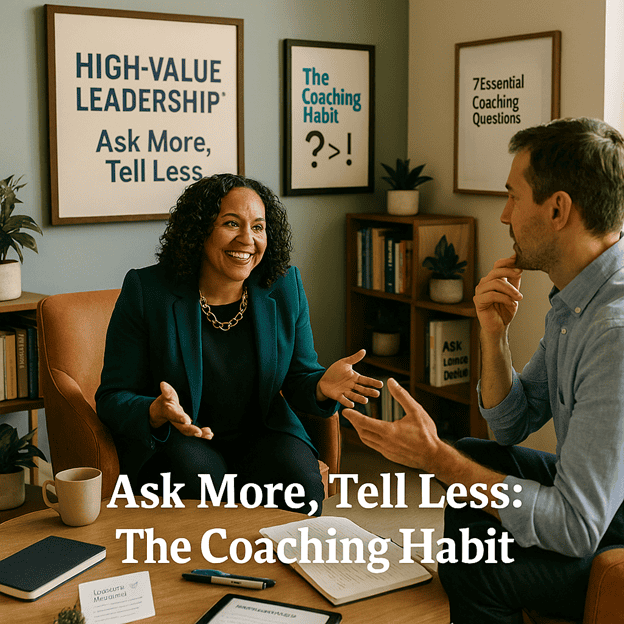
The Coaching Habit: Developing Leaders Through Powerful Questions 💬

Why the best leaders ask more than they answer—and how questions transform organizations


The senior director had all the answers. Twenty years of industry experience had taught him exactly how problems should be solved, decisions should be made, and work should be executed. When his team brought challenges, he dispensed solutions efficiently. When they proposed ideas, he quickly identified flaws and provided corrections. He was knowledgeable, decisive, and always available to tell people what to do.

His team was also disengaged, dependent, and stagnant. Nobody developed problem-solving capabilities because he solved all the problems. Nobody took ownership because he owned all the decisions. Nobody grew because he did all the thinking.

When his best performer resigned, the exit interview revealed a painful truth: “I didn’t leave for more money. I left because I stopped learning. Every conversation with him was him telling me what to do. I became a pair of hands executing his ideas rather than a professional developing my own capabilities.”

This leader had mistaken directing for developing. He’d confused having answers with building leaders. And he’d paid for it with turnover, disengagement, and a team that couldn’t function without his constant intervention.

The shift he needed—and that most leaders need—is simple but profound: from telling to asking. From providing answers to asking powerful questions that develop thinking, build ownership, and create leaders rather than followers.

The Case for Coaching-Style Leadership 🎯

Traditional leadership operated on an expertise model: the leader knew most, decided most, and directed execution. This model worked reasonably well in stable environments with routine work and predictable challenges. It fails spectacularly in complex, rapidly changing environments requiring innovation, adaptation, and distributed decision-making.

As I discuss in High-Value Leadership: Transforming Organizations Through Purposeful Culture, high-value leaders understand that their job isn’t to be the smartest person in the room—it’s to make everyone in the room smarter. This requires a fundamental shift from directive leadership to developmental leadership, from command-and-control to coach-and-cultivate.

Research by the International Coach Federation demonstrates that organizations with strong coaching cultures report:

  • 62% higher employee engagement
  • 51% higher revenue growth
  • 60% improvement in team performance
  • 48% improvement in organizational culture

These aren’t marginal improvements—they’re transformational differences driven by a simple practice: leaders who ask powerful questions instead of providing all the answers.

Why coaching-style leadership matters more in 2025 and beyond:

Pace of change exceeds leader knowledge: Leaders can no longer know everything their teams need to know. Technology, market conditions, customer preferences, and competitive dynamics change faster than any single person can track. Leaders who insist on having all answers become bottlenecks.

Talent expectations have shifted: Younger professionals expect development, not just direction. They want to learn, grow, and build capabilities—not just execute tasks. Leaders who only tell rather than develop lose talent to competitors who coach.

Complex problems require diverse thinking: The challenges organizations face exceed any individual’s cognitive capacity. Solutions emerge from collective intelligence, not individual genius. Coaching-style leadership leverages diverse perspectives rather than imposing single viewpoints.

Remote work demands autonomy: Distributed teams can’t wait for leader approval on every decision. Coaching develops judgment and ownership that enables effective autonomous action when leaders aren’t immediately available.

Inclusion requires voice: Traditionally marginalized groups—particularly Black women—have been talked at and directed rather than asked and developed. Coaching-style leadership creates space for voices that have been historically silenced.

Understanding Powerful Questions ❓

Not all questions are created equal. Many so-called questions are actually disguised directives, judgments, or rhetorical devices designed to prove points rather than provoke thinking.

Pseudo-questions that don’t actually coach:

“Don’t you think you should…?” (This is telling disguised as asking) “Why did you do it that way?” (This often implies criticism rather than curiosity) “Have you considered [my solution]?” (This is directing with a question mark) “Wouldn’t it be better if…?” (This is judgment framed as inquiry)

These questions don’t develop thinking—they impose the leader’s thinking while creating the appearance of involvement.

Powerful questions share key characteristics:

They’re genuinely curious: The leader doesn’t know the answer and actually wants to understand the other person’s thinking. Genuine curiosity creates psychological safety and invites authentic responses.

They’re open-ended: Powerful questions can’t be answered with yes/no. They require thinking, reflection, and articulation of perspectives. “What concerns you about this approach?” generates more development than “Are you concerned?”

They expand thinking: Great coaching questions help people see possibilities, connections, or implications they hadn’t considered. “What else could be true?” or “Who else might be affected?” broaden perspective beyond initial framing.

They build ownership: Questions like “What do you think we should do?” or “What would you propose?” shift responsibility from the leader to the person being coached. This develops both capability and accountability.

They surface assumptions: “What are you assuming about this situation?” or “What would need to be true for that to work?” help people examine their mental models rather than operating on autopilot.

They connect to purpose: “How does this connect to what matters most?” or “What impact do you want to have?” ground problem-solving in values and objectives rather than just tactics.

The Seven Essential Coaching Questions 7️⃣

While coaching conversations can include infinite questions, research by Michael Bungay Stanier and others identifies several questions with outsized impact. These questions, asked consistently, transform how leaders develop their teams.

1. “What’s on your mind?” 🤔

Purpose: Opens conversation without imposing agenda. Lets the other person surface what matters most to them rather than what you assume matters.

Why it’s powerful: This question immediately signals that this conversation is about their thinking, not your telling. It creates space for issues the leader might not have considered or even known about.

When to use it: Opening one-on-ones, check-ins, or whenever someone seems to need to talk but hasn’t articulated what about.

Example in practice:

A team member seems distracted during meetings but hasn’t raised concerns. Rather than assuming the problem or offering unsolicited advice, the leader opens their one-on-one with: “What’s on your mind?”

The team member shares that they’re struggling with work-life balance since their elderly parent moved in with them. This isn’t a problem the leader could have solved by providing technical guidance—it required space to articulate what was actually affecting performance.

The leader’s role shifts from problem-solver to thought partner, exploring: “What support would help you manage this?” and “What adjustments might make this season more sustainable?”

2. “And what else?” (AWE) 🔄

Purpose: Deepens exploration beyond the first, often surface-level response. Humans tend to offer the most available or least risky answer first. “And what else?” surfaces additional factors, concerns, or ideas.

Why it’s powerful: This simple question generates exponentially more insight than stopping at the first response. It also demonstrates genuine interest rather than performative inquiry.

When to use it: After almost any response to deepen understanding. Research shows asking “and what else?” 3-5 times in a conversation dramatically improves the quality of thinking.

Example in practice:

Leader: “What challenges are you facing with this project?” Team member: “We’re behind schedule.” Leader: “And what else?” Team member: “The vendor hasn’t delivered what they promised.” Leader: “And what else?” Team member: “Honestly, I’m not sure everyone on the team understands what we’re trying to accomplish.”

That third factor—lack of shared understanding—is often the root cause that wouldn’t have surfaced without deeper exploration. The leader now knows that solving the schedule and vendor issues without addressing alignment will still leave the project struggling.

3. “What’s the real challenge here for you?” 🎯

Purpose: Focuses on the core issue rather than symptoms or surface problems. Helps people distinguish between what looks like the problem and what actually is the problem.

Why it’s powerful: People often present presenting problems rather than real problems. This question cuts through to what actually matters and makes the challenge specific to the person, not abstract.

When to use it: When conversations spiral across multiple issues, when someone seems stuck, or when the stated problem doesn’t explain the level of frustration or difficulty.

Example in practice:

A manager brings multiple complaints about a project: the timeline is unrealistic, resources are insufficient, stakeholders keep changing requirements, and the team seems demotivated.

Rather than trying to solve all these issues, the leader asks: “What’s the real challenge here for you?”

After reflection: “I’ve never led a project this high-visibility before. I’m afraid if it fails, it will define my reputation. So I’m trying to control everything instead of trusting my team and managing stakeholder expectations.”

The real challenge isn’t timeline, resources, or scope—it’s the manager’s fear and resulting micromanagement. Solving the stated problems wouldn’t have addressed the underlying issue driving dysfunction.

4. “What do you want?” 🎁

Purpose: Clarifies objectives and desired outcomes. Many people know what they don’t want but haven’t articulated what they actually want instead.

Why it’s powerful: This question shifts from complaint to aspiration, from problem to possibility. It also surfaces whether someone wants advice, validation, decision-making authority, or just to be heard.

When to use it: When conversations feel stuck in problem description without moving toward solutions, or when you’re unclear what the person actually needs from you.

Example in practice:

A team member brings repeated concerns about team dynamics but doesn’t propose solutions. The leader asks: “What do you want?”

Initial response: “I want people to stop interrupting me in meetings.”

Leader: “And what else do you want?”

Deeper response: “I want my ideas to be taken seriously. I want to feel like my perspective matters to the team.”

Now the conversation shifts from managing meeting behavior (which the leader could mandate) to building influence and voice (which requires developmental coaching about communication, relationship-building, and confidence).

5. “How can I help?” 🤝

Purpose: Clarifies what support is actually needed versus what the leader assumes is needed. Prevents over-functioning or providing help that doesn’t help.

Why it’s powerful: This question makes the other person specify what would be useful rather than the leader imposing their preferred form of help. It also positions the leader as supportive resource rather than controlling authority.

When to use it: After someone has articulated a challenge or goal. Before jumping in to solve or advise.

Example in practice:

A team member shares they’re struggling with a difficult stakeholder who dismisses their recommendations.

Instead of immediately offering advice (“Have you tried…”), the leader asks: “How can I help?”

Possible responses reveal very different needs:

  • “Could you attend the next meeting and observe the dynamic?” (Wants witness/validation)
  • “Would you help me role-play the conversation?” (Wants practice/skill development)
  • “Could you talk to them directly?” (Wants intervention)
  • “Just listen to me vent for a minute.” (Wants empathy, not solving)

Each requires different help. Asking prevents providing the wrong type of support.

6. “If you’re saying yes to this, what are you saying no to?” ⚖️

Purpose: Surfaces trade-offs and opportunity costs. Helps people think strategically about priorities rather than just adding to their plate.

Why it’s powerful: People habitually say yes without considering what they’ll sacrifice to accommodate new commitments. This question forces explicit trade-off thinking that prevents overcommitment and burnout.

When to use it: When someone is considering new commitments, struggling with workload, or saying yes to everything while complaining about overwhelm.

Example in practice:

A high-performer volunteers for another task force while already stretched thin. Rather than either approving or denying the request, the leader asks: “If you’re saying yes to this task force, what are you saying no to?”

The team member considers: “I guess I’d have to deprioritize the process improvement project I’ve been leading. Or stop mentoring the two junior team members who’ve been asking for my time. Or reduce time on my core responsibilities.”

This reflection reveals that the task force—while potentially valuable—comes at costs the team member hadn’t fully considered. They may still choose it, but now it’s a conscious strategic choice rather than reflexive yes.

7. “What was most useful about this conversation?” 📝

Purpose: Consolidates learning and signals that development happens through their thinking, not your telling. Also provides you feedback about what’s actually helpful.

Why it’s powerful: This question requires reflection about what mattered, which reinforces integration. It also trains people to extract value from conversations rather than passively receiving advice.

When to use it: Closing coaching conversations, one-on-ones, or developmental discussions.

Example in practice:

After a thirty-minute coaching conversation about navigating organizational politics, the leader closes with: “What was most useful about this conversation?”

Response: “Realizing that I’ve been waiting for permission to build relationships with senior leaders when I actually just need to reach out. And that my discomfort isn’t a sign I shouldn’t do it—it’s just unfamiliarity.”

This reflection crystallizes the insight from the conversation and identifies what will actually drive behavior change versus everything else discussed that might have been interesting but won’t translate to action.

The Traditionally Overlooked: Coaching Black Women Leaders 🌟

Coaching-style leadership takes on particular significance for Black women and other marginalized leaders who’ve historically been directed, dismissed, and developed least.

As I explore in Rise & Thrive: A Black Woman’s Blueprint for Leadership Excellence, Black women in corporate spaces often navigate environments where their thinking isn’t solicited, their perspectives aren’t valued, and their development isn’t prioritized. They receive direction without development, criticism without coaching, and feedback about how they should be different rather than questions that help them grow from where they are.

Common patterns affecting Black women that coaching can address:

Under-developed and over-directed: Black women frequently receive explicit instructions about tasks while their white peers receive developmental coaching about leadership. This perpetuates skill gaps that then get cited as reasons for non-promotion.

There was a technology company where performance reviews revealed striking patterns: Black women’s reviews contained 42% more directive language (“you should,” “you need to,” “make sure you”) while white men’s reviews contained 67% more developmental language (“consider,” “what if you,” “how might you”).

The directive approach treated Black women as executors rather than thinkers, denying them the coaching that builds strategic capability.

Questions as interrogation rather than development: Black women report that when leaders ask them questions, it often feels like skeptical interrogation (“Why did you do it that way?” with implicit criticism) rather than curious development (“What was your thinking?” with genuine interest).

This distinction—between questions that question judgment versus questions that develop judgment—profoundly affects whether coaching actually develops capability or just reinforces insecurity.

Feedback without psychological safety: Effective coaching requires psychological safety to think out loud, make mistakes, and explore ideas without fear. Black women often lack this safety, making coaching conversations feel risky rather than developmental.

Style feedback masquerading as coaching: Black women disproportionately receive “coaching” focused on changing how they communicate, dress, or show up rather than questions that develop their strategic thinking, leadership capability, or technical expertise.

“Have you considered being less direct?” isn’t developmental coaching—it’s assimilation pressure disguised as development.

Lack of access to coaching: Executive coaching, leadership development, and other coaching resources disproportionately flow to people who “look like leaders”—which often means white men. Black women get excluded from coaching opportunities then face criticism for lacking capabilities coaching would have developed.

Effective coaching for Black women requires:

Genuine curiosity about their thinking: Questions that actually want to understand their perspective rather than leading them to pre-determined “correct” answers.

Recognition of context: Understanding that Black women navigate additional complexities that white colleagues don’t face. “What challenges are you facing?” followed by “And what else?” might surface dynamics of exclusion, bias, or isolation that require different coaching approaches.

Development of full capability spectrum: Coaching that builds strategic thinking, leadership presence, technical depth, political navigation—not just style modification to fit dominant culture norms.

Psychological safety for authentic development: Creating conditions where Black women can think out loud, explore ideas, admit uncertainty, and develop without fear that vulnerability will be weaponized against them.

Sponsorship alongside coaching: Coaching develops capability, but Black women also need sponsors who create opportunities to apply those capabilities. Coaching without opportunity access is development without advancement.

Building a Coaching Culture: Beyond Individual Conversations 🏢

While individual coaching conversations matter, sustainable impact requires building coaching into organizational culture—making it how work gets done rather than something special that happens occasionally.

As I outline in Mastering a High-Value Company Culture, high-value cultures integrate coaching into regular rhythms: team meetings, project debriefs, performance conversations, problem-solving sessions, and decision-making processes.

Elements of strong coaching cultures:

Regular Coaching Rhythms 📅

Weekly one-on-ones structured around coaching questions: Instead of status update meetings, leaders use structured time to develop team members through powerful questions about challenges they’re facing, opportunities they’re seeing, and capabilities they’re building.

Team coaching sessions: Regular team time devoted to collective learning through questions like: “What did we learn from this project?” “What’s working well that we should do more of?” “What’s not working that we need to change?”

Peer coaching: Structured opportunities for colleagues to coach each other, not just receive coaching from leaders. This democratizes development and builds coaching capabilities across the organization.

Leader Accountability for Development 📊

Coaching as performance metric: Leaders evaluated not just on their team’s outputs but on their team’s development. Metrics like: team members’ skill growth, promotion rates, engagement scores, and self-reported development.

Development plans for every team member: Not just for underperformers or high-potentials, but systematic development conversations and plans for everyone. Coaching questions drive these conversations rather than leader-prescribed development paths.

Time allocation expectations: Leaders explicitly expected to spend significant time (20-30%) on developing people, not just managing tasks. This time is protected and valued rather than treated as optional when “real work” allows.

Training and Support for Coaches 🎓

Coaching skills development: Teaching leaders how to ask powerful questions, create psychological safety, listen deeply, and resist the advice-giving reflex. These are learned skills, not innate talents.

Practice and feedback: Leaders practice coaching with observation and feedback, not just attend training then return to old patterns. Skill development requires deliberate practice with refinement.

Peer learning communities: Leaders learn coaching together through peer observation, case consultation, and shared problem-solving about developmental challenges.

Systems That Support Coaching 🔧

Performance management redesigned: Shifting from annual reviews to ongoing coaching conversations. Replacing rating systems that create defensiveness with developmental dialogue that builds capability.

Meeting structures that enable coaching: Agendas with time for questions rather than only presentations. Norms that value inquiry over advocacy. Practices that ensure psychological safety for learning.

Recognition for development: Celebrating not just results but how people developed capabilities, helped others learn, and built organizational capability for the future.

Case Study: Manufacturing Company’s Coaching Transformation 🏭

A Michigan automotive supplier faced concerning patterns: engagement was low (43%), turnover was high (31%), and leadership bench strength was weak. When senior leaders retired or left, they struggled to fill positions internally.

Exit interviews revealed a common theme: “My manager told me what to do but never developed me. I stopped learning, so I left.”

The CEO recognized they had directive leaders who managed tasks but didn’t develop people. She commissioned a coaching culture initiative.

Initial assessment revealed:

  • Managers spent 78% of time directing work, 22% developing people
  • One-on-ones focused almost entirely on status updates
  • Questions managers asked were mostly interrogative (“Why is this late?”) rather than developmental
  • No systematic approach to employee development beyond required training
  • High-performers left because they plateaued—capable managers didn’t know how to develop them further

Intervention design:

Phase 1: Leader Development (Months 1-3)

  • All managers trained in coaching skills: asking powerful questions, active listening, resisting advice reflex
  • Introduction of the seven essential coaching questions
  • Practice sessions with feedback and refinement
  • Peer coaching partnerships established

Phase 2: Structure and Rhythm Changes (Months 4-6)

  • One-on-ones restructured: first 20 minutes for coaching questions, last 10 for status updates (reversed previous ratio)
  • Monthly team learning sessions where leaders coached teams through challenges
  • Development plans required for all employees, driven by coaching questions rather than manager prescriptions
  • Manager performance metrics expanded to include team development outcomes

Phase 3: Culture Embedding (Months 7-12)

  • Coaching competency added to leadership requirements
  • Recognition program highlighting developmental leadership examples
  • Peer coaching expanded beyond managers to include all employees
  • Project debriefs redesigned around coaching questions: “What worked? What didn’t? What would we do differently? What did we learn?”

Results after 18 months:

Engagement increased from 43% to 68%: Employees reported feeling more valued, developed, and empowered.

Turnover decreased from 31% to 17%: Exit interviews showed people staying because “I’m still learning” rather than leaving because “I stopped growing.”

Internal promotion rate increased by 47%: More people ready for advancement because they’d been developed systematically.

Problem-solving improved: Teams solved problems more independently because coaching had developed their thinking capabilities rather than dependence on manager solutions.

Innovation increased: Coaching questions surfaced ideas from people who previously hadn’t been asked for their thinking.

Manager effectiveness improved: Managers reported less stress from feeling responsible for having all answers, more satisfaction from developing people.

The most significant shift wasn’t in metrics—it was in how work felt. One manager reflected: “I used to go home exhausted from solving everyone’s problems. Now I go home energized by helping people solve their own problems. And they’re becoming better problem-solvers than I ever was because they’re developing their own thinking instead of just executing mine.”

Overcoming the Advice-Giving Addiction 🚫

The biggest barrier to coaching-style leadership is most leaders’ addiction to giving advice. Telling feels efficient, demonstrates expertise, and provides immediate gratification. Asking feels slow, uncertain, and risks exposing that you don’t know everything.

Why leaders default to telling:

Efficiency illusion: Telling seems faster than asking. “Just do X” takes thirty seconds. Coaching someone to develop their own solution takes twenty minutes. But the long-term efficiency reverses—coached people solve future problems independently while directed people keep returning for solutions.

Expertise identity: Many leaders derive self-worth from being the smartest person who has the answers. Asking questions threatens this identity: “If I’m asking instead of knowing, what’s my value?”

Organizational culture: Many organizations reward quick decisive action over developmental patience. Leaders who coach face pressure to “just tell people what to do and move on.”

Lack of skill: Leaders often don’t know how to coach effectively, so they default to comfortable directive approaches even when they intellectually believe coaching matters.

Breaking the advice addiction requires:

Awareness of the reflex: Notice how quickly you jump to advice. When someone brings a challenge, count to five before responding. The pause interrupts automatic telling.

Start with one question: Before offering any advice, ask just one coaching question: “What have you already tried?” or “What ideas do you have?” This small step builds the coaching muscle.

Make advice opt-in, not default: Instead of offering unsolicited solutions, ask: “Would you like my thoughts on this, or would it be more helpful to think through it together?” This makes advice something they can request rather than something you impose.

Celebrate developed thinking, not just delivered solutions: Recognize when team members solve problems independently, even if their solutions differ from what you would have done. This reinforces development over dependence.

Get coaching yourself: Leaders who receive coaching understand its value viscerally rather than abstractly. Executive coaching for leaders models the developmental approach you want them to practice.

Coaching Questions for Common Leadership Situations 💼

When team members bring problems seeking solutions:

Instead of: “Here’s what you should do…”

Ask:

  • “What options have you considered?”
  • “What would you do if I weren’t available to ask?”
  • “What’s your recommendation and what’s your reasoning?”
  • “What would need to be true for your approach to work?”
  • “How could you test your solution on small scale before full implementation?”

When someone proposes an idea you think is flawed:

Instead of: “That won’t work because…”

Ask:

  • “Walk me through your thinking—what led you to this approach?”
  • “What potential challenges do you see with this approach?”
  • “What would success look like? How would you measure it?”
  • “Who else might be affected? What’s their perspective?”
  • “What’s Plan B if this doesn’t work as hoped?”

When you notice performance issues:

Instead of: “You need to improve X…”

Ask:

  • “How do you think things are going?”
  • “What’s getting in the way of your best work?”
  • “What support would help you perform at your highest level?”
  • “What patterns are you noticing in your work?”
  • “What would you like to be different?”

When someone seems stuck or frustrated:

Instead of: Offering solutions or motivation

Ask:

  • “What’s the hardest part of this for you?”
  • “What’s one small step you could take today?”
  • “What would make this feel more manageable?”
  • “Who could help you with this?”
  • “What’s worked when you’ve faced similar challenges before?”

When coaching emerging leaders:

Instead of: Telling them how to lead

Ask:

  • “What kind of leader do you want to be?”
  • “What impact do you want to have on your team?”
  • “What’s your learning edge right now—where are you most growing?”
  • “What leadership behaviors have you observed that you want to emulate? Which do you want to avoid?”
  • “How will you know you’re developing as a leader?”

Research-Backed Coaching Best Practices 📚

Organizations that coach effectively share common practices supported by research:

They ask more than they tell: Research by Julia Milner and Trenton Milner published in Harvard Business Review found that managers who ask questions rather than provide solutions develop higher-performing teams. The optimal ratio: 60-70% questions, 30-40% advice.

They resist premature advice: Studies show that leaders who wait until after asking at least three questions before offering advice generate better outcomes than those who jump immediately to solutions. The discipline of inquiry before advocacy improves both the quality of advice (when given) and team member development.

They listen more than they speak: Research on coaching effectiveness shows that in developmental conversations, the person being coached should speak 60-70% of the time. When leaders dominate conversation, development doesn’t happen.

They tolerate productive struggle: Carol Dweck’s research on growth mindset shows that struggle is essential to learning. Leaders who rescue people from difficulty prevent development. Coaching-style leaders ask: “What could you try?” rather than eliminating struggle with solutions.

They coach the person, not just the problem: Effective coaches focus on building capabilities that transfer across situations rather than just solving the immediate issue. Questions like “What’s the pattern here?” or “Where else does this show up?” connect specific situations to broader development.

They make coaching everyone’s job: Organizations with strongest coaching cultures democratize coaching rather than treating it as something only senior leaders do. Peer coaching, team coaching, and upward coaching (junior people coaching senior leaders) all contribute to development.

Common Coaching Mistakes That Undermine Development ⚠️

Mistake 1: Asking leading questions that aren’t actually questions

“Don’t you think you should…” is telling with a question mark. Powerful questions are genuinely open without predetermined answers.

Mistake 2: Asking questions but not listening to answers

Leaders who ask questions but interrupt, argue with responses, or ignore input teach people that their thinking doesn’t actually matter. Asking questions requires genuine curiosity about answers.

Mistake 3: Using questions to avoid difficult conversations

Coaching questions work for development, not for addressing performance problems requiring direct feedback. “What could you do differently?” isn’t appropriate when clear corrective feedback is needed: “This behavior is unacceptable and must stop.”

Mistake 4: Coaching when directing is appropriate

Coaching develops judgment for ambiguous situations. Some situations require clear direction: safety issues, compliance requirements, organizational mandates. Know when each approach fits.

Mistake 5: Coaching without psychological safety

Questions asked in threatening environments generate defensive responses, not developmental thinking. Coaching requires foundation of safety, trust, and genuine development intent.

Mistake 6: Assuming everyone wants or needs the same coaching

Different people need different developmental support. Some need confidence-building, others need challenge. Some need technical skill development, others need strategic thinking development. Effective coaches diagnose individual needs rather than applying one-size-fits-all approaches.

Mistake 7: Measuring coaching by time spent rather than impact achieved

Having coaching conversations doesn’t equal effective development. Impact shows up in capability growth, independent problem-solving, ownership increases, and engagement improvements—not just hours of coaching delivered.

Building Your Personal Coaching Practice 🌱

Developing coaching-style leadership is a practice, not a switch you flip. Start small, build gradually, and refine based on what works.

Week 1: Awareness and Baseline

  • Notice how often you give advice versus ask questions
  • Count: How many coaching questions do you ask per day?
  • Observe: When do you jump to advice? What triggers the telling reflex?
  • Record: What questions do you currently ask? Are they genuine or leading?

Week 2-3: One Question Practice

  • Commit to asking one coaching question before any advice
  • Start with: “What’s your thinking on this?”
  • Practice the three-second pause before responding
  • Notice what happens when you ask first

Week 4-5: Expand Question Repertoire

  • Add “And what else?” to deepen exploration
  • Introduce “What’s the real challenge here for you?”
  • Practice “How can I help?” before offering solutions
  • Experiment with different questions in different contexts

Week 6-8: Build Coaching Rhythms

  • Restructure one-on-ones to start with coaching questions
  • Add one team coaching session per month
  • Establish peer coaching partnership with colleague
  • Track what questions generate best thinking

Month 3 and beyond: Refine and Expand

  • Seek feedback: “What’s most useful about our conversations?”
  • Observe patterns: Which questions work for which situations?
  • Learn from mistakes: When did questions not work? Why?
  • Deepen practice: Executive coaching for yourself to experience coaching from inside

Month 6: Assess Impact

  • How has team engagement changed?
  • Are people solving more problems independently?
  • What capabilities have team members developed?
  • How has your experience of leadership shifted?

Discussion Questions for Your Leadership Team 💭

  1. When we review our typical leadership conversations, are we asking or telling more often? What’s the ratio, and what’s ideal for our context?
  2. How would our team members describe the questions we ask? Genuine developmental inquiry? Skeptical interrogation? Leading questions disguised as participation?
  3. What prevents us from coaching more effectively? Time pressure? Advice addiction? Lack of skill? Organizational culture that rewards quick solutions?
  4. When we look at who receives developmental coaching in our organization, what patterns emerge by race, gender, and other demographics? Who gets coached and who gets directed?
  5. What would shift if we measured leaders not just on their team’s outputs but on their team’s development? What behaviors would this change?
  6. Black women and other marginalized leaders: Do you receive genuine developmental coaching or primarily directive feedback and style policing? What would change if you received the former?
  7. If we committed to asking three coaching questions before offering any advice, what would become possible in our organization?

Next Steps: Your Coaching Development Action Plan 📝

Immediate Actions (This Week):

  1. Choose one coaching question to practice consistently this week
  2. Notice your advice-giving reflex and pause before responding
  3. Schedule one conversation specifically for coaching practice
  4. Ask someone for feedback: “Do my questions feel developmental or interrogative?”
  5. Identify one leader whose coaching style you admire and observe how they ask questions

Short-Term Actions (Next 30 Days):

  1. Implement coaching questions in one-on-ones with direct reports
  2. Establish one peer coaching partnership for mutual development
  3. Read or listen to resources on coaching-style leadership
  4. Practice all seven essential coaching questions in various contexts
  5. Track what questions generate best thinking and development

Long-Term Culture Shift (Next 6 Months):

  1. Build coaching competency into leadership evaluation criteria
  2. Train all managers in coaching skills with practice and feedback
  3. Restructure meetings and one-on-ones to include coaching time
  4. Create peer coaching programs across the organization
  5. Measure and celebrate team member development alongside task completion
  6. Establish coaching culture indicators and track progress quarterly

Partner with Che’ Blackmon Consulting: Building Coaching Capability at Scale ✨

Transforming from directive to developmental leadership requires more than individual commitment—it requires organizational systems, skilled development, and sustained support.

Che’ Blackmon Consulting helps organizations build coaching cultures through:

Leadership Coaching Skills Development: Training programs that build leaders’ capacity to ask powerful questions, create psychological safety, and develop people through inquiry rather than direction.

Executive Coaching: One-on-one coaching for leaders to develop their own coaching capabilities while experiencing coaching from the inside, making the value visceral rather than abstract.

Coaching Culture Assessment: Evaluation of current state (how much coaching happens, how effective it is, who receives it equitably) and roadmap for building stronger developmental culture.

Manager Development Programs: Cohort-based learning where managers develop coaching skills together through practice, feedback, and peer learning.

Organizational System Redesign: Transformation of performance management, meeting structures, and leadership rhythms to integrate coaching rather than treating it as separate from “real work.”

Equity-Focused Coaching Practices: Specific development of coaching approaches that effectively develop Black women and other traditionally marginalized leaders who’ve been over-directed and under-coached.

As a doctoral candidate in Organizational Leadership and founder of Che’ Blackmon Consulting, I bring both research-backed frameworks and practical implementation experience to help you shift from telling cultures to asking cultures, from directive leadership to developmental leadership, from creating followers to building leaders.

The leaders your organization needs tomorrow won’t develop by being told what to do today. They’ll develop by being asked powerful questions that build their thinking, judgment, ownership, and capability.

Your choice: Build leaders who depend on you for answers, or build leaders who develop their own? One requires telling. The other requires asking.

📧 admin@cheblackmon.com
📞 888.369.7243
🌐 cheblackmon.com

Let’s build the coaching capabilities your leaders need to develop the organization your mission requires.


Che’ Blackmon is a doctoral candidate in Organizational Leadership, founder and CEO of Che’ Blackmon Consulting, and author of “High-Value Leadership: Transforming Organizations Through Purposeful Culture,” “Mastering a High-Value Company Culture,” and “Rise & Thrive: A Black Woman’s Blueprint for Leadership Excellence.” She brings 24+ years of progressive HR leadership experience helping organizations build coaching cultures that develop capability at scale and create environments where all leaders—including those traditionally overlooked—receive the developmental support required for excellence.

#CoachingLeadership #LeadershipDevelopment #HighValueLeadership #ExecutiveCoaching #LeadershipSkills #DevelopmentalLeadership #PowerfulQuestions #TalentDevelopment #LeadershipCoaching #OrganizationalDevelopment #EmployeeEngagement #BlackWomenInLeadership #InclusiveLeadership #GrowthMindset #LeadershipCulture #PeopleFirst #CoachingCulture #LeadershipTransformation #ExecutiveDevelopment #TeamDevelopment

Exit Interviews That Matter: Learning from Those Who Leave 🚪

Why the most valuable feedback comes from people walking out the door—and how to actually use it


The HR manager sat across from another departing employee, working through the standard exit interview form. Question by question, checkbox by checkbox, the conversation followed its predictable script. “Why are you leaving?” The departing employee offered the safe answer: “Better opportunity.” The HR manager nodded, checked the box, and moved to the next question.

Three days later, that employee posted on Glassdoor: “Toxic leadership. Ideas stolen. Promotions promised but never delivered. Left because I couldn’t take one more day of being professionally invisible.”

The exit interview captured none of this truth. It generated a data point for a report nobody read. The organization learned nothing, changed nothing, and six weeks later, another talented person resigned for the same reasons.

This isn’t an exit interview. It’s an exit ritual—a bureaucratic formality that checks compliance boxes while missing the diagnostic gold that departing employees could provide if anyone actually listened.

The Exit Interview Paradox 🔄

Organizations invest enormous resources recruiting and onboarding talent. They spend significantly less developing and retaining that talent. And when people leave, they conduct exit interviews that generate data they don’t analyze and insights they don’t act on.

This paradox is both widespread and expensive. The cost of replacing an employee ranges from 50% to 200% of their annual salary when you factor in recruiting, onboarding, lost productivity, knowledge loss, and impact on remaining team morale. Exit interviews represent one of the few opportunities to understand why this costly turnover happens—yet most organizations treat them as administrative tasks rather than strategic intelligence gathering.

A technology company analyzed three years of exit interview data and discovered something disturbing: they’d been asking the same questions, getting the same vague answers, filing the same reports, and learning absolutely nothing. Their turnover rate had increased by 34% over those three years while their exit interviews consistently reported “career growth” and “compensation” as top reasons for departure.

Then someone actually read the Glassdoor reviews. The real reasons? Toxic managers, bias in promotion decisions, ideas being stolen, overwork without recognition, and what one reviewer called “a culture where you’re valued until you’re not useful, then you’re disposable.”

The exit interviews had captured none of this because they weren’t designed to surface truth. They were designed to protect the organization from legal liability and generate reports for leadership that confirmed what they already believed.

Understanding What Makes Exit Interviews Matter 💡

Exit interviews matter when they accomplish three essential purposes: they surface truth about organizational problems, they provide actionable intelligence for improvement, and they demonstrate to departing employees that their experience and perspective have value even as they leave.

As I discuss in High-Value Leadership: Transforming Organizations Through Purposeful Culture, high-value cultures are built on honest feedback loops that inform continuous improvement. Exit interviews should be one of the most valuable feedback mechanisms available—departing employees have nothing to lose by telling truth that current employees might fear speaking.

But this value depends entirely on how exit interviews are designed, conducted, and utilized.

Most exit interviews fail because:

They’re conducted by the wrong people: HR conducting exit interviews when HR is part of the problem. Direct managers conducting interviews when the manager is the reason for departure. Anyone conducting interviews who lacks psychological safety to hear and act on difficult truths.

They ask the wrong questions: Generic, checkbox-style questions that generate data for reports rather than insight for improvement. Questions designed to protect the organization rather than understand the employee experience.

They happen at the wrong time: Final day interviews when departing employees just want to leave, have already mentally exited, or fear burning bridges. Too early interviews when employees haven’t processed their experience or decided what feedback feels safe to share.

They create the wrong conditions: Formal, recorded conversations that feel like interrogations. Spaces where departing employees don’t feel psychological safety to speak candidly. Contexts where employees reasonably fear that honest feedback will follow them to their next role via back-channel references.

Nobody does anything with the insights: Exit interview data that goes into reports that go into files that nobody reads. Patterns that get documented but never addressed. Feedback that generates no accountability, no change, and no learning.

Effective exit interviews require fundamentally different approaches.

The Traditionally Overlooked: What Black Women’s Exits Reveal 🔍

Black women’s exit interviews—when conducted well—often reveal organizational dysfunctions that affect everyone but impact them most acutely. Their departures frequently represent organizational failures that leadership would prefer not to confront.

As I detail in Rise & Thrive: A Black Woman’s Blueprint for Leadership Excellence, Black women navigate corporate environments where they experience compound marginalization that rarely gets captured in standard exit processes. When they leave, they take with them insights about organizational culture that could prevent future turnover—if anyone would listen.

Common patterns in Black women’s departures that exit interviews miss:

The “Potential” Trap: Years of being labeled “high potential” without receiving actual developmental opportunities, stretch assignments, or promotions. Exit interviews attribute departure to “seeking growth opportunities” rather than naming that the organization failed to provide promised development.

Idea Theft and Credit Denial: Contributions consistently attributed to others, ideas dismissed then praised when repeated by white colleagues, achievements minimized while mistakes get magnified. Exit interviews rarely capture this pattern because asking “why are you leaving?” doesn’t surface “because my work was stolen for three years.”

The Isolation Tax: Being the only or one of few Black women in spaces, shouldering emotional labor of mentoring other people of color, serving on every diversity committee without compensation or workload reduction, managing white colleagues’ racial discomfort. Exit interviews miss this because exhaustion from isolation doesn’t fit neatly into standard categories.

Style Policing and Double Standards: Receiving feedback that communication style is “too aggressive” while watching white men praised for identical behavior. Being told to develop “executive presence” that means assimilating to white professional norms. Exit interviews attribute departure to “cultural fit” rather than interrogating whose culture fits and whose doesn’t.

Lack of Sponsorship: Receiving mentorship without advocacy, advice without opportunity creation, praise without promotion. Exit interviews miss that Black women weren’t leaving for “better opportunities”—they were leaving because their organization refused to provide opportunities at all.

There was a financial services company where Black women represented 8% of professional staff but 23% of voluntary departures. Standard exit interviews showed nothing alarming—”career growth,” “compensation,” “relocation”—all standard reasons that triggered no concern.

Then a departing Black woman executive who’d already secured her next role decided to tell the complete truth. She detailed three years of having her ideas stolen, watching less qualified white colleagues get promoted past her, receiving contradictory feedback about her leadership style, and being voluntarily excluded from golf outings and client dinners where real relationship-building happened. She named specific incidents, patterns, and leaders involved.

HR filed her exit interview and did nothing.

She posted a detailed account on LinkedIn. Local media picked it up. The company faced public relations crisis, lost recruiting credibility, and watched three more Black women leaders resign in solidarity within six weeks.

The exit interview had surfaced the truth. The organization’s failure to act on it created exponentially greater damage than if they’d never asked.

Designing Exit Interviews That Actually Matter 📋

Effective exit interviews require intentional design across multiple dimensions: who conducts them, when they happen, what questions get asked, how psychological safety gets created, and most critically, what accountability exists for acting on insights.

Dimension 1: Who Conducts the Interview

Not the direct manager: If the manager is the problem (which is common), employees won’t speak honestly to them. Even if the manager isn’t the problem, power dynamics inhibit candor.

Not HR if HR is implicated: If HR failed to address reported problems, ignored complaints, or was part of the dysfunction, employees won’t trust HR with exit interview honesty.

Best practices:

  • Senior leaders from different departments (signals importance, removes immediate power dynamics)
  • External consultants or coaches (maximizes psychological safety, removes organizational loyalty conflicts)
  • Peer exit interviews conducted by respected colleagues at similar levels (can create surprising candor when power is removed)
  • Combination approaches: HR conducts initial interview, external party conducts deeper follow-up for voluntary departures

Dimension 2: When the Interview Happens

Final day exit interviews capture people who just want to leave. Interviews too far in advance risk feedback before employees have fully processed their experience.

Optimal timing approaches:

  • Initial conversation during resignation period while still employed
  • Deeper conversation 2-3 weeks after departure when bridge-burning fears decrease
  • Follow-up conversation 3-6 months later when perspective has matured and new role provides contrast

Dimension 3: What Questions Get Asked

Standard exit interview questions generate standard useless answers. Better questions create conditions for truth-telling and pattern recognition.

Instead of: “Why are you leaving?”

Ask:

  • “Walk me through the moments when you seriously considered leaving. What was happening? What had you tried before deciding to resign?”
  • “If you could change three things about your experience here, what would they be and why?”
  • “What patterns did you notice in who succeeds here and who struggles? What determines who gets promoted and who gets overlooked?”
  • “Were there moments when you considered raising concerns before deciding to leave? What stopped you?”

Instead of: “What did you like about working here?”

Ask:

  • “What worked well during your time here? What would you advise we protect and maintain?”
  • “Who were the leaders who helped you succeed? What specifically did they do that made a difference?”
  • “What gave you energy and engagement during your best periods here?”

Instead of: “Any suggestions for improvement?”

Ask:

  • “If you were CEO for a day, what would you change immediately and why?”
  • “What’s the one thing everyone knows is broken but nobody talks about fixing?”
  • “What patterns have you noticed in other people’s departures? What are we missing?”
  • “How did your experience here differ based on your identity? Did being [Black/a woman/young/etc.] affect your opportunities, treatment, or advancement?”

Critical questions about inclusion and equity:

  • “Did you ever experience or witness bias in decisions about promotion, project assignment, or recognition? Tell me about that.”
  • “Were there unwritten rules about who succeeds here? What were they?”
  • “Did you feel you could bring your full authentic self to work? If not, what parts did you feel you needed to hide or modify?”
  • “How did leaders respond when you or others raised concerns about fairness, inclusion, or problematic behavior?”

Dimension 4: Creating Psychological Safety

People won’t tell truth if they fear consequences. Psychological safety requires explicit creation, not assumption.

Safety-creating practices:

  • Clear statements about confidentiality and how information will be used
  • Separation between exit interview content and reference provision (employees need to know honest feedback won’t sabotage future opportunities)
  • Anonymous aggregation of themes rather than attribution of specific quotes
  • Demonstration through action: “Here’s what we learned from previous exit interviews and what we changed as a result”
  • Multiple feedback channels: written surveys, verbal interviews, anonymous options for people who don’t feel safe in any direct conversation

Dimension 5: Analysis and Action

Exit interviews matter only if someone analyzes patterns and acts on insights.

Essential analysis practices:

Disaggregate everything: Overall turnover statistics hide the reality that specific groups are leaving at higher rates. Analyze departures by:

  • Demographics (race, gender, age, etc.)
  • Department and team
  • Manager
  • Tenure
  • Performance level
  • Reason for departure

Look for patterns, not individual incidents: One person leaving because of a toxic manager is concerning but might be isolated. Six people leaving the same manager for similar reasons over eighteen months is a pattern requiring intervention.

Compare exit interview data with other sources: Glassdoor reviews, engagement survey results, HR complaint patterns, promotion data, recognition patterns. Where do stories align or contradict?

Conduct thematic analysis: What themes emerge across multiple departures? Common complaints about leadership, systems, culture, or practices? Patterns affecting specific groups?

Create accountability for action: Exit interview insights should trigger specific interventions with clear ownership and timelines. Without accountability, analysis becomes expensive documentation of problems everyone continues to ignore.

Case Study: Manufacturing Company’s Exit Interview Transformation 🏭

A Michigan automotive supplier had conducted exit interviews for years, filing reports quarterly that leadership glanced at before moving on. Their turnover was 28%—higher than industry average but not alarming enough to trigger serious attention.

Then their CFO did something unusual: she actually read three years of exit interview reports and compared them to Glassdoor reviews, engagement surveys, and turnover patterns by demographics.

What she discovered:

The official story (from exit interviews): People left for “better opportunities” (48%), “compensation” (23%), “relocation” (15%), and “career growth” (12%). Nothing actionable, nothing alarming.

The real story (from deeper analysis):

  • Women left at 43% higher rates than men
  • People of color left at 51% higher rates than white employees
  • Certain departments had turnover rates exceeding 40%
  • Three specific managers accounted for 31% of all voluntary departures
  • Glassdoor reviews described “favoritism,” “toxic leadership,” “ideas being stolen,” and “promoting the wrong people”

The CFO’s response:

Rather than defending the current process, she acknowledged it was broken and commissioned a complete redesign.

Changes implemented:

New interview approach:

  • Conducted by external consultant for all voluntary departures
  • Two-stage process: initial conversation during notice period, deeper follow-up 3-4 weeks after departure
  • Questions redesigned to surface systemic issues rather than individual reasons
  • Specific questions about bias, inclusion, and differential treatment
  • Anonymous written survey option for people uncomfortable with verbal interviews

New analysis approach:

  • Monthly review of patterns by executive team
  • Quarterly disaggregated reporting by demographics, department, and manager
  • Integration with other data sources (engagement surveys, promotion patterns, complaint data)
  • Thematic analysis identifying systemic issues versus individual incidents

New accountability mechanisms:

  • Managers with patterns of high turnover required to develop retention improvement plans
  • Exit interview insights explicitly included in leadership performance evaluations
  • Quarterly “what we learned and what we changed” communications to all staff
  • HR compensation partially tied to improvement in exit interview insights and retention metrics

Results after 18 months:

The first few months were painful. When people realized the organization actually wanted truth, they provided it. The volume and severity of feedback initially overwhelmed leadership.

But then they started acting:

  • Two toxic managers counseled out when patterns became undeniable
  • Promotion process redesigned after exit interviews revealed bias patterns
  • Pay equity analysis triggered after compensation complaints in exit interviews
  • Meeting norms changed after multiple people cited being talked over and having ideas stolen
  • Manager training implemented focusing on inclusive leadership and development

Outcomes:

  • Turnover decreased from 28% to 16%
  • Women’s turnover decreased by 47%
  • Turnover of people of color decreased by 52%
  • Glassdoor rating increased from 3.1 to 4.2
  • Exit interviews shifted from “checkbox exercise” to “strategic intelligence source”

The CFO later reflected: “We’d been conducting exit interviews for years while learning nothing. Once we actually listened and acted, we discovered that our departing employees were trying to help us. We just hadn’t been willing to hear them.”

Special Considerations for Remote and Hybrid Departures 💻

Remote work has changed exit interviews in ways many organizations haven’t recognized. The informal final conversations that happened naturally in office environments—the honest lunch with a trusted colleague, the unguarded moment in the parking lot—don’t happen remotely.

Remote exit interview challenges:

Reduced informal truth-telling: Remote employees may have fewer relationships where they feel safe sharing honest departure reasons. The casual conversations that might have surfaced truth don’t happen via Zoom.

Zoom fatigue affects candor: After months or years of video meetings, departing employees often don’t want another formal video call. Phone or written options may generate more honest feedback.

Digital trails create caution: Remote workers may worry more about recorded interviews or email documentation that could follow them. This inhibits honesty unless confidentiality is exceptionally clear.

Manager proximity paradox: Remote workers who rarely saw their managers in person might have different departure reasons than office workers. Exit interviews need to explore how remote work dynamics affected their experience.

Best practices for remote exit interviews:

  • Offer multiple modalities: video, phone, written survey, combination approaches
  • Be explicit about recording practices (ideally don’t record; take notes instead)
  • Create extra psychological safety given digital documentation concerns
  • Ask specifically about remote work experience: “How did being remote affect your experience here? Your opportunities? Your relationships? Your visibility?”
  • Consider asynchronous options: written questions delivered via email where employees can respond thoughtfully rather than in real-time conversation

What Research Tells Us About Exit Interview Effectiveness 📊

Organizations that conduct effective exit interviews share common characteristics according to research:

They treat exits as learning opportunities: Work by the Society for Human Resource Management shows that organizations viewing exit interviews as strategic intelligence rather than administrative tasks gain significantly more value. They invest in training interviewers, designing thoughtful questions, and analyzing patterns.

They act on insights: Research by Gartner demonstrates that organizations that close the feedback loop—communicating what they learned from exits and what they changed—create cultures where current employees also feel heard. This improves retention among those who stay.

They disaggregate data: McKinsey research consistently shows that analyzing exit data by demographics reveals disparities that overall statistics hide. Organizations that examine whose leaving and why make more targeted interventions.

They integrate multiple data sources: Exit interviews combined with engagement surveys, stay interviews, Glassdoor reviews, and HR complaint patterns provide more complete pictures than any single source alone.

They create psychological safety: Dr. Amy Edmondson’s research on psychological safety shows that honest feedback requires explicit safety creation. Organizations that produce conditions for candor receive more valuable exit interview insights.

The Stay Interview Complement 🤝

As I emphasize in Mastering a High-Value Company Culture, high-value cultures don’t wait for exits to understand employee experience. Stay interviews—structured conversations with current high-performing employees about what keeps them engaged and what might cause them to consider leaving—provide proactive intelligence that prevents exits rather than learning from them.

Stay interview essential questions:

  • “What do you look forward to when you come to work? What gives you energy?”
  • “What are you learning? What do you want to learn?”
  • “What would make you consider opportunities elsewhere?”
  • “What gets in the way of you doing your best work?”
  • “Do you feel valued here? When did you last feel genuinely recognized?”
  • “Is there anything happening that concerns you or that you think I should know about?”

Organizations that conduct both stay interviews with current employees and effective exit interviews with departing employees create comprehensive feedback systems that inform continuous culture improvement.

Common Exit Interview Mistakes That Undermine Value ⚠️

Mistake 1: Conducting interviews only for voluntary departures

Involuntary separations also generate valuable insights. Why did this person fail? Was it hiring, onboarding, development, management, or cultural fit? Exit interviews for all departures create richer learning.

Mistake 2: Using exit interviews to change departing employees’ minds

Once someone has decided to leave and given notice, exit interviews should focus on learning, not retention. Attempts to convince people to stay undermine the feedback process and generate useless information.

Mistake 3: Getting defensive when hearing difficult feedback

If interviewers argue with, justify, or explain away feedback, they teach departing employees to stop being honest. Effective interviewers listen, ask clarifying questions, and thank people for candor—even when feedback is uncomfortable.

Mistake 4: Failing to protect confidentiality appropriately

While aggregated themes should be shared, identifying information that could harm departing employees must be protected. Violations of confidentiality destroy trust and ensure future exit interviews will be useless.

Mistake 5: Analyzing exit interviews in isolation

Exit data combined only with other exit data provides limited insight. Integration with engagement surveys, promotion patterns, recognition data, compensation analysis, and manager effectiveness metrics creates comprehensive understanding.

Mistake 6: Treating all departures equally

High-performer exits matter more than low-performer exits for understanding retention challenges. Exits of diverse talent matter for understanding inclusion. Exits after short tenure matter for understanding onboarding. Different departures provide different insights.

Mistake 7: Asking questions but taking no action

This is the deadliest mistake. Organizations that repeatedly ask for feedback then do nothing teach employees—both departing and staying—that their input doesn’t matter. This destroys engagement and accelerates turnover.

Making Exit Interviews Matter: Practical Implementation Guide 🛠️

Phase 1: Audit Your Current Process (Month 1)

Before redesigning, understand what you’re currently doing and what value (or lack thereof) it’s generating.

Assessment questions:

  • Who conducts our exit interviews currently?
  • What questions do we ask?
  • What happens with the information collected?
  • Has exit interview data ever triggered organizational change?
  • Do departing employees feel safe being honest?
  • What percentage of exit interviews generate identical vague responses?
  • How does our exit interview data compare to Glassdoor reviews and other external feedback?

Phase 2: Redesign the Process (Months 2-3)

Based on audit findings, redesign your exit interview approach using best practices:

Decisions to make:

  • Who will conduct interviews (internal senior leaders, external consultants, hybrid approach)?
  • What timing will maximize candor (during notice, post-departure, multiple touchpoints)?
  • What questions will surface systemic insights rather than vague platitudes?
  • How will we create psychological safety for honest feedback?
  • What confidentiality parameters will we establish and communicate?
  • How will we integrate exit interview data with other feedback sources?

Phase 3: Train Interviewers (Month 3)

Effective exit interviews require skilled interviewers. Training should cover:

  • Creating psychological safety and rapport
  • Asking open-ended questions and probing for specificity
  • Listening without defensiveness or justification
  • Recognizing patterns versus isolated incidents
  • Documenting insights while protecting confidentiality
  • Managing difficult conversations and emotional reactions

Phase 4: Implement New Approach (Months 4-6)

Roll out the redesigned process with clear communication:

  • Explain to current employees why exit interviews are changing (builds trust)
  • Communicate confidentiality practices and how insights will be used
  • Establish clear workflows for who does what and when
  • Create documentation protocols that balance detail with confidentiality
  • Set expectations for how frequently exit interview insights will be reviewed and acted upon

Phase 5: Analyze and Act (Ongoing)

Create regular rhythms for exit interview review and action:

Monthly: Review all exit interviews from previous month, identify immediate concerns requiring rapid response.

Quarterly: Thematic analysis of patterns, disaggregated demographic analysis, integration with other data sources, presentation to executive leadership with recommendations.

Annually: Comprehensive review of all exit data, correlation with turnover costs, assessment of interventions triggered by previous exit interviews, refinement of process based on what’s working.

Critical success factor: Establish clear accountability for acting on exit interview insights. Assign owners for addressing identified issues with specific timelines and success metrics.

Creating the Feedback Loop: Communicating What You Learned ♻️

Organizations often forget that current employees watch how departing employees are treated and whether their feedback matters. Closing the feedback loop strengthens retention among those who stay.

Effective communication practices:

Quarterly “What We Learned” updates: Share aggregated themes from exit interviews (without identifying individuals) and specific actions taken in response. This demonstrates that feedback drives change.

Leadership transparency: When exit interviews reveal leadership problems, address them explicitly rather than hiding. “Exit feedback revealed that meeting dynamics weren’t inclusive. Here’s what we’re changing.”

Celebration of changes: When exit interview insights trigger improvements, celebrate them: “Thanks to feedback from departing employees, we redesigned our promotion process to be more equitable.”

Stay interview integration: Use insights from exit interviews to inform stay interview questions: “Exit data suggests people leave when they don’t see growth opportunities. Let’s talk about your development path.”

This feedback loop creates cultures where people believe their voices matter—including those who choose to leave.

Discussion Questions for Your Leadership Team 💭

  1. When we review our exit interview data from the past two years, what patterns emerge? What have we learned? What have we changed as a result?
  2. If we compared our exit interview data to our Glassdoor reviews, would the stories align or contradict? What might explain discrepancies?
  3. Who in our organization has left in the past year that we wish had stayed? Did their exit interviews reveal the real reasons they left? If not, why not?
  4. When we disaggregate our exit data by demographics, what patterns emerge? Are specific groups leaving at higher rates? What might their departures reveal about their experience here?
  5. Do departing employees feel psychologically safe being completely honest in exit interviews? How do we know? What evidence do we have?
  6. What’s one thing “everyone knows” about why people leave here that never appears in exit interview data? Why isn’t it surfacing?
  7. If we asked departing employees “What should we change immediately?” and actually implemented their suggestions, what would transform in our organization?

Next Steps: Your Exit Interview Action Plan 📝

Immediate Actions (Next 2 Weeks):

  1. Review exit interview data from past 12 months and disaggregate by demographics
  2. Compare exit interview insights to Glassdoor reviews and engagement survey data
  3. Identify patterns in who’s leaving and stated reasons for departure
  4. Assess whether current exit interview process generates actionable insights
  5. Calculate actual cost of turnover for your organization

Short-Term Actions (Next 30 Days):

  1. Audit current exit interview process against best practices
  2. Identify who should conduct exit interviews for maximum candor
  3. Redesign exit interview questions to surface systemic insights
  4. Establish confidentiality protocols and communication plans
  5. Create accountability mechanisms for acting on exit interview insights

Long-Term Culture Shift (Next 6 Months):

  1. Implement redesigned exit interview process
  2. Train interviewers on creating psychological safety and probing for truth
  3. Establish monthly and quarterly exit data review rhythms
  4. Integrate exit interviews with stay interviews and other feedback mechanisms
  5. Create “what we learned and what we changed” communication cadence
  6. Build exit interview insights into leadership accountability and performance evaluation

Partner with Che’ Blackmon Consulting: Transforming Exits into Intelligence ✨

Exit interviews represent one of the most underutilized strategic intelligence sources available to organizations. When designed and conducted effectively, they surface truths about culture, leadership, systems, and inclusion that current employees might fear speaking and leadership might not see.

Che’ Blackmon Consulting helps organizations transform exit interviews from bureaucratic rituals into strategic learning systems:

Exit Interview Process Design: Comprehensive redesign of who conducts interviews, what questions get asked, when conversations happen, and how psychological safety gets created.

Interviewer Training: Development of skilled interviewers who can create conditions for candor, probe for systemic insights, and manage difficult conversations without defensiveness.

Data Analysis and Pattern Recognition: Sophisticated analysis of exit interview data integrated with engagement surveys, demographic data, promotion patterns, and other sources to identify systemic issues requiring intervention.

Action Planning and Accountability: Translation of exit interview insights into specific interventions with clear ownership, timelines, and success metrics.

Stay Interview Implementation: Complementary stay interview programs that provide proactive intelligence preventing exits rather than only learning from them.

Culture Transformation Support: Organizational culture work to address systemic issues revealed through exit interview patterns.

As a doctoral candidate in Organizational Leadership and founder of Che’ Blackmon Consulting, I bring both research-backed frameworks and practical implementation experience to help you learn from those who leave—and use those insights to strengthen retention of those who stay.

The people walking out your door are trying to help you. The question is whether you’re willing to listen—and more importantly, whether you’re willing to act on what you hear.

Your departing employees know what’s broken. Are you asking the right questions? And if they told you the truth, would you do anything about it?

📧 admin@cheblackmon.com
📞 888.369.7243
🌐 cheblackmon.com

Let’s transform your exit interviews from checkbox exercises into strategic intelligence that strengthens your culture and retention.


Che’ Blackmon is a doctoral candidate in Organizational Leadership, founder and CEO of Che’ Blackmon Consulting, and author of “High-Value Leadership: Transforming Organizations Through Purposeful Culture,” “Mastering a High-Value Company Culture,” and “Rise & Thrive: A Black Woman’s Blueprint for Leadership Excellence.” She brings 24+ years of progressive HR leadership experience helping organizations build feedback systems that inform continuous culture improvement and strengthen talent retention.

#ExitInterviews #EmployeeRetention #TalentRetention #HighValueLeadership #OrganizationalCulture #HRLeadership #EmployeeFeedback #TurnoverReduction #WorkplaceCulture #TalentManagement #EmployeeEngagement #LeadershipDevelopment #CultureTransformation #BlackWomenInLeadership #InclusiveLeadership #PeopleAnalytics #HRStrategy #RetentionStrategy #EmployeeExperience #OrganizationalDevelopment

The Skills Gap Reality: What Leaders Need for 2026 🚀

Why the leadership capabilities that got you here won’t get you there—and what to develop instead


The manufacturing plant manager had twenty-three years of experience. He knew production systems intimately, could diagnose equipment issues by sound alone, and had relationships with every supplier in the region. By traditional measures, he was an exceptional leader.

Yet his team was hemorrhaging talent. Younger workers stayed an average of fourteen months before leaving. When HR finally conducted exit interviews systematically, the feedback was consistent: “He manages machines better than he manages people.”

This leader possessed deep technical expertise—the skills that earned him promotion in 2010. But the leadership capabilities required in 2026 are fundamentally different. Technical mastery alone no longer defines effective leadership. The skills gap isn’t just about workers lacking capabilities. It’s about leaders lacking the skills their organizations desperately need for what’s coming next.

The Skills Gap Nobody’s Talking About 🔍

Most discussions about skills gaps focus on frontline workers: not enough data analysts, insufficient cybersecurity professionals, inadequate AI literacy. These gaps are real and consequential.

But there’s a parallel skills gap in leadership that’s equally urgent and far less acknowledged. Leaders promoted for their technical expertise, operational knowledge, or functional mastery now face challenges their previous success didn’t prepare them for: leading through ambiguity, managing distributed teams, navigating rapid technological change, building inclusive cultures, developing talent in areas they’ve never worked, and making decisions with incomplete information in compressed timeframes.

The leadership playbook from 2015—or even 2020—is already obsolete. The playbook for 2026 requires capabilities many current leaders haven’t developed because they’ve never needed them before.

A technology company discovered this gap the expensive way. They promoted their best software engineers into management roles, assuming technical excellence would translate to leadership effectiveness. Within eighteen months, they had a retention crisis. Their most talented engineers were leaving, citing “terrible managers who treat us like code to be debugged rather than people to be developed.”

The promoted engineers weren’t failing because they were bad people. They were failing because they possessed 2015 skills in roles requiring 2026 capabilities.

Understanding the 2026 Leadership Landscape 🌐

As I discuss in High-Value Leadership: Transforming Organizations Through Purposeful Culture, the context in which leadership happens has transformed fundamentally. Leaders who succeed in 2026 will master capabilities that fall into five essential categories: adaptive intelligence, human-centered leadership, technological fluency, inclusive culture-building, and strategic foresight.

These aren’t soft skills or nice-to-haves. They’re competitive necessities. Organizations led by people who’ve developed these capabilities will outperform, out-innovate, and out-recruit those that haven’t.

What makes 2026 different?

Pace of change: The time between “new technology emerges” and “it fundamentally changes how we work” has collapsed from years to months. Leaders must learn, adapt, and guide their teams through continuous transformation rather than managing stable operations punctuated by occasional change.

Distributed everything: Remote and hybrid work aren’t temporary responses to a pandemic—they’re permanent features of the employment landscape. Leadership that depends on physical presence and direct observation no longer functions.

Talent power shift: In many sectors, talented people have more options than available positions. Leaders can’t rely on authority or scarcity to retain people. They must create environments people actively choose rather than grudgingly tolerate.

Transparency and accountability: Social media, employer review sites, and internal communication platforms mean leadership behavior becomes visible immediately. Toxic leaders who once operated with impunity now get exposed and held accountable.

Demographic transformation: The workforce is increasingly diverse across every dimension—race, gender, age, nationality, neurodiversity, work style preferences. Leadership approaches designed for homogeneous teams fail spectacularly with diverse ones.

The Five Critical Leadership Capability Clusters for 2026 🎯

1. Adaptive Intelligence: Learning at the Speed of Change 🧠

Adaptive intelligence is the capacity to learn quickly, unlearn outdated approaches, and apply new knowledge in unfamiliar contexts. It’s not about having all the answers—it’s about asking better questions and updating your thinking as new information emerges.

Traditional leadership rewarded confidence and decisive action. Adaptive intelligence requires something different: intellectual humility, curiosity, and comfort with uncertainty.

There was a healthcare organization whose senior leadership team averaged twenty-six years of industry experience. Their deep expertise had always been their competitive advantage. Then telehealth, AI diagnostics, and patient data analytics transformed their industry in thirty-six months.

Their expertise became a liability. They kept trying to apply solutions that worked in 2018 to problems that didn’t exist until 2024. Meanwhile, competitors with less experience but greater adaptability captured market share by experimenting, learning, and iterating rapidly.

Adaptive intelligence in practice:

Questioning assumptions: Regularly examining whether your mental models still match reality. The manufacturing leader who assumes “people want stability and clear hierarchy” might miss that younger workers actually value autonomy and purpose over predictability.

Learning from failure: Treating mistakes as data rather than disasters. Creating psychological safety where failed experiments generate insights rather than punishment.

Seeking diverse perspectives: Actively gathering input from people with different backgrounds, experiences, and viewpoints—especially those who see things you don’t.

Updating beliefs: Being willing to say “I was wrong” or “my thinking has changed” without viewing it as weakness. Adaptive leaders change their minds when evidence warrants it.

Experimenting intelligently: Testing new approaches on small scales, learning from results, and adjusting before full implementation.

As I outline in Mastering a High-Value Company Culture, high-value cultures are built by leaders who model continuous learning rather than pretending to know everything.

2. Human-Centered Leadership: Beyond Managing Productivity 💚

Human-centered leadership recognizes that people aren’t resources to be optimized—they’re complex humans with needs, aspirations, challenges, and lives outside work. This capability involves understanding motivation, building psychological safety, developing talent, and creating conditions where people can contribute their best work.

The shift here is profound. Industrial-era leadership focused on extracting maximum output. Knowledge-era leadership requires cultivating discretionary effort, creativity, and engagement—things that can’t be commanded or extracted.

A financial services company had always measured manager effectiveness through productivity metrics: transactions processed, sales closed, projects completed. These metrics showed their managers were highly effective.

Then they started measuring differently: employee engagement, retention, promotion rates of team members, innovation from teams, psychological safety scores. Under these measures, many “effective” managers looked terrible. They hit numbers by burning people out, micromanaging relentlessly, and creating fear-based cultures that drove away top talent.

Human-centered leadership capabilities:

Psychological safety creation: Building environments where people can speak up, take risks, admit mistakes, and challenge ideas without fear of humiliation or retaliation. Research by Dr. Amy Edmondson shows this is the foundation of high-performing teams.

Coaching orientation: Shifting from “telling people what to do” to “asking questions that help people think through problems themselves.” Developing people rather than just directing them.

Emotional intelligence: Understanding your own emotions and their impact, reading others’ emotional states accurately, and managing interpersonal dynamics skillfully. This isn’t touchy-feely softness—it’s strategic leadership capability.

Inclusive decision-making: Involving people in decisions that affect them, considering diverse perspectives before concluding, and explaining reasoning transparently. People support what they help create.

Work-life integration support: Recognizing that people’s capacity to contribute at work is affected by what’s happening in their lives, and creating flexibility that allows people to manage both effectively.

3. Technological Fluency: Leading in an AI-Augmented World 🤖

Leaders in 2026 don’t need to code (though it doesn’t hurt). They need sufficient technological fluency to understand how technology can enhance their operations, make informed decisions about technology investments, and lead teams through technological transformation.

This gap is particularly acute among leaders who built their careers before digital transformation accelerated. Many lack basic understanding of AI, automation, data analytics, or digital workflows—yet they’re making strategic decisions about these technologies.

There was a manufacturing company whose executive team averaged fifty-four years old with an average of twenty-eight years in the industry. When their technology director proposed implementing predictive maintenance AI, leadership dismissed it as “not how we do things here.”

A competitor implemented similar technology, reduced unplanned downtime by 67%, and captured contracts the first company had held for decades. By the time leadership recognized their mistake, they’d lost both market position and their best young engineers, who left for companies “actually living in the 21st century.”

Technological fluency for leaders:

Understanding AI capabilities and limitations: Knowing what AI can do well (pattern recognition, prediction, automation of routine tasks) and what it can’t (true creativity, ethical reasoning, complex human judgment). Leaders need enough knowledge to ask intelligent questions about AI proposals.

Data literacy: Understanding how to interpret data, recognize patterns, question methodology, and make data-informed (not data-driven) decisions. Leaders who can’t read analytics dashboards effectively are flying blind.

Automation strategy: Identifying which work should be automated to free humans for higher-value activities versus which work requires human judgment, creativity, or relationship-building.

Cybersecurity awareness: Understanding basic security principles, recognizing social engineering attempts, and creating security-conscious cultures. Leaders often represent the weakest link in cybersecurity.

Digital communication effectiveness: Leading effectively through video, chat, asynchronous communication, and collaboration platforms. Physical presence leadership skills don’t automatically translate.

4. Inclusive Culture-Building: Creating Belonging for Everyone 🌈

Inclusive culture-building is the capability to create environments where diverse people feel genuinely valued, can contribute authentically, and have equitable opportunities to succeed and advance. This goes far beyond diversity metrics or compliance training.

As I detail in Rise & Thrive: A Black Woman’s Blueprint for Leadership Excellence, Black women and other marginalized groups navigate corporate environments that weren’t designed with them in mind. Leaders who can’t recognize and address this reality will lose diverse talent to competitors who can.

The business case is unambiguous: McKinsey research consistently shows that companies with diverse leadership teams outperform homogeneous ones on profitability, innovation, and decision quality. Yet many organizations struggle to translate diversity into actual inclusion—and the gap shows up in their results.

There was a technology company that proudly announced they’d achieved 40% women in technical roles—well above industry average. Leadership celebrated their diversity success.

Then women started leaving at twice the rate of men. Exit interviews revealed that while the company recruited women effectively, it failed to create inclusive culture. Women reported being talked over in meetings, having ideas attributed to male colleagues, facing stricter performance standards, and being excluded from informal networks where real decisions happened.

The company had achieved representation without inclusion—and it cost them dearly in turnover, reputation, and lost innovation.

Inclusive culture-building capabilities:

Recognizing bias patterns: Understanding how unconscious bias shows up in decisions about hiring, promotion, recognition, project assignment, and performance evaluation. Leaders who can’t see bias can’t address it.

Creating equitable systems: Designing processes that produce fair outcomes rather than relying on “treating everyone the same” in systems built around dominant group norms.

Amplifying marginalized voices: Actively ensuring that people who are often overlooked or talked over get heard. This means intervening when interruptions happen, attributing ideas correctly, and creating multiple pathways for input.

Addressing microaggressions: Recognizing and interrupting subtle behaviors that communicate “you don’t belong here”—whether race-based, gender-based, or targeting other identities.

Sponsoring diverse talent: Using your organizational power to advocate for people who lack access to informal networks and opportunities. Mentorship is nice; sponsorship advances careers.

Cultural intelligence: Understanding how different cultural backgrounds shape communication styles, work approaches, and definitions of professionalism. What reads as “confidence” in one cultural context might be considered arrogant in another.

5. Strategic Foresight: Seeing Around Corners 🔮

Strategic foresight is the capability to anticipate emerging trends, understand their potential implications, and position your organization to capitalize on opportunities while mitigating risks. It’s pattern recognition applied to the future.

This doesn’t mean predicting the future accurately—that’s impossible. It means developing multiple scenarios, staying attuned to weak signals that suggest directional change, and maintaining strategic flexibility to pivot as circumstances evolve.

Leaders promoted for operational excellence often struggle here. They’re brilliant at optimizing current operations but less skilled at questioning whether current operations will remain relevant.

Strategic foresight capabilities:

Trend scanning: Systematically monitoring developments in technology, demographics, regulation, customer preferences, and competitive landscape. Not just reading industry publications but connecting dots across domains.

Scenario planning: Developing multiple plausible future scenarios and stress-testing strategies against each. This builds organizational agility and reduces vulnerability to unexpected disruption.

Systems thinking: Understanding how different parts of complex systems interact, recognizing unintended consequences, and identifying leverage points for intervention.

Risk intelligence: Distinguishing between risks worth taking and risks that could destroy the organization. Understanding that avoiding all risk is itself risky in changing environments.

Strategic resource allocation: Balancing investment between optimizing current operations and building capabilities for future needs. Leaders often over-invest in present while under-investing in future.

The Traditionally Overlooked: Barriers Facing Black Women Leaders 🚧

Black women face compounded barriers in developing and demonstrating leadership capabilities. Research by Catalyst and others consistently shows they receive less developmental feedback, fewer stretch assignments, less executive sponsorship, and more scrutiny for mistakes than white colleagues.

This creates a vicious cycle: Black women get fewer opportunities to develop and demonstrate emerging leadership capabilities, then face criticism for lacking capabilities they’ve been systematically denied opportunities to build.

Specific barriers affecting Black women’s leadership development:

The “Prove It Again” Penalty: Black women must repeatedly demonstrate competence that’s assumed in white colleagues. A white male leader who proposes an innovative approach is “visionary.” A Black woman proposing the same thing must provide extensive justification and still faces skepticism.

Exclusion from Development Opportunities: High-potential programs, executive coaching, stretch assignments, and other development opportunities disproportionately go to people who “look like leaders”—which often means white men. Black women get excluded from the very experiences that build leadership capabilities.

Style Policing: Black women face impossible standards around leadership presence and communication. Be too direct and you’re “aggressive.” Too collaborative and you “lack executive presence.” The feedback focuses on style rather than capability development.

Lack of Sponsorship: Black women are often over-mentored but under-sponsored. They receive advice but not advocacy. Development requires someone with organizational power actively creating opportunities—and Black women disproportionately lack sponsors.

Invisible Labor Tax: Black women often shoulder enormous amounts of DEI work, cultural translation, and emotional labor supporting other people of color—without recognition, compensation, or time to develop other leadership capabilities.

There was a financial services company where a talented Black woman consistently received performance reviews praising her “potential” while white male peers with equivalent performance received stretch assignments, executive coaching, and promotions. After five years, she’d been “high potential” without ever receiving opportunities to develop that potential. She left for a competitor who actually invested in her development.

Her departure cost the company a future executive—and they never understood why.

Closing Your Leadership Skills Gap: A Development Framework 📚

Step 1: Honest Self-Assessment (Month 1)

Most leaders overestimate their capabilities in areas where they’re actually weak. Effective development starts with honest assessment.

Assessment methods:

  • 360-degree feedback from direct reports, peers, and supervisors
  • Leadership competency assessments focused on 2026 capabilities
  • Anonymous team surveys about psychological safety, inclusion, and development
  • Review of your team’s outcomes: retention, engagement, promotion rates, innovation metrics
  • Comparison of your self-perception against how others experience your leadership

Critical questions:

  • How comfortable am I with ambiguity and rapid change?
  • Do my direct reports feel psychologically safe challenging my ideas?
  • Can I articulate how AI might transform our industry in the next three years?
  • What percentage of my team represents diverse backgrounds, and what’s their experience?
  • When did I last significantly change my mind about something important?

Step 2: Prioritized Development Planning (Months 2-3)

You can’t develop everything simultaneously. Prioritize based on:

  • Urgency: Which gaps create immediate risks or missed opportunities?
  • Leverage: Which capabilities, once developed, enable multiple other improvements?
  • Organizational need: Which capabilities does your organization most urgently need from leadership?

Create a development plan that includes:

  • Specific capabilities to develop
  • Measurable indicators of progress
  • Learning methods (formal training, coaching, experiential learning, peer learning)
  • Timeline and milestones
  • Resources required
  • Accountability mechanisms

Step 3: Multi-Modal Learning (Ongoing)

Different capabilities require different development approaches:

Formal learning: Courses, certifications, workshops, conferences. Best for: technical knowledge, frameworks, research-based insights. Limitation: doesn’t automatically translate to practical application.

Experiential learning: Stretch assignments, rotations, projects outside your expertise. Best for: building confidence, applying concepts in real situations, discovering what you don’t know. Limitation: requires organizational support and tolerance for learning mistakes.

Coaching: One-on-one work with executive coaches who provide accountability, perspective, and targeted development. Best for: behavioral change, overcoming specific challenges, developing self-awareness. Limitation: expensive and requires leader’s genuine commitment.

Peer learning: Action learning sets, leadership cohorts, peer consultation groups. Best for: learning from others facing similar challenges, building support networks, gaining diverse perspectives. Limitation: quality depends on peer group composition and facilitation.

Feedback integration: Regular solicitation and integration of feedback from team, peers, and supervisors. Best for: understanding impact, tracking progress, course-correcting quickly. Limitation: requires psychological safety and honest feedback culture.

Step 4: Practice with Feedback Loops (Months 4-12)

Developing capabilities requires deliberate practice—not just doing things, but doing things with attention to improvement and incorporating feedback.

For adaptive intelligence: Take on a project outside your expertise area. Document your assumptions, test them, update your thinking as you learn. Ask someone to observe and provide feedback on how you approach unfamiliar challenges.

For human-centered leadership: Implement weekly one-on-ones focused on development rather than status updates. Ask team members what they need to succeed. Solicit feedback on your effectiveness as a coach and developer.

For technological fluency: Commit to understanding one emerging technology deeply each quarter. Read beyond surface-level articles. Talk to technical experts. Experiment with tools yourself.

For inclusive culture-building: Track your meeting dynamics. Who speaks? Who gets interrupted? Whose ideas get implemented? Intervene when you notice patterns. Seek feedback from marginalized team members about their experience.

For strategic foresight: Develop quarterly “what if” scenarios with your team. Monitor trends systematically. Review your predictions quarterly to calibrate your pattern recognition.

Step 5: Measure Progress and Adjust (Quarterly Reviews)

Development without measurement is hope, not strategy.

Leading indicators (behaviors):

  • Frequency of seeking feedback and diverse perspectives
  • Time spent in development activities versus operational firefighting
  • Quality of questions asked in leadership meetings
  • Interventions when bias or exclusion surfaces
  • Experiments attempted and learning documented

Lagging indicators (outcomes):

  • Team engagement and retention trends
  • Diversity in promotions and high-profile assignments from your teams
  • Innovation and problem-solving quality
  • Feedback from 360 assessments over time
  • Your team’s capability development and advancement

Case Study: Manufacturing Leader’s Transformation Journey 🏭

A plant manager at a Michigan automotive supplier had built his career on technical expertise and operational excellence. He knew every machine, every process, every efficiency metric. His plant ran like clockwork.

But his turnover was 31%—nearly double the company average. His engagement scores were consistently the lowest in the organization. His team delivered results through compliance, not commitment.

When confronted with this data, his initial response was defensive: “People are too sensitive now. When I came up, you just did your job.”

The wake-up moment: His best engineer—a Black woman with remarkable talent—resigned to join a competitor. In her exit interview, she said something that stopped him: “You’re brilliant with machines. But you’ve never once asked me what I want to learn, where I want to grow, or what challenges I’m facing. I’m not a machine to be optimized.”

He could have dismissed this feedback. Instead, it cracked something open. He realized his leadership skills were fifteen years obsolete.

His development journey:

Months 1-3: Assessment and Planning

  • 360-degree feedback (painful but illuminating)
  • Engagement with executive coach
  • Reading: leadership books focused on human-centered approaches
  • Honest conversations with HR about his gaps
  • Development plan focusing on human-centered leadership and inclusive culture-building

Months 4-9: Active Development

  • Weekly one-on-ones with direct reports focused on their development, not just status
  • Deliberate practice asking questions instead of giving answers
  • Attendance at workshop on unconscious bias and inclusive leadership
  • Monthly meetings with diverse employees to understand their experience
  • Feedback solicitation: “How am I doing as your leader? What should I do differently?”

Months 10-18: Integration and Refinement

  • Implementation of team psychological safety practices
  • Sponsorship of two high-potential women of color for leadership development
  • Redesign of meeting practices to ensure equitable participation
  • Regular “learning out loud” with team about his development journey
  • Peer coaching arrangement with another leader working on similar development

Results after 18 months:

  • Turnover dropped from 31% to 14%
  • Engagement scores increased by 34 percentage points
  • His plant became preferred assignment for early-career engineers
  • Three team members promoted to leadership roles (including two women of color)
  • Plant productivity increased 11% as engagement drove discretionary effort

Most significantly: He changed from someone who managed machines that happened to involve people to someone who developed people who happened to work with machines.

His technical expertise remained valuable. But he’d added the human-centered and inclusive leadership capabilities required for 2026.

The Organizational Responsibility: Creating Development Infrastructure 🏢

Individual leader development is necessary but insufficient. Organizations must create infrastructure that supports widespread leadership capability building.

Essential organizational elements:

Leadership competency models aligned with 2026 needs: Update what you evaluate and promote. If your leadership competencies were written in 2010, they’re obsolete. Explicitly include adaptive intelligence, human-centered leadership, technological fluency, inclusive culture-building, and strategic foresight.

Equitable access to development: High-potential programs, executive coaching, stretch assignments, and other development opportunities must be distributed equitably across demographics. Audit your development investments by race and gender. Address disparities.

Psychological safety for learning: Leaders can’t develop new capabilities if admitting gaps or making learning mistakes threatens their careers. Create cultures where development is expected and supported rather than viewed as weakness.

Time and resources for development: If you claim leadership development is important but don’t allocate time and budget, you’re lying. Leaders need protected time for learning and resources for development activities.

Accountability for capability building: Include leadership development in performance evaluations and promotion decisions. Leaders should be evaluated on their own development and their effectiveness developing others.

Diverse leadership representation: People need to see leadership that looks like them to envision themselves in leadership. Homogeneous leadership teams signal who belongs and who doesn’t.

Research-Backed Best Practices 📊

Organizations successfully closing leadership skills gaps share common practices:

Continuous learning culture: Deloitte research shows that organizations with strong learning cultures are 92% more likely to innovate and 52% more productive. Leadership development isn’t episodic training—it’s embedded in organizational DNA.

Coaching and mentorship systems: Research by the International Coach Federation demonstrates that organizations with robust coaching cultures report stronger financial performance and leadership bench strength.

Action learning approaches: Studies by the Center for Creative Leadership show that experiential learning—applying concepts in real situations with coaching and feedback—produces more lasting behavioral change than classroom training alone.

Diverse development cohorts: Harvard Business Review research indicates that diverse peer learning groups produce better outcomes than homogeneous ones. Different perspectives enhance everyone’s learning.

Measurement and iteration: Organizations that systematically measure development outcomes and adjust approaches based on data achieve better results than those relying on anecdotal evidence.

Common Development Pitfalls to Avoid ⚠️

Assuming technical expertise translates to leadership capability: Your best engineer, salesperson, or analyst may not be your best leader. Promote based on leadership capability, not just functional excellence.

One-and-done training mentality: Sending leaders to a workshop doesn’t develop capabilities. Development requires sustained effort, practice, feedback, and refinement over time.

Ignoring systemic barriers: Individual development can’t overcome organizational systems that prevent capability application. If you develop inclusive leadership capabilities but your promotion system remains biased, nothing changes.

Treating development as remediation: Development should be positioned as investment in high-potential leaders, not punishment for deficiency. The best athletes have coaches; so should the best leaders.

Neglecting the middle: Organizations often focus development resources on senior executives or high-potentials while neglecting mid-level managers who have enormous impact on culture and operations.

Failing to address toxic high performers: Leaders who deliver results through toxic methods teach everyone that outcomes matter more than how you achieve them. No amount of development for others overcomes this cultural message.

Moving Forward: Your Leadership Development Action Plan 🎯

Within 30 Days:

  1. Complete honest self-assessment using 360 feedback and team surveys
  2. Identify your top three capability gaps for 2026 leadership
  3. Research development resources (coaches, programs, learning cohorts)
  4. Allocate time and budget for sustained development
  5. Share development commitment with your team to create accountability

Within 90 Days:

  1. Engage coach or development partner for sustained support
  2. Begin one significant experiential learning opportunity
  3. Establish feedback mechanisms to track progress
  4. Join peer learning group focused on 2026 leadership capabilities
  5. Implement one new practice in each of your development areas

Within One Year:

  1. Complete formal assessment of progress against development goals
  2. Document learning and share with others to reinforce integration
  3. Sponsor or mentor others in their development journey
  4. Advocate for organizational investment in leadership capability building
  5. Set next-level development goals for continued growth

Discussion Questions for Leadership Teams 💭

  1. If we’re honest, which 2026 leadership capabilities are most lacking in our organization? What’s the cost of this gap?
  2. How equitably are development opportunities distributed across our leadership population? What patterns emerge when we disaggregate by demographics?
  3. What leadership capabilities did we value in 2015 that may actually be liabilities in 2026? What sacred cows do we need to slaughter?
  4. How does our promotion process account for 2026 leadership capabilities versus legacy technical or operational skills?
  5. What barriers prevent our diverse talent—particularly Black women and other marginalized groups—from accessing development opportunities and demonstrating leadership capability?
  6. What percentage of our leadership development resources go toward capability building versus remediation? Should this balance shift?
  7. If we developed every leader’s adaptive intelligence, human-centered leadership, technological fluency, inclusive culture-building, and strategic foresight—what would become possible for our organization?

Next Steps: Partner with Che’ Blackmon Consulting for Leadership Capability Building ✨

The skills gap in leadership is real, urgent, and solvable. But it requires honest assessment, sustained development, and organizational commitment to building capabilities that most leaders haven’t needed until now.

Che’ Blackmon Consulting offers:

Leadership Capability Assessments: Comprehensive evaluation of individual and organizational leadership capabilities aligned with 2026 requirements, including 360-degree feedback and team effectiveness measures.

Executive Coaching: One-on-one coaching focused on developing adaptive intelligence, human-centered leadership, inclusive culture-building, and strategic foresight capabilities.

Leadership Development Programs: Cohort-based learning experiences that combine conceptual frameworks, experiential application, peer learning, and sustained practice with feedback.

Organizational Culture Transformation: Systematic work to create infrastructure that supports continuous leadership development, equitable opportunities, and high-value culture.

Fractional CHRO Services: Strategic HR leadership to build talent development systems, leadership pipelines, and organizational capabilities for sustainable competitive advantage.

As a doctoral candidate in Organizational Leadership and founder of Che’ Blackmon Consulting, I bring both cutting-edge research and practical implementation experience to help you build leadership capabilities for the challenges ahead.

The question isn’t whether leadership requirements have changed—they demonstrably have. The question is whether you’ll develop the capabilities to meet them.

Your competitors are investing in leadership capability building. Are you?

📧 admin@cheblackmon.com
📞 888.369.7243
🌐 cheblackmon.com

Let’s build the leadership capabilities your organization needs for 2026 and beyond.


Che’ Blackmon is a doctoral candidate in Organizational Leadership, founder and CEO of Che’ Blackmon Consulting, and author of “High-Value Leadership: Transforming Organizations Through Purposeful Culture,” “Mastering a High-Value Company Culture,” and “Rise & Thrive: A Black Woman’s Blueprint for Leadership Excellence.” She brings 24+ years of progressive HR leadership experience helping organizations develop leadership capabilities that drive sustainable competitive advantage.

#LeadershipDevelopment #SkillsGap #FutureOfLeadership #HighValueLeadership #LeadershipSkills #ExecutiveLeadership #OrganizationalDevelopment #TalentDevelopment #InclusiveLeadership #AdaptiveLeadership #LeadershipTransformation #BlackWomenInLeadership #EmotionalIntelligence #StrategicLeadership #CultureTransformation #HRLeadership #PeopleFirst #LeadershipCapabilities #WorkforceDevelopment #Leadership2026

Beyond the Holiday Party: Meaningful Year-End Recognition 🎁

Why the most impactful recognition happens long after the confetti settles


December arrives with its predictable rhythm: hastily planned holiday parties, generic gift cards distributed in breakrooms, and year-end bonuses announced with varying degrees of fanfare. Leadership checks the “employee appreciation” box, employees smile politely, and by January 3rd, everyone has forgotten the whole thing happened.

This isn’t recognition. It’s ritual.

Real recognition—the kind that actually motivates people, strengthens retention, and builds high-value culture—requires something far more intentional than catered appetizers and a Secret Santa exchange. It requires leaders who understand that meaningful recognition isn’t about the event. It’s about being truly seen.

The Recognition Gap Nobody Talks About 👀

A professional services firm discovered something troubling during their year-end review process. While preparing annual awards and bonuses, leadership realized they’d been recognizing the same people repeatedly—the visible performers whose work happened in high-profile meetings and client-facing roles.

Meanwhile, the people who kept operations running smoothly, who mentored junior staff without being asked, who solved problems before they became crises—these contributors remained invisible. When they disaggregated the recognition data by demographics, the pattern became stark: women and people of color were significantly underrepresented in both formal awards and informal acknowledgment.

This wasn’t malicious. It was worse—it was unconscious. Leadership genuinely believed they were recognizing contributions fairly. The data told a different story.

This recognition gap reflects a broader truth about organizational culture: we tend to see and celebrate work that looks like what we’ve traditionally valued, performed by people who look like those we’ve traditionally promoted. Everything else becomes background noise, no matter how essential.

Understanding Meaningful Recognition 💎

Recognition isn’t a single act. It’s a system of seeing, acknowledging, and valuing contributions in ways that matter to the recipient—not just the giver.

As I discuss in High-Value Leadership: Transforming Organizations Through Purposeful Culture, high-value leaders understand that recognition serves multiple purposes simultaneously: it reinforces desired behaviors, communicates organizational values, strengthens psychological safety, and demonstrates that contributions are noticed and matter.

But here’s what most leaders miss: recognition must be specific, timely, authentic, and equitable to achieve any of these purposes. Generic praise distributed indiscriminately accomplishes nothing except checking a box.

Meaningful recognition has four essential characteristics:

Specificity: “Great job this year” means nothing. “Your redesign of the supply chain tracking system reduced errors by 23% and saved the company $340,000” means everything. Specific recognition demonstrates that you actually understand what the person did and why it mattered.

Timeliness: Waiting until December to acknowledge contributions from March means you weren’t really paying attention. The most powerful recognition happens close to the achievement, when the effort and impact are still fresh and meaningful.

Authenticity: People can smell performative recognition from across the building. If you’re reading from a script written by HR about someone you barely know, everyone recognizes the theater. Authentic recognition comes from genuine observation and appreciation.

Equity: Recognition systems that consistently overlook certain people while repeatedly celebrating others create resentment, disengagement, and turnover. Equitable recognition requires intentional examination of who gets seen and who remains invisible.

The Traditionally Overlooked: Recognition Disparities That Drain Talent 📉

Black women navigate a particularly complex recognition landscape in corporate spaces. Research consistently shows they receive less recognition for equivalent or superior performance compared to their white counterparts—and when they do receive recognition, it’s often qualified, comparative, or backhanded.

As I detail in Rise & Thrive: A Black Woman’s Blueprint for Leadership Excellence, Black women in corporate environments frequently experience what I call “contribution invisibility”—their work gets absorbed into team achievements without individual acknowledgment, or worse, attributed to others entirely.

There was a technology company where a Black woman product manager led a complete platform overhaul that increased user engagement by 47%. During the year-end recognition event, leadership praised “the team” for the successful launch but specifically named three white male engineers for their “innovative thinking.” The product manager who conceived the strategy, secured stakeholder buy-in, and managed the entire initiative? Never mentioned.

She left three months later. In her exit interview, she said something that leadership should have found devastating: “I can accept not being celebrated. What I can’t accept is being erased.”

Common recognition gaps affecting Black women and other marginalized groups:

The “Team Player” Trap: While white men get recognized for “leadership” and “strategic thinking,” Black women disproportionately receive praise for being “team players” or “supportive”—language that codes their contributions as secondary rather than primary. This pattern appears consistently in performance reviews and recognition narratives.

Credit Redistribution: Ideas proposed by Black women that are initially dismissed but later praised when repeated by white colleagues. This isn’t just frustrating—it’s a form of intellectual theft that year-end recognition ceremonies often reinforce by celebrating the repeater rather than the originator.

The Emotional Labor Invisibility: Black women frequently shoulder enormous emotional labor—mentoring other people of color, serving on diversity committees, managing racial dynamics in team settings—without recognition or compensation. This work is treated as optional volunteer activity rather than valuable organizational contribution.

The Perfection Penalty: Research shows that Black women must perform at higher levels than white colleagues to receive equivalent recognition. They’re held to stricter standards while receiving less grace for mistakes, creating an exhausting dynamic where exceptional performance yields ordinary acknowledgment.

The Public-Private Recognition Gap: Some leaders privately acknowledge Black women’s contributions but fail to do so publicly, where it would actually advance their careers. This private praise without public advocacy maintains the status quo while making leadership feel better about their equity efforts.

Rethinking Year-End Recognition: A Strategic Approach 🎯

Move Beyond the Annual Event

The biggest mistake organizations make is treating recognition as a once-a-year event rather than an ongoing practice. By the time December arrives, most of the year’s contributions have been forgotten or misattributed.

A manufacturing company shifted their approach by implementing quarterly recognition reviews where leadership teams specifically examined: Who contributed significantly this quarter? Whose work might we have overlooked? When we look at who we’re recognizing, what patterns do we see by department, role, and demographics?

This systematic examination surfaced contributions that would have otherwise remained invisible. The facilities manager who redesigned the shift handoff process, reducing errors and improving safety. The HR coordinator who quietly resolved dozens of interpersonal conflicts before they escalated. The junior accountant whose process improvements saved twelve hours weekly across the finance team.

These contributions rarely made it into annual recognition ceremonies because they weren’t flashy. But they were essential.

Create Multiple Recognition Channels

Different people value different forms of recognition. Some appreciate public celebration. Others prefer private acknowledgment. Some value tangible rewards. Others want developmental opportunities or increased responsibility.

As I outline in Mastering a High-Value Company Culture, high-value cultures offer multiple pathways for recognition that respect individual preferences while maintaining equity and transparency.

Recognition options to consider:

Public celebration: Team meetings, company-wide communications, recognition events, awards ceremonies. Best for: people who value visibility and public affirmation. Caution: can feel performative if not authentic; some find public attention uncomfortable.

Private acknowledgment: One-on-one conversations, handwritten notes, personal emails from leadership. Best for: people who value sincere, personal connection over public display. Caution: without public recognition, contributions may remain invisible to others who make promotion decisions.

Tangible rewards: Bonuses, gifts, extra time off, professional development budgets, equipment upgrades. Best for: people who value concrete demonstrations of appreciation. Caution: can feel transactional if unaccompanied by genuine acknowledgment; must be equitably distributed.

Developmental opportunities: High-visibility projects, stretch assignments, conference attendance, mentorship from senior leaders, inclusion in strategic planning. Best for: ambitious professionals seeking career advancement. Caution: can be exploitative if presented as “recognition” when it’s actually additional unpaid work.

Increased autonomy: Flexible work arrangements, decision-making authority, reduced micromanagement, trust to set own priorities. Best for: experienced professionals who value independence and self-direction. Caution: must be offered equitably—not just to people who “look like” leaders.

The key is offering recognition in forms that matter to the recipient, not just what’s convenient for leadership.

Implement Recognition Audits

Just as culture requires regular auditing, so does recognition. Before planning any year-end recognition activities, conduct a systematic examination of who’s been recognized throughout the year.

Audit questions:

  • Who received recognition (formal and informal) this year? What patterns emerge by race, gender, department, and role?
  • Whose contributions might we have overlooked? Who does essential work that rarely gets visibility?
  • What types of contributions do we celebrate? What valuable work remains unrecognized because it doesn’t fit our traditional definition of achievement?
  • How does recognition correlate with advancement? Do the people we recognize most frequently also get promoted, or is recognition a substitute for actual career progression?
  • What feedback have employees provided about recognition? Do marginalized groups report feeling adequately recognized?

There was a healthcare organization that discovered through their recognition audit that 73% of their annual awards went to people in client-facing roles despite these positions representing only 34% of their workforce. Operations, IT, and support functions—where women and people of color were disproportionately concentrated—received minimal recognition despite being essential to organizational success.

The audit forced an uncomfortable conversation about what the organization truly valued. Did they value only work that happened in front of clients? Or did they value all the work required to deliver excellent client experiences? Their recognition patterns suggested the former even while their stated values claimed the latter.

The Psychology of Meaningful Recognition 🧠

Recognition isn’t just nice—it’s neurologically powerful. When done well, recognition activates reward centers in the brain, releases dopamine, and creates positive associations that motivate continued high performance.

But here’s what makes recognition complicated: its impact depends entirely on whether the recipient experiences it as authentic and fair.

Research from organizational psychology reveals several key insights:

Specificity matters more than magnitude: A specific acknowledgment of particular contributions creates more lasting impact than large but generic praise. The brain responds more strongly to evidence that someone actually noticed and understood your work than to grand but vague statements.

Equity affects everyone: When recognition is distributed inequitably, it doesn’t just harm those who are overlooked—it undermines motivation across the organization. People notice who gets celebrated and who doesn’t. When patterns emerge, even those who benefit from inequity begin to question the value of recognition.

Authenticity cannot be faked: The human brain is remarkably sophisticated at detecting genuine versus performative emotion. When leaders deliver recognition they don’t actually feel, recipients sense the disconnect. This performative recognition often does more harm than no recognition at all.

Timeliness creates causality: Recognition delivered close to the achievement helps the brain establish clear connections between behavior and reward. When months pass between contribution and acknowledgment, the psychological impact diminishes significantly.

Public recognition has amplifying effects: Being recognized in front of peers creates social capital, increases perceived status, and signals to others that certain contributions are valued. This is why the public-private recognition gap disproportionately harms marginalized groups—private praise doesn’t advance careers the way public acknowledgment does.

Designing Year-End Recognition That Actually Matters 🏆

Step 1: Conduct a Mid-Year Recognition Review (November)

Don’t wait until the last minute. In November, gather leadership to systematically review the year’s contributions:

  • Create a comprehensive list of significant achievements, innovations, and contributions across all departments
  • Identify whose work might have been overlooked or undervalued
  • Analyze patterns in who’s been recognized throughout the year
  • Gather input from managers about contributions they’ve observed
  • Review feedback from employees about who helped them succeed

Step 2: Disaggregate and Examine Patterns

Break down your recognition data by demographics, department, and role type. Look for:

  • Overrepresentation or underrepresentation of particular groups
  • Departments or functions that receive disproportionate recognition
  • Types of contributions that consistently get overlooked
  • Patterns in language used to describe different people’s achievements

If you find disparities—and you almost certainly will—don’t ignore them or explain them away. Investigate why these patterns exist and commit to correcting them.

Step 3: Develop Specific Recognition Plans

For each person you plan to recognize:

Write specific acknowledgments: Detail what they did, the impact it had, and why it mattered. Avoid generic praise.

Choose appropriate recognition form: Consider the individual’s preferences and what would be meaningful to them specifically.

Prepare genuine delivery: If you’re delivering recognition publicly, practice until you can speak authentically rather than reading a script. Your genuine appreciation matters more than polished performance.

Connect to values: Explicitly link their contribution to organizational values, showing how their work exemplifies what the company claims to prioritize.

Step 4: Create Surprise Recognition Moments

The most memorable recognition often happens outside formal ceremonies. Consider:

Leadership visits: Senior leaders personally visiting teams to acknowledge specific contributions. Not scripted tours—genuine conversations about their work.

Peer recognition programs: Structured opportunities for colleagues to recognize each other, with leadership visibility and support.

“Caught doing good” acknowledgments: Spontaneous recognition when leaders observe excellent work, delivered immediately rather than saved for later.

Handwritten notes: Personal messages from executives to employees whose work they genuinely appreciate—specific, authentic, and unexpected.

Step 5: Make Recognition Development-Focused

The most powerful year-end recognition includes forward-looking elements:

“Your work redesigning our customer intake process reduced response time by 40% and demonstrated strategic thinking that we want to see in our next generation of leaders. In the coming year, we’re offering you [specific developmental opportunity] to further develop these capabilities.”

This approach recognizes past contributions while investing in future potential—a combination that’s especially powerful for talented people who’ve felt stuck.

Case Study: Retail Company’s Recognition Transformation 🛍️

A regional retail company with twelve locations had always celebrated year-end with a dinner event where the CEO presented awards to “top performers.” The same people won repeatedly: store managers with the highest sales numbers.

An employee survey revealed low morale and a troubling trend: high turnover among assistant managers and team leads—roles where women and people of color were concentrated. Exit interviews consistently mentioned feeling “undervalued” and “invisible.”

Leadership brought in external consultation to examine their recognition practices. The findings were revealing:

What they discovered:

  • Sales-focused recognition ignored essential non-sales contributions
  • Store managers got credit for team performance without acknowledging who actually drove results
  • Women in assistant manager roles consistently exceeded performance metrics but rarely received recognition
  • Black employees reported that their contributions were frequently attributed to others
  • The holiday dinner felt performative—leadership barely knew the award recipients

What they changed:

Quarterly recognition reviews: Leadership teams specifically examined contributions across all functions, not just sales. They asked: Whose problem-solving prevented crises? Who mentored struggling team members? Who improved processes? Who maintained morale during difficult periods?

Peer nomination process: Employees could nominate colleagues for recognition, with specific examples required. This surfaced contributions leadership hadn’t observed.

Multiple recognition tiers: Not just “top performer” but categories like Innovation, Mentorship, Customer Experience, Team Leadership, and Problem-Solving—ensuring diverse contributions were celebrated.

Manager accountability: Managers were evaluated on whether they effectively recognized their teams. Recognition became a leadership competency, not an optional nicety.

Ongoing acknowledgment: Shifted from annual event to monthly recognition spotlights, quarterly awards, and spontaneous acknowledgment when warranted.

Results after 18 months:

  • Assistant manager turnover decreased by 52%
  • Employee engagement scores increased by 31 percentage points
  • First Black woman promoted to regional manager
  • Recognition became distributed across diverse contributors rather than concentrated among the same few people
  • Employees reported feeling “seen” and “valued” at significantly higher rates

The holiday event still happened, but it was no longer the only recognition. It became one element in a comprehensive system of seeing and valuing contributions year-round.

Special Considerations for Remote and Hybrid Teams 💻

Remote work has complicated recognition in ways many leaders haven’t addressed. The informal hallway conversations, spontaneous acknowledgments, and casual observations that drove recognition in office environments don’t translate automatically to virtual settings.

Remote recognition requires more intentionality:

Visibility challenges: Remote workers, particularly women and people of color, often experience heightened invisibility. Their contributions happen off-screen while visible performers dominate video meetings. Leaders must actively seek out remote workers’ contributions rather than relying on passive observation.

Timezone inequities: Recognition that happens during meetings excludes people working different hours. Consider recorded acknowledgments, written recognition, and structured programs that don’t depend on synchronous participation.

Digital exhaustion: Adding another video meeting for recognition may feel like burden rather than reward. Explore asynchronous recognition methods: personalized video messages, company-wide communications, digital badges with meaningful descriptions.

Loss of casual positive feedback: The micro-moments of acknowledgment that happened naturally in offices—”great point in that meeting,” “thanks for jumping in on this”—disappear remotely unless leaders deliberately create them through chat, email, and intentional check-ins.

The Hidden Costs of Poor Recognition 💸

Leaders often treat recognition as a “nice to have” rather than a strategic imperative. This is financially shortsighted.

Poor recognition drives turnover: Gallup research shows that lack of recognition is among the top reasons people leave organizations. The cost of replacing a skilled employee ranges from 50% to 200% of their annual salary when you factor in recruiting, onboarding, lost productivity, and institutional knowledge loss.

Poor recognition kills discretionary effort: People who feel unrecognized do exactly what’s required—nothing more. You lose the innovation, problem-solving, and extra effort that distinguishes high-performing organizations from mediocre ones.

Poor recognition creates inequitable cultures: When recognition systems consistently overlook marginalized groups, you signal that certain people’s contributions matter less. This drives away diverse talent and limits your organization’s potential.

Poor recognition undermines other investments: You can spend millions on development programs, competitive compensation, and workplace amenities—but if people don’t feel genuinely seen and valued, none of it matters. Recognition is the foundation that makes other investments worthwhile.

There was a technology company that couldn’t understand why they had such high turnover among women engineers despite paying market rates and offering generous benefits. An organizational culture assessment revealed the answer: women’s contributions were systematically overlooked in recognition programs while men received frequent acknowledgment for equivalent or lesser achievements. Pay and benefits couldn’t compensate for feeling professionally invisible.

Making Recognition Equitable: Practical Strategies ⚖️

Implement structured nomination processes: Rather than leaving recognition to leadership memory, create systems where anyone can nominate colleagues with specific examples of contributions. Review nominations for patterns and blind spots.

Use specific criteria: Define what you’re recognizing clearly. “Innovation” is vague. “Implemented new process that improved efficiency or created new solution to existing problem” is specific. Specific criteria reduce bias.

Include diverse decision-makers: Recognition decisions made by homogeneous leadership groups tend to favor people who look like them. Diverse panels make more equitable recognition decisions.

Track and audit: Just like culture audits, recognition requires systematic examination. Track who gets recognized quarterly, disaggregate by demographics, and investigate disparities.

Train managers on bias: Managers often unconsciously overlook contributions from people who don’t match their mental image of “high performer.” Training on recognition bias helps managers see more clearly.

Separate performance reviews from recognition: Performance reviews focus on improvement areas. Recognition celebrates achievements. When combined, recognition feels diluted and conditional.

Create clear pathways from recognition to advancement: If recognition doesn’t connect to career progression, it’s just nice words. Ensure that recognized contributors receive developmental opportunities, increased responsibility, and advancement consideration.

Beyond December: Building Year-Round Recognition Culture 🌟

The most effective recognition happens throughout the year, not just at year-end. High-value cultures build recognition into their regular operating rhythm.

Weekly team meetings: Reserve five minutes for acknowledgment—team members recognize each other’s contributions from the past week with specific examples.

Monthly spotlights: Feature one person’s contributions each month in company communications, with detailed description of their work and impact.

Quarterly reviews: Leadership specifically examines who’s been recognized and who might be overlooked, ensuring equitable distribution.

Anniversary acknowledgments: Recognize work anniversaries with specific reflection on that person’s contributions over their tenure—not generic “congratulations on five years” messages.

Project completion celebrations: When major projects conclude successfully, acknowledge everyone who contributed—not just the visible leaders but the support staff, technical experts, and behind-the-scenes problem-solvers.

Spontaneous recognition: The most powerful acknowledgment often happens in the moment—immediately after observing excellent work, problem-solving, or contribution.

As I emphasize in High-Value Leadership, transformational leaders understand that recognition is not an event—it’s a practice woven into organizational culture through consistent, intentional, equitable acknowledgment of contributions that matter.

Discussion Questions for Your Leadership Team 💭

  1. When we review our year-end recognition plans, whose contributions might we be overlooking? What work is essential to our success but rarely gets celebrated?
  2. If we disaggregated our recognition data by race and gender, what patterns would we find? Are we comfortable with those patterns?
  3. How do Black women and other marginalized groups experience recognition in our organization? Have we asked them directly?
  4. What’s the gap between private acknowledgment and public recognition in our organization? Who receives private praise but lacks the public advocacy that advances careers?
  5. Do we recognize diverse types of contributions, or only work that fits traditional definitions of achievement?
  6. How does our recognition system connect to actual career advancement? Or is recognition a substitute for opportunity?
  7. What would it take to shift from annual recognition events to year-round recognition culture?

Your Year-End Recognition Action Plan 📋

Immediate Actions (Next 2 Weeks):

  1. Conduct recognition audit: Review who’s been recognized this year and examine patterns
  2. Identify overlooked contributors: Who did essential work that hasn’t been acknowledged?
  3. Gather specific examples: Collect detailed information about contributions you plan to recognize
  4. Survey employees: Ask how they prefer to be recognized
  5. Review recognition budget: Ensure resources align with stated commitment to appreciation

Short-Term Actions (Next 30 Days):

  1. Develop specific recognition plans for year-end
  2. Train managers on equitable recognition practices
  3. Create multiple recognition channels to accommodate different preferences
  4. Prepare authentic, specific acknowledgments for recognized contributors
  5. Plan both public and private recognition moments

Long-Term Culture Shift (Next 6 Months):

  1. Implement quarterly recognition reviews
  2. Establish peer nomination process
  3. Create manager accountability for team recognition
  4. Build recognition into regular meeting rhythms
  5. Track recognition data and audit for equity
  6. Connect recognition to developmental opportunities and career advancement

Partner with Che’ Blackmon Consulting: Building Recognition into High-Value Culture ✨

Recognition isn’t separate from culture—it’s one of the most powerful ways culture gets communicated and reinforced. When you recognize certain contributions and overlook others, you’re teaching everyone what you actually value versus what you claim to value.

Che’ Blackmon Consulting helps organizations build recognition systems that:

  • Surface contributions from traditionally overlooked groups
  • Connect recognition to career advancement and development
  • Create equitable processes that reduce bias
  • Integrate recognition into ongoing culture rather than treating it as annual event
  • Train leaders to recognize authentically and specifically
  • Audit recognition patterns and address disparities

As a doctoral candidate in Organizational Leadership and founder of Che’ Blackmon Consulting, I bring both research-backed frameworks and practical implementation experience to help you build high-value cultures where everyone’s contributions are genuinely seen and valued.

This isn’t about making people feel good—though that’s a welcome benefit. It’s about building cultures that retain top talent, inspire discretionary effort, and create environments where diverse perspectives drive innovation and results.

Your people are watching. They notice who gets celebrated and who gets forgotten. They observe whose ideas get credited and whose get stolen. They track who receives public acknowledgment and who only gets private praise.

What is your recognition system teaching them about who matters in your organization?

Ready to build recognition systems that strengthen culture and drive results?

📧 admin@cheblackmon.com
📞 888.369.7243
🌐 cheblackmon.com

Let’s create recognition that actually recognizes.


Che’ Blackmon is a doctoral candidate in Organizational Leadership, founder and CEO of Che’ Blackmon Consulting, and author of “High-Value Leadership: Transforming Organizations Through Purposeful Culture,” “Mastering a High-Value Company Culture,” and “Rise & Thrive: A Black Woman’s Blueprint for Leadership Excellence.” She brings 24+ years of progressive HR leadership experience helping organizations build cultures where recognition translates to retention, advancement, and results.

#EmployeeRecognition #HighValueLeadership #YearEndRecognition #OrganizationalCulture #InclusiveLeadership #BlackWomenInLeadership #EmployeeEngagement #TalentRetention #LeadershipDevelopment #WorkplaceCulture #DEI #DiversityAndInclusion #CorporateCulture #HRLeadership #EquityAtWork #PeopleFirst #EmployeeAppreciation #CultureTransformation #RecognitionMatters #LeadershipStrategy

The Annual Culture Audit: Questions Every Leader Should Ask 🔍

Why the healthiest organizations make culture examination a non-negotiable priority


Most leaders schedule annual financial audits without hesitation. They review budgets, scrutinize expenses, and analyze revenue streams with meticulous attention. Yet these same leaders often go years—sometimes decades—without conducting a systematic examination of their organizational culture. This oversight isn’t just unfortunate. It’s costly.

Culture isn’t what you declare in mission statements or print on break room posters. It’s what actually happens when leaders leave the room. It’s the unspoken rules that govern how decisions get made, who gets heard, and who gets left behind.

The Real Cost of Cultural Neglect 💰

A mid-sized manufacturing company in Michigan recently discovered what ignoring culture can cost. Their turnover rate had climbed to 34% over eighteen months, yet leadership attributed it to “the labor market” and “generational differences.” When they finally conducted a culture audit, the findings revealed something far more troubling: women and people of color were leaving at nearly twice the rate of their white male counterparts. Exit interviews—when actually analyzed—showed patterns of exclusion, bypassed promotions, and what one departing engineer called “being professionally invisible.”

The financial impact? Over $2.7 million in recruiting, onboarding, and lost productivity costs. The reputational damage in their community? Immeasurable.

This isn’t an isolated case. Organizations that fail to audit their culture regularly operate on assumptions rather than evidence. They make critical decisions about people, processes, and priorities based on what they hope is happening instead of what’s actually happening.

Understanding the Annual Culture Audit 📊

A culture audit is a systematic examination of your organization’s values, behaviors, systems, and outcomes. It answers three fundamental questions:

  1. What culture do we actually have? (Not what we wish we had or claim to have)
  2. What culture do we need to achieve our strategic objectives?
  3. What’s the gap, and how do we close it?

As I outline in High-Value Leadership: Transforming Organizations Through Purposeful Culture, high-value cultures don’t happen by accident. They’re built through intentional design and maintained through consistent examination. Annual culture audits provide the diagnostic data leaders need to make informed decisions about organizational health.

Think of it like preventive healthcare. You don’t wait until you’re seriously ill to see a doctor. You schedule annual checkups to catch problems early when they’re still manageable. The same principle applies to organizational culture.

The Questions That Matter Most 🎯

1. Who gets heard, and who gets ignored?

This question cuts straight to the heart of inclusion and psychological safety. In many organizations, good ideas die not because they lack merit but because they come from the “wrong” person—someone without the right title, demographic profile, or social capital within the organization.

There was a company who conducted listening sessions as part of their audit and discovered that women leaders consistently had their ideas attributed to male colleagues who would repeat them minutes later. This pattern—often called “bropropriation”—had been happening for years, completely invisible to senior leadership. Black women in the organization reported an even more frustrating dynamic: their ideas were often dismissed as “too aggressive” when presented directly but praised when filtered through white colleagues.

Audit this by:

  • Analyzing meeting participation patterns (who speaks, how often, whose ideas get implemented)
  • Reviewing performance review language for gendered or racialized patterns
  • Conducting anonymous surveys about psychological safety
  • Tracking which employee suggestions actually result in organizational changes

2. What behaviors get rewarded, and what behaviors get tolerated?

Your culture isn’t defined by your values posters. It’s defined by the worst behavior you’re willing to accept from your highest performers.

A healthcare organization discovered through their audit that their top-performing department head created a toxic environment for his team. His results were excellent, but his methods included public humiliation, favoritism, and a revolving door of staff turnover. Leadership had tolerated this behavior for years because “he gets results.” The audit revealed those results came at tremendous cost: the department’s annual turnover was 67%, and HR complaints from that unit represented 43% of all organizational complaints despite comprising only 12% of total staff.

The audit forced an uncomfortable truth: by tolerating this behavior, leadership had communicated that results matter more than people. That’s culture.

Audit this by:

  • Comparing promotion rates against performance reviews and complaint history
  • Analyzing patterns in who receives developmental feedback versus disciplinary action
  • Reviewing how accountability is applied consistently (or inconsistently) across different levels and demographic groups
  • Examining the gap between stated values and actual decision-making

3. Do our systems create equity or maintain disparities? ⚖️

Systems are supposed to create fairness through standardization. Too often, they do the opposite. They codify historical biases and present them as neutral process.

As I discuss in Rise & Thrive: A Black Woman’s Blueprint for Leadership Excellence, Black women navigate corporate environments where the rules were written without them in mind. A manufacturing company’s culture audit revealed their “high-potential” identification process disproportionately selected people who looked and sounded like existing leadership. The criteria included “executive presence,” which upon examination, meant communication styles that aligned with white, male norms. Women who were direct were labeled “abrasive.” Men using identical language were “decisive.”

Audit this by:

  • Disaggregating all people data by race, gender, and other relevant demographics
  • Analyzing promotion velocity across different groups
  • Reviewing compensation equity through rigorous statistical analysis
  • Examining access to high-visibility projects, mentorship, and sponsorship

4. What’s the experience of the “only” in the room?

When someone is the only person of their race, gender, or other identity in a space, they carry additional burdens that others don’t see. They’re expected to speak for their entire demographic. Their mistakes get magnified while their successes get minimized. They’re culturally exhausted in ways that never appear on engagement surveys.

A technology company’s audit included focus groups specifically designed for “onlys”—people who were frequently the only Black person, only woman, or only person under 35 in their teams. The stories were striking. One Black woman engineer described spending so much energy managing other people’s racial discomfort that she had little left for actual engineering. Another described being asked to take notes in meetings despite having more seniority than the white men who never received the same request.

These experiences don’t show up in standard employee surveys. You have to ask specifically, and you have to create enough psychological safety for honest answers.

Audit this by:

  • Creating demographic heat maps showing representation across departments and levels
  • Conducting identity-specific focus groups and listening sessions
  • Analyzing networking and social patterns (who eats lunch together, who gets invited to informal gatherings)
  • Measuring burnout and engagement specifically among underrepresented groups

5. How do we handle failure and risk-taking? 🎲

Innovation requires experimentation. Experimentation requires safety to fail. But whose failures get forgiven, and whose define their careers?

Research consistently shows that women and people of color receive less grace for mistakes than their white male counterparts. A culture audit at a financial services firm confirmed this pattern in their own organization. When leaders made costly errors, white men typically received coaching and another opportunity. Women and people of color faced immediate performance improvement plans and increased scrutiny.

This creates a risk-averse culture for those who can least afford it. If you’re already fighting for credibility, you can’t afford to take chances. The result? Your organization loses innovation from the people with the freshest perspectives.

Audit this by:

  • Reviewing performance improvement plan data by demographic
  • Analyzing patterns in second chances and redemption narratives
  • Surveying perceived safety to take risks and make mistakes
  • Examining who gets “stretch” assignments versus who gets “prove yourself” tests

The Traditionally Overlooked: Making the Invisible Visible 👁️

Standard culture surveys miss critical data because they ask the wrong questions to the wrong people. The issues that most impact organizational health often exist in the experiences of those with the least organizational power.

Black women, in particular, navigate compound marginalization that most culture assessments never capture. As I detail in Mastering a High-Value Company Culture, high-value cultures are built on the foundation of genuine inclusion—not the performative kind that shows up in diversity statements but disappears in daily operations.

The questions that surface these hidden patterns include:

  • Who gets mentored versus who gets monitored? Black women often report receiving excessive scrutiny while watching white colleagues receive developmental support for similar or worse performance.
  • Whose communication style is considered “professional”? Audit the language in performance reviews. If Black women are consistently described as “intimidating” while white men using identical communication styles are “confident,” your culture has a problem.
  • Who bears the emotional labor of diversity, equity, and inclusion? Many organizations unconsciously assign DEI work to their Black employees—particularly Black women—without compensation, recognition, or reduction in other responsibilities. This amounts to an additional unpaid job.
  • Whose career paths include executive sponsorship? Mentorship is nice. Sponsorship—someone with power actively advocating for your advancement—is essential. Audit who receives sponsorship, and you’ll often find it flows through informal networks that exclude people who don’t fit the traditional leadership profile.

Conducting Your Culture Audit: A Practical Framework 📋

Phase 1: Data Collection (Weeks 1-4)

Gather quantitative data:

  • Demographic representation at all levels
  • Compensation analysis by role, level, race, and gender
  • Promotion rates and velocity
  • Turnover and retention patterns
  • Performance review language analysis
  • Complaint and HR issue patterns

Gather qualitative data:

  • Anonymous surveys with well-designed questions
  • Listening sessions and focus groups (including identity-specific sessions)
  • One-on-one interviews with departing employees
  • Review of internal communications and meeting patterns

Phase 2: Analysis (Weeks 5-6)

Look for patterns, not individual data points. One Black woman leaving isn’t a pattern. Black women leaving at twice the rate of other employees is a pattern. One complaint about a leader isn’t actionable. A pattern of complaints from women reporting to that leader demands attention.

Disaggregate everything. Overall engagement scores might look fine while specific groups are profoundly disengaged. Average salaries might seem equitable while significant gaps exist within job categories.

Phase 3: Report and Recommendations (Weeks 7-8)

Present findings with context. Numbers tell stories. Your job is to help leadership understand what the data reveals about the lived experience of working at your organization.

Include specific, actionable recommendations. “Improve diversity” isn’t actionable. “Implement blind resume screening and restructure interview panels to include diverse perspectives” is actionable.

Phase 4: Action Planning (Weeks 9-12)

Prioritize changes based on impact and feasibility. Some issues require long-term systemic change. Others can be addressed immediately. Do both.

Assign ownership and timelines. Without accountability, audits become expensive exercises in organizational navel-gazing.

Communicate transparently about findings and actions. Employees know the problems exist. Hiding audit results destroys trust.

Phase 5: Ongoing Monitoring

Culture audits aren’t one-time events. They’re annual practices. Establish metrics and check-ins to track progress quarterly.

Case Study: Manufacturing Company’s Transformation Journey 🏭

A Michigan-based automotive supplier conducted their first culture audit after three years of concerning turnover trends. The company employed 850 people across two plants and had prided itself on being “like family.”

Initial findings were uncomfortable:

  • Women comprised 23% of the workforce but 41% of departures
  • Black employees represented 18% of frontline staff but only 3% of leadership
  • Performance review language showed clear gender bias (women were “emotional,” men were “passionate”)
  • Exit interviews revealed patterns of exclusion from informal networks where real decisions happened

Leadership’s first instinct was defensiveness. “We treat everyone the same,” they insisted. The audit showed that treating everyone the same in an unequal system perpetuates inequality.

Actions taken:

  • Restructured promotion processes with clear criteria and diverse panel reviews
  • Implemented sponsorship program pairing high-potential women and people of color with executive sponsors
  • Created employee resource groups with budget and executive support
  • Revised performance review language and trained managers on bias
  • Made culture metrics part of leadership performance evaluations

Results after 18 months:

  • Turnover dropped from 34% to 18%
  • Women’s turnover decreased by 47%
  • First Black woman promoted to plant manager
  • Employee engagement scores increased by 23 percentage points
  • Production efficiency improved by 9% (engaged employees perform better)

The audit didn’t solve everything. Culture work is ongoing. But it provided the diagnostic foundation for targeted, effective intervention.

Research-Backed Best Practices 📚

Organizations with healthy cultures share common practices:

Regular systematic examination: McKinsey research shows that companies measuring culture systematically outperform those relying on anecdotal evidence or assumption. Annual audits create accountability and track progress over time.

Leadership vulnerability: Psychological safety starts at the top. When leaders acknowledge cultural problems rather than defending the status quo, they create space for honest dialogue. Research by Dr. Brené Brown demonstrates that vulnerability is strength in leadership, not weakness.

Disaggregated data analysis: Harvard Business Review research consistently shows that analyzing data by demographic reveals disparities that overall averages hide. You can’t fix problems you can’t see.

Employee voice integration: Gartner found that organizations actively incorporating employee feedback into decision-making have 21% higher profitability. Audits create structured opportunities for employee voice that actually influence outcomes.

Accountability mechanisms: Culture changes when consequences exist for maintaining problematic behaviors and rewards exist for modeling desired culture. Link culture metrics to compensation and promotion decisions for leaders.

The Leader’s Responsibility 💼

Culture audits fail when treated as HR projects rather than leadership priorities. Your organizational culture is your responsibility as a leader—not something to delegate and forget.

This means:

  • Participating personally in listening sessions and focus groups
  • Reviewing audit findings yourself rather than receiving sanitized summaries
  • Making difficult decisions when data reveals sacred cows need slaughtering
  • Modeling vulnerability by acknowledging what’s not working
  • Committing resources—budget, time, and political capital—to culture improvement

As I emphasize in High-Value Leadership, transformational leaders understand that culture is strategy. You can’t execute strategy effectively in a toxic culture. You can’t retain talent in an exclusionary culture. You can’t innovate in a culture that punishes risk-taking.

Culture audits provide the diagnostic foundation for intentional culture design. They move you from hope-based leadership to evidence-based leadership.

Common Pitfalls to Avoid ⚠️

Survey fatigue without action: If you conduct audits but never implement changes, employees stop participating honestly. Surveys become performative exercises that waste everyone’s time.

Focusing only on engagement scores: Engagement is one metric, not the whole story. You can have high engagement among your majority population while marginalized groups are profoundly disengaged. Disaggregate your data.

Shooting the messenger: When audit findings challenge comfortable narratives, weak leaders blame the methodology or discredit the feedback. Strong leaders confront uncomfortable truths.

Confusing compliance with culture: Meeting legal requirements for non-discrimination isn’t the same as creating inclusive culture. Compliance is the floor, not the ceiling.

Implementing solutions before understanding problems: Many organizations jump to solutions (diversity training! mentorship programs!) before diagnosing what’s actually wrong. Audits prevent expensive, ineffective interventions.

Moving Forward: Your Culture Audit Action Plan 🚀

Within the next 30 days:

  1. Commit to conducting an annual culture audit as organizational practice
  2. Assemble a cross-functional team to design your audit approach
  3. Review existing data sources (HR metrics, surveys, exit interviews)
  4. Schedule listening sessions with diverse employee groups
  5. Set clear timeline and accountability for completing the audit

Within 90 days:

  1. Complete data collection and analysis
  2. Present findings to executive leadership
  3. Develop action plan with specific owners and timelines
  4. Communicate transparently with employees about findings and planned actions
  5. Begin implementing high-impact, quick-win changes

Within one year:

  1. Implement major systemic changes identified through audit
  2. Establish quarterly check-ins on culture metrics
  3. Integrate culture outcomes into leadership performance reviews
  4. Prepare for your second annual audit
  5. Measure progress against baseline data from first audit

Discussion Questions for Your Leadership Team 💭

  1. When was the last time we systematically examined our organizational culture? What did we learn, and what did we change?
  2. If we disaggregated all our people data by race and gender, what disparities might we find? Why haven’t we done this already?
  3. Whose voices are missing from our leadership conversations? What mechanisms exist for their perspectives to shape decisions?
  4. What behaviors do we tolerate from high performers that violate our stated values? What message does this tolerance send?
  5. How do Black women experience our organization differently than white men in similar roles? Have we ever asked?
  6. What would employees say are the unwritten rules that govern advancement here? Would those rules align with our stated values?
  7. If we’re honest, do we spend more time, energy, and resources examining our finances than examining our culture? Why?

Next Steps: Partner with Che’ Blackmon Consulting ✨

Culture audits require expertise, objectivity, and courage. As an outside partner, I bring all three.

Che’ Blackmon Consulting offers:

  • Comprehensive culture audits that surface hidden patterns and provide actionable insights
  • Leadership coaching to help you navigate difficult culture conversations and decisions
  • Fractional HR leadership to build systems that support high-value culture
  • Workshop facilitation to engage your team in culture transformation work
  • AI-powered culture analytics to predict turnover and identify intervention opportunities before problems escalate

I’ve spent more than two decades helping organizations build cultures where everyone can contribute their best work. This isn’t theory—it’s practical application of proven frameworks that drive real results.

Your culture determines whether talented people stay or leave. Whether innovation thrives or dies. Whether your organization adapts to change or gets disrupted by it.

The question isn’t whether you can afford to invest in culture work.

It’s whether you can afford not to.

Ready to examine your culture with courage and transform it with purpose?

📧 admin@cheblackmon.com
📞 888.369.7243
🌐 cheblackmon.com

Let’s build something high-value together.


Che’ Blackmon, is the founder and CEO of Che’ Blackmon Consulting and author of “High-Value Leadership: Transforming Organizations Through Purposeful Culture,” “Mastering a High-Value Company Culture,” and “Rise & Thrive: A Black Woman’s Blueprint for Leadership Excellence.” She brings 24+ years of progressive HR leadership experience and is developing Michigan’s first AI-powered culture transformation platform.

#CultureAudit #HighValueLeadership #OrganizationalCulture #DiversityEquityInclusion #LeadershipDevelopment #CorporateCulture #BlackWomenInLeadership #InclusiveLeadership #HRLeadership #CultureTransformation #EmployeeRetention #PsychologicalSafety #DEI #TalentRetention #LeadershipStrategy #OrganizationalHealth #WorkplaceCulture #ExecutiveLeadership #CHROInsights #PeopleFirst