Black Friday for Leaders: Investing in Your Team’s Success Before Year-End 🛒💼

By Che’ Blackmon, SPHR | Founder & CEO, Che’ Blackmon Consulting

Black Friday is here. Across the country, people are strategizing their best deals, planning their purchases, and making calculated decisions about where to invest their hard-earned dollars for maximum return. The smart shoppers aren’t buying randomly—they’re prioritizing items that will serve them well into the new year.

Leaders should be doing exactly the same thing—but with a far more valuable commodity than holiday inventory.

As we approach the final weeks of the year, you’re likely sitting on one of the most powerful investment opportunities in your organizational arsenal: your remaining training and development budget. And if your organization operates under a “use it or lose it” policy—as most do—those dollars are about to expire.

The question isn’t whether you’ll spend that money. The question is whether you’ll invest it strategically or let it disappear into the fiscal void—taking next year’s budget allocation down with it.

The Year-End Investment Imperative 📊

Here’s what every high-value leader needs to understand about year-end budget dynamics: those leftover training dollars represent far more than unspent line items. They represent unrealized potential, missed development opportunities, and—if left untouched—a signal to finance that your department doesn’t actually need the resources you requested.

The math is simple but sobering. Leave training dollars on the table this year, and next year’s allocation gets slashed. Your CFO isn’t being punitive—they’re being logical. Empty budget lines look like waste. But demonstrate that your team development investments move the needle? That’s a different conversation entirely.

The research supports strategic year-end investment. LinkedIn’s 2025 Workplace Learning Report found that 83% of organizations plan to maintain or increase career-driven learning investments. Organizations that prioritize career development are significantly more confident in their ability to retain qualified talent. And here’s the kicker: companies that invest in training see up to a 17% increase in productivity and as much as a 24% increase in profit margins.

Yet many leaders treat December’s remaining budget like holiday leftovers—something to dispose of quickly rather than savor strategically.

The Real Cost of Not Investing in Your People 💸

Let’s talk about what happens when leaders fail to invest in their teams.

Employee engagement in the U.S. has fallen to a 10-year low—just 31%, according to Gallup’s 2025 data. That means nearly seven out of ten employees are showing up without being fully present, doing the minimum required, and quietly (or not so quietly) wondering if they should be somewhere else.

The turnover numbers are equally stark. Research shows that 41% of employees who quit their jobs cite a lack of career development opportunities as the primary reason. Meanwhile, 94% of employees say they would stay longer at a company that invests in their development. And a survey by Amazon and Workplace Intelligence reveals that 74% of Millennial and Gen Z employees would leave their jobs if they weren’t given enough opportunities for skills development.

The financial implications are staggering. The rising cost of turnover for U.S. employers hovers around 33% of an employee’s base salary. For a $60,000 employee, that’s $20,000 walking out the door—and that doesn’t account for the institutional knowledge, relationship capital, and team disruption that follows.

Organizations with comprehensive retention strategies—including robust development programs—achieve 87% higher employee retention rates and 67% lower recruitment costs. Companies with 91% of organizations with mentorship programs report higher retention.

In “Mastering a High-Value Company Culture,” I explore how strategic investment in people development isn’t a “nice to have”—it’s the foundation of sustainable organizational success. The organizations that thrive aren’t those with the biggest budgets; they’re the ones that invest their budgets most wisely in their greatest asset: their people.

The Equity Imperative: Who Gets Developed Matters 🎯

Here’s where we need to have a critical conversation that too many year-end investment discussions overlook.

Who receives development opportunities matters as much as whether development opportunities exist.

The data on Black women in corporate America tells a story that should concern every leader committed to high-value culture. Less than a quarter of Black women feel they have the sponsorship they need to advance their careers. Black women are much less likely than their non-Black colleagues to interact with senior leaders at work. They’re less likely to have managers showcase their work, advocate for new opportunities, or give them opportunities to manage people and projects.

A 2024 study published in Advancing Women in Leadership found something troubling: while formal mentoring and sponsorship programs existed for their white counterparts, Black women college administrators reported these opportunities were simply not accessible to them. The same pattern plays out across corporate America.

Only 24% of companies have created career development programs with tailored content for women of color. This despite research consistently showing that when Black women receive development support, they demonstrate exceptional leadership capabilities—including the emotional intelligence, authenticity, and agility that organizations desperately need.

I wrote “Rise & Thrive: A Black Woman’s Blueprint for Leadership Excellence” because I’ve seen this gap firsthand through over 24 years in HR leadership. I’ve watched talented Black women leave organizations not because they lacked ability, but because they lacked investment. They weren’t included in leadership development cohorts. They weren’t sponsored for stretch assignments. They weren’t given the visibility opportunities that fast-track careers.

As you consider where to invest your year-end budget, ask yourself: Are your development dollars reaching everyone with potential, or are they flowing to the same people who’ve always received them?
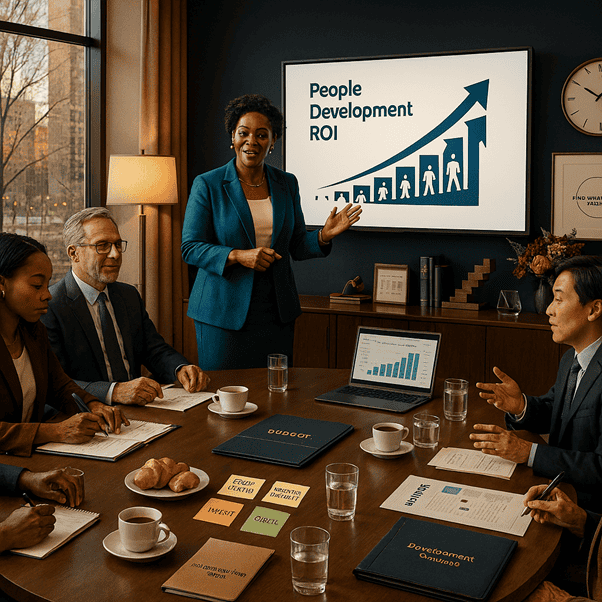
The Smart Leader’s Year-End Investment Strategy 🧠

High-value leaders don’t scramble in December. They invest strategically.

Here’s how to transform your remaining budget from an obligation into an opportunity:

1. Invest in Leadership Development That Sticks

Six months from now, that fancy software you rushed to purchase will collect digital dust. But your people will still be using the leadership skills they developed in December. Research from McKinsey shows that companies with high-performing middle managers achieve 3 to 21 times higher shareholder returns over five years. Yet most organizations spend the majority of their leadership development budget on senior executives, leaving first-time managers and emerging leaders under-resourced.

First-time manager training delivers a 415% ROI annually, with measurable gains in team productivity, retention, and communication effectiveness. That’s not an expense—that’s a strategic multiplier.

2. Create Sponsorship and Mentorship Structures

Employees who have consistent manager support are more likely to be promoted, and they’re more likely to believe they have an equal opportunity to advance. But support doesn’t happen by accident—it requires intentional structures.

Use year-end budget to launch or strengthen formal mentorship programs that pair high-potential employees—especially those from traditionally overlooked groups—with senior leaders who can provide guidance, advocacy, and career support. Research shows these programs are among the most effective retention tools available.

3. Fund Culture Transformation Initiatives

Employees with a strong sense of purpose at work are 5.6 times more likely to be engaged and significantly less likely to experience burnout or seek other opportunities. Culture work—including assessments, strategic planning sessions, and leadership alignment initiatives—creates the conditions where people want to bring their best.

As I emphasize in “High-Value Leadership: Transforming Organizations Through Purposeful Culture,” the organizations that win in the long term aren’t just operationally excellent—they’re culturally intentional.

4. Book Training Now, Deliver in Q1

One of the smartest year-end strategies is securing commitments now for development that rolls out when your team has capacity to engage fully. The end of the year is crunch time for everyone. Your people are focused on closing deals, hitting targets, and trying to enjoy the holidays.

Smart leaders book development resources in December for January and February delivery—capturing the budget while positioning their teams to hit the ground running in the new year. Think of it as strategic layaway for professional growth.

5. Address the Equity Gap Directly

Review who has received development opportunities this year. If certain groups are underrepresented—and they almost certainly are—use remaining budget to create targeted programming. This isn’t about checking boxes; it’s about unlocking potential that’s been systematically overlooked.

Women of color deserve professional development spaces designed specifically for their experiences and challenges. They need to connect with others who understand the unique navigation required in corporate environments that weren’t built with them in mind.

What Happens When Leaders Actually Invest 📈

There was a mid-sized manufacturing company in the Midwest facing what many organizations face: declining engagement, increasing turnover, and a leadership pipeline that looked nothing like their diverse frontline workforce. They had budget remaining in Q4, and the easy path would have been to let it lapse or spend it on equipment nobody needed.

Instead, leadership made a different choice. They invested in a comprehensive leadership development program targeting their overlooked middle managers—many of whom were women and people of color who had been passed over for previous development opportunities. They created formal sponsorship structures pairing emerging leaders with senior executives. They commissioned a culture assessment to understand why talented people were leaving.

Within eighteen months, the results were measurable: significant improvement in engagement scores, reduced voluntary turnover, and—critically—a more diverse leadership pipeline that better reflected the communities they served.

The investment paid for itself multiple times over in reduced recruitment costs alone. But the real return was harder to quantify: a culture where people wanted to stay, grow, and contribute their best work.

This is what high-value leadership looks like in practice. It’s not about grand gestures or impressive-sounding initiatives. It’s about making intentional decisions, day by day and budget line by budget line, that communicate to your people: You matter. Your growth matters. Your future here matters.

The Bottom Line: Your People Are Your Best Investment 💎

Black Friday shoppers understand something fundamental: the best deals aren’t about spending money—they’re about investing in things that will deliver value long after the transaction is complete.

Your remaining development budget works the same way.

That coffee machine in the break room? It’ll break down in eighteen months. That project management software nobody asked for? It’ll have a 15% utilization rate by March. Those ergonomic keyboards purchased because they were on sale? Nice gesture, forgettable impact.

But the leader who learned how to have difficult conversations will navigate every challenge differently going forward. The emerging professional who finally got sponsored for a stretch assignment will remember who believed in them. The team that participated in culture-building work will collaborate at a higher level indefinitely.

People development isn’t a line item. It’s a legacy.

As you navigate these final weeks of the year, I challenge you to think like the savviest Black Friday shopper: What investment will deliver returns long after December 31st? Where can you put resources that will multiply rather than depreciate? Who on your team has been waiting for someone to believe in their potential enough to invest in their growth?

The budget expires. The opportunity to build something lasting doesn’t have to.

Discussion Questions for Your Leadership Team 💬

  1. What percentage of our training and development budget remains unspent? What message does our typical year-end spending pattern send about our priorities?
  2. Who received development opportunities this year? Who didn’t? What patterns emerge when we examine participation by role, tenure, gender, and race?
  3. What would it take to create formal sponsorship structures that connect high-potential employees from traditionally overlooked groups with senior leaders who can advocate for their advancement?
  4. How might we use remaining budget to position our team for success in Q1 rather than simply “spending down” to protect next year’s allocation?
  5. If we could only make one development investment before year-end, where would we get the greatest return—both in business results and in demonstrating our values?

Your Next Steps 🚀

  1. Audit Your Remaining Budget This Week: Identify exactly how much remains in your training, development, and HR budget categories. Create a clear picture of what’s available for strategic investment.
  2. Identify Your Underinvested Talent: Review who has—and hasn’t—received development opportunities this year. Look specifically at emerging leaders, middle managers, and employees from traditionally overlooked backgrounds.
  3. Book Q1 Development Now: Secure commitments for leadership development, culture work, or team training that can be delivered when your organization has capacity to engage fully in the new year.
  4. Deepen Your Understanding: Explore “High-Value Leadership: Transforming Organizations Through Purposeful Culture” for comprehensive frameworks on building cultures where every team member can contribute fully and thrive.

Ready to Make Your Year-End Investment Count? 🌟

Your remaining budget represents an opportunity—not just to spend, but to transform. Whether you’re looking for leadership development that creates lasting behavior change, culture assessment and strategic planning, or targeted programming for your emerging leaders and traditionally overlooked talent, Che’ Blackmon Consulting can help you invest wisely.

We specialize in helping organizations build high-value cultures where every team member can rise and thrive. And we understand the year-end timeline—we can structure engagements to capture your current budget while delivering impact that extends well into the new year and beyond.

Let’s connect before the year ends:

  • 📧  Email: admin@cheblackmon.com
  • 📞  Phone: 888.369.7243
  • 🌐  Website: cheblackmon.com

Don’t let your best investment opportunity expire. Your team is worth more than leftover budget treatment.

_______________

Che’ Blackmon, SPHR is the Founder and CEO of Che’ Blackmon Consulting, providing fractional HR services and culture transformation solutions for organizations committed to becoming high-value workplaces. She is the author of “High-Value Leadership: Transforming Organizations Through Purposeful Culture,” “Mastering a High-Value Company Culture,” and “Rise & Thrive: A Black Woman’s Blueprint for Leadership Excellence.” She hosts the podcast “Unlock, Empower, Transform” and brings over 24 years of HR leadership experience across manufacturing, automotive, and healthcare sectors.

#YearEndInvestment #LeadershipDevelopment #HighValueLeadership #EmployeeEngagement #WorkplaceCulture #HRLeadership #TalentDevelopment #BlackWomenInLeadership #RiseAndThrive #CultureTransformation #TrainingBudget #PeopleDevelopment

Grateful Leaders, Engaged Teams: The Culture Transformation Connection 🌟

By Che’ Blackmon, SPHR | Founder & CEO, Che’ Blackmon Consulting

Here’s a truth that might surprise you: the most powerful culture transformation tool doesn’t cost a dime. It requires no software implementation, no consultant-led workshops, and no corporate retreat. Yet research consistently shows it can boost engagement, reduce turnover, and fundamentally reshape how your team shows up every single day.

That tool? Gratitude.

Before you dismiss this as soft leadership advice, consider the hard data. Gallup’s 2025 State of the Global Workplace Report reveals that global employee engagement has dropped to 21%, representing a significant decline from previous years—the first such drop since the COVID-19 pandemic lockdowns. In the United States, engagement has sunk to a 10-year low of just 31%. Meanwhile, disengaged employees cost the global economy nearly $9 trillion annually in lost productivity.

These aren’t just statistics. They represent real people—your people—showing up without showing up. And while organizations scramble to implement the next big retention strategy or engagement platform, they’re overlooking one of the most evidence-based interventions available: a culture of gratitude, anchored by grateful leadership.

The Science Behind Grateful Leadership 🔬

Gratitude in leadership isn’t about being nice. It’s about being strategic.

A groundbreaking 2025 study published in BMC Psychology demonstrated what many high-value leaders have long suspected: gratitude journaling for just 12 days significantly improved work engagement among Japanese employees across industries including IT, logistics, and manufacturing. The research showed that writing about gratitude helped participants become more aware of workplace resources—including encouragement from supervisors and cooperation among colleagues.

But here’s what makes this finding particularly compelling: the study established a causal link between gratitude practices and increased work engagement. Not just correlation—causation.

Additional research on nurses found that gratitude interventions effectively improved job involvement while reducing stress and burnout. For healthcare organizations facing chronic staffing shortages and turnover, this isn’t just interesting—it’s essential.

In my book “High-Value Leadership: Transforming Organizations Through Purposeful Culture,” I explore how intentional leadership practices create ripple effects throughout organizations. Gratitude represents one of the most powerful yet underutilized tools in a leader’s toolkit. When leaders express genuine appreciation, they’re not just making someone’s day—they’re rewiring workplace dynamics and building the foundation for sustainable engagement.

The Engagement-Gratitude Connection: What the Numbers Tell Us 📊

The business case for gratitude-driven culture transformation is irrefutable.

According to Snappy’s 2025 Workforce Study, 40% of employees report that appreciation from their direct manager is the most meaningful form of recognition they can receive. When recognition comes from leadership, it reinforces the connection between employees and their organization—and that connection translates directly to retention, productivity, and performance.

Consider these findings:

  • Companies with highly engaged employees see a 21% increase in profitability and a 17% boost in productivity
  • Engaged teams experience up to 59% less turnover in high-turnover industries
  • Employees who express gratitude in the workplace are 26% more likely to trust their company’s senior leadership
  • Employees with a strong sense of purpose at work are 5.6 times more likely to be engaged than those without—and gratitude helps create that sense of purpose

What’s particularly striking about Gallup’s 2025 data is where engagement is declining most dramatically: among managers under 35 and female managers, who experienced drops of 5 and 7 percentage points respectively. This isn’t random. When the people responsible for modeling culture and driving team performance feel disconnected, the entire organizational ecosystem suffers.

This is precisely why I emphasize in “Mastering a High-Value Company Culture” that culture transformation must be intentional and leader-driven. Gratitude isn’t a perk—it’s a practice. And like any practice, it requires commitment, consistency, and courage.

The Overlooked Truth: Gratitude and the Black Woman’s Experience in Corporate America 💪🏾

Here’s where we need to have an honest conversation—one that too many leadership discussions avoid.

The 2024 Women in the Workplace report from McKinsey and LeanIn.Org delivered sobering news: after notable improvements in 2021 and 2022, Black women’s promotion rates regressed to 2020 levels. The “broken rung” at the first promotion to manager continues to disproportionately impact Black women, who face both racial and gender barriers simultaneously.

But the statistics only tell part of the story. Black women in corporate spaces often experience what researchers describe as the “prove-it-again” bias—the need to consistently surpass their peers to achieve equal recognition. Less than a quarter of Black women feel they have the sponsorship needed to advance their careers. Many report being “the only” Black person in the room, leading to heightened feelings of exclusion, increased scrutiny, and pressure to perform not just for themselves, but as representatives of their entire demographic.

In this context, gratitude and recognition aren’t luxuries—they’re lifelines.

When leaders practice genuine gratitude toward traditionally overlooked team members, they do more than boost morale. They signal belonging. They validate contributions that might otherwise go unnoticed. They counter the invisibility that so many Black women describe as a defining feature of their corporate experience.

I wrote “Rise & Thrive: A Black Woman’s Blueprint for Leadership Excellence” because I understand this landscape intimately. With over 24 years in HR leadership across manufacturing, automotive, and healthcare sectors, I’ve witnessed how recognition—or its absence—shapes careers. I’ve seen talented Black women leave organizations not because they lacked capability, but because they lacked acknowledgment. The research from Harvard Business School confirms what many of us have experienced: Black women in leadership positions exhibit exceptional emotional intelligence, authenticity, and agility—traits developed precisely because navigating invisible hierarchies demands exceptional resilience.

A culture of gratitude doesn’t replace the systemic changes necessary for true equity. But it creates the conditions where those changes become possible—and where Black women and other traditionally marginalized employees can bring their full talents to the table.

Learning from the Lions: A Case Study in Culture Transformation 🦁

Sometimes the best business lessons come from unexpected places. For me, one of the most compelling examples of culture transformation comes from my hometown Detroit Lions.

For decades, the Lions were defined by losing. Multiple coaches came and went. Hall of Fame players like Barry Sanders and Calvin Johnson retired early rather than continue with a toxic organization. Fans wore paper bags to games. The culture was so damaged that talented people fled—sound familiar to any organizations you know?

Then something shifted. In 2020, Sheila Ford Hamp took over as principal owner. She recognized what so many organizational leaders fail to acknowledge: you cannot transform performance without transforming culture first. She brought in Chris Spielman as a special assistant specifically focused on culture, establishing what the organization called a “Culture Task Force.” She hired head coach Dan Campbell, who understood that sustainable success requires building people, not just strategies.

What Campbell brought wasn’t just football expertise—it was a philosophy of appreciation, development, and genuine connection. He invested in relationships, expressed pride in his players’ growth, and created an environment where every team member understood their value.

“Culture change. It’s easy to say, but it’s difficult to do,” Spielman noted. “63 percent of culture changes in corporate America or within a sports organization usually fail.”

The Lions didn’t just talk about culture—they built systems to sustain it. They conducted personal interviews with every new hire, asking about their backgrounds, their families, and what their organizational values meant to them personally. They made information available across the organization so everyone could put faces to names and understand their colleagues as whole people.

The results? The once-laughingstock franchise became one of the best teams in the NFL. Players who had opportunities elsewhere chose to stay because the culture made them want to be part of something meaningful.

The parallel to corporate culture transformation is direct: when leaders prioritize appreciation, development, and connection—when they see team members as whole people rather than just producers—everything changes. Grit emerges. Resilience develops. People stop watching for exit opportunities and start investing in collective success.

From Theory to Practice: Building Your Gratitude-Driven Culture ⚡

Understanding why gratitude matters is one thing. Implementing it is another.

Here’s what the research—and my experience working with organizations across sectors—reveals about making gratitude practices stick:

1. Make It Specific and Sincere

Generic “good job” statements don’t move the needle. Effective gratitude names specific contributions and connects them to organizational impact. Instead of “Thanks for your help on the project,” try “Your attention to detail in the Johnson presentation caught an error that could have cost us the contract. That kind of thoroughness makes our whole team stronger.”

2. Recognize Immediately and Consistently

Research shows that frequent, timely recognition creates greater impact than annual awards or periodic acknowledgments. Employees who receive recognition at least weekly are significantly more engaged than those recognized less frequently. This doesn’t require elaborate programs—it requires intentional attention.

3. Create Peer-to-Peer Recognition Channels

While recognition from leadership matters most, peer recognition builds the relational fabric that sustains culture. When team members acknowledge each other’s contributions, trust and collaboration flourish. This is especially important for traditionally overlooked employees who may not have regular access to senior leadership visibility.

4. Connect Gratitude to Purpose

Gallup’s research reveals that employees with strong work purpose are 5.6 times more likely to be engaged—and only 13% report frequent burnout, compared to 38% of those with low purpose. Gratitude becomes transformative when it connects individual contributions to meaningful outcomes. Help people see how their work matters.

5. Model It from the Top

Culture flows from leadership. If executives and managers don’t authentically practice gratitude, no program or platform will create lasting change. This requires vulnerability—acknowledging that you don’t have all the answers and that you genuinely value what others bring to the table.

6. Address Structural Barriers Simultaneously

Gratitude without equity rings hollow. For traditionally overlooked employees, recognition must be accompanied by fair promotion practices, equitable compensation, and genuine access to development opportunities. As I emphasize throughout my work, high-value leadership integrates appreciation with accountability for systemic change.

The Bottom Line: Culture Transformation Starts with You 🎯

The data is clear: gratitude isn’t soft—it’s strategic. Organizations that embed appreciation into their cultural DNA see measurable improvements in engagement, retention, productivity, and profitability.

But here’s what I want you to understand: culture transformation isn’t something that happens to organizations. It’s something leaders choose, day by day, interaction by interaction.

Every time you pause to acknowledge someone’s contribution, you’re building culture. Every time you ensure that the quietest voice in the room gets heard and appreciated, you’re building culture. Every time you connect someone’s work to larger purpose, you’re building culture.

For those of us who have navigated corporate spaces where our contributions were overlooked, where we had to work twice as hard for half the recognition, where our presence was tolerated but our excellence was invisible—we understand the transformative power of genuine appreciation. We know what it means to finally be seen.

That knowing gives us a unique capacity to lead with gratitude, to build cultures where everyone can rise and thrive.

The question isn’t whether gratitude works. The science has settled that. The question is whether you’re willing to lead the transformation your organization needs.

Discussion Questions for Your Leadership Team 💬

  1. How would you describe our current culture of recognition and appreciation? What would your team members say if asked the same question?
  2. Think about the last time you expressed specific, sincere gratitude to a team member. When was it? What prevented you from doing it more frequently?
  3. Which team members might be experiencing invisibility in our organization? How can we ensure their contributions receive appropriate recognition?
  4. What systems or practices could we implement to make gratitude a consistent part of our organizational culture rather than a periodic event?
  5. How do our recognition practices intersect with our equity goals? Are we inadvertently overlooking contributions from traditionally marginalized team members?

Your Next Steps 🚀

  1. Start a Gratitude Practice This Week: Commit to expressing specific, sincere appreciation to at least one team member each day for the next two weeks. Track the responses and your own experience.
  2. Audit Your Recognition Patterns: Review the last month of recognition in your team or organization. Who received acknowledgment? Who didn’t? What patterns emerge?
  3. Create Structural Support: Identify one system or process you can implement to make gratitude more consistent—whether it’s a standing agenda item in team meetings, a peer recognition platform, or simply a weekly reminder in your calendar.
  4. Deepen Your Understanding: Explore “High-Value Leadership” and “Mastering a High-Value Company Culture” for comprehensive frameworks on building sustainable, purpose-driven organizational cultures.

Ready to Transform Your Culture? 🌱

Culture transformation requires more than good intentions—it requires strategic implementation, accountability structures, and sometimes, an outside perspective to see what’s invisible from within.

At Che’ Blackmon Consulting, we partner with organizations to build high-value cultures where every team member can contribute fully and thrive authentically. Whether you’re facing engagement challenges, retention concerns, or simply know your culture needs to evolve, we can help you develop and implement a transformation strategy that delivers measurable results.

Let’s connect:

  • 📧  Email: admin@cheblackmon.com
  • 📞  Phone: 888.369.7243
  • 🌐  Website: cheblackmon.com

_______________

Che’ Blackmon, SPHR is the Founder and CEO of Che’ Blackmon Consulting, providing fractional HR services and culture transformation solutions for organizations committed to becoming high-value workplaces. She is the author of “High-Value Leadership: Transforming Organizations Through Purposeful Culture,” “Mastering a High-Value Company Culture,” and “Rise & Thrive: A Black Woman’s Blueprint for Leadership Excellence.” She hosts the podcast “Unlock, Empower, Transform” and brings over 24 years of HR leadership experience across manufacturing, automotive, and healthcare sectors.

#GratefulLeadership #EmployeeEngagement #CultureTransformation #HighValueLeadership #WorkplaceCulture #HRLeadership #LeadershipDevelopment #BlackWomenInLeadership #RiseAndThrive #OrganizationalCulture #TalentRetention #EmployeeExperience #FractionalHR #PurposeDrivenLeadership #LeadershipTips

Giving Thanks While Setting Boundaries: A Leader’s Holiday Guide 🎄

The email landed at 9:47 PM on Thanksgiving evening: “Quick question about the quarterly report…”

Sound familiar?

As we enter the holiday season, leaders face an impossible paradox. We’re supposed to embody gratitude, generosity, and availability while simultaneously protecting our wellbeing, modeling work-life balance, and preventing burnout. We’re expected to be both boundlessly giving and firmly boundaried. Present for our teams and present for our families.

For many leaders—especially women, and particularly Black women who navigate additional workplace pressures—the holidays become a masterclass in impossible expectations.

But what if I told you that boundaries and gratitude aren’t opposites? That the most thankful thing you can do this season is to establish clear, compassionate limits? That true High-Value Leadership means modeling the radical act of saying both “thank you” and “not right now”?

The Holiday Pressure Cooker: Why Boundaries Disappear in December 🫠

Let’s name what actually happens during the holiday season in most organizations. Year-end deadlines collide with vacation schedules. Skeleton crews manage full workloads. “Quick questions” multiply like wreaths in a mall. And somewhere between the third virtual holiday party and the fifth “urgent” request, boundaries don’t just blur—they evaporate.

Research from the American Psychological Association shows that 38% of people report increased stress during the holidays, with work pressure being a primary contributor. But here’s what those statistics don’t capture: the disproportionate burden on those who are already navigating complex workplace dynamics.

For Black women in leadership, the holiday season often intensifies existing challenges. The emotional labor of code-switching increases at holiday gatherings. The pressure to be the “strong one” who handles everything escalates. The expectation to be grateful for opportunities while simultaneously fighting for equity becomes exhausting.

There was a healthcare organization where Black female directors reported working an average of 18 hours more than their peers during the holiday season. Why? They felt they couldn’t say no to additional responsibilities without reinforcing stereotypes about work ethic. They couldn’t set boundaries without being labeled “difficult.” The gratitude they were supposed to feel became a weapon used against their wellbeing.

This is what I call the “gratitude trap”—when thankfulness becomes a tool for exploitation rather than appreciation.

The Neuroscience of No: Why Boundaries Are Essential for Sustainable Leadership 🧠

Dr. Brené Brown’s research on boundaries revolutionized my understanding of leadership sustainability. Here’s the neurological truth: our brains literally cannot maintain peak performance without boundaries. When we operate in constant availability mode, our prefrontal cortex—responsible for decision-making and emotional regulation—begins to shut down.

The result? We make poorer decisions. We lose empathy. We model unsustainable behavior that our teams then replicate.

But here’s where it gets interesting. Studies from Harvard Medical School show that leaders who maintain clear boundaries actually inspire more trust and respect than those who are constantly available. Why? Because boundaries signal self-respect, and humans are wired to respect those who respect themselves.

In “High-Value Leadership: Transforming Organizations Through Purposeful Culture,” I discuss how boundaries aren’t walls—they’re bridges. They create the space for genuine connection by preventing resentment and burnout. When you can say no to what depletes you, your yes becomes more powerful.

The Cultural Complexity: Boundaries Across Difference 🌍

Setting boundaries becomes infinitely more complex when you’re navigating cultural expectations, both organizational and personal. Many cultures view boundary-setting as selfish or disrespectful. For leaders from collectivist backgrounds, prioritizing individual needs over group harmony feels like betrayal.

Add racial dynamics, and complexity multiplies. Black women leaders report facing what researchers call “boundary punishment”—disproportionate negative consequences for setting the same limits their white counterparts establish without question. A white executive’s “work-life balance” becomes a Black woman’s “lack of commitment.”

There was a financial services firm where they tracked response times to after-hours emails. White male executives who didn’t respond until business hours were seen as “focused on strategic priorities.” Black women who did the same were noted as “not being team players” in performance reviews. Same boundary. Different consequences.

This is why boundary-setting for traditionally overlooked leaders isn’t just about personal wellness—it’s about systemic change. Every boundary you set creates permission for others who look like you to do the same.

The THANKS Framework: Boundaries With Grace 🎁

In “Rise & Thrive: A Black Woman’s Blueprint for Leadership Excellence,” I introduce strategies for navigating workplace challenges with both strength and wisdom. Here’s my THANKS Framework for holiday boundary-setting:

T – Time-box availability: “I’m checking emails once daily from December 23-26, and will respond to urgent matters within 24 hours.”

H – Honor commitments selectively: Not every invitation requires your presence. Choose the ones that align with your values and energy.

A – Acknowledge requests warmly: “Thank you for thinking of me for this project. I’m honored you value my input.”

N – Navigate to alternatives: “While I can’t take this on before year-end, here are three ways we could approach it in January.”

K – Keep boundaries consistent: Don’t set boundaries you won’t maintain. Inconsistency creates confusion and erodes trust.

S – Support others’ boundaries: When team members set limits, celebrate them publicly. Make boundary-setting culturally acceptable.

Let me show you how this works in practice.

Real-World Implementation: Boundaries in Action 📋

Scenario 1: The Holiday Party Circuit

Instead of attending seven holiday events out of obligation, one leader sent this message: “Thank you for including me in your celebration. This year, I’m limiting myself to three holiday events to maintain energy for both work and family. I’m choosing [specific event] because [genuine reason]. Please know my absence isn’t a reflection of my appreciation for our partnership.”

Result? Multiple colleagues privately thanked her for modeling what they wished they could say.

Scenario 2: The Vacation That’s Actually Vacation

A director at a manufacturing company implemented “delegation December.” Before taking PTO, she created a detailed coverage plan, empowered team members with decision-making authority, and set this out-of-office message: “I’m recharging with family through January 2. For urgent matters, contact [specific person]. For everything else, I look forward to connecting with you in the new year. Your patience helps me return energized to serve you better.”

The key? She actually disconnected. No email checking. No “quick calls.” Her team, initially anxious, discovered they were more capable than they realized.

Scenario 3: The End-of-Year Push Back

There was a technology company where December always meant launching initiatives that should have started in October. A Black woman VP finally said: “I notice we consistently create December crises through poor planning. I propose we establish a ‘no new initiatives after December 10’ policy. This protects our team’s wellbeing and improves our strategic planning.”

Initially, there was resistance. By the second year, employee satisfaction scores had increased 23% and December sick days decreased by 40%.

The Gratitude Side: Appreciation With Boundaries 🙏

Boundaries without gratitude become walls. Gratitude without boundaries becomes exploitation. The magic happens when we combine them.

Here’s how to express authentic appreciation while maintaining limits:

Be Specific in Your Thanks: Instead of “Thanks for all you do,” try “Your analysis on the Morrison project revealed insights that saved us $200K. I’m grateful for your strategic thinking.”

Time Your Gratitude Thoughtfully: Don’t send appreciation emails at midnight—it suggests you expect others to be working then too.

Separate Gratitude from Requests: If you’re thanking someone, make it pure appreciation. Don’t follow thanks with “and while I have you…”

Model Bounded Gratitude: “I’m thankful for this opportunity, AND I need to decline to maintain my other commitments.”

The Leadership Imperative: Why Your Boundaries Matter for Everyone 👥

Your boundaries don’t just protect you—they protect your entire organization. When leaders model healthy limits, several things happen:

  1. Productivity Increases: Stanford research shows productivity drops dramatically after 50 hours per week. Boundaries keep teams in their optimal performance zone.
  2. Retention Improves: Employees with leaders who respect boundaries are 31% less likely to leave.
  3. Innovation Flourishes: Rested brains are creative brains. Boundaries create space for breakthrough thinking.
  4. Equity Advances: When boundary-setting becomes normalized, traditionally overlooked employees face fewer penalties for self-care.

Current Trends: The Future of Workplace Boundaries 🔮

The pandemic permanently shifted boundary expectations. Here’s what’s emerging:

“Async December”: Companies declaring December an asynchronous work month—no mandatory meetings, flexible hours, outcome-focused rather than hours-focused.

Boundary Coaching: Organizations investing in boundary-setting training, recognizing it as a crucial leadership skill.

Cultural Calendars: Respecting diverse holiday traditions by not assuming everyone celebrates the same occasions or needs the same time off.

Collective Boundaries: Teams setting group boundaries together, making it socially acceptable to disconnect.

Recovery Requirements: Some organizations mandating time off, recognizing that unused PTO is an organizational failure, not individual virtue.

The Intersectional Impact: Boundaries as Liberation 🗽

For Black women in leadership, boundary-setting isn’t just personal wellness—it’s revolutionary. Every boundary challenges stereotypes about who must be constantly available, endlessly giving, and perpetually grateful for opportunity.

In “Mastering a High-Value Company Culture,” I explore how individual actions create cultural shifts. When Black women leaders set boundaries, we don’t just protect ourselves. We challenge the strong Black woman trope that demands superhuman performance. We model sustainable excellence for the next generation. We prove that leadership strength includes knowing when to rest.

There was a consulting firm where a Black woman partner instituted “Boundary Wednesdays”—no meetings, focused work only. Initially criticized, she maintained the practice. Her team’s productivity increased 34%. Client satisfaction improved. Other partners began adopting similar practices. What started as one woman’s boundary became organizational transformation.

Your Holiday Boundary Action Plan 🎯

Here’s your practical guide for implementing boundaries this holiday season:

Week 1: Audit Your Energy

  • List all holiday commitments (work and personal)
  • Rate each from 1-10 on energy drain vs. energy gain
  • Identify three things you can decline or delegate

Week 2: Communicate Boundaries

  • Send holiday schedule communication to team and stakeholders
  • Set out-of-office messages with clear return dates and emergency protocols
  • Decline non-essential commitments with grace

Week 3: Model and Support

  • Publicly appreciate team members who set boundaries
  • Share your own boundary-setting challenges and victories
  • Create team agreements about holiday availability

Week 4: Maintain and Adjust

  • Track boundary violations (yours and others’)
  • Adjust approaches based on what’s working
  • Celebrate successful boundary maintenance

The Resistance Response: When Boundaries Meet Pushback 💪

Let’s be real. Not everyone will appreciate your boundaries. Here’s how to handle resistance:

The Guilt Trip: “I guess you’re too important to help the team.” Response: “I understand this is frustrating. I’m protecting my capacity so I can contribute fully when I return.”

The Emergency Everything: Suddenly everything becomes urgent in December. Response: “Help me understand what makes this urgent now versus addressing it in January?”

The Comparison Game: “Well, Sandra is always available.” Response: “I respect Sandra’s choices. This is what works for my sustained performance.”

The Cultural Challenge: “In this company, we go above and beyond.” Response: “I’m committed to excellence, which requires strategic energy management.”

Practical Scripts for Common Scenarios 📝

Declining Holiday Events: “Thank you for the invitation to [event]. I’m limiting my holiday commitments to preserve energy for both work and family priorities. I hope you have a wonderful celebration.”

Setting Email Boundaries: “During the holiday season (Dec 23-Jan 2), I’ll be checking email once daily at 9 AM. For true emergencies requiring immediate response, please text. Otherwise, I’ll respond when I return.”

Pushing Back on Year-End Requests: “I want to give this project the attention it deserves. Starting it now would mean rushed work. Can we schedule a January kickoff to ensure quality outcomes?”

Protecting Team Boundaries: “I notice we’re asking the team to deliver significant work over the holidays. Let’s discuss what’s truly critical versus what can wait until January.”

The Gratitude Practice: Appreciation Without Exploitation ✨

Here’s how to express genuine gratitude while maintaining boundaries:

  1. Morning Gratitude, Evening Boundaries: Start days with appreciation, end them with clear stopping points.
  2. Thank You Thursdays: Dedicate one day weekly to pure appreciation—no requests attached.
  3. Boundary Gratitude: Thank people for respecting your boundaries. Make it positive.
  4. Gratitude Bank: Write appreciation notes in advance to send during time off, maintaining connection without real-time engagement.

Your Discussion Questions 💭

For leadership teams to explore together:

  • What organizational practices make boundary-setting difficult during holidays?
  • How do we handle equity when some roles genuinely require holiday coverage?
  • What would change if we normalized leaders taking complete disconnection time?
  • How might our traditionally overlooked employees experience different boundary challenges?
  • What’s one boundary we could set collectively as a leadership team?
  • How do we balance customer expectations with employee wellbeing during holidays?
  • What would “radical rest” look like in our organization?

Your Next Steps: Building Boundaries That Last 🎄

The holiday season doesn’t have to be a boundary disaster. Here’s how to start:

  1. Today: Identify your three most important holiday boundaries. Write them down.
  2. This Week: Communicate one boundary clearly to your team or family.
  3. This Month: Practice saying no to one holiday obligation that drains rather than energizes.
  4. This Season: Model bounded gratitude—appreciation with limits.
  5. Next Year: Build boundary-setting into your annual planning, not just holiday survival.

Transform Your Leadership Through Bounded Excellence

Ready to master the art of grateful boundaries? To lead with both appreciation and sustainability? To model what High-Value Leadership looks like when it honors both achievement and rest?

Che’ Blackmon Consulting specializes in helping leaders—especially those from traditionally overlooked backgrounds—build sustainable excellence through strategic boundary-setting and authentic appreciation.

Don’t let another holiday season leave you depleted. Invest in boundaries that honor both your gratitude and your greatness.

Start your boundary revolution today:

📧 Email us: admin@cheblackmon.com
📞 Call us: 888.369.7243
🌐 Visit us: cheblackmon.com

Because true leadership isn’t about being everything to everyone all the time. It’s about being your best self consistently—and that requires boundaries.

This holiday season, give yourself the gift that keeps on giving: the power of a well-placed, graciously delivered no. Your future self—and your team—will thank you.


Remember: Boundaries aren’t about being ungrateful. They’re about being grateful enough for your opportunities to protect your ability to fulfill them. This holiday season, let your boundaries be an act of gratitude—for your role, your health, and your future.

#LeadershipBoundaries, #HolidayWellbeing, #HighValueLeadership, #WorkLifeBalance, #BlackWomenLead, #ExecutiveWellness, #SustainableLeadership, #BoundariesAtWork, #LeadershipDevelopment, #GratefulLeadership, #WomenInLeadership, #CorporateWellness, #InclusiveLeadership, #HolidayStress, #LeadershipCoaching, #ProfessionalBoundaries, #WorkplaceCulture, #SelfCareForLeaders, #DiversityAndInclusion, #BurnoutPrevention

The Thank You Economy: Recognition Systems That Actually Work 💎

Let’s start with an uncomfortable truth. Most recognition programs fail.

That employee-of-the-month parking spot? The generic anniversary plaques? The annual awards dinner where the same five people get honored? They’re not just ineffective—they’re actively damaging your culture. Because nothing breeds cynicism faster than recognition that feels forced, formulaic, or unfair.

But here’s what keeps me up at night: while organizations pump millions into recognition programs that don’t work, 65% of employees haven’t received any recognition in the past year. Not a thank you. Not an acknowledgment. Nothing.

We’re living in what I call the Thank You Economy—where genuine recognition has become so rare, it’s now a competitive differentiator. Organizations that crack the code on authentic appreciation don’t just retain talent. They unleash it.

The Recognition Revolution: Why Traditional Systems Fail 📉

Traditional recognition systems fail for three fundamental reasons. First, they’re episodic rather than embedded. Second, they recognize outcomes instead of efforts. Third—and this is critical—they reflect and reinforce existing power structures, systematically overlooking contributions from those outside the inner circle.

McKinsey’s latest research confirms what many of us have experienced: traditional recognition programs have a negative ROI. Companies spend an average of $100 per employee annually on recognition programs, yet engagement continues to plummet. Why? Because we’ve confused recognition with rewards, appreciation with administration.

There was a Fortune 500 company that spent $2.3 million on their annual recognition program. Fancy awards. Big ceremony. Professional video production. Post-event surveys revealed 72% of employees felt less valued after the event. The reason? Watching the same leadership favorites receive awards while everyday excellence went unnoticed actually highlighted how little most contributions mattered.

The Thank You Economy demands something different. Not bigger budgets or fancier programs, but fundamental restructuring of how we see, value, and acknowledge contribution.

The Neuroscience of Recognition: What Actually Happens in Our Brains 🧠

Dr. Paul White’s research on appreciation languages revolutionized my understanding of why recognition fails. Just as we have different love languages, we have different appreciation languages. Some thrive on public praise. Others prefer private acknowledgment. Some value quality time with leadership. Others want increased autonomy.

But here’s where it gets interesting. Neuroscientist Dr. Matthew Lieberman’s UCLA studies show that social recognition activates the same reward centers as financial compensation—sometimes more powerfully. When someone receives authentic appreciation, their brain releases oxytocin (the connection hormone) and dopamine (the motivation chemical). It’s literally addictive.

Yet most recognition programs trigger the opposite response. Generic, inauthentic recognition activates the anterior cingulate cortex—the brain’s BS detector. Our brains can distinguish between genuine gratitude and checkbox appreciation in milliseconds. That’s why that templated “Great job!” email lands flat. Your brain knows it’s fake.

The solution? Recognition systems built on specificity, authenticity, and frequency. Not annual. Not monthly. Daily.

The Equity Imperative: Recognizing the Traditionally Overlooked 🌟

Let’s address the elephant in every boardroom. Recognition isn’t distributed equally.

Research from Harvard Business Review reveals that women receive 25% less recognition than men for identical contributions. For Black women, the gap widens to 38%. This isn’t just unfair—it’s economically irrational. Organizations are literally ignoring excellence because it doesn’t fit their mental model of what achievement looks like.

In “Rise & Thrive: A Black Woman’s Blueprint for Leadership Excellence,” I explore how Black women navigate what I call “excellence invisibility”—working twice as hard for half the recognition. The psychological toll is devastating. The organizational cost? Incalculable.

Consider this reality: Black women are the most educated demographic in America, yet hold only 1.5% of executive positions. Part of this stems from chronic under-recognition throughout their careers. Their innovations get attributed to others. Their leadership gets labeled as “help.” Their strategic thinking gets dismissed as “operational support.”

There was a healthcare organization in Chicago that discovered something shocking during their recognition audit. Black women in their organization had submitted 43% of process improvement suggestions that got implemented, yet received only 8% of innovation awards. Why? Their contributions were consistently reframed as “team efforts” while individual men received sole credit for similar innovations.

Once exposed, they didn’t just adjust their awards. They rebuilt their entire recognition infrastructure to capture and celebrate all forms of excellence. Within 18 months, promotion rates for Black women increased 40%. Not through quotas—through finally recognizing what was already there.

The Architecture of Effective Recognition Systems 🏗️

Building recognition systems that actually work requires abandoning everything you think you know about appreciation. In “High-Value Leadership: Transforming Organizations Through Purposeful Culture,” I outline the framework that transforms recognition from performance theater to performance catalyst:

The SEEN Method™:

  • Specific: Acknowledge exact contributions, not general performance
  • Equitable: Actively seek overlooked excellence
  • Embedded: Build recognition into daily operations
  • Networked: Enable peer-to-peer appreciation

Let me show you how this works in practice.

Daily Stand-up Appreciations: Start every team meeting with 60 seconds of specific peer recognition. Not “Good job everyone” but “Sarah, your analysis yesterday helped us avoid a $30K mistake. Thank you.” Simple. Powerful. Transformative.

Recognition Mapping: Track who gives and receives recognition. Plot it visually. You’ll immediately see the gaps. One manufacturing company discovered 80% of their recognition flowed between just 12% of employees—all in senior positions. Making the invisible visible changed everything.

Contribution Journals: Require managers to document one specific contribution from each team member weekly. Not for HR files—for recognition planning. When you actively look for excellence, you find it everywhere.

Cross-functional Spotlights: Monthly sessions where departments recognize other teams’ contributions. IT thanks accounting for fast invoice processing. Sales acknowledges operations for rush fulfillment. Silos dissolve when appreciation flows horizontally.

Current Trends: The Future of Recognition 🚀

The Thank You Economy is evolving rapidly. Here’s what’s reshaping recognition:

AI-Powered Recognition Platforms: Companies like Workhuman and Achievers use artificial intelligence to prompt managers when recognition gaps emerge. If someone hasn’t been recognized in two weeks, managers get nudged. Participation rates increased 340% in early adopters.

Micro-Recognition Systems: Forget annual awards. The future is continuous micro-appreciations. Slack kudos. Teams celebrations. LinkedIn shoutouts. Death by a thousand thank-yous beats one grand gesture every time.

Values-Aligned Recognition: Don’t just recognize what people achieve. Recognize how they achieve it. When someone demonstrates core values—integrity, innovation, inclusion—make it visible. There was a tech startup that saw 50% culture score improvement after shifting from results-only to values-based recognition.

Peer-to-Peer Predominance: Manager recognition matters, but peer recognition transforms. Organizations with strong peer recognition report 35% better customer satisfaction scores. Why? Appreciated employees appreciate customers.

Cultural Competence in Recognition: One size doesn’t fit all. Some cultures value public recognition; others prefer private acknowledgment. Some prize individual achievement; others emphasize collective success. Effective systems adapt to cultural diversity rather than forcing conformity.

The ROI of Real Recognition 💰

Let’s talk numbers, because transformation without measurement is just hope:

Organizations with effective recognition systems report:

  • 31% lower voluntary turnover
  • 14% better productivity metrics
  • 12% stronger customer metrics
  • 22% better profitability
  • 28% higher engagement scores

But my favorite statistic? Companies with strong recognition cultures have 2.5x better stock market performance over 10 years. The Thank You Economy isn’t just nice. It’s profitable.

There was a regional bank struggling with 34% annual turnover in their call center. Traditional retention strategies—salary increases, better benefits, flexible schedules—barely moved the needle. Then they implemented daily peer recognition through a simple app. Employees could send “praise points” with specific appreciations. No budget. No prizes. Just visibility and gratitude.

Result? Turnover dropped to 11% in nine months. Customer satisfaction scores increased 23%. The only cost? The commitment to make appreciation systematic rather than sporadic.

Building Your Recognition Infrastructure: A 90-Day Blueprint 📋

Ready to build recognition systems that actually work? Here’s your roadmap:

Days 1-30: Assessment and Awareness

  • Conduct a recognition audit. Who gets recognized? For what? By whom?
  • Survey employees about their appreciation preferences
  • Map current recognition patterns to identify gaps
  • Document overlooked contributions, especially from traditionally marginalized groups

Days 31-60: Design and Development

  • Create your recognition philosophy statement
  • Build daily appreciation practices into existing meetings
  • Develop peer-to-peer recognition mechanisms
  • Train managers on specific, authentic appreciation
  • Establish recognition metrics and tracking systems

Days 61-90: Implementation and Integration

  • Launch with leader modeling—recognition starts at the top
  • Celebrate early wins and participation
  • Adjust based on feedback and participation data
  • Embed recognition into performance discussions
  • Create sustainability plans to prevent program decay

The Hidden Cost of Recognition Gaps 😔

We need to talk about what happens when recognition systems fail traditionally overlooked employees. It’s not just disengagement. It’s talent hemorrhaging.

Black women are leaving corporate America at unprecedented rates. They’re not leaving for better pay—studies show they often take pay cuts. They’re leaving because they’re exhausted from excellence invisibility. From having their ideas credited to others. From being told they’re “not ready” for promotions while training their less-qualified supervisors.

The Thank You Economy offers a solution. Not perfect, but powerful. When recognition becomes systematic, democratic, and transparent, bias has fewer places to hide. When peer recognition supplements manager recognition, diverse excellence gets surfaced. When contribution tracking becomes standard, patterns of oversight become obvious.

There was a financial services firm that thought they had a pipeline problem with Black female talent. After implementing transparent recognition systems, they discovered the truth: they had a visibility problem. Black women were consistently delivering exceptional results that went unrecognized. Once their contributions became visible through systematic appreciation, promotion rates equalized within two years. No special programs. Just equal recognition for equal excellence.

Technology and Tools: Scaling Recognition 🛠️

The Thank You Economy thrives on technology that makes recognition frictionless:

Recognition Platforms Worth Considering:

  • Bonusly: Peer-to-peer recognition with redeemable points
  • Kudos: Analytics-driven appreciation platform
  • Achievers: AI-powered recognition with science-based insights
  • TINYpulse: Combines recognition with engagement surveying
  • Assembly: Free tier available for smaller organizations

But here’s the critical insight: technology enables recognition; it doesn’t create it. The fanciest platform fails without leadership commitment. Conversely, a simple spreadsheet can transform culture when leadership genuinely values appreciation.

Low-Tech High-Impact Options:

  • Gratitude walls where anyone can post appreciations
  • Weekly newsletter featuring peer-nominated recognitions
  • Team WhatsApp groups dedicated to celebrations
  • Old-fashioned handwritten notes (still the gold standard)
  • Walking meetings focused entirely on appreciation

The Leadership Imperative: Modeling the Way 👥

Recognition systems fail when leaders don’t participate authentically. You can’t delegate appreciation. You can’t outsource gratitude. You must model what you expect.

In “Mastering a High-Value Company Culture,” I share the 5-3-1 Rule:

  • 5 minutes daily for appreciation planning
  • 3 specific recognitions delivered daily
  • 1 weekly reflection on recognition patterns

Leaders who follow this simple framework report profound shifts. Not just in their teams’ performance, but in their own leadership satisfaction. There’s something powerful about actively looking for excellence. You start seeing it everywhere.

But here’s the challenge: most leaders are recognition-starved themselves. They’re pouring from empty cups. That’s why effective recognition systems must flow omnidirectionally—up, down, and sideways. Everyone needs appreciation. Even—especially—those at the top.

Sustaining the System: Beyond the Honeymoon Phase 🌱

Every recognition program starts strong. The challenge is sustainability. Here’s how to prevent recognition decay:

Rotation and Refresh: Change recognition methods quarterly to prevent staleness. If you’ve been doing shoutouts, switch to peer nominations. If public recognition has become routine, try private appreciation.

Measurement and Accountability: Track recognition metrics like any other KPI. Participation rates. Coverage gaps. Frequency patterns. What gets measured gets sustained.

Story Collection: Document how recognition changed outcomes. That project saved because someone felt valued enough to speak up. That customer retained because an appreciated employee went extra. Stories sustain systems.

Cultural Integration: Don’t treat recognition as a program. Embed it into your cultural DNA. Make appreciation as natural as breathing, as expected as showing up on time.

Your Call to Action 📢

The Thank You Economy isn’t coming. It’s here. Organizations that master authentic recognition will win the war for talent. Those that don’t will wonder why their best people keep leaving for “opportunities” that pay less but appreciate more.

Here’s your immediate action plan:

  1. Today: Deliver three specific appreciations. Not “good job” but “Your analysis in yesterday’s meeting revealed insights we all missed. Thank you.”
  2. This Week: Audit your recognition patterns. Who are you overlooking? Whose contributions go unnoticed? Commit to recognizing someone outside your usual circle.
  3. This Month: Implement one systematic recognition practice. Start meetings with appreciation. End emails with gratitude. Create a peer recognition channel. Choose one and stick with it.
  4. This Quarter: Build your recognition infrastructure. Design systems that surface all excellence, not just the loudest or most visible.

Discussion Questions for Leadership Teams 💭

  • What percentage of our employees received meaningful recognition last month? Last week? Yesterday?
  • How does recognition flow in our organization—who gives it, who receives it, and who’s excluded?
  • What contributions in our organization consistently go unrecognized?
  • How might systematic recognition specifically impact our traditionally overlooked talent?
  • What would change if every employee received specific appreciation daily?
  • How can we build recognition systems that survive leadership transitions?
  • What’s preventing us from starting today?

Transform Your Recognition Reality

Ready to build recognition systems that actually work? Systems that surface excellence wherever it exists, retain your best talent, and create cultures where everyone—especially your traditionally overlooked contributors—can thrive?

Che’ Blackmon Consulting specializes in designing and implementing recognition infrastructures that deliver measurable results. Through our High-Value Leadership™ framework, we’ll help you build appreciation systems that transform culture and drive performance.

Don’t let another day pass with excellence going unrecognized in your organization.

Start your recognition revolution today:

📧 Email us: admin@cheblackmon.com
📞 Call us: 888.369.7243
🌐 Visit us: cheblackmon.com

Because in the Thank You Economy, the organizations that win won’t be those with the biggest recognition budgets. They’ll be the ones that see and celebrate all forms of excellence. The ones where appreciation flows freely in all directions. The ones where no contribution goes unnoticed and no excellence remains invisible.

Your people are already delivering excellence. The question is: will you recognize it before your competitors do?


Remember: Recognition isn’t expensive. Turnover is. In the Thank You Economy, appreciation isn’t just nice to have—it’s a business imperative. Master it, and watch your organization transform from a place people work to a place people thrive.

#ThankYouEconomy, #EmployeeRecognition, #HighValueLeadership, #CompanyCulture, #TalentRetention, #LeadershipDevelopment, #DiversityEquityInclusion, #BlackWomenInBusiness, #WorkplaceAppreciation, #EmployeeEngagement, #OrganizationalCulture, #PeerRecognition, #CultureTransformation, #HRStrategy, #LeadershipExcellence, #RecognitionMatters, #WorkplaceCulture, #InclusiveLeadership, #TalentManagement, #BusinessTransformation

Grateful Leadership: The Competitive Advantage of Appreciation 🌟

In today’s hyper-competitive business landscape, organizations are constantly searching for that elusive edge—the differentiator that transforms good companies into great ones. While many chase the latest technology or trendy management fads, the most powerful competitive advantage might be simpler than you think. It’s gratitude.

Yes, appreciation. That fundamental human need we all share, yet somehow gets lost in quarterly reports and KPI dashboards.

The Business Case for Gratitude 📊

Research from the University of Pennsylvania reveals that grateful leaders see a 50% increase in team performance compared to their less appreciative counterparts. But here’s what the statistics don’t capture: grateful leadership fundamentally rewires organizational culture, creating ripple effects that touch every metric that matters—from retention to innovation to bottom-line results.

Consider this stark reality. Gallup reports that 79% of employees who quit their jobs cite “lack of appreciation” as a key reason for leaving. In an era where replacing an employee costs anywhere from 50% to 200% of their annual salary, can any organization afford NOT to prioritize gratitude?

The math is simple. The implementation? That’s where leadership transformation begins.

Beyond Token Gestures: The Architecture of Authentic Appreciation

True grateful leadership transcends the occasional “good job” email or annual recognition dinner. It requires what I call in “High-Value Leadership” a systematic approach to embedding appreciation into the organizational DNA. This isn’t about feel-good initiatives that fade after the next crisis hits. It’s about building sustainable practices that become as routine as your morning operations meeting.

There was a manufacturing company in Michigan struggling with 40% annual turnover on their production floor. Traditional retention strategies—salary increases, signing bonuses, enhanced benefits—barely moved the needle. Then they implemented a gratitude-centered leadership approach. Supervisors were trained to deliver specific, timely appreciation daily. Not generic praise, but targeted recognition that acknowledged individual contributions and connected them to organizational impact. Within six months, turnover dropped to 18%. The secret? Employees finally felt seen.

This mirrors what neuroscience tells us about human motivation. Dr. Robert Emmons’ groundbreaking research at UC Davis shows that expressions of gratitude activate the hypothalamus, flooding our brains with dopamine. It’s literally addictive—in the best possible way. When leaders consistently express authentic appreciation, they’re not just being nice. They’re triggering neurochemical responses that enhance performance, creativity, and loyalty.

The Intersection of Gratitude and Equity 💫

Here’s where grateful leadership becomes revolutionary, particularly for traditionally overlooked populations in corporate America. Black women, who represent 7% of the U.S. population, hold only 1.5% of executive positions in Fortune 500 companies. The reasons are complex, but one factor stands out: chronic under-recognition of contributions.

Research from Catalyst reveals that Black women receive less credit for their ideas, have their expertise questioned more frequently, and must work harder to receive the same recognition as their peers. In this context, grateful leadership isn’t just nice to have—it’s a crucial tool for equity.

When organizations implement structured appreciation practices, something powerful happens. The invisible becomes visible. Contributions that might have been overlooked get spotlighted. The quiet excellence that Black women often demonstrate while navigating additional workplace challenges finally receives its due recognition.

A healthcare system in Detroit discovered this firsthand. After implementing daily gratitude rounds where leaders specifically acknowledged contributions across all levels, they noticed a pattern. Many of their most innovative solutions came from Black women in middle management who had been consistently overlooked for advancement. Once their contributions were regularly recognized, promotion rates for this demographic increased by 35% over 18 months. Not through quotas or special programs, but through the simple act of seeing and appreciating what was already there.

The Cultural Transformation Framework 🎯

Building a culture of grateful leadership requires intentionality. In “Mastering a High-Value Company Culture,” I outline the framework that transforms appreciation from random acts to systematic practice:

Morning Gratitude Huddles: Start each day with teams sharing one specific appreciation for a colleague’s recent contribution. It takes five minutes and sets the tone for the entire day. The key? Specificity. Not “Thanks for your hard work,” but “Thank you for staying late to resolve that customer issue—your dedication saved that account.”

The 5:1 Ratio: Research from the Gottman Institute shows that high-performing teams maintain a ratio of five positive interactions to every negative one. Track your appreciation-to-criticism ratio. Most leaders are shocked to discover they’re operating at 1:3 in the opposite direction.

Cross-Functional Gratitude: Silos dissolve when appreciation flows horizontally. Implement monthly sessions where departments formally recognize other teams’ contributions. Watch how collaboration improves when people feel valued by colleagues beyond their immediate circle.

Appreciation Mapping: Document and celebrate the journey, not just destinations. There was a logistics company that created visual maps showing how individual contributions connected to achieve major wins. Warehouse workers could literally see how their accuracy improvements led to customer retention. Powerful.

The Traditionally Overlooked: Making Space for Everyone’s Excellence

Grateful leadership has particular resonance for those who’ve been historically marginalized in corporate spaces. As outlined in “Rise & Thrive: A Black Woman’s Blueprint for Leadership Excellence,” recognition isn’t distributed equally in most organizations. Women receive 25% less recognition than men for similar achievements. For Black women, that gap widens further.

But here’s what happens when leaders commit to equitable appreciation. Psychological safety increases. People stop code-switching and bring their authentic selves to work. Innovation flourishes because diverse perspectives feel valued enough to be shared.

Consider the story of a technology firm that implemented “Appreciation Audits.” They tracked who received public recognition over three months and discovered 78% went to the same 15% of employees—predominantly white men in technical roles. Once aware, they didn’t lower their standards. They expanded their definition of excellence. Customer service innovations received the same spotlight as coding breakthroughs. Process improvements got celebrated alongside product launches. Within a year, employee engagement scores among traditionally overlooked groups increased by 42%.

Current Trends: The Evolution of Appreciation 📈

Today’s workforce demands more than annual performance reviews and employee-of-the-month plaques. They crave continuous, meaningful recognition that acknowledges their whole selves. Here’s what’s trending:

Peer-to-Peer Recognition Platforms: Technology enables real-time appreciation that doesn’t wait for manager approval. Teams using platforms like Bonusly or Achievers report 32% higher engagement scores.

Values-Based Recognition: Don’t just appreciate what people do. Recognize how they do it. When someone demonstrates core values—integrity, innovation, inclusion—call it out specifically.

Micro-Appreciations: The future isn’t grand gestures. It’s consistent, small acknowledgments that add up to feeling valued every single day. A Slack message. A handwritten note. A public shoutout in the team meeting.

Cultural Celebration: Grateful leadership acknowledges the whole person. Recognizing cultural holidays, learning correct name pronunciations, appreciating diverse problem-solving approaches—these “small” acts have massive impact.

The Retention Revolution 💪

Let’s talk ROI. Organizations implementing comprehensive grateful leadership practices report:

  • 31% lower turnover
  • 12% increase in productivity
  • 23% higher profitability
  • 87% better employee engagement scores

But perhaps more importantly, they report something unquantifiable: hope. Employees believe their organizations care about them as humans, not just producers. That belief transforms everything.

There was an automotive supplier facing a talent crisis. Skilled workers were leaving for competitors offering $2-3 more per hour. Instead of entering a bidding war, they invested in grateful leadership training for all supervisors. The result? Turnover dropped 44% without increasing wages. Employees literally turned down higher-paying offers because they finally felt valued where they were.

Practical Implementation: Your 30-Day Gratitude Challenge 🚀

Ready to harness the competitive advantage of appreciation? Here’s your roadmap:

Week 1: Baseline Assessment Track your current appreciation practices. How often do you express gratitude? Who receives it? What triggers it? Be honest about your starting point.

Week 2: Daily Gratitude Practice Commit to three specific appreciations daily. One to a direct report. One to a peer. One to someone whose work indirectly impacts yours. Use this formula: “I appreciate [specific action] because [impact it had].”

Week 3: Systemic Implementation Institute one structural change. Maybe it’s starting meetings with appreciation. Perhaps it’s ending emails with gratitude. Choose one practice and make it non-negotiable.

Week 4: Expand the Circle Look for overlooked excellence. Whose contributions go unrecognized? Whose ideas get credited to others? Become an appreciation advocate for the traditionally overlooked.

The Leadership Imperative

Grateful leadership isn’t soft. It’s strategic. In a world where talent has choices, where innovation requires psychological safety, where diversity drives competitive advantage, appreciation becomes your secret weapon.

But here’s the truth bomb: most leaders know this intellectually yet fail to execute consistently. Why? Because gratitude requires vulnerability. It means admitting we need each other. It means seeing others’ contributions as essential, not threatening. It means dismantling the myth of the self-made success.

For Black women and other traditionally overlooked populations, grateful leadership offers something even more profound: visibility. After decades of having contributions minimized or attributed to others, consistent appreciation validates what they’ve always known—their excellence matters.

Your Next Action Steps 🎯

The journey to grateful leadership starts with a single step, but sustainable transformation requires support. Here’s how to begin:

  1. Conduct an Appreciation Audit: Honestly assess your current recognition practices. Who gets appreciated? Who doesn’t? What contributions go unnoticed?
  2. Create Your Gratitude Protocol: Design specific, repeatable practices that ensure appreciation becomes systematic, not sporadic.
  3. Address Equity Gaps: Actively seek out and recognize traditionally overlooked contributions. Be intentional about appreciating diverse forms of excellence.
  4. Measure Impact: Track changes in engagement, retention, and performance. What gets measured gets sustained.
  5. Get Support: Leadership transformation doesn’t happen in isolation. Whether through coaching, training, or consulting, invest in developing this critical capability.

Discussion Questions for Your Team 💭

  • How would our workplace culture change if everyone received meaningful appreciation daily?
  • What contributions in our organization regularly go unrecognized?
  • How might grateful leadership specifically impact our traditionally overlooked team members?
  • What stops us from expressing appreciation more frequently?
  • How could we build appreciation into our operational rhythms, not just special occasions?
  • What would it look like if gratitude became our competitive advantage?

Transform Your Organization Through Grateful Leadership

Ready to build a culture where appreciation drives performance, retention soars, and everyone—especially your traditionally overlooked talent—thrives?

Che’ Blackmon Consulting specializes in helping organizations implement grateful leadership practices that deliver measurable results. Through our High-Value Leadership framework, we’ll help you build systematic appreciation practices that transform culture and drive competitive advantage.

Whether you’re facing retention challenges, engagement issues, or simply know your organization could achieve more through grateful leadership, we’re here to guide your transformation.

Take the first step toward becoming a grateful leader:

📧 Email us: admin@cheblackmon.com
📞 Call us: 888.369.7243
🌐 Visit us: cheblackmon.com

Because in the end, the organizations that win won’t be those with the biggest budgets or the flashiest technology. They’ll be the ones where people feel genuinely valued for their contributions. Where excellence gets recognized regardless of who delivers it. Where gratitude isn’t an HR initiative but a leadership imperative.

That competitive advantage? It’s waiting for you. The only question is: are you ready to claim it?


Remember: Grateful leadership isn’t about being soft. It’s about being smart. In a world crying out for authentic human connection, the leaders who master appreciation won’t just build better organizations—they’ll build better humans. And that’s the ultimate competitive advantage.

#GratefulLeadership, #HighValueLeadership, #LeadershipDevelopment, #CompanyCulture, #EmployeeEngagement, #DiversityAndInclusion, #BlackWomenInLeadership, #OrganizationalCulture, #TalentRetention, #LeadershipCoaching, #WorkplaceCulture, #EmployeeRecognition, #CultureTransformation, #ExecutiveCoaching, #LeadershipMatters, #HRLeadership, #InclusiveLeadership, #AuthenticLeadership, #PurposefulCulture, #LeadershipExcellence

Measuring What Matters: Culture Metrics That Drive Real Change 📊

The dashboard looked perfect. Employee satisfaction: 78%. Turnover: industry standard. Engagement scores: trending upward. Yet the CHRO knew something was terribly wrong. The company was hemorrhaging top talent—specifically, their high-performing Black women were leaving at three times the rate of other demographics. The metrics showed health. Reality showed crisis.

This is the measurement paradox that plagues organizational culture: we’ve gotten sophisticated at measuring everything except what actually matters. We track what’s easy to count, not what counts. We measure averages that hide disparities. We celebrate vanity metrics while missing vital signs.

It’s time to revolutionize how we measure culture—not just to know where we are, but to drive where we’re going.

The Measurement Crisis: Why Traditional Metrics Fail 📉

Traditional culture metrics are like taking someone’s temperature to diagnose a broken heart. They might indicate something’s wrong, but they don’t reveal what or why. More critically, they often mask the very problems they should expose.

Consider the typical engagement survey. When an organization reports 75% engagement, it sounds healthy. But what if that number breaks down to 85% engagement for white males, 70% for white females, and 45% for Black women? The average hides the crisis. High-value leadership demands metrics that reveal truth, not comfort.

Research from McKinsey shows that companies tracking disaggregated culture metrics are 2.3 times more likely to identify and address systemic issues before they become crises. Yet only 11% of organizations analyze culture data through demographic lenses, and even fewer track the intersectional experiences that reveal deepest truths.

The Hidden Cost of Measurement Blindness 💰

When we fail to measure what matters, the costs compound:

Talent Hemorrhage: A tech company celebrated their 12% overall turnover rate—below industry average. Hidden statistic: 67% of Black women who joined left within two years. Cost of replacement and lost institutional knowledge: $4.7 million annually.

Innovation Drought: Organizations with poor inclusion metrics show 45% less innovation output. When traditionally overlooked voices don’t feel valued, they stop sharing transformative ideas.

Reputation Risk: In our transparent world, cultural failures go viral. The average culture crisis costs large companies $1.2 billion in market value.

Legal Exposure: Companies with poor culture metrics face 3.5 times more discrimination lawsuits, averaging $125,000 per claim before legal fees.

But the greatest cost can’t be calculated: the human potential wasted when cultures fail to create environments where everyone can thrive.

The New Metrics Framework: Beyond Averages 🎯

Tier 1: Disaggregated Foundation Metrics

Never report an average without understanding its composition. Every metric should be analyzable by:

  • Race/ethnicity
  • Gender
  • Age
  • Tenure
  • Level
  • Department
  • Location
  • Intersectional identities

A healthcare system discovered their “excellent” 82% employee satisfaction score masked a stark reality: satisfaction among Black nurses was 51%. This revelation sparked targeted interventions that not only improved Black nurses’ experiences but elevated patient care quality scores by 23%.

Tier 2: Experience Differential Indicators

These metrics reveal gaps between different populations’ experiences:

Advancement Velocity Differential: Time to promotion by demographic. One financial firm found Black women took 5.3 years average for first promotion versus 2.8 years for white men with identical performance ratings.

Voice Amplification Index: Whose ideas get heard, credited, and implemented. Track idea origination versus attribution.

Development Access Gap: Who receives stretch assignments, sponsorship, and development opportunities.

Psychological Safety Variance: How safety perceptions differ across demographics. Often reveals 30-40 point gaps.

Tier 3: System Health Indicators

These metrics reveal whether your culture systems work for everyone:

Cultural Code-Switching Index: Energy spent conforming to dominant culture norms. Higher scores correlate with faster burnout.

Inclusion Reality Ratio: Gap between inclusion statements and lived experience. Most organizations show 50+ point gaps.

Belonging Trajectory: How belonging changes over time by demographic. Declining trajectories predict turnover 6 months out.

Allyship Action Score: Moves beyond intention to measure actual advocacy behaviors.

The REAL Framework: Measuring for Transformation 📐

Reveal hidden dynamics
Expose systemic barriers
Accelerate targeted intervention
Lead to sustained change

Reveal: Making the Invisible Visible

Meeting Equity Audit: A consulting firm started tracking speaking time in meetings by demographic. Discovery: Men spoke 75% of time despite being 50% of participants. Black women spoke 8% despite being 20% of attendees. Simple awareness of these metrics shifted dynamics within weeks.

Effort Multiplier Measurement: Track extra effort required for equal recognition. One organization found traditionally overlooked employees spent 40% more time documenting achievements to receive similar performance ratings.

Cultural Labor Tracking: Who does the unpaid culture work? Organizing events, onboarding, mentoring. Often falls disproportionately on Black women without recognition.

Expose: Surfacing Systemic Patterns

Promotion Pipeline Analysis: Map where different demographics get stuck. A manufacturing company found Black women consistently excelled at mid-level but faced invisible barriers to senior positions.

Network Opportunity Mapping: Analyze who gets invited to high-visibility projects, leadership exposure, informal power gatherings. Reveals the “old boys’ club” in data.

Feedback Quality Assessment: Beyond quantity, measure feedback quality by demographic. Research shows Black women receive less actionable, more personality-based feedback.

Accelerate: Driving Targeted Action

Culture Sprint Metrics: Fast-cycle measurements that enable rapid iteration. Weekly pulse checks on specific interventions allow real-time adjustment.

Champion Impact Tracking: Measure influence radius of culture champions. One company found each champion positively impacted 27 colleagues’ engagement on average.

Micro-Intervention Effectiveness: Test small changes with big impact. Adding “no meeting Fridays” improved Black women’s wellbeing scores by 34%—they finally had time for deep work without cultural navigation demands.

Lead: Sustaining Transformation

Culture Momentum Indicators: Measure whether change is accelerating or stalling. Track voluntary participation in culture initiatives, organic spread of new practices, unsolicited success stories.

Regression Alerts: Early warning systems for backsliding. When psychological safety scores dip 10% for any group, triggers immediate investigation.

Legacy Metrics: Long-term culture health indicators that outlast individual leaders. Succession diversity, next generation engagement, cultural narrative evolution.

Case Study: The Transformation Dashboard 🌟

A Fortune 500 company revolutionized their culture measurement approach after losing 40% of their Black female talent in 18 months. Their old dashboard showed green lights. Their new one revealed the truth.

Old Metrics:

  • Overall engagement: 71%
  • Diversity hiring: 35%
  • Inclusion training completion: 95%
  • Average promotion time: 3.2 years

New Metrics:

  • Black women’s engagement: 42% (vs. 71% overall)
  • Black women in hiring: 12% but in promotions: 3%
  • Inclusion training impact on behavior: 8% change
  • Black women’s promotion time: 6.7 years (vs. 3.2 average)

Additional Revealing Metrics:

  • Code-switching exhaustion index: 8.2/10 for Black women
  • Sponsorship access: Black women 5x less likely to have sponsors
  • Innovation contribution vs. recognition: 30% of ideas, 5% of credit
  • Meeting equity: Black women interrupted 3x more often

The Response: Armed with truth, they could act:

  • Created sponsorship equity program ensuring all high performers had sponsors
  • Implemented “amplification protocol” where allies repeated and credited ideas
  • Introduced code-switching recovery time—flexible schedules acknowledging cultural labor
  • Tied manager bonuses to team inclusion metrics, not just averages

Results After 18 Months:

  • Black women’s engagement rose to 68%
  • Promotion timeline gap reduced to 6 months
  • Retention improved by 60%
  • Innovation metrics increased 34% as more voices were heard
  • Company won industry culture transformation award

The Technology Revolution in Culture Measurement 🖥️

AI-Powered Sentiment Analysis

Natural language processing now analyzes communication patterns to reveal culture dynamics. One company’s AI discovered that emails to Black women contained 40% more “prove it” language—requests for additional validation—than those to white peers.

Network Analysis Tools

Software maps actual influence and collaboration networks, revealing whose voices carry weight. Often exposes dramatic gaps between org charts and actual power dynamics.

Continuous Listening Platforms

Move beyond annual surveys to always-on culture sensing. Real-time dashboards show culture health moment by moment, enabling rapid response to emerging issues.

Predictive Analytics

Machine learning identifies patterns predicting turnover, disengagement, or culture breakdown 6-12 months in advance. Particularly powerful for identifying flight risk among traditionally overlooked talent.

Virtual Reality Assessments

VR simulations reveal unconscious bias in action. Participants’ responses to identical scenarios with different demographic presentations expose hidden preferences affecting culture.

Building Your Culture Measurement System 📋

Phase 1: Audit Current State (Weeks 1-2)

Inventory Existing Metrics:

  • What do you currently measure?
  • What decisions do these metrics drive?
  • Whose experiences are centered?
  • What stories remain untold?

Identify Measurement Gaps:

  • Which populations are invisible in your data?
  • What culture aspects affect success but aren’t measured?
  • Where do averages hide disparities?
  • What leading indicators are you missing?

Phase 2: Design New Framework (Weeks 3-4)

Select Core Metrics:

  • 5-7 vital signs for culture health
  • 3-5 equity indicators revealing gaps
  • 2-3 predictive metrics for early warning
  • 1-2 transformation momentum trackers

Build Measurement Infrastructure:

  • Data collection methods
  • Analysis protocols
  • Reporting rhythms
  • Action triggers

Phase 3: Pilot and Refine (Weeks 5-8)

Test with Sample Groups:

  • Start with willing departments
  • Include diverse voices in design
  • Iterate based on feedback
  • Validate metrics drive action

Refine Based on Learning:

  • Which metrics spark productive dialogue?
  • What resistance emerges?
  • How can presentation improve reception?
  • What support do leaders need?

Phase 4: Scale and Embed (Weeks 9-12)

Organization-Wide Rollout:

  • Leadership alignment sessions
  • Manager capability building
  • Communication campaign
  • Integration with existing systems

Sustainability Practices:

  • Regular review cycles
  • Metric refresh protocols
  • Accountability structures
  • Celebration rituals

The Metrics That Actually Matter 💡

After analyzing culture transformations across industries, certain metrics consistently predict and drive real change:

The Vital Five

  1. Psychological Safety Variance: The gap between safest and least safe demographic groups. When this exceeds 20 points, innovation and engagement plummet.
  2. Talent Flow Velocity: Speed and direction of movement for different demographics. Reveals whether you’re building diverse leadership or just diverse entry levels.
  3. Voice Utilization Rate: Percentage of employees whose ideas influence decisions. High-performing cultures exceed 60%; most hover around 20%.
  4. Cultural Energy Expenditure: Effort required to navigate culture by demographic. When traditionally overlooked employees spend 40%+ energy on cultural navigation, performance suffers.
  5. Belonging Trajectory: Direction and speed of belonging change over time. Declining trajectories predict turnover, disengagement, and reduced innovation.

The Equity Essentials

Opportunity Distribution Index: Who gets stretch assignments, high-visibility projects, leadership exposure? Should approach parity but rarely does.

Development Investment Ratio: Training dollars, coaching hours, sponsorship access by demographic. Often shows 3-5x disparities.

Recognition Equity Score: Whose contributions get celebrated? Analysis often reveals identical achievements receive different recognition based on who delivers them.

Failure Recovery Rate: How quickly different demographics bounce back from mistakes. Some get second chances; others get sidelined.

The Resistance You’ll Face (And How to Overcome It) 🛡️

“These Metrics Are Divisive”

Response: Ignoring disparities doesn’t make them disappear. It makes them metastasize. Measurement creates accountability for the inclusion everyone claims to want.

“We Don’t Have the Data”

Response: Start where you are. Even basic disaggregation reveals patterns. Perfect data paralysis prevents progress.

“This Feels Like Quotas”

Response: Quotas mandate outcomes. Metrics reveal reality. You can’t manage what you don’t measure, and you can’t improve what you don’t acknowledge.

“Our Culture Is Colorblind”

Response: Colorblind cultures often create the greatest disparities because they can’t see problems to solve them. Equal treatment doesn’t create equal outcomes when starting points differ.

The Black Women’s Experience: A Canary in the Coal Mine 🕊️

Organizations serious about culture transformation should pay special attention to Black women’s metrics. Research consistently shows that when Black women thrive, everyone thrives. When they struggle, it signals systemic issues affecting many.

Why Black Women’s Metrics Matter for Everyone:

Early Warning System: Black women often experience culture problems first and most intensely. Their metrics provide 6-12 month advance warning of broader issues.

Innovation Indicators: When Black women feel psychologically safe, innovation metrics improve across entire organizations. Their inclusion literally drives creativity.

Culture Integrity Test: The gap between stated values and Black women’s lived experience reveals true culture health. Small gaps indicate authentic inclusive excellence.

Transformation Catalyst: Improvements in Black women’s experience create positive ripple effects throughout organizations, elevating everyone’s engagement and performance.

A pharmaceutical company started tracking all culture metrics through the lens of Black women’s experience. This focus revealed systemic issues affecting many demographics, leading to transformations that improved culture for everyone while specifically addressing deepest disparities.

Current Trends Reshaping Culture Measurement 🔄

The Shift from Lag to Lead Indicators

Organizations are moving from measuring what happened (turnover, engagement) to predicting what will happen (flight risk, culture breakdown indicators).

Intersectional Analytics

Single-dimension diversity metrics are giving way to intersectional analysis revealing compound effects of multiple identities.

Employee-Owned Metrics

Rather than HR-imposed measurements, employees increasingly co-create metrics that matter to them.

Real-Time Culture Dashboards

Annual surveys are becoming obsolete. Leaders now access live culture health monitors enabling immediate response.

Outcome-Linked Measurement

Metrics increasingly connect to business outcomes, proving culture’s ROI and securing investment in transformation.

Your Measurement Action Plan 📝

Immediate Actions (This Week):

  • Disaggregate one existing metric by demographics
  • Identify three metrics you’re not tracking but should
  • Survey traditionally overlooked employees about what metrics matter to them
  • Calculate the cost of not measuring what matters

Short-Term Initiatives (Next 30 Days):

  • Design pilot dashboard with equity-revealing metrics
  • Train leaders to interpret and act on disaggregated data
  • Establish baseline measurements for transformation tracking
  • Create safe channels for qualitative culture feedback

Medium-Term Transformation (Next Quarter):

  • Implement comprehensive culture measurement system
  • Link manager evaluations to inclusive culture metrics
  • Build predictive models for culture health
  • Establish culture measurement governance

Long-Term Excellence (Next Year):

  • Achieve measurement maturity with predictive capabilities
  • Create culture measurement transparency
  • Tie executive compensation to equity metrics
  • Become measurement model for industry

Discussion Questions for Reflection 🤔

  1. What culture reality might your current metrics be hiding, and who pays the price for that blindness?
  2. If you measured Black women’s experience as your primary culture indicator, what would you discover?
  3. Which metrics would your traditionally overlooked employees create if they designed the dashboard?
  4. What’s the real cost—human and financial—of not measuring culture disparities in your organization?
  5. How would your leadership decisions change if you saw disaggregated data daily instead of averages annually?
  6. What resistance to measurement reveals about your organization’s actual commitment to inclusion?
  7. Which single metric, if improved, would most transform your culture for traditionally overlooked talent?

Your Next Steps

Culture measurement isn’t neutral. It either perpetuates disparities by hiding them or drives transformation by revealing them. Every day you measure averages instead of experiences, vanity instead of value, comfort instead of truth, you choose the status quo over change.

The metrics that matter aren’t always comfortable to see. They reveal gaps between intention and impact, rhetoric and reality, privilege and struggle. But uncomfortable truth beats comfortable fiction when transformation is the goal.

Ready to measure what matters?

Che’ Blackmon Consulting specializes in designing culture measurement systems that reveal truth and drive transformation. We help organizations move beyond vanity metrics to measurements that matter, with particular expertise in surfacing traditionally overlooked experiences that predict and propel culture change.

Through our High-Value Leadership methodology, we help you:

  • Design equity-revealing measurement frameworks
  • Build predictive culture analytics
  • Create accountability through transparency
  • Link culture metrics to business outcomes
  • Center traditionally overlooked voices in measurement
  • Transform data into action

We understand that measurement without action is judgment, but measurement with commitment is transformation.

Start measuring what matters:

📧 Email: admin@cheblackmon.com
📞 Phone: 888.369.7243
🌐 Website: cheblackmon.com

Because what gets measured gets attention, and what gets attention gets transformed. 📊


Che’ Blackmon is the founder of Che’ Blackmon Consulting, author of “High-Value Leadership: Transforming Organizations Through Purposeful Culture,” “Mastering a High-Value Company Culture,” and “Rise & Thrive: A Black Woman’s Blueprint for Leadership Excellence.” With 24+ years of progressive HR leadership experience and doctoral studies in Organizational Leadership, she helps organizations build measurement systems that reveal culture truth and drive inclusive transformation.

#CultureMetrics, #PeopleAnalytics, #OrganizationalCulture, #DataDrivenHR, #InclusionMetrics, #BlackWomenAtWork, #HighValueLeadership, #CultureTransformation, #HRAnalytics, #DiversityMetrics, #WorkplaceEquity, #EmployeeEngagement, #CultureMeasurement, #InclusiveLeadership, #HRMetrics, #DEIMetrics, #OrganizationalDevelopment, #CultureStrategy, #WorkplaceAnalytics, #LeadershipMetrics