The Coalition of the Willing: Finding Your Culture Champions 🌟

The transformation started with seven people. Not the C-suite. Not the board. Seven employees scattered across departments who saw what could be and refused to accept what was. Within 18 months, this informal coalition had sparked changes that three years of top-down initiatives hadn’t achieved. Employee engagement jumped 34%. Retention increased by 41%. Innovation metrics that had flatlined for years suddenly surged.

They called themselves “The Culture Catalysts,” but the CEO had a different name for them: the difference between transformation and another failed initiative.

The Myth of Top-Down Culture Change 🏗️

Here’s the uncomfortable truth most consultants won’t tell you: culture change doesn’t cascade down org charts like water flowing downhill. It spreads like wildfire—unpredictably, jumping levels, creating its own paths. The match that lights it? Your culture champions.

Research from MIT Sloan reveals that 70% of transformation efforts fail when driven solely from the top. But when organizations identify and empower culture champions at all levels, success rates jump to 84%. The difference isn’t just statistical—it’s fundamental. High-value leadership recognizes that sustainable culture change requires distributed ownership, not hierarchical mandate.

Yet most organizations still pour millions into executive-led initiatives while ignoring the passionate employees already fighting for change in the trenches. They mistake position for influence, authority for impact, and wonder why their culture remains stuck.

Who Are Culture Champions? 💡

Culture champions aren’t who you think they are. They’re not always the obvious leaders or the loudest voices. They’re certainly not always the people with the fanciest titles. More often, they’re:

The Translators: People who naturally bridge different groups, speaking multiple “organizational languages” and building unexpected connections.

The Truth-Tellers: Those brave enough to name elephants in rooms, call out misalignments, and speak uncomfortable truths with grace.

The Experimenters: Employees who pilot new approaches in their corners of the organization, proving possibility through action.

The Connectors: Natural network builders who know everyone and, more importantly, know how to mobilize them.

The Keepers: Those who embody organizational values so authentically that others look to them as cultural compasses.

A technology company discovered their most influential culture champion wasn’t on any leadership radar. She was a mid-level QA engineer who ran an informal mentoring circle for women in tech. Through her network, new practices spread faster than through official channels. When they finally recognized and resourced her efforts, her “side project” became the blueprint for their entire mentoring program.

The Hidden Champions: Traditionally Overlooked Voices 🎭

Here’s what most organizations miss: their most powerful culture champions often come from traditionally overlooked populations. Why? Because these employees have been practicing cultural transformation their entire careers.

Black women, in particular, have developed extraordinary culture-building skills through necessity:

Code-Switching Mastery: The ability to navigate between multiple cultural contexts makes them natural bridges between different organizational worlds.

Informal Network Leadership: Excluded from formal power structures, they’ve built influential informal networks that actually drive how work gets done.

Cultural Pattern Recognition: Living at intersections provides unique sight lines into organizational dynamics others can’t see.

Resilience Modeling: Their very presence demonstrates that excellence is possible despite barriers—inspiring others facing challenges.

Safety Creation: They’ve learned to create psychological safety in hostile environments, a skill essential for culture transformation.

Research from the Center for Talent Innovation found that Black women are 2.5 times more likely than white women to be informal mentors and sponsors, despite being the least likely to receive such support themselves. They’re already doing the culture work. They’re just doing it without recognition, resources, or reward.

The Champion Identification Framework 🔍

Finding culture champions requires looking beyond traditional metrics. Here’s the framework that reveals hidden influencers:

The Network Analysis

Map informal connections by asking:

  • Who do people go to for honest advice?
  • Who makes things happen regardless of title?
  • Who connects disparate groups?
  • Who do new employees naturally gravitate toward?
  • Whose departure would leave the biggest cultural void?

The Values Audit

Identify values embodiment through:

  • Consistent behavior alignment with stated values
  • Willingness to defend values under pressure
  • Ability to translate values into daily practice
  • Track record of values-based decision making
  • Natural tendency to celebrate others’ values alignment

The Influence Assessment

Measure actual versus positional influence:

  • Whose ideas get adopted (regardless of who presents them)?
  • Who shifts energy when they enter rooms?
  • Who can mobilize voluntary participation?
  • Whose endorsement carries weight?
  • Who builds coalitions across boundaries?

The Change Readiness

Evaluate transformation capacity:

  • Comfort with ambiguity and evolution
  • History of successful adaptation
  • Ability to maintain optimism through challenges
  • Skill at bringing others along through change
  • Resilience in face of resistance

Case Study: The Transformation Multiplier Effect 📈

A healthcare system faced a crisis. Patient satisfaction scores had plummeted. Staff turnover exceeded 30%. Traditional interventions—town halls, surveys, task forces—produced reports but no results. Then they tried something different.

Instead of another top-down initiative, they identified 50 culture champions across their 10,000-person organization. The selection process deliberately sought traditionally overlooked voices: night shift nurses, environmental services staff, administrative assistants, and yes, a significant number of Black and Brown women who’d been holding the culture together informally for years.

These champions received:

  • 20% protected time for culture work
  • Direct access to senior leadership
  • Small budgets for experiments
  • Connection to peer champions
  • Visible recognition and platform

The results:

Year 1: Champions launched 127 grassroots initiatives. Most were small—a communication protocol here, a celebration practice there. But patterns emerged. Successful experiments spread organically.

Year 2: Patient satisfaction increased 23%. Staff engagement jumped 31%. Turnover dropped to 18%. The champions had created what leadership couldn’t: genuine buy-in for change.

Year 3: The transformation sustains itself. Champions mentor new champions. Culture building becomes part of how work gets done, not an add-on. The organization wins a national culture excellence award.

The secret? They stopped trying to change culture from the outside and started empowering those already living it from within.

Building Your Coalition: The Strategic Approach 🤝

Phase 1: Discovery

Don’t assume you know who your champions are. Often, the most influential culture builders fly under radar because they’re doing the work without seeking credit.

Action Steps:

  • Conduct network mapping exercises
  • Use pulse surveys asking “Who inspires you?”
  • Observe informal gathering patterns
  • Listen for whose names come up repeatedly in positive contexts
  • Notice who gets called when things need to happen fast

Phase 2: Invitation

Culture champions can’t be assigned—they must be invited. The invitation itself signals organizational commitment to authentic change.

Invitation Framework:

  • Acknowledge their existing influence
  • Be specific about why they were selected
  • Clarify expectations and support
  • Offer genuine decision power
  • Respect if they decline (and learn why)

Phase 3: Empowerment

Champions without power become martyrs. Real empowerment means resources, protection, and platforms.

Essential Empowerment Elements:

  • Time: Protected hours for culture work
  • Access: Direct lines to decision makers
  • Resources: Budgets for experiments and initiatives
  • Protection: Shield from retaliation for truth-telling
  • Platform: Visible forums for sharing insights
  • Connection: Links to other champions
  • Recognition: Public acknowledgment of contributions

Phase 4: Activation

Champions need structure to be effective, but not so much that it kills organic momentum.

Activation Architecture:

  • Clear charter defining purpose and scope
  • Regular gathering rhythms (virtual or in-person)
  • Communication channels for rapid coordination
  • Success metrics that matter
  • Celebration practices for wins
  • Learning protocols for failures

Phase 5: Evolution

Champion networks must evolve or become another layer of bureaucracy.

Evolution Practices:

  • Rotating leadership within network
  • Regular refresh of membership
  • Graduating champions to new roles
  • Mentoring emerging champions
  • Documenting and sharing learnings
  • Scaling successful experiments

The Unique Power of Black Women Champions 👑

Let’s address what many organizations discover but rarely discuss: Black women often emerge as the most effective culture champions. This isn’t coincidence—it’s capability developed through necessity.

The Bridge Builder Advantage

A financial services firm noticed something interesting in their champion network data. Their Black women champions had 3x more cross-functional connections than other demographics. Years of navigating predominantly white, male environments had made them expert bridge builders. When they became official champions, these existing networks accelerated change exponentially.

The Trust Premium

Because Black women often have to work twice as hard for half the recognition, when they endorse change, people listen. Their credibility comes from demonstrated excellence despite barriers. A manufacturing company found that initiatives championed by their Black women leaders had 67% higher voluntary adoption rates.

The Innovation Catalyst

Living at intersections breeds innovation. Black women champions consistently introduced solutions that addressed multiple challenges simultaneously—approaches that homogeneous thinking missed. Their both/and thinking replaced either/or limitations.

The Resilience Model

Perhaps most importantly, Black women champions demonstrate that transformation is possible despite resistance. Their very presence proves that excellence can emerge from anywhere, inspiring others who feel overlooked or undervalued.

Common Pitfalls and How to Avoid Them ⚠️

Pitfall 1: The Usual Suspects

Selecting only obvious, safe choices for champions reinforces existing power structures. Solution: Deliberately seek champions from overlooked populations. Set diversity targets for your coalition.

Pitfall 2: The Unfunded Mandate

Expecting champions to transform culture in their “spare time” guarantees burnout. Solution: Provide real resources—time, budget, support—not just titles.

Pitfall 3: The Lip Service

Using champions as cover for predetermined decisions destroys trust. Solution: Give champions real influence over decisions. If you’re not ready to share power, you’re not ready for champions.

Pitfall 4: The Martyrdom Machine

Burning out your most passionate people through unsustainable expectations. Solution: Build sustainable practices, rotate intensive responsibilities, and protect champion wellbeing.

Pitfall 5: The Set and Forget

Launching a champion network then abandoning it to figure things out alone. Solution: Provide ongoing support, coaching, and connection to leadership.

Current Trends in Champion Networks 🌐

Digital-First Coalition Building

Remote work has democratized champion networks. Geography no longer limits participation. Virtual coalitions can include voices from all locations, shifts, and levels. Tools like Slack and Teams enable always-on culture building.

Data-Driven Champion Selection

Organizations use network analysis software to identify hidden influencers. Email patterns, collaboration tools, and communication flows reveal actual versus perceived influence.

Micro-Champion Models

Rather than select a small group of super-champions, organizations are creating networks of hundreds of micro-champions, each owning small pieces of culture transformation.

Champion-Led Innovation

Companies recognize that culture champions often identify innovation opportunities first. Many organizations now funnel innovation initiatives through champion networks.

Cross-Organization Coalitions

Champions are connecting across company boundaries, sharing learnings and amplifying impact through industry-wide culture movements.

The ROI of Champion Networks 📊

Investing in culture champions delivers measurable returns:

Engagement Metrics:

  • Organizations with active champion networks show 45% higher engagement scores
  • Champions themselves report 87% engagement versus 67% organizational average
  • Teams with embedded champions outperform others by 23%

Retention Impact:

  • Champions stay 3x longer than average employees
  • Departments with champions show 34% lower turnover
  • Cost savings from reduced recruitment average $2.1M annually

Innovation Outcomes:

  • 56% of successful innovations originate from champion-led initiatives
  • Time from idea to implementation reduces by 40%
  • Champion-sponsored changes show 71% sustained adoption

Cultural Indicators:

  • Trust scores increase 29% in champion-influenced areas
  • Psychological safety metrics improve by 41%
  • Values alignment strengthens by 33%

Sustaining Your Coalition Over Time 🔄

Champion networks require intentional sustainability practices:

Renewal Rituals

  • Annual recommitment ceremonies
  • Quarterly celebration of wins
  • Monthly story-sharing sessions
  • Weekly connection points

Evolution Practices

  • Regular membership refresh (20% annually)
  • Leadership rotation within network
  • Skill development opportunities
  • External learning exchanges

Protection Protocols

  • Clear escalation paths for challenges
  • Executive sponsorship for air cover
  • Peer support systems
  • Burnout prevention practices

Amplification Systems

  • Platform for sharing champion stories
  • Media training for external visibility
  • Speaking opportunities at company events
  • Recognition in performance discussions

Implementation Roadmap 🗺️

Month 1: Foundation

  • Secure executive sponsorship
  • Define champion charter
  • Allocate resources
  • Design selection process

Month 2: Discovery

  • Conduct network analysis
  • Identify potential champions
  • Map current culture state
  • Define transformation goals

Month 3: Selection

  • Issue invitations
  • Conduct champion orientation
  • Establish communication channels
  • Create initial connections

Months 4-6: Activation

  • Launch first initiatives
  • Establish meeting rhythms
  • Begin measuring impact
  • Celebrate early wins

Months 7-12: Amplification

  • Scale successful experiments
  • Add new champions
  • Share learnings broadly
  • Build sustainability practices

Discussion Questions for Reflection 🤔

  1. Who are the hidden culture champions in your organization that positional power has overlooked?
  2. What would change if your traditionally overlooked employees had real resources to drive culture transformation?
  3. How might centering Black women’s voices in your champion network reveal blind spots in your culture strategy?
  4. What systems protect the status quo by excluding natural culture builders from influence?
  5. Where do you see informal networks already doing culture work without recognition or resources?
  6. How could champion networks replace expensive top-down initiatives with organic, sustainable change?
  7. What fears keep your organization from sharing real power with culture champions?

Your Next Steps

Culture transformation doesn’t require everyone to be on board initially. It requires the right people—your coalition of the willing—to have the resources, protection, and platform to model what’s possible. When traditionally overlooked voices lead culture change, the transformation goes deeper and lasts longer because it addresses dynamics that privileged perspectives miss.

The question isn’t whether you have culture champions. You do. They’re already doing the work, probably without recognition, certainly without resources. The question is whether you’re ready to see them, empower them, and follow their lead toward the culture you claim to want.

Ready to build your coalition of the willing?

Che’ Blackmon Consulting specializes in identifying, developing, and empowering culture champions, with particular expertise in elevating traditionally overlooked voices that accelerate transformation. Through our High-Value Leadership methodology, we help you:

  • Map informal influence networks to find hidden champions
  • Design inclusive champion selection processes
  • Build sustainable coalition structures
  • Develop champion capabilities
  • Measure and amplify champion impact
  • Create protection and support systems for culture builders

We understand that the most powerful culture champions often come from unexpected places. Our approach ensures these voices don’t just get heard—they get resourced.

Start building your transformation coalition:

📧 Email: admin@cheblackmon.com
📞 Phone: 888.369.7243
🌐 Website: cheblackmon.com

Because culture change isn’t a spectator sport—it requires champions who are willing to lead the transformation. 🌟


Che’ Blackmon is the founder of Che’ Blackmon Consulting, author of “High-Value Leadership: Transforming Organizations Through Purposeful Culture,” “Mastering a High-Value Company Culture,” and “Rise & Thrive: A Black Woman’s Blueprint for Leadership Excellence.” With 24+ years of progressive HR leadership experience and doctoral studies in Organizational Leadership, she helps organizations build coalitions of culture champions that drive sustainable transformation from within.

#CultureChampions, #OrganizationalCulture, #CultureTransformation, #BlackWomenLead, #EmployeeEngagement, #ChangeAgents, #HighValueLeadership, #InclusiveLeadership, #CultureChange, #WorkplaceCulture, #DiversityAndInclusion, #LeadershipDevelopment, #GrassrootsLeadership, #EmployeeEmpowerment, #CorporateCulture, #TransformationalChange, #CultureStrategy, #TeamEngagement, #OrganizationalDevelopment, #InternalInfluencers


Strategic Storytelling: Using Narrative to Drive Change 📚

The CEO paused mid-presentation. The quarterly numbers were strong, but the room felt disconnected. Then she shifted approach. “Let me tell you about Maria in our Detroit facility,” she began. “Last month, she noticed something our engineers missed…” Within seconds, every executive leaned forward. The story that followed didn’t just explain their new quality process—it made them feel it. Six months later, that story had been retold hundreds of times, driving the fastest culture transformation in the company’s history.

This is the power of strategic storytelling. Not feel-good anecdotes or motivational fluff, but narrative as a precision tool for organizational change.

The Science of Story: Why Narratives Transform Organizations 🧠

Neuroscience reveals what leaders have long intuited: stories change brains in ways that facts alone cannot. When we hear statistics, only two areas of our brain activate—the language processing parts. But stories? They light up the entire brain. The sensory cortex activates during descriptive passages. The motor cortex engages during action sequences. Most importantly, neural coupling occurs—the listener’s brain activity begins to mirror the storyteller’s.

Dr. Paul Zak’s research at Claremont Graduate University found that character-driven stories with emotional arcs trigger oxytocin synthesis, increasing generosity, trustworthiness, and compassion. In organizational terms, this translates to enhanced collaboration, increased buy-in for change initiatives, and stronger cultural cohesion.

Yet traditional corporate communication remains trapped in PowerPoint purgatory. Bullet points. Bar graphs. Bloodless metrics that inform the mind but fail to move the heart. High-value leadership recognizes that transformation requires both intellectual understanding and emotional engagement.

The Narrative Gap: Whose Stories Get Told 💡

Here’s what rarely gets discussed in storytelling seminars: organizational narratives have historically centered certain voices while marginalizing others. The hero’s journey assumes a particular kind of hero. Success stories follow predictable patterns that often exclude the experiences of traditionally overlooked professionals.

Research from the Harvard Business Review shows that stories featuring women and people of color as protagonists appear in less than 15% of business case studies, despite these demographics representing nearly 50% of the workforce. For Black women specifically, the number drops to under 3%. This narrative absence creates a compounding effect:

  • Invisibility of contributions: When your successes aren’t storied, they’re easily forgotten or attributed to others
  • Limited templates for advancement: Without diverse success narratives, organizations default to narrow advancement patterns
  • Cultural disconnection: Employees don’t see themselves in organizational stories, reducing engagement and belonging
  • Innovation blindness: Organizations miss transformative insights that emerge from different narrative perspectives

The solution isn’t just adding diverse characters to existing narrative structures. It’s recognizing that traditionally overlooked professionals bring entirely different story frameworks that can revolutionize how organizations understand and drive change.

The Strategic Storytelling Framework 🎯

Strategic storytelling isn’t random inspiration—it’s systematic architecture. Here’s the framework that transforms narrative from nice-to-have to must-have:

1. Purpose Alignment

Every story must serve a strategic purpose. Before crafting any narrative, ask:

  • What specific behavior change are we seeking?
  • Which cultural values does this reinforce?
  • How does this advance our transformation goals?

2. Audience Resonance

Stories must meet people where they are, not where we wish they were. This requires:

  • Understanding audience perspectives and concerns
  • Speaking to both explicit and implicit resistance
  • Using familiar contexts to introduce new concepts

3. Emotional Architecture

Strategic stories follow a deliberate emotional arc:

  • Connection: Establish relatable context
  • Tension: Introduce challenge or conflict
  • Transformation: Show the journey of change
  • Resolution: Demonstrate new possibility
  • Application: Bridge to audience action

4. Authentic Grounding

Stories must be true enough to be believable and aspirational enough to inspire. This means:

  • Drawing from real organizational experiences
  • Acknowledging complexity without overwhelming
  • Celebrating progress while maintaining honesty about challenges

5. Cascade Strategy

Single stories rarely drive change. You need a narrative ecosystem:

  • Leader stories that cast vision
  • Peer stories that build belief
  • Success stories that prove possibility
  • Failure stories that provide learning
  • Future stories that inspire action

The Power of Counter-Narratives 🌟

Traditionally overlooked professionals, particularly Black women, have developed sophisticated counter-narrative strategies that organizations desperately need. These aren’t just different stories—they’re different ways of storying.

The Both/And Narrative

Where traditional business narratives often force false either/or choices, Black women have long navigated both/and realities. A healthcare organization discovered this when their diversity initiative stalled. The traditional narrative framed it as “excellence OR inclusion.” A Black woman executive reframed it through story: she shared how her grandmother, a midwife in rural Alabama, maintained the highest medical standards while serving everyone, regardless of ability to pay. Excellence AND inclusion weren’t competing values—they were interdependent. This reframe transformed resistance into enthusiasm.

The Collective Success Story

Traditional hero narratives celebrate individual achievement. But many Black women share stories of collective uplift—success that brings others along. A technology firm struggling with retention heard story after story of individual achievement. Then a Black woman engineer shared how her team created “success circles” where each person’s advancement included responsibility for developing others. The narrative shifted from “climbing the ladder” to “building the bridge,” resulting in 40% improvement in retention.

The Wisdom of Margins

Stories from the margins see what the center misses. A retail company couldn’t understand declining customer satisfaction despite strong sales. A Black woman store manager shared stories from her team—mostly women of color—about subtle customer interactions invisible to corporate metrics. These narratives revealed experience gaps that, once addressed, drove 20% improvement in satisfaction scores.

Case Study: Narrative-Driven Transformation 📈

A manufacturing company faced a crisis. Safety incidents were rising despite increased training and stricter protocols. Traditional approaches—more rules, more consequences—weren’t working. They needed narrative intervention.

The transformation began with story collection. Instead of asking “What went wrong?”, they asked “Tell us about a time when you prevented an accident.” Stories poured in, but the most powerful came from traditionally overlooked workers—women and people of color who’d developed informal safety networks because they couldn’t rely on formal structures.

One story became legendary: A Latina line worker noticed a subtle sound change in machinery that technically met all safety parameters. Drawing on knowledge passed down from her mechanic father, she insisted on inspection despite skepticism. They found a critical flaw that could have caused catastrophic failure. But here’s what transformed culture: she shared how she’d tried reporting similar concerns before but wasn’t believed until male colleagues repeated them.

This story did what policies couldn’t:

  • It validated overlooked expertise
  • It revealed systemic listening failures
  • It demonstrated the cost of dismissing diverse perspectives
  • It inspired others to share their knowledge
  • It changed how managers responded to concerns

Within six months:

  • Safety incidents decreased by 60%
  • Near-miss reporting increased by 200% (people felt safe sharing concerns)
  • Employee engagement rose by 35%
  • The company saved $2.3 million in prevented incidents

The transformation wasn’t driven by the story alone, but by how leadership responded: they created “Story Circles” where employees shared experiences that shaped new policies. They promoted the Latina line worker to Safety Innovation Lead. They made narrative sharing part of their continuous improvement process.

Modern Storytelling Channels and Formats 💻

Today’s strategic storytelling requires multi-channel fluency. Different platforms demand different narrative approaches:

Digital Storytelling

  • Video narratives: 70% more likely to be shared than text
  • Podcast stories: Create intimate connection during commute time
  • Social media micro-stories: Build narrative through accumulated moments
  • Interactive stories: Let audiences choose their own narrative path

Visual Storytelling

  • Infographic narratives: Combine data with story arc
  • Photo essays: Show transformation through images
  • Animation: Make complex concepts accessible through visual metaphor

Experiential Storytelling

  • Immersive workshops: Participants live the story
  • Simulation exercises: Experience consequences of different choices
  • Story walks: Physical journey that mirrors narrative arc

A financial services firm revolutionized onboarding by transforming orientation from PowerPoint to podcast. New hires received a series of audio stories from employees at all levels sharing transformation moments. Engagement scores for new hires increased by 45%.

The Story Collection Process 🎤

Organizations often have powerful stories buried in daily operations. Here’s how to surface them:

Create Safe Spaces

  • Establish psychological safety for authentic sharing
  • Use anonymous collection methods initially
  • Celebrate vulnerability as strength
  • Protect storytellers from retaliation

Ask Better Questions

Instead of “What’s your success story?”, try:

  • “Tell me about a time when you knew things had to change”
  • “What moment made you proud to work here?”
  • “When did you see our values actually lived out?”
  • “What story would you tell a new employee about who we really are?”

Listen for Patterns

  • Which stories get retold organically?
  • What narratives emerge across different groups?
  • Where do stories reveal gaps between stated and lived values?
  • Which stories inspire action versus passive consumption?

Document Deliberately

  • Record stories in multiple formats (audio, video, written)
  • Create story repositories accessible across the organization
  • Tag stories by theme, value, and application
  • Update stories to maintain relevance

Overcoming Resistance to New Narratives 🔄

“That’s not how we’ve always told it.” This resistance is real when introducing narratives that challenge organizational mythology. Here’s how to navigate it:

Start With Addition, Not Replacement

Don’t immediately challenge cherished organizational stories. Add new narratives alongside existing ones, letting them coexist until the new perspectives become familiar.

Use Data to Support Story

When sharing counter-narratives that challenge conventional wisdom, support them with metrics. “This story might surprise you, but the data confirms…”

Create Narrative Bridges

Connect new stories to accepted organizational values. Show how different narratives actually fulfill stated principles better than traditional approaches.

Amplify Multiple Voices

Single counter-narratives are easily dismissed as exceptions. Create chorus effects by sharing multiple stories that reinforce new perspectives.

The Storytelling Skills Gap 📝

Most leaders aren’t natural storytellers—it’s a skill that requires development. Key capabilities include:

Story Structure

Understanding narrative elements:

  • Character development that creates connection
  • Conflict that maintains attention
  • Resolution that inspires action
  • Details that create memorability
  • Pacing that maintains engagement

Emotional Intelligence

Reading the room to know:

  • Which stories will resonate
  • When audience needs logic versus emotion
  • How to adjust narrative based on response
  • When to push boundaries versus provide comfort

Cultural Translation

Adapting stories across different audiences:

  • Translating technical stories for general audiences
  • Bridging generational narrative preferences
  • Code-switching without losing authenticity
  • Making specific stories universally relevant

Delivery Mastery

The how matters as much as the what:

  • Vocal variation that maintains attention
  • Physical presence that reinforces message
  • Timing that maximizes impact
  • Vulnerability that creates connection

Strategic Storytelling for Black Women Leaders 👑

Black women navigating corporate spaces face unique storytelling challenges and opportunities. The “Rise & Thrive” framework offers specific strategies:

Control Your Narrative

Don’t let others tell your story. Proactively share:

  • Your journey to leadership
  • Your vision for transformation
  • Your unique value proposition
  • Your definition of success

Bridge Multiple Worlds

Your ability to translate between communities is a superpower. Use stories that:

  • Connect disparate stakeholder groups
  • Translate cultural insights for organizational benefit
  • Build unexpected coalitions
  • Reveal hidden connections

Reframe the Game

Challenge narratives that constrain possibility:

  • Replace scarcity mindset with abundance thinking
  • Transform competition narratives into collaboration stories
  • Shift from “first and only” to “first of many”
  • Move from survival stories to thrival narratives

Document Impact

Your contributions often go uncredited. Combat this through:

  • Creating story portfolios of your achievements
  • Sharing transformation narratives in real-time
  • Building witnesses who can retell your stories
  • Quantifying narrative impact on business outcomes

Current Trends in Organizational Storytelling 🌐

Authenticity Over Polish

Audiences increasingly reject overly produced corporate narratives. Raw, honest stories that acknowledge struggle resonate more than sanitized success stories.

Employee-Generated Content

Organizations are discovering that peer stories carry more weight than leader narratives. User-generated story content drives 50% more engagement than corporate-created content.

Story-Driven Learning

L&D departments are replacing traditional training with narrative-based learning. Story-centered programs show 65% better retention than conventional instruction.

Narrative Analytics

Organizations now measure story impact through:

  • Engagement metrics (shares, comments, time spent)
  • Behavior change indicators
  • Cultural assessment surveys
  • Business outcome correlation

Virtual Story Experiences

Remote work has created new storytelling opportunities:

  • Virtual story circles that connect global teams
  • Asynchronous story sharing through collaborative platforms
  • Digital story walls where narratives accumulate over time
  • AR/VR experiences that immerse participants in organizational stories

The Implementation Playbook 📋

Phase 1: Assessment (Weeks 1-2)

Audit Current Narratives

  • What stories does your organization tell repeatedly?
  • Whose voices are centered in these narratives?
  • Which stories drive behavior versus entertainment?
  • Where do narrative gaps exist?

Identify Story Needs

  • What changes require narrative support?
  • Which audiences need different stories?
  • What resistance needs narrative intervention?
  • Where could stories accelerate transformation?

Phase 2: Collection (Weeks 3-4)

Gather Diverse Stories

  • Conduct story circles with different employee groups
  • Use multiple collection methods (interviews, written, video)
  • Specifically seek traditionally overlooked voices
  • Document stories in searchable repository

Analyze Patterns

  • Which themes emerge consistently?
  • What counter-narratives challenge assumptions?
  • Where do stories reveal cultural truth?
  • Which narratives inspire action?

Phase 3: Crafting (Weeks 5-6)

Develop Strategic Narratives

  • Align stories with transformation goals
  • Create emotional architecture for each narrative
  • Build story portfolios for different applications
  • Design cascade strategies for story distribution

Test and Refine

  • Share stories with sample audiences
  • Measure emotional and behavioral response
  • Refine based on feedback
  • Identify story champions

Phase 4: Integration (Weeks 7-8)

Embed in Operations

  • Include stories in onboarding
  • Open meetings with strategic narratives
  • Build story sharing into performance discussions
  • Create story-driven communication campaigns

Build Capability

  • Train leaders in storytelling skills
  • Create story coaching programs
  • Develop narrative frameworks and templates
  • Celebrate storytelling excellence

Phase 5: Evolution (Ongoing)

Measure Impact

  • Track story engagement metrics
  • Assess behavior change indicators
  • Connect narratives to business outcomes
  • Document cultural shifts

Refresh and Expand

  • Continuously collect new stories
  • Retire narratives that no longer serve
  • Expand successful story frameworks
  • Build narrative innovation practices

Measuring Narrative ROI 📊

Strategic storytelling must demonstrate value beyond engagement. Key metrics include:

Behavioral Indicators

  • Adoption rates for new initiatives
  • Participation in change programs
  • Peer-to-peer story sharing
  • Voluntary behavior changes

Cultural Metrics

  • Employee engagement scores
  • Cultural assessment improvements
  • Trust and psychological safety measures
  • Inclusion and belonging indicators

Business Outcomes

  • Innovation metrics
  • Customer satisfaction scores
  • Retention and recruitment success
  • Financial performance indicators

A professional services firm tracked their narrative intervention around digital transformation. Stories about employees successfully using new tools—especially from initially skeptical adopters—drove 73% faster adoption than traditional training alone.

Discussion Questions for Reflection 🤔

  1. What story about your organization’s culture do you wish everyone knew, but rarely gets told?
  2. Whose voices are missing from your organization’s dominant narratives, and what insights might those perspectives reveal?
  3. How could shifting from individual hero narratives to collective success stories transform your team dynamics?
  4. What organizational myth needs challenging through counter-narrative, and what story could begin that shift?
  5. Where in your change initiatives could strategic storytelling replace or supplement traditional communication?
  6. What story from your own journey could inspire others facing similar challenges?
  7. How might documenting and sharing traditionally overlooked success stories change your organization’s understanding of excellence?

Your Next Steps

Stories shape reality. The narratives we tell determine the futures we can imagine and the changes we can achieve. For too long, organizational stories have reflected narrow perspectives and reinforced limiting beliefs. It’s time to expand the narrative.

Strategic storytelling isn’t just another communication tool—it’s a transformation catalyst that engages hearts while informing minds. When traditionally overlooked voices shape organizational narratives, innovation accelerates, engagement deepens, and possibilities expand.

Ready to transform your organization through strategic storytelling?

Che’ Blackmon Consulting helps organizations harness the power of narrative for lasting change. We specialize in surfacing traditionally overlooked stories that reveal transformation opportunities others miss. Through our High-Value Leadership methodology, we help you:

  • Audit and evolve organizational narratives
  • Build diverse story portfolios that drive change
  • Develop storytelling capabilities across leadership
  • Create narrative strategies for culture transformation
  • Measure and maximize story impact on business outcomes

Our unique approach centers voices that have been marginalized, revealing insights that revolutionize how organizations operate.

Start writing your transformation story:

📧 Email: admin@cheblackmon.com
📞 Phone: 888.369.7243
🌐 Website: cheblackmon.com

Because the stories we tell determine the futures we create. 📚


Che’ Blackmon is the founder of Che’ Blackmon Consulting, author of “High-Value Leadership: Transforming Organizations Through Purposeful Culture,” “Mastering a High-Value Company Culture,” and “Rise & Thrive: A Black Woman’s Blueprint for Leadership Excellence.” With 24+ years of progressive HR leadership experience and doctoral studies in Organizational Leadership, she helps organizations transform culture through strategic narrative, ensuring traditionally overlooked voices shape the stories that drive change.

#StrategicStorytelling, #ChangeManagement, #OrganizationalCulture, #BlackWomenLead, #CorporateStorytelling, #LeadershipDevelopment, #NarrativeLeadership, #DiversityInBusiness, #HighValueLeadership, #CultureTransformation, #BusinessStorytelling, #InclusiveLeadership, #ExecutiveCommunication, #ThoughtLeadership, #WomenInLeadership, #CorporateNarrative, #EmployeeEngagement, #InnovationMindset, #StorytellingForChange, #TransformationalLeadership

The Thought Leader’s Playbook: Building Your Authority Platform 🚀

She had 25 years of transformational HR experience. She’d increased engagement by double digits, saved millions through retention strategies, and revolutionized cultures at three different organizations. Yet when industry publications sought expert commentary, they called consultants with half her experience but twice her visibility. The difference? They had built authority platforms. She had built results.

This gap between expertise and recognition disproportionately affects traditionally overlooked professionals, particularly Black women who deliver exceptional outcomes while remaining invisible in thought leadership spaces. It’s time to change that narrative.

The Authority Gap: Why Visibility Matters More Than Ever

Thought leadership isn’t vanity—it’s strategy. According to LinkedIn’s 2024 research, 58% of decision-makers cite thought leadership as directly influencing their purchasing decisions. For consultants and senior professionals, an authority platform can mean the difference between competing on price and commanding premium rates based on recognized expertise.

Yet the thought leadership landscape remains strikingly homogeneous. A recent study by the PR firm Weber Shandwick found that only 11% of recognized thought leaders in business are Black women, despite representing a growing percentage of senior leadership and entrepreneurship. This isn’t just an individual loss—it’s an intellectual capital crisis for industries desperate for diverse perspectives on complex challenges.

The cost of invisibility compounds over time. While others shape industry narratives, traditionally overlooked experts watch their innovations get credited to louder voices. Their methodologies get repackaged without attribution. Their insights get filtered through others’ perspectives.

Understanding the Modern Authority Platform 💡

Today’s authority platform isn’t built on a single channel—it’s an ecosystem of strategic touchpoints that reinforce your expertise across multiple dimensions. Think of it as cultural architecture for your professional brand, where each element supports and amplifies the others.

The Five Pillars of Authority

1. Core Expertise Definition Your authority platform begins with crystal clarity about your unique value proposition. This isn’t about being everything to everyone. It’s about owning a specific intersection of knowledge where you have undeniable credibility.

2. Content Architecture Strategic content creation that demonstrates thought leadership through multiple formats: articles, videos, podcasts, research, and speaking engagements. Each piece builds on your core narrative while addressing current industry challenges.

3. Platform Distribution Multi-channel presence that meets your audience where they are: LinkedIn for professional networking, industry publications for credibility, podcasts for intimate connection, and your owned platforms for deeper engagement.

4. Community Building Authority isn’t broadcast—it’s cultivated through relationships. This includes engaging with other thought leaders, nurturing your audience, and creating spaces for meaningful dialogue around your expertise.

5. Results Amplification Documented impact that proves your ideas work in practice. Case studies, testimonials, and quantifiable outcomes that transform theory into proven methodology.

The Unique Challenges and Opportunities for Black Women 🌟

Building an authority platform as a Black woman requires navigating additional complexities while leveraging unique strengths. The challenges are real:

  • Credibility tax: Having to prove expertise repeatedly while others enjoy assumed competence
  • Tone policing: Balancing authentic expression with palatability expectations
  • Cultural translation: Code-switching between communities without losing authentic voice
  • Representation burden: Being expected to speak for all Black women rather than from your individual expertise

But these challenges have forged extraordinary capabilities:

  • Perspective advantage: Seeing patterns others miss due to lived experience
  • Bridge-building expertise: Connecting disparate communities through shared values
  • Resilience modeling: Demonstrating success strategies for overcoming systemic barriers
  • Cultural fluency: Speaking to diverse audiences with authentic understanding

A technology executive built her authority platform by specifically addressing the intersection of AI ethics and diversity—a critical blindspot for the industry. Within 18 months, she became the go-to expert for Fortune 500 companies grappling with algorithmic bias. Her unique perspective, informed by personal experience with systemic bias, provided insights traditional thought leaders couldn’t access.

The Content Strategy That Commands Attention 📝

Start With Your Intellectual Property

Before creating new content, audit your existing intellectual capital. What frameworks have you developed? What methodologies consistently deliver results? What insights do you share that make people say, “I never thought of it that way”?

The High-Value Leadership methodology, for example, emerged from recognizing that traditional leadership models failed to unlock the potential of overlooked talent. By documenting and systematizing this approach, it becomes teachable, scalable, and recognizable as a distinct thought leadership contribution.

The 70-20-10 Content Framework

70% Educational Content: Provide genuine value without asking for anything in return. Share frameworks, insights, and strategies that demonstrate your expertise while helping your audience solve real problems.

20% Curated Perspectives: Comment on industry trends, research, and others’ content through your unique lens. This positions you within larger conversations while demonstrating thought leadership beyond self-promotion.

10% Authority Building: Share your wins, testimonials, media features, and speaking engagements. This isn’t bragging—it’s necessary social proof that reinforces your expertise.

Content Formats That Resonate

Different formats serve different purposes in your authority platform:

Long-form Articles (like this one): Demonstrate depth of thinking and comprehensive expertise. Ideal for complex topics requiring nuance.

Video Content: Builds personal connection and demonstrates communication skills. Particularly powerful for traditionally overlooked professionals whose expertise might be questioned in text alone.

Podcast Appearances: Allows for conversational expertise demonstration and reaches audiences during commute/workout time.

Research and White Papers: Establishes academic credibility and provides quotable statistics for media coverage.

Social Media Micro-Content: Maintains visibility and engagement between major content pieces.

Platform Selection: Where to Build Your Authority 🎯

LinkedIn: The Professional Foundation

LinkedIn remains the cornerstone platform for B2B thought leadership. With over 1 billion users, it’s where decision-makers seek expertise. Key strategies include:

  • Publishing weekly articles that demonstrate expertise
  • Sharing daily insights that maintain visibility
  • Engaging meaningfully with others’ content
  • Using native video for higher engagement
  • Leveraging LinkedIn newsletters for subscriber building

Industry Publications: The Credibility Builders

Contributing to recognized industry publications provides third-party validation. Start with trade publications in your niche before targeting broader business media. Many publications actively seek diverse voices—leverage this opportunity.

Your Owned Platform: The Authority Hub

Whether it’s a blog, podcast, or YouTube channel, owned media gives you complete control over your narrative. This becomes your intellectual property repository where deeper engagement happens.

Speaking Platforms: The Multiplier Effect

Speaking engagements—virtual and in-person—accelerate authority building. Each presentation becomes content you can repurpose across platforms. Start with podcasts and virtual panels, building toward keynote opportunities.

The Networking Strategy That Amplifies Authority 🤝

Thought leadership isn’t a solo sport. Strategic relationships accelerate authority building exponentially.

The Circle of Influence Model

Inner Circle: 5-7 thought leaders at or above your level who become collaboration partners, providing mutual support and amplification.

Middle Circle: 20-30 rising professionals who benefit from your expertise while expanding your reach into new networks.

Outer Circle: Your broader audience who consume content and occasionally engage, providing social proof of influence.

Strategic Collaboration Over Competition

Rather than viewing other thought leaders as competition, seek collaboration opportunities:

  • Co-authored articles that combine expertise
  • Panel discussions that showcase complementary perspectives
  • Podcast swaps that cross-pollinate audiences
  • Research partnerships that create original insights

A group of Black women consultants created a thought leadership collective, amplifying each other’s content and creating speaking opportunities through their combined networks. Within one year, all members saw 40%+ increases in speaking engagements and premium client acquisition.

Overcoming Imposter Syndrome and Visibility Fears 💫

“Who am I to claim thought leadership?” This question particularly plagues traditionally overlooked professionals who’ve been conditioned to minimize their expertise. Consider these reframes:

From Expertise to Service: Your visibility isn’t about ego—it’s about serving those who need your insights. Staying invisible serves no one.

From Perfect to Progressive: You don’t need all the answers. Share what you know now, learn publicly, and evolve your thinking transparently.

From Individual to Collective: Your thought leadership creates pathways for others with similar backgrounds. Visibility becomes community service.

From Comparison to Contribution: Stop comparing your beginning to others’ middle. Focus on your unique contribution to important conversations.

The Monetization Framework 💰

Authority platforms should generate returns beyond recognition. Here’s how thought leadership translates to revenue:

Direct Monetization

  • Premium Consulting: Command higher rates based on recognized expertise
  • Speaking Fees: Paid keynotes and workshop facilitation
  • Course Creation: Package expertise into scalable learning experiences
  • Book Deals: Publishers seek recognized thought leaders
  • Board Appointments: Authority leads to governance opportunities

Indirect Monetization

  • Client Acquisition: Thought leadership becomes your sales funnel
  • Partnership Opportunities: Strategic alliances with complementary experts
  • Media Opportunities: Paid commentary and expert positioning
  • Investment Attraction: Authority platforms attract funding for ventures

The Authority Premium

Research from Hinge Marketing shows that visible experts command rates 13x higher than their invisible counterparts. For traditionally overlooked professionals, this premium can overcome systemic pay gaps through market positioning.

Case Study: From Invisible Expert to Industry Authority 🌟

A healthcare administrator with 20 years of experience struggled to differentiate her consulting practice despite exceptional results. She’d improved patient satisfaction scores by 30% consistently but couldn’t command premium rates.

Her authority platform journey:

Month 1-3: Defined her niche—patient experience through cultural competency. Began publishing weekly LinkedIn articles sharing frameworks.

Month 4-6: Launched a podcast interviewing healthcare leaders about diversity challenges. Each episode became multiple content pieces.

Month 7-9: Speaking opportunities emerged from podcast visibility. Industry publications requested contributed articles.

Month 10-12: Keynote invitations arrived. Consulting inquiries shifted from price-sensitive to value-focused. Rates doubled.

Year 2: Published research on cultural competency’s ROI. Became quoted expert in major healthcare publications. Launched premium mastermind program.

The transformation wasn’t just financial. She shifted from implementing others’ strategies to having her methodologies taught in healthcare MBA programs.

Current Trends Shaping Thought Leadership

The Authenticity Imperative

Audiences increasingly reject polished perfection for raw authenticity. Vulnerability, when strategic, builds deeper connection than flawless presentation. This trend particularly benefits traditionally overlooked voices whose authenticity provides refreshing perspective.

Video-First Evolution

Video content receives 48% more engagement than text. However, this doesn’t mean abandoning writing—it means repurposing written content into video formats. The Rise & Thrive framework translates powerfully to video series exploring each principle.

Micro-Influence Over Mass Reach

Depth beats breadth. Having 1,000 engaged executives following your content delivers more value than 10,000 passive followers. Focus on quality engagement over vanity metrics.

AI-Augmented Creation

AI tools accelerate content creation without replacing authentic voice. Use AI for research, outline generation, and editing while maintaining your unique perspective and expertise.

The Action Plan: Your First 90 Days 📋

Days 1-30: Foundation Building

Week 1: Complete expertise audit and define your unique value proposition

  • List your top 10 professional achievements
  • Identify patterns in your success stories
  • Define the intersection where your expertise is unique

Week 2: Develop your core message architecture

  • Create your thought leadership thesis statement
  • Outline 3-5 key frameworks or methodologies
  • Write your authority bio (150, 300, and 500-word versions)

Week 3: Establish platform presence

  • Optimize LinkedIn profile for thought leadership
  • Set up owned platform (blog, newsletter, or podcast)
  • Create content calendar for next quarter

Week 4: Begin content creation

  • Publish first long-form piece establishing expertise
  • Create 10 social media posts from that content
  • Engage meaningfully with 5 other thought leaders’ content

Days 31-60: Momentum Building

Week 5-6: Expand content formats

  • Record video version of written content
  • Seek first podcast guest opportunity
  • Submit article to industry publication

Week 7-8: Network strategically

  • Identify 20 thought leaders in your space
  • Engage consistently with their content
  • Propose collaboration to 3 peers

Days 61-90: Acceleration

Week 9-10: Amplify reach

  • Launch email newsletter to capture audience
  • Create lead magnet showcasing expertise
  • Pitch speaking opportunity for virtual event

Week 11-12: Measure and iterate

  • Analyze content performance metrics
  • Survey audience for topic interests
  • Refine strategy based on data

Week 13: Scale what works

  • Double down on highest-performing content format
  • Systematize content creation process
  • Begin developing premium offering

Integration with High-Value Leadership Principles 🎯

Building an authority platform embodies High-Value Leadership principles:

Cultural Architecture: Your thought leadership shapes industry culture by introducing new paradigms and challenging outdated thinking.

Purposeful Influence: Every piece of content serves your larger mission of transforming how organizations recognize and develop talent.

Inclusive Excellence: Your platform amplifies traditionally overlooked perspectives while maintaining exceptional standards.

Sustainable Impact: Thought leadership creates lasting change beyond individual transactions, influencing how entire industries operate.

Discussion Questions for Reflection 🤔

  1. What expertise do you possess that could transform your industry if more people knew about it?
  2. What fears have kept you from building your authority platform, and what would be possible if you overcame them?
  3. How might your unique perspective as a traditionally overlooked professional become your greatest thought leadership advantage?
  4. What would change in your industry if your methodology became standard practice?
  5. Who are three thought leaders you could collaborate with to amplify collective impact?
  6. What content format feels most authentic to your communication style?
  7. How could your thought leadership create pathways for others with similar backgrounds?

Your Next Steps

Building an authority platform isn’t optional for traditionally overlooked professionals—it’s essential for ensuring our expertise shapes important conversations. You’ve spent years developing unique insights and proven methodologies. Now it’s time to ensure they reach those who need them most.

The thought leadership gap won’t close itself. Every day you remain invisible, industries miss critical perspectives that could transform outcomes. Your expertise isn’t just valuable—it’s necessary.

Ready to build your authority platform?

Che’ Blackmon Consulting specializes in helping traditionally overlooked professionals, particularly Black women, build powerful thought leadership platforms that command attention and premium rates. Through our comprehensive approach, we help you:

  • Define and articulate your unique expertise
  • Develop compelling content strategies
  • Build strategic visibility across platforms
  • Create monetization frameworks for your thought leadership
  • Overcome visibility fears with proven confidence-building techniques

Our High-Value Leadership methodology ensures your authority platform doesn’t just elevate you—it creates pathways for others while transforming industry standards.

Transform your expertise into recognized authority:

📧 Email: admin@cheblackmon.com
📞 Phone: 888.369.7243
🌐 Website: cheblackmon.com

Because your voice isn’t just valuable—it’s vital to transforming how business gets done. 🌟


Che’ Blackmon is the founder of Che’ Blackmon Consulting, author of “High-Value Leadership: Transforming Organizations Through Purposeful Culture,” “Mastering a High-Value Company Culture,” and “Rise & Thrive: A Black Woman’s Blueprint for Leadership Excellence.” With 24+ years of progressive HR leadership experience and doctoral studies in Organizational Leadership, she helps traditionally overlooked professionals build authority platforms that transform industries through AI-enhanced strategies and proven thought leadership frameworks.

#ThoughtLeadership, #BlackWomenInBusiness, #AuthorityBuilding, #PersonalBranding, #WomenInLeadership, #ExecutiveBranding, #ContentStrategy, #LinkedInStrategy, #HighValueLeadership, #ConsultingSuccess, #BusinessStrategy, #LeadershipDevelopment, #BrandAuthority, #ProfessionalGrowth, #ExpertPositioning, #DigitalAuthority, #WomenEntrepreneurs, #CorporateLeadership, #InfluencerMarketing, #BusinessTransformation

Executive Presence After 45: Commanding Respect Without Playing Games 💎

The boardroom fell silent when she walked in. Not because of her title or her perfectly tailored suit, but because of something deeper—an authentic command of space that couldn’t be taught in any MBA program. At 52, this senior executive had learned what many never discover: true executive presence after 45 isn’t about performing power; it’s about embodying it.

The Evolution of Executive Presence in Midlife

Executive presence transforms dramatically as we mature. The performative confidence of our thirties gives way to something more substantial—a grounded authority built on decades of experience, wisdom, and self-knowledge. This evolution is particularly powerful for professionals who’ve spent years navigating corporate environments where their contributions were minimized or overlooked.

Research from the Center for Talent Innovation reveals that executive presence accounts for 26% of what it takes to get promoted. Yet traditional definitions often exclude the unique strengths that emerge with age and experience, especially for Black women and other traditionally marginalized professionals who’ve developed exceptional resilience and strategic thinking through necessity.

Breaking Free from Outdated Playbooks 🎯

The old rules of executive presence—aggressive posturing, emotional suppression, and conformity to narrow standards—were never designed for our success. They were designed to maintain existing power structures. After 45, we have the wisdom to recognize these games for what they are: exhausting performances that diminish our authentic power.

Consider the technology company that lost three senior Black female executives in one year. Exit interviews revealed a common thread: they were exhausted from code-switching, moderating their voices, and navigating the unwritten rules of “fitting in.” The company’s definition of executive presence was so narrow it excluded the very perspectives that could have driven innovation.

The high-value leadership approach recognizes that authentic presence comes from alignment between personal values and professional expression. When we stop playing games designed for someone else’s success, we create space for genuine influence.

The Authenticity Advantage

Authenticity after 45 isn’t just liberating—it’s strategic. Years of experience have taught us that sustainable success comes from consistency between who we are and how we lead. This authenticity advantage manifests in several ways:

Deep Credibility: You’ve earned your expertise through real experience. Your insights carry weight because they’re battle-tested. You don’t need to inflate your accomplishments or adopt aggressive tactics to be heard.

Emotional Intelligence: Decades of navigating complex relationships have honed your ability to read rooms, build coalitions, and influence without manipulation. You understand that respect is commanded through consistency, not demanded through authority.

Strategic Patience: You’ve learned that not every battle needs to be fought today. This strategic patience allows you to choose your moments, conserve energy, and focus on transformational rather than transactional wins.

Cultural Intelligence as Executive Currency 💡

For Black women and other traditionally overlooked professionals, executive presence after 45 includes a sophisticated form of cultural intelligence that organizations desperately need but rarely recognize. This includes:

  • Code-switching mastery: The ability to navigate multiple cultural contexts while maintaining authenticity
  • Pattern recognition: Identifying systemic issues others miss because you’ve experienced their impact firsthand
  • Bridge-building expertise: Connecting diverse stakeholders through shared values rather than surface similarities
  • Resilience modeling: Demonstrating how to thrive despite barriers, inspiring others facing similar challenges

A Fortune 500 company recently discovered that their most successful transformation initiative was led by a 48-year-old Black woman who’d been passed over for promotion three times. Her success came from understanding cultural dynamics others couldn’t see and building trust across traditionally siloed departments. Her executive presence wasn’t loud or performative—it was precise, inclusive, and devastatingly effective.

Navigating the Double Standards 🎭

Let’s address the elephant in the room. Executive presence standards remain riddled with bias. Research from Harvard Business Review shows that Black women executives face unique challenges:

  • Being perceived as “too aggressive” when displaying the same assertiveness praised in others
  • Having expertise questioned more frequently despite equal or superior qualifications
  • Needing to prove competence repeatedly while peers enjoy assumed credibility
  • Balancing warmth and authority in ways not required of other demographics

The solution isn’t to work harder at meeting impossible standards. It’s to redefine the game entirely. High-value leadership means establishing your own metrics for success while delivering undeniable results.

Practical Strategies for Commanding Respect

1. Own Your Narrative 📖

Stop letting others define your story. Create a clear, consistent narrative about your value and expertise. Use specific examples of impact, not just activities. Frame your experience as strategic assets, not just years served.

2. Build Strategic Visibility

Executive presence requires being seen in the right contexts. This means:

  • Contributing to high-visibility projects that align with organizational priorities
  • Speaking up in meetings with prepared, strategic insights
  • Publishing thought leadership that positions you as an industry expert
  • Building relationships with decision-makers across the organization

3. Master the Art of Presence ✨

Physical presence matters, but not in the way traditional advice suggests. Instead of power poses and aggressive body language:

  • Take up appropriate space without apology
  • Speak at a measured pace that commands attention
  • Make deliberate eye contact that conveys confidence
  • Use strategic silence to create impact

4. Leverage Your Experience Network

After 45, your network should be a strategic asset. Cultivate relationships that provide:

  • Access to opportunities and information
  • Advocacy and sponsorship for advancement
  • Diverse perspectives that enhance decision-making
  • Support systems for navigating challenges

5. Practice Strategic Non-Compliance 🚀

Sometimes commanding respect means refusing to participate in dynamics that diminish you. This might look like:

  • Declining to take notes in meetings where you’re the senior person present
  • Redirecting conversations that focus on appearance rather than performance
  • Refusing to moderate your expertise to make others comfortable
  • Setting boundaries around access to your time and energy

The Neuroscience of Mature Confidence

Recent neuroscience research reveals that our brains actually improve in crucial leadership areas as we age. The anterior cingulate cortex, responsible for conflict resolution and empathy, becomes more developed. The prefrontal cortex, governing strategic thinking and emotional regulation, reaches peak integration.

This biological evolution supports what many of us feel intuitively: we’re better leaders after 45 than we were before. We process complex information more effectively, make more nuanced decisions, and maintain emotional equilibrium under pressure.

Case Study: The Transformation Effect 🌟

A healthcare organization struggled with employee engagement scores hovering around 42%. They brought in a 51-year-old Black woman as Chief Culture Officer—a role created specifically for her after she’d been passed over for COO.

Within 18 months, she:

  • Increased engagement to 71% by implementing inclusive leadership practices
  • Reduced turnover by 34% through mentorship programs targeting overlooked talent
  • Improved patient satisfaction scores by 28% by aligning culture with care delivery
  • Saved $2.3 million through retention and productivity improvements

Her executive presence wasn’t traditional. She led through stories, built consensus through listening circles, and commanded respect through consistent delivery of results. She didn’t play the games—she changed them.

Integration with High-Value Leadership Principles

The principles outlined in “High-Value Leadership: Transforming Organizations Through Purposeful Culture” directly support authentic executive presence after 45:

Purpose-Driven Authority: Your presence is grounded in clear purpose, not positional power. This creates sustainable influence that transcends titles.

Cultural Architecture: You understand that presence isn’t individual—it’s systemic. By modeling high-value behaviors, you create cultural permission for others to do the same.

Inclusive Excellence: Your executive presence includes rather than excludes, creating psychological safety while maintaining high standards.

The Rise & Thrive Framework in Action 💫

For Black women specifically, the “Rise & Thrive” blueprint offers additional strategies:

  1. Recognize Your Worth: Document your contributions and impact regularly. Create a “value portfolio” that makes your executive presence undeniable.
  2. Invest in Your Growth: Continue developing skills that differentiate you. After 45, this might include board readiness, succession planning, or industry thought leadership.
  3. Seek Strategic Sponsors: Move beyond mentors to sponsors who will actively advocate for your advancement and create opportunities for your presence to be recognized.
  4. Establish Your Legacy: Define what you want to be known for and align your executive presence with that legacy vision.

Current Trends Shaping Executive Presence

The Authenticity Revolution 🌈

Organizations are finally recognizing that authentic leadership drives better results. McKinsey research shows companies with authentic leadership cultures outperform peers by 25% in profitability.

The Inclusion Imperative

Diverse leadership teams make better decisions 87% of the time, according to recent studies. Executive presence that includes rather than excludes is becoming a competitive advantage.

The Wisdom Premium

As organizations face unprecedented complexity, the pattern recognition and strategic thinking that come with experience are increasingly valued. The “wisdom premium” is real and measurable.

Actionable Takeaways

This Week:

  • Conduct an executive presence audit. Where are you playing games versus showing up authentically?
  • Identify three specific ways your unique perspective adds value
  • Practice one strategic non-compliance behavior that preserves your energy

This Month:

  • Document five significant impacts you’ve made using your value portfolio format
  • Schedule coffee with two strategic connections who can advocate for your advancement
  • Deliver one high-visibility presentation that showcases your expertise

This Quarter:

  • Develop thought leadership content that positions you as an industry expert
  • Seek feedback on your executive presence from trusted advisors
  • Align your presence with your legacy vision

Discussion Questions for Reflection 🤔

  1. What “games” have you been playing that no longer serve your authentic leadership?
  2. How has your understanding of executive presence evolved throughout your career?
  3. What unique strengths do you bring to leadership after 45 that younger colleagues might not possess?
  4. Where do you see opportunities to redefine executive presence standards in your organization?
  5. What would change if you stopped moderating your expertise to make others comfortable?

Your Next Steps

Executive presence after 45 isn’t about fitting into outdated molds—it’s about breaking them and creating new paradigms for leadership success. You’ve earned the right to show up authentically, command respect without compromise, and lead from your unique strengths.

If you’re ready to develop executive presence that honors your experience, amplifies your influence, and creates lasting impact without playing exhausting games, it’s time to explore how high-value leadership principles can transform your professional trajectory.

Ready to command respect on your own terms?

Che’ Blackmon Consulting specializes in helping experienced professionals, particularly Black women and traditionally overlooked talent, develop authentic executive presence that drives results. Through our culture transformation framework and leadership development programs, we help you:

  • Define and articulate your unique value proposition
  • Navigate organizational dynamics with strategic intelligence
  • Build influence without compromising authenticity
  • Create sustainable success aligned with your values

Connect with us to explore your leadership transformation:

📧 Email: admin@cheblackmon.com
📞 Phone: 888.369.7243
🌐 Website: cheblackmon.com

Because after 45, you’re not here to play games—you’re here to change them. 💎


Che’ Blackmon is the founder of Che’ Blackmon Consulting, author of “High-Value Leadership: Transforming Organizations Through Purposeful Culture,” “Mastering a High-Value Company Culture,” and “Rise & Thrive: A Black Woman’s Blueprint for Leadership Excellence.” With 24+ years of progressive HR leadership experience and doctoral studies in Organizational Leadership, she helps organizations unlock the potential of traditionally overlooked talent through AI-enhanced culture transformation.

#ExecutivePresence, #WomenInLeadership, #BlackWomenLead, #Leadership45Plus, #AuthenticLeadership, #CorporateCulture, #HighValueLeadership, #LeadershipDevelopment, #DiversityAndInclusion, #WomenOver45, #ExecutiveCoaching, #CareerGrowth, #ThoughtLeadership, #CultureTransformation, #InclusiveLeadership, #BlackExcellence, #LeadershipMatters, #WisdomAtWork, #ProfessionalDevelopment, #TransformationalLeadership

The Great Reconnection: Rebuilding Team Cohesion Post-Pandemic 🔗

When Zoom Fatigue Meets the Hunger for Real Connection

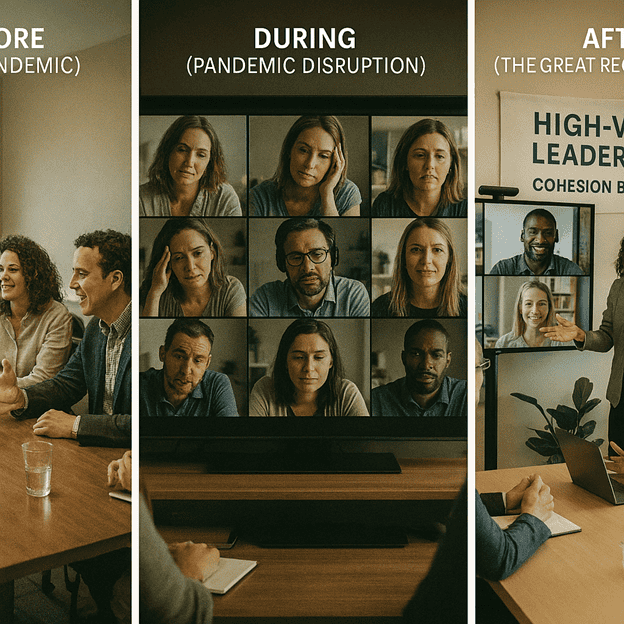
Remember March 2020? One week you were grabbing coffee with colleagues, collaborating at whiteboards, and having impromptu hallway conversations that solved problems in five minutes. The next week, everyone was home, staring at gallery view, trying to figure out how to unmute.

We thought it was temporary.

Now, years later, we’re in a different reality. Some teams are fully remote. Others are hybrid. Some have returned to offices. But here’s what’s universal: the connections that held teams together before the pandemic—those aren’t coming back automatically.

The casual trust-building that happened over lunch? Gone. The cultural osmosis that new employees absorbed by being physically present? Missing. The relationships that made difficult conversations easier and innovation faster? Frayed or broken.

And for Black women and other traditionally overlooked employees who were already navigating workplace isolation, exclusion from informal networks, and the emotional labor of being “the only”—the pandemic’s disconnection compounded challenges that existed long before COVID-19. 💔

Leaders are asking: How do we rebuild what was lost? How do we create cohesion when people aren’t in the same place? How do we build culture when the old culture-building methods no longer apply?

The answer isn’t “return to office” mandates or forced fun Zoom happy hours. It’s something deeper, more intentional, and frankly, more necessary: The Great Reconnection.

This is about rebuilding team cohesion deliberately, equitably, and sustainably for the world we’re actually working in—not the one we left behind.

Let’s explore how to reconnect teams in ways that honor what we’ve learned, address what we’ve lost, and build something better than what existed before.

What We Actually Lost (And What We Didn’t) 📉

Before we rebuild, let’s be honest about what broke.

What the Pandemic Disrupted:

Informal Relationship Building
The coffee chats, lunch conversations, and post-meeting hallway debriefs where relationships deepened and trust built—these evaporated overnight. For new employees who started remotely, they never experienced these connections at all.

Cultural Transmission
New hires used to learn organizational culture by observation—how people interact, what’s really valued, how decisions get made. In remote environments, this cultural knowledge transfer became invisible or nonexistent.

Spontaneous Collaboration
The “hey, can I ask you something?” moments that led to quick problem-solving, knowledge sharing, and serendipitous innovation—these required more effort remotely and often just didn’t happen.

Social Capital for Those Without Access
Even before the pandemic, Black women and other marginalized employees often lacked access to informal networks where real decisions happened. Remote work made these invisible networks even more invisible—and even more powerful.

Boundaries Between Work and Life
For many, particularly women and caretakers, the pandemic erased boundaries. Work invaded homes. “Always on” became the expectation. The mental health impact continues.

But Here’s What the Pandemic Revealed:

Flexibility is Possible
Organizations that claimed remote work was impossible proved it wasn’t. This opened possibilities for people with disabilities, caretakers, and those who thrive outside traditional office environments.

Productivity Doesn’t Require Presenteeism
Results matter more than where or when work happens. This was always true; the pandemic just made it undeniable.

Commutes and Office Politics Were Costly
Particularly for Black women who spend emotional energy code-switching, navigating microaggressions, and managing office dynamics—remote work reduced some of that exhausting labor.

Meetings Could Have Been Emails
We learned to be more intentional about what requires synchronous time and what doesn’t. That’s valuable.

What We Learned Can’t Be Unlearned
Employees experienced autonomy, flexibility, and work-life integration. Many won’t—and shouldn’t have to—give that up to rebuild connection.

The question isn’t whether to rebuild cohesion. It’s how to rebuild it in ways that honor what we’ve learned while addressing what we’ve lost.

Why Traditional Team-Building Won’t Work Anymore 🚫

Let’s address the elephant in the Zoom room: most traditional team-building approaches are failing in post-pandemic environments.

The Mandatory Return-to-Office Approach
“We need people back in the office to rebuild culture.” This ignores that:

  • Flexibility is now a retention issue, not a perk
  • Forced proximity doesn’t create genuine connection
  • The people most harmed by inflexible mandates are often caretakers, people with disabilities, and those who face discrimination in office environments
  • Culture is what you build, not where you build it

Research from Gartner shows that proximity bias—favoring employees who are physically present—increases in hybrid environments. Black women and other remote workers get disadvantaged in visibility, opportunities, and advancement.

The Forced Fun Approach
Virtual happy hours, mandatory team games, synchronized coffee breaks. These rarely build genuine connection and often create resentment, especially among employees juggling caregiving or managing Zoom fatigue.

The “Just Like Before” Approach
Trying to recreate 2019’s team dynamics in 2025 ignores that people, priorities, and possibilities have changed. Nostalgia isn’t a strategy.

The One-Size-Fits-All Approach
What builds connection for extroverts might exhaust introverts. What works for local employees might exclude distributed team members. What feels inclusive to some might feel performative to others.

The Technology-Will-Save-Us Approach
Collaboration tools, virtual reality meetings, team apps—technology enables connection but doesn’t create it. Connection is human; technology is infrastructure.

So if these approaches don’t work, what does?

The High-Value Framework for Post-Pandemic Cohesion 🎯

High-Value Leadership: Transforming Organizations Through Purposeful Culture teaches that cohesion isn’t about proximity—it’s about psychological safety, shared purpose, and genuine belonging.

Post-pandemic team cohesion requires four foundational elements:

1. Intentional Connection Architecture

Pre-pandemic, connection happened organically through physical proximity. Post-pandemic, connection must be architecturally designed into how teams work.

This means:

  • Structured Relationship-Building: Regular one-on-ones, team rituals, and dedicated connection time that’s protected, not optional
  • Purposeful Meeting Design: Clear intentions for when synchronous time is needed and what should be asynchronous
  • Connection Metrics: Tracking relationship health, trust levels, and belonging as rigorously as tracking productivity
  • Distributed-First Design: Designing for remote participants first, then adapting for in-person, rather than the reverse

A technology company redesigned their team structure post-pandemic around “connection pods”—small, stable groups of 4-6 people who met weekly for 30 minutes with no agenda other than connection. Not to discuss work. Not to problem-solve. Just to see each other as humans. These pods cut across departments and levels, deliberately mixing people who wouldn’t normally interact.

Result? Employee engagement scores rose 40%, retention improved significantly, and cross-functional collaboration increased because people had relationships beyond their immediate teams.

Implementation Tip: Design connection into your calendar as deliberately as you design project time. Make it non-negotiable, not optional when there’s “extra time.”

2. Equity in Access and Visibility

Pre-pandemic informal networks already excluded many. Post-pandemic remote and hybrid work either amplifies that exclusion or creates opportunity to democratize access—depending on how it’s designed.

Black women in corporate spaces face a specific challenge post-pandemic: we’re often remote (by choice or necessity), which can reduce some microaggression exposure but also reduces visibility to leadership, access to mentors and sponsors, and inclusion in informal networks where decisions happen.

There was a financial services firm that noticed their promotion rates shifted dramatically post-pandemic. Remote employees—disproportionately women and people of color—were promoted at lower rates than in-office employees, despite equal or better performance metrics. The issue? Proximity bias. Leaders were unconsciously favoring people they saw in person.

They addressed it by:

  • Making all-hands and leadership meetings hybrid with equal engagement for remote and in-person participants
  • Implementing “remote-first” communication norms where everything was documented digitally, not just discussed in hallways
  • Requiring leaders to track their one-on-one time with remote vs. in-office employees and address imbalances
  • Creating explicit criteria for promotions that didn’t include “office presence”

Implementation Tip: Audit who has access to informal conversations, mentorship, visibility opportunities, and face time with leadership. If patterns emerge showing certain groups are excluded, redesign access intentionally.

3. Psychological Safety Across Distance

Psychological safety—the belief that you can speak up, take risks, disagree, and be yourself without fear of punishment—is harder to build and easier to lose when teams aren’t physically together.

Why? Because trust is built through micro-interactions over time. A smile. A supportive comment after a mistake. Body language that says “I’ve got your back.” These are harder to read through screens or in asynchronous communication.

For Black women, psychological safety requires even more intentionality. Research from Catalyst shows Black women are the least likely demographic to feel they belong at work, the least likely to have sponsors, and the most likely to experience isolation. Remote work can either amplify that isolation or—if designed well—reduce it by minimizing some in-person bias.

A consulting firm rebuilt psychological safety post-pandemic through:

  • Vulnerability Modeling: Leaders shared personal challenges, admitted mistakes, and discussed their own pandemic struggles in team meetings
  • Structured Check-Ins: Every meeting started with a genuine “how are you?” round with permission to be honest, not performative
  • Brave Spaces: Monthly forums where team members could discuss difficult topics—bias, burnout, caregiving challenges—with facilitator support
  • Rapid Response to Harm: When someone experienced bias or exclusion, leadership addressed it immediately and transparently

Implementation Tip: Don’t assume psychological safety exists. Measure it through anonymous surveys, listen to what marginalized employees say about their experience, and intervene when safety is compromised.

4. Purpose-Driven Cohesion

The strongest teams aren’t bonded by forced fun—they’re bonded by shared purpose, mutual respect, and collective impact.

Mastering a High-Value Company Culture emphasizes that culture is what you’re building together, not just how you interact while building it. Post-pandemic cohesion must be anchored in meaningful work, not manufactured closeness.

This means:

  • Clarifying team mission and how each person contributes
  • Celebrating wins collectively and publicly
  • Making impact visible so people see how their work matters
  • Creating opportunities for collaboration on meaningful projects
  • Building communities of practice around shared interests and expertise

A healthcare organization rebuilt cohesion by creating “impact circles”—voluntary groups focused on solving real organizational challenges. A circle focused on patient experience. Another on operational efficiency. Another on health equity. Employees joined based on interest, worked on real problems, and presented solutions to leadership.

Result? People built relationships through meaningful collaboration. The work mattered beyond the relationships, and the relationships deepened because the work mattered.

Implementation Tip: Don’t just build connection for connection’s sake. Build it through purposeful work that creates collective meaning.

The Rise & Thrive Strategy: Reconnection as Empowerment 💪🏾

Rise & Thrive: A Black Woman’s Blueprint for Leadership Excellence addresses something particularly relevant here: for Black women, “team cohesion” has always been complex.

We’ve experienced team cohesion that includes us performatively but excludes us meaningfully. We’ve been on teams where we’re expected to bring “diversity” but our expertise is questioned. We’ve built relationships with colleagues who are friendly in private but silent when we face bias publicly.

So when we talk about “The Great Reconnection,” Black women are asking: Reconnection to what? To cultures that never fully included us? To dynamics that exhausted us?

The answer must be: No. We’re not rebuilding what was. We’re building what should have been.

Post-pandemic reconnection is an opportunity to:

Design Inclusion Intentionally
Remote and hybrid work removes some physical barriers. Use this opportunity to ensure Black women have equal access to leadership, equal visibility for contributions, equal opportunity for advancement.

Redistribute Emotional Labor
Black women have historically carried disproportionate emotional labor—supporting others, managing office dynamics, code-switching. Reconnection should redistribute that labor equitably, not assume we’ll resume carrying it.

Center Well-Being
Reconnection shouldn’t mean returning to unsustainable hustle culture. It should mean building sustainable ways of working that honor our full humanity—our caregiving responsibilities, our mental health needs, our boundaries.

Create Authentic Belonging
Not “cultural fit” (which often means “similarity to those already here”) but genuine belonging where we can bring our full selves, our unique perspectives, and our authentic leadership.

Build Sponsorship, Not Just Mentorship
Cohesion that benefits Black women includes leaders who actively sponsor us for opportunities, advocate for our advancement, and open doors that have historically been closed.

The Great Reconnection, done right, isn’t about returning to pre-pandemic norms. It’s about creating post-pandemic cultures where everyone—especially those previously excluded—can genuinely belong and thrive.

Best Practices From Organizations Getting It Right 📊

Current research from Gallup, Microsoft’s Work Trend Index, and McKinsey reveals patterns among organizations successfully rebuilding cohesion:

They Embrace Flexible Work as Permanent

The highest-performing post-pandemic organizations don’t treat flexibility as temporary. They’ve redesigned work around outcomes, autonomy, and trust—not location and hours.

Practice: Offer flexibility by default. Require justification for inflexibility, not the reverse. Design roles for remote success first, then adapt for hybrid/in-person as needed.

They Over-Communicate and Over-Clarify

In distributed environments, communication that feels like “too much” is actually sufficient. Assumptions and unspoken expectations destroy cohesion.

Practice: Repeat important information through multiple channels. Document decisions transparently. Create space for questions. Assume nothing is obvious.

They Invest in Technology That Enables Connection

Not just Zoom. But asynchronous collaboration tools, virtual whiteboarding, team recognition platforms, and digital spaces for informal connection.

Practice: Evaluate tools based on whether they create equity between remote and in-person team members. If remote employees have degraded experiences, the tool isn’t working.

They Design Hybrid for Equity

When some team members are in-person and others are remote, the risk of two-tiered systems is high. Equitable hybrid design ensures remote participants aren’t second-class.

Practice: “Remote-first” meeting norms even in hybrid settings—everyone on their own screen during video calls (even if in the same office), digital collaboration boards everyone can access, documentation of hallway conversations.

They Measure Connection, Not Just Output

High-performing organizations track relationship health, belonging scores, psychological safety metrics, and connection quality—not just productivity and deliverables.

Practice: Regular pulse surveys asking: “Do you feel connected to your team?” “Do you feel your contributions are valued?” “Do you have relationships at work where you can be authentic?” Use data to improve.

They Create Intentional In-Person Moments

When teams do gather physically, it’s purposeful—focused on activities that benefit from being together (relationship building, strategic planning, creative collaboration) rather than routine work that can happen remotely.

Practice: Design in-person time for maximum relational value. Don’t waste precious face-to-face time on information sharing that could be asynchronous. Use it for connection, collaboration, and culture-building.

They Prioritize Manager Development

Middle managers are the frontline of reconnection. They need training, support, and resources to build cohesion in hybrid/remote environments.

Practice: Invest heavily in manager development focused on: leading distributed teams, building psychological safety remotely, inclusive facilitation, recognizing and addressing bias, supporting well-being.

They Address Proximity Bias Explicitly

Organizations that acknowledge proximity bias exists are better positioned to mitigate it. Those that pretend it doesn’t struggle.

Practice: Name proximity bias openly. Track promotion and opportunity distribution by work location. Train leaders to recognize and interrupt bias. Hold leaders accountable for equitable treatment of remote and in-person employees.

Practical Strategies for Rebuilding Cohesion 🛠️

Ready to reconnect your team? Here are actionable approaches:

Strategy 1: Rituals That Create Rhythm

Consistent, meaningful rituals create predictability and connection even when people aren’t physically together.

Examples:

  • Weekly team check-ins starting with personal shares (not just work updates)
  • Monthly “learning lunches” where someone teaches the team something they’re passionate about
  • Quarterly in-person gatherings (if geographically feasible) focused on relationship building
  • Daily asynchronous “wins” channel where team members share successes
  • “First Friday” virtual coffees in small randomized groups

Implementation: Start small. One ritual, done consistently, builds more cohesion than multiple sporadic efforts. Get team input on what feels meaningful, not mandated.

Strategy 2: Connection Roles and Responsibilities

Designate specific team members (on rotation) to facilitate connection—not just the leader’s job.

Examples:

  • “Connection Captain” who plans monthly team activities
  • “Recognition Champion” who highlights team member contributions weekly
  • “Onboarding Buddy” for each new hire, responsible for cultural integration
  • “Wellness Advocate” who checks in on team well-being and flags concerns

Implementation: Rotate these roles so everyone contributes to culture-building. Provide resources and support. Recognize this work as valuable, not “extra.”

Strategy 3: Structured Vulnerability

Psychological safety grows when leaders model vulnerability and create structured opportunities for authenticity.

Examples:

  • “Failure Fridays” where team members share something that didn’t work and what they learned
  • Leadership sharing their own challenges, mistakes, and growth areas publicly
  • “Whole Person” check-ins where people share what’s happening in their lives, not just work
  • Team retrospectives that include “what’s working for me” and “what’s hard for me” reflections

Implementation: Start with leadership modeling. Make vulnerability voluntary but encouraged. Create clear agreements about confidentiality and respect.

Strategy 4: Cross-Functional Connection

Cohesion within teams matters, but cross-organizational relationships prevent silos and build broader connection.

Examples:

  • “Coffee Roulette” programs matching random employees across departments for virtual coffee
  • Cross-functional project teams working on real organizational challenges
  • Internal mentorship programs connecting people from different areas
  • “Shadowing days” where employees experience other departments’ work
  • Communities of practice around shared interests (ERGs, hobbies, professional development)

Implementation: Make these programs opt-in but highly encouraged. Provide work time for participation. Celebrate connections that form and collaborate that emerges.

Strategy 5: Recognition and Celebration

Shared celebration builds collective identity and reinforces what matters.

Examples:

  • Public recognition in team meetings for specific contributions (not generic praise)
  • Peer-to-peer recognition platforms where employees appreciate each other
  • Milestone celebrations (work anniversaries, project completions, personal achievements)
  • “Impact stories” where employees share how their work made a difference
  • Team wins celebrated collectively, not just individual achievements

Implementation: Make recognition specific, frequent, and equitable. Ensure recognition reaches all team members, not just the most visible. Celebrate learning and effort, not just results.

Strategy 6: Equity Audits and Adjustments

Regularly assess whether reconnection efforts are working for everyone, especially those historically excluded.

Examples:

  • Quarterly surveys asking marginalized employees specifically about belonging and connection
  • Analysis of who participates in connection activities and who doesn’t—investigate barriers
  • Tracking who gets face time with leadership, mentorship, and visibility opportunities
  • Exit interviews asking specifically about connection and belonging
  • Inclusion council reviewing cohesion strategies through equity lens

Implementation: Don’t just collect data—act on it. When disparities emerge, address them immediately and transparently. Make equity in connection a measurable goal.

When Physical Return Makes Sense (And When It Doesn’t) 🏢

Let’s address the contentious question: Should teams return to physical offices?

The answer: It depends—and it should be determined by purpose, not nostalgia.

Physical presence may support cohesion when:

  • The work genuinely requires in-person collaboration (physical prototyping, hands-on training, etc.)
  • Teams are co-located and commutes are reasonable
  • Office environments are inclusive, accessible, and psychologically safe for all employees
  • In-person time is designed for maximum relational value, not routine tasks
  • Flexibility is maintained for those with caregiving, disabilities, or other needs
  • The organization invests in making offices worth commuting to

Physical presence may harm cohesion when:

  • It’s mandated without clear purpose, breeding resentment
  • Remote employees are excluded or disadvantaged
  • Offices aren’t inclusive spaces (accessibility barriers, code-switching pressure, microaggressions)
  • Commute costs disproportionately burden lower-paid employees
  • Presenteeism gets rewarded over actual performance
  • Flexibility disappears, driving away talent who thrived remotely

For Black women specifically, the return-to-office question is layered:

  • Does in-person presence reduce some isolation, or does it increase emotional labor?
  • Will I have more or less access to leadership and opportunities in-office?
  • Is the office environment psychologically safe, or is remote work a buffer from daily microaggressions?
  • Will my flexibility needs be accommodated, or will I be penalized for them?

There’s no universal answer. The right approach is flexibility by default, intentionality always, and equity non-negotiable.

Common Pitfalls to Avoid ⚠️

As you rebuild cohesion, watch for these mistakes:

Pitfall #1: Assuming Connection Happens Automatically
Pre-pandemic, proximity created some organic connection. Post-pandemic, connection must be designed, facilitated, and protected.

Solution: Make connection-building explicit work with dedicated time, resources, and accountability.

Pitfall #2: Prioritizing Extroverts’ Needs
Loud, visible, social connection feels like “team cohesion” but exhausts introverts and neurodiverse team members.

Solution: Offer multiple ways to connect—some social, some work-focused, some large group, some one-on-one, some synchronous, some asynchronous.

Pitfall #3: Ignoring Proximity Bias
Hybrid teams without intentional equity design advantage in-office employees and disadvantage remote employees.

Solution: Explicitly name and address proximity bias. Design for remote-first. Track and correct disparities in opportunities and advancement.

Pitfall #4: Underestimating Pandemic Trauma
People experienced loss, isolation, stress, and change. Reconnection must honor that, not dismiss it.

Solution: Create space for people to process what they’ve been through. Don’t rush to “normal.” Build in healing alongside connection.

Pitfall #5: One-Size-Fits-All Approaches
What builds connection for one person or team may not work for another.

Solution: Offer options. Get team input. Iterate based on what actually works, not what leadership thinks should work.

Pitfall #6: Forgetting About New Employees
People who joined during/after the pandemic never experienced pre-pandemic culture. They need intentional integration.

Solution: Create robust onboarding focused on relationships, not just logistics. Assign mentors/buddies. Over-communicate culture explicitly rather than assuming they’ll “pick it up.”

Pitfall #7: Neglecting Manager Support
Managers are expected to rebuild cohesion without training, resources, or their own support systems.

Solution: Invest heavily in manager development, peer support for managers, and reducing manager burnout. They can’t build team cohesion if they’re drowning.

Discussion Questions for Leadership Teams 💬

Use these to facilitate meaningful conversations:

  1. On a scale of 1-10, how connected do we think our teams feel right now? What evidence do we have for that assessment?
  2. What worked about our pre-pandemic culture, and what do we absolutely not want to rebuild? Be specific.
  3. Who on our teams might be experiencing isolation or exclusion that we’re not seeing? How do we find out and address it?
  4. What assumptions are we making about what people need to feel connected? Have we actually asked them?
  5. How are we measuring team cohesion and belonging? Are we tracking it as rigorously as productivity?
  6. If our Black women employees, remote workers, or other marginalized team members were asked whether they feel genuinely included in our reconnection efforts—what would they say?
  7. What would have to change for cohesion to exist regardless of where or when people work?

Next Steps: Your Reconnection Roadmap 🗺️

This Week:

  • Survey your team on how connected they currently feel and what would increase connection
  • Identify 1-2 current practices that might be excluding some team members
  • Have individual conversations with team members about their connection needs

This Month:

  • Implement one consistent team ritual focused on connection
  • Audit proximity bias—who’s getting opportunities, visibility, and access to leadership?
  • Train managers on building cohesion in distributed/hybrid environments
  • Create or refresh onboarding to explicitly build relationships for new hires

This Quarter:

  • Design intentional in-person time (if applicable) focused on high-value connection activities
  • Launch cross-functional connection initiatives (mentorship, coffee roulette, communities of practice)
  • Measure psychological safety and belonging, especially for marginalized employees
  • Adjust work design to support both flexibility and connection

This Year:

  • Build connection metrics into performance management and organizational health assessments
  • Create sustainable rituals and structures that maintain cohesion long-term
  • Develop manager capability in leading connected, distributed teams
  • Make equity in connection a measurable organizational priority
  • Celebrate reconnection wins while continuing to improve

Partner With Che’ Blackmon Consulting 🤝

Rebuilding team cohesion in post-pandemic environments isn’t something you improvise. It requires expertise in culture transformation, inclusive design, distributed team dynamics, and leadership development—especially ensuring that reconnection efforts truly include everyone, particularly those traditionally overlooked.

Che’ Blackmon Consulting partners with organizations committed to building cohesive, high-performing teams where everyone genuinely belongs—regardless of where, when, or how they work. We bring deep expertise in designing connection architecturally, centering equity in hybrid work, and transforming cultures to thrive in our new reality.

We can help you:

  • Assess current team cohesion and identify disconnection drivers
  • Design connection strategies that work for distributed, hybrid, and in-person teams
  • Train leaders to build psychological safety and belonging remotely
  • Address proximity bias and ensure equitable experiences for all employees
  • Create rituals, structures, and systems that sustain cohesion long-term
  • Center marginalized voices in reconnection design
  • Measure and improve belonging as organizational health metric

The strongest teams post-pandemic aren’t trying to recreate 2019. They’re building something better—more flexible, more equitable, more intentional, and more human.

Ready to lead The Great Reconnection and build cohesion that includes everyone?

📧 admin@cheblackmon.com
📞 888.369.7243
🌐 cheblackmon.com


We’re not going back to how things were. We’re moving forward to how things should be—where teams are connected not by proximity, but by purpose, psychological safety, and genuine belonging. That’s the reconnection worth building.

#TeamCohesion #HybridWork #HighValueLeadership #RemoteWork #PostPandemic #PsychologicalSafety #InclusiveLeadership #FutureOfWork #OrganizationalCulture #WorkplaceConnection #DiversityAndInclusion #LeadershipDevelopment #EmployeeEngagement #HybridTeams #WorkplaceBelonging

Building Innovation Labs: Safe Spaces for Calculated Risk 🚀

Where Breakthrough Ideas Meet Psychological Safety

Innovation doesn’t happen by accident. And it certainly doesn’t happen in cultures where failure means career damage, where speaking up feels risky, and where only certain people’s ideas are taken seriously.

You’ve seen it happen. Someone suggests a bold idea in a meeting. The room goes silent. Eyes dart toward the most senior person, waiting to see how they’ll react. If they’re skeptical, the idea dies. If they like it, suddenly everyone loved it all along. And the person who took the risk of suggesting it? They’re left wondering if speaking up was worth it.

Now imagine this: Your organization has a designated space—physical, digital, or both—where experimentation is expected, failure is a learning tool rather than a career liability, and diverse perspectives are not just welcomed but actively sought. A place where the junior team member’s insight carries the same weight as the VP’s opinion. Where Black women don’t have to code-switch or minimize their ideas to be heard. Where innovation is democratized, not gatekept.

This is what innovation labs do when built right. 🎯

But here’s the challenge: most organizations talk about innovation while maintaining cultures that punish risk. They want breakthrough thinking while rewarding safe conformity. They claim to value diverse perspectives while centering the same voices in every important conversation.

Real innovation requires real safety. Calculated risk requires cultures that calculate differently—measuring learning alongside results, valuing diverse thought alongside execution, and understanding that the best ideas often come from people who experience problems differently.

Let’s explore how to build innovation labs that don’t just generate ideas, but transform cultures into spaces where everyone—especially the traditionally overlooked—can safely contribute their genius.

Why Traditional Innovation Approaches Fall Short 💡

Before we build something better, let’s understand what’s broken.

Most organizations approach innovation through one of these flawed models:

The “Suggestion Box” Model
“We value your ideas! Submit them here!” Then those ideas disappear into a black hole. No feedback. No implementation. No acknowledgment. Employees learn that sharing ideas is performative, not purposeful.

The “Innovation Theater” Model
Hackathons! Brainstorming sessions! Innovation workshops! Lots of energy, sticky notes, and enthusiasm. Then everyone returns to their regular work, nothing changes, and the ideas collected gather dust. Innovation becomes an event, not a practice.

The “Genius Leadership” Model
Innovation is the domain of executives and designated “thought leaders.” Everyone else executes. This concentrates power, limits perspectives, and ensures you miss innovations that could only come from people closest to the work or the customer.

The “Failure Is Not an Option” Model
The stated goal is innovation. The unstated rule is don’t mess up. So people play it safe, propose incremental improvements, and avoid anything bold enough to fail. You get optimization, not transformation.

The “Diversity of Thought” Model (Without Actual Diversity)
Leadership claims they want diverse thinking while maintaining homogeneous leadership teams. They want “fresh perspectives” but only from people who look, sound, and think like them. The innovation that comes from genuinely different experiences never enters the room.

Harvard Business School research shows that diverse teams are more innovative—but only when psychological safety exists. Without safety, diverse team members self-censor, conforming to dominant perspectives rather than offering unique insights.

This is particularly true for Black women in corporate spaces. We navigate workplaces where we’re often the only—or one of few—and where our ideas are frequently met with skepticism, appropriated without credit, or dismissed until someone else repeats them. In that environment, why would we share our most innovative thinking?

The cost isn’t just to us. It’s to organizations missing breakthrough innovations because they haven’t created the conditions for all voices to contribute safely.

What Innovation Labs Actually Are (And Aren’t) 🔬

Let’s define terms. An innovation lab isn’t necessarily a physical room with whiteboards and bean bags (though it can be). It’s a structured approach to creating psychological safety for calculated risk-taking.

Innovation labs are:

Dedicated Spaces (physical, digital, or temporal) where normal rules of work are suspended in favor of experimentation, learning, and creative problem-solving.

Cross-Functional and Multi-Level environments where hierarchy is flattened, diverse perspectives are actively sourced, and contributions are valued based on insight rather than title.

Protected Environments where failure is expected, documented as learning, and separated from performance evaluation—allowing genuine experimentation without career risk.

Structured Processes with clear objectives, decision-making frameworks, resource allocation, and pathways from experimentation to implementation—so ideas don’t die in the lab.

Cultural Catalysts that model the behaviors organizations want everywhere: psychological safety, inclusive collaboration, learning from failure, and democratized innovation.

Innovation labs aren’t:

❌ Places where only “creative types” or tech people work
❌ Escapes from accountability or results
❌ Permission to waste resources without strategy
❌ Separate from the “real business”
❌ Substitutes for fixing toxic cultures

As High-Value Leadership: Transforming Organizations Through Purposeful Culture emphasizes: Innovation is a cultural outcome, not a departmental function. Labs are tools for building that culture.

The Psychological Safety Foundation 🛡️

You cannot have sustainable innovation without psychological safety. Full stop.

Google’s Project Aristotle studied hundreds of teams to identify what makes some successful and others fail. The number one factor? Psychological safety—the belief that you can take risks, voice concerns, ask questions, and admit mistakes without fear of punishment or humiliation.

Dr. Amy Edmondson’s decades of research on psychological safety confirms: teams that feel safe to fail learn faster, innovate more, and outperform teams that don’t.

But here’s what’s often missed: psychological safety isn’t equally distributed.

A healthcare company launched an innovation lab and wondered why their Black and Latinx employees weren’t participating. When they dug deeper, they discovered that these employees didn’t feel safe experimenting. Why? Because in their regular work, they were held to higher standards, scrutinized more intensely, and had less room for error than their white counterparts. The idea that they could “fail safely” in an innovation lab while being unable to fail safely in their actual roles felt like a trap, not an opportunity.

Psychological safety in innovation labs requires:

Trust That Failure Won’t Be Weaponized
Employees need to believe—based on evidence, not just words—that experimentation won’t damage their careers, reputations, or relationships.

Equity in Who Gets to Experiment
If only certain people are invited to the lab, or if participation is seen as a privilege rather than a responsibility, you’ve already created hierarchy that undermines safety.

Consistency Between Lab Culture and Organizational Culture
If the lab operates with psychological safety but the rest of the organization doesn’t, people will see it as performative. Real safety requires cultural alignment.

Protection for Historically Marginalized Voices
Black women, LGBTQ+ employees, people with disabilities—those who face additional scrutiny in corporate spaces—need explicit assurance and demonstrated evidence that their participation is safe and valued.

Designing Innovation Labs for Equity and Excellence 🎨

The best innovation labs aren’t built for the mythical “average employee.” They’re designed intentionally to include people who’ve historically been excluded from innovation conversations.

Here’s how:

1. Democratize Access and Participation

Innovation opportunities shouldn’t require an invitation from leadership. They should be open, transparent, and accessible to anyone interested.

A manufacturing company created an innovation lab with one rule: any employee at any level could propose a project and form a team to explore it. They provided time (4 hours per month), resources (small budget and materials), and support (facilitation and mentorship).

Within six months, a warehouse associate proposed a logistics optimization that saved the company $200,000 annually. A customer service rep designed a communication tool that reduced complaints by 30%. These weren’t “creative” roles. But when given space, time, and permission, frontline employees innovated in ways leadership never imagined.

Implementation Tip: Make innovation lab participation opt-in but encourage everyone. Provide work time for it (if people have to do it on top of their regular job, only those with bandwidth—or privilege—can participate). Remove barriers to entry.

2. Flatten Hierarchy Intentionally

In the lab, titles don’t matter. Ideas do.

There was a financial services firm whose innovation lab had a practice: in lab sessions, everyone wore the same color shirts (provided) with their first name only—no titles, no departments visible. This simple ritual signaled: “In here, we’re equals.”

They also implemented “role rotation”—each session, a different person facilitated, someone else took notes, another managed time. Junior employees led sessions where VPs participated as contributors. It disrupted the normal power dynamics that usually silence certain voices.

Implementation Tip: Create rituals and structures that explicitly flatten hierarchy. Use facilitation techniques that ensure everyone speaks. Call on quieter voices. Interrupt interruptions. Make equity visible and intentional.

3. Center Diverse Perspectives as Strategic Assets

Innovation labs should actively seek perspectives from people with different experiences, backgrounds, and relationships to the problem being solved.

A consumer goods company was struggling with declining market share among Gen Z consumers of color. Their marketing team—predominantly white and millennial—kept proposing campaigns that fell flat. So they created an innovation lab specifically inviting young Black and Brown employees from across the organization (not just marketing) to reimagine the brand’s approach.

The result? A campaign concept that tripled engagement in their target demographic and spawned three new product lines. The innovation didn’t come from the “experts.” It came from people who actually understood the customer because they were the customer.

Implementation Tip: Don’t just invite diverse people as token participants. Center their expertise. Compensate fairly (if lab work is beyond their regular role). Credit their contributions publicly. Create pathways for their ideas to reach decision-makers.

4. Separate Experimentation From Performance Evaluation

This is critical: what happens in the lab doesn’t affect performance reviews.

If experiments that “fail” damage your reputation or career trajectory, you’ll never take real risks. You’ll only propose safe ideas you’re confident will succeed—which defeats the purpose of experimentation.

A technology company made this explicit in their innovation lab charter: “Ideas explored here—whether successful or not—are separate from performance evaluation. We assess learning, not just outcomes. We celebrate productive failures as much as successes.”

They tracked “experiments run,” “learnings documented,” and “pivots made based on data” as success metrics, not just “projects that worked.” This freed people to actually experiment.

Implementation Tip: Document this separation clearly. Train managers on it. When someone’s lab experiment fails but generates valuable learning, celebrate it in company communications. Make it real, not just policy.

5. Create Clear Pathways From Lab to Implementation

The fastest way to kill innovation enthusiasm? Let great ideas die in the lab because there’s no process for implementing them.

An insurance company built a “graduation pathway”: when a lab project showed promise, it could be presented to a cross-functional review team (which included both executives and employees). If approved, it received budget, dedicated team members, and executive sponsorship for implementation.

This pathway was transparent, with clear criteria for what made an idea ready to graduate. Teams knew exactly what they needed to demonstrate. And importantly, the people who developed the idea in the lab often moved with it into implementation—they weren’t just idea generators for others to execute.

Implementation Tip: Design the pathway from lab to implementation before launching the lab. Make it visible and navigable. Ensure diverse voices aren’t just generating ideas for others to get credit and advancement from implementing.

The Rise & Thrive Principle: Innovation Through Inclusion 💪🏾

Rise & Thrive: A Black Woman’s Blueprint for Leadership Excellence addresses a reality that’s directly relevant to innovation labs: Black women are master innovators—we’ve had to be.

We’ve innovated solutions to exclusion, bias, and systems not designed for us. We’ve created pathways where none existed. We’ve built communities, movements, and models for success in hostile environments. That’s innovation under the most challenging conditions.

Yet in corporate innovation spaces, our insights are often:

  • Dismissed as “too specific” when we bring unique perspectives
  • Appropriated without credit when we share solutions
  • Questioned more rigorously than others’ ideas
  • Evaluated through bias that sees confidence as aggression
  • Undervalued because we’re not in roles traditionally associated with “innovation”

Innovation labs designed with equity create different dynamics:

Our Experience Becomes Expertise
Instead of being asked to leave our identity at the door, we’re invited to bring the full context of our experiences to problem-solving. That lens often reveals opportunities others miss.

Our Ideas Get Fair Evaluation
When labs intentionally design for equity—facilitating discussions to prevent idea appropriation, ensuring credit goes to originators, implementing bias checks—our innovations receive the consideration they deserve.

Our Risk-Taking Is Protected
When psychological safety is real and not just rhetoric, we can experiment without the added burden of representing our entire demographic or being held to different standards when things don’t work.

Our Success Benefits Everyone
When Black women succeed in innovation labs, the ideas that emerge often benefit broader populations—because we understand navigating systems designed for exclusion, and solutions that work for the most marginalized often work better for everyone.

The question for leaders building innovation labs: Are you creating space where Black women’s innovative genius can flourish, or are you replicating the same gatekeeping with better furniture?

Best Practices From High-Performing Innovation Labs 📊

Research from MIT Sloan, Stanford d.school, and innovation leaders like IDEO reveals patterns among the most successful innovation environments:

They Start With Real Problems, Not Blue-Sky Brainstorming

The best labs focus on specific challenges that matter to the business and to customers. Abstract “think outside the box” exercises generate energy but rarely produce implementable innovations.

Practice: Frame lab projects around concrete questions: “How might we reduce customer churn in the 18-25 demographic?” “What would make our supply chain 20% more efficient?” “How could we make our workplace more accessible?”

They Prototype Fast and Learn Faster

Innovation isn’t about having perfect ideas. It’s about testing imperfect ideas quickly, learning from what doesn’t work, and iterating.

A retail company’s innovation lab had a “72-hour prototype rule”—teams couldn’t spend more than three days building a first version. This forced rapid creation over perfectionism and generated learning cycles fast enough to matter.

Practice: Build bias toward action. Create structures that reward quick experimentation over prolonged analysis. Use prototyping methods appropriate to the problem (paper prototypes, digital mockups, pilot programs, etc.).

They Integrate Customer/User Feedback Early and Often

Innovations developed in isolation from the people they’re meant to serve rarely succeed. The best labs bring users into the process—not just to validate final products, but to inform development throughout.

Practice: Identify who benefits from the innovation and engage them directly. For employee-facing innovations, that means employees using the lab themselves or providing feedback on prototypes. For customer-facing innovations, it means real customer input, not assumptions about what customers want.

They Measure Learning, Not Just Success

Traditional ROI metrics kill innovation because most experiments don’t produce immediate returns. Innovation labs need different metrics.

Practice: Track experiments run, hypotheses tested, pivots based on data, skills developed, cross-functional collaborations formed, and speed from idea to prototype. Celebrate teams that learned valuable “this doesn’t work because X” insights as much as teams whose projects succeed.

They Make Failure Visible and Valuable

Hiding failures ensures others repeat them. Sharing failures accelerates organizational learning.

A pharmaceutical company held quarterly “failure parties” where innovation lab teams presented what didn’t work, what they learned, and what they’d do differently. These presentations were attended by leadership and celebrated as much as success stories.

Practice: Create forums for sharing what didn’t work. Document learnings publicly. When leaders share their own productive failures, it normalizes risk-taking for everyone else.

They Build Diverse Teams Intentionally

Diversity isn’t just about demographic representation (though that matters). It’s also about cognitive diversity—different disciplines, experiences, thinking styles, and relationships to the problem.

Practice: Require lab teams to be cross-functional. Encourage teams to include people from different levels, departments, and backgrounds. Facilitate in ways that surface diverse perspectives rather than allowing dominant voices to drive all decisions.

Common Pitfalls to Avoid ⚠️

Even well-intentioned innovation labs can fail. Here’s what to watch for:

Pitfall #1: The Lab Becomes an Elite Club
When only high performers, leadership favorites, or certain departments participate, you’ve created exclusivity that undermines psychological safety and limits perspectives.

Solution: Make participation transparent, accessible, and rotating. Track who participates and who doesn’t—if patterns emerge, investigate barriers.

Pitfall #2: Innovations Never Leave the Lab
Great ideas pile up with no implementation pathway. Teams become cynical that their work matters.

Solution: Design the implementation pathway first. Establish clear criteria, decision-makers, and resources for moving ideas from lab to execution.

Pitfall #3: Failure Is Celebrated in Theory, Punished in Practice
You say failure is okay, but people who experiment and fail get quietly sidelined or excluded from future opportunities.

Solution: Leaders must visibly participate in the lab, share their own failures, and demonstrate through promotions and opportunities that lab participation—regardless of outcomes—is valued.

Pitfall #4: The Lab Reinforces Existing Bias
Without intentional design for equity, labs replicate the same dynamics that silence marginalized voices everywhere else.

Solution: Train facilitators on equity and inclusion. Use structured methods that ensure all voices are heard. Monitor who speaks, whose ideas gain traction, and who gets credit. Intervene when patterns of inequity emerge.

Pitfall #5: Lab Work Is Expected on Top of Regular Work
If only people with excess capacity can participate, you’ve created class and privilege barriers. Single parents, caretakers, people without flexibility can’t participate.

Solution: Provide dedicated time for lab work. Make it part of work, not extra. Ensure participation is feasible for people with constraints.

Pitfall #6: The Lab Is Disconnected From Strategy
Innovation for innovation’s sake generates ideas that don’t align with organizational goals or available resources.

Solution: Connect lab projects to strategic priorities. Provide strategic context. Ensure leadership engagement so teams understand how their work fits the bigger picture.

The High-Value Culture Integration 🌟

Mastering a High-Value Company Culture teaches that sustainable innovation isn’t a program—it’s a cultural capacity. Innovation labs are most powerful when they model and build the culture you want throughout the organization.

High-value cultures use innovation labs to:

Model Psychological Safety at Scale
What people experience in the lab—safety to risk, permission to fail, voice without fear—should gradually extend throughout the organization. The lab becomes proof of concept for a different way of working.

Develop Leadership Capacity
Lab facilitation, project leadership, and team participation develop skills that translate to better leadership everywhere: inclusive facilitation, bias awareness, design thinking, rapid learning, and collaborative decision-making.

Build Cross-Functional Relationships
Labs break down silos by bringing together people who don’t normally collaborate. These relationships strengthen the organization beyond any specific innovation.

Create Equity Muscle
When organizations practice equity intentionally in labs—centering marginalized voices, designing for inclusion, interrupting bias—they build capacity to do it everywhere else.

Generate Cultural Stories
The stories that emerge from labs—”Remember when the intern’s idea became a $2M revenue stream?” or “Remember when we failed fast, learned, and pivoted to something better?”—become cultural narratives that shape what’s possible.

The goal isn’t just innovations. It’s a culture where innovation is how you work, not something separate from work.

Practical Implementation Guide 🛠️

Ready to build an innovation lab? Here’s your roadmap:

Phase 1: Foundation and Design (Weeks 1-4)

Define Purpose and Scope

  • What problems will the lab address?
  • Who can participate?
  • What resources are available?
  • How will success be measured?
  • What’s the pathway from lab to implementation?

Build the Equity Framework

  • How will you ensure diverse participation?
  • What facilitates psychological safety for all?
  • How will you prevent bias in idea evaluation?
  • What accommodations ensure accessibility?

Secure Leadership Commitment

  • Leadership must visibly support the lab
  • Provide resources (time, budget, space)
  • Protect lab participants from career risk
  • Commit to evaluating ideas fairly

Design the Structure

  • Physical or virtual space
  • Time allocation for participants
  • Facilitation approach and training
  • Documentation and knowledge sharing systems
  • Decision-making processes

Phase 2: Launch and Learn (Months 1-3)

Start Small

  • Pilot with 2-3 projects and willing participants
  • Focus on proving the model works
  • Build trust through demonstrated safety
  • Document learnings intensely

Facilitate Intentionally

  • Train facilitators in inclusive practices
  • Use structured methods that surface all voices
  • Monitor for bias and intervene when needed
  • Create rituals that build psychological safety

Prototype Rapidly

  • Bias toward action over analysis
  • Test assumptions quickly
  • Iterate based on learning
  • Celebrate productive failures

Communicate Transparently

  • Share what’s happening in the lab
  • Invite feedback and questions
  • Make processes and decisions visible
  • Build credibility through honesty about what’s working and what isn’t

Phase 3: Scale and Integrate (Months 4-12)

Expand Participation

  • Open to broader employee base
  • Rotate facilitation and leadership
  • Ensure ongoing demographic diversity
  • Track and address barriers to participation

Implement Promising Innovations

  • Use the graduation pathway you designed
  • Provide resources for implementation
  • Keep originators involved when possible
  • Credit appropriately and publicly

Measure and Adjust

  • Track participation demographics
  • Survey participants on psychological safety
  • Analyze which ideas move to implementation
  • Monitor for equity in whose ideas succeed
  • Adjust based on data and feedback

Integrate Lab Practices Into Culture

  • Train leaders on facilitation methods used in labs
  • Apply psychological safety practices to regular meetings
  • Use prototyping and rapid learning approaches beyond the lab
  • Celebrate failures and learning organization-wide

Phase 4: Sustaining Excellence (Ongoing)

Maintain Momentum

  • Regular project cycles
  • Continuous recruitment of participants
  • Fresh problems to solve
  • Evolving methods and approaches

Deepen Equity

  • Ongoing bias training
  • Regular equity audits of participation and outcomes
  • Adjustment when disparities emerge
  • Centering voices that haven’t been heard

Share Learning

  • Document case studies
  • Present at company events
  • Create playbooks for scaling practices
  • Build community among lab alumni

Connect to Strategy

  • Ensure lab projects align with organizational priorities
  • Bring lab learnings to strategic planning
  • Use lab as talent development pathway
  • Integrate innovation capacity building into leadership development

For Leaders: Creating the Conditions for Innovation 🎯

If you’re leading the charge to build an innovation lab, here are critical success factors:

Model Vulnerability
Share your own experiments that failed. Talk about what you learned. Show that leaders take risks too and survive failure. This permission structure is essential.

Protect Risk-Takers
When someone experiments in the lab and it doesn’t work, ensure there are no negative career consequences. If necessary, intervene explicitly: “That was a valuable experiment with important learnings. I’m glad they took that risk.”

Redistribute Power
Innovation labs only work when hierarchy is genuinely flattened inside them. This means you, as a leader, must be willing to be wrong, to learn from junior employees, to implement ideas that didn’t come from leadership.

Resource Adequately
Innovation labs without time, budget, space, or tools are performative. If you’re asking for innovation, provide what innovation requires.

Connect to Rewards
Lab participation and learning should be valued in performance evaluations, promotion decisions, and recognition. Not just the successful innovations—the participation itself.

Address Inequity Immediately
If you notice patterns—certain demographics not participating, certain voices dominating, credit going to the wrong people—intervene immediately and transparently.

Discussion Questions for Leadership Teams 💬

Use these to facilitate meaningful conversations:

  1. If we asked our frontline employees if they feel safe proposing bold ideas here, what percentage would say yes? What makes us think that?
  2. Whose voices are currently missing from our innovation conversations? What specific barriers prevent their participation?
  3. What happened the last time someone experimented and failed here? What did we do? What message did that send?
  4. How do we currently evaluate ideas—based on merit, or based on who proposes them? What evidence supports our answer?
  5. If we built an innovation lab, would our Black women employees trust that it’s genuinely safe? Why or why not?
  6. What would have to change in our culture for innovation to happen everywhere, not just in a designated lab?
  7. Are we prepared to implement ideas that come from unexpected sources, even if they challenge how we’ve always done things?

Next Steps: From Concept to Reality 🚀

This Week:

  • Identify 2-3 specific problems an innovation lab could address
  • List barriers that currently prevent people from taking calculated risks here
  • Talk to employees about what would make them feel safe to experiment

This Month:

  • Form a diverse planning team (not just leadership) to design the lab
  • Audit current innovation processes for bias and inequity
  • Identify resources (time, budget, space) available for the lab
  • Research models from other organizations (but adapt, don’t copy)

This Quarter:

  • Design the lab structure, participation model, and implementation pathway
  • Pilot with 2-3 projects and willing, diverse participants
  • Train facilitators in equity-centered facilitation
  • Document learnings and iterate quickly

This Year:

  • Scale to broader participation based on pilot learnings
  • Implement at least 2-3 innovations from lab to operations
  • Measure psychological safety, participation demographics, and impact
  • Begin integrating lab practices into organizational culture beyond the lab
  • Celebrate both successes and productive failures publicly

Partner With Che’ Blackmon Consulting 🤝

Building an innovation lab that actually generates breakthrough ideas while centering equity isn’t something you figure out by trial and error. It requires expertise in culture transformation, inclusive design, change management, and leadership development.

Che’ Blackmon Consulting partners with organizations ready to build cultures where innovation thrives because everyone—especially the traditionally overlooked—can contribute their best thinking safely. We bring deep expertise in designing for equity, building psychological safety, and creating systems where calculated risk drives growth.

We can help you:

  • Design innovation labs built explicitly for equity and psychological safety
  • Assess current innovation barriers, particularly for marginalized employees
  • Train leaders and facilitators in inclusive innovation practices
  • Create pathways from experimentation to implementation
  • Build organizational capacity for innovation as cultural practice, not just program
  • Measure and improve participation, psychological safety, and equitable outcomes
  • Integrate innovation lab learnings into broader culture transformation

The strongest organizations don’t just have innovation labs—they become innovation cultures where breakthrough thinking is how work happens, where diverse perspectives drive competitive advantage, and where everyone can safely contribute their genius.

Ready to build innovation labs where calculated risk drives breakthrough results?

📧 admin@cheblackmon.com
📞 888.369.7243
🌐 cheblackmon.com


Innovation doesn’t require genius. It requires safety. When you build cultures where everyone can take calculated risks without career consequences, where diverse voices are centered, and where learning matters as much as winning—breakthrough innovation becomes inevitable.

#InnovationLabs #PsychologicalSafety #HighValueLeadership #CorporateInnovation #InclusiveInnovation #DiversityAndInclusion #LeadershipDevelopment #OrganizationalCulture #DesignThinking #BlackWomenInLeadership #CalculatedRisk #InnovationStrategy #CultureOfInnovation #EquityInBusiness #FutureOfWork