Veterans Day Week: What Military Leadership Teaches Us About Building High-Value Organizations

By Che’ Blackmon, DBA Candidate | Founder & CEO, Che’ Blackmon Consulting

A 19-year-old on a night patrol can usually tell you exactly why the mission matters. Many employees who have been with a company for 19 years cannot tell you what their company is trying to do. That gap is less about intelligence or commitment. It comes from how the two kinds of organizations lead. This Veterans Day Week, we honor those who served, and we also look closely at the leadership habits that military service builds, because those habits line up well with what makes an organization high-value.

🇺🇸 Why Veterans Day Week Is a Leadership Conversation

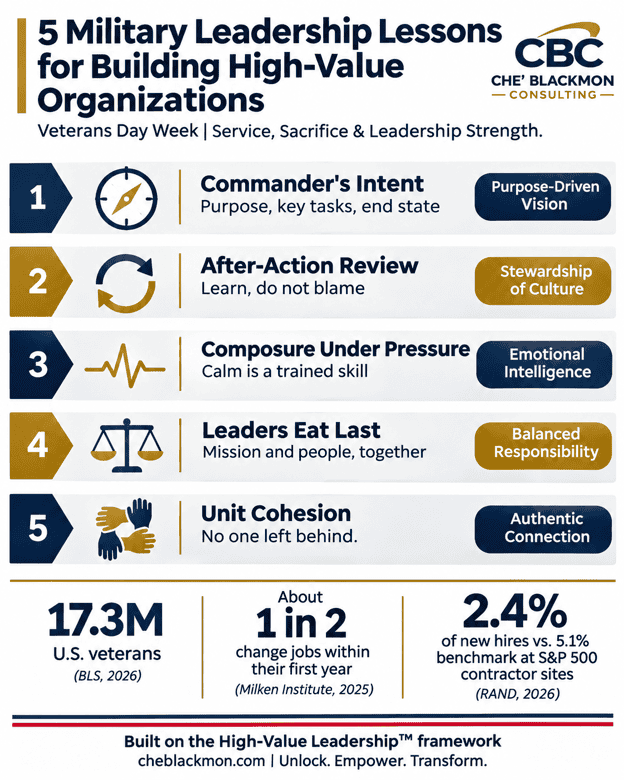
The veteran workforce is large, skilled, and often underused. The Bureau of Labor Statistics (2026) reported 17.3 million veterans in 2025, with a veteran unemployment rate of 3.5% compared with 4.2% for nonveterans. Getting hired is not the hard part. The hard part is keeping and growing that talent. A Milken Institute report found that about half of the roughly 200,000 veterans who leave the military each year are in a different job within twelve months, and about two thirds believe they are underemployed (Hines et al., 2025). The same authors point to a repeated disconnect: people who led teams under extreme pressure in uniform often do not reach senior civilian roles (Hines et al., 2025).

Corporate follow-through is uneven too. A 2026 RAND analysis of S&P 500 companies found that nearly 80% described veteran programs in voluntary materials, but veterans made up only 2.4% of new hires at those companies’ federal contractor sites, compared with a 5.1% national planning benchmark (Zuo & Wenger, 2026). The researchers also noted that companies rarely report whether veterans stay, get promoted, or move into management (Zuo & Wenger, 2026). Recognizing veterans is not enough. Organizations get the most when they learn from how veterans lead.

🧭 Lesson 1: Commander’s Intent Turns Purpose Into Action

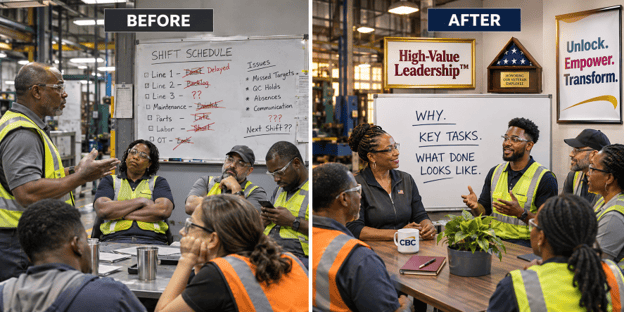
In military planning, commander’s intent is a short statement of the purpose of an operation, the key tasks, and what success looks like at the end. Its value shows up when plans fall apart. When conditions change, people who understand the intent can adapt without waiting for permission. This maps directly to the Purpose-Driven Vision pillar of High-Value Leadership™. A vision statement on the lobby wall does nothing at 2:00 a.m. when a line goes down. A clear, repeated intent statement gives a supervisor what they need to make a good call on their own.

Best practice: Before your next project kickoff or shift start, give a three-line brief: Why we are doing this. The two or three things that must happen. What done looks like. Then ask one team member to say it back in their own words.

🔁 Lesson 2: The After-Action Review Builds a Learning Culture

Military units hold after-action reviews (AARs) built around four questions. What was supposed to happen? What actually happened? Why was there a difference? What will we keep doing or change? The ground rule is that rank stays outside the room, so the point is learning and not blame. This is the Stewardship of Culture pillar in practice. Leaders who protect honest debriefs are building a culture where problems come to the surface early, which is cheaper than finding them late.

🧠 Lesson 3: Composure Under Pressure Is a Teachable Skill

Employers often name composure under pressure as one of the strengths veterans bring, along with mission focus and problem solving (Hines et al., 2025). That composure does not come from personality alone. It comes from rehearsal, clear roles, and practice regulating emotion while stress is high. This is the Emotional Intelligence pillar. Leaders can build the same strength through scenario drills, pre-briefs before difficult conversations, and naming the emotional temperature of a room before deciding anything.

⚖️ Lesson 4: “Leaders Eat Last” Balances the Mission and the People

Many military units follow a custom where junior members eat first and leaders eat last. The custom carries a principle: the mission matters, and the people doing it matter equally. This is Balanced Responsibility. Organizations that push results while neglecting people lose the people, and organizations that care for people without clear results lose direction. Military leaders are trained to hold both.

🤝 Lesson 5: Cohesion Is Built on Purpose

Unit cohesion is more than friendship. It comes from shared purpose, shared hardship, and the confidence that no one will be left behind. This reflects Authentic Connection. In civilian workplaces, that loss of belonging can be part of why veterans leave early. Research from the Employee Benefit Research Institute (2025) found that veteran workers were more likely than nonveterans to intend to stay with their current employer and to prefer longer tenure with one employer. The loyalty is there. The work is to give it a culture where it belongs.

📈 Current Trends Leaders Should Watch

The veteran talent pool is changing. SHRM reported that the veteran labor force has shrunk by more than 40% since 2000, and veterans now make up about 5% of employed people (Society for Human Resource Management [SHRM], 2025). The same analysis found that veterans ages 16 to 54 are more than twice as likely as nonveterans to have a disability, 15.2% compared with 6.3% (SHRM, 2025). That makes accommodation readiness and accessible onboarding part of a serious veteran strategy. Meanwhile, HR Dive reported that many veteran programs had been housed under DEI initiatives, which leaves them exposed during the current pullback from DEI (Colvin, 2026). RAND likewise found that high-quality corporate disclosures about veteran programs fell sharply in 2025 and the first half of 2026 (Zuo & Wenger, 2026). Organizations that tie veteran integration to core talent and culture strategy, and not to a program that can be cut, will be the ones to keep this talent.

🏭 Composite Scenario: From Turnover to Ownership

The following is a composite scenario drawn from common patterns in manufacturing culture work. Details and figures are illustrative.

A 600-person manufacturer was losing more than a third of its second-shift new hires within the first 90 days. Exit feedback kept repeating the same complaint: “Nobody told me why anything mattered.” Leadership took three military-inspired steps. Every shift began with a three-line intent brief. Supervisors ran 15-minute weekly after-action reviews with no blame and no rank in the room. Veteran supervisors were paired with newer team leaders in a peer coaching group.

After two quarters, first-90-day turnover on second shift fell from 38% to 24%. Near-miss safety reporting rose by 40%. In this case that was good news, because it showed people trusted that reporting problems was safe. Supervisors also said they spent less time chasing approvals, because their teams understood the intent well enough to act. The equipment and the pay scale stayed the same. Only the leadership habits changed.

⚠️ A Myth to Retire

Military leadership is often confused with rigid command and control. Modern military doctrine leans the other way. It favors decentralized execution, trust, and initiative within clear intent. Organizations that borrow only the hierarchy will miss the point. The real lesson is to make purpose clear enough that people can act without waiting to be told.

✅ Actionable Takeaways for This Week

  1. Write a commander’s intent for one current priority. Keep it to three lines and share it with your team by Wednesday.
  2. Run one after-action review on a recent project. Use the four questions and leave titles outside the room.
  3. Audit your veteran retention data. Check whether you can see how veterans stay, advance, and reach management, and not only how many you hire.
  4. Ask a veteran on your team what leadership practice from their service they wish your organization used. Listen without defending.
  5. Check your onboarding for accessibility. Make sure accommodation conversations are routine and not reactive.

💬 Discussion Questions

  1. If your front-line team lost contact with leadership for a full shift, how well would they understand the intent behind their work?
  2. Where does your organization debrief to learn, and where does it debrief to assign blame?
  3. What does your data show about whether veterans in your organization advance into leadership roles?
  4. Which High-Value Leadership™ pillar is your organization’s strongest, and which one would a veteran employee notice is missing?

🚀 Next Steps for Readers

Share this article with one leader who supervises veterans or hires for front-line roles. Pick one practice from this article and try it before Friday. Then follow along all week as the Veterans Day series continues with veteran integration, transferable skills, the service mindset, and leadership legacy. To build these practices into your culture in a structured way, join the High-Value Leadership™ Intensive waitlist.

📚 References

Bureau of Labor Statistics. (2026, April 28). Employment situation of veterans: 2025 [News release]. U.S. Department of Labor. https://www.bls.gov/news.release/archives/vet_04282026.htm

Colvin, C. (2026, September 16). Veterans caught in the middle on anti-DEI efforts, research says. HR Dive. https://www.hrdive.com/news/veterans-retention-2026/830566/

Employee Benefit Research Institute. (2025, January 9). Satisfaction after service: Findings from a focus on veterans in the 2024 Workplace Wellness Survey [Issue brief]. https://www.ebri.org/content/satisfaction-after-service–findings-from-a-focus-on-veterans-in-the-2024-workplace-wellness-survey

Hines, G., Spitaletta, S., & Flaum, L. (2025). Saluting service and bolstering business: Redefining employer investments in veterans. Milken Institute. https://milkeninstitute.org/sites/default/files/2025-10/SalutingServiceBolsteringBusinessRedefiningEmployer.pdf

Society for Human Resource Management. (2025, November 10). New SHRM research spotlights veterans as America’s hidden talent [Press release]. https://www.shrm.org/in/about/press-room/new-shrm-research-spotlights-veterans-as-america-s-hidden-talent

Zuo, G., & Wenger, J. B. (2026). What can public data tell us about corporate support for veterans? RAND. https://www.rand.org/news/press/2026/09/corporate-support-for-veterans-is-widespread-but-public.html


Ready to build a high-value organization that leads with purpose, discipline, and care? Che’ Blackmon Consulting partners with leaders to turn culture into a competitive advantage.

📧 admin@cheblackmon.com | 📞 888.369.7243 | 🌐 cheblackmon.com

Belonging Is Not Enough: The Business Case for Truly Inclusive Culture Architecture

By Che’ Blackmon, DBA Candidate | Founder & CEO, Che’ Blackmon Consulting

🌈 Inclusive Culture Architecture | Pride Month

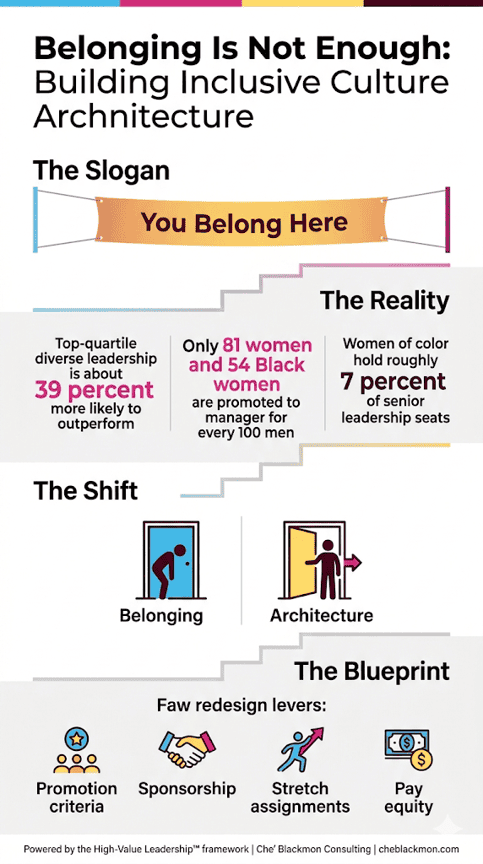
Walk into almost any company today and you will find the word everywhere. It lives on the careers page. It shows up in the values painted on the lobby wall. It gets repeated in onboarding decks and quarterly town halls. You belong here. The phrase is meant to feel warm, and for many people it does. Yet for some of the very people it claims to welcome, belonging has started to feel like a promise the building was never designed to keep.

🏗️ When the Welcome Mat Hides a Locked Door

Belonging became the headline of inclusion work for a good reason. It captures something representation alone cannot. You can hire a more diverse team and still leave people feeling like guests in someone else’s house. So leaders reached for belonging as the next frontier, and that instinct was right. The problem is where many stopped.

Here is the quiet flaw in the way belonging often gets used. It asks the individual to adjust to a culture that was built without them in mind. Fit in. Find your people. Bring your whole self, as long as your whole self matches the unwritten rules already in place. Belonging, framed this way, becomes one more thing the overlooked have to earn. The pressure to assimilate gets rebranded as inclusion.

This matters most for the people who have always been asked to do the adjusting. Across manufacturing, automotive, healthcare, non-profit, quick-service, and professional services settings, Black women in corporate spaces have learned to read a room, soften an idea, and carry the emotional cost of being the only one at the table. A culture can tell them they belong while every system around them quietly says prove it again.

📊 The Business Case Is Stronger Than the Slogans

The financial argument for inclusion is not soft, and it is not new. In its 2023 analysis of more than a thousand companies across two dozen countries, McKinsey & Company found that organizations in the top quartile for gender and for ethnic diversity in leadership were roughly 39 percent more likely to outperform their peers on profitability than companies in the bottom quartile (McKinsey & Company, 2023). That figure has climbed steadily across a decade of study. The relationship is an association rather than a guarantee, yet the pattern is consistent enough that ignoring it has become its own kind of risk.

The cost of getting it wrong shows up just as clearly. A 2023 peer reviewed study of workplace ostracism found that when people are subtly pushed to the margins, their basic need to belong is thwarted, and the fallout is measurable: lower job satisfaction, a stronger intention to quit, weaker loyalty, and even higher reported depression (Brison & Caesens, 2023). Exclusion, in other words, is not only unkind. It is expensive, and the invoice arrives through turnover, disengagement, and lost institutional knowledge.

🪜 The Broken Rung Black Women Keep Hitting

If belonging programs alone solved the problem, the promotion data would show it. It does not. The 2024 Women in the Workplace report, the tenth edition of the study by McKinsey & Company and LeanIn.Org, describes a broken rung at the very first step into management. For every 100 men promoted to manager, only 81 women advance. For Black women, that number falls to 54 (McKinsey & Company & LeanIn.Org, 2024). Women of color hold only about 7 percent of senior leadership seats, a number that has barely moved in years.

The daily experience tells the same story. Women who absorb three or more microaggressions are far more likely to burn out and to seriously consider leaving, with the data pointing to several times the risk of their peers (McKinsey & Company & LeanIn.Org, 2024). Black women in corporate spaces often carry an extra weight that rarely appears in an engagement survey: being mistaken for someone else of the same race, having their competence quietly questioned, or feeling judged for how they speak.

Put the pieces together and the limit of belonging language becomes obvious. You cannot affirm your way out of a structural problem. Telling a Black woman she belongs while the promotion machinery routes opportunity around her is asking her to feel at home in a house whose stairs keep collapsing under her feet. The warmth is real. The architecture is broken.

🧱 From Belonging to Architecture

Belonging is a feeling. Architecture is a structure. That single distinction reframes the entire conversation. Feelings can be nurtured with intention and care, and they should be. Structures, though, have to be designed, inspected, and rebuilt when they fail. Inclusive culture architecture asks a harder and more useful question than do people feel welcome. It asks how is opportunity actually distributed here, and who built the rules.

That means looking at the load bearing walls of an organization. How are promotion criteria written and applied. Who gets the high visibility projects that lead to advancement. Who has a sponsor with real influence, not just a mentor with kind words. How are pay, feedback, and meeting norms designed, and who gets interrupted while someone else gets credit. These are not vibes. They are decisions, and decisions can be redesigned.

This is where the High-Value Leadership™ framework earns its place. Its Stewardship of Culture pillar treats culture as something a leader designs and maintains on purpose, the way a steward tends a property rather than hoping the weather cooperates. Paired with the Authentic Connection pillar, it pushes leaders past the comfortable slogan toward the uncomfortable audit. Belonging asks people to fit the building. Architecture asks the building to fit the people.

🏢 Case Study: The Company That Redesigned the Room

Consider an organization in the professional services space that had spent two years investing heavily in belonging. There were affinity groups, listening sessions, and a values statement that named inclusion in bold letters. Engagement scores looked respectable. Leaders felt proud. Yet a closer look at the exit data told a different story, because women of color were leaving at nearly twice the rate of their colleagues, and the talent pipeline into management had quietly narrowed to almost no one who looked like the clients they served.

Rather than launch another awareness campaign, the leadership team stopped asking people to fit and started auditing the structure itself. They examined who received stretch assignments and found the choices ran on familiarity rather than merit. They rewrote vague promotion criteria into clear and observable standards. They built a sponsorship program that paired emerging Black women leaders with senior leaders who held real budget and real decision power, and they tracked the outcomes the same way they tracked revenue.

The results showed up in the numbers that matter. Within eighteen months, voluntary turnover among women of color fell by roughly a third, internal promotion rates for the group rose, and the management pipeline began to reflect the workforce and the market. The belonging programs had not been wrong. They had simply been asked to carry weight that only architecture could hold. The shift, anchored in deliberate Stewardship of Culture, turned good intentions into a measurable result.

✅ What You Can Do This Week

  1. Audit one process, not your whole culture.Pull the last two years of promotions and ask a hard question. Did opportunity flow evenly, or did it follow familiarity? One honest data pull beats a dozen value statements.
  2. Separate mentors from sponsors.A mentor gives advice. A sponsor spends political capital on your behalf. Identify which Black women on your team have real sponsors, and close the gap on purpose.
  3. Make your promotion criteria observable.Replace words like leadership presence with specific, written, and measurable standards so the rules stop living in people’s heads.
  4. Track stretch assignments like you track budget.Visibility work leads to advancement. Watch who gets it for the next quarter and notice the pattern.
  5. Ask a quieter question in your next survey.Move past do you feel you belong and ask whether people believe the path to advancement is fair. The gap between those two answers is your real work.

💬 Discussion Questions

  • Where in your organization does belonging language outpace structural change?
  • If you mapped how your last five promotions actually happened, what would the map reveal?
  • Who are the Black women on your team, and do they have sponsors with real influence or only mentors with kind words?
  • What is one load bearing process you could redesign this quarter instead of asking people to adapt to it?

👣 Next Steps for Readers

Start with a single audit rather than a sweeping initiative. Choose promotions, sponsorship, or stretch assignments, and look at the real data for the past two years. Bring the findings to your leadership team and frame the conversation around architecture rather than blame. Then pick one structure to redesign, set a measurable goal, and revisit it in ninety days. Inclusive culture is not built in a town hall. It is built in the quiet decisions you are willing to change.

🤝 Work With Che’ Blackmon Consulting

If you are ready to move from belonging slogans to inclusive culture architecture that produces measurable results, Che’ Blackmon Consulting partners with leaders to design cultures worth staying for. Let us build the structure together.

📧 admin@cheblackmon.com    📞 888.369.7243    🌐

cheblackmon.com

📚 References

Brison, N., & Caesens, G. (2023). The relationship between workplace ostracism and organizational dehumanization: The role of need to belong and its outcomes. Psychologica Belgica, 63(1). https://doi.org/10.5334/pb.1215

McKinsey & Company. (2023). Diversity matters even more: The case for holistic impact. https://www.mckinsey.com/featured-insights/diversity-and-inclusion/diversity-matters-even-more

McKinsey & Company, & LeanIn.Org. (2024). Women in the workplace 2024: The 10th-anniversary report. https://www.mckinsey.com/featured-insights/diversity-and-inclusion/women-in-the-workplace-2024

#InclusiveLeadership #CultureArchitecture #BlackWomenInLeadership #BelongingAtWork #HighValueLeadership #DEI #PrideMonth #FractionalHR #OrganizationalCulture #LeadershipDevelopment

📊 Quarter‑End Culture Check: 5 Questions Every Leader Should Ask Before April 1 📋

📚 By Che’ Blackmon, DBA Candidate | Founder & CEO, Che’ Blackmon Consulting

🎯 Introduction: The Quarter Is Ending. Is Your Culture on Track?

As we approach the end of the first quarter, leaders everywhere are reviewing financial targets, sales pipelines, and operational dashboards. But how many are pausing to evaluate something equally critical: the health of their organizational culture? Culture is not a static initiative that launches once and runs on autopilot. It is a living, breathing ecosystem that requires consistent attention, honest assessment, and intentional recalibration.

In Mastering a High‑Value Company Culture, I explored the foundational truth that culture is the lifeblood of any organization. It summarizes the values, beliefs, attitudes, and behaviors that define the environment where people work. When leaders invest in culture strategically, organizations see measurable returns: higher engagement, stronger retention, accelerated innovation, and improved customer satisfaction. When they neglect it, even the most talented teams begin to fracture.

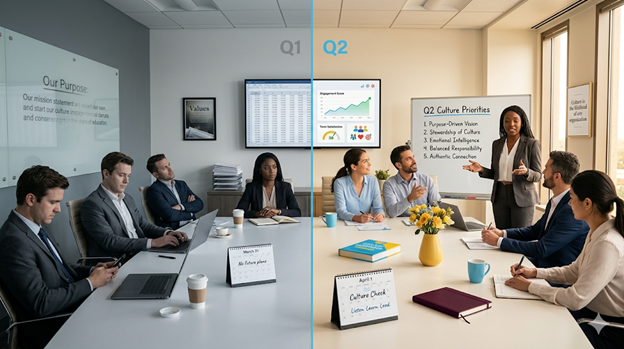
The transition from Q1 to Q2 presents a natural inflection point. Goals have been tested against reality. Team dynamics have been stress tested. And the patterns that will define your culture for the rest of the year are already forming. This is the ideal moment to conduct a deliberate culture check, not to assign blame or generate anxiety, but to ensure your organization is building on a foundation of purpose, trust, and shared accountability.

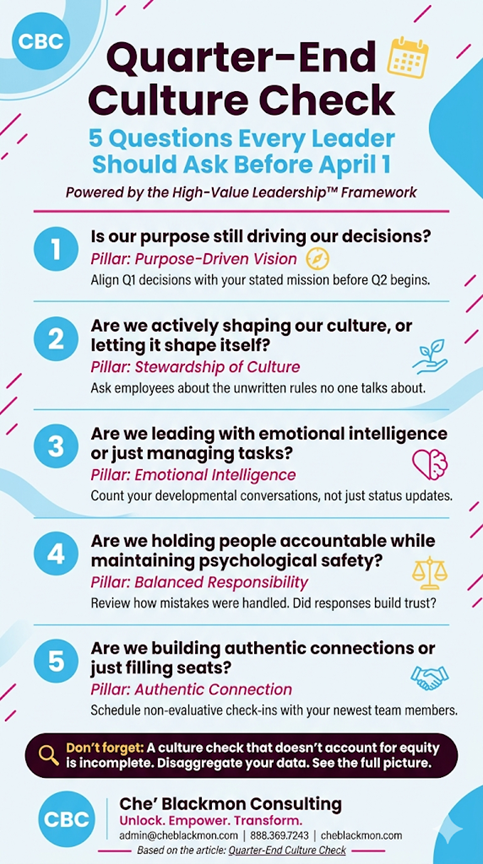
The five questions outlined below are drawn from the High‑Value Leadership™ framework, which I introduced in High‑Value Leadership: Transforming Organizations Through Purposeful Culture. Each question aligns with one of the five pillars of that framework: Purpose‑Driven Vision, Stewardship of Culture, Emotional Intelligence, Balanced Responsibility, and Authentic Connection. Together, they offer a practical and thorough lens for evaluating where your culture stands today and where it needs to go tomorrow.

❓ Question 1: Is Our Purpose Still Driving Our Decisions?

Pillar: Purpose‑Driven Vision

Every organization begins the year with a stated mission, a set of strategic objectives, and a vision for where it wants to be. But by March, something subtle often happens. The day to day operational pressure begins to overshadow the “why” behind the work. Decisions that should be guided by mission and values start to be driven by urgency, convenience, or simply “the way things have always been done.”

In High‑Value Leadership, I describe Purpose‑Driven Vision as the leader’s ability to birth and deliver a strong “why” that inspires action. Simon Sinek’s enduring insight that organizations must “start with why” remains one of the most relevant leadership principles of our time. When that “why” fades from daily decision making, culture begins to drift.

There was a mid‑size manufacturing company that opened the year with an ambitious employee engagement strategy. Their stated purpose was to create a workplace where every associate felt valued and empowered to contribute ideas. By mid‑March, leadership meetings had become consumed by production metrics and cost reduction targets, with no time reserved for engagement updates or employee feedback review. Purpose had been replaced by pressure.

💡 Actionable Takeaway:

Before Q2 begins, schedule a 30 minute leadership alignment session focused solely on this question: “Does our most recent major decision reflect our stated purpose?” If the answer is unclear or uncomfortable, it is a signal to recalibrate. Review your mission statement alongside your Q1 decisions and look for alignment gaps.

❓ Question 2: Are We Actively Shaping Our Culture, or Letting It Shape Itself?

Pillar: Stewardship of Culture

One of the most consequential truths in organizational development is this: culture will form whether you design it intentionally or not. In the absence of deliberate shaping, culture defaults to the behaviors that are tolerated, the narratives that go unchallenged, and the values that are modeled (or contradicted) by those in power.

In Mastering a High‑Value Company Culture, I wrote extensively about the contrast between leaders who actively steward their culture and those who allow it to evolve unchecked. I shared the story of two operations managers at the same plant: one who embodied high‑value leadership through consistency, respect, and clear communication; and another whose passive aggressive behaviors and misaligned incentives eroded trust across the organization. Both were technically competent. But only one built a culture worth working in.

A recent Gallup study confirms that manager behavior is the single most significant factor in employee engagement, accounting for up to 70% of the variance in team engagement scores. This means that culture is not shaped by posters on the wall or values listed on a website. It is shaped by what leaders do every day.

For traditionally overlooked populations, particularly Black women in corporate spaces, the absence of intentional culture stewardship has outsized consequences. In Rise & Thrive: A Black Woman’s Blueprint for Leadership Excellence, I highlighted the reality that Black women hold just 4% of C‑suite positions and 1.4% of executive and senior level roles in Fortune 500 companies. When culture is left unmanaged, the biases, microaggressions, and inequities that already exist tend to deepen rather than diminish. Intentional stewardship is not optional; it is the difference between inclusion as a value and inclusion as a practice.

💡 Actionable Takeaway:

Conduct a brief “culture audit” by asking three to five employees at different levels this question: “What is one unwritten rule in our organization that everyone knows but no one talks about?” The answers will reveal the gap between your intended culture and your actual culture. Address the most common themes in a transparent leadership communication before Q2 kicks off.

❓ Question 3: Are We Leading with Emotional Intelligence or Just Managing Tasks?

Pillar: Emotional Intelligence

The pace of Q1 often rewards task completion over human connection. Leaders who began the year with intentions of checking in with their teams, offering mentorship, and creating space for honest dialogue may find that those commitments quietly slipped away as deadlines intensified. When this happens, leaders are not leading; they are simply managing.

Daniel Goleman’s foundational research on emotional intelligence demonstrates that self‑awareness, empathy, and relational management are not “soft” skills; they are critical leadership competencies that directly impact team performance and organizational outcomes. In High‑Value Leadership, I positioned Emotional Intelligence as a core pillar because I have seen, across more than two decades in manufacturing, automotive, healthcare, nonprofit, and professional services environments, that the leaders who create lasting cultural impact are those who understand people as deeply as they understand processes.

There was a healthcare organization that struggled with high turnover among frontline staff. When leadership finally conducted exit interviews with genuine curiosity rather than defensiveness, a pattern emerged: employees did not feel “heard.” They had raised concerns about scheduling fairness, workload distribution, and recognition, but leadership had treated these as operational issues rather than emotional ones. When the incoming director began holding monthly listening sessions with no agenda other than understanding, turnover dropped by nearly 20% within two quarters.

This matters acutely for professionals who are already navigating invisible workloads. In Rise & Thrive, I discussed the concept of “double jeopardy” that Black women face in professional settings: the cognitive and emotional labor required to manage both racial and gender bias while simultaneously performing at the highest level. Leaders who lack emotional intelligence often fail to see this additional burden, which means they also fail to create the conditions under which all employees, not just the most visible ones, can thrive.

💡 Actionable Takeaway:

Before April 1, send your leadership team a one‑question self assessment: “In the past 90 days, how many one on one conversations have I had with my direct reports that focused on their development, concerns, or career aspirations rather than status updates?” If the number is low, prioritize building human connection into your Q2 leadership rhythm. Consider adopting a structured monthly check in template that includes at least one question about well being and professional growth.

❓ Question 4: Are We Holding People Accountable While Maintaining Psychological Safety?

Pillar: Balanced Responsibility

Accountability without safety creates fear. Safety without accountability creates complacency. High‑value leaders understand that both must coexist for a culture to be truly effective.

Amy Edmondson’s research on psychological safety, which has become one of the most cited frameworks in organizational science, shows that the highest performing teams are those where members feel safe to take risks, admit mistakes, and raise concerns without fear of punishment. At the same time, Patty McCord’s work in Powerful reminds us that maintaining high standards is not the enemy of a healthy culture; it is a prerequisite for one.

In High‑Value Leadership, I described Balanced Responsibility as the ability to maintain high standards while cultivating an environment that feels psychologically safe. This is one of the most difficult leadership balances to strike, particularly in high‑pressure industries like manufacturing and automotive where results are measured in real time and margins for error are slim.

There was a quick‑service organization that had built a reputation for operational excellence, but employee satisfaction scores were consistently low. The root cause was not the standards themselves; it was how they were enforced. Mistakes were met with public correction rather than private coaching. Employees learned to hide problems rather than surface them. When the leadership team shifted to a model of accountable coaching, where expectations remained high but feedback was delivered with respect and developmental intent, both performance metrics and engagement scores improved simultaneously.

For Black women and other traditionally overlooked professionals, the absence of psychological safety is not merely uncomfortable; it is career limiting. When the cost of speaking up is perceived to be higher than the cost of staying silent, organizations lose access to perspectives that could drive innovation, prevent errors, and strengthen decision making.

💡 Actionable Takeaway:

Ask your leadership team to evaluate the last three instances where an employee made a mistake or raised a concern. How was each situation handled? Were responses consistent across levels and demographics? Use this review to identify whether your accountability practices are building trust or eroding it. If patterns of inequity emerge, address them directly in Q2 leadership development programming.

❓ Question 5: Are We Building Authentic Connections or Just Filling Seats?

Pillar: Authentic Connection

The final question in this quarter‑end culture check may be the most telling. Are the relationships within your organization real, or are they transactional? Do leaders know their people, or do they simply know their people’s output?

John Maxwell’s principle that “people don’t care how much you know until they know how much you care” is not a motivational platitude. It is supported by decades of research linking relational trust to organizational performance. In High‑Value Leadership, I identified Authentic Connection as the fifth pillar because it is the element that gives the other four pillars their staying power. Purpose without connection is just a slogan. Accountability without connection feels punitive. Emotional intelligence without connection becomes performative.

There was an automotive supplier that invested heavily in diversity hiring, successfully increasing representation at the mid management level. However, within 18 months, a significant portion of newly hired diverse leaders had left the organization. Exit data revealed a consistent theme: they did not feel a sense of belonging. They had been recruited but not integrated. Their managers had not invested in building genuine relationships with them, and mentorship or sponsorship opportunities were largely extended through informal networks that favored those who already “fit in.”

In Rise & Thrive, I addressed this challenge directly, noting that Black women who attain leadership positions often face what researchers call the “glass cliff” phenomenon, being promoted into high‑risk roles during times of organizational crisis while simultaneously lacking the relational support systems that their peers take for granted. Authentic connection is the antidote to this isolation. It is what transforms diversity from a metric into a lived experience.

💡 Actionable Takeaway:

Before Q2 begins, identify three employees who have been with your organization for less than one year, particularly those from historically underrepresented backgrounds. Schedule a casual, non evaluative conversation with each of them. Ask about their onboarding experience, whether they feel connected to their team, and what would make them want to stay long term. Use these insights to inform your retention and engagement strategies for the remainder of the year.

🔍 The Overlooked Factor: Why Culture Checks Must Center Equity

A quarter‑end culture check that does not account for equity is incomplete. Organizations often measure culture through aggregate engagement scores and satisfaction surveys, but these tools can mask significant disparities in experience across demographics.

McKinsey’s 2024 “Women in the Workplace” report continues to document that women of color, and Black women in particular, report markedly different workplace experiences than their white counterparts. They are more likely to have their competence questioned, to feel isolated from social networks, and to experience being the “only one” in meetings and decision making spaces. These experiences do not show up in company wide averages, but they are defining the culture for a significant portion of your workforce.

In my consulting practice with Che’ Blackmon Consulting, I work with organizations to disaggregate their culture data by demographic groups so they can see the full picture. The results are often eye opening. An organization that believes its culture is strong may discover that the experience is vastly different depending on who you ask. This kind of insight is not a reason for discouragement; it is a roadmap for targeted, meaningful improvement.

As I wrote in Rise & Thrive, “It is not our differences that divide us. It is our inability to recognize, accept, and celebrate those differences.” A truly high‑value culture does not simply tolerate diversity; it actively creates the conditions under which every person, regardless of background, can contribute fully and be recognized for that contribution.

📈 Current Trends Reinforcing the Need for Culture Accountability

Several trends in the current business environment make this quarter‑end culture check more urgent than ever.

The Return to Office Debate: As more organizations mandate or encourage in‑person work, leaders must be especially attentive to how these transitions impact different groups. Employees with caregiving responsibilities, those with disabilities, and professionals who found that remote work reduced their exposure to microaggressions all experience these transitions differently. A culture check should include questions about whether return to office policies are being implemented equitably.

AI and Workforce Transformation: The rapid adoption of artificial intelligence is reshaping job roles, creating anxiety about displacement, and demanding new skills. Leaders who are not proactively communicating about AI’s impact on their workforce are allowing fear and misinformation to fill the vacuum. Culture checks should assess whether employees feel informed and supported as technology reshapes their work.

The Evolving DEI Landscape: Regardless of where your organization stands on the broader societal conversation about diversity, equity, and inclusion, the internal expectation from employees, particularly those from marginalized communities, has not diminished. A 2025 Pew Research Center study found that the majority of workers still believe their employers should be doing more to promote fairness and inclusion in the workplace. Leaders who treat equity as a trend rather than a value risk losing the trust and talent of their most underrepresented team members.

Mental Health and Well Being: The World Health Organization’s recognition of burnout as an occupational phenomenon has prompted organizations to rethink how they support employee well being. A quarter‑end culture check should include an honest assessment of whether leadership is modeling sustainable work habits and whether mental health resources are accessible, not just available.

📋 Quick Reference: Your Q1 Culture Check Summary

Question 1 (Purpose‑Driven Vision): Is our purpose still driving our decisions?

Question 2 (Stewardship of Culture): Are we actively shaping our culture, or letting it shape itself?

Question 3 (Emotional Intelligence): Are we leading with emotional intelligence or just managing tasks?

Question 4 (Balanced Responsibility): Are we holding people accountable while maintaining psychological safety?

Question 5 (Authentic Connection): Are we building authentic connections or just filling seats?

💬 Discussion Questions for Your Leadership Team

Use these questions to facilitate a leadership roundtable, strategy meeting, or team development session as you transition into Q2:

1. If a new employee joined your team today, what would they observe about your culture within the first week? Would that observation align with your values statement?

2. Which voices in your organization are consistently present in decision making conversations, and which are absent? What is the impact of that imbalance?

3. Think about a recent mistake made by someone on your team. How was it handled? Did the response build trust or diminish it?

4. What is one “unwritten rule” in your organization that may be undermining your stated values?

5. How are you personally investing in the development and belonging of someone who does not look like you, think like you, or come from the same background as you?

6. If you disaggregated your engagement data by race, gender, tenure, and level, what story would that data tell? Have you looked?

✅ Next Steps: Moving from Reflection to Action

Reflection without action is just conversation. Here are concrete steps you can take before the first week of Q2:

Week 1: Conduct a leadership alignment session using the five questions above. Document where your culture is strong and where it needs attention.

Week 2: Gather employee perspectives through listening sessions, anonymous surveys, or skip‑level conversations. Prioritize hearing from historically underrepresented team members.

Week 3: Identify two to three specific culture commitments for Q2. Assign ownership, define success metrics, and communicate them transparently to the organization.

Week 4: Begin implementing your Q2 culture plan and schedule a mid‑quarter check in to assess progress.

📚 Further Reading from Che’ Blackmon

For a deeper exploration of the concepts discussed in this article, the following resources from Che’ Blackmon offer comprehensive frameworks, real world examples, and actionable strategies:

Mastering a High‑Value Company Culture — A practical guide to building, maintaining, and evolving the culture that defines your organization’s success.

High‑Value Leadership: Transforming Organizations Through Purposeful Culture — An in‑depth exploration of the five pillars of High‑Value Leadership™ and how they drive lasting cultural transformation.

Rise & Thrive: A Black Woman’s Blueprint for Leadership Excellence — A strategic guide designed for Black women navigating corporate leadership with authenticity, resilience, and purpose.

🚀 Ready to Transform Your Culture? Let’s Talk.

Whether you are navigating a cultural transition, preparing for growth, or seeking to create an environment where every employee can contribute fully, Che’ Blackmon Consulting offers fractional HR leadership and culture transformation services tailored to your organization’s unique needs.

With over 24 years of progressive HR leadership spanning manufacturing, automotive, healthcare, nonprofit, quick‑service, and professional services industries, Che’ Blackmon brings a practitioner’s depth and a scholar’s rigor to every engagement.

📧 admin@cheblackmon.com

📞 888.369.7243

🌐 cheblackmon.com

© 2026 Che’ Blackmon Consulting. All rights reserved.

High‑Value Leadership™ is a trademark of Che’ Blackmon Consulting.

#HighValueLeadership #CultureTransformation #HRLeadership #OrganizationalCulture #LeadershipDevelopment #QuarterEndReview #FractionalHR #InclusiveLeadership #BlackWomenLead #WorkplaceCulture #EmployeeEngagement #CheBlackmonConsulting #PurposeDrivenLeadership #PsychologicalSafety #DEI #TalentRetention #CultureMatters #HRStrategy #AuthenticLeadership #LeadershipCoaching
📚 AI‑Powered Stay Interviews: The Modern Tool for Understanding Why People Stay

By Che’ Blackmon, DBA Candidate | Founder & CEO, Che’ Blackmon Consulting

Most organizations spend the majority of their retention energy on the wrong conversation. They invest in exit interviews, asking people who have already decided to leave why they are going. By the time that conversation happens, the decision is final, the institutional knowledge is walking out the door, and the feedback arrives too late to change anything for the person giving it. Exit interviews do not prevent turnover. They document it.

Stay interviews flip the equation entirely. Instead of asking departing employees why they left, stay interviews ask current employees why they stay, what might cause them to leave, and what the organization could do differently to keep them engaged and committed. It is a simple concept with extraordinary power. And now, with the integration of artificial intelligence, the stay interview is evolving from an occasional HR initiative into a continuous, data driven retention strategy that can identify flight risk, surface hidden frustrations, and reveal engagement patterns that traditional surveys miss entirely.

In Mastering a High‑Value Company Culture, I wrote that culture is the lifeblood of any organization. But understanding the health of that lifeblood requires more than annual check ups. It requires ongoing, intelligent listening. AI powered stay interviews represent the next evolution of that listening, and organizations that embrace this tool will retain the talent their competitors are still trying to figure out how to attract.

🔄 From Exit to Stay: Why the Conversation Must Shift

The exit interview has been a staple of HR practice for decades. And for decades, it has produced the same frustrating outcome: a folder full of honest feedback from people who are no longer around to benefit from the changes that feedback might inspire. According to the Work Institute’s 2023 Retention Report, more than 75% of the root causes of voluntary turnover are preventable. The problem is not that organizations lack the information to prevent departures. The problem is that they gather that information at the wrong time.

Stay interviews address this timing gap directly. Popularized by workplace strategist Beverly Kaye and first introduced in her work on employee engagement, the stay interview is a structured, proactive conversation between a manager and a current employee designed to understand what keeps the employee engaged and what could push them toward the door. The questions are straightforward: What do you look forward to when you come to work? What are you learning here? What would make your job better? If you could change something about your role or the team, what would it be? What might tempt you to leave?

These are not complicated questions. But they are rarely asked. And when they are asked, the answers are often captured in a notebook, shared informally, and never analyzed at scale. This is where artificial intelligence changes everything.

🤖 What AI Brings to the Stay Interview

Artificial intelligence does not replace the human connection at the heart of a stay interview. What it does is amplify the organization’s ability to listen at scale, identify patterns that no individual manager could detect, and transform qualitative conversations into quantitative, actionable intelligence.

📊 Sentiment Analysis at Scale

AI powered natural language processing (NLP) tools can analyze the text and tone of stay interview responses across hundreds or thousands of employees simultaneously. These tools detect emotional sentiment, recurring themes, shifts in language over time, and even the difference between what employees say and how they say it. For example, an employee who responds “everything is fine” with language patterns that suggest resignation rather than satisfaction will be flagged differently than one who says the same words with genuine enthusiasm. This level of analysis is impossible for a human reviewer to perform consistently at scale.

🔮 Predictive Flight Risk Modeling

When stay interview data is combined with other organizational data points such as tenure, promotion history, manager tenure, performance ratings, PTO usage patterns, and engagement survey scores, AI can build predictive models that identify which employees are at elevated risk of leaving within the next three to six months. This moves retention from a reactive practice (waiting for the resignation letter) to a predictive strategy (intervening before the decision is made). In my brand voice document for Che’ Blackmon Consulting, I describe this as “predictive analytics for people, not just products.” It is the principle that the same data science rigor organizations apply to forecasting supply chain disruptions and customer churn can and should be applied to understanding and preventing talent loss.

🎯 Theme Detection and Root Cause Analysis

Traditional stay interviews produce valuable but often siloed insights. Manager A learns that their employee wants more development opportunities. Manager B learns that their employee is frustrated by scheduling practices. Manager C learns that their employee feels overlooked for recognition. In isolation, these feel like individual concerns. AI powered analysis aggregates these inputs and identifies systemic themes: perhaps development, scheduling, and recognition are not three separate problems but three symptoms of a single root cause, such as supervisor capacity or an inequitable resource allocation model. This kind of pattern recognition transforms stay interview data from anecdotal feedback into strategic intelligence.

📱 Continuous Pulse Integration

AI enables organizations to move stay interviews from an annual or quarterly event to a continuous listening rhythm. Chatbot based micro stay interviews can be deployed through existing communication platforms, asking employees two to three targeted questions at regular intervals. The AI compiles and analyzes responses over time, building a longitudinal picture of each employee’s engagement trajectory. This approach reduces survey fatigue (because each interaction is brief) while dramatically increasing the richness and timeliness of the data.

❤️ The Equity Imperative: Why AI Stay Interviews Matter Most for Overlooked Talent

Traditional stay interviews, when conducted exclusively by direct managers, carry an inherent limitation: they rely on the employee feeling psychologically safe enough to be honest with the person who holds the most direct power over their daily experience. For many employees, especially those from traditionally overlooked backgrounds, that safety does not exist.

In Rise & Thrive: A Black Woman’s Blueprint for Leadership Excellence, I address the reality that Black women in corporate spaces face a compounding set of barriers that make honest upward communication especially risky. They navigate what scholars call “double jeopardy,” facing bias related to both race and gender. They are more likely to receive coded feedback, to be overlooked for stretch assignments, and to feel that raising concerns will be career limiting. In a traditional stay interview setting, a Black woman may tell her manager “everything is fine” not because it is, but because her lived experience has taught her that honesty with authority figures can be weaponized.

AI powered stay interviews offer a critical alternative pathway. When employees can respond to stay interview questions through an anonymous or semi anonymous digital interface, the psychological barriers to honesty are significantly reduced. The employee is not looking into the eyes of the person who controls their performance review. They are sharing their truth with a system that aggregates it alongside hundreds of other voices, protecting individual identity while surfacing collective patterns.

Furthermore, AI analysis can be designed to disaggregate data by demographic group, revealing whether the stay interview themes for Black women differ from those of their peers. If Black women are consistently reporting concerns about advancement equity, feedback quality, or belonging at higher rates than the general population, the AI flags that disparity as a systemic issue requiring targeted intervention rather than burying it inside an aggregated average that makes everything look acceptable.

💡 Case in Point

There was a company in the manufacturing sector that implemented an AI powered stay interview platform across its three largest plants. The overall results were positive: 71% of employees reported feeling engaged, and the most common “stay factor” was team relationships. But when the AI disaggregated the data by race and gender, a starkly different picture emerged for Black women in mid level roles. Their top reported concern was not compensation or workload. It was “I do not feel my manager advocates for me.” This insight had never surfaced in the company’s traditional engagement survey because it was averaged into the broader population’s more positive responses.

Armed with this insight, the company implemented a targeted sponsorship program for Black women in mid level positions and added advocacy training to its supervisor coaching curriculum. Within 12 months, voluntary turnover among Black women in the organization dropped by 28%, and their engagement scores improved by 15 points. The AI did not solve the problem. It made the problem visible. Leadership solved it by choosing to act.

📈 Current Trends: The AI Stay Interview Landscape in 2025 and 2026

  • Conversational AI Platforms Are Maturing. Tools like Culture Amp, Qualtrics, Peakon (now part of Workday), and Lattice have integrated AI driven sentiment analysis into their employee listening suites. Newer entrants are building purpose built stay interview chatbots that feel conversational rather than transactional, reducing the friction that makes traditional surveys feel like homework.
  • Predictive People Analytics Is No Longer Experimental. Organizations that once viewed predictive turnover modeling as futuristic are now deploying it operationally. A 2024 report from Deloitte found that 47% of large organizations are actively using or piloting AI powered people analytics tools, up from 29% in 2022. The tools are becoming more accessible, more affordable, and more accurate.
  • Ethical AI and Algorithmic Fairness Are Front and Center. As AI tools become more prevalent in HR, concerns about algorithmic bias, data privacy, and the ethical use of employee data are intensifying. Responsible organizations are establishing AI governance frameworks that ensure their tools do not replicate or amplify existing biases. This is especially critical when analyzing data for traditionally overlooked populations, where biased algorithms could produce recommendations that worsen rather than improve equity outcomes.
  • Manager Enablement Is the Missing Piece. The most sophisticated AI platform in the world is useless if the managers who receive its insights do not know what to do with them. Progressive organizations are pairing AI stay interview tools with manager coaching programs that teach supervisors how to interpret the data, have follow up conversations, and implement changes based on what the AI reveals. The technology generates the insight. The manager generates the trust.
  • Integration with Employee Experience Ecosystems. AI stay interview data is increasingly being integrated with broader employee experience platforms that connect onboarding, learning, performance, and career mobility into a single ecosystem. This integration allows organizations to respond to a stay interview insight (“I want more development”) with a concrete action (“Here are three learning pathways aligned with your stated career goal”) in near real time.

✨ The High‑Value Leadership™ Framework and AI Stay Interviews

Technology alone does not transform culture. Technology amplifies the culture that already exists. If the culture is one of genuine listening and responsive leadership, AI stay interviews will accelerate that culture’s impact. If the culture is one of lip service and performative engagement, AI will simply produce more data that leadership ignores. The difference is the quality of the leadership operating the tool.

The High‑Value Leadership™ framework I developed through High‑Value Leadership: Transforming Organizations Through Purposeful Culture provides the leadership foundation that makes AI stay interviews effective. Each of the five pillars directly supports the conditions required for AI powered listening to produce real results.

  1. Purpose‑Driven Vision ensures that stay interview data is used in service of a compelling organizational mission, not as a surveillance tool. When employees understand that the organization’s purpose includes their growth and wellbeing, they are more willing to share honest feedback through any channel.
  2. Stewardship of Culture means that leaders actively use the insights generated by AI stay interviews to nurture the culture rather than filing them away. Stewardship requires closing the loop: telling employees what was heard, what is being done, and what cannot change (and why).
  3. Emotional Intelligence equips managers to respond to AI generated insights with empathy and skill. The data might reveal that an employee is at risk. The emotionally intelligent manager translates that data point into a human conversation that makes the employee feel seen, not surveilled.
  4. Balanced Responsibility ensures that the accountability for acting on stay interview insights does not fall solely on HR. Retention is a leadership responsibility, and AI stay interview data should be integrated into every people leader’s performance expectations.
  5. Authentic Connection reminds us that no amount of data replaces the power of a leader who knows their people. AI stay interviews provide the map. Authentic connection provides the relationship that makes the map worth following.