By Che’ Blackmon, DBA Candidate | Founder & CEO, Che’ Blackmon Consulting
A 19-year-old on a night patrol can usually tell you exactly why the mission matters. Many employees who have been with a company for 19 years cannot tell you what their company is trying to do. That gap is less about intelligence or commitment. It comes from how the two kinds of organizations lead. This Veterans Day Week, we honor those who served, and we also look closely at the leadership habits that military service builds, because those habits line up well with what makes an organization high-value.
🇺🇸 Why Veterans Day Week Is a Leadership Conversation
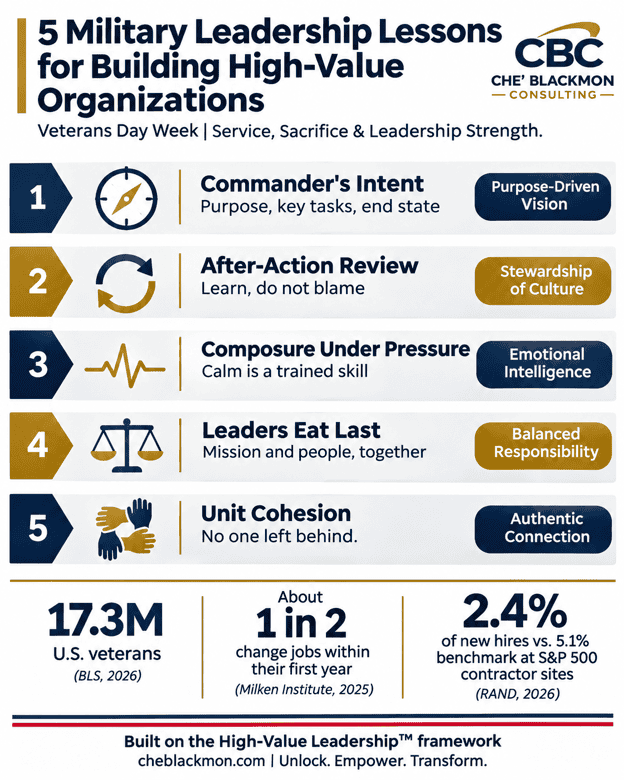
The veteran workforce is large, skilled, and often underused. The Bureau of Labor Statistics (2026) reported 17.3 million veterans in 2025, with a veteran unemployment rate of 3.5% compared with 4.2% for nonveterans. Getting hired is not the hard part. The hard part is keeping and growing that talent. A Milken Institute report found that about half of the roughly 200,000 veterans who leave the military each year are in a different job within twelve months, and about two thirds believe they are underemployed (Hines et al., 2025). The same authors point to a repeated disconnect: people who led teams under extreme pressure in uniform often do not reach senior civilian roles (Hines et al., 2025).
Corporate follow-through is uneven too. A 2026 RAND analysis of S&P 500 companies found that nearly 80% described veteran programs in voluntary materials, but veterans made up only 2.4% of new hires at those companies’ federal contractor sites, compared with a 5.1% national planning benchmark (Zuo & Wenger, 2026). The researchers also noted that companies rarely report whether veterans stay, get promoted, or move into management (Zuo & Wenger, 2026). Recognizing veterans is not enough. Organizations get the most when they learn from how veterans lead.
🧭 Lesson 1: Commander’s Intent Turns Purpose Into Action
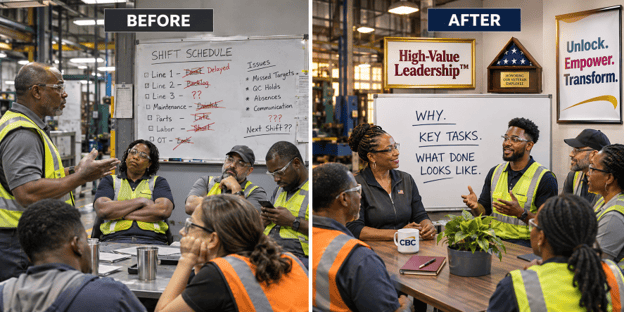
In military planning, commander’s intent is a short statement of the purpose of an operation, the key tasks, and what success looks like at the end. Its value shows up when plans fall apart. When conditions change, people who understand the intent can adapt without waiting for permission. This maps directly to the Purpose-Driven Vision pillar of High-Value Leadership™. A vision statement on the lobby wall does nothing at 2:00 a.m. when a line goes down. A clear, repeated intent statement gives a supervisor what they need to make a good call on their own.
Best practice: Before your next project kickoff or shift start, give a three-line brief: Why we are doing this. The two or three things that must happen. What done looks like. Then ask one team member to say it back in their own words.
🔁 Lesson 2: The After-Action Review Builds a Learning Culture
Military units hold after-action reviews (AARs) built around four questions. What was supposed to happen? What actually happened? Why was there a difference? What will we keep doing or change? The ground rule is that rank stays outside the room, so the point is learning and not blame. This is the Stewardship of Culture pillar in practice. Leaders who protect honest debriefs are building a culture where problems come to the surface early, which is cheaper than finding them late.
🧠 Lesson 3: Composure Under Pressure Is a Teachable Skill
Employers often name composure under pressure as one of the strengths veterans bring, along with mission focus and problem solving (Hines et al., 2025). That composure does not come from personality alone. It comes from rehearsal, clear roles, and practice regulating emotion while stress is high. This is the Emotional Intelligence pillar. Leaders can build the same strength through scenario drills, pre-briefs before difficult conversations, and naming the emotional temperature of a room before deciding anything.
⚖️ Lesson 4: “Leaders Eat Last” Balances the Mission and the People
Many military units follow a custom where junior members eat first and leaders eat last. The custom carries a principle: the mission matters, and the people doing it matter equally. This is Balanced Responsibility. Organizations that push results while neglecting people lose the people, and organizations that care for people without clear results lose direction. Military leaders are trained to hold both.
🤝 Lesson 5: Cohesion Is Built on Purpose
Unit cohesion is more than friendship. It comes from shared purpose, shared hardship, and the confidence that no one will be left behind. This reflects Authentic Connection. In civilian workplaces, that loss of belonging can be part of why veterans leave early. Research from the Employee Benefit Research Institute (2025) found that veteran workers were more likely than nonveterans to intend to stay with their current employer and to prefer longer tenure with one employer. The loyalty is there. The work is to give it a culture where it belongs.
📈 Current Trends Leaders Should Watch
The veteran talent pool is changing. SHRM reported that the veteran labor force has shrunk by more than 40% since 2000, and veterans now make up about 5% of employed people (Society for Human Resource Management [SHRM], 2025). The same analysis found that veterans ages 16 to 54 are more than twice as likely as nonveterans to have a disability, 15.2% compared with 6.3% (SHRM, 2025). That makes accommodation readiness and accessible onboarding part of a serious veteran strategy. Meanwhile, HR Dive reported that many veteran programs had been housed under DEI initiatives, which leaves them exposed during the current pullback from DEI (Colvin, 2026). RAND likewise found that high-quality corporate disclosures about veteran programs fell sharply in 2025 and the first half of 2026 (Zuo & Wenger, 2026). Organizations that tie veteran integration to core talent and culture strategy, and not to a program that can be cut, will be the ones to keep this talent.
🏭 Composite Scenario: From Turnover to Ownership
The following is a composite scenario drawn from common patterns in manufacturing culture work. Details and figures are illustrative.
A 600-person manufacturer was losing more than a third of its second-shift new hires within the first 90 days. Exit feedback kept repeating the same complaint: “Nobody told me why anything mattered.” Leadership took three military-inspired steps. Every shift began with a three-line intent brief. Supervisors ran 15-minute weekly after-action reviews with no blame and no rank in the room. Veteran supervisors were paired with newer team leaders in a peer coaching group.
After two quarters, first-90-day turnover on second shift fell from 38% to 24%. Near-miss safety reporting rose by 40%. In this case that was good news, because it showed people trusted that reporting problems was safe. Supervisors also said they spent less time chasing approvals, because their teams understood the intent well enough to act. The equipment and the pay scale stayed the same. Only the leadership habits changed.
⚠️ A Myth to Retire
Military leadership is often confused with rigid command and control. Modern military doctrine leans the other way. It favors decentralized execution, trust, and initiative within clear intent. Organizations that borrow only the hierarchy will miss the point. The real lesson is to make purpose clear enough that people can act without waiting to be told.
✅ Actionable Takeaways for This Week
- Write a commander’s intent for one current priority. Keep it to three lines and share it with your team by Wednesday.
- Run one after-action review on a recent project. Use the four questions and leave titles outside the room.
- Audit your veteran retention data. Check whether you can see how veterans stay, advance, and reach management, and not only how many you hire.
- Ask a veteran on your team what leadership practice from their service they wish your organization used. Listen without defending.
- Check your onboarding for accessibility. Make sure accommodation conversations are routine and not reactive.
💬 Discussion Questions
- If your front-line team lost contact with leadership for a full shift, how well would they understand the intent behind their work?
- Where does your organization debrief to learn, and where does it debrief to assign blame?
- What does your data show about whether veterans in your organization advance into leadership roles?
- Which High-Value Leadership™ pillar is your organization’s strongest, and which one would a veteran employee notice is missing?
🚀 Next Steps for Readers
Share this article with one leader who supervises veterans or hires for front-line roles. Pick one practice from this article and try it before Friday. Then follow along all week as the Veterans Day series continues with veteran integration, transferable skills, the service mindset, and leadership legacy. To build these practices into your culture in a structured way, join the High-Value Leadership™ Intensive waitlist.
📚 References
Bureau of Labor Statistics. (2026, April 28). Employment situation of veterans: 2025 [News release]. U.S. Department of Labor. https://www.bls.gov/news.release/archives/vet_04282026.htm
Colvin, C. (2026, September 16). Veterans caught in the middle on anti-DEI efforts, research says. HR Dive. https://www.hrdive.com/news/veterans-retention-2026/830566/
Employee Benefit Research Institute. (2025, January 9). Satisfaction after service: Findings from a focus on veterans in the 2024 Workplace Wellness Survey [Issue brief]. https://www.ebri.org/content/satisfaction-after-service–findings-from-a-focus-on-veterans-in-the-2024-workplace-wellness-survey
Hines, G., Spitaletta, S., & Flaum, L. (2025). Saluting service and bolstering business: Redefining employer investments in veterans. Milken Institute. https://milkeninstitute.org/sites/default/files/2025-10/SalutingServiceBolsteringBusinessRedefiningEmployer.pdf
Society for Human Resource Management. (2025, November 10). New SHRM research spotlights veterans as America’s hidden talent [Press release]. https://www.shrm.org/in/about/press-room/new-shrm-research-spotlights-veterans-as-america-s-hidden-talent
Zuo, G., & Wenger, J. B. (2026). What can public data tell us about corporate support for veterans? RAND. https://www.rand.org/news/press/2026/09/corporate-support-for-veterans-is-widespread-but-public.html
Ready to build a high-value organization that leads with purpose, discipline, and care? Che’ Blackmon Consulting partners with leaders to turn culture into a competitive advantage.
📧 admin@cheblackmon.com | 📞 888.369.7243 | 🌐 cheblackmon.com

Leave a Reply