Women Over 45 in the C-Suite: Rewriting the Playbook on Executive Leadership

By Che’ Blackmon, DBA Candidate | Founder & CEO, Che’ Blackmon Consulting

There is a revolution happening in boardrooms and C-suites across America. It is quiet. It is powerful. And it is long overdue. Women over 45 are stepping into executive leadership roles with a level of mastery, depth, and strategic clarity that only comes from decades of experience. Yet despite their qualifications and track records, these women continue to face systemic resistance, invisible ceilings, and a corporate culture that was never fully designed with them in mind.

This article is for them. It is for the woman who has navigated layoffs, organizational restructuring, leadership transitions, and every workplace dynamic imaginable. It is for the woman who has mentored dozens of rising stars, contributed to multi-million dollar decisions, and still found herself passed over at the table. It is for Black women especially, who face not one but two layers of bias in corporate spaces and continue to lead anyway.

Leadership at its highest level is not about tenure alone. It is about vision, culture, emotional intelligence, and impact. That is the foundation of High-Value Leadership™, and it is precisely what women over 45 embody.

📊 The Landscape: What the Data Actually Says

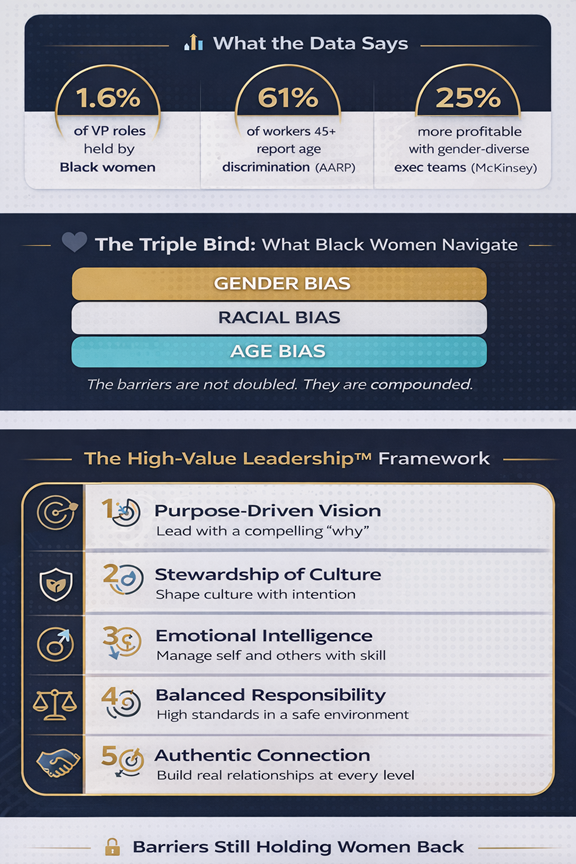
The numbers are sobering. According to McKinsey & Company’s Women in the Workplace report, women remain dramatically underrepresented at the senior leadership level. And when race is factored in, the gap widens significantly. Black women hold only about 1.6% of VP-level roles and approximately 1.4% of executive or senior-level positions in Fortune 500 companies. These are not figures that reflect a pipeline problem. They reflect a systemic structural barrier.

Women over 45 are also disproportionately impacted by ageism, a bias that intersects with gender and race to create compounded disadvantage. Research from AARP found that approximately 61% of workers over the age of 45 have either witnessed or personally experienced age discrimination in the workplace. For women, especially women of color, that figure is even more acute.

Yet here is the compelling counterpoint: women over 45 bring something irreplaceable to executive leadership. They bring institutional knowledge, refined judgment, and an emotional intelligence forged through real-world experience. Deloitte’s research on inclusive leadership consistently finds that organizations with diverse and experienced leadership teams outperform their peers in innovation, decision-making, and long-term profitability.

💡 Key Insight: “Culture is the lifeblood of any organization.” When the leaders shaping that culture are diverse, experienced, and intentional, organizations don’t just survive, they thrive. — Mastering a High-Value Company Culture by Che’ Blackmon

🏛️ The Unique Barriers Women Over 45 Face

⚔️ The Double Bias of Age and Gender

Women in leadership have long battled the perception that assertiveness is aggression, confidence is arrogance, and ambition is selfishness. Add age to that equation, and the bias becomes even more layered. Women over 45 are frequently labeled as “set in their ways,” “overly experienced for the role,” or “close to retirement,” all subtle forms of exclusion designed to justify overlooking qualified talent.

There was a company in the manufacturing sector that had a well-documented pattern of promoting younger male leaders over highly tenured women who consistently outperformed them in measurable outcomes. The organization’s leadership team had internalized a mental model of what a “leader looked like” and unconsciously filtered out candidates who did not match that image. When the culture was examined and the implicit bias was surfaced, the results were undeniable. Talented, experienced women had been systematically sidelined.

This is not an isolated story. It is a pattern.

🖤 The Triple Bind for Black Women

For Black women, the barriers are not simply doubled. They are compounded in ways that cannot be overstated. The concept of “double jeopardy” in organizational research refers to facing simultaneous bias rooted in both race and gender. For Black women over 45, there is a third layer added: age. This creates what some researchers refer to as a “triple bind.

Black women in corporate spaces often navigate contradictory expectations. They are expected to be assertive but not intimidating. Visible but not disruptive. Qualified but not threatening. The emotional and cognitive labor required to manage these contradictions creates an invisible tax on their energy and potential.

In Rise & Thrive: A Black Woman’s Blueprint for Leadership Excellence, this reality is addressed directly: “You encounter microaggressions that your white female or Black male colleagues might not experience.” Naming this reality is not a complaint. It is a call to build more intentional organizations.

Despite this, Black women are among the most ambitious professionals in the workforce. According to McKinsey, Black women are more likely than white women to aspire to senior leadership and to take proactive steps toward advancement. The problem has never been their drive. It has always been the structural resistance they face.

🕹️ The Glass Cliff Phenomenon

Another barrier that disproportionately affects women, and especially women of color, is the glass cliff. This is the documented tendency for organizations to promote women into leadership roles during times of crisis, when the risk of failure is highest. When the company is struggling, suddenly there is interest in diverse leadership. When things stabilize, the credit is rarely shared equally.

There was an organization in the healthcare space that brought in a senior Black female leader to stabilize operations during a significant period of regulatory scrutiny. She succeeded. She turned the division around, built the culture, and delivered results. When the crisis ended, she was repositioned into a role with less visibility and influence. Her story reflects a broader pattern that organizations must consciously disrupt.

🔑 What Women Over 45 Actually Bring to the Table

Let us be clear: the experience of women over 45 is not a liability. It is an organizational asset. The High-Value Leadership™ framework identifies five pillars that define exceptional leadership. Women over 45 embody each of them in ways that are hard-won and deeply earned.

🎯 Pillar 1: Purpose-Driven Vision

Women who have navigated decades of professional growth have been forced to examine their “why” repeatedly. They know the difference between a job and a calling. They have seen mission statements come and go, and they understand what it actually takes to align people behind a compelling vision. Their leadership is not reactive. It is intentional.

🏛️ Pillar 2: Stewardship of Culture

Culture is shaped by what leaders tolerate, what they celebrate, and what they model. Women over 45 have developed a sophisticated understanding of how culture is built and how quickly it can erode. They bring the perspective of having lived through organizational cultures that worked and those that did not. That experience translates directly into stronger, more intentional culture leadership.

🧠 Pillar 3: Emotional Intelligence

Research from the Harvard Business Review consistently identifies emotional intelligence as a key differentiator in executive leadership effectiveness. Women generally, and experienced women in particular, score higher on emotional intelligence assessments. They are more adept at reading interpersonal dynamics, managing conflict, and building the trust necessary to move organizations forward.

⚖️ Pillar 4: Balanced Responsibility

High-value leaders hold people accountable while creating environments of psychological safety. Women over 45 have typically had to master this balance out of necessity. They understand how to set high standards without creating fear, and how to challenge performance without undermining dignity. That balance is exactly what modern organizations need.

🤝 Pillar 5: Authentic Connection

As detailed in High-Value Leadership: Transforming Organizations Through Purposeful Culture, authentic connection is about building real relationships at every level of the organization. Women over 45 have cultivated the self-awareness to lead authentically, to acknowledge their own blind spots, and to create genuine relationships that drive organizational loyalty and engagement.

📌 “When you lead authentically as a Black woman, you not only enhance your own effectiveness but potentially transform the environment for others.” — Rise & Thrive: A Black Woman’s Blueprint for Leadership Excellence

🚀 Rewriting the Playbook: Current Trends and Best Practices

🌍 Trend 1: The Rise of the Fractional C-Suite

One of the most empowering shifts in today’s leadership landscape is the rise of fractional executive roles. Companies are increasingly turning to experienced leaders on a contract or advisory basis to fill critical gaps. For women over 45, this represents a significant opportunity to leverage decades of expertise without the barriers of traditional hiring pipelines. It also offers the flexibility to align work with personal and professional values.

Organizations that engage fractional HR and culture leaders, for example, gain access to deep institutional knowledge without the long-term overhead of a full-time executive hire. This trend is growing, and women with decades of experience are uniquely positioned to lead in this space.

🧩 Trend 2: Culture as Competitive Strategy

In a post-pandemic workplace reshaped by The Great Resignation and the ongoing talent wars, culture has moved from a “nice to have” to a core business imperative. Organizations that fail to invest in their culture lose talent, innovation, and market share. Women over 45 who have spent careers building and transforming cultures are precisely the leaders organizations need right now.

As explored in Mastering a High-Value Company Culture, culture is the lifeblood of every organization. The leaders best equipped to shape that culture are those who understand it from the inside out, which is exactly what experienced women bring.

📊 Trend 3: Data-Driven Diversity and Inclusion Accountability

More organizations are publicly committing to diversity, equity, and inclusion goals with measurable outcomes. Boards and investors are increasingly scrutinizing representation at the leadership level. This creates both opportunity and urgency for companies to identify and elevate women over 45, particularly Black women, into executive roles.

Best practice organizations are moving beyond representation optics and building systemic structures that ensure equitable access to leadership development, sponsorship, and executive positioning. Companies that do this well see measurable improvements in retention, engagement, and financial performance.

📱 Trend 4: Leadership Development Redefined

The traditional model of leadership development, which typically favored younger high-potential employees, is being reimagined. Forward-thinking organizations now recognize that leadership at the senior level requires life experience, not just technical training. Coaching, peer advisory groups, and executive development programs designed specifically for mid-career and senior professionals are growing in both demand and effectiveness.

📋 Actionable Takeaways for Women Over 45

For Women in the C-Suite or Ascending Toward It:

  • 🔥 Own your expertise unapologetically. Your years of experience are not a liability. They are your greatest competitive advantage. Stop minimizing your tenure and start positioning it as the strategic asset it is.
  • 🤝 Invest in your network intentionally. Leadership at the executive level is largely relational. Build relationships across industries, invest in peer advisory communities, and stay visibly engaged in your professional community.
  • 📚 Document your impact. Numbers tell the story that emotions cannot. Quantify your contributions wherever possible. Whether it is engagement improvements, cost reductions, turnover decreases, or cultural transformation outcomes, your results deserve to be visible.
  • 📣 Elevate your brand. Thought leadership is a leadership tool. Write articles. Speak on panels. Share insights on LinkedIn. Your voice and perspective add value beyond your organizational walls.
  • 🧘🏿‍♀️ Protect your energy. Sustainable leadership requires sustainable habits. Rest, recovery, and personal renewal are not luxuries. They are leadership disciplines.

For Black Women Specifically:

  • 💥 Name it to navigate it. When you can name the bias or barrier you are facing, you can address it strategically rather than absorbing it personally.
  • 🔗 Find your sponsorship, not just mentorship. Mentors give advice. Sponsors advocate for you in rooms you have not entered yet. Both are important, but sponsorship is what creates access at the executive level.
  • 🏆 Claim your seat at the table. You were not given that seat by accident. You earned it. Lead from that truth.
  • 🤟 Build community with other Black women leaders. Collective wisdom is power. Peer relationships with other Black women in leadership provide both support and strategic intelligence that no formal program can replicate.

For Organizations Seeking to Do Better:

  • 🔍 Audit your leadership pipeline with an equity lens. Who is being developed? Who is being sponsored? Who is being promoted? The answers will tell you whether your DEI commitments are real or performative.
  • 📅 Create structured sponsorship programs. Organic networking favors those who already have access. Intentional sponsorship structures level the field for women who have been systematically excluded from informal power networks.
  • 🎯 Redefine what leadership potential looks like. If your organization’s mental model of a high-potential leader skews young, white, and male, your selection processes will reflect that bias. Expanding the definition of potential is both a justice issue and a business imperative.

🗣️ Expert Insights: The Research Behind the Revolution

The research supporting the value of experienced, diverse women in executive leadership is both compelling and growing.

  • McKinsey & Company reports that companies in the top quartile for gender diversity on executive teams are 25% more likely to achieve above-average profitability.
  • Harvard Business Review found that women rate higher than men on 17 of 19 capabilities that distinguish excellent leaders from average ones, particularly in areas of initiative, resilience, and developing others.
  • Catalyst research consistently documents that organizations with the highest representation of women in senior leadership demonstrate significantly stronger return on equity, return on sales, and return on invested capital.
  • The Center for Creative Leadership notes that leaders who have navigated adversity, particularly identity-based adversity, develop stronger adaptive leadership capabilities over time.

These are not soft findings. They are business outcomes. Organizations that invest in elevating experienced women, and Black women in particular, do not just create more equitable workplaces. They build more profitable ones.

🤔 Discussion Questions for Reflection and Growth

Whether you are an executive, an emerging leader, a DEI practitioner, or an organizational leader, these questions are designed to push your thinking further.

  1. When you think about the most effective leaders you have known personally or professionally, what characteristics come to mind? How many of those leaders were women over 45?
  2. If your organization were to audit its leadership pipeline today, where would women over 45 and Black women specifically appear? What would that data reveal about your culture?
  3. What invisible barriers exist in your workplace that prevent experienced women from advancing? Are those barriers documented? Are they being actively addressed?
  4. As a woman leader, where do you feel most confident in your leadership identity? Where do you still find yourself minimizing your contributions or second-guessing your authority?
  5. How does your organization currently define high-potential leadership? Does that definition create access for diverse, experienced women, or does it inadvertently narrow the field?
  6. What would it look like for your organization to fully leverage the leadership capital of women over 45, including those who have historically been overlooked or underutilized?

📈 Next Steps: From Reading to Leading

Inspiration without action is just information. Here is how to move forward with intention.

If You Are an Individual Leader:

  • Grab a copy of Rise & Thrive: A Black Woman’s Blueprint for Leadership Excellence and use it as a personal leadership development guide.
  • Schedule a personal leadership audit. Identify your top three strengths, the two areas that need development, and the one barrier that is most holding you back right now.
  • Identify one sponsor and one peer community that can elevate your visibility and access in the next 90 days.
  • Begin documenting your leadership impact in measurable terms. Create a running record of wins, outcomes, and contributions.

If You Lead an Organization:

  • Conduct a leadership pipeline equity audit within the next quarter.
  • Invest in Mastering a High-Value Company Culture as a foundation for strategic culture transformation.
  • Establish a formal sponsorship program specifically designed to elevate women of color at the senior leadership level.
  • Revisit your leadership competency model and expand your definition of executive potential to include the lived experience and institutional knowledge that experienced women bring.
📚 Available Now: Books by Che’ Blackmon • Mastering a High-Value Company Culture • High-Value Leadership: Transforming Organizations Through Purposeful Culture • Rise & Thrive: A Black Woman’s Blueprint for Leadership Excellence (e-book) Available at: https://books.by/blackmons-bookshelf

🤝 Ready to Transform Your Leadership and Your Organization?

Che’ Blackmon Consulting specializes in fractional HR leadership, culture transformation, and executive development for organizations that are serious about building high-value cultures and developing high-impact leaders. Whether you are a senior leader navigating your next chapter, an organization committed to building a more inclusive and effective leadership pipeline, or a team ready to close the gap between your current culture and the one your people deserve, we are here for that work.

This is not generic consulting. This is high-value partnership rooted in 24-plus years of real-world HR leadership experience, a published body of work, and a proven framework for sustainable organizational transformation. The work is personal. The results are measurable.

Let’s Connect 📧 admin@cheblackmon.com 📞 888.369.7243 🌐 cheblackmon.com Fractional HR Leadership | Culture Transformation | Executive Development

“Leadership is not about the title. It is about impact, culture, and the courage to show up fully every single day.”

— Che’ Blackmon

© Che’ Blackmon Consulting | High-Value Leadership™ | cheblackmon.com

#WomenInLeadership #BlackWomenLead #ExecutiveLeadership #WomenOver45 #HighValueLeadership

#CultureTransformation #DEI #InclusiveLeadership #LeadershipDevelopment #FractionalHR

#WomenInBusiness #BlackExcellence #CSuite #OrganizationalCulture #HRLeadership

#CheBlackmonConsulting #LeadershipCoaching #ThoughtLeadership #CareerGrowth #ExecutiveDevelopment

The Retain Wise Advantage: How Predictive Analytics Sees Turnover Before It Happens

By Che’ Blackmon, DBA Candidate | Founder & CEO, Che’ Blackmon Consulting

📚 Book Tie-In: Mastering a High-Value Company Culture — Data-Driven Culture Sections

By the time an employee submits their resignation, the decision was usually made months earlier. The signs were there. The disengagement was building. The warning indicators were accumulating in plain sight. And yet, for most organizations, the first official notice of a departure comes as a surprise.

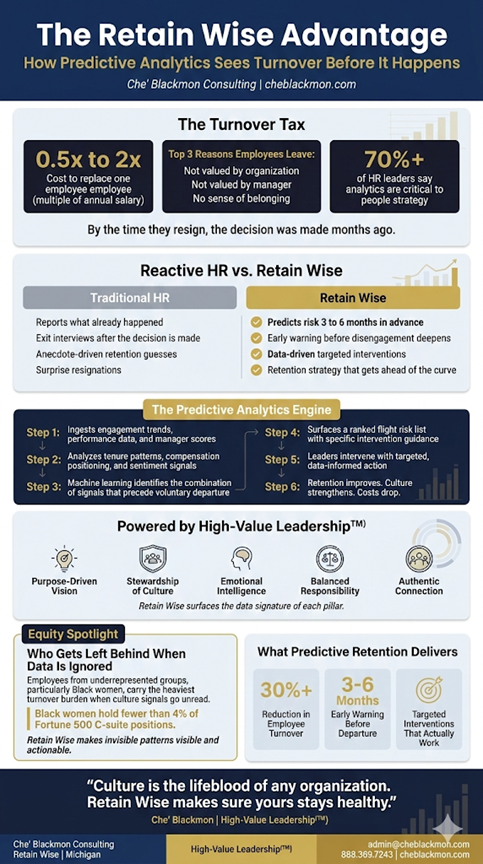
That surprise is expensive. The cost of replacing a single employee ranges from one-half to two times their annual salary, according to research from Gallup. For a mid-sized company experiencing ongoing turnover, those costs compound silently into millions of dollars annually in recruitment expenses, productivity loss, institutional knowledge gaps, and cultural disruption.

But what if you could see it coming? Not after the fact. Not during the exit interview. Three to six months before the resignation ever lands on anyone’s desk.

That is precisely the promise of Retain Wise, the AI-powered predictive analytics platform developed by Che’ Blackmon Consulting specifically for small and mid-sized organizations. Retain Wise does not simply report what has already happened inside your organization. It reads the patterns, analyzes the culture signals, and identifies flight risk before talent walks out the door. It is not reactive HR. It is strategic, data-driven people leadership at its most proactive.

This article explains how predictive analytics is transforming the way forward-thinking organizations understand and respond to employee turnover, what the data reveals about who bears the heaviest burden when turnover goes unaddressed, and why the integration of AI and culture strategy is no longer a future conversation. It is the present competitive advantage.

📉 The Turnover Crisis: What the Numbers Are Really Saying

Turnover has always been a business challenge. What is different now is the scale, the speed, and the compounding nature of the problem in a post-pandemic, multigenerational workforce.

According to the U.S. Bureau of Labor Statistics, millions of American workers voluntarily left their jobs every single month throughout 2022 and 2023, a sustained wave of departures that researchers began calling the Great Resignation. While the most extreme phase of that wave has passed, the underlying conditions that drove it have not.

Employee expectations have permanently shifted. Workers across every industry and generation now prioritize culture, leadership quality, flexibility, and sense of purpose alongside compensation. Research from McKinsey found that the top reasons employees left their jobs were not primarily about pay. They were about not feeling valued by their organization, not feeling valued by their manager, and not belonging to a community at work.

Read that again. The top drivers of voluntary turnover are cultural. They are relational. They are, at their core, a function of how people experience leadership on a daily basis.

“Culture is the lifeblood of any organization. It is not a feel-good concept. It is the secret sauce that makes or breaks the success of an organization.” — Mastering a High-Value Company Culture

This is the gap that no traditional HR metric can fully close. Annual engagement surveys capture sentiment at a single point in time. Exit interviews gather data from people who have already decided to leave. Performance reviews measure output but rarely measure belonging, psychological safety, or leadership trust.

The result is that most organizations are managing their talent retention strategy on a significant time delay. They are looking in the rearview mirror while their people are already halfway out the door.

🧠 What Is Predictive Analytics, and Why Does It Change Everything?

Predictive analytics is the use of data, statistical modeling, and machine learning algorithms to identify the likelihood of future outcomes based on historical and current patterns. In the context of employee turnover, predictive analytics ingests data from multiple organizational touchpoints and surfaces risk indicators that human observation alone would miss or interpret too late.

This is not a science fiction concept. It is a mature and rapidly expanding application of artificial intelligence that is already in use across healthcare, financial services, retail, and increasingly, human resources.

Retain Wise applies this capability specifically to the culture and people dynamics of small and mid-sized organizations, filling a critical gap in the market. Enterprise-scale corporations have had access to sophisticated HR analytics tools for years. The companies with 20 to 200 employees have largely been left without affordable, accessible, and actionable predictive intelligence about their own people.

🔍 How Predictive Analytics Identifies Flight Risk

Traditional HR data tells you what happened. Predictive analytics tells you what is about to happen if nothing changes. The distinction is fundamental.

An effective predictive model for employee turnover draws on a wide range of data inputs. These inputs can include engagement survey trends over time, performance review patterns and trajectory, absenteeism and attendance fluctuations, compensation positioning relative to internal peers and external market benchmarks, promotion history and velocity, manager effectiveness scores, team-level sentiment data, onboarding satisfaction and early tenure indicators, and organizational tenure benchmarks by role and department.

Individually, any one of these data points tells a limited story. But when a machine learning model analyzes them together, looking for the combination of signals that historically precede voluntary departures, it begins to surface something that no individual manager or HR generalist could reliably identify: the early pattern of disengagement that predicts turnover three to six months before it materializes.

“A strong, intentional culture propels tangible results. Such a culture does not come easy to create and maintain. It requires vision, strategy, and relentless commitment.” — Mastering a High-Value Company Culture

📊 The Difference Between Reporting and Predicting

Consider two organizations facing similar turnover challenges. The first organization has invested in a solid HR dashboard. Every month, leadership reviews a report showing last month’s turnover rate, the number of open positions, and the average time to fill each role. They see the problem clearly in the data.

But the data is describing what already happened. The employees who left are already gone. The knowledge they carried walked out with them. The team that depended on them is now stretched thin or operating without the coverage it needs.

The second organization uses Retain Wise. Six months before that same wave of departures, the platform flagged a cluster of risk indicators in a specific department: declining engagement trends among tenured employees, a manager effectiveness score that had been trending downward for two consecutive quarters, compensation data showing three employees at or below the 25th percentile for their roles relative to the external market, and an uptick in absenteeism patterns that the platform had learned to associate with pre-departure disengagement.

Leadership in the second organization had the information they needed to intervene. Not to apply a blanket fix to a vague culture problem. To have specific, targeted conversations with specific employees. To address the compensation gaps before the competition made a better offer. To invest in the manager’s development before the team reached a breaking point.

The resignation letters that arrived in the first organization never arrived in the second. That is the Retain Wise advantage.

🏭 Case Studies: Predictive Analytics in the Real World

🔧 The Automotive Supplier That Stopped the Bleed

There was a regional automotive supply company with approximately 120 employees that had been experiencing turnover rates exceeding 35% annually for three consecutive years. Leadership had responded each time the way most organizations respond: posting the open positions, interviewing candidates, extending offers, and repeating the cycle. Each year, the problem returned.

When the organization implemented predictive analytics monitoring, the data revealed a pattern that had been invisible to management. The highest-risk employees were not the newest hires, as leadership had assumed. They were the employees between two and four years of tenure who had been promoted once but were now stagnating. The predictive model identified a combination of signals: flat compensation relative to their increased responsibilities, infrequent recognition from their direct managers, and engagement scores that had dipped subtly across three consecutive quarterly pulse surveys.

With this intelligence, the company targeted specific interventions: a compensation review for mid-tenure employees in the flagged roles, a manager development series focused on recognition and career development conversations, and a structured stay interview process for employees who the model identified as at risk.

Turnover in the following 12 months dropped by more than half. The cost savings were measurable. The cultural impact was profound.

🏥 The Healthcare Organization That Found the Signal in the Noise

A regional healthcare organization was facing a staffing crisis that leadership attributed to the industry-wide nursing shortage. What the predictive data revealed was more specific and more actionable than a market-level problem.

The analytics platform identified that the turnover risk was concentrated not across the organization broadly, but within three specific units where a combination of leadership ineffectiveness indicators, high overtime load, and declining psychological safety scores created a predictable departure pattern. The market shortage was real. But it was being amplified by controllable internal conditions that the organization had the power to address.

Once the data identified the specific units and the specific risk factors, the organization was able to reallocate leadership development resources, address scheduling practices in the flagged units, and implement targeted retention conversations with employees the model identified as highest risk.

The data did not solve the problem automatically. Leaders still had to make the decisions and do the work. But the data told them exactly where to look, which meant that every intervention dollar spent was strategically targeted rather than broadly cast.

This is the core value proposition of data-driven culture leadership as articulated in Mastering a High-Value Company Culture: not simply identifying that a problem exists, but having the specific, actionable intelligence to address it where it is actually happening.

❤️ The Equity Dimension: What Predictive Analytics Reveals About Who Gets Left Behind

Any honest conversation about employee turnover and predictive people analytics must confront a difficult truth: the employees who are most likely to leave are often the employees whose departure signals have been most consistently ignored.

Black women in corporate America leave their organizations at disproportionately high rates not because of a lack of ambition or commitment. They leave because the conditions that predict departure, undervaluation, stagnant career advancement, exclusion from informal networks, inadequate recognition, and leadership relationships that do not see or support their full capability, are often present and unaddressed for years before the resignation arrives.

“The data instead points to systemic barriers including hiring bias, limited access to influential networks, lack of sponsorship, and inhospitable workplace cultures.” — Rise & Thrive: A Black Woman’s Blueprint for Leadership Excellence

A predictive analytics approach that is properly designed and equitably applied has the potential to disrupt this pattern in a meaningful way. When data surfaces that the employees with the highest flight risk in a given organization share a demographic pattern, that information creates an undeniable accountability signal for leadership that anecdote and individual performance reviews cannot produce.

Consider what this means in practice. When a predictive platform reveals that a disproportionate share of mid-tenure Black women employees are clustered in the highest-risk segments of the departure model, that is not merely a data point. It is an organizational diagnostic. It raises questions that demand answers. Are these employees being promoted at rates comparable to their peers? Are their compensation trajectories aligned with performance? Do their engagement scores reflect a sense of belonging, recognition, and leadership support?

Data does not carry bias in the same way human intuition does. When the pattern emerges in the numbers, it is harder to dismiss, explain away, or attribute to individual circumstances. It creates a basis for institutional accountability.

💡 From Data to Equity: The Leadership Responsibility

In Rise and Thrive: A Black Woman’s Blueprint for Leadership Excellence, the concept of purposeful navigation is explored in depth. It describes the exhausting labor of operating in environments that require extraordinary skill and resilience to advance, not because of a lack of capability but because of systems that were not designed with Black women’s success in mind.

Predictive analytics, used with intention and equity as an explicit design criterion, can become a tool that finally makes those invisible patterns visible at the organizational level. It is not a substitute for the deeper cultural work of building inclusive, high-value environments. But it can be the instrument that makes the systemic patterns undeniable and therefore actionable.

Organizations that use Retain Wise have the ability to segment their turnover risk data in ways that surface equity patterns. That capability is not a threat to leadership. It is a gift. It replaces the organizational blind spots that allow inequity to persist with specific, targeted information that empowers leaders to intervene.

🌟 The High-Value Leadership™ Connection: Data Meets Culture

Predictive analytics is not a replacement for the human dimensions of leadership. It is the instrument that makes those human dimensions more precise and more accountable.

The High-Value Leadership™ framework built into the core of Che’ Blackmon Consulting’s approach is grounded in five interconnected pillars: Purpose-Driven Vision, Stewardship of Culture, Emotional Intelligence, Balanced Responsibility, and Authentic Connection. Each of these pillars has a data signature.

When Purpose-Driven Vision is present, employees can articulate how their work connects to the organizational mission. Engagement data reflects that clarity. When it is absent, data shows a particular pattern of disengagement that begins to emerge in the two to three year tenure window.

When Stewardship of Culture is operating effectively, organizational norms reinforce the stated values and leaders model the behaviors they expect. When misalignment exists between espoused values and lived experience, that gap surfaces in sentiment data, manager effectiveness scores, and the cultural trust measures that predict pre-departure disengagement.

Emotional Intelligence as a leadership competency shapes the quality of manager-employee relationships, which are consistently among the top predictors of voluntary turnover across every research study on the topic. Employees do not leave companies. They leave managers. And the data shows exactly which manager relationships carry the highest departure risk.

Balanced Responsibility and Authentic Connection show up in psychological safety scores, in the patterns of who speaks up in team meetings and who does not, in the recognition data and in the career development conversation frequency metrics. Every dimension of the High-Value Leadership™ framework has measurable data that a predictive model can track.

“High-value leadership is characterized through purpose-driven vision, stewardship of culture, emotional intelligence, balanced responsibility, and authentic connection.” — High-Value Leadership: Transforming Organizations Through Purposeful Culture

Retain Wise does not exist in isolation from culture strategy. It was built as the data layer that makes culture strategy specific, targeted, and accountable. The platform surfaces the signals. The High-Value Leadership™ framework provides the response architecture. Together, they represent an approach to people management that is both rigorous and deeply human.

🚀 Current Trends: Why This Moment Demands Predictive People Intelligence

🤖 The AI Transformation of HR

The integration of artificial intelligence into human resources is not a distant trend. According to Deloitte’s Global Human Capital Trends Report, more than 70% of HR leaders reported that analytics capabilities were important or very important to their organizations’ people strategy. The adoption rate among small and mid-sized businesses, however, has lagged significantly behind enterprise-scale organizations, creating both a challenge and an opportunity.

Retain Wise was specifically designed to close that gap. The predictive capability that Fortune 500 companies have deployed in their talent retention strategies for years is now accessible to the companies that arguably need it most: the growing organizations that cannot afford the catastrophic cost of unmanaged turnover but have also not had access to the analytical tools to address it proactively.

💼 The Multigenerational Workforce Complexity

Today’s workforce spans five generations, each with distinct expectations, motivations, and engagement patterns. Gen Z employees who entered the workforce during and after the pandemic have markedly different expectations around flexibility, purpose alignment, and manager transparency than Baby Boomer colleagues who may be in their final years before retirement. Gen X professionals in mid-career bring a particular set of advancement expectations that, when unmet, translate to departure risk in a predictable pattern.

Managing across this complexity requires more than generational stereotypes and one-size-fits-all engagement initiatives. It requires the kind of granular, individualized risk intelligence that predictive analytics provides. A well-designed model accounts for generational patterns in the data while remaining specific enough to flag individual-level risk without generalizing.

🌍 The Values-Led Business Imperative

Organizations that lead with explicit values and demonstrate measurable commitment to those values through culture, policy, and people practices attract better talent, retain that talent longer, and outperform their competitors on engagement metrics. This is not opinion. Research from Glassdoor, Harvard Business Review, and multiple independent workforce studies consistently confirms the business case for high-value culture as a retention strategy.

But values without accountability measures are aspirational statements. Retain Wise provides the accountability infrastructure that turns cultural commitments into trackable, improvable outcomes. It answers the question that too many organizations avoid: are the values we say we have actually producing the culture we claim to be building?

✅ Actionable Takeaways

For Business Leaders and CEOs:

  1. Calculate the true cost of your current turnover. Take your average annual salary for departing roles, multiply it by 1.5, and multiply that by the number of employees who left in the past 12 months. That number is the financial case for investing in predictive retention strategy.
  2. Stop relying solely on exit interviews. By the time an employee is sitting in an exit interview, the decision has been made and the knowledge transfer opportunity has passed. Shift your investment upstream to early warning systems and proactive retention intervention.
  3. Ask whether your culture data is predictive or retrospective. If your current HR analytics only describe what happened last quarter, you are operating without the forward visibility your business needs.
  4. Invest in manager effectiveness as a retention lever. The single most predictable driver of voluntary turnover is the quality of the manager relationship. Identify which manager relationships in your organization carry the highest risk and invest in development with urgency.
  5. Make equity an explicit dimension of your retention strategy. Analyze your turnover data by demographic patterns. If certain groups are departing at disproportionate rates, that is an organizational signal that demands a targeted organizational response.

For HR and People Operations Professionals:

  • Position your function as predictive, not reactive. The organizations that see HR as a strategic partner are the ones where people professionals have shifted from reporting what happened to anticipating what is coming. Build your case for predictive analytics investment with cost data and competitive benchmarking.
  • Integrate culture signals into your data infrastructure. Engagement scores, manager effectiveness data, and sentiment trends are not soft inputs. They are predictive variables. Ensure your data architecture captures them consistently and uses them in your risk assessments.
  • Build stay interview processes now. Stay interviews with high-performing, at-risk employees are one of the highest-return investments in retention strategy. They generate both intelligence and goodwill. Implement them before the predictive model flags the risk, not after.
  • Use data to surface equity patterns. Predictive analytics that does not include an equity lens is an incomplete tool. Ensure that your turnover risk analysis disaggregates data in ways that reveal whether certain groups are disproportionately represented in high-risk segments.
  • Connect retention outcomes to organizational performance metrics. Make the business case visible. Turnover reduction translates directly to cost savings, productivity gains, and customer satisfaction improvements. Quantify those relationships and communicate them to leadership regularly.

🗣️ Discussion Questions for Readers

Whether you are reading this as an organizational leader, an HR professional, or someone navigating the impact of turnover in your own team, these questions are worth sitting with carefully.

  1. How much of your current HR data describes what already happened, versus helping you anticipate what is about to happen? What would change in your organization if you had six months of early warning before your highest-risk departures?
  2. When you think about the employees who left your organization in the past two years, what patterns do you notice? Were there demographic patterns? Tenure patterns? Manager relationship patterns? What did those patterns tell you, and what did the organization do in response?
  3. How does your organization’s lived culture compare to its stated culture? Where is the gap largest? And do you have the data to know, or are you operating on assumption and anecdote?
  4. If you analyzed your turnover data by demographic segment today, what do you think you would find? And if you found a disproportionate departure rate among Black women or other historically underrepresented professionals, what would your organization be prepared to do differently?
  5. What would it mean for your organization to move from reactive people management to predictive people strategy? What investment would that require, and what would the return on that investment look like over 12 to 24 months?

👟 Next Steps for Readers

Recognition is the first step. The organizations that close the gap between knowing and acting are the ones that will outperform their competition in talent retention and culture health for the decade ahead.

Here are three concrete steps to begin your journey from reactive to predictive people strategy.

  1. Read the foundational work. Mastering a High-Value Company Culture provides the complete strategic framework for building organizational environments where the data-driven culture practices described in this article can take root. High-Value Leadership: Transforming Organizations Through Purposeful Culture gives you the leadership philosophy and behavioral architecture that translates predictive intelligence into purposeful action. Rise and Thrive: A Black Woman’s Blueprint for Leadership Excellence speaks directly to the equity dimensions of culture leadership that this article addresses. All three are available through Che’ Blackmon Consulting.
  2. Conduct a retention risk audit. Before investing in predictive technology, conduct a structured review of your last 24 months of turnover data. Identify the patterns: by tenure, by role, by department, by demographic group, and by manager. That manual analysis will both surface immediate insights and make the case for a more sophisticated predictive infrastructure.
  3. Start the conversation. If you are ready to explore how Retain Wise can bring predictive people analytics to your organization, the conversation begins with understanding your specific context, your current data infrastructure, and your most pressing people challenges. Retain Wise was built for organizations exactly like yours.

🤝 Ready to See Turnover Before It Happens?

Che’ Blackmon Consulting is the home of Retain Wise, Michigan’s first AI-powered culture transformation platform designed specifically for small and mid-sized organizations. Built on more than 24 years of progressive HR and organizational leadership experience, doctoral-level research in AI-enhanced predictive analytics for culture transformation, and the High-Value Leadership™ methodology, Retain Wise gives your organization the forward visibility it needs to retain your best people before the exit interview ever happens.

The cost of doing nothing is already showing up in your financials, your team dynamics, and your organizational culture. The cost of acting now is a fraction of that. The question is not whether predictive analytics is the right investment. The question is how many more departure surprises your organization can afford.

Let’s see what the data can do for your people strategy.

📧 admin@cheblackmon.com   📞 888.369.7243   🌐 cheblackmon.com

Che’ Blackmon Consulting | Retain Wise | Fractional HR & Culture Transformation | Michigan

#RetainWise #PredictiveAnalytics #EmployeeRetention #HRStrategy #HighValueLeadership #CultureTransformation #PeopleAnalytics #TurnoverPrevention #FractionalHR #BlackWomenLead #WorkforcePlanning #HRLeadership #AIinHR #OrganizationalCulture #CheBlackmonConsulting

GenX Leaders: Stop Waiting to Be Discovered The CEO’s Guide to Taking Your Seat at the Table

By Che’ Blackmon, DBA Candidate | Founder & CEO, Che’ Blackmon Consulting

📚 Book Tie-In: High-Value Leadership: Transforming Organizations Through Purposeful Culture — Chapters on Purpose-Driven Direction and Trust-Based Empowerment

You have built the career. You have the experience, the institutional knowledge, the battle scars, and the results to prove it. You have watched younger colleagues get promoted around you, sat through meetings where your ideas were credited to someone else, and told yourself to be patient because your time was coming.

It is time to stop waiting.

Generation X, the 65 million Americans born roughly between 1965 and 1980, represents one of the most seasoned, resilient, and capable leadership cohorts in the modern workforce. Yet GenX professionals are also among the most chronically underestimated. Sandwiched between the massive cultural footprint of Baby Boomers and the loud market presence of Millennials, GenX leaders have spent decades doing the work without always receiving the recognition, promotion, or platform their contributions deserve.

This article is a direct conversation with GenX professionals who are done waiting to be discovered. It is a guide for stepping into your full leadership authority, building the visibility that executive presence requires, and creating the kind of organizational impact that makes you impossible to overlook. It also speaks to those within the GenX generation who carry an additional weight: Black women leaders who have navigated not just the generation gap but also the compounding barriers of race and gender in corporate spaces.

The seat at the table you have been waiting for? It is time to pull it up yourself.

🗺️ The GenX Paradox: Maximum Experience, Minimum Visibility

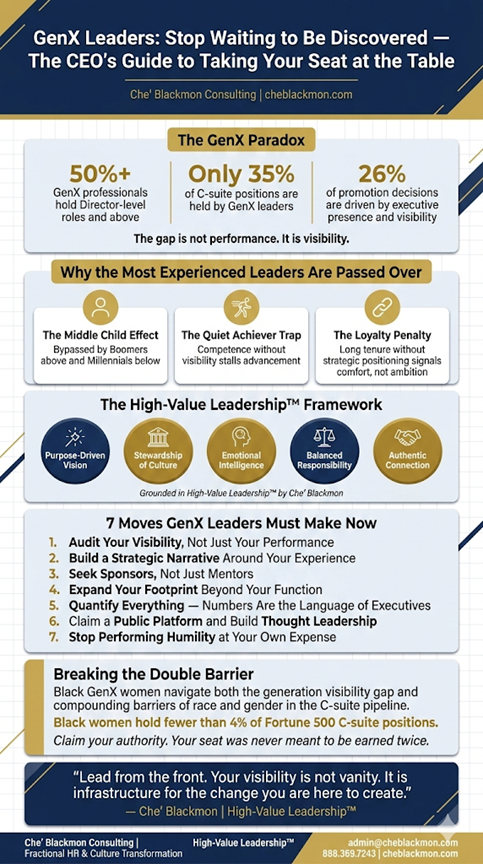
Here is a remarkable data point. According to research from the nonprofit Visier, Generation X makes up more than 50% of leadership roles at the Director level and above in most U.S. organizations. And yet GenX accounts for only about 35% of the C-suite. That gap is not accidental. It reflects a structural visibility problem that has followed this generation throughout its career.

GenX professionals entered the workforce in an era that rewarded competence, loyalty, and heads-down execution. They were trained to let the work speak for itself. They absorbed a professional culture that viewed self-promotion as unseemly and believed that doing an exceptional job would naturally lead to recognition and advancement. For many, it worked through the early stages of their careers.

But the rules changed. The executive suite increasingly rewards visibility, narrative, and strategic self-positioning alongside performance. Those who mastered the art of making their work known, building upward relationships, and being seen as strategic thinkers moved faster. Those who continued to lead with quiet competence found themselves consistently passed over.

“High-value leadership is not about commanding a room. It is about being so intentional, so purposeful, and so aligned in your values and your actions that people cannot help but follow.” — High-Value Leadership: Transforming Organizations Through Purposeful Culture

The paradox for GenX is real. The generation most experienced in navigating organizational complexity, managing multigenerational teams, and delivering sustained results is also the generation most likely to underinvest in the strategic visibility that executive advancement now requires.

Understanding that paradox is the first step. Dismantling it is the work.

🔍 Why GenX Gets Overlooked: The Structural Truth

Before we talk strategy, it is important to name the structural realities that have shaped the GenX leadership experience. This is not about assigning blame. It is about understanding the terrain so you can navigate it more effectively.

📌 The Middle Child Syndrome of the Workforce

Baby Boomers built the corporate infrastructure and held senior leadership positions well into the 2010s, often longer than previous generations due to improved health and financial uncertainty. When they finally began transitioning out, many organizations made a strategic leap directly to Millennials, investing heavily in the recruitment, development, and promotion of younger talent in response to market pressures around innovation and digital transformation.

GenX, once again, got lost in the middle. Too young to be the Boomer heir apparent, too experienced to be positioned as the fresh new talent, this generation has spent years watching leadership pipelines flow around them rather than through them.

📊 The Quiet Achiever Trap

Research consistently shows that visibility is one of the strongest predictors of promotion decisions, often outweighing performance scores when candidates are otherwise equally qualified. A study from the Center for Talent Innovation found that executive presence, defined broadly as the ability to project confidence, credibility, and command attention, accounts for as much as 26% of what it takes to get promoted to senior leadership.

GenX professionals, culturally conditioned to value substance over style, frequently underinvest in executive presence. They do the work. They solve the problems. They manage the teams. But they often fail to architect the narrative around that work in ways that register at the executive level.

🧠 The Loyalty Penalty

GenX is the generation that stayed. While Millennials became known for job hopping and Boomers for building empire-like tenure at single organizations, GenX professionals demonstrated a particular brand of organizational loyalty that often translated into being taken for granted.

In many cases, long tenure without explicit visibility and positioning strategies results in being perceived as part of the furniture rather than as a candidate for the next level. Organizations sometimes overlook their most tenured performers precisely because those performers have not actively signaled readiness for advancement.

❤️ The Double Burden: GenX Black Women in Corporate Spaces

No examination of GenX leadership and the visibility gap would be complete without explicitly addressing the experience of Black women within this generation. For Black GenX women in corporate America, the challenges described above are compounded in ways that cannot be ignored.

Black women who came of age professionally in the 1990s and early 2000s entered organizations that were largely unprepared to see them as future executives. They were often the first, the only, or one of very few in the rooms where decisions were made. They did everything right. They earned the degrees, built the competencies, delivered the results, and mentored others along the way. And they were still passed over.

“The data instead points to systemic barriers including hiring bias, limited access to influential networks, lack of sponsorship, and inhospitable workplace cultures.” — Rise & Thrive: A Black Woman’s Blueprint for Leadership Excellence

According to McKinsey’s Women in the Workplace report, Black women are promoted at lower rates than all other groups of women at nearly every stage of the corporate pipeline. The gap is most pronounced at the transition from individual contributor to manager and again at the transition into the C-suite. These are not soft data points. They represent the cumulative lived experience of an entire cohort of extraordinary professionals whose contributions have been systemically undervalued.

GenX Black women also face a phenomenon that researchers call the double bind. When they display the confidence, assertiveness, and strategic authority that are universally rewarded in male leaders, those same behaviors are frequently coded as aggressive, difficult, or threatening in Black women. When they lead with warmth, collaboration, and humility, those qualities are often interpreted as a lack of executive readiness.

There is no perfect performance that eliminates the bias. But there is a strategy. And that strategy begins with claiming your authority rather than waiting for it to be granted.

💡 Reclaiming the Narrative

In Rise and Thrive: A Black Woman’s Blueprint for Leadership Excellence, the concept of purposeful navigation is explored in depth. It is the practice of making strategic choices about visibility, advocacy, and positioning while remaining anchored in authenticity and integrity. For GenX Black women, purposeful navigation is not optional. It is the leadership competency that the moment demands.

This is not about playing a game whose rules were written by and for someone else. It is about understanding the terrain clearly enough to change it.

💼 Case Studies: GenX Leaders Who Stopped Waiting

🏭 The Operations Leader Who Rewrote Her Story

There was a mid-sized manufacturing organization where a veteran operations director had spent 14 years building one of the company’s most consistently high-performing departments. Her teams routinely outperformed their quarterly targets. Her attrition numbers were the envy of peers across the organization. She was respected, well-liked, and completely invisible to the senior leadership team when VP-level openings arose.

What changed was not her performance. What changed was her strategy. She began requesting time on the quarterly leadership agenda to present her department’s results directly to the executive team rather than allowing those results to be filtered through her direct supervisor. She started writing a brief monthly internal newsletter that connected her team’s operational wins to the company’s stated strategic priorities. She requested a meeting with the CEO to share her perspective on a company-wide challenge she had identified. Within 18 months, she was promoted to VP of Operations.

The work was always there. What changed was the visibility of the work, and the intentionality of the positioning.

🏥 The HR Director Who Claimed Her Expertise Publicly

There was a regional healthcare organization where a long-tenured HR director had developed a sophisticated understanding of how culture directly impacted patient outcomes, staff retention, and organizational performance. She had the data. She had the analysis. She had a framework. But she kept it largely internal, presenting her insights in department-level meetings without ever positioning herself as a thought leader beyond the organization.

A mentor challenged her to take her expertise public. She began writing brief LinkedIn articles on the intersection of HR strategy and healthcare outcomes. She submitted a proposal to speak at a regional industry conference. She connected her internal frameworks to published research and started citing those connections explicitly in executive presentations.

The result was twofold. Externally, she began building a reputation as a subject matter expert in healthcare culture and HR strategy. Internally, the executive team’s perception of her shifted from competent director to strategic thought leader. Both pathways mattered.

🌟 The High-Value Leadership™ Framework for GenX Advancement

In High-Value Leadership: Transforming Organizations Through Purposeful Culture, a distinction is drawn between leaders who manage organizations and leaders who transform them. GenX professionals, with their depth of experience and their cross-functional perspective, are uniquely positioned to be the latter. But transformation requires more than competence. It requires the three pillars of High-Value Leadership™ operating simultaneously.

1️⃣ Purpose-Driven Direction

High-value leaders do not simply manage the work. They articulate a vision that gives the work meaning. For GenX professionals looking to claim their executive seat, this means developing and communicating a point of view about where the organization needs to go and why. Not just at the department level. At the enterprise level.

This is the shift from being a manager of a function to being a strategic voice in the room. It requires asking bigger questions, connecting operational realities to organizational strategy, and being willing to put a stake in the ground with a perspective.

2️⃣ Trust-Based Empowerment

GenX leaders are exceptionally skilled at this pillar, often without realizing it. Their experience managing through multiple organizational cycles, their capacity for empathy built from years of navigating complexity, and their natural tendency toward collaborative problem-solving are all expressions of trust-based empowerment.

The advancement opportunity here is to make this strength visible. Document how your leadership approach has driven team performance. Quantify engagement, retention, and productivity outcomes. Tell the story of how you lead, not just what your teams produce.

3️⃣ Cultural Alignment

Mastering a High-Value Company Culture makes the case that culture is the lifeblood of any organization. GenX leaders who have lived through multiple culture cycles within their organizations carry rare institutional wisdom about what builds culture, what destroys it, and what it takes to sustain it through leadership transitions, market disruptions, and generational shifts.

This wisdom is extraordinarily valuable. It is also frequently underarticulated. Claim it. Make your perspective on culture a consistent part of your leadership narrative, both internally and externally.

🚀 The Strategic Visibility Blueprint: 7 Moves GenX Leaders Must Make Now

The following strategies are not theoretical. They are practical, evidence-based moves that GenX professionals can begin implementing immediately, regardless of their current title or organizational context.

📈 Move 1: Audit Your Visibility, Not Just Your Performance

Most GenX professionals can recite their performance metrics. Fewer can articulate exactly how visi