The Power of Vulnerability: Brené Brown Was Right About Leadership

By Che’ Blackmon


The executive stood in front of her leadership team and said the words that leaders are taught never to say: “I don’t know.”

She admitted that the strategy wasn’t working. That she’d made the wrong call on a major investment. That she needed their help to figure out the path forward.

The room went silent. Then something remarkable happened.

Her team leaned in. Ideas started flowing. People who’d been quietly disengaged for months suddenly became invested in solving the problem together. Trust deepened. Innovation accelerated. The vulnerability that conventional leadership wisdom says destroys credibility actually strengthened it.

Brené Brown has spent two decades researching vulnerability, courage, and leadership. Her core finding? Vulnerability isn’t weakness—it’s the most accurate measure of courage. Leaders who can be authentic about uncertainty, acknowledge mistakes, and show up as fully human don’t lose respect. They earn it. 💪🏾

But here’s where the conversation gets complicated: vulnerability in leadership isn’t equally safe or equally valued across all identities. When a white male CEO admits uncertainty, it’s often celebrated as authenticity and emotional intelligence. When a Black woman leader shows the same vulnerability, she risks confirming stereotypes about competence, being seen as unprepared, or having her authority undermined.

So yes, Brené Brown was right about leadership. Vulnerability is powerful. But we need to talk about how power, privilege, race, and gender shape who gets to be vulnerable—and at what cost.

What Vulnerability Actually Means in Leadership

Let’s start by clarifying what we’re talking about. Vulnerability in leadership doesn’t mean:

❌ Oversharing personal struggles inappropriately
❌ Using your team as your therapist
❌ Abdicating responsibility or decision-making authority
❌ Constant self-doubt or lack of confidence
❌ Emotional volatility or unpredictability

Vulnerability in leadership does mean:

✅ Acknowledging when you don’t have all the answers
✅ Admitting mistakes and taking responsibility
✅ Being honest about challenges the organization faces
✅ Asking for help and input from others
✅ Showing appropriate emotion and humanity
✅ Taking interpersonal risks to build genuine connection
✅ Being transparent about your values and what matters to you

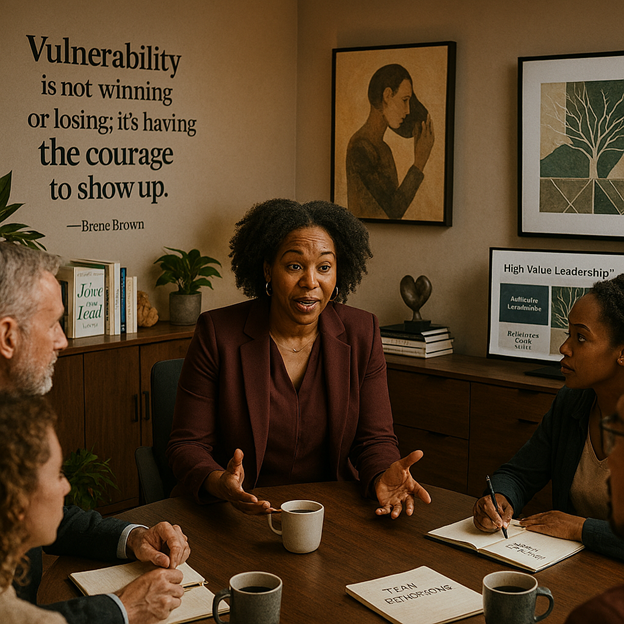
As Brown writes in Dare to Lead, “Vulnerability is not winning or losing; it’s having the courage to show up and be seen when we have no control over the outcome.” In leadership, that means making decisions without certainty, having difficult conversations without guaranteed outcomes, and leading through ambiguity without pretending you have it all figured out.

Research backs this up. A study published in the Journal of Applied Psychology found that leaders who demonstrated appropriate vulnerability—admitting mistakes, acknowledging limitations, asking for feedback—were rated as more effective by their teams and inspired higher levels of trust and psychological safety.

Google’s Project Aristotle, which studied hundreds of teams to identify what makes them successful, found that psychological safety—the belief that you can take risks without being punished or humiliated—was the single most important factor. And psychological safety starts with leaders modeling vulnerability.

The Business Case: Why Vulnerable Leadership Works 📊

Organizations benefit measurably when leaders practice authentic vulnerability:

Innovation Increases: When leaders admit they don’t have all the answers, teams feel empowered to experiment, take risks, and propose unconventional solutions. Research from Harvard Business School shows that psychological safety—created through leader vulnerability—directly correlates with innovation outcomes.

Trust Deepens: Employees trust leaders who are authentic more than leaders who project perfection. Edelman’s Trust Barometer consistently shows that authenticity is a key driver of trust in leadership.

Engagement Rises: Gallup research demonstrates that employees who feel their leaders care about them as people (not just as workers) are significantly more engaged. Vulnerability signals that you see employees as humans, not just resources.

Retention Improves: People don’t leave jobs—they leave managers. When leaders create psychologically safe environments through vulnerability, employees are more likely to stay, even during challenging times.

Decision-Making Improves: Leaders who can say “I don’t know” create space for diverse perspectives, which leads to better decisions. Research from Harvard Business Review shows that inclusive decision-making (which requires leader vulnerability) produces better business outcomes.

Organizational Resilience Strengthens: Companies led by vulnerable, authentic leaders navigate crises more effectively because employees trust leadership’s transparency and feel invested in solutions.

As I discuss in “High-Value Leadership: Transforming Organizations Through Purposeful Culture,” high-value organizations don’t demand perfection from leaders—they demand authenticity, accountability, and the courage to be human.

The Complication: Vulnerability and Identity 🎭

Here’s where Brown’s research, while groundbreaking, requires additional context for leaders from marginalized identities: vulnerability carries different risks depending on who you are.

The Gender Paradox

Women leaders are told to be authentic and vulnerable—right up until they actually are, at which point they’re often labeled as “too emotional,” “not executive material,” or “lacking confidence.”

Research from NYU’s Stern School of Business found that when women leaders show emotion, they’re judged more harshly than men showing identical emotions. Women’s tears are seen as unprofessional; men’s tears are seen as passionate commitment. Women’s admission of uncertainty is seen as incompetence; men’s is seen as thoughtful deliberation.

The Racial Dimension

For Black women leaders, the stakes of vulnerability are even higher. You’re already fighting stereotypes about competence, navigating the “angry Black woman” trope, and working twice as hard to establish credibility. Showing vulnerability can feel like confirming others’ doubts rather than demonstrating courage.

Dr. Ella F. Washington’s research on Black women’s leadership shows that Black women describe feeling they must project “twice the confidence” and “half the vulnerability” compared to white colleagues to be taken seriously. One participant in her study said: “I can’t afford to not know something. White men get promoted on potential. I get evaluated on perfection.”

As I write in “Rise & Thrive: A Black Woman’s Blueprint for Leadership Excellence,” Black women leaders navigate a painful double bind: be authentic and vulnerable (and risk confirming stereotypes), or project invulnerability (and be labeled as cold, unapproachable, or inauthentic). Neither path is safe.

The Authority Tax

There was a technology company where a white male executive and a Black woman executive made similar admissions in separate leadership meetings. The white man said, “I made a strategic error on this acquisition. Here’s what I learned.” His team rallied around him, seeing it as courageous accountability.

The Black woman said almost identical words about a different decision. Her team’s reaction was different. Some questioned whether she was the right person for the role. Others expressed concern about her judgment. Within weeks, her authority was being undermined in ways his never was.

Same vulnerability. Dramatically different outcomes.

This isn’t to say Black women shouldn’t be vulnerable—it’s to acknowledge that the cost-benefit analysis is different, and we need organizational cultures that make vulnerability safe for everyone, not just those already perceived as competent by default.

Strategic Vulnerability: A Framework for All Leaders 💎

Given these complexities, how do we practice vulnerability strategically—especially for leaders navigating marginalized identities?

1. Build Your Foundation First

Vulnerability works best when it’s built on a foundation of demonstrated competence and established credibility. This shouldn’t be necessary in a perfect world, but in the real world, it matters.

For Black women leaders, this often means:

  • Documenting your expertise and accomplishments thoroughly
  • Building a track record before taking major vulnerability risks
  • Establishing your authority clearly before showing uncertainty
  • Creating political capital before spending it on vulnerability

This isn’t about being inauthentic—it’s about being strategic. As I emphasize in “Mastering a High-Value Company Culture,” high-value leaders understand that context matters. The same behavior that builds trust in one context might undermine authority in another.

2. Choose Your Moments

Not every moment requires vulnerability, and not every audience is safe for it. Strategic vulnerability means discerning:

Safe spaces: Where can you be most vulnerable? (Trusted peers, executive coaches, close mentors, therapy, peer networks outside your organization)

Calculated risks: Where might vulnerability serve your goals? (Team meetings where you need input, moments when admitting uncertainty models the behavior you want from others)

Protected boundaries: Where should you maintain more professional distance? (Initial interactions with new stakeholders, contexts where your authority is already being questioned, situations with people who’ve demonstrated untrustworthiness)

There was a Black woman executive who kept two different “vulnerability budgets.” With her trusted leadership team, she was increasingly open about challenges and uncertainties. In broader organizational contexts where her credibility was still being established, she was more measured and strategic. This wasn’t dishonest—it was discerning.

3. Frame Vulnerability as Strength

How you present vulnerability matters as much as the vulnerability itself.

Weaker framing: “I don’t know what to do. I’m overwhelmed.”
Stronger framing: “This challenge is complex. I don’t have all the answers yet, which is why I’m bringing together the smartest people I know to solve it together.”

Weaker framing: “I made a terrible mistake.”
Stronger framing: “I made a decision that didn’t produce the results we needed. Here’s what I learned and how we’re adjusting course.”

Notice the difference? The second framings acknowledge reality while demonstrating leadership—taking ownership, showing strategic thinking, inviting collaboration.

4. Pair Vulnerability with Competence

Research suggests that leaders are most effective when they demonstrate both warmth (which includes vulnerability) and competence. Show both simultaneously:

“I don’t know the right answer here [vulnerability], and here’s my plan for how we’ll figure it out [competence].”

“I made an error in judgment on this project [vulnerability], and I’ve already implemented three changes to prevent similar issues going forward [competence].”

This combination prevents vulnerability from being misread as incompetence.

5. Create Psychological Safety for Others First 🤝

One of the most powerful forms of leader vulnerability is creating space for others to be vulnerable. You might say:

  • “I want this to be a space where we can discuss what’s not working without fear of punishment.”
  • “The best ideas often come from admitting what we don’t know. Who has questions or uncertainties we should discuss?”
  • “I expect we’ll make mistakes as we navigate this. That’s part of innovation. Let’s be transparent when they happen.”

When you create psychological safety for your team, you demonstrate vulnerable leadership without necessarily exposing your own uncertainties prematurely.

6. Practice Selective Transparency

You don’t need to share everything. Selective transparency means being authentic about what matters most while maintaining appropriate boundaries.

You might share:

  • Strategic challenges the organization faces and your thinking about them
  • Your values and what drives your decision-making
  • Mistakes you’ve made and lessons you’ve learned
  • Areas where you’re learning and growing

You probably shouldn’t share:

  • Confidential personnel or financial information
  • Personal struggles that aren’t relevant to work
  • Doubts about your fundamental capability to do your job
  • Information that would undermine others’ privacy or dignity

7. Find Your Vulnerability Village 👥

Given that workplace vulnerability carries risks, especially for marginalized leaders, it’s essential to have spaces where you can be fully vulnerable without professional consequences.

This might include:

  • Executive coaching or therapy
  • Peer networks of other leaders at similar levels
  • Trusted mentors outside your organization
  • Affinity groups for leaders navigating similar identities
  • Close friends or family who understand your work context

As I discuss in the article on leadership loneliness, sustainable leadership requires multiple layers of support. You can’t be vulnerable everywhere—but you must be vulnerable somewhere.
Organizational Responsibility: Making Vulnerability Safe 🏢

While individual strategies matter, organizations must create cultures where vulnerability is genuinely safe and valued for everyone.

Examine Your Leadership Prototypes

Who gets celebrated as “authentic” and “emotionally intelligent” in your organization? Who gets penalized for the same behaviors? If vulnerability is only safe for certain demographics, that’s not a vulnerability-friendly culture—that’s a privilege-protected culture.

Train Leaders on Psychological Safety

Teach leaders how to:

  • Respond to vulnerability without punishing it
  • Ask for input genuinely, not performatively
  • Acknowledge their own limitations without undermining confidence
  • Create space for dissent and uncertainty
  • Distinguish between appropriate and inappropriate vulnerability

Evaluate Leaders on Relational Skills

If your leadership competencies focus exclusively on results, strategy, and decisiveness without valuing relationship-building, authenticity, and team development, you’re incentivizing invulnerability.

High-value organizations, as I discuss in “High-Value Leadership,” evaluate leaders on both task accomplishment and relational effectiveness—including their ability to create psychologically safe environments.

Address Stereotype Threat

Provide training on how stereotypes about different groups affect perceptions of vulnerability. When evaluators understand that they’re more likely to interpret Black women’s vulnerability as incompetence due to bias, they can consciously counter that tendency.

Model Vulnerability at the Top

Senior leaders set the tone. When C-suite executives authentically share challenges, admit mistakes, and ask for help, it gives permission for others to do the same. But ensure that this modeling is genuine, not performative—employees can tell the difference.

Create Structured Opportunities for Vulnerability

Some organizations build vulnerability into regular practices:

  • After-action reviews where teams discuss what went wrong without blame
  • Failure celebrations where teams share lessons learned from experiments that didn’t work
  • Leadership development programs that include sharing personal leadership journeys
  • Town halls where leaders answer unfiltered employee questions
  • Team retrospectives focused on continuous improvement through honest reflection

Real-World Examples: Vulnerability in Action ✨

Satya Nadella, Microsoft CEO, transformed Microsoft’s culture in part by modeling vulnerability. He openly discussed his journey as the parent of a child with disabilities and how it shaped his leadership. He admitted Microsoft had fallen behind competitors and needed to learn. This vulnerability helped shift Microsoft from a “know-it-all” to a “learn-it-all” culture, contributing to its dramatic business turnaround.

Jacinda Ardern, former Prime Minister of New Zealand, led with remarkable vulnerability throughout her tenure—openly discussing the challenges of parenting while leading, showing emotion during national crises, and admitting when she didn’t have all the answers. Her approval ratings were among the highest globally, suggesting that vulnerability can strengthen rather than weaken political leadership.

Howard Schultz, former Starbucks CEO, shared his personal story growing up in poverty and watching his father struggle without health insurance. This vulnerability informed Starbucks’ decision to provide comprehensive benefits to part-time employees—a competitive advantage in attracting and retaining talent.

Mellody Hobson, co-CEO of Ariel Investments and prominent Black woman executive, has spoken openly about experiences of racism in corporate America and the challenges of being “the only” in many spaces. Her vulnerability on these topics has helped advance conversations about race and equity in business while strengthening rather than undermining her credibility.

These examples show that vulnerability can be powerful across different contexts—but it’s worth noting that most examples that get celebrated are from people who already held significant power and credibility. The challenge remains: how do we make vulnerability equally safe for emerging leaders and those from marginalized backgrounds?

When Vulnerability Backfires: Learning from Mistakes ⚠️

Vulnerability in leadership isn’t always successful. Understanding when and why it fails helps us practice it more effectively.

Oversharing: There was a leader who regularly shared detailed personal struggles—relationship problems, financial stress, health concerns—in team meetings. While vulnerability is valuable, this crossed into inappropriate oversharing that made the team uncomfortable and undermined confidence in the leader’s stability.

Lack of Follow-Through: A CEO publicly admitted the company had made strategic errors and promised transparency going forward. But when employees asked for specifics, leadership reverted to corporate speak and avoided accountability. The initial vulnerability seemed manipulative rather than authentic.

Vulnerability Without Competence: A new manager, trying to build connection, led with extensive vulnerability about feeling unprepared and uncertain. Without first establishing baseline competence, the team lost confidence before trust could develop.

Weaponized Vulnerability: Some leaders use vulnerability strategically to avoid accountability (“I’m working on it, I’m learning, give me grace”) without actually changing behavior or taking responsibility for impact.

Unreciprocated Vulnerability: Leaders who demand vulnerability from their teams while remaining invulnerable themselves create unhealthy power dynamics.

Practical Strategies: Developing Your Vulnerability Capacity 💪🏾

Start Small

You don’t need to transform overnight. Begin with low-stakes vulnerability:

  • Admit when you don’t know something minor
  • Ask for input on a decision you’re genuinely uncertain about
  • Share a small mistake and what you learned
  • Thank someone who corrected you or challenged your thinking

Practice Self-Compassion

Kristin Neff’s research on self-compassion shows that leaders who treat themselves with kindness when they fail are more resilient and effective. Before you can be vulnerable with others, practice being vulnerable with yourself—acknowledging imperfection without harsh self-judgment.

Develop Emotional Literacy

Vulnerability requires the ability to recognize and name emotions. If you grew up in contexts where emotions were suppressed or where showing feeling was dangerous, this may require intentional development. Therapy, coaching, or even emotion vocabulary resources can help.

Seek Feedback

Ask trusted colleagues: How do I come across? Do I seem approachable? Do people feel safe bringing problems to me? Their honest feedback can reveal where you might need more vulnerability—or where you might be oversharing.

Reflect on Your Leadership Legacy

What do you want to be remembered for? Leaders remembered most powerfully are often those who connected authentically—who were excellent and human simultaneously. Does your current leadership style reflect that aspiration?

For Black Women Leaders: Navigating the Tightrope 🎭

If you’re a Black woman leader wrestling with how to practice vulnerability given the higher risks:

Know that your caution is valid: You’re not being paranoid or inauthentic. The risks are real, and your strategic discernment about when and where to be vulnerable is sophisticated leadership judgment.

Build your evidence base first: Document your wins, establish your expertise, create a track record. Vulnerability works better when it’s not the first thing people know about you.

Find your safe spaces: Identify where you can be fully vulnerable without professional risk. You need those spaces to sustain yourself.

Frame vulnerability as strategic leadership: When you admit uncertainty, frame it as bringing together expertise to solve complex problems—which is what excellent leaders do.

Connect with other Black women leaders: Share strategies, support each other, and remember you’re not alone in navigating these dynamics.

Trust your instincts: If a situation doesn’t feel safe for vulnerability, it probably isn’t. Your pattern recognition about organizational dynamics is valuable data.

Advocate for cultural change: Use your voice to push for organizational cultures where vulnerability is safe for everyone, not just those already perceived as credible.

As I write in “Rise & Thrive,” your survival strategies—including strategic invulnerability—are sophisticated leadership skills developed in response to real organizational barriers. The goal isn’t to abandon them prematurely; it’s to create organizations where you don’t need them as much.

Discussion Questions 💭

  1. How does vulnerability show up (or not show up) in your organization’s leadership culture? Who seems to benefit from being vulnerable, and who pays a price?
  2. What makes vulnerability feel safe or unsafe for you personally? What would need to change for you to take more vulnerability risks?
  3. How do race, gender, and other identities shape who gets to be vulnerable in your organization without consequences?
  4. When have you witnessed vulnerability strengthen a leader’s effectiveness? When have you seen it backfire?
  5. What’s one area where showing more vulnerability might serve your leadership goals? What’s holding you back?
  6. How can your organization create cultures where vulnerability is genuinely safe for everyone, not just those who already hold power and credibility?

Next Steps: Practicing Vulnerability Today 🚀

For Individual Leaders:

  • Identify one low-stakes situation this week where you can practice vulnerability (admitting you don’t know something, asking for help, acknowledging a small mistake)
  • Reflect on where you currently fall on the spectrum from invulnerable to over-vulnerable—and whether that’s serving you
  • Identify your “vulnerability village”—safe spaces where you can be fully authentic without professional risk
  • Read or watch Brené Brown’s work on vulnerability, courage, and leadership
  • Practice self-compassion when you make mistakes or fall short of your own expectations

For Organizational Leaders:

  • Model appropriate vulnerability in your next leadership communication or team meeting
  • Create structured opportunities for teams to practice vulnerability without punishment (retrospectives, after-action reviews, learning debriefs)
  • Examine whether vulnerability is equally safe across demographics in your organization
  • Include psychological safety and vulnerability in leadership competency models
  • Train managers on how to create psychologically safe environments

For HR and Talent Development:

  • Assess whether your performance management system punishes honesty about mistakes and challenges
  • Include “creating psychological safety” as a leadership competency
  • Provide training on responding effectively when employees are vulnerable
  • Review evaluation data to see if different groups face different consequences for similar behaviors
  • Design leadership development programs that include vulnerability skill-building

For Everyone:

  • Notice when you witness vulnerability and respond with compassion rather than judgment
  • Create space for others to be uncertain, make mistakes, or not know things
  • Challenge cultures that demand perfection and punish humanity
  • Practice being vulnerable in small ways to build your capacity
  • Remember that vulnerability and accountability can coexist—admitting mistakes doesn’t mean avoiding consequences

Work With Che’ Blackmon Consulting

Is your organization ready to build a culture where vulnerability strengthens rather than undermines leadership?

Che’ Blackmon Consulting partners with leaders and organizations to create high-value cultures where authenticity, accountability, and excellence coexist. We understand that vulnerability in leadership isn’t one-size-fits-all—it must be practiced strategically and supported structurally.

Our services include:

  • Executive coaching for leaders developing their vulnerability capacity
  • Leadership development programs focused on authentic, courageous leadership
  • Organizational culture transformation to build psychological safety
  • Consulting on inclusive leadership practices that work for all identities
  • Strategic guidance on navigating vulnerability as a leader from a marginalized background

We help leaders and organizations move beyond performative authenticity to genuine cultures of courage.

Ready to lead with both strength and vulnerability?

📧 admin@cheblackmon.com
📞 888.369.7243
🌐 cheblackmon.com


Brené Brown was right: vulnerability is courage, and courage is essential for leadership. But we must also acknowledge that the risks and rewards of vulnerability are not equally distributed. Until we create organizations where vulnerability is safe for everyone—not just those already perceived as competent and credible—we haven’t fully embraced its power. That’s the work ahead: building cultures where every leader can be both excellent and human.

#VulnerableLeadership #AuthenticLeadership #HighValueLeadership #BreneBrown #BlackWomenLeaders #PsychologicalSafety #LeadershipDevelopment #CourageousLeadership #EmotionalIntelligence #InclusiveLeadership #ExecutiveLeadership #DEI #OrganizationalCulture #LeadershipCourage #WorkplaceCulture #AuthenticityInLeadership #ExecutivePresence #LeadershipSkills #DareToLead #ProfessionalDevelopment


Cultural Intelligence: Leading Across Differences

By Che’ Blackmon


The meeting was scheduled for 9 AM sharp. The American team arrived at 8:55, laptops open, ready to dive in. Their colleagues from Brazil arrived at 9:20, greeting everyone warmly, asking about families before discussing business. The Americans interpreted this as unprofessional. The Brazilians saw the Americans as cold and transactional.

Neither group was wrong. They were operating from different cultural frameworks—and neither had the cultural intelligence to bridge the gap.

Now scale that scenario across your organization. Different communication styles. Different approaches to authority and hierarchy. Different definitions of professionalism, directness, and respect. Different experiences of race, gender, and power that shape how people show up in workplace spaces.

In today’s globalized, diverse, and increasingly complex business environment, technical expertise alone won’t make you an effective leader. You need cultural intelligence—the capability to function effectively across national, ethnic, organizational, and social cultures. 🌍

For Black women leaders navigating predominantly white corporate spaces, cultural intelligence isn’t optional—it’s survival. You’ve likely been developing it your entire career, code-switching across contexts, translating between cultures, reading unspoken rules that were never explicitly taught. That expertise is valuable. The question is: how do we cultivate it systematically across entire organizations so that the burden doesn’t fall solely on those navigating from the margins?

What Is Cultural Intelligence (CQ)?

Cultural intelligence, or CQ, is a framework developed by researchers Christopher Earley and Soon Ang. It’s defined as the capability to relate and work effectively in culturally diverse situations. Unlike IQ (cognitive intelligence) or EQ (emotional intelligence), CQ specifically addresses our ability to function across cultural differences.

CQ consists of four capabilities:

CQ Drive (Motivation): Your interest, confidence, and drive to adapt to multicultural situations. Do you genuinely want to learn about and engage with different cultures, or do you see difference as a problem to manage?

CQ Knowledge (Cognition): Your understanding of how cultures are similar and different. This includes knowledge about cultural values, norms, economic systems, and how culture shapes behavior.

CQ Strategy (Metacognition): Your awareness and ability to plan for multicultural interactions. Can you check your assumptions? Do you adjust your mental models when cultural differences emerge?

CQ Action (Behavior): Your ability to adapt verbal and nonverbal behavior appropriately in cross-cultural situations. Can you modify your communication style, decision-making approach, or leadership behavior when needed?

Research shows that leaders with high CQ:

  • Build stronger, more innovative teams
  • Navigate global business contexts more effectively
  • Create more inclusive workplace cultures
  • Make better decisions by considering diverse perspectives
  • Experience less conflict and misunderstanding across differences

For organizations, CQ translates directly to business outcomes: higher employee engagement, better talent retention, increased innovation, and stronger financial performance in diverse markets.

Why Cultural Intelligence Matters More Than Ever 📈

The business case for cultural intelligence has never been stronger:

Demographic Shifts: The U.S. workforce is increasingly diverse. By 2030, people of color will comprise the majority of the working-age population. Global teams are standard, not exceptional. Leaders who can’t navigate across differences will struggle to lead effectively.

Remote and Hybrid Work: Virtual work eliminates some cultural barriers (like geographical distance) while intensifying others. Without in-person context clues, cultural misunderstandings multiply. Leaders need heightened CQ to lead distributed, diverse teams effectively.

Social Justice Movements: Events like the 2020 racial reckoning following George Floyd’s murder forced organizations to confront how culture, power, and identity shape workplace experiences. Employees—especially younger workers—increasingly expect leaders to demonstrate cultural competence, not just cultural awareness.

Globalized Markets: Even small organizations operate in global contexts—supply chains, customer bases, competitors. Understanding cultural differences isn’t just about being respectful; it’s about being competitive.

Innovation Imperative: Research from Boston Consulting Group shows that companies with above-average diversity in leadership teams report innovation revenue that is 19% higher than companies with below-average diversity. But diversity only drives innovation when leaders can effectively leverage different perspectives—which requires cultural intelligence.

The Hidden Curriculum: Black Women’s Cultural Intelligence 💎

Here’s what often goes unacknowledged: Black women in corporate America have been developing sophisticated cultural intelligence our entire careers. We’ve had to.

As I write in “Rise & Thrive: A Black Woman’s Blueprint for Leadership Excellence,” Black women become expert code-switchers, translating between home culture and corporate culture, adjusting tone and language depending on audience, reading subtle social cues about when to speak up and when to stay quiet, managing perceptions while staying authentic.

This is cultural intelligence in action—though it’s rarely named or valued as such.

Dr. Ella F. Washington, in her research on Black women’s leadership, notes that Black women develop what she calls “bicultural competence”—the ability to navigate both Black cultural contexts and predominantly white corporate environments. This competence is a form of expertise, yet it’s typically framed as a personal necessity rather than an organizational asset.

Consider this: A Black woman leader enters a meeting where she’s the only Black person and one of few women. She immediately assesses:

  • How formal or casual should her language be?
  • How assertive can she be without triggering “angry Black woman” stereotypes?
  • How much can she challenge without being seen as difficult?
  • How warm should she be without being dismissed as less competent?
  • How do the power dynamics in the room shape what’s safe to say?

She’s conducting a complex cultural analysis in real-time, every single day. That’s high-level CQ. But instead of being recognized as a strategic skill, it’s often invisible labor that goes uncompensated and unacknowledged.

Meanwhile, leaders who’ve never had to code-switch—who’ve only operated in environments designed for them—may have never developed these capabilities at all.

The Four Dimensions: Building Your Cultural Intelligence

Let’s break down how to develop each component of CQ, with particular attention to how this shows up in diverse workplace contexts.

1. CQ Drive: Cultivating Genuine Curiosity 🌱

CQ Drive starts with motivation—not just tolerance of difference, but genuine interest in learning from people whose experiences and perspectives differ from your own.

What undermines CQ Drive:

  • Treating diversity as a compliance requirement rather than a strategic advantage
  • Assuming your cultural norms are universal or “just professional”
  • Believing that good intentions eliminate the need for cultural learning
  • Viewing difference as a problem to manage rather than a resource to leverage

What builds CQ Drive:

  • Developing meaningful relationships across difference
  • Reflecting on how your own cultural identity shapes your worldview
  • Seeking out experiences that challenge your assumptions
  • Recognizing the business and human benefits of cultural diversity

There was a tech company that required all senior leaders to participate in a “reverse mentoring” program, where executives were paired with employees from underrepresented backgrounds. The explicit goal wasn’t for the senior leader to mentor the junior employee, but the reverse—junior employees shared their experiences navigating the organization as people of color, women, LGBTQ+ individuals, or people with disabilities. This built CQ Drive by creating personal investment in understanding different experiences.

2. CQ Knowledge: Understanding Cultural Frameworks 📚

CQ Knowledge involves understanding how cultures differ across key dimensions and recognizing patterns without stereotyping individuals.

Social psychologist Geert Hofstede identified six dimensions along which cultures vary:

  • Power Distance: The extent to which less powerful members accept unequal power distribution. In high power distance cultures, hierarchy is respected and rarely questioned. In low power distance cultures, leaders are expected to be accessible and employees feel comfortable challenging authority.
  • Individualism vs. Collectivism: Whether cultures prioritize individual achievement or group harmony.
  • Uncertainty Avoidance: How comfortable cultures are with ambiguity and unstructured situations.
  • Masculinity vs. Femininity: The distribution of emotional roles and values between genders.
  • Long-term vs. Short-term Orientation: Focus on future rewards vs. immediate results.
  • Indulgence vs. Restraint: The extent to which societies allow gratification of desires.

Understanding these dimensions helps leaders recognize why colleagues from different backgrounds might approach work differently—not because they’re difficult or unprofessional, but because they’re operating from different cultural logic.

Critical caveat: CQ Knowledge should never become stereotyping. Not all members of a culture embody cultural norms equally, and individuals are shaped by multiple, intersecting cultural identities. A Black woman from Atlanta who grew up middle-class and attended an HBCU has different cultural reference points than a Black woman from rural Mississippi who was first-generation college. Both are Black women, but treating “Black women” as a monolithic cultural category erases complexity.

As I emphasize in “High-Value Leadership: Transforming Organizations Through Purposeful Culture,” high-value leaders hold both pattern recognition (understanding general cultural tendencies) and individual recognition (seeing people as unique) simultaneously.

3. CQ Strategy: Planning and Awareness 🧠

CQ Strategy is metacognitive—it’s your ability to think about your own thinking and adjust your mental models when engaging across difference.

Key practices:

Before cross-cultural interactions:

  • What cultural differences might influence this interaction?
  • What assumptions am I making?
  • What do I need to learn or clarify?
  • How might my own cultural background influence my interpretations?

During cross-cultural interactions:

  • Am I checking my assumptions or jumping to conclusions?
  • What’s being communicated beyond the words?
  • Are there cultural differences influencing this dynamic?
  • What’s working? What needs adjustment?

After cross-cultural interactions:

  • What went well? What didn’t?
  • What did I learn about this cultural context?
  • What will I do differently next time?
  • How did my own cultural lens influence my interpretation?

There was a multinational organization that implemented a practice they called “cultural debriefs” after major cross-cultural initiatives or challenging interactions. Teams would gather to discuss: What cultural factors influenced outcomes? What assumptions proved accurate or inaccurate? What would we do differently? This built CQ Strategy by making cultural reflection a regular practice, not an afterthought.

For Black women leaders, CQ Strategy often means consciously analyzing: “Was that feedback about my actual performance, or was it filtered through racial or gender bias? Is this a universal workplace norm, or a culturally specific expectation being presented as universal?” This strategic analysis is exhausting but necessary—and it’s a form of CQ that should be recognized as leadership expertise.

4. CQ Action: Adapting Your Behavior 🎭

CQ Action is where cultural intelligence becomes visible—it’s your ability to adjust communication style, decision-making processes, and leadership behaviors based on cultural context.

This is NOT about losing authenticity or becoming a chameleon. It’s about having behavioral flexibility—the capability to adjust your approach while staying grounded in your values and core identity.

Communication Adjustments:

Some cultures value direct, explicit communication (“Tell me exactly what you think”). Others prefer indirect, high-context communication (“Read between the lines and preserve harmony”). Effective cross-cultural leaders can flex between styles.

For example, in giving feedback:

  • A low-context approach: “Your report missed three key data points and needs revision.”
  • A high-context approach: “This is a strong start. As we refine it, let’s ensure we’re capturing X, Y, and Z.”

Neither is inherently better—they’re culturally different. Leaders with high CQ can use both.

Decision-Making Adjustments:

Some cultures expect leaders to make decisions autonomously and decisively. Others expect extensive consultation and consensus-building. A leader who only knows one approach will struggle in contexts that require another.

There was a U.S.-based company that acquired a Japanese firm. The American CEO made quick, top-down decisions—which was valued in U.S. corporate culture as decisive leadership. But in the Japanese subsidiary, this approach was perceived as disrespectful and undermined trust. The CEO had to learn to slow down, incorporate more consultation, and build consensus before decisions—not because his original approach was wrong, but because it was culturally mismatched to the context.

Authority and Hierarchy:

Black women leaders often navigate complex territory here. In many corporate cultures, challenging authority or “speaking truth to power” is theoretically valued. But when Black women do it, they’re more likely to face negative consequences—labeled as aggressive, insubordinate, or having “attitude problems.”

This requires sophisticated CQ Action: reading the room, assessing who holds power and how they respond to challenge, calibrating your approach based on context. It’s exhausting. And it’s an advanced leadership skill that should be recognized as such.

Organizational Cultural Intelligence: Beyond Individual Skills 🏢

While individual CQ matters, sustainable cultural intelligence requires organizational commitment. As I discuss in “Mastering a High-Value Company Culture,” high-value organizations don’t ask diverse employees to adapt to static, monocultural environments. They build cultures that value and leverage cultural differences.

Assess Your Organizational CQ

How culturally intelligent is your organization? Ask:

  • Do your “professional norms” reflect one dominant culture, or do they genuinely accommodate diverse cultural approaches?
  • Are cultural differences treated as deficits to be fixed or assets to be leveraged?
  • Who does the adapting? Do people from dominant groups ever adjust to accommodate others, or is adaptation always required from marginalized groups?
  • Are communication norms flexible, or is there one “right” way to communicate?
  • Do your promotion and performance criteria favor one cultural style over others?

Build Structurally Inclusive Practices

Flexible Communication Norms: Instead of mandating one communication style, create space for multiple approaches. Some people process verbally in meetings; others need written prep to contribute best thinking. Neither is wrong.

Diversify Leadership Definitions: If “leadership” is defined narrowly (assertive, individually competitive, hierarchical), you’ll miss leaders whose cultural backgrounds emphasize collaborative, collectivist, or consensus-driven approaches.

Cultural Humility Training: Move beyond one-time diversity training to ongoing cultural humility development—the recognition that cultural learning is never complete and requires continuous curiosity and self-reflection.

Employee Resource Groups (ERGs): Support ERGs not just as social networks but as strategic partners who provide cultural insight that strengthens business decisions.

Inclusive Decision-Making: When significant decisions are made, ask: Who’s not in the room? Whose perspectives are we missing? What cultural blind spots might we have?

Address Power and Privilege ⚖️

Cultural intelligence without attention to power dynamics is incomplete. It’s not enough to “celebrate differences” if some cultural expressions are valued while others are penalized.

Research from sociologist Arlie Hochschild shows that emotional labor—managing one’s emotions and expressions to meet organizational norms—is disproportionately required from women and people of color. Black women are expected to be warm but not “too much,” confident but not threatening, authentic but palatable to white colleagues.

That’s not cultural intelligence—that’s requiring cultural assimilation while calling it professionalism.

True organizational CQ means examining:

  • Whose cultural norms are treated as default “professional standards”?
  • Who gets labeled “unprofessional” or “not a culture fit” and why?
  • Who has to code-switch constantly, and who never does?
  • How does your organization value the cultural intelligence that marginalized groups have developed?

The Global Context: Cultural Intelligence Across Borders 🌏

While we’ve focused primarily on cultural differences within U.S. workplaces, CQ is equally critical for global business contexts.

Time Orientation: In some cultures, punctuality means arriving exactly on time. In others, approximate timing is normal and relationships matter more than schedules. Neither is unprofessional—they’re culturally different approaches to time.

Negotiation Styles: Some cultures value directness in negotiation; others see it as aggressive. Some expect written contracts; others prioritize relationship trust over legal documents.

Hierarchy and Formality: In some contexts, using first names with senior leaders is appropriate; in others, it’s disrespectful. Understanding these nuances prevents costly misunderstandings.

Feedback Approaches: Direct criticism in some cultures is seen as helpful honesty; in others, it causes shame and damages relationships. Effective leaders learn to adapt feedback style to cultural context.

There was a global consulting firm that nearly lost a major contract in South Korea because their presentation team didn’t understand Korean business etiquette. They addressed senior executives by first names (too informal), handed business cards with one hand instead of two (disrespectful), and presented aggressive recommendations without sufficient relationship-building first. A competitor with higher CQ won the contract—not because their strategy was better, but because they demonstrated cultural respect and understanding.

Practical Strategies: Developing Your CQ 💪🏾

1. Conduct a Cultural Self-Assessment

Before you can lead across difference, understand your own cultural background:

  • What cultural identities shape your worldview? (race, ethnicity, nationality, religion, region, social class, gender, sexual orientation, etc.)
  • What cultural assumptions do you hold about “the right way” to communicate, make decisions, or demonstrate respect?
  • In what contexts do you experience cultural privilege? Where do you navigate as a cultural outsider?
  • What cultural intelligence have you already developed, and where do you need growth?

2. Seek Diverse Relationships

Cultural intelligence develops through relationships, not just books. Intentionally build friendships and professional relationships with people whose backgrounds differ from yours. Listen more than you speak. Ask genuine questions. Allow your assumptions to be challenged.

3. Study Cultural Frameworks

Read scholarship on cultural dimensions (Hofstede, Hall, Trompenaars). Study how culture shapes communication, leadership, and organizational behavior. But hold frameworks lightly—they explain patterns, not individuals.

4. Practice Cultural Humility

Cultural humility means recognizing that you’ll never fully understand someone else’s cultural experience—and that’s okay. Approach cross-cultural interactions with curiosity rather than certainty. Be willing to be wrong. Apologize when you cause harm, even unintentionally.

5. Learn Languages

Even basic language learning builds CQ. It requires you to think differently, recognize cultural nuances embedded in language, and demonstrate respect for others’ cultures.

6. Travel With Purpose

If you have the privilege to travel, do so with cultural learning goals—not just as a tourist, but as a cultural student. Engage with locals. Learn history. Question your assumptions.

7. Consume Diverse Media

Read books by authors from different backgrounds. Watch films from different countries. Listen to podcasts that center voices different from your own. Art and storytelling build cultural empathy.

8. Create Feedback Loops

Ask trusted colleagues from different backgrounds: How do I show up in cross-cultural contexts? What do I do well? Where do I have blind spots? Welcome honest feedback as a gift.

For Black Women: Leveraging Your Cultural Intelligence ✨

If you’re a Black woman leader, you’ve likely been developing CQ your entire career—though it may not have been named as such. Consider how to:

Name your expertise: The code-switching, cultural translation, and bias navigation you do daily are advanced cultural intelligence skills. That’s leadership expertise, not a personal burden.

Teach what you know: Your insights about navigating cultural differences are valuable. Share them with colleagues, mentor emerging leaders, write about your experiences. Your knowledge strengthens organizations.

Set boundaries: Just because you have high CQ doesn’t mean you should carry the entire burden of cultural bridge-building. It’s not your job alone to make others comfortable or to educate everyone about race and culture.

Build community: Connect with other Black women leaders who understand your experience. As discussed in “Rise & Thrive,” community isn’t just comfort—it’s strategic support that sustains your leadership.

Advocate for structural change: Use your cultural intelligence to identify where organizational systems and norms create barriers for people from different backgrounds—then advocate for change.

Discussion Questions 💭

  1. What cultural identities and experiences shape how you lead? How do they influence your assumptions about “the right way” to communicate or make decisions?
  2. Where does your organization’s definition of “professionalism” reflect one dominant culture rather than genuine cultural flexibility?
  3. Who in your organization carries the burden of code-switching and cultural adaptation? What would it look like to distribute that labor more equitably?
  4. How does your organization recognize and value the cultural intelligence that Black women and other marginalized groups have developed?
  5. What cultural blind spots might exist in your leadership team’s decision-making? Whose perspectives are consistently missing?
  6. How can you build your own CQ Drive—moving from tolerance of difference to genuine curiosity and learning?

Next Steps: Leading Across Differences Today 🚀

For Individual Leaders:

  • Complete a cultural self-assessment identifying your cultural identities and assumptions
  • Identify one cross-cultural relationship to deepen through intentional conversation and learning
  • Read one book or watch one film that centers a cultural experience different from your own
  • Practice CQ Strategy by debriefing after your next cross-cultural interaction
  • Seek feedback from colleagues about your cultural intelligence strengths and growth areas

For Organizational Leaders:

  • Conduct a cultural audit of your organization’s norms, practices, and “unwritten rules”
  • Assess whether your leadership competencies favor one cultural approach over others
  • Create opportunities for leaders to develop CQ through training, coaching, and cross-cultural experiences
  • Examine promotion and performance data to identify cultural bias patterns
  • Establish accountability for building inclusive, culturally intelligent practices

For HR and Talent Development:

  • Integrate CQ assessment and development into leadership programs
  • Create mentoring and sponsorship programs that deliberately cross cultural boundaries
  • Support Employee Resource Groups as strategic cultural intelligence resources
  • Design onboarding that acknowledges multiple cultural approaches to workplace success
  • Build performance management systems that value diverse cultural expressions of leadership

For Everyone:

  • Challenge the assumption that your cultural norms are universal
  • When you don’t understand someone’s behavior, get curious rather than judgmental
  • Learn about one cultural framework or dimension this month
  • Speak up when culturally biased assumptions go unchallenged
  • Practice cultural humility in every interaction

Work With Che’ Blackmon Consulting

Is your organization ready to move beyond diversity statements to genuine cultural intelligence?

Che’ Blackmon Consulting partners with leaders and organizations to develop the cultural intelligence that drives innovation, inclusion, and business results. We understand that cultural intelligence isn’t just about learning frameworks—it’s about building organizational cultures where diverse leadership approaches are valued and leveraged.

Our services include:

  • Cultural intelligence assessments for individuals and organizations
  • Leadership development programs focused on leading across difference
  • Organizational culture audits identifying where cultural biases limit effectiveness
  • Executive coaching for leaders navigating complex cultural dynamics
  • Strategic consulting on building high-value, culturally intelligent organizations

We help you transform cultural diversity from a compliance requirement into a strategic advantage.

Ready to lead effectively across differences?

📧 admin@cheblackmon.com
📞 888.369.7243
🌐 cheblackmon.com


Cultural intelligence isn’t about mastering every culture you encounter—that’s impossible. It’s about approaching difference with curiosity, humility, and flexibility. It’s about recognizing that your way isn’t the only way, and that organizational excellence requires leveraging the full spectrum of human diversity. That’s not just good ethics. It’s good leadership.

#CulturalIntelligence #DiverseLeadership #HighValueLeadership #GlobalLeadership #InclusiveLeadership #DEI #CrossCulturalCommunication #LeadershipDevelopment #BlackWomenLeaders #OrganizationalCulture #CulturalCompetence #DiversityAndInclusion #ExecutiveLeadership #WorkplaceCulture #GlobalBusiness #InclusiveWorkplace #LeadershipSkills #CultureTransformation #BusinessStrategy #ProfessionalDevelopment

The Loneliness of Leadership: Building Support Systems That Sustain

By Che’ Blackmon


You made it. You climbed the ladder, earned the title, claimed the seat at the table you worked so hard to reach.

So why do you feel so alone?

You can’t vent to your team about the pressure you’re under—that would undermine their confidence in your leadership. You can’t be fully vulnerable with your peers because you’re competing for the same opportunities. You can’t always confide in your boss because you need them to see you as capable, not struggling. And the higher you climb, the fewer people understand what you’re navigating.

Welcome to one of leadership’s best-kept secrets: it’s lonely up here. 🏔️

For Black women leaders, this loneliness intensifies. You’re often one of few—or the only one—in senior spaces. You carry the weight of representation, the burden of proving yourself repeatedly, and the exhaustion of code-switching across cultural contexts. You may have fought twice as hard to earn half the recognition, and now that you’ve arrived, there’s precious little space to be fully human.

The loneliness of leadership isn’t a personal failing. It’s a structural reality. But it doesn’t have to be a permanent condition.

The Hidden Epidemic: Leadership Isolation by the Numbers

Research from Harvard Business Review found that half of CEOs report feelings of loneliness in their roles, and 61% believe that loneliness hinders their job performance. The isolation isn’t limited to the C-suite—it affects leaders at every level who carry decision-making authority, performance pressure, and the responsibility for others’ livelihoods.

For women leaders and leaders of color, the isolation compounds:

  • A 2022 study in the Journal of Business and Psychology found that women leaders report higher levels of workplace isolation than their male counterparts, particularly in male-dominated industries
  • Research from the Center for Talent Innovation shows that 37% of Black professionals feel isolated at work, compared to 22% of white professionals
  • Black women leaders often describe experiencing “onlyness”—being the only person of their race and gender in decision-making spaces—which creates unique psychological burdens

Dr. Ella F. Washington, organizational psychologist and professor at Georgetown University, notes that for Black women leaders, isolation often stems from being “placed in leadership roles without the structural support, authentic relationships, or cultural belonging necessary for sustainable success.” You’re given the title but not the infrastructure.

This isn’t just uncomfortable—it’s unsustainable. Chronic loneliness correlates with decreased job satisfaction, increased burnout, higher turnover intentions, and even physical health consequences including cardiovascular disease and compromised immune function.

Leadership shouldn’t cost you your wellbeing. But without intentional support systems, it often does.

Why Leadership Feels So Lonely

Understanding the sources of leadership isolation helps us address them more effectively.

1. Positional Power Creates Distance 👥

The moment you become someone’s supervisor, the relationship changes. Employees are less likely to be fully candid with you. Social invitations decrease. The easy camaraderie of peer relationships shifts into something more formal and guarded.

This is especially pronounced for Black women leaders, who may already navigate complex dynamics around authority and likability. Research shows that Black women leaders are more likely to have their authority questioned and must work harder to establish credibility—which can make authentic relationship-building even more challenging.

2. Confidentiality Constraints

Leaders carry information they cannot share: impending layoffs, strategic pivots, performance issues, salary data, succession plans. This necessary confidentiality creates asymmetry in relationships. You know things others don’t, and you can’t fully explain your decisions or concerns.

3. The Vulnerability Paradox

Leaders are expected to project confidence, clarity, and certainty even when they feel uncertain or overwhelmed. Admitting doubt or struggle can be perceived as weakness or incompetence. Yet the absence of vulnerability prevents genuine connection.

For Black women, this paradox is particularly acute. You’re already fighting stereotypes about competence and leadership capability. Showing vulnerability might feel like confirming others’ doubts rather than demonstrating authenticity.

4. Scarcity of True Peers

The higher you climb, the fewer people occupy similar roles. Finding someone who truly understands your specific challenges becomes harder. If you’re a Black woman in senior leadership, you may be navigating dynamics that very few people in your organization—or even your industry—can relate to.

5. Performative Diversity 🎭

There was a Fortune 500 company that celebrated hiring their first Black woman VP with much fanfare—social media announcements, internal town halls, the works. But once the celebration ended, she found herself profoundly isolated. She was expected to lead diversity initiatives on top of her full-time role, invited to speak at recruiting events, and held up as proof of the company’s commitment to inclusion. Yet she had no Black peers in leadership, no mentors who understood her experience, and no structural support for navigating the unique challenges she faced.

Being a “first” or “only” is often framed as an honor. But it’s also isolating.

The Unique Burden: Black Women’s Leadership Isolation

Black women leaders navigate intersectional isolation that compounds racial and gender dynamics:

Cultural Tax Without Cultural Community

Black women are often asked to lead diversity initiatives, mentor other Black employees, educate colleagues about race and inclusion, and represent their entire demographic in decision-making conversations—all without additional compensation or support. This “cultural tax” is exhausting, and it’s typically performed in isolation without a community of peers who share the experience.

Hypervisibility and Invisibility

Black women leaders are hypervisible when it comes to representation—their presence is noted, celebrated, and sometimes tokenized. Yet their ideas, concerns, and contributions are often overlooked or attributed to others. This combination of being seen as a symbol while being unheard as a person is profoundly alienating.

Stereotype Threat and Code-Switching

Research by psychologists Claude Steele and Joshua Aronson shows that stereotype threat—the concern about confirming negative stereotypes about one’s group—creates cognitive burden and anxiety. For Black women leaders, this means constantly calibrating behavior, tone, and expression to avoid triggering stereotypes about Black women being “angry,” “aggressive,” or “unprofessional.”

This code-switching is exhausting and isolating. As I write in “Rise & Thrive: A Black Woman’s Blueprint for Leadership Excellence,” the constant performance of palatability comes at a cost—and that cost is often borne in isolation because admitting the burden feels like weakness.

Limited Access to Sponsorship

Mentorship is valuable, but sponsorship—having senior advocates who actively champion your advancement—is essential. Research from the Center for Talent Innovation found that 71% of executives have protégés who share their gender and race. When senior leadership is predominantly white and male, Black women have fewer natural access points to sponsorship, increasing professional isolation.

What Sustainable Support Actually Looks Like ✨

Addressing leadership loneliness requires both individual agency and organizational responsibility. The most effective support systems include multiple layers of connection and safety.

1. Executive Peer Networks

Structured peer networks bring together leaders at similar levels across different organizations or departments to share challenges, insights, and support. These networks work because:

  • Participants don’t compete for the same opportunities
  • Confidentiality can be maintained more easily than with internal colleagues
  • Diverse perspectives broaden thinking and problem-solving
  • The shared experience of leadership challenges creates authentic connection

For Black women leaders, affinity-based peer networks (like the Executive Leadership Council or National Black MBA Association) provide the added benefit of cultural understanding and shared navigation of racialized professional dynamics.

2. Executive Coaching

Professional coaching provides a confidential space for leaders to process challenges, explore blind spots, and develop strategies without judgment or professional risk. Unlike mentorship, which often includes advice-giving and relationship reciprocity, coaching is purely focused on the leader’s growth and wellbeing.

High-quality executive coaching should address both technical leadership competencies and the emotional, psychological, and identity-related dimensions of leadership—particularly for Black women navigating intersectional challenges.

3. Mentorship AND Sponsorship

While these terms are often used interchangeably, they serve different functions:

  • Mentors provide guidance, advice, and support based on their experience
  • Sponsors use their influence and political capital to advocate for your advancement

Black women leaders need both—and need them from people with actual power to impact their careers. As I discuss in “High-Value Leadership: Transforming Organizations Through Purposeful Culture,” high-value organizations don’t leave sponsorship to chance; they formalize programs that connect high-potential leaders with senior advocates.

4. Intentional Community Building 🤝

Some leaders create their own support structures: small groups of trusted peers who meet regularly (monthly dinners, quarterly retreats, weekly check-in calls) to share experiences and hold each other accountable.

There was a group of Black women executives across different industries who formed what they called a “Board of Directors for their lives.” They met quarterly, reviewed each member’s professional goals, discussed challenges, and provided direct feedback and support. The structure created accountability, connection, and a space to be fully authentic without professional risk.

5. Therapeutic Support

Leadership is psychologically demanding. Therapy isn’t just for crisis—it’s a proactive tool for managing stress, processing challenges, and maintaining mental health. For Black women leaders navigating racial trauma, microaggressions, and the compounded stress of intersectional marginalization, therapy with culturally competent providers can be essential.

Organizations increasingly recognize that therapy and mental health support aren’t personal luxuries—they’re professional necessities.

6. Internal Structural Changes

Organizations can reduce leadership isolation by:

  • Creating executive cohort programs where senior leaders go through development experiences together
  • Facilitating cross-functional leadership communities of practice
  • Providing structured onboarding for leaders transitioning into new roles
  • Normalizing vulnerability and transparency at senior levels
  • Establishing formal sponsorship programs, particularly for leaders from underrepresented backgrounds
  • Creating affinity groups specifically for leaders (not just entry or mid-level employees)

Red Flags: When Isolation Becomes Crisis 🚨

Leadership loneliness exists on a spectrum. Sometimes it’s manageable discomfort; other times it’s a crisis requiring immediate intervention. Warning signs include:

  • Feeling disconnected from your purpose or values
  • Chronic exhaustion that rest doesn’t resolve
  • Cynicism about your work or the people you lead
  • Difficulty making decisions or persistent second-guessing
  • Physical symptoms like insomnia, headaches, or digestive issues
  • Increased reliance on unhealthy coping mechanisms (overwork, substance use, emotional eating)
  • Withdrawal from relationships or activities you previously enjoyed
  • Thoughts that you’re failing or that you don’t belong in leadership

If you recognize these signs in yourself, that’s not weakness—it’s information. It means the current situation isn’t sustainable and something needs to change.

Practical Strategies: Building Your Own Support Infrastructure 💪🏾

You don’t have to wait for organizational support to address isolation. Here are strategies you can implement immediately:

Audit Your Current Support System

Ask yourself:

  • Who can I talk to about strategic challenges without fear of judgment?
  • Who understands the unique dynamics I navigate as a Black woman leader?
  • Who has the power to advocate for my advancement?
  • Who holds me accountable to my goals and values?
  • Who reminds me of my worth when I doubt myself?

If the answers reveal gaps, that’s your starting point.

Diversify Your Support

Don’t rely on a single person or relationship to meet all your support needs. Build a portfolio:

  • Strategic advisors for business decisions and leadership development
  • Emotional support from trusted friends or therapists who know you deeply
  • Identity-based community where you can be fully yourself without code-switching
  • Peer accountability partners at similar career stages
  • Sponsors with organizational influence

Schedule Connection Deliberately 📅

Waiting until you “have time” for relationships means they never happen. Put connection on your calendar:

  • Monthly dinners with your peer group
  • Quarterly coffee with mentors or sponsors
  • Weekly therapy or coaching sessions
  • Annual retreats focused on reflection and restoration

Treat these commitments as seriously as you treat business meetings.

Create Rituals That Ground You

Leadership isolation often includes disconnection from yourself—your values, purpose, and identity beyond your role. Regular practices can help:

  • Morning journaling or meditation
  • Weekly reflection on wins and challenges
  • Monthly evaluation of whether your work aligns with your values
  • Annual retreats to reassess goals and direction

As I emphasize in “Mastering a High-Value Company Culture,” sustainable high performance requires intentional restoration, not just relentless productivity.

Be Strategic About Vulnerability

You don’t need to be vulnerable with everyone, but you do need to be vulnerable with someone. Choose wisely:

  • Confide in people who have demonstrated trustworthiness over time
  • Share struggles with those outside your direct reporting line or competitive sphere
  • Be authentic with your team about challenges without undermining confidence in your leadership
  • Model appropriate vulnerability to give others permission to be human

Advocate for Organizational Change

If you’re experiencing isolation, you’re probably not alone. Consider:

  • Proposing a leadership cohort program
  • Initiating an affinity group for Black women leaders
  • Requesting executive coaching as part of professional development
  • Partnering with HR to create structured sponsorship programs

Your advocacy might benefit not just yourself but future leaders navigating similar challenges.

Organizational Responsibility: Designing for Connection

Leadership isolation isn’t inevitable—it’s often the result of organizational design choices that prioritize hierarchy and competition over connection and support.

High-value organizations recognize that isolated leaders underperform and burn out. They intentionally create structures that foster connection:

Normalize Vulnerability at the Top

When senior leaders model appropriate vulnerability—sharing challenges, admitting uncertainty, asking for help—it creates permission for others to do the same. This doesn’t mean oversharing or undermining confidence; it means being human.

Create Leadership Communities of Practice

Bring together leaders across functions and levels to discuss common challenges, share best practices, and build relationships. These communities reduce isolation while strengthening organizational cohesion.

Invest in Black Women’s Leadership Development

Don’t just hire Black women into leadership and hope they figure it out. Provide:

  • Executive coaching from culturally competent coaches
  • Sponsorship from senior leaders with actual influence
  • Peer networks with other Black women leaders
  • Development programs that address the specific challenges of leading while Black and female
  • Support for attending external conferences and networks

Measure and Address Isolation

Include questions about belonging, connection, and isolation in engagement surveys. Disaggregate data by race and gender. If Black women leaders report higher isolation, that’s actionable information requiring strategic response.

Rethink Onboarding for Senior Leaders

New executives are often left to “figure it out” with minimal support. Provide structured onboarding that includes:

  • Introduction to informal networks and key relationships
  • Pairing with a peer buddy at a similar level
  • Regular check-ins during the first 90-180 days
  • Clear expectations and success criteria

The ROI of Connection: Why This Matters 📊

Some leaders resist investing in support systems because it feels “soft” or indulgent. The data suggests otherwise:

  • Research from the American Psychological Association shows that loneliness costs U.S. employers approximately $406 billion annually in reduced productivity, increased turnover, and healthcare costs
  • A study in the Academy of Management Journal found that leaders with strong support networks make better decisions, navigate crises more effectively, and report higher job satisfaction
  • Gallup research indicates that having a “best friend at work” significantly increases engagement, productivity, and retention—even at senior levels

Support isn’t a luxury. It’s infrastructure for sustainable high performance.

Discussion Questions 💭

  1. What does leadership loneliness look like in your organization? How does it manifest differently for leaders from different backgrounds?
  2. What formal and informal support systems exist for senior leaders in your organization? Who has access to them, and who doesn’t?
  3. How does your organizational culture treat vulnerability? Is it seen as strength, weakness, or something else?
  4. For Black women leaders: What specific forms of isolation do you experience that others may not? What support would be most valuable?
  5. What would change if your organization viewed leader wellbeing and connection as strategic priorities rather than personal responsibilities?
  6. Who in your network truly understands your leadership journey? If the answer is “no one” or “very few,” what does that tell you?

Next Steps: Building Sustainable Support Today 🚀

For Individual Leaders:

  • Conduct an honest audit of your current support system and identify gaps
  • Reach out to one person this week to initiate or deepen a supportive relationship
  • Research executive coaching, peer networks, or professional communities relevant to your role
  • Schedule one self-care or connection activity per week for the next month
  • If you’re experiencing warning signs of crisis-level isolation, reach out to a therapist or coach immediately

For Organizational Leaders:

  • Survey your leadership team about experiences of isolation and belonging
  • Create or expand leadership cohort programs that build peer connection
  • Formalize sponsorship programs, particularly for underrepresented leaders
  • Provide executive coaching as a standard leadership development resource
  • Model appropriate vulnerability and normalize asking for support

For HR and Talent Development:

  • Develop structured onboarding for senior leaders that includes relationship-building
  • Create affinity networks specifically for leaders from underrepresented groups
  • Partner with external organizations that provide community and support for Black women executives
  • Include connection and belonging metrics in leadership effectiveness evaluations

For Everyone:

  • Check in on leaders in your sphere—they may be struggling more than they show
  • Create opportunities for authentic connection that transcend hierarchy
  • Challenge the notion that leadership requires isolation
  • Advocate for cultures where asking for help is seen as strength, not weakness

Work With Che’ Blackmon Consulting

Are you navigating the loneliness of leadership without the support you need? Is your organization losing talented leaders to isolation and burnout?

Che’ Blackmon Consulting partners with leaders and organizations to build the support systems that sustain excellence. We understand that leadership—especially for Black women and other traditionally overlooked talent—requires more than skill development. It requires community, connection, and structural support.

Our services include:

  • Executive coaching for senior leaders navigating complex challenges
  • Leadership development programs that prioritize wellbeing and sustainability
  • Organizational culture assessments identifying isolation patterns
  • Design and facilitation of leadership cohort and peer support programs
  • Strategic consulting on retention and advancement for underrepresented leaders

We help leaders build the infrastructure for sustainable success—because your leadership should elevate you, not exhaust you.

Ready to build support systems that actually sustain?

📧 admin@cheblackmon.com
📞 888.369.7243
🌐 cheblackmon.com


Leadership doesn’t have to be lonely. When we build intentional support systems—individually and organizationally—we create space for leaders to be both excellent and human. That’s not just good for leaders. It’s good for everyone they serve.

#LeadershipDevelopment #ExecutiveLeadership #BlackWomenLeaders #HighValueLeadership #LeadershipLoneliness #ExecutiveCoaching #WomenInLeadership #MentalHealthAtWork #LeaderWellbeing #SustainableLeadership #DEI #OrganizationalCulture #ExecutiveSupport #BlackExcellence #LeadershipCommunity #ProfessionalDevelopment #CorporateCulture #InclusiveLeadership #LeadershipSupport #WorkplaceWellbeing

Pay Equity in Practice: Moving Beyond Good Intentions

By Che’ Blackmon


The company issued a press release celebrating their commitment to pay equity. They formed a task force. They hosted a lunch-and-learn. They added a diversity statement to their careers page.

Then nothing changed.

A year later, Black women in the organization were still earning 63 cents for every dollar paid to white men in similar roles. Latina women earned 57 cents. The gap persisted across departments, levels, and tenure. When employees raised concerns, they were told the organization was “working on it” and that these things “take time.”

How much time, exactly, does it take to pay people fairly? 💰

Pay equity isn’t a aspirational goal or a nice-to-have initiative. It’s a fundamental aspect of organizational integrity. Yet despite decades of conversations about equal pay, the wage gap remains stubbornly persistent—and for Black women and other women of color, it’s getting wider, not narrower.

Good intentions don’t close wage gaps. Intentional action does.

The State of Pay Inequity: The Numbers Tell the Story

According to the National Women’s Law Center, in 2024, women overall were paid 84 cents for every dollar paid to men. But that statistic masks significant disparities:

  • Black women are paid approximately 67 cents on the dollar compared to white men
  • Native American women are paid approximately 60 cents on the dollar
  • Latina women are paid approximately 57 cents on the dollar
  • Asian American women’s pay varies significantly by ethnicity, with some groups facing substantial gaps

These aren’t minor discrepancies. Over a 40-year career, the average Black woman loses more than $946,000 due to the wage gap. That’s generational wealth denied. That’s retirement security diminished. That’s economic power systematically withheld.

And before someone suggests this is simply about educational attainment or career choices, the data refutes that narrative. Research from the American Association of University Women shows that even when controlling for education, occupation, hours worked, and years of experience, unexplained pay gaps persist. Black women with advanced degrees often earn less than white men with only bachelor’s degrees.

This isn’t accidental. It’s structural.

Why Good Intentions Fail 🚫

Most organizations genuinely believe they pay fairly. They have HR policies. They conduct market analyses. They claim to value diversity. Yet the gaps remain. Why?

1. Opacity Protects Inequity

When salary information is treated as confidential and employees are discouraged (or prohibited) from discussing compensation, inequities hide in plain sight. Pay secrecy policies overwhelmingly benefit employers, not employees, and they disproportionately harm women and people of color who lack information to negotiate effectively.

2. Negotiation Gaps Are Framed as Individual Failures

Women—and especially Black women—are often told they need to “negotiate better” or “advocate for themselves more effectively.” But research shows that women who negotiate assertively face social penalties that men don’t. They’re perceived as difficult, aggressive, or ungrateful. This is particularly acute for Black women, who navigate both gendered and racialized expectations about assertiveness and ambition.

Framing pay inequity as a negotiation skills problem places the burden on individuals to fix a systemic issue. As I write in “Rise & Thrive: A Black Woman’s Blueprint for Leadership Excellence,” Black women already perform extraordinary amounts of additional labor—code-switching, managing bias, building credibility from scratch—without additional compensation. Asking them to also solve pay inequity through better negotiation is adding insult to financial injury.

3. Subjective Criteria Enable Bias

When decisions about pay, promotions, and performance ratings rely on subjective assessments like “leadership potential,” “cultural fit,” or “executive presence,” bias flourishes. Research consistently shows that these vague criteria are applied inconsistently and tend to favor people who look like existing leadership—which in most organizations means white men.

4. Historical Inequities Compound Over Time

If your starting salary is lower because of bias in the hiring process, and your raises are calculated as percentages of your current salary, the gap widens with every pay cycle. Over a career, these compounding disparities create massive wealth differences.

5. Lack of Accountability 📊

Organizations announce commitments to pay equity, but few establish measurable goals, transparent timelines, or consequences for failing to achieve equity. Without accountability mechanisms, pay equity remains aspirational rather than operational.

What Pay Equity Actually Requires

Moving from intention to action means implementing concrete, measurable practices that address the root causes of pay disparities.

Conduct Comprehensive Pay Audits

A real pay audit isn’t a one-time HR project. It’s an ongoing diagnostic process that examines:

  • Base salary differences by gender, race, and other demographics
  • Bonus and incentive compensation gaps
  • Benefits utilization and access
  • Promotion rates and timelines
  • Starting salary offers for new hires

The audit should control for legitimate factors like experience, education, and performance ratings—but also question whether those factors themselves reflect bias. For example, if performance ratings consistently rank Black women lower than their peers, is that an accurate assessment or evidence of biased evaluation?

There was a technology company that conducted a pay audit and discovered that women were consistently offered lower starting salaries than men with identical qualifications. The issue wasn’t in their promotion or raise processes—it was happening at the point of entry. They revised their offer process to use standardized salary bands and removed salary history questions from their hiring process, which helped close the gap significantly.

Establish Transparent Salary Bands 💎

Salary transparency is one of the most effective tools for achieving pay equity. When organizations publish salary ranges for roles and levels, several things happen:

  • Employees can assess whether they’re being paid fairly
  • Managers can’t make arbitrary compensation decisions
  • Negotiation becomes less about individual savvy and more about organizational standards
  • Pay disparities become visible and therefore addressable

Some organizations worry that transparency will create dissatisfaction or competition. Research suggests the opposite: employees in organizations with pay transparency report higher levels of trust and perceive their compensation as fairer, even when they’re not the highest earners.

Standardize Hiring and Promotion Processes

Bias thrives in ambiguity. Structured processes reduce opportunities for bias to influence decisions:

  • Use consistent interview questions and scoring rubrics
  • Require multiple interviewers and aggregate their assessments
  • Remove salary history questions from applications and interviews (better yet, operate in jurisdictions where this is legally prohibited)
  • Make job descriptions explicit about required qualifications vs. “nice to have” preferences
  • Establish clear promotion criteria that are applied consistently

As I discuss in “Mastering a High-Value Company Culture,” high-value organizations don’t leave critical processes to individual manager discretion. They build systems that produce equitable outcomes by design.

Address the “Motherhood Penalty” and Caregiving Bias 👶🏾

Research shows that mothers face wage penalties while fathers often receive wage premiums—a disparity that reflects gendered assumptions about commitment and competence. Black mothers face compounded penalties.

Organizations committed to pay equity must examine:

  • Whether parents (especially mothers) are being passed over for high-visibility assignments
  • How parental leave affects performance ratings and raises
  • Whether flexible work arrangements impact compensation or promotion eligibility
  • How caregiving responsibilities (for children, aging parents, etc.) are accommodated

Pay equity isn’t just about base salary—it’s about ensuring that life circumstances don’t create permanent economic disadvantages.

Make Pay Equity Someone’s Job 🎯

Too often, pay equity is everyone’s responsibility, which means it’s no one’s responsibility. Assign accountability:

  • Designate an executive sponsor for pay equity initiatives
  • Include pay equity metrics in leadership performance evaluations
  • Establish a cross-functional team with authority and resources
  • Report progress regularly to the board and workforce
  • Tie executive compensation to achieving equity goals

Create Paths to Promotion for Traditionally Overlooked Talent

Pay equity isn’t only about equal pay for equal work—it’s also about equal access to higher-paying roles. If Black women are clustered in lower-paying positions and underrepresented in senior leadership, wage gaps will persist even if pay within levels is equitable.

This requires:

  • Identifying high-potential Black women and women of color early
  • Providing sponsorship, not just mentorship
  • Creating stretch assignments and leadership development opportunities
  • Examining whether “high-potential” criteria reflect diverse paths to leadership
  • Addressing attrition patterns that disproportionately affect women of color

Research from McKinsey’s Women in the Workplace report consistently shows that Black women are the most ambitious demographic in corporate America—more likely than any other group to want promotions to senior leadership. Yet they face the steepest barriers. That’s not a pipeline problem. That’s a systemic barrier problem.

Real-World Models: What Success Looks Like ✨

Some organizations are moving beyond intentions to measurable action:

Salesforce conducted a comprehensive pay audit and invested $16 million to address unexplained pay differences. They repeat the audit annually and have continued to make adjustments, recognizing that pay equity requires ongoing vigilance, not one-time fixes.

Buffer, a fully remote software company, publishes every employee’s salary online. Their radical transparency includes the formula they use to calculate salaries, removing subjectivity and negotiation from the equation entirely.

Starbucks achieved 100% gender pay equity in the U.S. and is working toward the same goal globally. They publish their progress annually and have committed to transparency and accountability in their equity journey.

These aren’t perfect organizations—no organization is. But they demonstrate that pay equity is achievable when organizations commit resources, establish accountability, and measure progress.

The Business Case (Beyond Basic Fairness)

While the moral case for pay equity should be sufficient, organizational leaders often need to understand the business implications:

Attraction and Retention: Top talent—especially younger workers—increasingly demand transparency and equity. Organizations known for pay disparities struggle to attract and retain high performers.

Engagement and Productivity: When employees believe they’re paid fairly, engagement increases. Research from Glassdoor shows that employees who feel fairly compensated are more likely to recommend their employer and less likely to search for other jobs.

Legal and Reputational Risk: Pay discrimination lawsuits are expensive, time-consuming, and damaging to brand reputation. Proactive equity efforts mitigate these risks.

Innovation: Diverse teams produce better business outcomes, but only when diverse talent is valued equitably. Pay disparities signal that some contributions matter less than others, which stifles the innovation that diversity promises.

As I emphasize in “High-Value Leadership: Transforming Organizations Through Purposeful Culture,” high-value organizations recognize that equity isn’t a cost—it’s an investment in organizational excellence. When you pay people fairly, you signal that their contributions matter. When you don’t, you signal the opposite, regardless of what your diversity statement says.

Common Objections (and Responses) 🤔

“We can’t afford to close the gap immediately.”

Then create a transparent, time-bound plan with interim milestones. Employees are more patient with gradual progress than with indefinite delays. The key is demonstrating genuine commitment through consistent action.

“Our pay is based on market rates, and market rates reflect these disparities.”

Market rates often reflect historical discrimination. Choosing to perpetuate those disparities because “that’s what the market pays” is choosing to perpetuate discrimination. High-value organizations lead markets; they don’t simply follow them.

“We pay for performance, and performance varies.”

That’s fair—if your performance evaluation system is truly objective and unbiased. But research shows that performance ratings themselves often reflect bias, with women and people of color rated lower for identical performance. Before claiming that pay differences reflect performance differences, audit your performance management system.

“Employees know they can negotiate.”

Relying on negotiation as the primary mechanism for fair pay advantages those who have information, confidence, and freedom from stereotype threat. It’s not a neutral process. Standardized pay practices are more equitable than negotiation-based systems.

Individual Strategies: What You Can Do Today 💪🏾

While systemic change is essential, individuals can also take strategic action:

Research Your Worth

Use resources like Glassdoor, Payscale, and industry salary surveys to understand market rates for your role, experience, and location. Join professional associations that provide salary data. Talk to peers (in compliance with your organization’s policies and legal protections—in many jurisdictions, discussing salary is legally protected).

Document Your Value

Keep detailed records of your contributions, accomplishments, and impact. Quantify results wherever possible. This documentation becomes essential during compensation conversations.

Know Your Rights

In many states, employers cannot ask about salary history. Some jurisdictions require salary ranges in job postings. Some states explicitly protect employees’ rights to discuss compensation. Understand the legal landscape in your location.

Practice the Conversation

Compensation negotiations can feel uncomfortable, especially for Black women who face stereotype threat. Practice with a trusted colleague, mentor, or coach. Anticipate objections and prepare responses. As I discuss in “Rise & Thrive,” preparation builds confidence, and confidence impacts outcomes.

Consider the Total Package

If base salary adjustments aren’t immediately available, negotiate other components: bonuses, equity, professional development budgets, title changes that position you for future increases, or flexible work arrangements that provide value.

Know When to Walk

Sometimes the most powerful negotiation tactic is being willing to leave. If an organization consistently undervalues your contributions despite evidence of your worth, that’s important information. High-value leaders recognize their worth and make decisions accordingly.

Discussion Questions 💭

  1. When was the last time your organization conducted a comprehensive pay equity audit? What did it reveal, and what actions resulted?
  2. How transparent is compensation in your organization? Do employees know the salary ranges for their roles and levels? Should they?
  3. What would it look like for your organization to move from aspirational commitments to measurable accountability on pay equity?
  4. How do your performance evaluation and promotion processes create opportunities for bias to influence compensation decisions?
  5. If you discovered significant pay disparities in your organization tomorrow, what would a responsible response plan include? Who would be accountable for implementation?
  6. For individual contributors: Do you know whether you’re being paid fairly relative to your peers? If not, what’s preventing you from finding out?

Next Steps: Take Action Today 🚀

For Organizational Leaders:

  • Schedule a comprehensive pay equity audit for the next quarter
  • Review and revise your compensation philosophy to explicitly address equity
  • Establish transparent salary bands for all roles and levels
  • Create an accountability structure with specific goals, timelines, and consequences
  • Examine whether your promotion and performance management processes introduce bias

For HR and People Operations:

  • Remove salary history questions from your hiring process
  • Standardize interview and evaluation processes
  • Provide training on bias in compensation decisions
  • Create dashboards that track pay equity metrics in real time
  • Develop communication strategies to increase transparency

For Individual Contributors:

  • Research market rates for your role and experience level
  • Document your contributions and quantifiable impact
  • Schedule a compensation conversation with your manager
  • Connect with mentors or coaches who can provide guidance on negotiation
  • Know your legal rights regarding salary discussions and pay equity

For Everyone:

  • Challenge the notion that pay disparities are inevitable or acceptable
  • Support colleagues who raise concerns about pay equity
  • Vote for policies and leaders who prioritize economic justice
  • Hold organizations accountable for their public commitments

Work With Che’ Blackmon Consulting

Is your organization ready to move from pay equity intentions to pay equity results?

Che’ Blackmon Consulting partners with organizations to conduct comprehensive pay equity audits, design compensation systems that produce equitable outcomes, and build high-value cultures where all talent is valued fairly.

Our services include:

  • Comprehensive compensation audits and gap analysis
  • Compensation system design and salary band development
  • Leadership training on equitable pay practices
  • Organizational culture assessments
  • Strategic planning for sustainable equity initiatives

We don’t just identify problems—we partner with you to implement solutions that work.

Ready to ensure your people are paid what they’re worth?

📧 admin@cheblackmon.com
📞 888.369.7243
🌐 cheblackmon.com


Pay equity isn’t complex. It just requires the will to act and the courage to change. The question isn’t whether your organization can afford to achieve pay equity. It’s whether you can afford not to.

#PayEquity #WageGap #BlackWomenInBusiness #HighValueLeadership #CompensationEquity #DEI #OrganizationalCulture #HRLeadership #InclusiveWorkplace #EqualPay #DiversityAndInclusion #WomenInLeadership #BlackWomenLeaders #ExecutiveLeadership #PeopleOperations #TalentManagement #WorkplaceEquity #CultureTransformation #LeadershipDevelopment #CorporateResponsibility

The Double Bind: How Women Leaders Navigate Contradictory Expectations

By Che’ Blackmon Consulting


You walk into the boardroom with your proposal polished and your data airtight. You present with confidence—not too much, though, because you’ve learned that assertiveness can be misread as aggression. You speak firmly but make sure to smile. You advocate for your team while being careful not to seem too emotional. You lead decisively but check in constantly to avoid being labeled domineering.

Welcome to the double bind. 🎭

For women leaders—and especially Black women in corporate America—this isn’t just an occasional tightrope walk. It’s the everyday reality of leadership. You’re expected to be strong but not intimidating, confident but not arrogant, ambitious but not threatening, warm but not weak.

The contradictions are exhausting. And they’re costing organizations far more than they realize.

Understanding the Double Bind

The term “double bind” was popularized by researcher Marilyn Frye and further explored in organizational contexts by scholars like Kathleen Hall Jamieson. It describes a situation where women leaders face two conflicting sets of expectations: conform to traditional feminine stereotypes (be nurturing, collaborative, humble) or adopt conventionally masculine leadership traits (be decisive, assertive, competitive). Choose one path, and you’re criticized for not embodying the other. Try to balance both, and you’re seen as inauthentic or confusing.

Research from Catalyst found that women who behaved assertively were perceived as competent but not likable, while those who exhibited communal behavior were seen as likable but not competent. Men rarely face this trade-off. Their assertiveness is called leadership. Their confidence is called executive presence.

For Black women, this bind tightens even further.

The “angry Black woman” stereotype adds another layer of complexity that white women simply don’t navigate. A 2019 study published in Psychological Science found that Black women’s anger is more likely to be perceived as threatening and problematic compared to white women’s anger, which is often interpreted as justified or passionate. This means Black women leaders must manage not only gendered expectations but also racialized ones—performing a kind of emotional labor that remains largely invisible and uncompensated.

As I write in “Rise & Thrive: A Black Woman’s Blueprint for Leadership Excellence,” Black women leaders often become master code-switchers, adjusting tone, language, and even posture depending on the audience. This constant calibration is mentally and emotionally draining, yet it’s framed as a personal responsibility rather than an organizational failing.

The Real-World Impact 💼

Consider this scenario: There was a company that promoted a Black woman to VP of Operations after years of exemplary performance. Within months, she began receiving feedback that she was “too direct” in meetings and needed to “build more consensus.” When she adjusted her approach and spent more time gathering input before decisions, new feedback emerged: she was “indecisive” and “lacked executive presence.”

The goalposts kept moving because the real issue wasn’t her leadership style—it was that her leadership didn’t match the narrow, often white and male prototype people expected.

This isn’t rare. According to research from the Center for Talent Innovation, 57% of Black women in corporate settings report feeling “on guard” against potential bias. This hypervigilance takes a toll. It leads to burnout, disengagement, and ultimately, turnover. McKinsey’s Women in the Workplace report consistently shows that Black women leave their companies at higher rates than any other demographic, often citing lack of advancement opportunities and exclusionary workplace cultures.

The double bind doesn’t just harm individuals—it undermines organizational effectiveness. When talented leaders must expend energy managing contradictory expectations instead of focusing on strategy and innovation, everyone loses.

How the Double Bind Shows Up

1. Communication Style Critiques 🗣️

Women leaders are told they’re “too aggressive” when they’re direct, yet “too soft” when they’re collaborative. Black women especially report being labeled “intimidating” for behaviors that would be praised as “executive presence” in white male colleagues.

2. The Likeability Penalty

Studies show that successful women are often perceived as less likable than successful men. For women leaders, this creates an impossible calculation: Do you prioritize being respected or being liked? And why should you have to choose?

3. Emotional Labor Expectations

Women leaders are expected to be the emotional caretakers of their teams—remembering birthdays, managing morale, smoothing over conflicts—while simultaneously demonstrating the “toughness” required for strategic decision-making. This emotional labor is rarely acknowledged in performance reviews or compensation discussions.

4. The Competence Assumption Gap

Research from Harvard Business Review shows that men are often hired and promoted based on potential, while women must prove their competence repeatedly. For Black women, this gap widens further due to stereotypes about intelligence and capability.

Breaking Free: Strategies for Individual Leaders

While systemic change is necessary, women leaders can adopt strategies to navigate the double bind more effectively:

Know Your Value 💎

Ground yourself in your accomplishments and expertise. Keep a “wins folder” documenting your achievements, positive feedback, and impact metrics. When contradictory feedback emerges, you’ll have concrete evidence of your capabilities. As I emphasize in “High-Value Leadership: Transforming Organizations Through Purposeful Culture,” leaders must anchor themselves in their values and vision rather than constantly adjusting to others’ perceptions.

Build Strategic Alliances

Identify sponsors (not just mentors) who will advocate for you in rooms where decisions are made. Research shows that women and people of color benefit significantly from having senior advocates who actively champion their advancement.

Name the Pattern

When you receive contradictory feedback, you can respectfully name it. “I’m hearing that I need to be both more collaborative and more decisive. Can you help me understand what that looks like in practice?” This moves the burden back to the feedback-giver to clarify their expectations.

Invest in Your Well-Being 🧘🏾‍♀️

Navigating the double bind is exhausting. Prioritize practices that restore your energy—whether that’s therapy, coaching, exercise, spiritual practice, or creative outlets. Your sustainability as a leader depends on it.

Document Everything

Keep records of your contributions, decisions, and feedback received. This protects you and provides evidence if patterns of bias emerge.

Organizational Solutions: Creating High-Value Cultures

Individual strategies are necessary, but insufficient. Organizations must address the structural and cultural factors that create double binds in the first place.

Audit Your Leadership Criteria 📊

What does “executive presence” actually mean in your organization? When leaders are described as “not ready,” what specific competencies are missing? Often, these criteria are subjective and unexamined, allowing bias to flourish. As I discuss in “Mastering a High-Value Company Culture,” high-value organizations are intentional about defining leadership in ways that are inclusive and competency-based rather than based on cultural fit with existing (often homogenous) leadership.

Standardize Performance Evaluation

Research shows that women’s performance reviews are more likely to include vague feedback and personality critiques, while men’s focus on specific achievements and actionable development areas. Implement structured evaluation processes that focus on measurable outcomes and behaviors.

Train Evaluators on Bias

Unconscious bias training alone isn’t enough, but when combined with systemic changes, it can help. Train those who evaluate and promote leaders to recognize how gendered and racialized stereotypes influence their perceptions. Use real examples from your organization.

Create Sponsorship Programs 🤝

Formalize sponsorship opportunities that connect high-potential women leaders—especially Black women and other women of color—with senior leaders who can advocate for their advancement. Hold sponsors accountable for outcomes, not just engagement.

Normalize Different Leadership Styles

Challenge the notion that there’s one “right” way to lead. Celebrate leaders who bring diverse approaches—collaborative and directive, analytical and intuitive, reserved and expressive. This expands what leadership can look like.

Address Emotional Labor

Make visible and valued the relationship-building, culture-shaping, and team-supporting work that women leaders disproportionately perform. Include it in job descriptions, performance criteria, and compensation decisions.

The Path Forward ✨

The double bind persists because it’s embedded in organizational cultures that were designed without women—and especially without Black women—in mind. Dismantling it requires more than policy changes. It requires cultural transformation.

This is the work at the heart of Che’ Blackmon Consulting. High-value company cultures don’t just tolerate diverse leaders; they’re redesigned to leverage the full range of human talent and leadership capability. They don’t ask women to contort themselves into narrow leadership prototypes. They expand the prototype.

When organizations commit to this work, the results are measurable: increased innovation, stronger employee engagement, better financial performance, and higher retention of top talent. Research from McKinsey shows that companies in the top quartile for gender and ethnic diversity are 36% more likely to outperform their peers financially.

But beyond the business case, there’s a human one. Every day that women leaders—and particularly Black women leaders—spend managing contradictory expectations is a day they’re not spending on the strategic, visionary, transformative work they’re capable of doing. That’s not just their loss. It’s everyone’s.

Discussion Questions 💭

  1. What contradictory expectations have you observed or experienced in your organization? How do they show up differently for different groups of leaders?
  2. In what ways does your organization’s definition of “leadership” or “executive presence” reflect a narrow prototype? What would a more inclusive definition include?
  3. How does your organization recognize and value the emotional labor that women leaders often perform? If it doesn’t, what would that look like?
  4. What specific actions could your leadership team take in the next 90 days to reduce the double bind for women leaders in your organization?
  5. For individual leaders: What strategies have you used to navigate contradictory expectations? What has worked, and what hasn’t?

Next Steps: Take Action Today 🚀

For Individual Leaders:

  • Schedule time this week to update your “wins folder” and review your documented value
  • Identify one potential sponsor and reach out to schedule a conversation
  • Join or create a peer support network with other women leaders navigating similar challenges

For Organizational Leaders:

  • Conduct an audit of your leadership competency criteria and performance review language
  • Review promotion and compensation data disaggregated by gender and race
  • Schedule a culture assessment to identify where double binds show up in your organization

For Everyone:

  • Notice when contradictory feedback is being given and name the pattern
  • Advocate for women leaders in your sphere of influence
  • Commit to expanding your definition of what leadership looks like

Work With Che’ Blackmon Consulting

Are you ready to transform your organizational culture and create an environment where all leaders can thrive without navigating impossible contradictions?

Che’ Blackmon Consulting specializes in helping organizations build high-value cultures that unlock the full potential of diverse leadership. Through strategic consulting, leadership development, and cultural transformation initiatives, we partner with you to create sustainable change.

Whether you need help with:

  • Executive leadership development
  • Organizational culture assessments and transformation
  • DEI strategy and implementation
  • Women’s leadership programs
  • Succession planning that works for everyone

We’re here to help you build something better.

Let’s talk.

📧 admin@cheblackmon.com
📞 888.369.7243
🌐 cheblackmon.com


The double bind isn’t inevitable. It’s a design flaw. And design flaws can be fixed.

#WomenInLeadership #BlackWomenLeaders #HighValueLeadership #LeadershipDevelopment #DiversityAndInclusion #ExecutivePresence #CorporateCulture #WomenLeaders #InclusiveLeadership #DEI #OrganizationalCulture #BlackExcellence #LeadershipCoaching #WorkplaceCulture #CultureTransformation #WomenOfColor #ExecutiveLeadership #LeadershipStrategy #CareerDevelopment #ProfessionalDevelopment

Leadership Nightmares: Learning from Culture Transformation Failures 💔➡️💪

The most powerful lessons about building high-value cultures come from the wreckage of those that tried and failed


The conference room was beautifully appointed. Leadership had spared no expense on the culture transformation launch—custom workbooks, motivational speakers, catered breakfast, even branded swag. The CEO stood at the front, eyes shining with conviction, and declared: “Starting today, we’re becoming a people-first organization.”

Eighteen months later, turnover had increased by 40%. Employee engagement scores had plummeted. The company’s Glassdoor rating featured words like “toxic,” “performative,” and “worse than before.” Three Black women who had been recruited as “diverse voices” during the initiative had already left, their exit interviews revealing a chasm between the glossy culture deck and their daily reality.

What happened?

The same thing that happens in boardrooms, nonprofits, hospitals, tech startups, and government agencies across the country every single day: culture transformation was treated as a program instead of a practice, as words instead of work, as announcement instead of action.

These failures are painful. They’re expensive. They damage trust in ways that take years to rebuild. But they’re also some of our greatest teachers—if we’re brave enough to examine them honestly.

Let’s walk through the wreckage together and extract the wisdom that only failure can provide.

🚨 The Anatomy of Culture Transformation Failure

Before we can learn from failures, we need to understand what actually goes wrong. Culture transformation doesn’t typically collapse because of a single catastrophic mistake. It dies by a thousand cuts—each one small enough to excuse, together fatal enough to destroy.

Here are the patterns that show up again and again:

Pattern 1: The Vision-Execution Chasm

Leadership articulates a beautiful vision. PowerPoints are created. Town halls are held. Employees nod along, genuinely hopeful. Then everyone returns to their desks where the old incentive structures, the old performance metrics, the old unspoken rules still govern everything that actually matters.

There was a company who announced they were transforming into a “feedback-rich culture” where everyone would feel safe sharing honest perspectives. They hired consultants. They conducted workshops. They put posters on the walls about psychological safety.

But when a mid-level Black woman manager offered constructive feedback about a flawed product launch strategy in a leadership meeting, she was later pulled aside and told she needed to work on being “more positive” and “less challenging.” Within six months, she and two other women of color who had witnessed the interaction had left the organization.

The failure point: The stated values and the operating values weren’t just misaligned—they were in direct conflict. And when values collide, operating values always win.

Pattern 2: The Diversity Theater Disaster

Organizations announce ambitious diversity, equity, and inclusion initiatives with great fanfare. They hire Chief Diversity Officers. They set representation targets. They update their websites with diverse faces. They sponsor heritage month celebrations.

But they don’t examine who gets promoted. They don’t audit compensation equity. They don’t change who gets access to sponsors and stretch assignments. They don’t address the whisper networks that warn women of color about certain managers or departments. They don’t modify meeting structures that privilege certain communication styles over others.

There was a company who invested heavily in recruiting Black women for leadership roles, celebrating each hire in company newsletters. What they didn’t invest in was creating conditions for those women to succeed. No mentorship infrastructure. No sponsors at the executive level. No intervention when they were consistently talked over in meetings or excluded from informal networks where real decisions were made.

Within two years, 70% of those recruits had left. The company was genuinely baffled. “We gave them opportunities,” leadership lamented.

The failure point: They confused representation with belonging, presence with power, diversity with equity.

As I discuss in “Rise & Thrive: A Black Woman’s Blueprint for Leadership Excellence,” being invited to the table means nothing if you’re expected to sit silently while others eat.

Pattern 3: The Accountability Vacuum

Culture transformation initiatives are announced with great conviction. Timelines are established. Resources are allocated. And then… nothing is measured. No one is held accountable. The initiative becomes something that matters “in general” but not specifically enough to influence anyone’s performance review, compensation, or advancement.

When transformation is everyone’s responsibility, it becomes no one’s responsibility.

There was a company who established “culture champions” throughout the organization—volunteers who were supposed to model desired behaviors and support the transformation. These champions were given no authority, no budget, no protected time, and no recognition in their performance evaluations.

Predictably, when workload pressures increased, culture work was the first thing dropped. The champions burned out. The initiative withered. And leadership expressed disappointment in people’s “lack of commitment to the vision.”

The failure point: Accountability flows from consequences. Without them, transformation is just wishful thinking with better branding.

Pattern 4: The Surface Solution to Systemic Problems

Organizations identify symptoms—low engagement, high turnover, poor collaboration—and implement solutions that address surface manifestations rather than root causes.

People say they’re leaving for “better opportunities,” so the company increases salaries. Exit interviews mention “limited growth,” so they create more training programs. Engagement surveys reveal “communication gaps,” so they add more all-hands meetings.

But they don’t examine why people really leave. They don’t ask why certain demographics are disproportionately represented in the “limited growth” category. They don’t explore what “communication gaps” means when translated from corporate-speak: “I don’t feel heard, valued, or respected.”

There was a company who noticed their Black female employees had significantly higher attrition rates than other groups. Their solution? A women’s leadership development program. More training for the women who were leaving, as if the problem was their skill deficit rather than the organization’s culture deficit.

The failure point: Treating symptoms while ignoring disease guarantees recurring crises.

💡 The Unique Impact on Black Women: When Failure Cuts Deeper

While culture transformation failures damage everyone, the impact lands differently—and often more severely—on Black women and other traditionally overlooked professionals.

Here’s why:

The Compounding Cost of False Starts

When a white male leader takes a role at an organization attempting culture transformation and it fails, his resume shows “leadership experience during organizational change.” When a Black woman takes a similar role and the transformation fails, she faces questions about whether she was “the right fit” or had the “leadership presence” for the challenge.

The failure follows her differently. The risk compounds. Every failed transformation makes the next leap harder to justify—to others and sometimes to herself.

The Visibility-Vulnerability Paradox

Black women in organizations undergoing culture transformation often find themselves in an impossible position: hyper-visible as symbols of the organization’s commitment to change, yet systematically invisible when it comes to actual decision-making power.

They’re asked to sit on panels about diversity. They’re featured in recruiting materials. They’re expected to mentor every other person of color in the organization while managing full workloads. But they’re rarely consulted about strategy, included in succession planning, or given the authority to actually drive transformation.

When the initiative fails, they experience a unique form of whiplash: blamed for not being vocal enough while simultaneously punished for being “too aggressive” when they were.

The Exhaustion Accumulation

Many Black women enter culture transformation efforts having already spent years—sometimes entire careers—navigating broken systems, translating themselves to be palatable, managing others’ discomfort with their presence, and advocating for changes that should be obvious.

When an organization announces a transformation initiative, it can feel like finally being seen. Like the work they’ve been doing in the margins might be recognized and amplified.

When that initiative fails—when it becomes clear it was performative or half-hearted or under-resourced—it’s not just disappointing. It’s depleting in a way that touches old wounds and raises new questions about whether real change is even possible.

In “High-Value Leadership: Transforming Organizations Through Purposeful Culture,” I emphasize that transformation requires distributing both the labor and the rewards equitably. When organizations ask those most affected by broken cultures to fix them while offering neither power nor protection, failure is guaranteed.

📚 Case Studies: Specific Failures and Their Lessons

Let’s examine some real patterns of failure and extract actionable wisdom:

Case Study 1: The Values Without Teeth

What Happened: A mid-sized tech company conducted extensive stakeholder interviews and developed a beautiful set of values: Innovation, Integrity, Inclusion, Impact. They created artwork. They updated email signatures. They referenced these values in every presentation.

But when decision time came, different values governed. A talented Black woman product manager identified a significant flaw in a product about to launch. Raising this concern would delay the launch by six weeks. She raised it anyway, citing the “Integrity” value.

She was told they’d “address it in the next iteration.” The product launched with the flaw. Customers complained. The company spent months fixing what could have been prevented. The product manager’s performance review noted she “sometimes struggled with understanding business priorities.”

Within a year, she had left. So had three other senior women who had watched the situation unfold.

The Lesson: Values you won’t defend when they’re expensive aren’t values—they’re marketing. Real culture transformation requires designating someone with authority to say: “This decision violates our stated values, and we’re not proceeding until we reconcile this.”

What Should Have Happened: Leadership should have publicly acknowledged the tension between speed and integrity, made the hard call to delay, and explicitly recognized the product manager for embodying the company’s stated values. That single decision would have done more to build culture than a thousand posters.

Case Study 2: The Diversity Initiative That Forgot Equity

What Happened: A financial services firm launched an ambitious initiative to increase racial diversity in leadership. They set targets. They adjusted recruiting strategies. They celebrated every milestone.

But they didn’t change compensation structures that paid lower base salaries with higher bonuses—a model that advantaged those who could afford to take lower initial pay. They didn’t address the “Executive presence” feedback that showed up disproportionately in performance reviews of Black employees. They didn’t examine their promotion process, which heavily weighted “senior leader advocacy”—a system that favored those with existing access to power networks.

They recruited diverse talent into a system designed for homogeneity. Representation numbers briefly improved. Then attrition among diverse hires accelerated. The pipeline leaked faster than they could fill it.

The Lesson: Diversity without equity is extraction. You cannot add diverse people to inequitable systems and call it transformation. The systems must change, not just the faces within them.

What Should Have Happened: Before recruiting a single diverse candidate, they should have conducted comprehensive equity audits of compensation, promotion processes, performance review language, and access to development opportunities. They should have identified and eliminated structural barriers before inviting more people to encounter them.

Case Study 3: The Change Management That Ignored Change Fatigue

What Happened: A healthcare organization launched three major transformation initiatives within 18 months: a culture transformation, a digital systems overhaul, and a restructuring. Leadership genuinely believed in all three. Each had its own timeline, its own consultants, its own demands on employees’ time and attention.

Frontline workers—disproportionately women and people of color—were drowning. They attended mandatory culture workshops while learning new software while adapting to new reporting structures. They had neither the bandwidth nor the psychological space to genuinely engage with any single initiative.

When the culture transformation stalled, leadership blamed “resistance to change.” Exit interviews told a different story: people weren’t resisting change—they were exhausted by its pace and volume.

The Lesson: Change capacity is finite. Transformation requires not just vision and commitment but also realistic assessment of organizational bandwidth. When you ask people to transform while simultaneously demanding they maintain productivity, adapt to new systems, and absorb structural changes, something will break—usually the people.

What Should Have Happened: Leadership should have sequenced initiatives, allocated transition time, and explicitly reduced other expectations during transformation periods. They should have acknowledged that real change requires space—space to learn, space to adapt, space to integrate new ways of working.

🛠️ The Seven Deadly Sins of Culture Transformation

Drawing from patterns across industries and organizations, here are the failures that kill culture transformation:

1. Impatience

Expecting sustainable culture change in 90 days or six months or even a year. Real transformation takes years, not quarters. The failure comes from treating culture like a sprint when it’s a marathon.

2. Inconsistency 🎭

Modeling different values at different levels or in different circumstances. When executives operate under one set of rules while demanding another from everyone else, transformation becomes impossible. People follow what leaders do, not what they say.

3. Under-resourcing 💸

Announcing transformation but allocating no budget, no protected time, no authority to those responsible for driving it. This communicates that transformation is theater, not priority.

4. Surface Engagement 🎤

Asking people what they think through surveys and listening sessions, then proceeding with predetermined plans. Performing consultation without genuine consideration breeds cynicism deeper than if you’d never asked at all.

5. Selective Accountability ⚖️

Holding some people (typically those with less power) accountable for embodying new cultural values while exempting others (typically high performers or senior leaders). This teaches that culture matters only when convenient.

6. Change Without Mourning 😢

Failing to acknowledge that transformation requires letting go of old identities, familiar patterns, and comfortable habits. When you demand people change without honoring what they’re losing, resistance is inevitable.

7. Metrics Myopia 📊

Measuring only what’s easy to count (number of trainings completed, diversity percentages) rather than what actually matters (belonging, psychological safety, equitable opportunity distribution, retention of diverse talent).

💪 Rising from the Ashes: What Successful Recovery Looks Like

Here’s what often gets missed in conversations about failure: organizations can recover. Not all culture transformation failures are fatal. But recovery requires specific, often uncomfortable actions.

Own the Failure Publicly

There was a company whose culture transformation initiative collapsed spectacularly. Instead of quietly moving on to the next initiative, their CEO called an all-hands meeting and said something remarkable: “We failed. Not you—leadership. We announced values we weren’t prepared to defend. We asked for your trust without earning it. We’re going to take the next six months to understand what went wrong before we ask you to believe in us again.”

That honesty became the foundation for actual transformation. Not because the failure was comfortable, but because the ownership was real.

Conduct Honest Autopsies

Successful recovery requires understanding why transformation failed, not just that it did. This means:

  • Exit interviews conducted by third parties who can capture unfiltered truth
  • Equity audits that examine outcomes by demographic group
  • Culture assessments that measure actual behavior, not stated intentions
  • Leadership 360-degree feedback that doesn’t get sanitized before delivery
  • Willingness to hear hard truths about whose voices were centered and whose were marginalized

Redistribute Power, Not Just Responsibility

Real transformation requires shifting who makes decisions, who controls resources, and who defines success. Organizations that recover from failed transformation often establish new governance structures that include voices previously excluded from strategy conversations.

As I discuss in “Mastering a High-Value Company Culture,” sustainable transformation happens when those most affected by culture have meaningful influence over its direction.

Start Smaller and Deeper

Instead of announcing sweeping organization-wide transformation, successful recoveries often focus on specific teams or departments. They go deep before going wide. They demonstrate proof of concept before scaling.

There was a company who, after a failed transformation, focused exclusively on redesigning their performance review process in one division. They involved frontline employees in the redesign. They piloted for six months. They measured impact. They adjusted based on feedback. Only after proving the new approach worked did they expand it.

That humility—starting small enough to actually do it well—rebuilt trust the previous grand announcements had destroyed.

✅ Actionable Takeaways: Learning Without Repeating

Ready to learn from others’ failures without creating your own? Here’s your roadmap:

Before You Announce Anything

Map the gap between stated and operating values What do your marketing materials, recruitment pitches, and vision statements say you value? Now what do your promotion patterns, meeting norms, and resource allocation decisions reveal you actually value? The distance between these two is your culture challenge.

Audit for equity, not just diversity Before launching any transformation:

  • Analyze compensation by demographic group at every level
  • Review promotion patterns over the past three years
  • Examine who gets stretch assignments and visibility opportunities
  • Assess performance review language for coded bias
  • Identify which voices are present in strategy conversations and which are absent

Calculate your change capacity How many other initiatives are currently underway? What percentage of people’s time is already allocated? What’s the emotional state of your workforce? Transformation launched into exhaustion fails.

As You Design Transformation

Start with the “So what?” question Culture transformation isn’t valuable because it’s popular—it’s valuable because of specific outcomes. What will be different if this succeeds? How will daily experience change for employees? What decisions will be made differently?

Identify your culture-keepers and culture-killers Who has formal authority to uphold or undermine new cultural norms? This is usually executives and senior leaders, but it also includes informal influencers, long-tenured employees, and those who control access to opportunities. You need explicit strategies for engaging both groups.

Build in protected failure space Real change requires experimentation. Experimentation requires permission to try things that might not work. Without explicit protection for thoughtful risk-taking, people will default to safe conformity.

Resource proportionate to ambition If transformation is truly your priority, it needs dedicated budget, protected time, empowered leadership, and consequences for non-participation. Otherwise, it’s a hobby.

During Implementation

Make the invisible visible Track and transparently share data on:

  • Who’s being promoted and at what rates
  • Who’s participating in transformation activities and who’s not
  • How meeting time is distributed across different voices
  • What early indicators suggest about trajectory

Create escalation pathways When someone experiences the gap between stated and operating values, where do they go? Who has authority to intervene? What happens when the problem involves a senior leader? Without answers to these questions, transformation is performative.

Protect your truth-tellers The people who will tell you transformation isn’t working—who will identify gaps, name problems, challenge inconsistencies—are your most valuable assets. They’re also often the most vulnerable. Active protection isn’t optional.

Celebrate behavior, not just outcomes What gets recognized gets repeated. Are you celebrating leaders who have hard conversations about equity? Teams that experiment with new collaboration models? Individuals who name problems everyone else is avoiding?

After Initial Implementation

Conduct six-month honest assessments What’s actually different? Not what do surveys say—what do daily experiences reflect? Who’s thriving? Who’s leaving? What patterns are emerging?

Adjust based on data, especially uncomfortable data If the data reveals that Black women are still being promoted at lower rates despite the transformation, don’t explain it away. Investigate it. Address it. Change it.

Sustain momentum across leadership transitions Culture transformation that lives or dies with a particular executive isn’t transformation—it’s one person’s project. Build ownership broadly and deeply enough to survive leadership changes.

🎯 Special Considerations for Black Women Leading Transformation

If you’re a Black woman tasked with leading or significantly contributing to culture transformation, you need specific strategies to protect yourself while driving change:

Negotiate Authority, Not Just Responsibility

Before accepting transformation leadership:

  • Clarify decision-making power: What can you actually change?
  • Secure budget authority: Can you allocate resources or just make recommendations?
  • Establish executive sponsorship: Who will defend this work when it gets hard?
  • Define success metrics: What outcomes determine whether you’ve succeeded?
  • Determine consequences: What happens if others don’t engage?

Without clear answers, you’re being set up as a scapegoat, not a leader.

Build Your Coalition Before You Need It

Identify allies at multiple levels:

  • Executive sponsors who have influence and will use it
  • Peer leaders who will model desired behaviors
  • Frontline employees who will speak truth about what’s working
  • External advisors who can provide perspective and support

In “Rise & Thrive,” I emphasize that Black women’s leadership strength often lies in coalition-building—the capacity to create networks of mutual support and shared purpose. Use this strength strategically.

Document Everything

Keep records of:

  • What you were told transformation would include
  • Decisions made and by whom
  • Resources committed and actually allocated
  • Resistance encountered and how it was addressed
  • Wins achieved and who contributed

This documentation protects you if the narrative shifts.

Know Your Exit Criteria

Before you start, identify the conditions under which you’ll walk away:

  • If promises made during negotiation are broken
  • If you’re given responsibility without authority
  • If your physical or mental health is suffering
  • If the gap between stated commitment and actual investment becomes untenable

Having clear exit criteria isn’t planning to fail—it’s refusing to be destroyed by someone else’s failure.

🔮 Current Trends: What’s Changing in Culture Transformation

The landscape of organizational culture work is evolving. Understanding current trends helps us learn from past failures:

From Programs to Systems

The most effective organizations are moving away from “culture initiatives” toward integrated systems where cultural values inform every process—hiring, promotion, resource allocation, strategic planning, performance management.

From Diversity to Belonging

Language is shifting from diversity (representation) to belonging (experience). This reflects growing recognition that getting diverse people in the door means nothing if they can’t thrive once inside.

From Training to Structural Change

Organizations are realizing that unconscious bias training doesn’t address structural inequities. The conversation is shifting toward changing systems, not just changing minds.

From Annual Surveys to Continuous Listening

Rather than waiting for yearly engagement surveys, leading organizations are implementing continuous feedback mechanisms—pulse surveys, exit interviews, stay interviews, real-time sentiment analysis.

From Chief Diversity Officers to Distributed Ownership

While CDO roles remain important, there’s growing recognition that culture transformation can’t be one person’s job. Accountability is being embedded in every leader’s role.

💭 Discussion Questions for Your Leadership Team

Use these questions to assess your transformation readiness and learn from others’ failures:

  1. What’s the distance between our stated values and our operating values? Where do they align? Where do they conflict? How do we know?
  2. If our culture transformation failed, what would be the most likely cause? Are we willing to address that now rather than discovering it through failure?
  3. Who are the voices consistently absent from our strategy conversations? What are we missing by not including them? How will we change that?
  4. What are we asking people to give up as we transform? How are we honoring what’s being lost even as we move toward what’s being gained?
  5. How will we know if we’re succeeding? What specific outcomes—beyond completion of activities—define success? How will we measure them?
  6. What happens when someone with power violates our cultural values? Do we have a recent example of holding a high performer or senior leader accountable? If not, why not?
  7. Are we resourced appropriately for the transformation we’re claiming to pursue? Does our budget, our time allocation, and our accountability structures reflect this as a true priority?
  8. How are we protecting the people doing the hardest cultural work—often those from marginalized identities who have been advocating for change long before it became an initiative?

🌟 Next Steps: Building on the Wisdom of Failure

Failure teaches, but only if we’re willing to be students. Here’s how to move forward:

Conduct your own pre-mortem: Before launching transformation, imagine it has failed spectacularly. Working backward, what were the causes? Use this exercise to identify and address vulnerabilities before they become fatal.

Seek the truth-tellers: Who in your organization consistently names problems others avoid? Bring them into the process early. Give them genuine influence, not just token inclusion.

Start with diagnosis: Invest as much time understanding your current culture as you do designing your future one. You can’t transform what you don’t understand.

Build for sustainability: Design transformation processes that can survive leadership changes, market pressures, and competing priorities. If it only works under ideal conditions, it won’t work.

Learn publicly: When something doesn’t work, say so. Organizations that treat failure as shameful create cultures where people hide problems until they become catastrophic.


📞 Ready to Transform Culture Without the Nightmare?

At Che’ Blackmon Consulting, we help organizations learn from others’ failures so they can write their own success stories. We bring decades of experience building High-Value Leadership℠ cultures where everyone—especially the traditionally overlooked—can rise and thrive.

We don’t believe in cookie-cutter transformation. We believe in diagnosis before prescription, truth before comfort, and systems change before individual blame.

Let’s have an honest conversation about your culture—what’s working, what’s not, and what’s possible:

📧 admin@cheblackmon.com
📞 888.369.7243
🌐 cheblackmon.com

Because the best time to learn from failure is before it happens.


Failure isn’t the opposite of success—it’s the tuition we pay for wisdom. The question is whether we’ll learn from others’ expensive lessons or insist on purchasing our own. 💡

#CultureTransformation #LeadershipFailures #HighValueLeadership #OrganizationalCulture #BlackWomenInLeadership #ChangeManagement #CultureChange #LeadershipLessons #DiversityAndInclusion #EquityInAction #CorporateCulture #TransformationalLeadership #HRLeadership #OrganizationalDevelopment #CheBlackmonConsulting #InclusiveLeadership #CultureStrategy #LeadershipDevelopment #BlackWomenLeaders #WorkplaceCulture #FailForward #BusinessTransformation #PurposefulCulture #AuthenticLeadership #TruthInLeadership