

The Forgotten Bridge-Builders and the Future of Inclusive Leadership
Four generations. One workplace. Infinite misunderstandings.
But here’s what most leadership experts miss: While everyone’s focused on the Boomer-Millennial divide or Gen Z’s workplace revolution, there’s a generation quietly holding it all together. Gen X—my generation—has become the forgotten bridge between analog and digital, hierarchy and flexibility, tradition and transformation.
And for Black women in Gen X? We’re not just bridging generations. We’re bridging cultures, bridging access gaps, and often bridging our organizations into the future while rarely getting credit for the architectural work we do.
As organizations struggle with the most age-diverse workforce in history, the real question isn’t how to manage generational differences. It’s how to leverage the unique strengths of each generation while recognizing who’s actually doing the bridging work—and ensuring they’re valued for it.
The Generational Landscape: More Complex Than You Think
Let’s start with reality. Today’s workplace spans five generations:
- Traditionalists (Born before 1946): Mostly retired, but some still in senior advisory roles
- Baby Boomers (1946-1964): Holding senior positions, approaching retirement
- Generation X (1965-1980): The forgotten middle children in leadership roles
- Millennials (1981-1996): The largest workforce segment
- Gen Z (1997-2012): The newest entrants reshaping workplace norms
Each generation brings distinct values shaped by their formative experiences. But here’s what’s overlooked: Gen X is the only generation that’s truly bilingual in both analog and digital worlds. We wrote term papers on typewriters AND computers. We remember life before email AND helped build the digital revolution. We learned hierarchy AND pioneered flexibility.
As I explored in “Mastering a High-Value Company Culture,” successful cultures leverage diverse perspectives. Yet most generational discussions skip right over the generation that’s uniquely positioned to translate between all others.
Consider this: Gen X makes up only 25% of the workforce but holds 51% of leadership roles globally. We’re literally running organizations while being culturally invisible. For Black Gen X women, this invisibility is doubled—we’re overlooked generationally AND racially, even as we do the critical work of cultural translation.
The Hidden Work of Gen X Bridge-Builders
Gen X entered the workforce during massive upheaval. We witnessed downsizing, the end of lifetime employment, and the birth of the gig economy. We learned early that loyalty didn’t guarantee security. This made us pragmatic, adaptable, and skeptical of institutional promises.
These experiences positioned us perfectly as organizational bridge-builders:
We Translate Between Analog and Digital A Black female Gen X executive at a Fortune 500 company told me: “I spend half my day translating Boomer executives’ vision into digital strategies Millennials can execute, then translating Millennial innovations back into metrics Boomers understand. I’m a full-time interpreter, but my title says ‘Operations Director.’”
We Balance Hierarchy with Flexibility We respect traditional structures enough to navigate them but question them enough to evolve them. We invented “work-life balance” because we saw our parents sacrifice everything for jobs that ultimately didn’t protect them.
We Pioneer Remote Work (Quietly) While Millennials get credit for demanding remote work, Gen X has been quietly negotiating flexibility for decades. We just didn’t Instagram about it.
We Mentor in Multiple Directions We’re simultaneously mentoring Millennials up and helping Boomers adapt to digital transformation. We’re reverse-mentoring on technology while forward-mentoring on organizational navigation.
In “High-Value Leadership: Transforming Organizations Through Purposeful Culture,” I discuss how transformation requires leaders who can hold multiple perspectives simultaneously. Gen X leaders—especially Black women who’ve always had to code-switch—are masters at this multiplicity.
Understanding Each Generation’s Superpowers
Dave Ulrich’s evolution of human capability emphasizes leveraging diverse talents. Each generation brings unique capabilities that, when properly integrated, create organizational excellence:
Baby Boomers: The Relationship Architects
Strengths:
- Deep institutional knowledge
- Extensive networks built over decades
- Face-to-face relationship mastery
- Long-term strategic thinking
- Work ethic that built industries
What They Need:
- Recognition for their contributions before retirement
- Respect for their experience
- Support in digital adaptation
- Meaningful legacy projects
Generation X: The Pragmatic Innovators
Strengths:
- Bilingual in analog and digital
- Independent problem-solvers
- Skeptical enough to question, experienced enough to execute
- Masters of efficiency (we invented “work smarter, not harder”)
- Cultural translators across all generations
What We Need:
- Recognition that we exist and lead
- Appreciation for our bridging work
- Authority to make changes we see necessary
- Flexibility we’ve earned through decades of adaptation
Millennials: The Purpose-Driven Optimizers
Strengths:
- Digital natives who think in networks
- Collaboration as default mode
- Purpose-driven and values-aligned
- Global perspective from day one
- Feedback-hungry continuous learners
What They Need:
- Clear purpose and values alignment
- Regular feedback and recognition
- Growth opportunities and skill development
- Work-life integration (not just balance)
Gen Z: The Radical Re-imaginers
Strengths:
- True digital natives who think in ecosystems
- Diversity as baseline expectation
- Mental health awareness and advocacy
- Entrepreneurial mindset
- Unafraid to challenge everything
What They Need:
- Psychological safety to express themselves
- Flexibility in how work gets done
- Authentic leadership and transparency
- Social impact and sustainability
The Double Bind for Black Women Across Generations
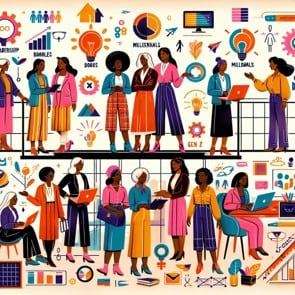
For Black women, generational dynamics add another layer to existing challenges. We navigate not just age differences but how those differences intersect with race and gender.
In “Rise & Thrive: A Black Woman’s Blueprint for Leadership Excellence,” I address how Black women must often be cultural translators. When you add generational translation, the burden multiplies:
Black Boomer Women fought to break down doors, often as “firsts” and “onlys.” They may feel younger generations don’t appreciate the battles fought or maintain professional standards they established through excellence.
Black Gen X Women (my cohort) inherited opened doors but found glass ceilings waiting. We’re simultaneously honoring our Boomer mentors’ sacrifices while trying to create more inclusive paths for younger generations. We’re exhausted from being everyone’s bridge.
Black Millennial Women entered workplaces expecting equality and found it didn’t exist. They’re pushing for change while being told to “wait their turn” by multiple generations.
Black Gen Z Women refuse to accept what previous generations tolerated. They’re demanding authenticity and inclusion from day one, challenging respectability politics that older Black women used for survival.
A Black Gen X HR director shared: “I’m constantly mediating between the Black Boomer women who mentored me and think younger Black women are ‘too bold,’ and Black Millennial and Gen Z women who think I’m ‘too accommodating.’ Meanwhile, I’m trying to create space for all of us while navigating white generational dynamics too. It’s exhausting being everyone’s translator.”
Case Study: TechForward’s Generational Integration Success
TechForward (name changed), a financial technology company, was struggling with generational conflict that particularly affected their diversity goals. Younger diverse talent was leaving, citing lack of advancement, while senior leaders (mostly white Boomers) felt disrespected and undermined.
Working with their leadership team—led by a Black Gen X female COO—we implemented a comprehensive generational bridge-building strategy:
Phase 1: Generational Mapping We analyzed their workforce:
- Senior leadership: 70% Boomers, 30% Gen X (only 5% Black women)
- Middle management: 60% Gen X, 40% Millennials (12% Black women)
- Individual contributors: 45% Millennials, 55% Gen Z (18% Black women)
The insight: Gen X held the key positions for bridging but were burned out and underrecognized.
Phase 2: Bridge-Builder Recognition We formally recognized and rewarded generational bridging work:
- Created “Cultural Translation” competency in performance reviews
- Established “Bridge-Builder Awards” for cross-generational collaboration
- Compensated mentoring and reverse-mentoring time
- Highlighted Gen X contributions in organizational communications
Phase 3: Structured Cross-Generational Collaboration We created formal structures for generational exchange:
- Innovation Labs: Gen Z and Millennials led, Boomers and Gen X advised
- Strategy Councils: Boomers led with mandatory Millennial and Gen Z representation
- Digital Transformation Teams: Gen X led, bridging all generations
- Mentoring Circles: Multi-directional mentoring across generations
Phase 4: Differentiated Communication We adapted communication for generational preferences while maintaining inclusion:
- Important announcements delivered via email (Boomers), Slack (Gen X/Millennials), and video (Gen Z)
- Meetings combined in-person and virtual options
- Recognition given publicly (Millennials/Gen Z) and privately (Boomers/Gen X)
- Feedback provided continuously (younger) and formally scheduled (older)
Results after 18 months:
- Retention increased 40% across all generations
- Black women’s advancement to senior roles increased 60%
- Cross-generational project success rate improved 75%
- Employee satisfaction scores rose 35% across all age groups
- Gen X burnout decreased 50% after bridging work was recognized
- Innovation metrics increased 80% through generational collaboration
Building Bridges: Practical Strategies for Each Generation
For Boomer Leaders:
- Acknowledge Digital Evolution: Partner with younger generations for technology rather than resisting
- Share Stories, Not Just Policies: Your experience has value—share the why behind decisions
- Create Legacy Projects: Mentor emerging leaders to ensure your knowledge transfers
- Embrace Reverse Mentoring: Learn from younger generations’ perspectives
- Recognize Bridge-Builders: Acknowledge Gen X’s translation work
For Gen X Leaders:
- Claim Your Space: Stop being invisible—document and communicate your bridging value
- Set Boundaries: You can’t translate for everyone all the time
- Build Peer Support: Connect with other Gen X leaders who understand the burden
- Leverage Your Position: Use your bridging power to create systemic change
- Mentor Strategically: Focus energy where it has maximum impact
For Millennial Leaders:
- Honor the Path-Makers: Recognize sacrifices previous generations made
- Bridge Forward: Help Gen Z navigate while learning from Boomers and Gen X
- Document Your Value: Track contributions beyond traditional metrics
- Seek Sponsors, Not Just Mentors: Build relationships with decision-makers
- Challenge Respectfully: Push for change while acknowledging context
For Gen Z Professionals:
- Learn the History: Understand why things are before demanding they change
- Find Cultural Interpreters: Identify allies who can help you navigate
- Bring Solutions, Not Just Problems: Pair challenges with recommendations
- Build Relationships Beyond Digital: Master face-to-face connection
- Respect Different Paces: Change takes time—persistence matters
For HR and Senior Leaders:
- Map Your Generational Landscape: Understand your demographic distribution
- Recognize Bridging Work: Make cultural translation a valued competency
- Create Cross-Generational Teams: Intentionally mix generations on projects
- Adapt Communication Strategies: Meet each generation where they are
- Address Intersectional Challenges: Recognize how race and gender compound generational dynamics
The Future of Cross-Generational Leadership
Several trends are reshaping generational dynamics:
The Great Retirement Acceleration COVID-19 accelerated Boomer retirements, creating knowledge gaps and advancement opportunities. Organizations must capture institutional knowledge while creating advancement pathways that don’t skip Gen X.
The Rise of Gen X Leadership As Boomers retire, Gen X is finally ascending to senior roles. We bring unique perspectives on flexibility, technology integration, and work-life balance that can reshape organizational cultures.
Gen Z’s Non-Negotiables The youngest generation won’t compromise on diversity, flexibility, and purpose. Organizations must adapt or lose access to emerging talent.
The Longevity Economy People working longer means five generations in one workplace will become normal. Generational bridging will become a critical leadership competency.
AI and Generational Divides Different generations have vastly different relationships with AI. Gen X’s bilingual capability becomes crucial for helping organizations navigate this divide.
Creating Your Cross-Generational Leadership Strategy
Building effective cross-generational leadership requires intentional design and sustained commitment. Here’s your roadmap:
Assessment Phase:
- Map generational distribution across levels and departments
- Identify where generational conflicts create friction
- Recognize who’s doing bridging work (formally or informally)
- Analyze how generational dynamics affect diversity goals
- Evaluate generational representation in decision-making
Strategy Development:
- Create formal recognition for generational bridging
- Design cross-generational collaboration structures
- Develop differentiated communication strategies
- Build mentoring programs that go multiple directions
- Establish generational diversity metrics
Implementation:
- Launch with transparent communication about goals
- Start with pilot cross-generational projects
- Provide training on generational differences and strengths
- Create safe spaces for generational dialogue
- Celebrate early wins across all generations
Sustainment:
- Regularly assess generational dynamics
- Adjust strategies based on workforce changes
- Continue recognizing bridging work
- Share success stories broadly
- Build generational awareness into leadership development
Discussion Questions for Your Organization:
- Who in your organization is doing the invisible work of generational bridging? How can you recognize and reward them?
- How do generational dynamics in your organization affect traditionally overlooked employees, particularly Black women?
- What knowledge will be lost when Boomers retire? What systems can capture and transfer it?
- How can you leverage Gen X’s unique position to bridge generational divides?
- What would true cross-generational collaboration look like in your organization?
Next Steps for Action:
- Conduct a Generational Audit: Map your workforce demographics and identify bridging gaps
- Recognize Bridge-Builders: Formally acknowledge those doing generational translation work
- Create Cross-Generational Teams: Launch a pilot project mixing all generations
- Develop Generational Intelligence: Train leaders on leveraging generational strengths
- Share This Article: Start conversations about generational dynamics and bridging
Ready to Bridge Your Generational Divides?
At Che’ Blackmon Consulting, we understand that generational diversity is as critical as any other form of diversity. We specialize in helping organizations leverage the unique strengths of each generation while recognizing and rewarding the crucial bridging work that makes collaboration possible.
We partner with organizations ready to:
- Build cultures that value every generation’s contributions
- Recognize and reward generational bridging work
- Create advancement pathways that don’t skip generations
- Develop leaders who can navigate generational complexity
- Implement changes that leverage generational diversity for competitive advantage
Our frameworks have helped organizations increase cross-generational collaboration by 75%, improve retention across all age groups by 40%, and accelerate traditionally overlooked talent into leadership—including the Black Gen X women who’ve been bridging gaps all along.
Ready to transform generational tension into generational synergy?
Contact us today at admin@cheblackmon.com or call 888.369.7243 to schedule a consultation. Let’s explore how your organization can thrive by leveraging the full spectrum of generational talent.
Visit cheblackmon.com to learn more about our services and access resources for building cross-generational leadership excellence.
Because when organizations truly value every generation—especially those doing the bridging work—everyone rises together.
Che’ Blackmon is a Gen X HR Executive, Leadership Development Expert, and author of three books on organizational culture and leadership. With over two decades of experience transforming organizations across multiple industries, she specializes in creating inclusive cultures that leverage generational diversity while recognizing the often-invisible work of bridge-builders.
#GenXLeadership #CrossGenerationalLeadership #GenerationalDiversity #BlackWomenLeaders #WorkplaceBridgeBuilders #GenerationalIntelligence #InclusiveLeadership #CulturalTranslation #DiversityAndInclusion #LeadershipDevelopment #GenerationalCollaboration #HRLeadership #OrganizationalCulture #FutureOfLeadership #BridgingGenerations