


By Che’ Blackmon, DBA Candidate | Founder & CEO, Che’ Blackmon Consulting
📚 Book Tie-In: Mastering a High-Value Company Culture — Culture Architecture Foundations
“Culture is not a perk. It is not a foosball table, a catered lunch, or a wellness stipend. Culture is the operating system of your organization. And just like any operating system, if it is not intentionally designed, it will default to something you never chose.”
Let’s call it what it is. Too many organizations have confused the aesthetics of culture with its architecture. They stack benefits on top of dysfunction and call it engagement. They print values on a lobby wall and wonder why trust is eroding from the inside out. They recruit for diversity and then suffocate it with conformity. Sound familiar?
This is not a criticism of good intentions. It is a call to action for higher standards. Because the organizations that will lead the next decade of business are not the ones with the flashiest perks packages. They are the ones that have done the deep, intentional, sometimes uncomfortable work of building culture from the inside out. That is what High-Value Leadership™ demands. That is what this manifesto is about.

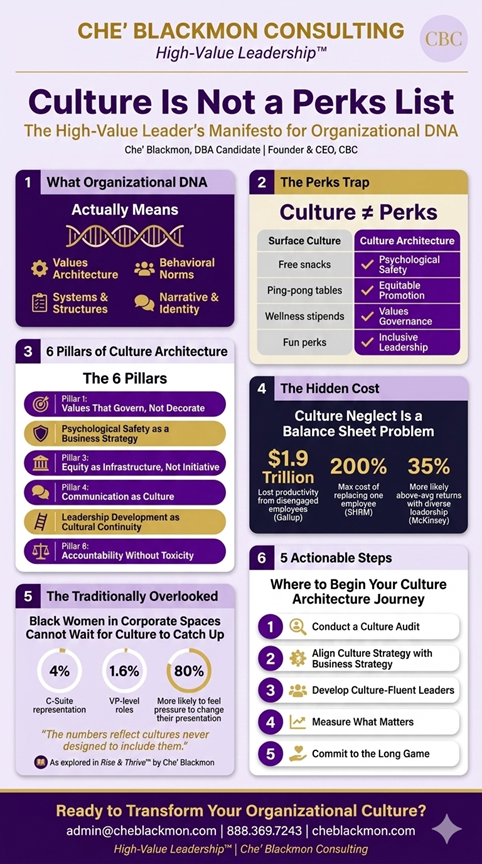
🏛️ What Organizational DNA Actually Means
When biologists talk about DNA, they are describing the fundamental code that determines how an organism grows, functions, and responds to its environment. Organizational DNA works the same way. It is the deep-coded blueprint of how your company makes decisions, treats people, handles adversity, and defines success. And here is the critical truth: every organization already has a culture. The only question is whether leaders built it on purpose or by accident.
In Mastering a High-Value Company Culture, the foundation is clear: culture is the lifeblood of any organization. It encompasses the values, beliefs, attitudes, and behaviors that define the environment where people work. It can be the distinguishing feature that makes a company not just survive but truly thrive. Free snacks and ping-pong tables are great, but that is not what high-value culture really means.
“At the heart of every great company culture is its people. Your employees are not resources; they form the lifeblood of your organization.” — Mastering a High-Value Company Culture
Organizational DNA has four core strands that every High-Value Leader™ must understand and intentionally shape:
- 🧬 Values Architecture: The non-negotiable principles that govern decision-making at every level, not just in the boardroom.
- 🧬 Behavioral Norms: The unwritten rules about how people actually interact, communicate, and treat one another daily.
- 🧬 Systems and Structures: The processes, policies, and organizational design that either reinforce or contradict stated values.
- 🧬 Narrative and Identity: The stories an organization tells about itself, its history, and its people.
When these four strands are aligned and intentional, an organization develops what can only be described as cultural immunity. It becomes resilient in crisis. It attracts and retains top talent. It produces results that outlast any single leader’s tenure. When they are misaligned, the organization bleeds from the inside, regardless of how impressive the benefits package looks on the surface.
🚨 The Perks Trap: How Good Intentions Create a Cultural Illusion
There was a company that invested heavily in its employee experience. State-of-the-art break rooms. Generous PTO. Flexible schedules. Wellness reimbursements. On the surface, this organization looked like a cultural gold standard. But beneath the surface, senior leadership consistently dismissed employee feedback. High-performing women, and particularly women of color, were routinely passed over for advancement. Decisions were made in closed rooms, and the people closest to the work had no voice in shaping it.
Turnover climbed. Engagement scores dropped. The most talented people left. And leadership was genuinely confused. “We give them everything,” was a phrase heard often in those boardrooms. But that is precisely the problem. Culture is not something you give people. It is something you build with them.
⚠️ Perks can attract talent. Only culture can keep it.
Dr. Edgar Schein, one of the foremost organizational culture researchers of the modern era, distinguished between the artifacts of culture (what we can see and touch), the espoused values (what we say we believe), and the underlying assumptions (what we actually believe and act on). The perks trap occurs when organizations invest heavily in artifacts while neglecting the deeper layers. You can refresh the break room and replace the coffee machine all you want. If your underlying assumptions about who belongs, who leads, and whose ideas matter remain unchanged, the culture will reflect those assumptions regardless of the surface upgrades.
🔍 The Five Warning Signs Your Organization Is in the Perks Trap
- Your engagement survey results improve but voluntary turnover remains high.
- Diversity numbers are growing in entry-level roles but stagnant at the leadership level.
- Your stated values are visible everywhere but rarely referenced in actual decisions.
- Managers are promoted based on technical performance rather than cultural leadership.
- Employees describe the culture differently depending on their identity or department.
If any of these resonate, your organization may be investing in the aesthetics of culture while the architecture remains unaddressed. This is not a failure of effort. It is a failure of strategy.
💼 The High-Value Leader’s Manifesto: Six Pillars of Culture Architecture
High-Value Leadership™ is not a title. It is a commitment. It is the decision, made daily, to build organizations where people are not just employed but genuinely empowered. In High-Value Leadership: Transforming Organizations Through Purposeful Culture, this framework is defined through purpose-driven vision, stewardship of culture, emotional intelligence, balanced responsibility, and authentic connection. These are not soft skills. They are strategic competencies that directly impact the bottom line.
Here are the six pillars that form the foundation of intentional culture architecture:
Pillar 1: 🎯 Values That Govern, Not Decorate
Values are only as powerful as the decisions they drive. A High-Value Leader™ ensures that organizational values show up in performance reviews, in how conflict is handled, in who gets promoted, and in how mistakes are addressed. There was a company that embedded its core value of integrity so deeply into its talent management processes that every manager’s annual review included a behavioral assessment scored against that value. When a senior leader was found to have violated it, the consequence was swift and public. The message was unmistakable: the values were real.
This is what values-as-governance looks like in practice. It requires courage and consistency from leadership. Most importantly, it requires alignment between what is written and what is done.
Pillar 2: 🤝 Psychological Safety as a Business Strategy
Google’s landmark Project Aristotle identified psychological safety as the single most important factor in high-performing teams. Not talent density. Not technical skill. Safety. The ability to speak up, take risks, share ideas, and admit mistakes without fear of humiliation or retaliation. Yet psychological safety remains one of the most underdeveloped organizational competencies in corporate America today.
There was a manufacturing organization that implemented what it called “courageous conversation circles” at the team level. Every quarter, teams gathered without their direct manager present to surface what was working, what was not working, and what felt unsafe. The insights gathered transformed not just morale but operational efficiency. Problems that had gone unaddressed for years were solved in weeks because people finally felt safe enough to name them.
- Audit your meeting culture: Who speaks most often? Who never speaks? Why?
- Examine how mistakes are handled at the leadership level. Is there modeling of accountability without shame?
- Create structured channels for candid feedback that do not require bravery to access.
Pillar 3: 📈 Equity as Infrastructure, Not Initiative
Equity is not a program. It is not a training module rolled out in February during Black History Month and then shelved until the following year. Equity is infrastructure. It is built into how roles are scoped, how compensation is set, how performance is evaluated, and how leadership pipelines are developed. When equity is treated as an initiative, it remains optional. When it is treated as infrastructure, it becomes structural.
Research from McKinsey & Company consistently demonstrates that organizations in the top quartile for racial and ethnic diversity are 35 percent more likely to experience above-average financial returns. This is not a moral argument alone, though the moral case is compelling. This is a performance argument.
Pillar 4: 🗣️ Communication as Culture
The way an organization communicates is its culture made audible. Are employees informed or left to guess? Are feedback loops bidirectional or one-way? Are difficult conversations had directly or gossiped around? Every communication pattern either reinforces or erodes the cultural DNA you are trying to build.
One of the most immediate interventions a leader can make is to audit the organization’s communication architecture. This includes not just what is communicated but how, by whom, at what frequency, and through which channels. Transparency builds trust. Consistency builds credibility. Both are foundational to a high-value culture.
Pillar 5: 🌱 Leadership Development as Cultural Continuity
Culture does not sustain itself. It is transmitted, modeled, and reinforced by the leaders an organization grows and promotes. This means that leadership development is not an HR function. It is a cultural strategy. Who you develop for leadership tells your organization everything about what you actually value.
There was a company that invested in a two-year leadership pipeline program specifically designed to develop mid-level managers from underrepresented backgrounds. The program included executive sponsorship, cross-functional project leadership, and coaching. Within three years, the organization saw measurable improvements in engagement scores in departments led by program graduates and a significant reduction in attrition among their direct reports. The investment in people translated directly into cultural strength and business results.
Pillar 6: 🔄 Accountability Without Toxicity
High standards and psychological safety are not opposites. They are partners. A high-value culture holds people accountable not through fear and public humiliation but through clear expectations, consistent feedback, and genuine investment in people’s growth. When accountability is delivered with dignity, it elevates performance. When it is weaponized, it destroys trust and drives away talent.
The goal is what can be described as a “courage culture”, one where leaders have the courage to set high standards and the humility to support people in meeting them. This requires emotional intelligence, relational trust, and a deep belief that people are fundamentally capable of growth.
💑 The Hidden Cost: What Culture Neglect Costs Organizations
Let’s talk numbers. Because culture is not just a human issue. It is a financial one.
According to Gallup’s State of the Global Workplace report, actively disengaged employees cost the U.S. economy an estimated $1.9 trillion in lost productivity annually. The Society for Human Resource Management estimates that replacing an employee costs between 50 percent and 200 percent of that employee’s annual salary. Add to this the hidden costs of absenteeism, presenteeism, poor customer experience, innovation stagnation, and reputational damage, and the business case for intentional culture investment becomes undeniable.
Culture neglect is not a soft problem. It is a balance sheet problem.
“A high-value culture routinely creates value for employees, customers, shareholders, and the community at large. That kind of culture does not happen by accident.” — Mastering a High-Value Company Culture
There was a mid-size company in the professional services sector that experienced a 43 percent annual turnover rate for three consecutive years. Leadership attributed the problem to compensation. When a deeper culture audit was conducted, the real drivers emerged: managers who were promoted without regard for their people leadership capabilities, a communication style from senior leadership that was inconsistent and often dismissive, and a complete absence of psychological safety at the individual contributor level. When the culture work began in earnest, turnover dropped to 18 percent within 18 months. The financial impact was significant. The human impact was even greater.
✊🏽 The Traditionally Overlooked: Why Black Women in Corporate Spaces Cannot Wait for Culture to Catch Up
Any honest conversation about organizational culture must include an honest conversation about who that culture was built for and who it has historically excluded. The data does not lie, and neither does lived experience.
As explored in Rise & Thrive: A Black Woman’s Blueprint for Leadership Excellence, Black women in corporate America navigate what researchers call “double jeopardy,” facing bias and barriers related to both race and gender simultaneously. Despite making up approximately 7.4 percent of the U.S. population, Black women hold just 4 percent of C-suite positions, 1.6 percent of VP roles, and 1.4 percent of executive and senior-level positions in Fortune 500 companies.
These numbers are not a reflection of ambition, capability, or effort. Research consistently shows that Black women are more likely than white women to aspire to leadership roles and to take proactive steps toward promotion. The numbers reflect something else entirely. They reflect organizational cultures that were never intentionally designed to include, develop, or advance Black women at every level.
“You encounter microaggressions that your white female or Black male colleagues might not experience. The cognitive and emotional labor required to navigate these contradictions creates an additional workload that remains largely invisible to others.” — Rise & Thrive
📉 The Cultural Tax Black Women Pay
In cultures that were not designed with inclusion as infrastructure, Black women often pay what can be described as a cultural tax. This tax takes many forms. It is the energy spent code-switching in order to be taken seriously in professional environments. It is the emotional labor of managing microaggressions while simultaneously delivering excellent work. It is the invisible weight of being the only one in the room and feeling responsible for representing an entire community while also being made to feel that your presence is conditional.
This tax is real. It is measurable. And it is a direct product of cultural neglect at the organizational level.
There was a company whose engagement survey revealed high satisfaction scores organization-wide but significant disparities when data was segmented by race and gender. Black women scored notably lower on questions related to belonging, advancement opportunity, and psychological safety. When leadership chose to look at the disaggregated data and respond to what it revealed, the culture work that followed was transformative. Affinity groups were given real resources and executive sponsorship. Promotional processes were redesigned with structured equity reviews. Managers received training on sponsorship versus mentorship. The results were measurable and lasting.
The lesson is clear. Inclusive culture is not a separate agenda from organizational culture. It is organizational culture. A culture that works only for some of the people, some of the time, is not a high-value culture. It is a high-cost culture that is subsidized by the people it excludes.
💡 What High-Value Leaders Do Differently for Underrepresented Talent
- They sponsor, not just mentor. Mentors give advice. Sponsors use their political capital to advocate.
- They disaggregate engagement data. They refuse to hide disparities behind average scores.
- They examine promotion processes for structural bias, not just individual bias.
- They create visibility opportunities for high-potential employees who may not self-promote due to cultural norms around humility.
- They listen to the stories behind the data, then act on what they hear.
📊 Current Trends Shaping Culture Architecture in 2024 and Beyond
The conversation around organizational culture is evolving rapidly. High-Value Leaders™ who want to remain ahead of the curve must understand the forces reshaping the cultural landscape.
🤖 AI and the Human Element of Culture
Artificial intelligence is transforming how organizations operate. Predictive analytics are being used to identify flight risks, engagement trends, and skills gaps before they become crises. But the most forward-thinking organizations understand that AI is a tool for culture intelligence, not a replacement for culture leadership. The data can tell you what is happening. Only humans can address why and lead the change.
🏠 The Hybrid Workplace Culture Challenge
Hybrid and remote work arrangements have fundamentally disrupted many of the informal mechanisms through which culture is transmitted. Hallway conversations, spontaneous collaboration, and visible modeling of values are harder to replicate in virtual environments. Organizations that are thriving in this landscape are those that have deliberately redesigned their culture touchpoints for distributed teams, creating intentional rituals, rhythms, and structures that reinforce connection and belonging regardless of physical location.
🌎 The Rise of the Purpose-Driven Workforce
Increasingly, workers at every level are making employment decisions based on organizational purpose and values alignment. Deloitte’s research consistently shows that purpose-driven companies report higher levels of innovation, customer satisfaction, and employee engagement. For Gen Z and Millennial employees in particular, a company’s public commitments around equity, sustainability, and community impact are becoming as important as compensation in talent decisions.
This trend makes culture architecture even more urgent. Because the workforce that will power the next decade of business development is watching not just what organizations say they value, but what those organizations actually do.
✅ Actionable Takeaways: Where to Begin Your Culture Architecture Journey
Culture transformation does not require a complete organizational overhaul overnight. It requires intentional, consistent action over time. Here is where to start:
🔎 Step 1: Conduct a Culture Audit
Before you build anything, you must understand what already exists. A meaningful culture audit examines not just survey scores but the stories employees tell, the decisions leadership makes under pressure, the patterns in who advances and who does not, and the gap between stated values and experienced reality. Disaggregate your data by race, gender, tenure, and level. The gaps in that disaggregated data will tell you everything.
🎯 Step 2: Align Culture Strategy with Business Strategy
Culture is not separate from business strategy. It is the enabler of business strategy. Identify the two or three cultural capabilities your organization needs most to execute on its strategic goals, and build your culture initiatives around those specific capabilities. This creates alignment between leadership, HR, and the rest of the organization.
🤝 Step 3: Develop Culture-Fluent Leaders
The single greatest leverage point in culture transformation is the quality of people managers throughout the organization. Invest in developing managers who understand their role as culture carriers, not just task supervisors. This means equipping them with skills in coaching, feedback delivery, inclusive leadership, and psychological safety practices.
📊 Step 4: Measure What Matters
What gets measured gets managed. Build a culture scorecard that tracks leading indicators of cultural health: inclusion index scores, internal mobility rates, disaggregated engagement and belonging scores, leadership development pipeline diversity, and voluntary turnover by demographic segment. Review these metrics with the same rigor you apply to financial dashboards.
🔄 Step 5: Commit to the Long Game
Culture transformation is not a quarter-long initiative. It is a multi-year commitment that requires sustained leadership attention, consistent resource investment, and the organizational humility to revisit and recalibrate as you learn. The organizations that get this right are the ones that never stop building.
🔬 Research Corner: What the Data Says
The research supporting intentional culture investment is robust and growing. Here are a few data points that every leader should know:
- Harvard Business Review research found that organizations with strong cultures saw a 4x increase in revenue growth compared to organizations with weak cultures over an 11-year period.
- Gallup reports that managers account for at least 70 percent of the variance in employee engagement scores. The individual manager is the culture architect at the team level.
- McKinsey & Company found that companies in the top quartile for gender diversity are 25 percent more likely to achieve above-average profitability.
- The Center for Talent Innovation reported that Black women in the United States are 80 percent more likely than white women to agree that they need to change how they present themselves in order to be viewed as leadership material. This statistic is a cultural indictment, not a talent deficit.
- Deloitte’s Global Human Capital Trends report found that 94 percent of executives and 88 percent of employees believe a distinct workplace culture is important to business success. Yet less than 20 percent report their culture as “highly effective.”
The gap between knowing and doing is where culture strategy lives. High-Value Leaders™ close that gap with intention, consistency, and courage.
💬 Discussion Questions for Leaders and Teams
Use these questions to spark honest conversations in your organization:
- If you removed all of the visible perks and benefits from your organization, what would remain? How would employees describe the culture they experience?
- When you look at your last 10 promotion decisions, what patterns emerge? Who advances in your organization, and what does that signal about your cultural values?
- How would underrepresented employees in your organization describe their experience of belonging, advancement opportunity, and psychological safety? Do you actually know?
- What story does your organization tell about itself? Does that story match the story your employees tell about it?
- What would it cost your organization, in real financial terms, if your culture remains unchanged for the next three years?
- Who in your organization is paying the cultural tax described in this article? What would it take to eliminate that tax?
🚀 Next Steps for Readers
Reading is the beginning. Application is the transformation. Here is how to move from insight to action:
- Share this article with at least one leader in your organization and commit to a conversation about one idea it surfaces.
- Pick one of the five actionable steps above and identify a specific action you will take in the next 30 days.
- Order your copies of Mastering a High-Value Company Culture and High-Value Leadership: Transforming Organizations Through Purposeful Culture for the deeper framework and tools behind every principle discussed here.
- If you are a Black woman navigating or leading in corporate spaces, Rise & Thrive: A Black Woman’s Blueprint for Leadership Excellence was written specifically for your journey. It is available now.
- Assess your organization’s current culture honestly. Not the culture you aspire to have. The one you actually have. That honest assessment is the only place transformation can begin.
🤝 Ready to Transform Your Organizational Culture?
Che’ Blackmon Consulting partners with organizations and leaders who are ready to move beyond perks and into purposeful culture architecture. Through fractional HR strategy, culture diagnostics, leadership development, and the High-Value Leadership System™, CBC delivers the insight, infrastructure, and implementation support that transforms organizations from the inside out.
Whether you are a C-suite executive, an HR leader, a people manager, or an entrepreneur building a company with culture at its core, Che’ Blackmon Consulting has the frameworks, the research, and the real-world expertise to meet you where you are and take your organization where it needs to go.
📧 admin@cheblackmon.com
📞 888.369.7243
🌐 cheblackmon.com
© Che’ Blackmon Consulting | High-Value Leadership™ | All Rights Reserved
#HighValueLeadership #CultureTransformation #OrganizationalDNA #HRLeadership #WorkplaceCulture
#LeadershipDevelopment #BlackWomenLead #InclusiveLeadership #DEI #EmployeeEngagement
#CompanyCulture #HRStrategy #PurposeDrivenLeadership #ExecutiveLeadership #CheBlackmon
#FractionalHR #CultureFirst #LeadershipMatters #WorkplaceEquity #HighValueCulture