


By Che’ Blackmon, DBA Candidate | Founder & CEO, Che’ Blackmon Consulting
For decades, HR professionals have operated in a perpetual state of reaction. A grievance lands on the desk and they respond. Turnover spikes unexpectedly and they scramble. A culture crisis erupts and they are called to fix what no one bothered to prevent. The work has always been urgent, always important, and chronically under-resourced. That is the firefighting mode that most HR teams know all too well.
But the landscape is shifting. Dramatically. Artificial intelligence is not a distant future concept sitting in a tech industry brochure. It is already inside the tools, platforms, and systems that forward-thinking HR departments are using today to move from reactive crisis management to proactive, predictive strategy. The transformation is not just technological. It is philosophical.
This article is for every HR leader, organizational executive, and people-first practitioner who knows that great culture does not happen by accident. It is built with intention, informed by data, and sustained by leadership that refuses to accept the status quo. It is also for the Black women in HR and executive spaces who have always carried the weight of both the work and the invisible labor of navigating that work in environments not designed with them in mind. Because when AI is deployed with equity at its center, it has the power to level a field that has been tilted for far too long.
The shift from firefighting to forecasting is not just possible. It is happening now. And the organizations that embrace it will not simply survive the next wave of workplace disruption. They will lead it.

🔥 The State of HR: Still Fighting Fires in a Digital Age
Let us be honest about where most HR functions still live. Despite the proliferation of HR technology platforms, many teams remain buried in transactional work. Benefits administration. Compliance tracking. Employee relations firefighting. Performance documentation that happens after the fact rather than shaping what comes next. The irony is painful: the function most responsible for human potential is often the one with the least capacity to think strategically about it.
According to Gartner, HR leaders consistently rank talent acquisition, employee experience, and leadership development as their top priorities. Yet the same research shows that HR teams spend the majority of their time on administrative and compliance tasks rather than strategic work. The gap between where HR needs to be and where it actually operates is widest in organizations that have not invested in intelligent automation and predictive analytics.
There was a mid-size manufacturing company that spent an entire fiscal year reacting to elevated voluntary turnover in its production workforce. Exit interviews revealed patterns that had been present for more than eighteen months before leadership took notice. The data existed. The signals were there. But without a system designed to surface and analyze that information proactively, the pattern went unseen until the damage was already done. That story is not unique. It is the rule rather than the exception across industries.
| 💡 Key Insight: “Culture is the lifeblood of any organization.” But culture cannot be managed by instinct alone. When HR operates reactively, the organization’s most important asset, its people, is perpetually at risk. — Mastering a High-Value Company Culture by Che’ Blackmon |
The shift to AI-powered forecasting does not eliminate the human element of HR. It amplifies it. It frees practitioners to focus on what only humans can do: build trust, hold culture, develop leaders, and design environments where people genuinely thrive. That is the promise of this technology. And it is a promise worth understanding deeply.
🤖 What AI in HR Actually Means: Cutting Through the Noise
The term artificial intelligence gets thrown around so broadly that it has started to lose meaning in many professional conversations. For HR leaders, it is worth establishing a clear and practical understanding of what AI actually is in this context, because the tools available today range widely in sophistication, purpose, and impact.
🔍 Natural Language Processing and People Analytics
Natural language processing allows AI systems to read, interpret, and analyze written or spoken human communication. In HR, this technology powers tools that can analyze open-ended survey responses, exit interview transcripts, and employee feedback at scale, surfacing themes, sentiment, and risk factors that would take a human analyst weeks to identify. What once required a consultant and a conference room now happens automatically and continuously.
People analytics platforms go a step further, combining structured HR data with unstructured input to generate predictive insights. Which employees are most likely to leave in the next six months? Which teams are showing early signs of disengagement? Which managers have the highest retention rates and what behaviors predict that outcome? These are questions that AI-powered analytics can now answer with reasonable accuracy, enabling HR to intervene before a problem becomes a crisis.
📊 Predictive Workforce Planning
Workforce planning has historically been an annual exercise driven by budget cycles and headcount projections. AI changes the timeline and the depth. Machine learning models can now analyze historical hiring data, skills inventories, industry trends, and internal mobility patterns to forecast future talent needs with far greater precision. Organizations that deploy these tools can begin building pipelines for roles that do not yet exist in their org charts, positioning themselves to respond to market changes with agility rather than urgency.
There was an organization in the logistics sector that integrated predictive workforce planning into its operations after experiencing repeated gaps in its skilled technician pipeline. Within two years, the average time to fill critical roles dropped significantly because recruitment was happening twelve to eighteen months before the vacancy appeared rather than thirty days after it opened. The shift did not require a bigger HR team. It required a smarter one.
🧠 AI-Powered Recruitment and Bias Detection
Hiring is one of the highest stakes decisions an organization makes repeatedly, and it is also one of the most susceptible to bias. AI-powered applicant tracking systems and assessment tools can help standardize evaluation criteria, reduce inconsistency in screening decisions, and flag patterns in hiring data that suggest inequitable outcomes. When used responsibly, these tools can create more objective entry points into organizations for candidates who have historically been screened out by systems that rewarded familiarity over merit.
This is an area where intentionality is non-negotiable. AI tools in recruitment can just as easily amplify bias as reduce it if they are trained on historical data that reflects past inequities. The technology is not inherently equitable. The responsibility for equitable application rests entirely with the humans who design, select, and govern these systems. That is a critical distinction for every HR leader and organizational executive to understand.
📋 Learning, Development, and Skills Intelligence
AI is also reshaping how organizations approach learning and development. Intelligent platforms can now assess individual skill gaps in real time, recommend personalized learning pathways, and track development progress in ways that traditional annual training programs never could. For organizations committed to growing talent from within, these tools create more visible and accessible pathways to advancement, particularly for employees who have historically been overlooked for development opportunities.
🖤 The Equity Question: Who Does AI Serve in the Workplace?
Any honest conversation about AI in HR must include a direct examination of equity. Because AI does not enter organizations as a neutral force. It arrives loaded with the assumptions, data, and design choices of the humans and institutions who built it. And historically, those assumptions have not centered the experiences or interests of Black women, women of color, or other marginalized groups in the workplace.
The research is clear on this point. A landmark study by researchers at MIT and Stanford found that commercial facial recognition systems performed significantly worse on darker-skinned women than on lighter-skinned men. While facial recognition in hiring is a narrow application, the finding points to a broader pattern: AI systems that are built without diverse data and diverse design teams reproduce and often amplify existing inequities.
For Black women in corporate spaces, this is not an abstract concern. It is a daily professional reality. Black women are already navigating what researchers call the triple bind of gender, racial, and often age bias in organizational settings. When AI tools are added to that environment without an equity audit, without inclusive design, and without accountability structures, they become another layer of systemic disadvantage rather than a pathway to opportunity.
🏼 The Flip Side: When AI Gets Equity Right
Here is the counterpoint, and it is a powerful one. When AI is deployed with intentionality, transparency, and equity at the center of its design and governance, it has the potential to do something that purely human systems have struggled to do: remove the discretionary moments where bias most easily enters the process.
Structured, AI-assisted interview scorecards that evaluate all candidates on identical criteria reduce the influence of affinity bias in early screening. Blind resume review tools that strip identifying information from applications before they reach a hiring manager have been shown to increase the diversity of candidate pools. Pay equity analytics tools that surface unexplained compensation disparities by race and gender create an accountability structure that subjective manager reviews could never provide.
As explored in Rise and Thrive: A Black Woman’s Blueprint for Leadership Excellence, the barriers facing Black women in leadership are structural, not personal. They are embedded in the systems organizations use to hire, evaluate, develop, and promote their people. AI, when designed and governed well, can interrupt those systems at their most consequential moments. That is not a small thing. It is transformational.
| 📌 “The path to leadership excellence as a Black woman isn’t about fitting into existing structures. It’s about bringing your unique perspective, experiences, and talents to transform those structures.” — Rise & Thrive: A Black Woman’s Blueprint for Leadership Excellence |
🔍 What Responsible AI Governance Looks Like in HR
Every organization that deploys AI tools in people-related decisions has an obligation to govern those tools responsibly. This is not a technology question. It is a leadership question. Responsible AI governance in HR includes the following practices.
- Regular algorithmic audits to assess whether AI tools are producing equitable outcomes across race, gender, age, and other protected categories.
- Transparent communication with employees about what data is being collected, how it is being used, and what decisions it informs.
- Human override protocols that ensure no consequential employment decision, hiring, promotion, termination, or compensation, is made solely by an algorithm without human review.
- Diverse AI governance teams that include HR professionals, legal counsel, data scientists, and employee representatives from across the organization.
- Ongoing vendor accountability that holds technology providers responsible for the equity performance of their tools, not just their technical functionality.
🔬 AI Tools That Are Actually Changing HR Practice
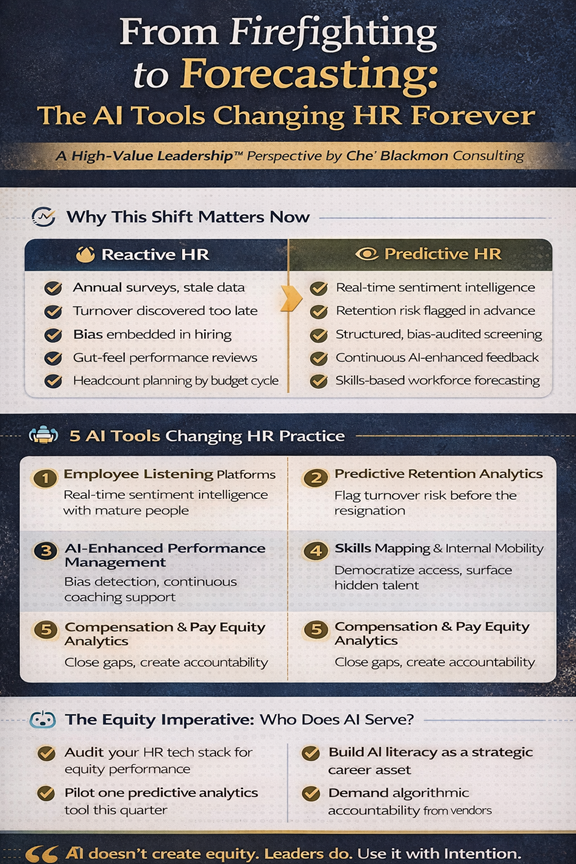
Let us move from concept to concrete. There are specific categories of AI tools that are already demonstrating measurable impact in HR functions across industries. Each of these represents an opportunity for organizations to shift from reactive people management to proactive people strategy.
📡 1. Employee Listening and Sentiment Intelligence Platforms
Traditional employee engagement surveys are conducted annually, analyzed slowly, and acted upon even more slowly. By the time an organization receives its results and develops a response plan, the employees who gave the feedback have often already disengaged or departed. AI-powered listening tools change this cycle fundamentally.
Platforms in this category use natural language processing to analyze ongoing feedback from pulse surveys, communication channels, and open-ended responses. They surface trending themes, flag sentiment shifts in real time, and identify at-risk groups before disengagement becomes departure. When integrated into a broader HR strategy, they allow leaders to respond to what their people are actually experiencing, not what an annual survey captured six months ago.
There was a professional services firm that implemented a continuous listening platform across its regional offices and within the first quarter identified a clear pattern of disengagement among its mid-level project managers, a group that had not surfaced as a concern in the previous year’s engagement survey. The platform’s ability to detect emerging trends before they became crises gave leadership the time to respond with targeted interventions rather than expensive replacement hiring.
🎯 2. Predictive Retention Analytics
Turnover is one of the most expensive and preventable problems in organizational life. The Society for Human Resource Management estimates that the cost of replacing an employee can range from fifty percent to more than two hundred percent of that employee’s annual salary, depending on role complexity and organizational level. For organizations losing high-performing talent consistently, the financial and cultural toll is enormous.
Predictive retention analytics platforms use machine learning to identify the combination of factors that historically precede voluntary departure in a specific organization: tenure, performance trajectory, manager relationship quality, compensation competitiveness, promotion velocity, and more. When these signals converge in a particular pattern, the system generates an alert that allows HR and managers to intervene before the resignation letter is written.
The power of this tool is not just in the prediction. It is in what organizations do with it. The prediction is only valuable if there is a culture that supports meaningful retention conversations, equitable development opportunities, and manager accountability for employee experience. That is where the High-Value Leadership™ framework becomes essential. Data can surface the problem. Only great leadership can solve it.
| 💡 From High-Value Leadership: Transforming Organizations Through Purposeful Culture: “High-value leadership is about creating environments in which both humans and organizations can thrive together.” Predictive analytics identifies where that environment is failing. Leadership creates the conditions for it to succeed. |
💼 3. AI-Enhanced Performance Management
Annual performance reviews are widely recognized as one of the least effective people management practices still in common use. They are backward-looking, susceptible to recency bias, and often disconnected from the ongoing coaching and development conversations that actually drive performance improvement. AI is helping organizations redesign this process fundamentally.
AI-enhanced performance tools support continuous feedback loops, flag when performance conversations are not happening at the expected frequency, analyze language in written reviews to identify bias patterns, and connect individual performance data to broader team and organizational outcomes. For managers who need support developing their coaching skills, these platforms can also recommend specific conversation frameworks based on an employee’s developmental stage and performance history.
The equity dimension here is significant. Research from McKinsey has documented that Black employees and employees of color receive less specific and less actionable performance feedback than their white peers, a disparity that has direct consequences for promotion rates and career trajectory. AI tools that flag vague, unsubstantiated, or inconsistent performance narratives can help HR leaders identify and correct these patterns before they compound into systemic inequity.
🧩 4. Workforce Skills Mapping and Internal Mobility
One of the most underutilized opportunities in organizational life is internal talent mobility. Most organizations have employees with skills, potential, and ambition that their current roles do not fully activate. They fill external roles at significant cost while the talent they need is already sitting in their workforce, unseen and underdeveloped.
AI-powered skills mapping platforms create dynamic, real-time inventories of the capabilities that exist within an organization. They match employee skill profiles to open roles, development programs, and project opportunities in ways that surface connections a human recruiter or HR generalist might never make. They also identify skills gaps at the workforce level, informing learning and development strategy with precision rather than assumption.
For organizations committed to equity, internal mobility tools represent an opportunity to democratize access to advancement. Historically, internal promotion has depended heavily on visibility, sponsorship, and informal networks, all systems that tend to advantage people who are already well connected within the organization. When internal opportunities are surfaced through objective skills matching rather than who someone knows, the field becomes measurably more level.
💰 5. Compensation Analytics and Pay Equity Tools
Pay equity is one of the most consequential and least consistently addressed issues in organizational life. Black women earn approximately sixty-seven cents for every dollar earned by white non-Hispanic men according to data from the National Women’s Law Center. This gap persists even when controlling for education, experience, and industry, pointing to systemic rather than circumstantial causes.
AI-powered compensation analytics tools give HR leaders the ability to conduct ongoing pay equity analyses rather than waiting for a lawsuit or an annual audit to surface disparities. These platforms can identify unexplained pay gaps by race, gender, and other demographic categories, trace the organizational decisions that contributed to those gaps over time, and recommend specific remediation pathways. For organizations serious about closing the equity gap, these tools are not optional. They are essential.
📊 The High-Value Leadership™ Framework and AI: A Natural Partnership
The five pillars of the High-Value Leadership™ framework are Purpose-Driven Vision, Stewardship of Culture, Emotional Intelligence, Balanced Responsibility, and Authentic Connection. Each of these pillars is strengthened, not replaced, by the intelligent application of AI in organizational practice.
🎯 Purpose-Driven Vision
When leaders have access to predictive workforce data, real-time culture insights, and skills intelligence, they can articulate and pursue an organizational vision with far greater clarity and confidence. Purpose becomes actionable because strategy is no longer built on instinct alone. It is built on insight.
🏛️ Stewardship of Culture
Culture cannot be stewarded if it is not measured. AI-powered listening tools give leaders continuous visibility into the health of their organizational culture, the alignment between espoused values and lived experience, and the early warning signs of cultural erosion. Stewardship of culture in the AI era means using those tools with consistency and acting on what they reveal with integrity.
🧠 Emotional Intelligence
Some leaders worry that AI will replace the human dimension of people leadership. The opposite is true. When AI handles the transactional and analytical work that used to consume HR professionals, it creates more space for the high-touch, emotionally intelligent leadership that no algorithm can replicate. Coaching conversations. Trust building. Authentic connection across difference. These become the primary currency of great leadership in an AI-enhanced environment.
⚖️ Balanced Responsibility
Balanced Responsibility in the High-Value Leadership™ framework means holding people accountable while creating environments of psychological safety. AI tools that make performance expectations transparent, feedback more consistent, and development opportunities more accessible contribute directly to this balance. They remove ambiguity from the accountability equation while freeing leaders to focus on the relational elements that sustain a high-performing culture.
🤝 Authentic Connection
There is a concern worth naming directly: that AI makes the workplace more transactional and less human. This concern is legitimate if AI is deployed without intentionality. When leaders use AI insights as a starting point for genuine connection rather than a substitute for it, the technology deepens rather than dilutes the relational fabric of the organization. The data tells you who is struggling. The leader decides to pick up the phone.
🚀 Current Trends and What They Mean for HR Leaders
🌍 Trend 1: Generative AI Is Entering the HR Workflow
Generative AI tools are now being used to draft job descriptions, create personalized onboarding content, generate learning materials, and summarize employee feedback at scale. For HR teams that are chronically understaffed and under-resourced, these applications represent a meaningful productivity gain. They also raise important questions about accuracy, bias, and the appropriate level of human review for AI-generated content in people-critical processes.
📱 Trend 2: The Rise of Real-Time Culture Intelligence
Organizations are moving away from point-in-time culture assessments and toward continuous, real-time culture intelligence. This shift reflects a growing recognition that culture is not a static artifact that can be measured annually. It is a living system that changes with every hiring decision, every leadership behavior, and every organizational policy. AI makes continuous measurement possible at a scale and depth that human analysis alone cannot match.
🤝 Trend 3: Skills-Based Organizations Are Growing
One of the most significant structural shifts in workforce strategy is the move toward skills-based organizations, companies that organize work, hiring, and development around skills rather than traditional job titles and credentials. AI is the enabling technology for this shift. Without the ability to assess, map, and match skills dynamically and at scale, a skills-based organization model is not operationally feasible. For professionals who have been historically disadvantaged by credential-based hiring, this shift represents a meaningful opportunity.
🔒 Trend 4: AI Ethics and Governance Are Becoming Board-Level Issues
The governance of AI in organizational settings is no longer a conversation confined to HR and IT departments. Boards of directors, investors, and regulators are increasingly scrutinizing how organizations deploy AI in decisions that affect people’s livelihoods. For HR leaders, this means that the function now has a strategic stake in enterprise AI governance discussions, not just an operational one. It is a seat at the table that has been earned by the very nature of what HR does.
📋 Actionable Takeaways: Your Path from Firefighting to Forecasting
For HR Leaders and Practitioners:
- 🔥 Audit your current HR technology stack. Identify where you are spending time on work that AI-powered automation could handle, and where strategic, human-centered work is being crowded out by transactional demands.
- 📊 Start with one predictive analytics use case. Retention analytics or employee sentiment intelligence are strong starting points. Pilot a tool, measure its equity performance, and build organizational confidence before expanding.
- 🔍 Build your AI literacy. You do not need to be a data scientist to govern AI responsibly. But you do need to understand what questions to ask about the tools you are evaluating and deploying. Seek out training, certification, and peer learning in this area.
- ⚖️ Advocate for equity-centered AI governance. Push for algorithmic audits, diverse governance teams, and transparent communication about AI use in your organization. This is not just good ethics. It is good risk management.
- 📞 Use data to earn the strategic seat you deserve. When HR can forecast workforce needs, predict cultural risk, and demonstrate the financial impact of people strategy decisions, it becomes impossible to relegate to a purely administrative function.
For Black Women in HR and Executive Leadership:
- 💥 Name AI equity as a professional priority. You bring lived expertise in navigating inequitable systems that most of your peers simply do not have. That expertise is invaluable in AI governance conversations. Claim your seat at that table.
- 📚 Invest in AI literacy as a career accelerator. The intersection of HR expertise and AI fluency is one of the most valuable professional skill combinations in today’s market. Developing both positions you for leadership opportunities that most of your peers are not yet equipped to pursue.
- 🤟 Advocate for the communities behind the data. When pay equity analyses surface disparities, when retention analytics reveal that certain demographic groups are leaving at higher rates, be the leader who not only names the finding but drives the structural response.
For Organizational Leaders and Executives:
- 🎯 Invest in HR technology as a strategic capability. HR technology investment is not an administrative budget line item. It is a strategic investment in your organization’s ability to forecast, plan, and compete for talent in an increasingly complex market.
- 🔍 Demand equity performance metrics from your AI vendors. Ask vendors to demonstrate how their tools perform across demographic groups. If they cannot answer that question, that is your answer.
- 🧩 Fund internal AI governance infrastructure. Responsible AI deployment requires dedicated resources: diverse governance teams, regular audits, and clear escalation protocols for when AI outputs are questioned or challenged.
🗣️ Expert Insights: The Research Behind the Revolution
The evidence supporting AI-enhanced HR practice is both compelling and growing across disciplines.
- Deloitte Insights reports that organizations with mature people analytics capabilities are twice as likely to improve their recruitment efforts, eight times more likely to recognize their employees, and three times more likely to realize cost reductions compared to organizations with limited analytics maturity.
- The IBM Institute for Business Value found that companies using AI for HR functions report a fifty percent reduction in time-to-hire and a thirty percent reduction in employee turnover when predictive analytics are integrated into talent strategy.
- McKinsey Global Institute research indicates that AI and automation could displace between four hundred million and eight hundred million jobs globally by 2030. The organizations best positioned to navigate this disruption are those that are already investing in workforce intelligence, skills mapping, and reskilling infrastructure.
- Harvard Business Review research on algorithmic hiring found that structured, AI-assisted screening processes can reduce the influence of implicit bias in hiring by up to fifty percent when properly designed and governed, making them a meaningful equity intervention when used intentionally.
The research does not suggest that AI is a silver bullet for the systemic challenges organizations face in managing their people. It suggests that organizations which pair AI capabilities with strong leadership, intentional culture work, and genuine equity commitment will outperform those that treat people strategy as either a purely human or purely technological exercise. The most powerful approach is integrative. It always has been.
🤔 Discussion Questions for Reflection and Action
Whether you are an HR practitioner, a C-suite leader, or a professional navigating these shifts as an individual contributor, these questions are designed to move your thinking from awareness to action.
- How would you honestly characterize your organization’s current HR function: primarily reactive, beginning to shift toward proactive, or genuinely predictive? What evidence leads you to that assessment?
- What is one area of your people strategy where data has historically been absent or underused? What would change in your decision-making if you had predictive intelligence in that area?
- If your organization were to conduct an equity audit of its current HR technology tools today, what do you think it would find? Would you be comfortable publishing those results publicly?
- How is your organization ensuring that Black employees, women, and other historically marginalized groups are represented in AI governance decisions that affect their employment outcomes?
- What is your personal AI literacy level as an HR or executive leader? What one step could you take in the next ninety days to strengthen it?
- The High-Value Leadership™ framework centers culture as a living system that leaders must actively steward. How does or should AI change the way your organization measures and manages its culture in real time?
- If you could eliminate one reactive HR process from your organization tomorrow and replace it with a predictive one, what would it be? What would it take to make that shift?
📈 Next Steps: Moving from Awareness to Action
If You Are an Individual HR Leader or Practitioner:
- Begin with a personal AI literacy audit. Identify your current knowledge level and one course, certification, or community of practice that will advance it.
- Read Mastering a High-Value Company Culture as a foundational framework for understanding how culture intelligence and people strategy connect.
- Identify one predictive analytics tool in your current technology stack that you are not using to its full capability, and commit to learning and deploying it within the next quarter.
- Join the conversation about AI equity in HR by participating in professional community discussions, writing about your perspective, or raising the topic in your own organization.
If You Lead an Organization:
- Commission an AI equity audit of your current HR technology ecosystem within the next two quarters.
- Invest in your HR team’s analytics capability through structured training, external expertise, or fractional HR leadership that brings immediate strategic capacity.
- Establish a cross-functional AI governance team that includes HR, legal, data science, and employee representation before expanding AI use in people-related decisions.
- Read High-Value Leadership: Transforming Organizations Through Purposeful Culture to ground your AI strategy in the leadership principles that make technology investments deliver on their human potential.
| 📚 Books by Che’ Blackmon • Mastering a High-Value Company Culture • High-Value Leadership: Transforming Organizations Through Purposeful Culture • Rise & Thrive: A Black Woman’s Blueprint for Leadership Excellence (e-book) Available at: https://books.by/blackmons-bookshelf |
🤝 Ready to Move Your Organization from Reactive to Predictive?
Che’ Blackmon Consulting works with organizations that are serious about building high-value cultures, developing high-impact leaders, and deploying strategy with both precision and purpose. Whether your organization is navigating the early stages of AI adoption, working to close systemic equity gaps in your people systems, or building the HR infrastructure needed to compete for talent in a rapidly shifting landscape, we bring the experience, the framework, and the conviction to do that work with you.
This is not generic consulting. It is fractional HR leadership and culture transformation partnership rooted in more than two decades of real-world organizational experience, a published body of work, and a doctoral research focus on AI-enhanced predictive analytics for culture transformation. The work is rigorous. The results are measurable. The mission is clear.
| Let’s Work Together 📧 admin@cheblackmon.com 📞 888.369.7243 🌐 cheblackmon.com Fractional HR Leadership | Culture Transformation | Executive Development |
“The organizations that will lead the next era of work are not the ones with the most advanced technology. They are the ones with leaders intentional enough to use it wisely.”
— Che’ Blackmon
© Che’ Blackmon Consulting | High-Value Leadership™ | cheblackmon.com
#AIinHR #FutureOfWork #PredictiveAnalytics #HRTransformation #HighValueLeadership
#PeopleAnalytics #WorkforcePlanning #HRLeadership #CultureTransformation #FractionalHR
#BlackWomenInBusiness #DEI #InclusiveLeadership #EquityAtWork #HRTechnology
#CheBlackmonConsulting #LeadershipDevelopment #OrganizationalCulture #ThoughtLeadership #StrategicHR