


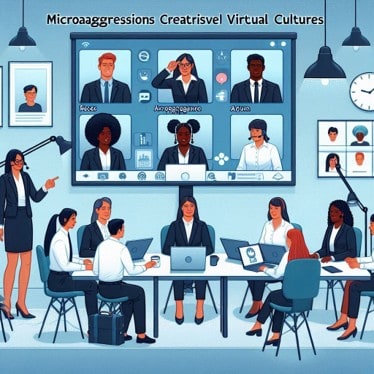
The Zoom call started like any other Monday morning meeting. Then it happened.
“Can everyone see my screen? Oh wait, let me make sure the lighting is better so we can actually see you, Jasmine.” The well-meaning comment landed like a weight on the only Black woman in the virtual room. In her home office, Jasmine adjusted her ring light—again—wondering if her white colleagues ever had to prove their visibility in quite the same way.
This is the new face of microaggressions: subtle, often unintentional slights that have evolved and multiplied in our digital workspaces. While technology promised to level playing fields, it has instead created new terrains where bias operates with alarming efficiency and reach.
The Digital Amplification Effect
Microaggressions aren’t new. What’s new is how digital platforms amplify their impact while making them harder to address. A dismissive comment in a physical meeting affects those present. That same comment in a recorded Zoom call? It lives forever, replayed in minds and potentially in actual recordings.
Research from Stanford’s Virtual Human Interaction Lab reveals that virtual meetings create “continuous partial attention” that makes people more likely to miss subtle bias while simultaneously making those experiencing it feel more isolated. For Black women, who already navigate what I call the “hypervisibility/invisibility paradox” in “Rise & Thrive,” digital spaces intensify both extremes.
Consider these digital-age microaggressions that traditionally overlooked talent, particularly Black women, face daily:
- Being asked to turn on cameras to “prove” engagement while others participate audio-only
- Having cultural hairstyles commented on or questioned in virtual meetings
- Experiencing more interruptions in virtual settings than in-person meetings
- Finding their virtual backgrounds scrutinized or judged differently
- Being muted or talked over more frequently in digital forums
- Receiving private messages questioning their authority or expertise during public meetings
The Toll of Digital Emotional Labor
In “Mastering a High-Value Company Culture,” I discuss how culture is built through daily interactions. In virtual settings, Black women perform additional emotional labor that goes unrecognized:
The Perpetual Performance: Every virtual meeting becomes a stage where you must perfectly balance professionalism with relatability, authority with approachability. Your home office must be “professional” enough but not “too much.” Your voice must be clear but not “too strong.”
The Technology Tax: Studies show that technical difficulties are more likely to be attributed to incompetence when experienced by women of color. A simple WiFi glitch becomes a credibility crisis.
The Chat Monitoring: Beyond participating in meetings, Black women often monitor chat boxes for subtle slights, ensure their contributions are acknowledged, and navigate private messages that undermine their public authority.
Case Study: The Transform Tech Initiative
A technology firm with 5,000 employees globally (identity protected) discovered through exit interviews that Black women were leaving at twice the rate of other demographics, despite strong performance reviews. The shift to remote work during 2020 had accelerated this trend.
Our assessment revealed a pattern of digital microaggressions:
- Black women were interrupted 3x more often in virtual meetings
- Their ideas were attributed to others 40% of the time in follow-up emails
- They received 60% more “coaching” messages about communication style
- Virtual happy hours consistently featured cultural references that excluded them
Working with Che’ Blackmon Consulting, the company implemented the DIGITAL framework:
D – Develop awareness through company-wide training on digital microaggressions I – Implement meeting protocols that ensure equitable participation G – Generate inclusive virtual spaces and practices I – Integrate feedback mechanisms for real-time correction T – Track participation patterns and intervention effectiveness A – Amplify traditionally overlooked voices through structured opportunities L – Lead by example with executives modeling inclusive behavior
Results after 8 months:
- Retention of Black women increased by 45%
- Overall meeting satisfaction scores improved by 33%
- Innovation metrics rose by 28%
- Employee NPS increased by 21 points
The Intersection of AI and Bias
As AI increasingly mediates our digital interactions, new forms of microaggressions emerge. Facial recognition that struggles with darker skin tones. Voice recognition that doesn’t understand certain accents. Sentiment analysis that misreads cultural communication styles as “aggressive” or “unprofessional.”
These aren’t just technical glitches—they’re systemic microaggressions built into the infrastructure of digital work. When a Black woman’s face isn’t recognized by the company’s security software, it sends a message: you don’t belong here. When her natural speech patterns are flagged as “unclear” by AI coaching tools, it reinforces centuries-old biases about “proper” communication.
Building Inclusive Virtual Cultures: The PATH Forward
Creating truly inclusive virtual cultures requires intentional design and consistent action. Here’s the PATH framework:
P – Protocols for Equity
Establish clear virtual meeting protocols:
- Rotate meeting facilitation responsibilities
- Use raised hand features to manage speaking order
- Require cameras-optional policies that apply equally
- Implement “no interruption” rules with consequences
- Create structured time for all voices
A – Awareness and Accountability
Build systems that surface and address microaggressions:
- Anonymous reporting mechanisms for virtual interactions
- Regular pulse surveys on digital inclusion
- Bystander intervention training for virtual settings
- Clear consequences for digital harassment
- Recognition for inclusive leadership behaviors
T – Technology That Includes
Choose and configure technology thoughtfully:
- Test all tools for bias across different demographics
- Provide multiple ways to participate (chat, voice, video)
- Ensure accessibility features are enabled and promoted
- Select platforms that support diverse communication styles
- Regularly audit AI tools for discriminatory patterns
H – Humanization of Digital Spaces
Remember the humans behind the screens:
- Start meetings with genuine check-ins
- Acknowledge the challenges of virtual work
- Respect different home situations and constraints
- Create virtual spaces for informal connection
- Celebrate cultural diversity explicitly
Practical Strategies for Leaders
In “High-Value Leadership: Transforming Organizations Through Purposeful Culture,” I emphasize that culture change requires consistent daily actions. Here are specific strategies for addressing digital microaggressions:
The Pre-Meeting Equity Check
Before each virtual meeting, ask:
- Who typically dominates conversation?
- Whose ideas get credited correctly?
- What cultural assumptions are we making?
- How can we ensure all voices are heard?
The Real-Time Interrupt
Develop scripts for addressing microaggressions as they happen:
- “Let’s make sure [Name] finishes their thought”
- “I want to circle back to what [Name] said earlier”
- “Let’s be mindful of everyone’s opportunity to contribute”
- “That comment may have landed differently than intended”
The Follow-Up Protocol
After meetings, leaders should:
- Send recap emails crediting ideas accurately
- Check in privately with those who seemed marginalized
- Address patterns of exclusion directly
- Celebrate inclusive behaviors publicly
The Amplification Strategy
Borrowed from women in the Obama administration:
- When a Black woman makes a point, repeat it and credit her
- Build on her ideas explicitly
- Redirect when others claim credit
- Ensure her contributions are documented
The Business Case for Digital Inclusion
Organizations that create inclusive virtual cultures see measurable returns:
- 87% higher employee engagement (Gallup, 2023)
- 2.3x more likely to exceed financial targets (McKinsey, 2023)
- 70% better employee retention (Deloitte, 2023)
- 1.7x more likely to be innovation leaders (BCG, 2023)
Yet only 23% of companies have specific strategies for addressing digital microaggressions. This gap represents both a risk and an opportunity.
Red Flags: When Virtual Culture Becomes Toxic
Watch for these warning signs:
- Decreased participation from traditionally overlooked employees
- Private “side conversations” that exclude certain groups
- Technical issues blamed on individual competence
- Cultural celebrations that center only dominant groups
- Feedback that focuses on style over substance for certain demographics
- Virtual backgrounds becoming status symbols
- Meeting recordings used to scrutinize rather than support
Your 30-Day Digital Inclusion Action Plan
Week 1: Awareness Building
- Document microaggressions you observe or experience
- Note patterns in virtual meeting dynamics
- Identify who speaks most and least
Week 2: Skill Development
- Practice interruption intervention techniques
- Develop your amplification strategy
- Create personal scripts for common situations
Week 3: System Implementation
- Propose one structural change to meeting formats
- Test new inclusive practices
- Gather feedback from traditionally overlooked colleagues
Week 4: Culture Shift
- Model inclusive behaviors consistently
- Recognize others who demonstrate inclusion
- Share learnings with your team
Discussion Questions for Leadership Teams
- How have digital platforms changed the way bias shows up in our organization?
- What additional emotional labor do our Black women employees perform in virtual settings that goes unrecognized?
- How might our technology choices inadvertently exclude certain groups?
- What would true digital inclusion look like in our organization?
- How can we measure and reward inclusive virtual leadership?
The Path Forward: From Awareness to Action
Digital microaggressions aren’t just annoyances—they’re barriers to innovation, engagement, and retention. For Black women and other traditionally overlooked talent, they represent daily reminders that virtual spaces, like physical ones, weren’t designed with them in mind.
But here’s the opportunity: Virtual cultures are still being formed. We have the chance to build them right, to create digital spaces where everyone can thrive authentically. This isn’t just about avoiding harm—it’s about unleashing the full potential of diverse talent.
Ready to Transform Your Virtual Culture?
Che’ Blackmon Consulting specializes in creating inclusive digital environments where traditionally overlooked talent doesn’t just survive—they lead. We understand the unique challenges of virtual microaggressions and design solutions that create real, measurable change.
We offer:
- Digital Culture Audits – Assess your virtual environment for inclusion gaps
- Inclusive Leadership Training – Build skills for leading diverse virtual teams
- Technology Equity Reviews – Ensure your tools support all employees
- Microaggression Intervention Programs – Create systems for real-time correction
- Fractional CHRO Services – Strategic guidance for cultural transformation
The future of work is digital. The question is whether that future will replicate past exclusions or create new possibilities for inclusion.
Take Action Today: Schedule your complimentary 30-minute consultation to discuss how to build an inclusive virtual culture that drives innovation and retention. Email admin@cheblackmon.com or visit cheblackmon.com/digital-inclusion.
Remember: Every virtual interaction is an opportunity to build or break culture. Choose to build.
Che’ Blackmon is an HR Executive, Leadership Development Expert, and author of three books on organizational culture and leadership. Through Che’ Blackmon Consulting, she partners with organizations ready to create virtual cultures where everyone can contribute their best work.
#DigitalInclusion #Microaggressions #VirtualCulture #DEI #BlackWomenAtWork #InclusiveLeadership #RemoteWork #WorkplaceCulture #DigitalEquity #VirtualMeetings #TechBias #CulturalIntelligence #HybridWork #LeadershipDevelopment #InclusionMatters