


By Che’ Blackmon, DBA Candidate & Founder, Che’ Blackmon Consulting
There is a quiet crisis happening in workplaces across America. Talented employees are struggling under the weight of impossible expectations. They are working longer hours, checking email at night, and lying awake wondering if they are doing enough. Many are experiencing what researchers call performance anxiety, a state of chronic stress centered on the fear of not measuring up.
For Black women in particular, this anxiety is compounded. In spaces where representation is limited and expectations are often unspoken and shifting, the pressure to perform becomes suffocating. The bar for success seems to keep moving. The feedback is inconsistent. The rules of the game are unclear. And underneath it all is a nagging feeling that no matter how hard you work, it might never be enough.
But here is what I have learned through years of work with organizations and individual leaders. The solution to performance anxiety is not to work harder or push yourself further. The solution is to redefine what success actually means and to build organizational cultures where people can do their best work without sacrificing their wellbeing. This is at the heart of High-Value Leadership™, and it is the conversation we need to have.
What Is Performance Anxiety and Why Does It Matter? 🔍
Performance anxiety is more than just nervousness before a presentation or worry about a deadline. It is a persistent state of worry about whether you are meeting expectations, whether you are good enough, whether your work is valuable. It is the feeling that you are always being evaluated and always coming up short.
In modern workplaces, performance anxiety has become normalized. Organizations set ambitious goals. They measure performance constantly. They provide feedback that often focuses on what is wrong rather than what is right. And many employees have internalized the message that their worth is directly tied to their output. This dynamic is destructive.
When people are operating from a place of anxiety, they are not at their best. They are not creative. They are not willing to take intelligent risks. They are not bringing their full selves to their work. Instead, they are focused on survival, on doing just enough to avoid criticism, on protecting themselves. And the organization loses out on the full potential of that person.
This matters because high performance that comes from a place of wellbeing is fundamentally different from high performance that comes from anxiety. One is sustainable. The other leads to burnout. One attracts and retains talent. The other drives people away. In my work as a DBA candidate researching organizational transformation, I have consistently observed that organizations that address performance anxiety see improvements in engagement, retention, and innovation. The question is not whether your organization can afford to address this. The question is whether you can afford not to.
The Unique Burden on Black Women in Corporate Spaces 👩🏾💼
Performance anxiety does not affect all employees equally. Black women in corporate environments face a particular version of this challenge that is shaped by systemic bias, stereotype threat, and the accumulated weight of being in spaces where they have historically been underrepresented.
Consider the research on stereotype threat. When people are in situations where they are reminded of negative stereotypes about their group, their performance actually declines. A Black woman walks into a meeting where she is the only person of color. She may not consciously register the feeling, but her brain registers it. And that awareness creates cognitive load. Part of her attention is focused on managing how she is perceived rather than fully engaging with the work. Over time, this constant performance of managing perception is exhausting.
There is also the phenomenon of code switching. In my e-book Rise and Thrive: A Black Woman’s Blueprint for Leadership Excellence, I explore how Black women often find themselves adjusting their communication style, their dress, their mannerisms to fit into predominantly white corporate cultures. The constant calculation of how much of yourself to show and how much to hide is a form of emotional labor that drains energy and creates anxiety. You are never fully yourself at work.
There is also the experience of having your competence questioned or your credentials scrutinized in ways that do not happen to colleagues who look like the existing power structure. A Black woman proposes an idea and is asked detailed questions about her thinking. A white male colleague proposes a similar idea and is asked when he can start. These micro-aggressions accumulate. They send a message that your presence is somehow conditional, that you need to prove yourself in ways that others do not.
These are not individual problems that Black women need to overcome. These are organizational problems that require systemic solutions. When organizations fail to address these dynamics, they are essentially asking Black women employees to carry the burden of organizational bias while also maintaining high performance. This is unsustainable.
The High-Performance Trap: When Excellence Becomes Exhaustion 😮💨
One of the most insidious aspects of performance anxiety is that it often targets your highest performers. These are the people who care about excellence. They take pride in their work. They want to contribute meaningfully. And so when they fall short of an impossible standard, the anxiety deepens.
There was an organization that experienced significant challenges with this dynamic. The company had set aggressive growth targets. Leadership kept raising the bar. Employees, particularly the high performers, responded by working longer hours and taking on more responsibility. The anxiety was palpable. People stopped taking vacation. They worked through lunch. They checked email at ten PM. And when they hit the new target, leadership celebrated briefly and then raised the target again. The message was clear: you are never doing enough.
Within two years, this organization lost many of its top performers. Not because they could not handle the work. But because the constant message that they were not enough wore them down. The anxiety was unsustainable. And when other opportunities came along, they left.
This happens because many organizations have confused high performance with unlimited output. They believe that more is always better. They set goals without considering whether the goals are realistic or whether achievement of the goals will require people to sacrifice their health or wellbeing. In High-Value Leadership, we recognize that sustainable performance comes from clarity about what matters most, realistic expectations, and a genuine commitment to supporting people. It is not about demanding more. It is about being intentional about what we ask and why.
Current Trends: How Workplaces Are Evolving 📊
The conversation around performance anxiety and workplace wellbeing is shifting. Several trends are reshaping how forward-thinking organizations approach this challenge.
From Productivity to Wellbeing
Progressive organizations are beginning to recognize that employee wellbeing is not a perk. It is a business imperative. Research consistently shows that employees with higher wellbeing scores also have higher productivity, higher engagement, and lower turnover. When you support your people’s wellbeing, you are not being soft. You are being strategic. Some organizations are now measuring success not just by output but by outcomes achieved with sustainable effort. This represents a fundamental shift in how performance is defined.
Redefining Performance Metrics
Traditional performance metrics often focus on individual output. New approaches are considering collaboration, innovation, psychological safety contributions, and how work is accomplished. Some companies are now asking: Did this person help create an environment where others could do their best work? Did they demonstrate the values we say we stand for? Did they take care of themselves while achieving results? These questions reflect a more holistic understanding of what high performance actually looks like.
Psychological Safety as Competitive Advantage
Organizations are recognizing that in complex, fast-changing environments, they need people who are willing to speak up, challenge ideas, and take intelligent risks. But people will not do this if they are living in fear of being evaluated and found wanting. So leaders are being trained in how to create psychological safety. They are learning to respond to mistakes with curiosity instead of blame. They are learning to separate performance feedback from worth as a human being. This shift is creating environments where performance anxiety naturally decreases because people feel safer.
Intentional Inclusion & Belonging
Forward-thinking organizations are recognizing that diversity and inclusion work must be intentional and ongoing. They are examining their systems to identify where bias might be creating additional performance pressure on underrepresented groups. They are training managers to recognize and interrupt micro-aggressions. They are creating mentorship programs specifically designed to support employees from overlooked populations. And they are holding leadership accountable for creating cultures where all employees feel valued and have a genuine chance to advance. This work is reducing the specific burden that Black women and other underrepresented talent carry in predominantly white workplaces.
Redefining Success: A High-Value Leadership™ Approach 💡
So what does success actually look like in a healthy organization? In my book Mastering a High-Value Company Culture, I argue that success must be redefined to include several elements that go beyond traditional metrics.
First, success means achieving meaningful business outcomes. This has not changed. Organizations still need to be profitable, productive, and effective. But in a high-value culture, these outcomes are achieved through sustainable effort, not unsustainable pressure.
Second, success means that employees can do their best work without sacrificing their health or wellbeing. This means realistic timelines. This means reasonable workloads. This means that people can actually take vacation and have evenings and weekends where they are not thinking about work. This means that the organization protects people from unnecessary chaos and drama so they can focus on what matters.
Third, success means that all employees feel valued and have a genuine sense of belonging. This is particularly important for historically overlooked talent. When Black women walk into a meeting, they should feel that their presence is welcomed and their contributions are valued. Their ideas should be considered on merit, not rejected because they do not fit the existing mold. They should have access to mentorship and advancement opportunities equivalent to their colleagues.
Fourth, success means clarity about expectations and transparent feedback. People should understand what success looks like in their role. They should receive regular, specific feedback about how they are doing. This feedback should be given with the intent to help them grow, not to find fault. And it should be consistent and fair across all employees.
Fifth, success means that people are developing and growing. Organizations should invest in the development of their people. They should create opportunities for learning and advancement. They should believe that people can grow and change. And they should provide the support needed for that growth to happen.
When success is defined this way, performance anxiety naturally decreases. People are still being held to high standards. But they understand what those standards are, they have realistic expectations about what they need to accomplish, and they feel supported in their efforts. This is the kind of environment where excellence is sustainable.
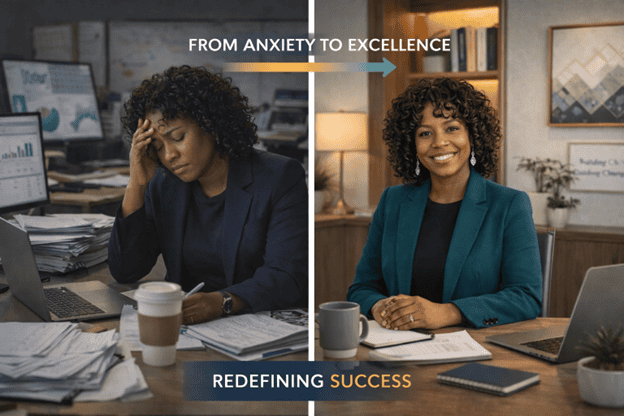
Real-World Examples: From Anxiety to Excellence 🌟
How does this work in practice? Here are some examples of how organizations have addressed performance anxiety and created cultures where people can do their best work.
Example One: The Manufacturing Organization That Reduced Turnover
A manufacturing company was experiencing significant turnover among their high performers. Exit interviews revealed a consistent theme: people felt like they were never doing enough. They were constantly being asked to do more, and when they achieved the goal, the goal simply got raised. There was no sense of completion or accomplishment.
Leadership made a deliberate decision to change this dynamic. They started by defining what success actually looked like for different roles. They were specific. Instead of saying they needed increased output, they defined the exact metrics and the realistic timelines. They communicated these goals clearly to their teams. Then they did something radical. When the team achieved the goal, they celebrated. They acknowledged what was accomplished. They did not immediately raise the bar. The message was: you succeeded. You did what we asked. That is valuable.
Within eighteen months, turnover among high performers declined significantly. People were still working hard. Performance metrics were still strong. But the anxiety had diminished because people understood the rules of the game and felt that their accomplishments were recognized. This simple shift in how success was defined made a profound difference.
Example Two: The Healthcare System That Prioritized Wellbeing
A healthcare organization was facing burnout among its clinical and administrative staff. The work was demanding, the hours were long, and the emotional toll was significant. Performance anxiety was compounded by the nature of healthcare work itself. People were literally dealing with life and death situations.
Rather than increasing expectations or adding more staff, the organization made a commitment to protecting the wellbeing of their people. They implemented reasonable shift lengths. They ensured that breaks were actually taken. They created quiet spaces where people could decompress. They hired additional support staff to reduce the workload on clinical staff. They trained managers in how to recognize burnout and how to respond with support rather than judgment.
The result? Turnover declined. Sick leave decreased. Patient satisfaction actually improved because staff who were less burned out provided better care. The organization found that investing in wellbeing was not a cost. It was an investment that paid dividends across every metric they cared about.
Example Three: The Tech Company That Built Inclusion Into Performance Management
A technology company recognized that their performance management system had inherent bias. High performers from underrepresented backgrounds were being given less credit for their contributions. When they spoke up in meetings, their ideas were often overlooked until a more senior person (typically white and male) repeated the same idea. The performance anxiety was particularly acute for women of color who were navigating this dynamic.
The company made several changes. First, they implemented blind code review processes where the reviewer does not know who wrote the code. This reduced bias in technical evaluations. Second, they changed how meetings were structured to ensure that all voices were heard. They trained managers to actively solicit input from quiet or underrepresented voices. Third, they made attribution explicit. When someone contributed an idea, that person received credit in the meeting and in the notes. This prevented the phenomenon of ideas being taken by others.
Most importantly, they made it clear that advancing women of color and other underrepresented talent was a business priority, not an afterthought. Leaders were evaluated on how well they developed talent from underrepresented backgrounds. Over time, the culture shifted. Women of color reported less performance anxiety because they felt that their contributions were genuinely valued. And the organization benefited from the full talents and perspectives of all their people.
Five Strategies to Address Performance Anxiety 🛠️
If you are a leader looking to address performance anxiety in your organization, here are five concrete strategies to start with.
Strategy One: Define Success Explicitly
Do not leave success to interpretation. Be specific about what success looks like in each role. What are the key metrics? What are the realistic timelines? What does good work actually look like? Once you have clarity, communicate it. Write it down. Discuss it in one-on-ones. Make sure everyone understands what you are asking for and why it matters. When expectations are clear, anxiety decreases because people know what they need to do.
Strategy Two: Separate Worth From Performance
This is perhaps the most important shift. Performance feedback is about whether someone met a specific goal or demonstrated a specific skill. It is not about their worth as a human being. When leaders conflate these two things, performance anxiety intensifies. An employee misses a deadline and suddenly feels like they are a failure. A project does not go as planned and they feel personally rejected. Help your team understand that performance is something they do, not something they are. They can miss a goal and still be a valued, capable person. This separation is liberating.
Strategy Three: Create Psychological Safety
People need to feel safe making mistakes and asking questions. This means responding to bad news with curiosity instead of blame. It means acknowledging when you do not know something. It means protecting people who take intelligent risks that do not work out. It means addressing mistakes as learning opportunities rather than character failures. When psychological safety is present, people are less anxious because they know that mistakes are survivable.
Strategy Four: Address Bias in Your Systems
If you have employees from underrepresented backgrounds experiencing disproportionate performance anxiety, look at your systems. How are decisions made about who gets promoted? Are there hidden criteria that advantage certain groups? How are employees from different backgrounds receiving feedback? Are some groups given harsher feedback or less specific guidance? How are contributions recognized and credited? Intentionally examine these systems and make changes to ensure they are fair and transparent. Black women and other underrepresented talent should not have to carry the additional burden of navigating biased systems while maintaining high performance.
Strategy Five: Protect Wellbeing as Intentionally as You Pursue Performance
Make a commitment that performance will not come at the cost of wellbeing. Have clear expectations about work hours. Protect vacation time. Monitor workload. Provide resources for stress management and mental health support. Make it clear that people will not be penalized for using wellness benefits. When people know that their wellbeing matters to the organization, their anxiety decreases. They are not operating in a state of constant threat. They can relax enough to do their best work.
The Role of Authentic Leadership 💼
None of these strategies work without authentic leadership. And authentic leadership means being honest about the challenges your organization faces while also maintaining confidence that change is possible.
It means acknowledging that if performance anxiety is present in your organization, that is not a personal failing of your employees. That is a systemic issue that your organization has created and that your organization can fix. It means being willing to examine your own contributions to the culture. Do you model what you are asking of others? Do you talk about having a sustainable life? Or are you always working, always connected, always pushing? Your people are watching. Your behavior sends a message about what is valued.
It means being willing to make changes that might feel uncomfortable in the short term. Redefining success might mean that some goals do not get accomplished. Protecting wellbeing might mean hiring additional staff. Addressing bias in your systems might mean confronting uncomfortable truths about how your organization works. These changes require courage.
But the payoff is significant. Organizations that address performance anxiety see improvement across every metric that matters. Engagement increases. Retention improves. Innovation accelerates. And perhaps most importantly, your people get their lives back. They can work hard at work without anxiety consuming their evenings and weekends. They can feel genuinely valued, not just tolerated. This is what authentic leadership creates.
Key Takeaways 📌
Performance anxiety is a systemic issue created by unclear expectations, unrealistic goals, and cultures that tie self-worth to output. It is not a personal problem that individuals need to overcome.
Black women in corporate spaces experience additional layers of performance anxiety due to stereotype threat, code-switching, and systemic bias in how their competence is perceived and evaluated.
High performance that comes from wellbeing is more sustainable and more valuable than high performance that comes from anxiety. Organizations that recognize this see benefits across engagement, retention, and innovation.
Success must be redefined to include business outcomes, employee wellbeing, belonging, clarity, and growth.
Five key strategies to address performance anxiety are defining success explicitly, separating worth from performance, creating psychological safety, addressing bias in systems, and protecting wellbeing.
Authentic leadership that models healthy work-life integration and is willing to make systemic changes is essential to creating lasting change.
Discussion Questions for Your Leadership Team 💭
To what extent is performance anxiety present in your organization, and which employees or teams seem most affected by it?
How are you currently defining success in your organization, and does that definition include employee wellbeing or just business outcomes?
What systems or practices in your organization might be creating additional performance pressure on Black women or other underrepresented groups?
How well do your employees understand what success looks like in their roles, and how consistent is the feedback they receive about whether they are meeting that standard?
What would change in your organization if you made a commitment that high performance would not come at the cost of employee wellbeing?
How are you modeling healthy work-life integration as a leader, and what message does your own behavior send about what is valued in your organization?
Next Steps: Creating a Culture Where Excellence Is Sustainable 🚀
Addressing performance anxiety is not a quick fix. It requires a commitment to examining how your organization works and being willing to make systemic changes. But the payoff is significant. When you create a culture where people can do excellent work without sacrificing their wellbeing, you build a competitive advantage that is hard to replicate.
This is what High-Value Leadership is all about. It is about building organizations where people can bring their full selves to work. Where excellence is expected and supported. Where success is clearly defined and consistently recognized. Where people from historically overlooked backgrounds have a genuine chance to thrive. And where the organization benefits from the full talents and perspectives of all their people.
If you are ready to begin this work, Che’ Blackmon Consulting can help. We specialize in working with leaders and organizations to redefine success, build psychological safety, address bias in systems, and create cultures where people can do their best work. We combine research-backed insights with practical strategies and tailor our approach to your specific organizational context.
Whether you are dealing with specific performance anxiety challenges, looking to improve retention among high performers, or wanting to build a more inclusive culture where all talent can thrive, we are here to support you. Our fractional consulting, executive coaching, and organizational training are designed to create sustainable change.
Ready to Redefine Success in Your Organization?
📧 Email: admin@cheblackmon.com
📞 Phone: 888.369.7243
🌐 Website: cheblackmon.com
Your organization deserves a culture where excellence is sustainable and all people can thrive. Let us help you get there.
Here’s to building organizations where success is defined by impact and wellbeing, not just output. 💚
#PerformanceAnxiety #WellnessAtWork #EmployeeWellbeing #SustainablePerformance #WorkLifeBalance #HighValueLeadership #OrganizationalCulture #LeadershipDevelopment #WorkplaceMentalHealth #EmployeeEngagement #BurnoutPrevention #LeadershipExcellence #PurposefulCulture #WomenInLeadership #BlackWomenLeaders