

By Che’ Blackmon, DBA Candidate | Founder & CEO, Che’ Blackmon Consulting
Burnout doesn’t happen overnight. It builds quietly over weeks and months, hiding behind professional commitment and high performance until the moment it becomes impossible to ignore. By then, the damage is done. Talented leaders walk away from careers they spent years building. Organizations lose institutional knowledge and cultural momentum. Teams fracture under the weight of covering for depleted colleagues.
The good news? Burnout is predictable. And what’s predictable is preventable. The warning signs appear long before the crisis hits, offering organizations and individuals precious time to intervene, recalibrate, and protect both human wellbeing and business outcomes.
This matters even more for Black women and other traditionally overlooked leaders who navigate additional stressors including microaggressions, cultural taxation, and the exhausting labor of being underestimated while simultaneously having to prove competence at every turn. For these leaders, burnout risk compounds exponentially, yet their warning signs are often dismissed or misinterpreted.
Understanding the early warning signs of burnout and taking decisive action transforms a reactive crisis management approach into proactive culture building. It’s the difference between losing talented leaders and retaining them. Between costly turnover and sustainable growth. Between organizational chaos and thriving teams.
Understanding Burnout: More Than Just Stress 🧠💔
Before we can prevent burnout, we need to understand what it actually is. Burnout isn’t simply being tired or stressed. Those are temporary states that rest and recovery can address. Burnout represents a chronic condition of emotional, physical, and mental exhaustion caused by prolonged exposure to demanding workplace conditions.
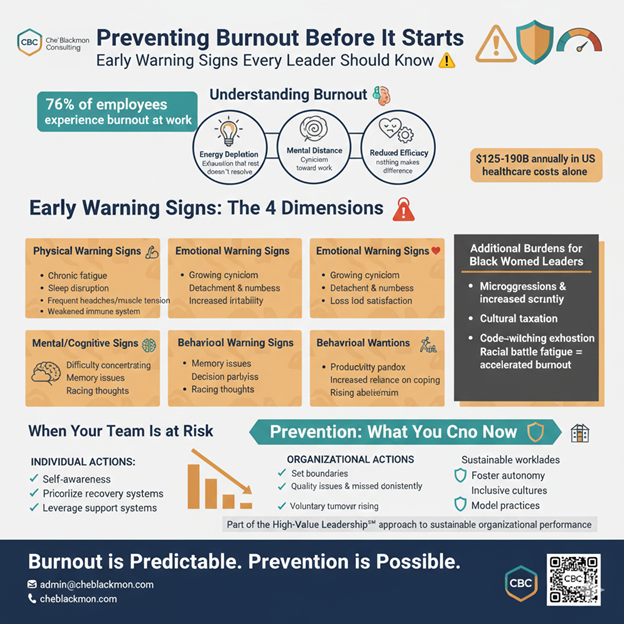
The World Health Organization officially recognized burnout in 2019 as an occupational phenomenon characterized by three dimensions. Energy depletion or exhaustion that rest doesn’t resolve. Increased mental distance from one’s job, or feelings of negativism or cynicism related to work. And reduced professional efficacy, a sense that nothing you do makes a difference anymore.
Research from Gallup reveals that 76% of employees experience burnout on the job at least sometimes, and 28% say they feel burned out “very often” or “always.” The financial costs are staggering. Burnout accounts for an estimated $125 billion to $190 billion annually in healthcare spending in the United States alone. Factor in turnover costs, lost productivity, absenteeism, and diminished innovation capacity, and the true price tag climbs into the hundreds of billions.
But burnout’s most devastating impact isn’t captured in financial metrics. It’s the brilliant strategist who stops contributing in meetings. The innovative leader who becomes cynical about change. The rising star who quietly updates their resume and slips out the door. The collective loss of human potential and organizational wisdom that never shows up on a balance sheet but fundamentally undermines competitive advantage.
The Unique Burnout Risk for Traditionally Overlooked Leaders 🎯⚖️
Black women in corporate leadership navigate a landscape where standard burnout risk factors are amplified and additional stressors layer on top. Understanding these unique dynamics is essential for any organization serious about preventing burnout and retaining diverse talent.
Research from the Institute for Women’s Policy Research shows that Black women face a higher likelihood of experiencing chronic workplace stress than their white counterparts. They experience microaggressions at rates significantly higher than other groups. They’re subjected to more scrutiny of their work and more frequent questioning of their competence. They carry the invisible burden of representing an entire demographic while simultaneously working to be seen as individuals.
This phenomenon, known as “covering,” requires Black women to downplay aspects of their identity to fit into predominantly white corporate cultures. The constant code switching, the careful calibration of tone and presentation, the monitoring of natural hair choices or style of dress, all of this represents additional cognitive and emotional labor that depletes energy reserves before the actual work even begins.
Then there’s cultural taxation, the expectation that Black women will serve as diversity representatives, informal mentors to all employees of color, and volunteer committee members for every inclusion initiative, usually without additional compensation or recognition toward advancement. This work, while valuable to organizations, often goes unrewarded while simultaneously pulling these leaders away from the strategic contributions that would position them for promotion.
Consider the healthcare executive who spent twelve years advancing through her organization, consistently exceeding performance targets. She was asked to lead the diversity and inclusion task force, mentor five early-career employees of color, participate in recruiting initiatives at HBCUs, and serve as the public face of the organization’s equity commitments. All while maintaining her demanding operational responsibilities. Within eighteen months, she developed anxiety, insomnia, and eventually left for a competitor who offered not just better compensation but genuine support structures.
When organizations ignore these additional stressors or worse, assume all employees face identical challenges, they create conditions where burnout among Black women becomes not just likely but inevitable. The warning signs appear earlier and compound faster, yet they’re frequently dismissed as individual performance issues rather than systemic failures that demand organizational response.
Individual Warning Signs: Recognizing the Red Flags 🚩👤
Burnout progresses through stages, and catching it early makes all the difference. Here are the warning signs that appear before full burnout sets in, organized by the dimension they most clearly represent.
Physical Warning Signs 💪⚡
The body speaks first. Physical symptoms often emerge before we consciously recognize emotional or mental exhaustion. Chronic fatigue that doesn’t improve with rest or sleep signals that something deeper than ordinary tiredness is occurring. You sleep eight hours but wake feeling depleted. Weekends no longer restore energy. Vacation provides temporary relief that evaporates within days of returning to work.
Sleep disruption manifests in multiple ways. Difficulty falling asleep despite exhaustion. Waking repeatedly throughout the night. Racing thoughts that prevent rest. Some people sleep too much, using sleep as escape from overwhelming demands, yet never feel truly rested.
Physical symptoms accumulate. Frequent headaches or migraines. Muscle tension, particularly in neck and shoulders. Digestive issues. Increased susceptibility to colds and infections as stress suppresses immune function. Changes in appetite, either eating far more or far less than normal. These aren’t random health issues. They’re your body’s alarm system signaling that current demands exceed your capacity to sustain them.
Emotional Warning Signs 😔❤️
Emotional changes often manifest as shifts in how you experience work and relationships. Growing cynicism about your job, colleagues, or organization represents a significant warning sign. The work that once energized you now feels pointless. Meetings that previously sparked engagement now trigger eye rolls. Colleagues you respected become sources of irritation.
Detachment and numbness signal advanced warning stages. You stop caring about outcomes that previously mattered. Team conflicts that would have concerned you now barely register. You go through motions mechanically, disconnected from the purpose that once drove your performance.
Emotional volatility increases. Small frustrations trigger disproportionate reactions. You snap at colleagues over minor issues. Feedback that you’d normally process constructively now feels like personal attack. The emotional regulation that characterized your professional demeanor becomes harder to maintain.
For Black women leaders, emotional exhaustion often includes what researchers call “racial battle fatigue,” the cumulative psychological and emotional toll of navigating racial microaggressions and systemic bias. This manifests as heightened frustration, sadness, or anger related to workplace dynamics, combined with the exhaustion of managing those emotions in professional settings where expressing them might be perceived as “unprofessional” or “aggressive.”
Mental and Cognitive Warning Signs 🧠💭
Cognitive function deteriorates under chronic stress. Concentration becomes difficult. You read emails three times without absorbing content. Meetings require intense effort to track conversations. Tasks that previously came easily now demand exhausting mental energy.
Memory issues emerge. Forgetting commitments, missing deadlines, or losing track of important details that you’d normally manage effortlessly. Your capacity for strategic thinking diminishes. Big picture vision gets lost in daily firefighting. Innovation and creative problem solving feel impossible when survival mode dominates.
Decision-making becomes paralyzing. Simple choices feel overwhelming. Analysis paralysis sets in even for routine matters. You second-guess yourself constantly, losing confidence in judgment that previously guided effective leadership.
Racing thoughts and rumination increase. Work concerns invade every moment. You can’t turn off mentally even during supposed downtime. Thoughts loop obsessively without productive resolution, creating mental exhaustion that compounds physical fatigue.
Behavioral Warning Signs 🚶♀️📉
Behavior changes provide observable indicators that others might notice before you fully recognize them yourself. Withdrawal from colleagues and relationships often signals advancing burnout. You skip social gatherings you’d normally attend. Stop participating in informal conversations. Decline lunch invitations. Retreat from connections that previously sustained you.
Productivity paradoxes emerge. Some people work longer hours while accomplishing less, spinning wheels without traction. Others disengage entirely, doing minimum necessary to get by while their performance slides. Procrastination increases as motivation wanes. Deadlines get missed or barely met when previously you delivered early.
Increased reliance on coping mechanisms becomes apparent. More caffeine to force energy. Alcohol to decompress. Comfort eating or restriction. These aren’t character flaws. They’re attempts to manage overwhelming stress through whatever tools feel accessible in the moment.
Absenteeism rises. More sick days. Arriving late. Leaving early. These absences represent attempts to catch breath, grab moments of recovery, or avoid environments that have become intolerable. They’re symptoms, not solutions, but they signal distress that demands attention.
Organizational Warning Signs: When Teams Are at Risk 🏢📊
Burnout isn’t just an individual problem. It’s a team and organizational phenomenon. Smart leaders watch for patterns that indicate their teams are sliding toward collective exhaustion.
Team Dynamics Shifts 👥⚠️
Team engagement metrics tell important stories. When survey scores drop consistently across quarters, particularly on questions about feeling valued, having manageable workload, or seeing purpose in work, burnout is building. Exit interview themes cluster around exhaustion, unsustainable demands, and lack of support. These aren’t isolated incidents. They’re patterns demanding systemic response.
Communication changes within teams. Meetings become tense or silent. Collaboration decreases. People work in silos rather than leveraging collective intelligence. Conflict increases as exhausted people have less emotional bandwidth for navigating differences constructively. Trust erodes when everyone operates in survival mode.
Innovation stalls. When people are burned out, they lack energy for creative thinking. Risk aversion increases. Safe, familiar approaches dominate even when circumstances demand new strategies. The team that previously generated breakthrough ideas now struggles to execute basic requirements.
Performance and Productivity Indicators 📈❌
Quality issues emerge across deliverables. Errors increase. Rework becomes necessary. Standards slip. These aren’t signs of incompetence. They’re evidence of teams stretched beyond sustainable capacity, lacking the mental clarity and energy necessary for excellence.
Project timelines consistently slip. What used to get done in reasonable timeframes now requires extensions. Not because people aren’t working hard, often they’re working harder than ever, but because depleted humans simply cannot sustain previous productivity levels indefinitely.
There was a technology company where sprint velocity dropped 40% over six months while hours worked increased 25%. The team wasn’t lazy or incompetent. They were burning out. More hours created diminishing returns as exhaustion undermined both speed and quality. Leadership initially pushed harder, demanding greater output. This accelerated the problem until three senior engineers quit within a month, forcing organizational reckoning with unsustainable practices.
Retention and Turnover Patterns 🚪💼
Voluntary turnover rates climb, particularly among high performers. When your best people start leaving, burnout is often the underlying cause. They have options. They’ll use them rather than sacrifice their wellbeing for organizations that don’t protect it.
Pay particular attention when traditionally overlooked talent exits at higher rates. If Black women, LGBTQ+ professionals, or other marginalized groups leave disproportionately, this signals that unique stressors aren’t being addressed. It’s not just about burnout from workload. It’s about the additional burden of navigating hostile or unwelcoming environments while managing demanding work.
Recruitment and onboarding become difficult. Word spreads about organizational culture. Talented candidates decline offers after talking to current employees or reading Glassdoor reviews that mention burnout, overwork, or lack of support. The organization’s employer brand suffers, making it progressively harder to attract quality talent.
Root Causes: Why Burnout Happens 🌳🔍
Understanding warning signs matters, but preventing burnout requires addressing root causes. Organizational conditions create environments where burnout either thrives or struggles to take hold.
Unsustainable Workload and Expectations 📚⏰
Chronic overwork represents the most direct path to burnout. When organizations consistently demand more than humans can sustainably deliver, exhaustion becomes inevitable. This manifests in multiple ways. Unrealistic deadlines that require extreme hours. Staffing levels insufficient for workload demands. Refusal to prioritize, treating everything as urgent and important simultaneously.
The “do more with less” mentality, while sometimes necessary during genuine crises, becomes toxic when it represents permanent operating philosophy. Teams absorb work from eliminated positions without corresponding reduction in expectations. People cover for vacant roles for months while organizations delay hiring. Individual capacity limits get ignored in pursuit of quarterly targets.
Technology exacerbates this by erasing boundaries between work and personal time. Email at all hours. Slack messages on weekends. The expectation of constant availability means people never fully disconnect. Recovery becomes impossible when the next demand arrives before the last one’s stress has dissipated.
Lack of Control and Autonomy 🎮🚫
Research consistently shows that lack of control over work significantly predicts burnout. When people have no say in how, when, or where they work, no influence over priorities or resource allocation, no voice in decisions affecting their roles, they experience powerlessness that breeds exhaustion and cynicism.
Micromanagement destroys autonomy and accelerates burnout. Talented professionals hired for expertise find themselves subjected to excessive oversight, questioned on routine decisions, and required to justify every action. This signals distrust that undermines engagement while creating additional work of documenting and explaining choices that should be delegated.
Lack of flexibility compounds control issues. Rigid policies that ignore individual needs and circumstances. Presenteeism cultures that value face time over results. Inability to adjust schedules for personal obligations without penalty. These restrictions feel particularly burdensome for working parents, caregivers, and anyone balancing significant responsibilities outside work.
Values Misalignment and Purpose Deficit 🎯💔
Burnout accelerates when people’s values conflict with organizational practices or when work feels meaningless. This shows up when organizations espouse values they don’t live. Claim to prioritize people while treating employees as disposable resources. Talk about innovation while punishing intelligent risk-taking. Champion diversity publicly while maintaining homogeneous leadership and inequitable practices privately.
Purpose matters profoundly for sustained engagement. When people can’t connect their daily work to meaningful impact, cynicism takes root. Tasks feel like pointless box checking. Energy drains away without the renewal that comes from knowing your contribution makes a difference.
For Black women and other traditionally overlooked leaders, values misalignment often centers on equity and inclusion. Working for organizations that claim commitment to diversity while experiencing or witnessing discriminatory practices creates profound dissonance. The emotional labor of navigating that contradiction while maintaining professional composure accelerates burnout.
Insufficient Recognition and Reward ⭐💰
Humans need acknowledgment for their contributions. When effort goes unrecognized, when achievements pass without celebration, when compensation fails to reflect value delivered, resentment builds and motivation withers.
This isn’t about constant praise or inflated egos. It’s about fundamental fairness. People working at high levels deserve compensation that reflects their contributions. Performance that exceeds expectations warrants recognition. Excellence should create pathways to advancement, not just more work without increased rewards.
Recognition gaps affect traditionally overlooked talent disproportionately. Research shows Black women receive less credit for collaborative work, less visibility for achievements, and fewer advancement opportunities despite equivalent or superior performance. This pattern of having contributions undervalued while simultaneously being expected to do more creates the perfect conditions for burnout.
Toxic Workplace Dynamics 🚩🤝
Workplace relationships and culture dramatically influence burnout risk. Toxic environments accelerate exhaustion through multiple pathways. Interpersonal conflict that goes unaddressed. Bullying or harassment. Lack of psychological safety where people fear speaking up. Blame cultures that punish mistakes rather than using them as learning opportunities.
Exclusionary cultures where certain groups never fully belong take tremendous toll. When Black women walk into meetings and realize they’re the only one who looks like them, again. When their ideas get credited to male colleagues. When they’re interrupted or spoken over repeatedly. When their natural hair or style of dress generates commentary. Each incident seems small in isolation, but cumulatively they create chronic stress that depletes energy and erodes engagement.
Leadership quality matters immensely. Bad managers create burnout through poor communication, unclear expectations, inconsistent decision making, favoritism, and failure to support their teams. People don’t leave jobs; they leave bad bosses. And often they leave because those bad bosses created conditions that made burnout inevitable.

Prevention Strategies: Individual Actions 🛡️💪
While organizations bear primary responsibility for creating conditions that prevent burnout, individuals can take proactive steps to protect their wellbeing and build resilience.
Develop Self-Awareness and Regular Check-Ins 🪞✅
You cannot address what you don’t recognize. Building awareness of your own warning signs enables early intervention before burnout becomes severe. Create regular practices for checking in with yourself. Weekly reviews of energy levels, emotional state, and work satisfaction. Monthly assessments of whether current pace feels sustainable. Quarterly big picture reflection on alignment between your values and work reality.
Track patterns. When do you feel most energized versus depleted? Which activities drain you disproportionately? What early physical or emotional signals appear when stress escalates? Understanding your unique burnout signature helps you intervene before symptoms become severe.
Journal, if that works for you. The act of writing about experiences helps process them and often reveals patterns that weren’t obvious in the moment. You might notice that every Sunday night brings dread about the coming week, or that certain types of meetings consistently leave you feeling dismissed or undervalued. These insights inform where you need to set boundaries or seek support.
Set and Maintain Boundaries ⚖️🚧
Boundaries protect sustainable performance. They’re not signs of weakness or lack of commitment. They’re requirements for long term effectiveness. This means establishing clear work hours and communicating them. Turning off notifications during personal time. Taking actual lunch breaks rather than eating at your desk. Using vacation time without checking email constantly.
Learning to say no strategically becomes essential. You cannot do everything. Attempting to do so guarantees you’ll do nothing particularly well while destroying your wellbeing in the process. Evaluate requests against priorities. Decline commitments that don’t align with core responsibilities or development goals. Suggest alternatives when you must say no to maintain relationships while protecting your capacity.
For Black women leaders, boundary setting often feels risky. Saying no might confirm stereotypes about not being team players. Setting limits might be interpreted as lack of ambition. These fears aren’t irrational given how Black women’s behavior gets scrutinized differently. But the alternative, accepting every request and sacrificing your wellbeing to prove your worth, guarantees burnout. Your boundaries might need to be communicated more carefully, framed more strategically, but they’re no less necessary.
Prioritize Recovery and Restoration 🌙🔋
Recovery isn’t optional. It’s required for sustainable high performance. Build intentional recovery practices into your routine. Daily practices might include short meditation breaks, brief walks outside, or simply closing your eyes and breathing for five minutes between meetings. Weekly recovery could involve exercise you genuinely enjoy, time in nature, engaging in hobbies unrelated to work, or spending quality time with people you love.
Sleep deserves priority. Most adults need seven to nine hours of quality sleep nightly. Chronic sleep deprivation undermines every aspect of functioning and accelerates burnout. Protect your sleep by establishing consistent bedtimes, creating restful environments, and avoiding screens before bed.
Take your vacation time. All of it. Research shows that people who take regular time off are more productive, creative, and engaged than those who don’t. Vacation isn’t reward for good performance. It’s maintenance required for continued performance. Disconnect fully during time off. The organization will survive without you for a week, and you’ll return significantly more capable than if you’d worked through supposed rest periods.
Build and Leverage Support Systems 🤝💬
Isolation amplifies burnout. Connection provides protection. Cultivate relationships with people who understand your experience and can offer support, perspective, and accountability. This might include mentors who’ve navigated similar challenges. Peers facing comparable demands. Friends outside your industry who remind you of your identity beyond your job title. Professional support like therapists or coaches who provide structured space for processing stress.
For Black women leaders, finding community with others who share your experience proves invaluable. Affinity groups, professional organizations for Black women, informal networks with other women of color in leadership, these spaces offer validation and wisdom that well-meaning colleagues from different backgrounds simply cannot provide. You shouldn’t have to explain why certain comments sting or why code switching exhausts you. Having people who just get it creates breathing room that sustains you through challenges.
Don’t hesitate to seek professional help. Therapy isn’t admission of failure or weakness. It’s strategic investment in your mental health and leadership capacity. A skilled therapist helps you process stress, develop coping strategies, identify patterns, and build resilience. The return on investment, both personally and professionally, far exceeds the cost.
Prevention Strategies: Organizational Responsibility 🏢🌟
Individual strategies matter, but preventing burnout requires organizational commitment. Leaders must create conditions where people can thrive sustainably rather than placing sole responsibility on individuals to cope with toxic or demanding environments.
Design Sustainable Workload and Staffing 📊👥
Right-size expectations to match human capacity. This requires honest assessment of what people can reasonably accomplish in standard work weeks without chronic overtime or weekend work. Conduct regular workload audits. Are people consistently working sixty-hour weeks? That’s a design flaw, not evidence of dedication.
Staff appropriately for actual workload. When positions go unfilled, work doesn’t disappear. It lands on remaining team members, often without corresponding reduction in their original responsibilities. This creates chronic overwork that accelerates burnout. Either hire to fill gaps or explicitly reduce deliverables to match available capacity.
Prioritize ruthlessly. Everything cannot be the top priority. When leaders treat all initiatives as equally urgent and important, they force teams to work unsustainably attempting impossible feat of doing everything at once. Clear prioritization enables teams to focus energy effectively rather than fragmenting attention across too many competing demands.
There was a professional services firm that instituted quarterly workload reviews where teams assessed their capacity against current and projected commitments. When workload exceeded sustainable thresholds, leadership made hard choices about what to postpone, eliminate, or resource differently. This practice reduced burnout rates by 43% over eighteen months and improved both retention and client satisfaction as teams delivered higher quality work on realistic timelines.
Foster Autonomy and Control 🎯✨
Trust your people. Hire talented professionals and then let them use their expertise. Micromanagement signals distrust and creates additional work while undermining engagement. Set clear outcomes and guardrails, then empower people to determine how to achieve those outcomes within established parameters.
Provide flexibility in how, when, and where work gets done. Different people have different peak productivity times, different life circumstances requiring accommodation, and different working styles that yield their best contributions. Rigid policies that demand uniformity sacrifice performance for the illusion of control.
Involve teams in decisions affecting their work. People support what they help create and resist what gets imposed. When changes are necessary, include those who’ll implement them in planning conversations. Their insights improve decisions while their involvement builds ownership and reduces resistance.
Build Psychologically Safe, Inclusive Cultures 🛡️🌈
Psychological safety, the belief that you can speak up, take risks, and make mistakes without fear of humiliation or punishment, protects against burnout. People in psychologically safe environments can raise concerns before they become crises, ask for help when they need it, and engage fully without exhausting emotional armor.
Leaders create psychological safety through their responses to vulnerability, mistakes, and dissent. When someone admits they’re struggling, do you respond with support or judgment? When an initiative fails, do you seek learning or assign blame? When someone questions a decision, do you engage curiosity or defensiveness? Your responses teach people whether it’s safe to be human.
Building inclusive cultures where all employees genuinely belong reduces burnout among traditionally overlooked talent. This requires more than diversity statements. It demands examining and changing practices that exclude. Calling out microaggressions. Ensuring equitable access to opportunities and resources. Creating pathways for diverse talent to advance without having to conform to narrow cultural expectations.
Address cultural taxation directly. If Black women or other marginalized groups carry disproportionate diversity and inclusion work, compensate them appropriately and count that work toward advancement. Better yet, distribute that work more equitably or hire dedicated staff rather than expecting volunteers to shoulder organizational responsibilities.
Recognize and Reward Contributions Fairly ⭐🏆
Acknowledge people’s work regularly and genuinely. This doesn’t require elaborate programs or expensive rewards. Often simple, specific recognition of contributions means more than generic praise. Tell people what they did well and why it mattered. Celebrate achievements publicly. Express appreciation privately.
Ensure compensation reflects value delivered. Conduct regular equity audits to identify and correct pay disparities. Research consistently shows Black women earn less than white men and women for equivalent work. If your organization replicates that pattern, you’re contributing to burnout through fundamental inequity.
Create clear advancement pathways and ensure they’re accessible to all talent. When people see no future beyond their current role, engagement deteriorates. When advancement requires sacrificing wellbeing or conforming to narrow cultural expectations, talented diverse leaders opt out. Promotion processes should reward performance and potential, not who fits traditional molds or who’s willing to work themselves into exhaustion.
Model and Support Sustainable Practices 🌱👔
Leaders set the tone. If you send emails at midnight, your team feels pressure to do the same. If you never take vacation, they won’t either. If you glorify overwork and celebrate people who sacrifice wellbeing for results, you create cultures where burnout becomes badge of honor rather than warning sign.
Model healthy boundaries. Take your vacation and disconnect during it. Leave the office at reasonable hours. Talk openly about prioritizing wellness and work-life integration. These behaviors give permission for others to do the same.
Provide resources that support wellbeing. Employee assistance programs with quality mental health coverage. Wellness stipends people can use for gym memberships, therapy, or whatever supports their health. Flexible work arrangements that accommodate diverse life circumstances. Professional development focused on stress management, resilience building, and sustainable performance.
Train managers to recognize warning signs and respond supportively. Many managers want to support their teams but lack skills to identify burnout risk or have difficult conversations about wellbeing. Invest in developing these capabilities. The return on investment shows up in retention, engagement, and performance.
Early Intervention: What to Do When Warning Signs Appear 🚨🤝
Recognizing warning signs means nothing without action. Here’s what to do when burnout signals appear.
For Individuals Experiencing Warning Signs
First, acknowledge what’s happening without judgment. You’re not weak or failing. Burnout signals that current conditions exceed sustainable capacity. That’s information, not indictment.
Assess your situation honestly. Review the warning signs. Which ones are you experiencing? How long have they been present? Are they getting worse? This assessment helps you determine urgency and appropriate interventions.
Take immediate action on what you control. Adjust your schedule to include more recovery time. Decline new commitments. Use available vacation days. Reconnect with support systems. These steps won’t solve systemic problems, but they provide breathing room while you address larger issues.
Have the conversation with your manager. This feels risky, particularly for Black women and other traditionally overlooked leaders who fear being perceived as not handling the work. But suffering in silence guarantees deterioration. Frame the conversation around sustainability and performance. “I’m noticing these signs that suggest my current workload isn’t sustainable long term. I want to discuss how we can adjust priorities or resources to maintain the quality and consistency you need from me.”
Seek professional support. Talk to your doctor if physical symptoms persist. Work with a therapist to develop coping strategies and process stress. Engage a coach to navigate career decisions or improve boundaries. These aren’t signs of failure. They’re strategic investments in your most important asset: you.
If organizational response is inadequate or the environment proves unchangeable, consider your options. Sometimes the healthiest choice is leaving. Your wellbeing matters more than any job. Organizations that create burnout conditions and refuse to address them don’t deserve your continued sacrifice.
For Leaders Observing Warning Signs in Team Members
Approach with care and compassion. Burnout often carries stigma. People fear being perceived as weak or inadequate. Create safe space for honest conversation. “I’ve noticed some changes and wanted to check in. How are you really doing?” Sometimes simply asking with genuine interest opens important dialogue.
Listen without judgment. Your role isn’t to fix everything immediately. It’s to understand the situation and demonstrate that you care about their wellbeing as much as their productivity. Validate their experience. Burnout isn’t personal failing. It’s often organizational failure that individuals experience.
Take action on what you can control. Redistribute workload. Adjust deadlines. Provide resources. Remove barriers. Connect them with support services. Small interventions can make significant difference when they signal genuine organizational commitment to employee wellbeing.
Escalate systemic issues. If your team member’s burnout results from organizational problems beyond your authority to fix, advocate upward. Bring concerns to senior leadership. Push for changes in policies, staffing, or expectations. Your credibility and position give you voice that individual contributors often lack.
Follow up consistently. One conversation won’t solve burnout. Check in regularly. Monitor progress. Adjust support as needed. Your sustained attention demonstrates that their wellbeing matters beyond immediate productivity concerns.
Building Burnout-Resistant Cultures 🏗️💪
Preventing burnout requires more than addressing individual warning signs. It demands building organizational cultures where sustainable high performance becomes the norm rather than the exception.
This starts with leadership commitment. When executives genuinely prioritize employee wellbeing, not just in statements but in budgets, policies, and daily decisions, cultures shift. When managers get evaluated and rewarded based on team sustainability as much as team productivity, behaviors change. When organizations invest in prevention rather than waiting to manage crisis, they protect both human dignity and business performance.
It requires particular attention to equity. Organizations cannot claim commitment to diversity while ignoring how burnout risk compounds for Black women and other traditionally overlooked talent. Preventing burnout in diverse workforces means acknowledging unique stressors, addressing systemic inequities, and creating conditions where all employees can thrive without sacrificing their identities or their health.
The warning signs are clear. The prevention strategies are known. What’s required now is courage to implement them even when doing so challenges deeply embedded cultural norms about work, worth, and what it means to be committed professional. Because the alternative, continuing to burn through talented people in pursuit of quarterly targets, creates losses that no organization can afford long term.
Burnout is preventable. Let’s act like it.
Reflection Questions for Your Team 💭🗣️
- Which burnout warning signs are most prevalent in our organization currently? What patterns do we notice across teams or departments?
- How do we currently respond when team members show signs of burnout? Are those responses effective or do they inadvertently worsen the situation?
- What organizational practices or cultural norms contribute to burnout risk in our workplace? Which of these are we willing to change?
- Do traditionally overlooked employees in our organization experience burnout at different rates or for different reasons than majority group members? If so, what does that reveal about our culture?
- How sustainable are our current workload expectations? If we’re honest, could our team maintain this pace for another year without significant burnout?
- What preventive measures could we implement immediately to reduce burnout risk? What longer-term systemic changes would have greatest impact?
- How do our leaders model sustainable work practices? What behaviors do we inadvertently reward that contribute to burnout?
Next Steps: Taking Action to Prevent Burnout 🎯
For Individuals:
- Complete a personal burnout assessment this week. Review the warning signs and honestly evaluate which ones you’re experiencing. Score yourself on each dimension.
- Identify three specific boundaries you need to establish or reinforce to protect your wellbeing. Write them down and communicate them clearly this month.
- Schedule recovery time for the next three months. Block your calendar. Commit to protecting this time as zealously as you protect important meetings.
- Reach out to your support network. Schedule coffee with a mentor, call a trusted friend, or book that first therapy appointment you’ve been considering.
- If you’re experiencing significant warning signs, have the conversation with your manager within two weeks. Prepare talking points focused on sustainability and solutions.
For Managers and Team Leaders:
- Conduct a team burnout risk assessment. Review warning signs with your leadership team and identify which team members might be at risk.
- Schedule one-on-one check-ins focused specifically on wellbeing, not just project status. Ask how people are really doing and create space for honest answers.
- Audit current workload expectations. Can your team sustainably deliver what you’re asking? If not, what needs to change?
- Examine your own practices. What are you modeling about work hours, boundaries, and sustainable performance? Make one visible change to model healthier patterns.
- Create a team agreement about communication expectations, work hours, and response time requirements. Get buy-in and model adherence.
For Organizations:
- Conduct an organizational burnout audit. Assess prevalence of warning signs across the organization, paying particular attention to patterns among different demographic groups.
- Establish burnout prevention as a strategic priority with specific goals, accountability, and resources allocated.
- Review policies, practices, and cultural norms that contribute to burnout. Create action plans to address the top three contributors.
- Train all managers on recognizing burnout warning signs and having supportive conversations about wellbeing.
- Specifically examine how burnout risk differs for Black women and other traditionally overlooked talent. Implement targeted interventions addressing unique stressors.
- Build burnout prevention metrics into leadership evaluation and organizational scorecards. Track trends and hold leaders accountable for creating sustainable conditions.
Partner with Che’ Blackmon Consulting 🤝✨
Preventing burnout requires more than awareness. It demands strategic intervention, cultural transformation, and sustained commitment. At Che’ Blackmon Consulting, we help organizations build burnout-resistant cultures through our High-Value Leadership methodology.
Our services include:
- Organizational burnout assessments and prevention planning
- Leadership development programs focused on sustainable high performance
- Culture transformation initiatives that prioritize employee wellbeing alongside business results
- Executive coaching for leaders navigating burnout personally or within their teams
- Specialized support for organizations committed to retaining diverse talent by addressing unique burnout risk factors
- AI-powered predictive analytics for identifying burnout risk 3-6 months in advance
We combine evidence-based approaches with deep understanding of how burnout manifests differently across diverse employee populations, ensuring interventions that actually work for all your talent.
Ready to Prevent Burnout Before It Starts? 🌟
Let’s build sustainable, high-performing teams together.
📧 admin@cheblackmon.com
📞 888.369.7243
🌐 cheblackmon.com
—
Che’ Blackmon, DBA Candidate, is the Founder & CEO of Che’ Blackmon Consulting, a fractional HR and culture transformation consultancy. With over 24 years of progressive HR leadership experience, she specializes in helping organizations build sustainable, high-performing cultures where all talent thrives. She is the author of “High-Value Leadership: Transforming Organizations Through Purposeful Culture,” “Mastering a High-Value Company Culture,” and “Rise & Thrive: A Black Woman’s Blueprint for Leadership Excellence.”
#BurnoutPrevention #EarlyWarningSigns #LeadershipWellness #WorkplaceBurnout #EmployeeWellbeing #HighValueLeadership #OrganizationalCulture #MentalHealthAtWork #BlackWomenLeaders #SustainableLeadership #HRLeadership #ExecutiveWellness #PreventBurnout #WorkplaceWellness #LeadershipDevelopment #EmployeeRetention #CultureTransformation #InclusiveLeadership #WorkLifeIntegration #LeadershipMatters