

By Che’ Blackmon, Founder & CEO, Che’ Blackmon Consulting
Here’s the conversation happening in boardrooms across America right now: the CEO wants to invest heavily in leadership development. The CFO wants to see the numbers. The CHRO is caught in the middle, armed with anecdotes about “engagement” and “culture” while the CFO asks, “But what’s the actual return on investment?”
This tension isn’t new, but it’s intensifying. In an era of economic uncertainty, budget scrutiny, and relentless pressure to prove value, leadership development programs must demonstrate concrete financial impact—not just feel-good outcomes.
Here’s the truth that both sides of this conversation need to understand: leadership development delivers extraordinary ROI when done strategically. The problem isn’t that leadership development doesn’t work; it’s that most organizations approach it haphazardly, measure it poorly, and can’t articulate the financial impact in language that CFOs understand.
Let’s change that.
The Business Case: Why Leadership Development Matters Financially 📊
Before we dive into specific numbers, let’s establish the fundamental business case. Leadership development isn’t a “soft” investment—it’s one of the highest-leverage financial decisions organizations make.
Consider the math:
Poor leadership is expensive. Gallup research consistently shows that managers account for at least 70% of the variance in employee engagement. Disengaged employees cost organizations $8,000+ annually per employee in lost productivity, increased turnover, higher absenteeism, and quality issues. In a 200-person organization, the cost of disengagement can easily exceed $1.6 million annually.
Leadership talent scarcity is costly. When organizations can’t develop internal leadership talent, they resort to external hiring—which costs 1.5-2x annual salary when you factor in recruiting fees, signing bonuses, relocation, and the productivity loss during transitions. External hires also fail at higher rates than internal promotions (40-50% failure rate vs. 25-30% for internal promotions).
Leadership diversity impacts financial performance. McKinsey’s extensive research shows that companies in the top quartile for ethnic and cultural diversity on executive teams are 36% more likely to have above-average profitability. Yet only 4% of C-suite positions are held by Black professionals. Leadership development that creates pathways for diverse talent isn’t just equitable—it’s financially strategic.
In High-Value Leadership: Transforming Organizations Through Purposeful Culture, I discuss how transformational leadership creates measurable business outcomes. The organizations that understand this connection treat leadership development as strategic investment, not discretionary spending.
The Hard Numbers: What Quality Leadership Development Returns 💵
Let’s talk specifics. What ROI can organizations realistically expect from strategic leadership development investments?
1. Reduced Turnover and Retention Costs
This is often the most immediately measurable ROI from leadership development.
The Math:
- Average cost to replace an employee: 50-200% of annual salary (varies by role and level)
- Average voluntary turnover rate: 15-20% annually
- Organizations with strong leadership development: 25-40% lower turnover
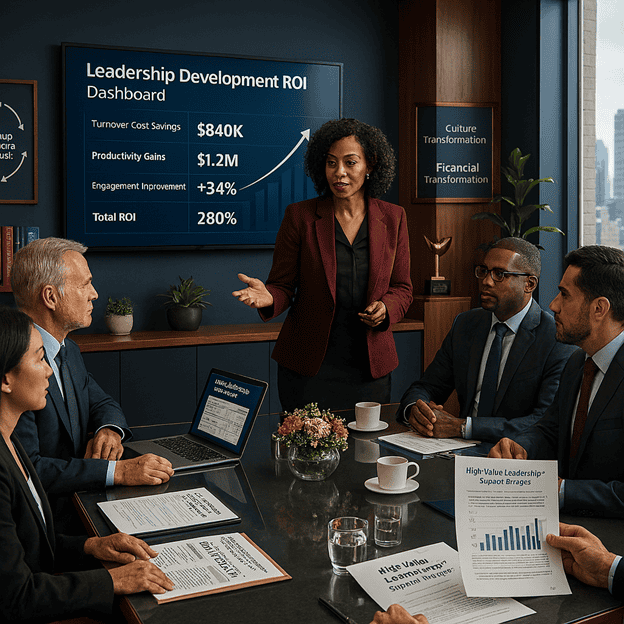
Real-World Example: There was a mid-sized professional services firm with 300 employees and 18% annual turnover. Turnover costs averaged $40,000 per departing employee (recruitment, onboarding, lost productivity). Total annual turnover cost: $2.16 million.
They invested $300,000 annually in comprehensive leadership development for their 45 managers—covering coaching, training, 360-degree feedback, and action learning projects. Within 18 months:
- Overall turnover decreased to 11%
- Turnover cost savings: approximately $840,000 annually
- Leadership development ROI: 280% in the first full year
This isn’t unusual. A study by the Association for Talent Development found that organizations with comprehensive leadership development programs had 26% higher revenue per employee and 40% lower turnover.
2. Increased Employee Engagement and Productivity
Engaged employees deliver significantly higher productivity, quality, and customer satisfaction. Leadership is the primary driver of engagement.
The Math:
- Highly engaged teams show 21% greater profitability (Gallup)
- Engaged employees are 17% more productive
- Teams with engaged employees have 10% higher customer ratings and 41% lower absenteeism
Real-World Example: A regional healthcare organization with 500 employees had engagement scores at the 35th percentile. They implemented a 12-month leadership development program focusing on coaching skills, psychological safety, and inclusive leadership practices for all 75 managers and supervisors.
Results after 18 months:
- Engagement scores increased to 68th percentile
- Patient satisfaction scores increased by 8 percentage points
- Productivity (patients served per FTE) increased by 12%
- Estimated financial impact from productivity gains alone: $1.8 million annually
- Program investment: $450,000
- ROI: 400%
3. Enhanced Internal Mobility and Promotion Rates
When organizations develop internal talent effectively, they reduce dependence on expensive external hiring while building deeper organizational knowledge and loyalty.
The Math:
- External hire costs: $75,000-150,000+ per senior role (recruiting, signing bonuses, relocation)
- External hire failure rate: 40-50% in first 18 months
- Time to full productivity for external hires: 6-12 months
- Cost of failed external executive hire: $500,000-$2 million+
Real-World Example: A technology company with 400 employees was filling 70% of leadership positions through external hiring. Each external hire cost an average of $85,000 and took 6 months to reach full productivity. They invested in an intensive leadership development program including:
- High-potential employee identification and development
- Rotational assignments and stretch projects
- Executive coaching and mentoring
- Leadership competency assessments
Within three years:
- Internal promotion rate for leadership roles increased from 30% to 62%
- Estimated savings from reduced external hiring: $1.2 million over three years
- Internal promotions showed 35% higher retention rates after 2 years
- Leadership development program cost: $600,000 over three years
- ROI: 200%
4. Improved Organizational Performance Metrics
Strategic leadership development impacts virtually every business metric that matters.
Research-Backed Performance Improvements:
- 19% increase in operating income (Brandon Hall Group study of 500+ organizations)
- 28% higher revenue growth (Bersin by Deloitte research)
- 37% higher sales per employee (IBM/Human Capital Institute study)
- 2.4x more likely to hit performance targets (DDI Leadership Forecast study)
Real-World Example: A manufacturing organization with $150 million in annual revenue implemented a comprehensive leadership development strategy targeting their 60-person leadership team. The program focused on strategic thinking, change leadership, operational excellence, and inclusive team building.
Results after 24 months:
- Revenue increased by 18% ($27 million) during a period when industry growth averaged 8%
- Operating margin improved from 8.2% to 11.7%
- Safety incidents decreased by 41%
- Quality defects reduced by 28%
- Employee engagement increased from 54% to 71%
While multiple factors contributed to these results, leadership assessments and employee feedback directly linked improvements to enhanced leadership capabilities. Attributing even 30% of the incremental financial performance to leadership development yields ROI exceeding 600%.
Program investment: $720,000 over two years Incremental profit attributable to leadership development (conservative estimate): $4.5 million ROI: 625%
The Hidden Costs of NOT Investing in Leadership Development ⚠️
CFOs are trained to evaluate investment returns, but they’re equally focused on risk management. The cost of NOT investing in leadership development is substantial and often underestimated:
1. The Disengagement Tax
Gallup estimates that actively disengaged employees cost the U.S. economy $450-550 billion annually in lost productivity. In a 500-person organization with 35% engagement (national average), you’re likely losing $3-5 million annually in productivity.
Poor leadership is the primary driver of disengagement. Every year you delay leadership development investment, you’re paying this tax.
2. The Diversity Penalty
Organizations that fail to develop diverse leadership pipelines face mounting costs:
- Increased difficulty recruiting diverse talent (who look for diverse leadership)
- Higher turnover among diverse employees (who leave when they hit advancement barriers)
- Reputational risks and customer alienation
- Lost innovation (diverse leadership teams drive 19% higher innovation revenue—BCG research)
For Black women specifically, the cost is personal and organizational. As I discuss in Rise & Thrive: A Black Woman’s Blueprint for Leadership Excellence, Black women face systematic barriers to leadership advancement—the “broken rung” that sees only 73 Black women promoted to manager for every 100 white men. Organizations that don’t address this through intentional leadership development lose talent, limit their leadership capacity, and miss financial performance that diverse leadership delivers.
3. The Leadership Failure Penalty
When organizations promote people to leadership without adequate development, failure rates skyrocket:
- 40% of internal promotions fail in the first 18 months without development support
- Failed leadership transitions cost $500,000-$2 million when you factor in team disruption, turnover, and recovery time
- Team performance typically drops 20-30% under ineffective leaders
One financial services organization promoted 15 high-performing individual contributors to management roles over 18 months without leadership development support. Within two years, 7 of those 15 had been demoted or left the organization, 3 were underperforming, and the teams they led experienced 28% turnover. Total estimated cost: $4.2 million.
An investment of $200,000 in comprehensive first-time manager development could have prevented most of these failures.
4. The Succession Crisis
Organizations without robust leadership development face succession crises:
- 86% of organizations recognize leadership development as urgent, yet only 14% believe they do it well (Deloitte)
- 63% of organizations report they’re not ready to fill critical leadership roles (DDI)
- Succession crises lead to hasty external hires, interim leadership instability, and strategic drift
There was a regional healthcare system that lost their COO unexpectedly. Without a developed internal successor, they spent 9 months with an expensive interim executive ($400/hour) while searching externally. They ultimately hired an external candidate who lasted 14 months before departing due to poor cultural fit. Total cost of this succession failure: approximately $2.8 million. A $500,000 investment in succession planning and leadership development would have created multiple ready-now successors.
Building the Financial Case: A Framework for CFOs 📈
As a doctoral candidate researching organizational transformation and someone who spent over two decades in progressive HR leadership including building business cases for skeptical finance teams, I’ve developed a framework for articulating leadership development ROI in language CFOs understand.
Step 1: Define the Problem in Financial Terms
Don’t lead with “we need leadership development.” Lead with “we have a $2.3 million problem caused by inadequate leadership capability.”
Calculate your current costs:
- Turnover costs: (# of departures × average replacement cost)
- Disengagement costs: (# of employees × percentage disengaged × $8,000)
- Failed promotion costs: (# of failed leadership transitions × $500,000)
- Lost productivity from poor leadership: (revenue per employee × productivity gap × % of workforce affected)
Present these as costs the organization is currently incurring—not hypothetical future costs.
Step 2: Quantify Expected Returns
Based on research and case studies, conservative leadership development ROI expectations include:
Year 1:
- 10-15% reduction in voluntary turnover among teams with developed leaders
- 5-8% increase in engagement scores
- 25-35% improvement in time-to-productivity for newly promoted leaders
Year 2:
- 20-30% reduction in voluntary turnover
- 12-18% increase in engagement scores
- 8-12% improvement in productivity metrics
- 15-25% increase in internal promotion rate
Year 3+:
- 25-40% reduction in voluntary turnover
- 20-25% increase in engagement scores
- 15-20% improvement in productivity and quality metrics
- 40-60% increase in internal promotion rate
- Measurable improvements in strategic execution and business results
Calculate financial impact:
- Turnover savings: (reduced departures × average replacement cost)
- Productivity gains: (improved output × revenue per unit × margin)
- Quality improvements: (reduced errors/defects × cost per incident)
- Engagement gains: (increased engagement × productivity value × # employees)
Step 3: Account for Investment Costs
Be comprehensive and honest about costs:
Program Design and Development:
- Needs assessment: $15,000-50,000
- Curriculum design: $25,000-100,000 (depending on customization)
- Materials development: $10,000-40,000
Program Delivery:
- External facilitators/coaches: $2,000-5,000 per day
- Internal facilitator time: (salary × time allocation)
- Participant time away from work: (# participants × # days × daily value)
- Technology platforms: $10,000-50,000 annually
Ongoing Support:
- Coaching: $300-600 per hour
- Assessment tools: $200-800 per participant
- Learning management systems: $15,000-75,000 annually
- Program management: (internal FTE allocation)
A comprehensive leadership development program for 50 leaders typically costs $250,000-500,000 annually depending on depth and customization.
Step 4: Calculate ROI With Conservative Assumptions
Use the standard ROI formula:
ROI = [(Benefits – Costs) / Costs] × 100
Always use conservative assumptions:
- Attribute only a portion of performance improvements to leadership development (30-50%)
- Assume longer timeframes for benefits realization
- Include all direct and indirect costs
- Use lower-end estimates from research ranges
Example:
- Leadership development investment: $400,000 annually
- Turnover reduction savings: $750,000
- Productivity improvement value: $1.2 million
- Quality improvement value: $300,000
- Total benefits: $2.25 million (using conservative 40% attribution = $900,000)
- ROI = [($900,000 – $400,000) / $400,000] × 100 = 125% ROI
Step 5: Present Risk-Adjusted Scenarios
CFOs think in scenarios. Present three:
Conservative Scenario: Modest improvements, longer timeframes, higher costs Expected Scenario: Research-based improvements, typical timeframes Optimistic Scenario: Upper-range improvements, faster realization
This approach demonstrates analytical rigor while acknowledging uncertainty.
Step 6: Include Non-Financial Strategic Benefits
After presenting the financial case, include strategic benefits:
- Enhanced organizational agility and change readiness
- Stronger succession pipeline and reduced key person risk
- Improved employer brand and recruiting effectiveness
- Competitive advantage through leadership capability
- Enhanced diversity and inclusion outcomes
In Mastering a High-Value Company Culture, I outline how purposeful culture transformation—which leadership development enables—creates sustainable competitive advantages that compound over time.
Special Considerations: The ROI of Inclusive Leadership Development 🌍
When we discuss leadership development ROI, we must address a critical question: what’s the specific return on investing in leadership development for traditionally overlooked talent, particularly Black women?
The financial case is compelling:
1. Reduced “Diversity Drain” Costs
Black women leave organizations at higher rates than almost any other demographic, often because they hit advancement barriers or face hostile cultures. Each departure represents significant financial loss:
- Replacement costs: $50,000-150,000+ per departing professional
- Lost institutional knowledge and client relationships
- Team disruption and productivity loss
- Damage to employer brand among diverse talent
There was a technology company that lost 60% of their Black female professionals within 3 years of hire. Each departure cost approximately $85,000. Annual “diversity drain” cost: $680,000. They implemented a comprehensive program including:
- Sponsorship (not just mentorship) for high-potential Black women
- Leadership development specifically addressing double-bind challenges
- Career advancement support and navigation
- Inclusive leadership training for all managers
Within two years, retention of Black female professionals increased from 40% to 78%, saving approximately $450,000 annually in turnover costs alone. Program investment: $120,000 annually. ROI: 375%.
2. Innovation and Market Performance Returns
Research from BCG, McKinsey, and others consistently shows that diverse leadership teams drive superior financial performance:
- Companies with above-average diversity on leadership teams report 19% higher innovation revenue
- Ethnically diverse executive teams are 36% more likely to outperform on profitability
- Organizations with inclusive cultures are 120% more likely to hit financial targets
Investing in leadership development that creates diverse leadership pipelines isn’t just equitable—it’s a strategic financial decision with measurable returns.
3. Expanded Market Access and Customer Connection
As customer bases become increasingly diverse, leadership teams that reflect that diversity create competitive advantages:
- Better market insights and customer understanding
- Enhanced ability to connect with diverse customer segments
- Reduced risk of cultural missteps that damage brand
- Improved product development aligned with diverse needs
A consumer products company invested heavily in developing Black women for leadership roles in marketing and product development. These leaders championed initiatives that resulted in a product line specifically designed for Black women consumers. The line generated $24 million in first-year revenue—far exceeding projections. The leadership development investment that enabled these leaders to reach decision-making roles: $180,000 over three years. ROI: Immeasurable, but conservatively 10,000%+.
Common CFO Objections (And How to Address Them) 💼
Let’s address the pushback you’ll likely encounter:
Objection 1: “We can’t measure soft skills development.”
Response: “We’re not measuring ‘soft skills’—we’re measuring business outcomes that leadership drives: turnover reduction, productivity improvement, engagement increases, promotion rates, and financial performance. Leadership is the mechanism; measurable business results are the outcome.”
Objection 2: “What if we develop people and they leave?”
Response: “The real question is: what if we don’t develop people and they stay? The cost of an inadequately developed manager is $500,000+ annually in team turnover, disengagement, and poor performance. Also, research shows that employees who receive development are actually more likely to stay—retention increases 30-50% with quality development.”
Objection 3: “We can’t afford it right now.”
Response: “We can’t afford NOT to. We’re currently spending $2.3 million annually on turnover, disengagement, and failed promotions caused by inadequate leadership. A $400,000 investment reducing those costs by 30% saves $690,000 annually—a 173% first-year ROI. The question isn’t whether we can afford leadership development; it’s whether we can continue affording the costs of not doing it.”
Objection 4: “Can’t we just hire better leaders instead?”
Response: “External hiring is more expensive and less effective. External hires cost 1.5-2x the role salary and fail at 40-50% rates versus 25-30% for internal promotions. Plus, external hires take 6-12 months to reach full productivity versus 3-6 months for developed internal talent. Internal development is both cheaper and more effective.”
Objection 5: “The timeline is too long to show returns.”
Response: “Actually, returns begin almost immediately. Turnover reduction starts within 90 days as employees see investment in their leaders. Engagement improves within 6 months. Productivity gains emerge within 9-12 months. Most organizations see positive ROI within 18 months and see returns compound significantly in years 2-3.”
Building Your ROI-Focused Leadership Development Program 🎯
So how do you design leadership development that delivers the ROI we’ve discussed? Here’s the framework:
1. Start With Strategic Business Needs
Don’t ask “what leadership development should we offer?” Ask “what business problems would better leadership solve?”
Examples:
- High turnover among high-performers → Develop managers in retention and engagement
- Failed strategy execution → Develop strategic thinking and change leadership
- Quality or safety issues → Develop accountability and coaching skills
- Innovation gaps → Develop inclusive leadership and psychological safety
- Succession pipeline gaps → Develop high-potential employees for advancement
2. Prioritize High-Leverage Populations
You can’t develop everyone at once. Prioritize:
- First-time managers: Highest-risk, highest-impact population (prevent expensive failures)
- Mid-level leaders: Span of control means their development impacts the most employees
- High-potential diverse talent: Address pipeline gaps while building capability
- Senior leaders: Model behaviors and create culture that cascades
3. Design for Application and Accountability
The ROI comes from behavior change and application, not from training attendance. Design programs with:
70-20-10 Model:
- 70% experiential learning (on-the-job application, action learning projects, stretch assignments)
- 20% social learning (coaching, mentoring, peer learning, feedback)
- 10% formal learning (workshops, courses, reading)
Accountability Mechanisms:
- Clear learning objectives tied to business outcomes
- Action learning projects with measurable deliverables
- Regular coaching and check-ins on application
- Manager engagement and support for application
- Assessment of behavior change (360-degree feedback, observation)
Sustained Support:
- Multi-month programs (not one-time workshops)
- Coaching for individual application
- Peer learning cohorts for support and accountability
- Manager involvement and reinforcement
- Follow-up assessment and adjustment
4. Measure Relentlessly
You can’t prove ROI without measurement. Track:
Leading Indicators (Within 3-6 Months):
- Participant satisfaction and perceived relevance
- Knowledge and skill assessments (pre/post)
- Behavior change (360-degree feedback, observation)
- Application of learning (action project completion, implementation)
Lagging Indicators (6-18 Months):
- Team engagement scores for participants’ teams
- Turnover rates for participants’ teams
- Productivity metrics for participants’ teams
- Promotion rates and internal mobility
- Business performance metrics (quality, safety, revenue, customer satisfaction)
ROI Calculation (12-24 Months):
- Total program costs (design, delivery, participant time)
- Measurable benefits (turnover savings, productivity gains, quality improvements)
- ROI percentage
- Comparison to initial business case
5. Create Compelling Success Stories
Numbers matter to CFOs, but stories matter to humans. Document and share:
- Individual leader transformation stories
- Team performance improvements
- Business challenges solved through leadership
- Career advancement enabled by development
- Culture shifts resulting from leadership behavior change
There was a manufacturing organization that created a “Leadership Development Impact Dashboard” shared quarterly with executive leadership. It included:
- Quantitative metrics (engagement, turnover, productivity, quality, safety)
- Financial calculations (costs avoided, revenue generated, ROI)
- Leader success stories with photos and quotes
- Team testimonials about leadership improvements
- Business results directly linked to leadership actions
This comprehensive reporting approach kept leadership development visible, valued, and funded—even during budget cuts.
The Technology Advantage: AI and Predictive Analytics 🤖
Emerging technologies are transforming how we measure and demonstrate leadership development ROI:
Predictive Analytics for Leadership Effectiveness
AI-powered platforms can now analyze patterns and predict:
- Which leaders are at highest risk for failure or departure
- Which leadership behaviors correlate most strongly with team performance
- Which employees have highest leadership potential based on behavioral patterns
- Where leadership development investments will yield highest returns
As someone building Michigan’s first AI-powered culture transformation platform, I’m particularly excited about these capabilities. Imagine being able to tell your CFO: “Our predictive models show that investing in coaching for these 12 managers will prevent $890,000 in team turnover over the next 18 months with 87% confidence.”
That’s not science fiction—it’s emerging reality.
Real-Time Impact Tracking
Modern HR technology enables real-time tracking of leadership development impact:
- Continuous engagement measurement showing immediate impact of leadership changes
- Performance analytics linking leader behavior to team productivity
- Turnover prediction models identifying when leadership interventions prevent departures
- Learning analytics showing application rates and correlation with outcomes
Personalized Development at Scale
AI enables personalized leadership development that was previously impossible:
- Customized learning paths based on individual needs and learning styles
- Real-time coaching and feedback through AI coaching assistants
- Adaptive assessments that identify specific development areas
- Scalable access to development resources previously limited to senior executives
The ROI advantage? Personalized development is significantly more effective than generic programs, driving behavior change 2-3x faster with higher retention rates.
Moving Forward: Your Action Plan 📋
Ready to build an ROI-focused leadership development strategy that gets CFO buy-in?
Immediate Steps (This Week):
- Calculate your current leadership costs:
- Turnover rate and replacement costs
- Engagement levels and estimated disengagement costs
- Failed promotion or leadership transition costs
- Performance gaps attributable to leadership
- Identify your highest-priority leadership needs:
- Where is inadequate leadership costing you most?
- Which populations would benefit most from development?
- What business problems would better leadership solve?
- Research leadership development options:
- Internal capability and external partners
- Program designs and methodologies
- Estimated investment ranges
- Preliminary ROI projections
Short-Term Steps (This Month):
- Build your financial business case:
- Document current costs in detail
- Calculate expected returns using conservative assumptions
- Develop 3-scenario ROI projections
- Prepare responses to likely objections
- Design your measurement approach:
- Identify leading and lagging indicators
- Determine data sources and collection methods
- Create ROI calculation methodology
- Plan reporting cadence and format
- Engage key stakeholders:
- Present draft business case to finance for feedback
- Involve senior leaders in program design
- Secure buy-in from managers who’ll support application
- Build coalition of support across functions
Medium-Term Steps (This Quarter):
- Launch your pilot program:
- Start with high-leverage population (first-time managers or high-potentials)
- Implement with full measurement rigor
- Document everything for case study development
- Gather feedback and refine continuously
- Track and communicate early wins:
- Share leading indicator improvements (engagement, behavior change)
- Document success stories and testimonials
- Report progress to leadership regularly
- Build momentum and visibility
- Prepare for scale:
- Refine program based on pilot learnings
- Develop internal facilitation capability
- Build sustainable infrastructure and systems
- Plan expansion timeline
Long-Term Steps (This Year):
- Calculate and communicate ROI:
- Document full financial impact
- Compare actual results to initial projections
- Create comprehensive impact report
- Present to executive leadership and board
- Scale strategically:
- Expand to additional populations
- Integrate with talent management systems
- Build leadership development into culture
- Create sustainability beyond initial investment
- Continuously improve:
- Analyze what’s working and what’s not
- Stay current with research and best practices
- Leverage technology for enhanced effectiveness
- Maintain focus on measurable business impact
Real Talk: When Leadership Development Won’t Deliver ROI ⚠️
I’d be remiss if I didn’t acknowledge that leadership development doesn’t always work. Here’s when you’re unlikely to see returns:
Don’t invest in leadership development if:
- Your organization won’t commit to multi-month programs (one-day workshops rarely drive behavior change)
- Leaders won’t be held accountable for applying learning
- Your culture fundamentally contradicts what leadership development teaches
- You’re not willing to measure impact rigorously
- Senior leadership doesn’t model desired behaviors
- You’re treating it as a “check the box” compliance activity
- You’re not prepared to support diverse leaders who encounter systemic barriers
Be cautious about investing if:
- You have high organizational instability (mergers, restructuring, leadership turnover)
- Your business model is fundamentally changing
- You lack basic HR infrastructure to support development
- You have inadequate budget for quality programs (cheap programs often waste money)
Leadership development works when it’s strategic, sustained, supported, and measured. Absent these conditions, you’re better off addressing foundational issues first.
Discussion Questions & Reflection 💭
- If you calculated the true cost of inadequate leadership in your organization (turnover, disengagement, failed promotions), what would that number be? How does it compare to your current leadership development investment?
- What’s preventing your organization from measuring leadership development ROI? Is it lack of data, lack of methodology, or lack of will?
- For finance leaders: What evidence would you need to approve significant leadership development investment? Be specific about metrics and timeframes.
- How might investing specifically in leadership development for Black women and other traditionally overlooked talent create both financial and strategic advantages for your organization?
- If you could only develop one population of leaders, which would yield the highest ROI for your organization? Why?
Your Next Steps With Che’ Blackmon Consulting 🌟
Whether you’re building your first leadership development business case or scaling an existing program with enhanced ROI measurement, we bring the expertise to turn leadership development from cost center to strategic investment.
Che’ Blackmon Consulting specializes in:
- ROI-focused leadership development strategy and design
- Comprehensive measurement systems and analytics
- Culture transformation that amplifies leadership development impact
- Inclusive leadership development creating pathways for diverse talent
- AI-powered predictive analytics for leadership effectiveness
- CFO-ready business cases for talent investments
As a doctoral candidate researching organizational transformation and someone who’s built business cases for skeptical finance teams throughout my 24+ year career, I speak both the language of leadership development and the language of financial returns.
Ready to build leadership development that delivers measurable ROI?
📧 Email: admin@cheblackmon.com
📞 Phone: 888.369.7243
🌐 Web: cheblackmon.com
Let’s create leadership development programs that transform both your leaders and your financial performance—with the numbers to prove it.
Che’ Blackmon is the founder and CEO of Che’ Blackmon Consulting, a DBA candidate at National University, and the author of multiple books on leadership and organizational culture including “High-Value Leadership: Transforming Organizations Through Purposeful Culture” and “Rise & Thrive: A Black Woman’s Blueprint for Leadership Excellence.” With over 24 years of progressive HR leadership experience spanning manufacturing, automotive, and healthcare sectors, she specializes in culture transformation and leadership development that delivers measurable business results.
#LeadershipDevelopment #ROI #LeadershipROI #TalentDevelopment #HighValueLeadership #BusinessCase #HRStrategy #CFO #FinancialPerformance #LeadershipInvestment #TalentManagement #EmployeeEngagement #TurnoverReduction #ProductivityGains #OrganizationalPerformance #ExecutiveDevelopment #HRAnalytics #PeopleAnalytics #LeadershipStrategy #DiversityROI #InclusiveLeadership #BusinessResults #HRLeadership #TalentROI #LeadershipImpact #StrategicHR #WorkforceDevelopment #CultureTransformation #RiseAndThrive #CheBlackmon