


By Che’ Blackmon, DBA Candidate | Founder & CEO, Che’ Blackmon Consulting
Every St. Patrick’s Day, the legend gets told again. Somewhere at the end of a rainbow, there is a pot of gold. The leprechaun guards it. Most people never reach it. And even in the stories where someone does find it, the gold has a way of disappearing before it can be held onto for long. It is a charming myth. But for the leaders and organizations chasing culture transformation, it is also a surprisingly accurate metaphor for what happens when culture is treated as something to be discovered rather than something to be built.
The truth is this: high-value culture is not found at the end of a rainbow. It does not appear because the timing is finally right, because the budget loosened up, or because a new HR initiative declared the organization a great place to work. It is engineered. It is earned. It is sustained through intention, investment, and the kind of leadership that refuses to let values be decorative. And the organizations that actually reach that gold? They find something far more valuable than luck.
This St. Patrick’s Day, let us look at what high-value organizations actually find at the end of a culture well built, why so many organizations never make it there, and what it takes to follow the rainbow all the way through.
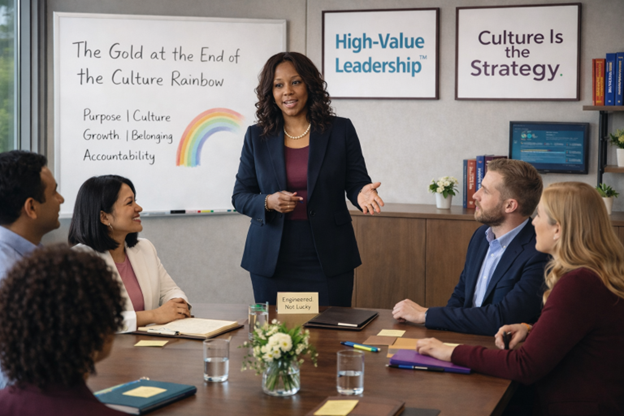
🌈 The Rainbow Is Real. The Luck Is Not.
In Irish folklore, the rainbow is beautiful but elusive. You can see where it is going, but every time you try to follow it, the end keeps moving. That is exactly how most organizations experience culture. They can see what a great culture looks like. They attend the conferences, read the case studies, and draft the values statements. But every time they try to close the gap between aspiration and reality, the destination seems to shift. The culture they are chasing never quite arrives.
The reason is almost always the same. They are following the rainbow instead of building the path. Culture is not a destination you find. It is an infrastructure you construct, one system, one decision, and one leadership behavior at a time. The organizations that treat it as something to be discovered are always in pursuit. The organizations that treat it as something to be engineered are the ones that eventually stand next to the pot of gold and say: we built this.
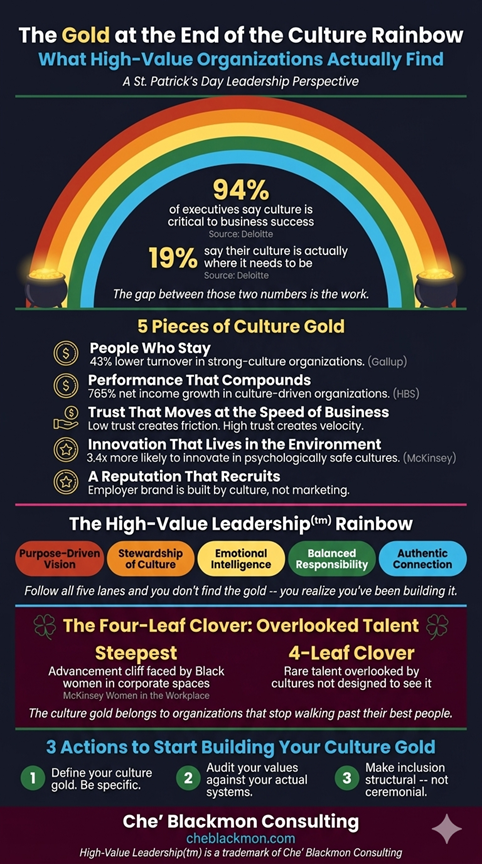
Research from Deloitte found that 94 percent of executives and 88 percent of employees believe a distinct workplace culture is important to business success. But only 19 percent of organizations feel their culture is where it needs to be. That gap is not a mystery. It is the distance between knowing culture matters and actually doing the disciplined work of creating it.
🍀 The rainbow is real. The culture gold is attainable. But it requires a map, not a wish.
🪨 The Pot of Gold: What High-Value Organizations Actually Find
When organizations do the work, the rewards are not abstract. They are measurable, durable, and transformative in ways that show up on both the balance sheet and the daily experience of every person who walks through the door. Here is what high-value organizations actually find at the end of a culture well built.
🥇 Gold Piece 1: People Who Stay
Voluntary turnover is one of the most costly and least discussed failures in organizational life. According to the Society for Human Resource Management, replacing a single employee costs between one half and two times that employee’s annual salary. For a workforce of any size, chronic turnover is not a staffing inconvenience. It is a financial hemorrhage. And the most common cause is not compensation. It is culture.
Gallup’s research consistently finds that employees in organizations with strong cultures are 43 percent less likely to leave voluntarily. They stay not because they cannot find something better elsewhere. They stay because what they have built here, the relationships, the purpose, the sense that their contribution matters, is genuinely difficult to replicate. That loyalty is not manufactured by a retention bonus or a perks program. It is the natural result of a culture that made them feel seen, valued, and invested in over time.
There was a manufacturing organization that had experienced significant voluntary turnover at the senior individual contributor level for three consecutive years. Every exit interview cited the same themes: unclear expectations, leadership that did not listen, and a sense that longevity was penalized rather than rewarded. When the organization committed to a structured culture realignment, including redesigned feedback systems, visible leadership accountability, and a formal internal mobility program, voluntary turnover dropped measurably within 18 months. The gold was not a new benefit. It was a culture that finally said: you belong here and your future is here.
🥇 Gold Piece 2: Performance That Compounds
Culture and performance are not separate conversations. They are the same conversation. Organizations with strong, intentional cultures outperform their peers not occasionally but consistently and significantly. A comprehensive study from Harvard Business School found that organizations with performance-enhancing cultures saw net income growth of 765 percent over an 11-year period, compared to 1 percent growth in organizations without strong cultures. These are not marginal differences. They are civilizational.
The mechanism is not magic. It is engagement. When people work in cultures where they understand the purpose, trust the leadership, feel psychologically safe to contribute, and see a clear connection between their effort and the organizational outcome, they work differently. Not harder in the frantic, depleting sense. Better. More creatively. More collaboratively. More sustainably. That quality of contribution compounds over time in ways that no individual talent acquisition strategy can replicate.
In High-Value Leadership: Transforming Organizations Through Purposeful Culture, the argument is that culture is not a byproduct of good strategy. It is the precondition for good strategy working at all. The same strategic plan produces wildly different outcomes depending on the culture in which it is executed. High-value culture multiplies every other organizational investment.
🥇 Gold Piece 3: Trust That Moves at the Speed of Business
In low-trust organizations, everything slows down. Decisions require more layers of approval. Information moves through gatekeepers instead of channels. Collaboration requires negotiation instead of assumption. Conflict generates defensiveness instead of resolution. The friction of low trust is invisible on an org chart but absolutely visible in the pace and quality of organizational output.
Patrick Lencioni, in The Five Dysfunctions of a Team, identified absence of trust as the foundational dysfunction from which every other organizational failure flows. High-value cultures build trust systemically, through consistent leadership behavior, transparent communication, psychological safety, and accountability that applies equally to everyone regardless of title or tenure. When that trust is present, organizations move faster, decide better, and recover from setbacks more completely.
There was a professional services organization that had struggled with a culture of internal competition that made information sharing a liability rather than a norm. Leaders hoarded insights. Teams duplicated work rather than collaborating. Client outcomes suffered. When leadership committed to a culture of transparent communication, shared accountability metrics, and visible recognition of collaborative behavior, the pace of client delivery improved significantly and internal satisfaction scores rose within two quarters. Trust, it turns out, is not soft. It is infrastructure.
🥇 Gold Piece 4: Innovation That Lives in the Environment
The most innovative organizations in the world are not innovative because they hired creative people. They are innovative because they built cultures in which creative thinking is safe, encouraged, and acted upon. Innovation does not live in a person. It lives in the conditions the culture creates for that person to bring their full thinking to work.
A 2023 McKinsey report found that organizations with psychologically safe cultures were 3.4 times more likely to report above-average innovation performance. Psychological safety, the belief that one can speak up, offer ideas, challenge assumptions, and admit mistakes without fear of punishment, is not a personality trait. It is a cultural output. It is produced by leaders who model intellectual humility, by systems that reward the raising of problems as well as the delivery of solutions, and by norms that treat disagreement as a gift rather than a threat.
Mastering a High-Value Company Culture makes the case that innovation is not a strategy. It is a symptom of a culture that has already done the foundational work of building safety, clarity, and genuine investment in its people. You cannot bolt on innovation. You have to grow the conditions from which it naturally emerges.
🥇 Gold Piece 5: A Reputation That Recruits
Employer brand is not built by marketing. It is built by culture. The organizations that consistently attract top talent without extraordinary compensation packages are the organizations whose reputation precedes them. People talk about where they work. They talk about how they were treated, whether their contributions were recognized, whether leadership lived the values stated on the website, and whether they would send a friend to apply. That word-of-mouth infrastructure, built entirely from genuine employee experience, is among the most powerful recruiting tools available and it costs nothing to create except the commitment to building a culture worth talking about.
✨ The Clover in the Crowd: Seeing Overlooked Talent as Organizational Gold
There is a particular element of the St. Patrick’s Day mythology that deserves a longer look in this context. The four-leaf clover is rare precisely because most people walk past thousands of three-leaf clovers without stopping to look carefully. The four-leaf version is not fundamentally different. It is simply overlooked by those who are not paying attention.
This is a perfect metaphor for what happens with overlooked talent in most organizations. The talent is there. It has always been there. It is simply not being seen by cultures and systems designed to recognize only the most obvious markers of potential and contribution.
🚨 The Compounded Invisibility of Black Women in Corporate Spaces
No group in the American corporate workforce has been more consistently undervalued, more systematically overlooked, and more persistently bypassed in advancement conversations than Black women. This is not a subjective observation. McKinsey and Company’s Women in the Workplace research has documented for years that Black women face the steepest advancement cliff of any demographic group, are the least likely to receive sponsorship from senior leaders, and are the most likely to have their ideas credited to others in collaborative settings.
In Rise and Thrive: A Black Woman’s Blueprint for Leadership Excellence, this reality is addressed without softening. Black women enter corporate organizations with credentials, competence, and the particular resilience that comes from navigating systems not designed for their success. They contribute, they lead, and they deliver results, often while managing the invisible tax of code-switching, navigating bias, and working harder for recognition that colleagues with less experience receive more readily. When organizations fail to retain and advance Black women, they are not losing a demographic. They are losing the four-leaf clover they walked right past.
The organizations that find the gold at the end of the culture rainbow are, without exception, the ones that have built systems to see and advance every form of talent equitably. Not through performative inclusion initiatives but through structural redesign of the processes that determine whose ideas get credited, whose names appear on succession plans, and whose contributions are measured with the same rigor as their colleagues.
📚 Rise & Thrive Connection: If you are a Black woman in a corporate environment where your contributions are consistently visible but your advancement is consistently stalled, Rise and Thrive: A Black Woman’s Blueprint for Leadership Excellence was written specifically for this season of your professional journey. The SHIELD Resilience Framework within that work is a strategic and personal toolkit designed to help you navigate exactly this terrain with clarity, confidence, and purpose.
The culture gold belongs to organizations that stop walking past their most valuable talent and start building the systems to recognize, develop, and advance them. Equitably. Structurally. Permanently.
🍀 The High-Value Leadership™ Rainbow: Following the Right Path
The High-Value Leadership™ framework is the map for organizations serious about reaching the cultural gold. Its five pillars are not a checklist. They are a system. Each one is a lane in the rainbow, and together they lead somewhere worth going.
1️⃣ Purpose-Driven Vision: The Red Lane
Purpose is not a tagline. It is the organizational north star that gives every employee a reason to come to work that transcends their job description. Organizations with a clear, authentic, and cascaded sense of purpose see higher engagement, lower turnover, and stronger alignment between individual effort and organizational outcome. The red lane of the rainbow is where culture begins. Without it, every other investment in culture is noise without direction.
2️⃣ Stewardship of Culture: The Orange Lane
Culture does not maintain itself. It requires active, intentional stewardship from leaders who model the values they want to permeate the organization, who hold themselves and others accountable to those values, and who understand that the daily decisions they make are cultural signals whether or not they intend them to be. Stewardship of culture is the orange lane: the warmth and energy that keeps the culture alive between the major initiatives and the annual engagement surveys.
3️⃣ Emotional Intelligence: The Yellow Lane
Daniel Goleman’s research has demonstrated that emotional intelligence accounts for 67 percent of the competencies most essential for strong leadership performance. Leaders who understand their own emotional landscape and who can read and respond to the emotional climate of their teams build cultures of safety, connection, and resilience. The yellow lane is where human beings actually experience each other, and it is where culture is either built or eroded in the ordinary moments of every workday.
4️⃣ Balanced Responsibility: The Green Lane
This is the St. Patrick’s Day lane. And it is fitting that the green lane of the High-Value Leadership™ framework is where growth lives. Balanced Responsibility is the discipline of holding high standards in a psychologically safe environment. It is the refusal to choose between care and accountability. It is the recognition that people grow fastest in environments where expectations are clear, feedback is honest and kind, and the standard applies to everyone. The green lane is where ordinary teams become exceptional ones.
5️⃣ Authentic Connection: The Blue Lane
The organizations people never want to leave are the organizations where the relationships are real. Authentic connection is not team building at an offsite. It is the daily practice of leaders who know their people as people, who communicate with transparency, who express genuine interest in the development of every person on their team, and who build the kind of relational trust that survives disagreement, setback, and change. The blue lane is where loyalty is built, and it cannot be purchased. It can only be earned.
🌈 Follow all five lanes, and you do not find the gold at the end. You realize you have been building it the entire way.
🏆 What Lucky Companies Are Actually Doing Differently
Here is a secret about the organizations that everyone calls lucky. They are not lucky. They are disciplined. They made commitments that most organizations resist making because those commitments require sustained investment, visible accountability, and the willingness to examine uncomfortable truths about where the culture currently is versus where it claims to be.
There was a healthcare organization that was widely regarded in its market as one of the best places to work. When asked what their secret was, senior leaders consistently said the same thing: they had committed years earlier to making every major people decision, including hiring, promotion, recognition, and development, consistent with their stated values. Not aspirationally consistent. Actually consistent. They audited their systems. They trained their managers. They measured the gaps and held themselves publicly accountable to closing them. They were not lucky. They were relentlessly intentional.
There was a quick-service organization that had historically struggled with front-line retention. After investing in a structured onboarding redesign, a manager development program built on the principles of psychological safety and clear expectations, and a recognition system that celebrated tenure and contribution equally, their 90-day voluntary turnover rate dropped by more than 30 percent within a year. They did not get lucky. They got deliberate.
And there was a nonprofit organization that had the kind of mission-driven culture that everyone admired from the outside but that was eroding internally because leaders had confused passion for purpose with the disciplined practices that sustain culture over time. When they introduced structured accountability systems, transparent communication norms, and a formal investment in leadership development, the internal culture began to match the external reputation. They did not find the gold. They built it.
🛠️ Actionable Takeaways: How to Follow Your Own Rainbow
The following takeaways are practical, immediate, and designed for leaders at every level who are ready to stop chasing culture and start building it.
✅ For Organizational Leaders and HR Professionals
Name What Your Culture Gold Actually Is
Most organizations have a vague aspiration toward great culture but no specific definition of what great looks like in their context. Define it. What does a high-value culture mean for your industry, your workforce, and your strategic goals? What are the three to five measurable outcomes that tell you the culture is working? You cannot build toward something you have not defined.
Audit Your Systems Against Your Values
Your values are only as real as the systems that reinforce them. Take one value your organization claims to hold and trace it through your actual people processes: hiring, onboarding, performance management, recognition, and promotion. Does the value show up at every touchpoint? Where it does not, you have found your work.
Make Inclusion Structural, Not Ceremonial
If your inclusion strategy consists of events, statements, and training sessions but has not touched the processes that determine whose ideas get credited, whose names appear on succession plans, and whose feedback shapes strategy, it is ceremonial. Structural inclusion means redesigning the systems. Start with one.
Invest in Leader Development as a Culture Strategy
Your culture is only as healthy as the leaders delivering it daily. Every manager in your organization is a culture carrier. The question is whether they are carrying it in the direction you intend. Invest in developing the High-Value Leadership™ competencies across your entire leadership pipeline.
✨ For Individual Professionals Building Their Own Culture Path
Identify Where You Are on the Rainbow
Before you can follow the path forward, you need an honest assessment of where you currently stand. Are you in an organization whose culture is aligned with your values? Are you in a role where your contributions are genuinely visible and equitably rewarded? Your answers determine your next strategic move.
Protect Your Energy Like It Is Gold
Because it is. The professional energy required to navigate a culture that is not designed for your success is finite and non-renewable. In Rise and Thrive, the point is made clearly: strategic resilience is not the ability to endure indefinitely. It is the wisdom to know when to invest more, when to advocate for change, and when to find a culture that actually deserves what you bring.
Build Your Own Five-Lane Rainbow
Regardless of the organizational culture around you, you can embody the High-Value Leadership™ principles in your own professional practice. Lead with purpose. Steward the culture of your team. Bring emotional intelligence to every interaction. Hold yourself and others to high standards with care. Build authentic connections everywhere you go. You become the culture you wish existed.
💬 Discussion Questions for Leaders and Teams
Use these questions to spark meaningful conversation within your organization, leadership team, or professional network.
- If you had to identify the one piece of “culture gold” your organization most needs right now, what would it be? Retention? Trust? Innovation? Inclusion? And what is one system you could redesign to begin building it?
- Where in your organization’s rainbow does the path get unclear or disappear? What is the specific gap between your stated values and the lived experience of your employees?
- Are there four-leaf clovers in your organization, talented professionals whose contributions are consistently undervalued or overlooked? What structural change could make them visible?
- Which of the five High-Value Leadership™ pillars is most present in your organizational culture right now, and which one is most absent? What would it look like to invest in the missing lane?
- For individual professionals: are you in a culture that is building toward gold? If not, what is your strategic response, and what resources do you need to navigate the path forward?
🚦 Next Steps: Start Following Your Rainbow Today
The pot of gold at the end of the culture rainbow is not a myth. It is a reality that disciplined, intentional, High-Value Leadership™ organizations reach every day. Here is how to begin following the path.
- Define your culture gold. Be specific about what a high-value culture looks and feels like in your organizational context.
- Conduct a values-to-systems audit. Identify the gap between what your culture claims and what your systems actually produce.
- Identify and address one area of structural invisibility where overlooked talent, including Black women and other underrepresented professionals, is not advancing at the rate their performance warrants.
- Invest in the High-Value Leadership™ competencies across your leadership pipeline through coaching, development programming, and accountability structures.
- If you are an individual professional navigating a culture misaligned with your values and potential, pick up Rise and Thrive: A Black Woman’s Blueprint for Leadership Excellence for a strategic framework designed for exactly this season.
- Revisit Mastering a High-Value Company Culture and High-Value Leadership: Transforming Organizations Through Purposeful Culture for the comprehensive frameworks behind every principle in this article.
🍀 This St. Patrick’s Day, may your organization be blessed not with luck, but with the discipline, the courage, and the leadership to build the culture gold that lasts. The rainbow is yours to follow. The gold is yours to build.
🚀 Ready to Build Your Culture Gold?
Che’ Blackmon Consulting partners with organizations and leaders who are serious about following the culture rainbow all the way through. Whether you are diagnosing a retention challenge, redesigning your people systems, or investing in the leadership development that makes every organizational strategy work better, we bring the frameworks, experience, and tools to help you find what you are building toward.
📧 admin@cheblackmon.com 📞 888.369.7243 🌐 cheblackmon.com
About the Author
Che’ Blackmon is a doctoral candidate in Organizational Leadership (DBA), the Founder and CEO of Che’ Blackmon Consulting, and a recognized expert in culture transformation, fractional HR leadership, and high-value leadership development. With more than 24 years of progressive HR leadership experience across manufacturing, automotive, healthcare, nonprofit, quick-service, and professional services industries, she has built a body of work dedicated to engineering cultures where every person can thrive at every career stage. She is the author of Mastering a High-Value Company Culture, High-Value Leadership: Transforming Organizations Through Purposeful Culture, and the e-book Rise and Thrive: A Black Woman’s Blueprint for Leadership Excellence. Che’ is the creator of the proprietary High-Value Leadership™ framework and the host of the Unlock, Empower, Transform podcast.
© 2025 Che’ Blackmon Consulting. All rights reserved. | High-Value Leadership™ is a trademark of Che’ Blackmon Consulting.
#StPatricksDay #CultureIsStrategy #HighValueLeadership #CompanyCulture #LeadershipDevelopment #OrganizationalCulture #BlackWomenLead #WorkplaceCulture #HRLeadership #CultureTransformation #EmployeeRetention #InclusiveLeadership #PurposeDrivenLeadership #FractionalHR #CheBlackmonConsulting