By Che’ Blackmon, DBA Candidate | Founder & CEO, Che’ Blackmon Consulting
The applause was real. So was the silence that followed.
She had just delivered the best talk of her career. People stood. Three attendees lined up afterward to say it was exactly what their organizations needed. Someone took a photo of her final slide. She went home with a stack of business cards, a glowing note from the organizer, and a feeling that everything was about to change.
Six weeks later, not one of those conversations had turned into a meeting.
If that story feels familiar, you are not alone. Many leaders, consultants, and subject matter experts treat a keynote as the finish line. It is not. The talk is the opening move. The real work, and the real return, lives in the conversations you design before you ever step on the stage.
🎤 The Applause Trap: Why Great Talks Die at the Door
Applause feels like progress. It is not a pipeline.
The applause trap happens when a speaker measures success by how the room felt instead of what the room did next. A talk can be inspiring, well researched, and beautifully delivered, and still produce nothing, because nobody was given a clear, easy, and specific next step.
Three habits keep speakers stuck in the trap:
- Ending on inspiration instead of invitation. The final minute is the most remembered part of a talk. Many speakers spend it on a quote. Few spend it on a next step.
- Leaving follow up to chance. A fishbowl of business cards is not a strategy. Neither is “Feel free to reach out.”
- Speaking to the room, but not through it. The person who books you is rarely the only decision maker. The most important buyer is often someone who was never in the audience.
Strategic speaking flips the order. You decide what conversations you want first, and then you build the talk that earns them.
📉 Why the Stage Matters More Than Ever
Here is the shift every leader who sells expertise needs to understand: buyers are doing more of the decision on their own, and they are doing it before they ever talk to you.
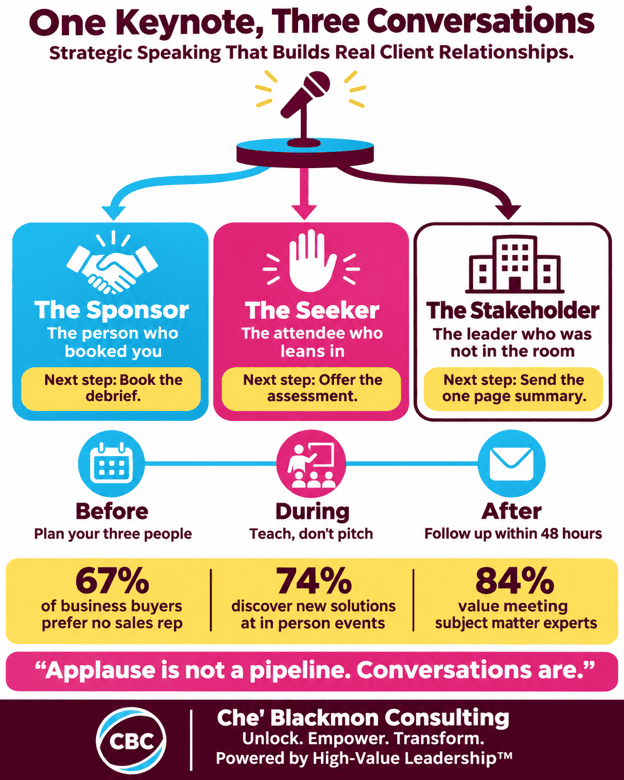
A recent Gartner survey of 646 business buyers found that 67 percent now prefer a buying experience without a sales representative, and 45 percent reported using AI during a recent purchase (Gartner, 2026). Read that again. Two out of three buyers would rather not be sold to at all. Cold outreach and polished brochures are losing ground, because buyers are researching, comparing, and shortlisting quietly.
So where does trust still get built? In the room. Freeman’s 2025 study of 1,022 trade show and conference attendees found that 74 percent name in person events as a place where they discover new products and services, ahead of company websites (56 percent) and online events (40 percent). Even more telling, 84 percent said connecting with subject matter experts at events is very or extremely important (Freeman, 2025).
Put those two findings side by side and the message is clear. Buyers want less selling and more expertise. A keynote is one of the few moments where a decision maker voluntarily gives you thirty to sixty minutes of undivided attention to show how you think. That is not a performance. It is the most valuable sales meeting you will never have to ask for.
⚖️ Who Gets the Big Stage, and Who Gets the Panel
Not everyone is invited to the same stage.
A 2025 study published in BioScience reviewed 1,692 distinguished speakers at North American professional conferences from 2000 to 2023. Women’s representation improved over time, but the pattern by stage size was striking: women made up 50 percent of moderators and panelists, 43 percent of keynote speakers, and only 36 percent of plenary speakers. Late career speakers were 44 percent less likely to be women than early and mid career speakers (Bombaci et al., 2025). The data comes from one field, but the pattern will look familiar to anyone who has watched conference lineups in business. The bigger and more senior the stage, the fewer women on it.
For Black women in corporate and consulting spaces, the gap is often wider. We are invited to moderate. We are asked to sit on the diversity panel. We are thanked for “sharing our story.” Far less often, we are booked as the expert whose framework anchors the main stage.
That is exactly why strategic speaking matters. When you are given fewer stages, each one has to work harder. The goal is not to be grateful for the invitation. The goal is to leave every room with relationships that move your work, your influence, and your income forward.
🧭 The One Keynote, Three Conversations Method
Every talk you give can open three distinct conversations. Each one has a different person, a different purpose, and a different next step. Plan all three before you write a single slide.
🤝 Conversation 1: The Sponsor
The Sponsor is the person who booked you: the event organizer, the association director, or the executive who invited you to speak to their team. They already trust you enough to put you in front of their people. That makes them your warmest relationship in the building.
Most speakers send a thank you note and move on. Strategic speakers schedule a debrief before the event even happens. Ask the Sponsor for twenty minutes the week after the talk to review what the audience said, what questions came up, and what challenges surfaced. That debrief often reveals a need inside the Sponsor’s own organization, and it is the most natural path to a workshop, a leadership retreat, or a longer engagement.
Try this: When you confirm the booking, write, “I’d love to schedule a short debrief after the event so I can share what I heard from your audience. Does the following Tuesday work?”
🙋🏾♀️ Conversation 2: The Seeker
The Seeker is the attendee who leans in. They took notes, asked a question, or waited after the session. They are feeling the exact problem you just described, and they want to know what to do next.
Do not leave the Seeker to find you. Give them a reason to raise their hand on purpose. Offer a short diagnostic, a one page assessment, or a framework worksheet that ties directly to your talk, and make it available through a QR code on your final slide. When someone requests it, you now know who they are, what organization they represent, and what they care about. That is a warm, relevant follow up, not a cold pitch.
Try this: End your talk with one clear invitation, such as, “Scan this code to get the five question culture check we used today, and I’ll send you your results personally.”
🏛️ Conversation 3: The Stakeholder Who Was Not in the Room
This is the conversation most speakers miss. The person with the budget and the final decision is often not in the audience. It is the chief executive, the chief operating officer, or the board member who will hear about your talk secondhand.
Make it easy for your audience to carry your message upstairs. Create a one page executive summary of your talk, with three insights, one key statistic, and one recommended action. Offer it to the Sponsor and to every Seeker, and say plainly, “This is written so you can forward it to your leadership team.” When that summary lands in the right inbox, you have earned a conversation with someone you never met.
Try this: Title your summary for the reader, not for you. “Three Culture Risks Your Leadership Team Should Discuss This Quarter” gets forwarded. “Recap of My Keynote” does not.
🛠️ Build the Bridge: Before, During, and After the Talk
The three conversations do not happen by accident. They are designed across the full life of the talk.
Before the talk
- Ask the Sponsor who will be in the room, what keeps them up at night, and which decision makers might hear about the session later.
- Build your content around one framework the audience can name and remember. In High-Value Leadership™, the framework is the bridge between insight and action, because people buy the way you think before they buy what you offer.
- Prepare your Seeker offer and your Stakeholder summary in advance, so you are not scrambling afterward.
During the talk
- Teach, do not pitch. The most persuasive thing you can do on stage is solve a real problem in front of the people who have it.
- Tell one story framed generally, such as “Consider an organization that,” with a measurable result. Numbers make your expertise concrete.
- Give one call to action, not five. Confusion kills follow up.
After the talk
- Follow up with every Seeker within 48 hours, while the talk is still fresh.
- Hold the Sponsor debrief within one week.
- Send the Stakeholder summary to the Sponsor with a short note about who might find it useful.
- Track every conversation by talk, so you know which stages actually build your business.
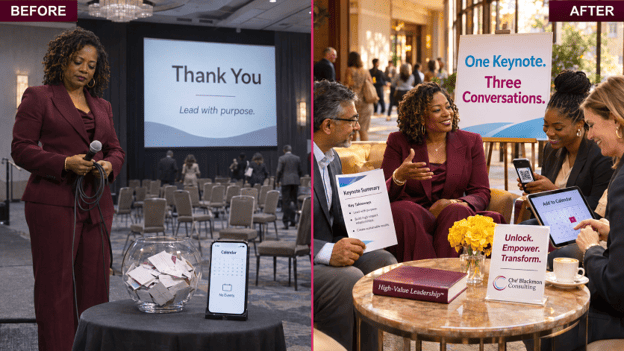
📊 Case in Point: A Culture Strategist Who Stopped Collecting Applause
The following is a composite scenario drawn from patterns common across professional services, manufacturing, and healthcare environments. The figures are illustrative.
🏭 The Challenge
Consider a culture strategist, a Black woman who spent two decades leading people strategy in manufacturing and healthcare before launching her own practice. She was an excellent speaker. In one year, she delivered twelve talks at industry associations, leadership summits, and regional conferences. Her evaluations were outstanding.
Her results were not. Across all twelve talks, she averaged fewer than one follow up meeting per event, and only one talk turned into a paid engagement. When she reviewed her process, the problem was obvious: every talk ended with a quote and a thank you. Follow up depended entirely on attendees reaching out on their own.
🔧 The Intervention
She rebuilt her speaking strategy around the three conversations and anchored every talk in a single, teachable High-Value Leadership™ framework on purposeful culture.
- Sponsor debriefs. Every booking confirmation included a request for a post event debrief, scheduled before the talk took place.
- A Seeker offer. Each talk ended with a QR code linked to a short culture assessment. She personally reviewed every response and sent a short, tailored note.
- A Stakeholder summary. She created a one page executive brief for each talk, written to be forwarded to senior leaders who were not in the room.
- Simple tracking. She logged every conversation by talk, by conversation type, and by outcome.
📈 The Results
Over the next twelve months, she delivered ten talks, two fewer than the year before. Those ten talks produced 31 follow up conversations, an average of just over three per talk. Nine became proposals, and six became signed engagements. Two of those engagements came directly from Sponsor debriefs, and three came from executives who received a forwarded summary and never attended a single session. The average time from talk to signed agreement dropped from about five months to seven weeks.
The lesson is simple. She did not need more stages. She needed a system that turned each stage into relationships. That is High-Value Leadership™ in practice: purpose first, value delivered generously, and a clear path for people to keep working with you.
🧠 Current Trends and Best Practices
- Buyers decide before they call. With most business buyers preferring to avoid sales conversations, speaking has become one of the strongest ways to be shortlisted before the first meeting.
- Smaller rooms, deeper conversations. Executive roundtables, private leadership dinners, and invite only workshops are growing because decision makers want access to expertise, not a crowd.
- The talk lives longer than the event. Clips, recap articles, and executive summaries let one keynote keep working for months. Plan your repurposing before you speak.
- AI is changing research, not trust. Buyers use AI tools to compare options, but they still want to hear directly from a credible human expert before they commit.
- Internal stages count too. For HR and culture leaders inside organizations, a presentation to the executive team works the same way. The Sponsor, the Seeker, and the Stakeholder all exist inside your company.
✅ Actionable Takeaways You Can Use This Week
- Audit your last three talks. For each one, count how many conversations it produced. Write the number down. That is your baseline.
- Name your three people. For your next talk, write the name or role of your likely Sponsor, Seeker, and Stakeholder.
- Book the debrief now. Email the organizer of your next talk today and schedule a debrief for the week after.
- Build one Seeker offer. Create a simple, one page assessment or worksheet that connects directly to your core message.
- Draft your executive summary. Write three insights, one statistic, and one recommended action in a format a senior leader would forward.
- Rewrite your last minute. Replace your closing quote with one clear invitation and one clear next step.
💬 Discussion Questions
- When you speak, how do you currently measure success, and what would change if you measured conversations instead of applause?
- Who is the most important decision maker who never hears your talks directly, and how could your message reach them?
- In your industry, who gets the main stage, and who is more often invited to moderate or sit on the panel?
- What would it take for the Black women experts in your organization or network to be booked as the keynote instead of the panel?
🚀 Next Steps for Readers
- Share this article with a leader, consultant, or HR executive who speaks often and deserves more return from every stage.
- Read High-Value Leadership: Transforming Organizations Through Purposeful Culture to build the framework you will teach with confidence from any stage.
- Join the High-Value Leadership Intensive waitlist to develop your authority, influence, and executive presence alongside other purpose driven leaders.
- Subscribe to The Blackmon Brief on Substack for weekly culture and leadership insights every Monday.
📚 References
Bombaci, S., Farr, C., Pejchar, L., Wilkins, K. D., & Wittman, T. (2025). Forward steps, lingering gaps: Gender representation among distinguished speakers at professional conferences. BioScience, 75(9), 737–746. https://doi.org/10.1093/biosci/biaf063
Freeman. (2025). Unpacking XLNC: The future of commerce for trade shows and conferences [Trends report]. https://www.freeman.com/wp-content/uploads/2025/04/Freeman-Commerce-Report-2025.pdf
Gartner. (2026, March 9). Gartner sales survey finds 67% of B2B buyers prefer a rep-free experience [Press release]. https://www.gartner.com/en/newsroom/press-releases/2026-03-09-gartner-sales-survey-finds-67-percent-of-b2b-buyers-prefer-a-rep-free-experience
🤝 Let’s Turn Your Next Stage Into Real Influence
Your expertise deserves more than applause. Whether you are an executive preparing for a board presentation, a consultant building authority in your industry, or a culture leader ready to claim the main stage, Che’ Blackmon Consulting helps you build the message, the framework, and the follow through that turn every talk into lasting relationships and measurable results. Let’s talk about your next stage.
📧 admin@cheblackmon.com | 📞 888.369.7243 | 🌐 cheblackmon.com
Unlock. Empower. Transform.
#StrategicSpeaking #KeynoteSpeaker #ThoughtLeadership #ExecutivePresence #HighValueLeadership #BusinessDevelopment #ClientRelationships #PublicSpeaking #BlackWomenInLeadership #WomenWhoSpeak #ConsultingLife #CheBlackmonConsulting