By Che’ Blackmon, DBA Candidate | Founder & CEO, Che’ Blackmon Consulting
At twenty four, she was responsible for forty people, millions of dollars in equipment, and decisions that could not wait until morning. Six years later, sitting across from a hiring panel, she was asked a simple question: “Do you have any leadership experience?”
She paused. Not because she lacked an answer, but because she had too many, and none of them were written in the language of the room.
That moment plays out in conference rooms every week. It is not a talent problem. It is a translation problem, and on this Veterans Day, it is worth asking whether our organizations are fluent enough to recognize the leaders already sitting in front of them.

🇺🇸 Why This Veterans Day Calls for More Than a Thank You
Gratitude matters. But a social media post and a lunch on November 11 do not change what happens to veterans on November 12.
The most recent federal labor data tells a story that deserves a closer look. In 2025, there were 17.3 million veterans in the United States, and their unemployment rate rose from 3.0 percent to 3.5 percent. The rate for women veterans climbed to 4.6 percent, and Black veterans faced an unemployment rate of 5.0 percent, compared with 3.3 percent for White veterans (U.S. Bureau of Labor Statistics, 2026). The veterans with the least access to opportunity are the very groups whose numbers are growing. Women are projected to grow from 11 percent of all veterans to 18 percent by 2048, while the share of Black veterans is expected to rise from 13 percent to 15 percent (Schaeffer, 2023).
Getting hired is also not the finish line. A study in the Journal of Veterans Studies followed roughly 3,000 post 9/11 veterans three years after they left the military. Roughly one third were underemployed even though they were satisfied with their pay, and another 10 percent were both underemployed and dissatisfied. That second group earned between $11,000 and $24,000 less than their peers. They were also four times more likely to leave their jobs (Davenport et al., 2024).
Read that again from an executive’s chair. Organizations are recruiting proven leaders, placing them below their capability, paying them accordingly, and then watching them walk out the door. That is not a veteran problem. That is a culture problem.
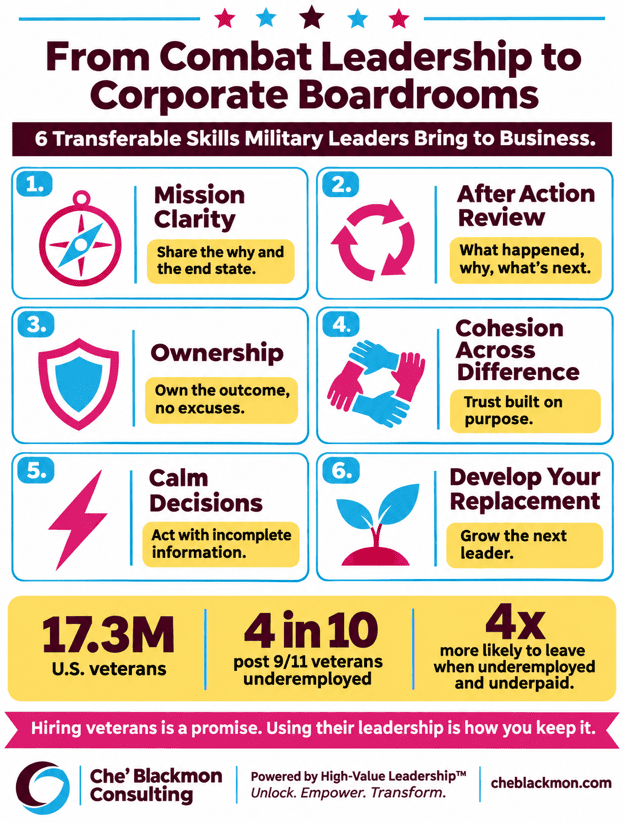
🎖️ Six Transferable Skills Military Leaders Bring to Business
Military leadership is not a personality type. It is a set of practiced, repeatable disciplines. Here are six that translate directly into business value when an organization knows how to use them.
🧭 1. Mission Clarity Through Commander’s Intent
Military leaders are trained to communicate not only the task but the purpose and the desired end state. When the plan falls apart (and it always does), the team still knows what success looks like and can adapt without waiting for permission.
In business: This is the difference between a strategy that lives in a slide deck and one that lives in daily decisions. Leaders who explain the “why” create teams that make sound calls when the boss is not in the room.
🔁 2. The After Action Review
Four questions drive this practice: What was supposed to happen? What actually happened? Why was there a difference? What will we do differently next time? The review is about learning, not blame, and rank is set aside at the table.
In business: Few tools build psychological safety and continuous improvement faster. Teams that debrief honestly fix problems in weeks instead of repeating them for years.
🛡️ 3. Ownership Without Excuses
In uniform, “that’s not my job” is rarely an option. Leaders own the outcome, including the parts they did not personally touch.
In business: Accountability is one of the most requested and least practiced leadership behaviors. Veterans often arrive already fluent in it, and they can model it for peers who have only heard it described.
🤝 4. Building Cohesion Across Difference
Military units bring together people from every region, background, and belief system, and then require them to trust one another completely. Cohesion is not optional. It is built on purpose.
In business: Inclusion is not a program. It is a daily leadership skill, and many veterans have practiced it under far higher stakes than a quarterly review.
⚡ 5. Calm Decisions With Incomplete Information
Military leaders learn to act on the best available information, set a clear direction, and adjust as new facts arrive.
In business: Markets, technology, and workforce expectations are changing faster than most annual plans. Leaders who can decide steadily in ambiguity are a competitive advantage.
🌱 6. Developing Your Replacement
In many units, a leader is expected to prepare someone to step into the role at a moment’s notice. Developing others is part of the job description, not a favor.
In business: Weak succession pipelines are a quiet risk in nearly every industry. Leaders who are wired to grow the next leader strengthen the bench without being asked.
👩🏾✈️ The Overlooked Advantage: Black Women Who Served
If veterans face a translation gap, Black women veterans often face a double one. They must translate their military experience into civilian language, and they must also push past the bias that so many Black women encounter in corporate spaces.
The same directness that earned respect in uniform can be mislabeled as “too aggressive” in a conference room. The same composure under pressure can be read as “distant.” Leadership that would be called decisive in someone else is too often questioned in her.
The data reflects that gap. Women veterans and Black veterans both experience higher unemployment than veterans overall (U.S. Bureau of Labor Statistics, 2026), and Black women sit where those two realities meet. Yet these are leaders who have already proven resilience, sacrifice, and purpose under conditions most executives will never face. This is a theme I explore throughout Rise & Thrive: A Black Woman’s Blueprint for Leadership Excellence, and it bears repeating here. When organizations overlook Black women who served, they are not only failing a group of employees. They are leaving some of their strongest leadership talent unused.
📊 Case in Point: A Manufacturer That Stopped Losing Its Veterans
The following is a composite scenario drawn from patterns common across manufacturing and automotive environments. The figures are illustrative.
🏭 The Challenge
Consider a midsized manufacturer that made a public commitment to hiring veterans. Recruiting went well. Retention did not. Eighteen months into the effort, 41 percent of veteran hires had left within their first year.
Exit interviews told a consistent story. Former squad leaders and logistics officers had been placed in entry level roles because hiring managers could not connect their experience to job requirements. One departing employee summed it up: “I led people in service. Here, nobody asked what I could do.”
🔧 The Intervention
Leadership treated the problem as a culture issue rather than a recruiting issue, and made three changes.
- Skills translation in hiring. Interview panels were trained to map military roles to civilian ones, so a platoon sergeant was evaluated as a frontline supervisor, not as an applicant with “no corporate experience.”
- Sponsorship, not just mentorship. Every veteran hire was paired with a senior leader who was accountable for advocating for that person’s growth, with intentional attention to women and veterans of color.
- After action reviews, plant wide. Veteran employees were invited to lead short debriefs after major production runs, turning their expertise into a shared leadership practice.
📈 The Results
Within twelve months, first year turnover among veteran hires dropped from 41 percent to 19 percent. Six veterans were promoted into supervisory roles, including two Black women who had previously been placed two levels below their experience. On the production lines that adopted after action reviews, recordable safety incidents fell by 22 percent.
The lesson is simple. Hiring veterans is a promise. Using their leadership is how an organization keeps it. This sits at the heart of High-Value Leadership™: culture is not what a company announces, it is what people experience every day, and high value cultures make sure every person’s full capability is seen and put to work.
🧠 Current Trends and Best Practices
- Skills based hiring is replacing degree and title screening. This shift opens the door for veterans, but only if job descriptions and interview guides describe skills in plain language that military experience can map to.
- Retention and promotion are the real metrics. Counting veteran hires is easy. Tracking how many stay, how many are promoted, and how their pay compares to peers tells you whether your culture is working.
- Sponsorship closes gaps that mentorship cannot. Advice is helpful. Advocacy changes careers, especially for women and people of color.
- Veteran employee resource groups need executive sponsors. Groups that include military spouses and are tied to business goals tend to influence decisions, not just host events.
- Stereotypes cost talent. Assumptions that veterans are rigid, only fit for security or operations roles, or carry unmanaged trauma keep strong leaders out of strategic seats.
✅ Actionable Takeaways You Can Use This Week
- Pull your numbers. How many veterans have you hired in the last two years? How many are still with you, and how many have been promoted?
- Rewrite one job posting. Replace jargon and title requirements with the actual skills the role needs, such as leading teams, managing resources, and making decisions under pressure.
- Run one after action review. Pick a recent project and walk your team through the four questions. Keep it blame free.
- Ask a better question. Sit down with a veteran on your team and ask, “What did you lead in service that we have not asked you to lead here?”
- Name a sponsor. Choose one veteran, especially a woman of color, and assign a senior leader to actively advocate for her next opportunity.
💬 Discussion Questions
- Where in your hiring process could a proven military leader be screened out for lacking “corporate experience”?
- Which of the six transferable skills is your organization weakest in today, and who on your team already has it?
- How would your culture change if every team used an after action review after major projects?
- What would it take for Black women veterans in your organization to be seen, sponsored, and promoted at the level of their experience?
🚀 Next Steps for Readers
- Share this article with a hiring manager or HR partner and talk through one change you can make before year end.
- Read High-Value Leadership: Transforming Organizations Through Purposeful Culture to build a culture where every person’s capability is visible and valued.
- Join the High-Value Leadership Intensive waitlist to work through these practices with other leaders committed to purposeful culture.
- Subscribe to The Blackmon Brief on Substack for weekly culture insights every Monday.
📚 References
Davenport, K. E., Morgan, N. R., Balotti, B. A., Aronson, K. R., & Perkins, D. F. (2024). Underemployment, compensation dissatisfaction, job turnover, and salary change: How are post-9/11 veterans doing three years after leaving the US military? Journal of Veterans Studies, 10(3), 1–18. https://doi.org/10.21061/jvs.v10i3.542
Schaeffer, K. (2023, November 8). The changing face of America’s veteran population. Pew Research Center. https://www.pewresearch.org/short-reads/2023/11/08/the-changing-face-of-americas-veteran-population/
U.S. Bureau of Labor Statistics. (2026, April 28). Employment situation of veterans: 2025 [News release]. U.S. Department of Labor. https://www.bls.gov/news.release/vet.nr0.htm
🤝 Let’s Build Your High-Value Culture Together
To every veteran reading this: thank you for your service, and thank you for the leadership you bring to every room you enter. To every executive: the leaders you need may already be on your payroll. Che’ Blackmon Consulting helps organizations build cultures where talent like this is recognized, developed, and retained. Let’s talk about what that looks like for your team.
📧 admin@cheblackmon.com | 📞 888.369.7243 | 🌐 cheblackmon.com
Unlock. Empower. Transform.
#VeteransDay #VeteransInBusiness #MilitaryLeadership #HireVeterans #LeadershipDevelopment #HighValueLeadership #CompanyCulture #WomenVeterans #BlackWomenInLeadership #TalentRetention #HRLeadership #CheBlackmonConsulting

Leave a Reply