The Retain Wise Advantage: How Predictive Analytics Sees Turnover Before It Happens

By Che’ Blackmon, DBA Candidate | Founder & CEO, Che’ Blackmon Consulting

📚 Book Tie-In: Mastering a High-Value Company Culture — Data-Driven Culture Sections

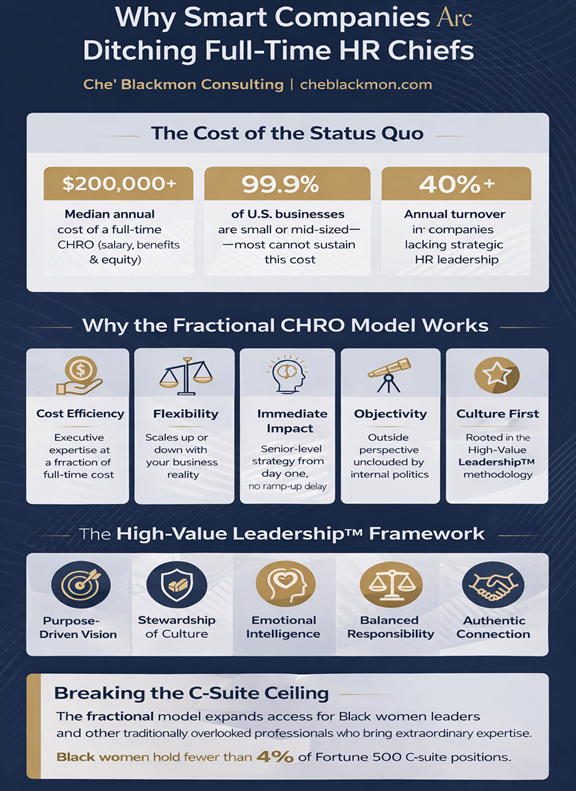
By the time an employee submits their resignation, the decision was usually made months earlier. The signs were there. The disengagement was building. The warning indicators were accumulating in plain sight. And yet, for most organizations, the first official notice of a departure comes as a surprise.

That surprise is expensive. The cost of replacing a single employee ranges from one-half to two times their annual salary, according to research from Gallup. For a mid-sized company experiencing ongoing turnover, those costs compound silently into millions of dollars annually in recruitment expenses, productivity loss, institutional knowledge gaps, and cultural disruption.

But what if you could see it coming? Not after the fact. Not during the exit interview. Three to six months before the resignation ever lands on anyone’s desk.

That is precisely the promise of Retain Wise, the AI-powered predictive analytics platform developed by Che’ Blackmon Consulting specifically for small and mid-sized organizations. Retain Wise does not simply report what has already happened inside your organization. It reads the patterns, analyzes the culture signals, and identifies flight risk before talent walks out the door. It is not reactive HR. It is strategic, data-driven people leadership at its most proactive.

This article explains how predictive analytics is transforming the way forward-thinking organizations understand and respond to employee turnover, what the data reveals about who bears the heaviest burden when turnover goes unaddressed, and why the integration of AI and culture strategy is no longer a future conversation. It is the present competitive advantage.

📉 The Turnover Crisis: What the Numbers Are Really Saying

Turnover has always been a business challenge. What is different now is the scale, the speed, and the compounding nature of the problem in a post-pandemic, multigenerational workforce.

According to the U.S. Bureau of Labor Statistics, millions of American workers voluntarily left their jobs every single month throughout 2022 and 2023, a sustained wave of departures that researchers began calling the Great Resignation. While the most extreme phase of that wave has passed, the underlying conditions that drove it have not.

Employee expectations have permanently shifted. Workers across every industry and generation now prioritize culture, leadership quality, flexibility, and sense of purpose alongside compensation. Research from McKinsey found that the top reasons employees left their jobs were not primarily about pay. They were about not feeling valued by their organization, not feeling valued by their manager, and not belonging to a community at work.

Read that again. The top drivers of voluntary turnover are cultural. They are relational. They are, at their core, a function of how people experience leadership on a daily basis.

“Culture is the lifeblood of any organization. It is not a feel-good concept. It is the secret sauce that makes or breaks the success of an organization.” — Mastering a High-Value Company Culture

This is the gap that no traditional HR metric can fully close. Annual engagement surveys capture sentiment at a single point in time. Exit interviews gather data from people who have already decided to leave. Performance reviews measure output but rarely measure belonging, psychological safety, or leadership trust.

The result is that most organizations are managing their talent retention strategy on a significant time delay. They are looking in the rearview mirror while their people are already halfway out the door.

🧠 What Is Predictive Analytics, and Why Does It Change Everything?

Predictive analytics is the use of data, statistical modeling, and machine learning algorithms to identify the likelihood of future outcomes based on historical and current patterns. In the context of employee turnover, predictive analytics ingests data from multiple organizational touchpoints and surfaces risk indicators that human observation alone would miss or interpret too late.

This is not a science fiction concept. It is a mature and rapidly expanding application of artificial intelligence that is already in use across healthcare, financial services, retail, and increasingly, human resources.

Retain Wise applies this capability specifically to the culture and people dynamics of small and mid-sized organizations, filling a critical gap in the market. Enterprise-scale corporations have had access to sophisticated HR analytics tools for years. The companies with 20 to 200 employees have largely been left without affordable, accessible, and actionable predictive intelligence about their own people.

🔍 How Predictive Analytics Identifies Flight Risk

Traditional HR data tells you what happened. Predictive analytics tells you what is about to happen if nothing changes. The distinction is fundamental.

An effective predictive model for employee turnover draws on a wide range of data inputs. These inputs can include engagement survey trends over time, performance review patterns and trajectory, absenteeism and attendance fluctuations, compensation positioning relative to internal peers and external market benchmarks, promotion history and velocity, manager effectiveness scores, team-level sentiment data, onboarding satisfaction and early tenure indicators, and organizational tenure benchmarks by role and department.

Individually, any one of these data points tells a limited story. But when a machine learning model analyzes them together, looking for the combination of signals that historically precede voluntary departures, it begins to surface something that no individual manager or HR generalist could reliably identify: the early pattern of disengagement that predicts turnover three to six months before it materializes.

“A strong, intentional culture propels tangible results. Such a culture does not come easy to create and maintain. It requires vision, strategy, and relentless commitment.” — Mastering a High-Value Company Culture

📊 The Difference Between Reporting and Predicting

Consider two organizations facing similar turnover challenges. The first organization has invested in a solid HR dashboard. Every month, leadership reviews a report showing last month’s turnover rate, the number of open positions, and the average time to fill each role. They see the problem clearly in the data.

But the data is describing what already happened. The employees who left are already gone. The knowledge they carried walked out with them. The team that depended on them is now stretched thin or operating without the coverage it needs.

The second organization uses Retain Wise. Six months before that same wave of departures, the platform flagged a cluster of risk indicators in a specific department: declining engagement trends among tenured employees, a manager effectiveness score that had been trending downward for two consecutive quarters, compensation data showing three employees at or below the 25th percentile for their roles relative to the external market, and an uptick in absenteeism patterns that the platform had learned to associate with pre-departure disengagement.

Leadership in the second organization had the information they needed to intervene. Not to apply a blanket fix to a vague culture problem. To have specific, targeted conversations with specific employees. To address the compensation gaps before the competition made a better offer. To invest in the manager’s development before the team reached a breaking point.

The resignation letters that arrived in the first organization never arrived in the second. That is the Retain Wise advantage.

🏭 Case Studies: Predictive Analytics in the Real World

🔧 The Automotive Supplier That Stopped the Bleed

There was a regional automotive supply company with approximately 120 employees that had been experiencing turnover rates exceeding 35% annually for three consecutive years. Leadership had responded each time the way most organizations respond: posting the open positions, interviewing candidates, extending offers, and repeating the cycle. Each year, the problem returned.

When the organization implemented predictive analytics monitoring, the data revealed a pattern that had been invisible to management. The highest-risk employees were not the newest hires, as leadership had assumed. They were the employees between two and four years of tenure who had been promoted once but were now stagnating. The predictive model identified a combination of signals: flat compensation relative to their increased responsibilities, infrequent recognition from their direct managers, and engagement scores that had dipped subtly across three consecutive quarterly pulse surveys.

With this intelligence, the company targeted specific interventions: a compensation review for mid-tenure employees in the flagged roles, a manager development series focused on recognition and career development conversations, and a structured stay interview process for employees who the model identified as at risk.

Turnover in the following 12 months dropped by more than half. The cost savings were measurable. The cultural impact was profound.

🏥 The Healthcare Organization That Found the Signal in the Noise

A regional healthcare organization was facing a staffing crisis that leadership attributed to the industry-wide nursing shortage. What the predictive data revealed was more specific and more actionable than a market-level problem.

The analytics platform identified that the turnover risk was concentrated not across the organization broadly, but within three specific units where a combination of leadership ineffectiveness indicators, high overtime load, and declining psychological safety scores created a predictable departure pattern. The market shortage was real. But it was being amplified by controllable internal conditions that the organization had the power to address.

Once the data identified the specific units and the specific risk factors, the organization was able to reallocate leadership development resources, address scheduling practices in the flagged units, and implement targeted retention conversations with employees the model identified as highest risk.

The data did not solve the problem automatically. Leaders still had to make the decisions and do the work. But the data told them exactly where to look, which meant that every intervention dollar spent was strategically targeted rather than broadly cast.

This is the core value proposition of data-driven culture leadership as articulated in Mastering a High-Value Company Culture: not simply identifying that a problem exists, but having the specific, actionable intelligence to address it where it is actually happening.

❤️ The Equity Dimension: What Predictive Analytics Reveals About Who Gets Left Behind

Any honest conversation about employee turnover and predictive people analytics must confront a difficult truth: the employees who are most likely to leave are often the employees whose departure signals have been most consistently ignored.

Black women in corporate America leave their organizations at disproportionately high rates not because of a lack of ambition or commitment. They leave because the conditions that predict departure, undervaluation, stagnant career advancement, exclusion from informal networks, inadequate recognition, and leadership relationships that do not see or support their full capability, are often present and unaddressed for years before the resignation arrives.

“The data instead points to systemic barriers including hiring bias, limited access to influential networks, lack of sponsorship, and inhospitable workplace cultures.” — Rise & Thrive: A Black Woman’s Blueprint for Leadership Excellence

A predictive analytics approach that is properly designed and equitably applied has the potential to disrupt this pattern in a meaningful way. When data surfaces that the employees with the highest flight risk in a given organization share a demographic pattern, that information creates an undeniable accountability signal for leadership that anecdote and individual performance reviews cannot produce.

Consider what this means in practice. When a predictive platform reveals that a disproportionate share of mid-tenure Black women employees are clustered in the highest-risk segments of the departure model, that is not merely a data point. It is an organizational diagnostic. It raises questions that demand answers. Are these employees being promoted at rates comparable to their peers? Are their compensation trajectories aligned with performance? Do their engagement scores reflect a sense of belonging, recognition, and leadership support?

Data does not carry bias in the same way human intuition does. When the pattern emerges in the numbers, it is harder to dismiss, explain away, or attribute to individual circumstances. It creates a basis for institutional accountability.

💡 From Data to Equity: The Leadership Responsibility

In Rise and Thrive: A Black Woman’s Blueprint for Leadership Excellence, the concept of purposeful navigation is explored in depth. It describes the exhausting labor of operating in environments that require extraordinary skill and resilience to advance, not because of a lack of capability but because of systems that were not designed with Black women’s success in mind.

Predictive analytics, used with intention and equity as an explicit design criterion, can become a tool that finally makes those invisible patterns visible at the organizational level. It is not a substitute for the deeper cultural work of building inclusive, high-value environments. But it can be the instrument that makes the systemic patterns undeniable and therefore actionable.

Organizations that use Retain Wise have the ability to segment their turnover risk data in ways that surface equity patterns. That capability is not a threat to leadership. It is a gift. It replaces the organizational blind spots that allow inequity to persist with specific, targeted information that empowers leaders to intervene.
🌟 The High-Value Leadership™ Connection: Data Meets Culture

Predictive analytics is not a replacement for the human dimensions of leadership. It is the instrument that makes those human dimensions more precise and more accountable.

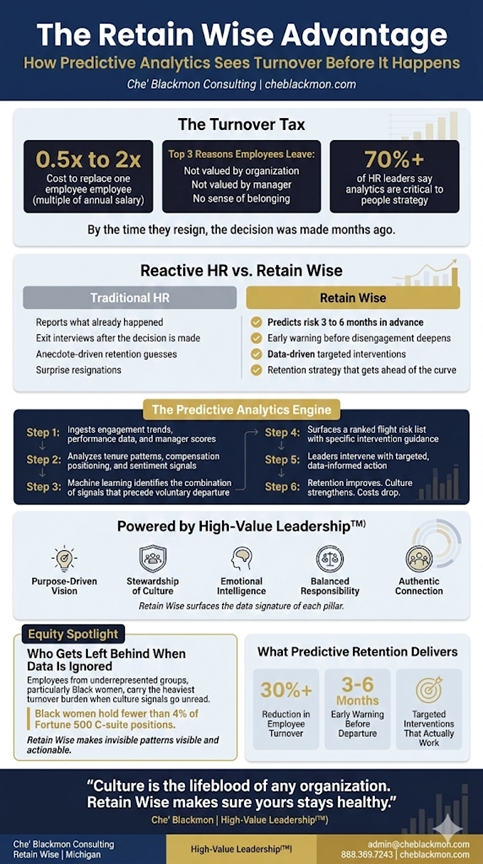
The High-Value Leadership™ framework built into the core of Che’ Blackmon Consulting’s approach is grounded in five interconnected pillars: Purpose-Driven Vision, Stewardship of Culture, Emotional Intelligence, Balanced Responsibility, and Authentic Connection. Each of these pillars has a data signature.

When Purpose-Driven Vision is present, employees can articulate how their work connects to the organizational mission. Engagement data reflects that clarity. When it is absent, data shows a particular pattern of disengagement that begins to emerge in the two to three year tenure window.

When Stewardship of Culture is operating effectively, organizational norms reinforce the stated values and leaders model the behaviors they expect. When misalignment exists between espoused values and lived experience, that gap surfaces in sentiment data, manager effectiveness scores, and the cultural trust measures that predict pre-departure disengagement.

Emotional Intelligence as a leadership competency shapes the quality of manager-employee relationships, which are consistently among the top predictors of voluntary turnover across every research study on the topic. Employees do not leave companies. They leave managers. And the data shows exactly which manager relationships carry the highest departure risk.

Balanced Responsibility and Authentic Connection show up in psychological safety scores, in the patterns of who speaks up in team meetings and who does not, in the recognition data and in the career development conversation frequency metrics. Every dimension of the High-Value Leadership™ framework has measurable data that a predictive model can track.

“High-value leadership is characterized through purpose-driven vision, stewardship of culture, emotional intelligence, balanced responsibility, and authentic connection.” — High-Value Leadership: Transforming Organizations Through Purposeful Culture

Retain Wise does not exist in isolation from culture strategy. It was built as the data layer that makes culture strategy specific, targeted, and accountable. The platform surfaces the signals. The High-Value Leadership™ framework provides the response architecture. Together, they represent an approach to people management that is both rigorous and deeply human.

🚀 Current Trends: Why This Moment Demands Predictive People Intelligence

🤖 The AI Transformation of HR

The integration of artificial intelligence into human resources is not a distant trend. According to Deloitte’s Global Human Capital Trends Report, more than 70% of HR leaders reported that analytics capabilities were important or very important to their organizations’ people strategy. The adoption rate among small and mid-sized businesses, however, has lagged significantly behind enterprise-scale organizations, creating both a challenge and an opportunity.

Retain Wise was specifically designed to close that gap. The predictive capability that Fortune 500 companies have deployed in their talent retention strategies for years is now accessible to the companies that arguably need it most: the growing organizations that cannot afford the catastrophic cost of unmanaged turnover but have also not had access to the analytical tools to address it proactively.

💼 The Multigenerational Workforce Complexity

Today’s workforce spans five generations, each with distinct expectations, motivations, and engagement patterns. Gen Z employees who entered the workforce during and after the pandemic have markedly different expectations around flexibility, purpose alignment, and manager transparency than Baby Boomer colleagues who may be in their final years before retirement. Gen X professionals in mid-career bring a particular set of advancement expectations that, when unmet, translate to departure risk in a predictable pattern.

Managing across this complexity requires more than generational stereotypes and one-size-fits-all engagement initiatives. It requires the kind of granular, individualized risk intelligence that predictive analytics provides. A well-designed model accounts for generational patterns in the data while remaining specific enough to flag individual-level risk without generalizing.

🌍 The Values-Led Business Imperative

Organizations that lead with explicit values and demonstrate measurable commitment to those values through culture, policy, and people practices attract better talent, retain that talent longer, and outperform their competitors on engagement metrics. This is not opinion. Research from Glassdoor, Harvard Business Review, and multiple independent workforce studies consistently confirms the business case for high-value culture as a retention strategy.

But values without accountability measures are aspirational statements. Retain Wise provides the accountability infrastructure that turns cultural commitments into trackable, improvable outcomes. It answers the question that too many organizations avoid: are the values we say we have actually producing the culture we claim to be building?

✅ Actionable Takeaways

For Business Leaders and CEOs:

  1. Calculate the true cost of your current turnover. Take your average annual salary for departing roles, multiply it by 1.5, and multiply that by the number of employees who left in the past 12 months. That number is the financial case for investing in predictive retention strategy.
  2. Stop relying solely on exit interviews. By the time an employee is sitting in an exit interview, the decision has been made and the knowledge transfer opportunity has passed. Shift your investment upstream to early warning systems and proactive retention intervention.
  3. Ask whether your culture data is predictive or retrospective. If your current HR analytics only describe what happened last quarter, you are operating without the forward visibility your business needs.
  4. Invest in manager effectiveness as a retention lever. The single most predictable driver of voluntary turnover is the quality of the manager relationship. Identify which manager relationships in your organization carry the highest risk and invest in development with urgency.
  5. Make equity an explicit dimension of your retention strategy. Analyze your turnover data by demographic patterns. If certain groups are departing at disproportionate rates, that is an organizational signal that demands a targeted organizational response.

For HR and People Operations Professionals:

  • Position your function as predictive, not reactive. The organizations that see HR as a strategic partner are the ones where people professionals have shifted from reporting what happened to anticipating what is coming. Build your case for predictive analytics investment with cost data and competitive benchmarking.
  • Integrate culture signals into your data infrastructure. Engagement scores, manager effectiveness data, and sentiment trends are not soft inputs. They are predictive variables. Ensure your data architecture captures them consistently and uses them in your risk assessments.
  • Build stay interview processes now. Stay interviews with high-performing, at-risk employees are one of the highest-return investments in retention strategy. They generate both intelligence and goodwill. Implement them before the predictive model flags the risk, not after.
  • Use data to surface equity patterns. Predictive analytics that does not include an equity lens is an incomplete tool. Ensure that your turnover risk analysis disaggregates data in ways that reveal whether certain groups are disproportionately represented in high-risk segments.
  • Connect retention outcomes to organizational performance metrics. Make the business case visible. Turnover reduction translates directly to cost savings, productivity gains, and customer satisfaction improvements. Quantify those relationships and communicate them to leadership regularly.

🗣️ Discussion Questions for Readers

Whether you are reading this as an organizational leader, an HR professional, or someone navigating the impact of turnover in your own team, these questions are worth sitting with carefully.

  1. How much of your current HR data describes what already happened, versus helping you anticipate what is about to happen? What would change in your organization if you had six months of early warning before your highest-risk departures?
  2. When you think about the employees who left your organization in the past two years, what patterns do you notice? Were there demographic patterns? Tenure patterns? Manager relationship patterns? What did those patterns tell you, and what did the organization do in response?
  3. How does your organization’s lived culture compare to its stated culture? Where is the gap largest? And do you have the data to know, or are you operating on assumption and anecdote?
  4. If you analyzed your turnover data by demographic segment today, what do you think you would find? And if you found a disproportionate departure rate among Black women or other historically underrepresented professionals, what would your organization be prepared to do differently?
  5. What would it mean for your organization to move from reactive people management to predictive people strategy? What investment would that require, and what would the return on that investment look like over 12 to 24 months?

👟 Next Steps for Readers

Recognition is the first step. The organizations that close the gap between knowing and acting are the ones that will outperform their competition in talent retention and culture health for the decade ahead.

Here are three concrete steps to begin your journey from reactive to predictive people strategy.

  1. Read the foundational work. Mastering a High-Value Company Culture provides the complete strategic framework for building organizational environments where the data-driven culture practices described in this article can take root. High-Value Leadership: Transforming Organizations Through Purposeful Culture gives you the leadership philosophy and behavioral architecture that translates predictive intelligence into purposeful action. Rise and Thrive: A Black Woman’s Blueprint for Leadership Excellence speaks directly to the equity dimensions of culture leadership that this article addresses. All three are available through Che’ Blackmon Consulting.
  2. Conduct a retention risk audit. Before investing in predictive technology, conduct a structured review of your last 24 months of turnover data. Identify the patterns: by tenure, by role, by department, by demographic group, and by manager. That manual analysis will both surface immediate insights and make the case for a more sophisticated predictive infrastructure.
  3. Start the conversation. If you are ready to explore how Retain Wise can bring predictive people analytics to your organization, the conversation begins with understanding your specific context, your current data infrastructure, and your most pressing people challenges. Retain Wise was built for organizations exactly like yours.

🤝 Ready to See Turnover Before It Happens?

Che’ Blackmon Consulting is the home of Retain Wise, Michigan’s first AI-powered culture transformation platform designed specifically for small and mid-sized organizations. Built on more than 24 years of progressive HR and organizational leadership experience, doctoral-level research in AI-enhanced predictive analytics for culture transformation, and the High-Value Leadership™ methodology, Retain Wise gives your organization the forward visibility it needs to retain your best people before the exit interview ever happens.

The cost of doing nothing is already showing up in your financials, your team dynamics, and your organizational culture. The cost of acting now is a fraction of that. The question is not whether predictive analytics is the right investment. The question is how many more departure surprises your organization can afford.

Let’s see what the data can do for your people strategy.

📧 admin@cheblackmon.com   📞 888.369.7243   🌐 cheblackmon.com

Che’ Blackmon Consulting | Retain Wise | Fractional HR & Culture Transformation | Michigan

#RetainWise #PredictiveAnalytics #EmployeeRetention #HRStrategy #HighValueLeadership #CultureTransformation #PeopleAnalytics #TurnoverPrevention #FractionalHR #BlackWomenLead #WorkforcePlanning #HRLeadership #AIinHR #OrganizationalCulture #CheBlackmonConsulting

GenX Leaders: Stop Waiting to Be Discovered The CEO’s Guide to Taking Your Seat at the Table

By Che’ Blackmon, DBA Candidate | Founder & CEO, Che’ Blackmon Consulting

📚 Book Tie-In: High-Value Leadership: Transforming Organizations Through Purposeful Culture — Chapters on Purpose-Driven Direction and Trust-Based Empowerment

You have built the career. You have the experience, the institutional knowledge, the battle scars, and the results to prove it. You have watched younger colleagues get promoted around you, sat through meetings where your ideas were credited to someone else, and told yourself to be patient because your time was coming.

It is time to stop waiting.

Generation X, the 65 million Americans born roughly between 1965 and 1980, represents one of the most seasoned, resilient, and capable leadership cohorts in the modern workforce. Yet GenX professionals are also among the most chronically underestimated. Sandwiched between the massive cultural footprint of Baby Boomers and the loud market presence of Millennials, GenX leaders have spent decades doing the work without always receiving the recognition, promotion, or platform their contributions deserve.

This article is a direct conversation with GenX professionals who are done waiting to be discovered. It is a guide for stepping into your full leadership authority, building the visibility that executive presence requires, and creating the kind of organizational impact that makes you impossible to overlook. It also speaks to those within the GenX generation who carry an additional weight: Black women leaders who have navigated not just the generation gap but also the compounding barriers of race and gender in corporate spaces.

The seat at the table you have been waiting for? It is time to pull it up yourself.

🗺️ The GenX Paradox: Maximum Experience, Minimum Visibility

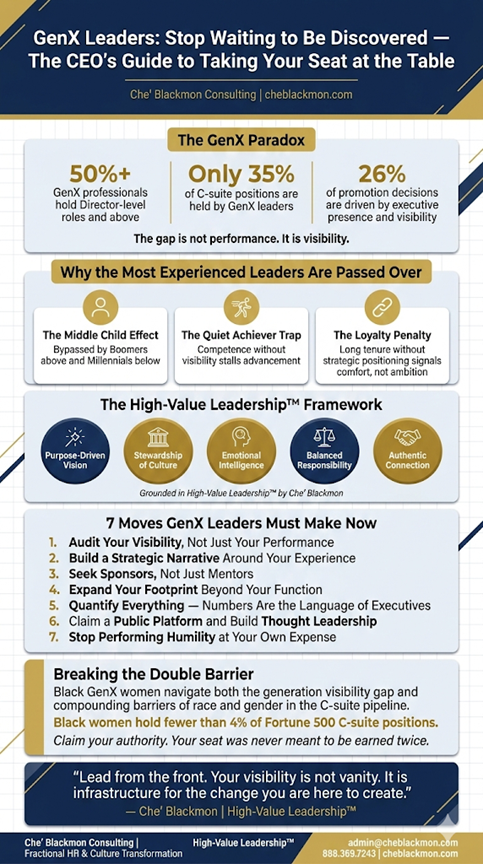
Here is a remarkable data point. According to research from the nonprofit Visier, Generation X makes up more than 50% of leadership roles at the Director level and above in most U.S. organizations. And yet GenX accounts for only about 35% of the C-suite. That gap is not accidental. It reflects a structural visibility problem that has followed this generation throughout its career.

GenX professionals entered the workforce in an era that rewarded competence, loyalty, and heads-down execution. They were trained to let the work speak for itself. They absorbed a professional culture that viewed self-promotion as unseemly and believed that doing an exceptional job would naturally lead to recognition and advancement. For many, it worked through the early stages of their careers.

But the rules changed. The executive suite increasingly rewards visibility, narrative, and strategic self-positioning alongside performance. Those who mastered the art of making their work known, building upward relationships, and being seen as strategic thinkers moved faster. Those who continued to lead with quiet competence found themselves consistently passed over.

“High-value leadership is not about commanding a room. It is about being so intentional, so purposeful, and so aligned in your values and your actions that people cannot help but follow.” — High-Value Leadership: Transforming Organizations Through Purposeful Culture

The paradox for GenX is real. The generation most experienced in navigating organizational complexity, managing multigenerational teams, and delivering sustained results is also the generation most likely to underinvest in the strategic visibility that executive advancement now requires.

Understanding that paradox is the first step. Dismantling it is the work.

🔍 Why GenX Gets Overlooked: The Structural Truth

Before we talk strategy, it is important to name the structural realities that have shaped the GenX leadership experience. This is not about assigning blame. It is about understanding the terrain so you can navigate it more effectively.

📌 The Middle Child Syndrome of the Workforce

Baby Boomers built the corporate infrastructure and held senior leadership positions well into the 2010s, often longer than previous generations due to improved health and financial uncertainty. When they finally began transitioning out, many organizations made a strategic leap directly to Millennials, investing heavily in the recruitment, development, and promotion of younger talent in response to market pressures around innovation and digital transformation.

GenX, once again, got lost in the middle. Too young to be the Boomer heir apparent, too experienced to be positioned as the fresh new talent, this generation has spent years watching leadership pipelines flow around them rather than through them.

📊 The Quiet Achiever Trap

Research consistently shows that visibility is one of the strongest predictors of promotion decisions, often outweighing performance scores when candidates are otherwise equally qualified. A study from the Center for Talent Innovation found that executive presence, defined broadly as the ability to project confidence, credibility, and command attention, accounts for as much as 26% of what it takes to get promoted to senior leadership.

GenX professionals, culturally conditioned to value substance over style, frequently underinvest in executive presence. They do the work. They solve the problems. They manage the teams. But they often fail to architect the narrative around that work in ways that register at the executive level.

🧠 The Loyalty Penalty

GenX is the generation that stayed. While Millennials became known for job hopping and Boomers for building empire-like tenure at single organizations, GenX professionals demonstrated a particular brand of organizational loyalty that often translated into being taken for granted.

In many cases, long tenure without explicit visibility and positioning strategies results in being perceived as part of the furniture rather than as a candidate for the next level. Organizations sometimes overlook their most tenured performers precisely because those performers have not actively signaled readiness for advancement.

❤️ The Double Burden: GenX Black Women in Corporate Spaces

No examination of GenX leadership and the visibility gap would be complete without explicitly addressing the experience of Black women within this generation. For Black GenX women in corporate America, the challenges described above are compounded in ways that cannot be ignored.

Black women who came of age professionally in the 1990s and early 2000s entered organizations that were largely unprepared to see them as future executives. They were often the first, the only, or one of very few in the rooms where decisions were made. They did everything right. They earned the degrees, built the competencies, delivered the results, and mentored others along the way. And they were still passed over.

“The data instead points to systemic barriers including hiring bias, limited access to influential networks, lack of sponsorship, and inhospitable workplace cultures.” — Rise & Thrive: A Black Woman’s Blueprint for Leadership Excellence

According to McKinsey’s Women in the Workplace report, Black women are promoted at lower rates than all other groups of women at nearly every stage of the corporate pipeline. The gap is most pronounced at the transition from individual contributor to manager and again at the transition into the C-suite. These are not soft data points. They represent the cumulative lived experience of an entire cohort of extraordinary professionals whose contributions have been systemically undervalued.

GenX Black women also face a phenomenon that researchers call the double bind. When they display the confidence, assertiveness, and strategic authority that are universally rewarded in male leaders, those same behaviors are frequently coded as aggressive, difficult, or threatening in Black women. When they lead with warmth, collaboration, and humility, those qualities are often interpreted as a lack of executive readiness.

There is no perfect performance that eliminates the bias. But there is a strategy. And that strategy begins with claiming your authority rather than waiting for it to be granted.

💡 Reclaiming the Narrative

In Rise and Thrive: A Black Woman’s Blueprint for Leadership Excellence, the concept of purposeful navigation is explored in depth. It is the practice of making strategic choices about visibility, advocacy, and positioning while remaining anchored in authenticity and integrity. For GenX Black women, purposeful navigation is not optional. It is the leadership competency that the moment demands.

This is not about playing a game whose rules were written by and for someone else. It is about understanding the terrain clearly enough to change it.

💼 Case Studies: GenX Leaders Who Stopped Waiting

🏭 The Operations Leader Who Rewrote Her Story

There was a mid-sized manufacturing organization where a veteran operations director had spent 14 years building one of the company’s most consistently high-performing departments. Her teams routinely outperformed their quarterly targets. Her attrition numbers were the envy of peers across the organization. She was respected, well-liked, and completely invisible to the senior leadership team when VP-level openings arose.

What changed was not her performance. What changed was her strategy. She began requesting time on the quarterly leadership agenda to present her department’s results directly to the executive team rather than allowing those results to be filtered through her direct supervisor. She started writing a brief monthly internal newsletter that connected her team’s operational wins to the company’s stated strategic priorities. She requested a meeting with the CEO to share her perspective on a company-wide challenge she had identified. Within 18 months, she was promoted to VP of Operations.

The work was always there. What changed was the visibility of the work, and the intentionality of the positioning.

🏥 The HR Director Who Claimed Her Expertise Publicly

There was a regional healthcare organization where a long-tenured HR director had developed a sophisticated understanding of how culture directly impacted patient outcomes, staff retention, and organizational performance. She had the data. She had the analysis. She had a framework. But she kept it largely internal, presenting her insights in department-level meetings without ever positioning herself as a thought leader beyond the organization.

A mentor challenged her to take her expertise public. She began writing brief LinkedIn articles on the intersection of HR strategy and healthcare outcomes. She submitted a proposal to speak at a regional industry conference. She connected her internal frameworks to published research and started citing those connections explicitly in executive presentations.

The result was twofold. Externally, she began building a reputation as a subject matter expert in healthcare culture and HR strategy. Internally, the executive team’s perception of her shifted from competent director to strategic thought leader. Both pathways mattered.

🌟 The High-Value Leadership™ Framework for GenX Advancement

In High-Value Leadership: Transforming Organizations Through Purposeful Culture, a distinction is drawn between leaders who manage organizations and leaders who transform them. GenX professionals, with their depth of experience and their cross-functional perspective, are uniquely positioned to be the latter. But transformation requires more than competence. It requires the three pillars of High-Value Leadership™ operating simultaneously.

1️⃣ Purpose-Driven Direction

High-value leaders do not simply manage the work. They articulate a vision that gives the work meaning. For GenX professionals looking to claim their executive seat, this means developing and communicating a point of view about where the organization needs to go and why. Not just at the department level. At the enterprise level.

This is the shift from being a manager of a function to being a strategic voice in the room. It requires asking bigger questions, connecting operational realities to organizational strategy, and being willing to put a stake in the ground with a perspective.

2️⃣ Trust-Based Empowerment

GenX leaders are exceptionally skilled at this pillar, often without realizing it. Their experience managing through multiple organizational cycles, their capacity for empathy built from years of navigating complexity, and their natural tendency toward collaborative problem-solving are all expressions of trust-based empowerment.

The advancement opportunity here is to make this strength visible. Document how your leadership approach has driven team performance. Quantify engagement, retention, and productivity outcomes. Tell the story of how you lead, not just what your teams produce.

3️⃣ Cultural Alignment

Mastering a High-Value Company Culture makes the case that culture is the lifeblood of any organization. GenX leaders who have lived through multiple culture cycles within their organizations carry rare institutional wisdom about what builds culture, what destroys it, and what it takes to sustain it through leadership transitions, market disruptions, and generational shifts.

This wisdom is extraordinarily valuable. It is also frequently underarticulated. Claim it. Make your perspective on culture a consistent part of your leadership narrative, both internally and externally.

🚀 The Strategic Visibility Blueprint: 7 Moves GenX Leaders Must Make Now

The following strategies are not theoretical. They are practical, evidence-based moves that GenX professionals can begin implementing immediately, regardless of their current title or organizational context.

📈 Move 1: Audit Your Visibility, Not Just Your Performance

Most GenX professionals can recite their performance metrics. Fewer can articulate exactly how visible they are to the people who make promotion decisions. Conduct a visibility audit. Identify the top five decision-makers whose perception of you most directly influences your advancement. Assess honestly how much direct interaction you have with each of them, whether they can specifically describe your contributions and strategic perspective, and whether they think of you when executive opportunities arise.

If the answer to any of these is no or rarely, that is your starting point.

📝 Move 2: Build a Strategic Narrative

Your experience is not self-explanatory. In a world saturated with information and competing priorities, even the most impressive career history requires a clear, compelling narrative to land with impact. Develop a three-sentence leadership positioning statement that communicates who you are, what you uniquely bring, and what organizational problem you are specifically positioned to solve at the next level.

Use this narrative consistently: in executive conversations, in your professional profiles, in how you introduce yourself in new relationships, and in how you frame your contributions in leadership meetings.

🤝 Move 3: Sponsor, Not Just Mentor

Research from Catalyst and Harvard Business Review consistently shows that sponsorship, having someone with organizational power who actively advocates for your advancement in rooms you are not in, is one of the most significant predictors of promotion for historically underrepresented professionals.

GenX leaders often become excellent mentors. The next level is identifying and cultivating sponsors. This requires building upward relationships intentionally, demonstrating your executive readiness directly to senior leaders, and being specific with your advocates about what opportunities you are seeking.

🌎 Move 4: Expand Your Footprint Beyond Your Function

One of the most common visibility limitations for GenX professionals is organizational siloing. You are brilliant within your function, but unknown across the enterprise. Seek cross-functional projects, enterprise-level committees, or organizational initiatives that place you in proximity to senior leaders and peers outside your direct domain.

Every cross-functional project is also a visibility opportunity. Treat it as one.

📊 Move 5: Quantify Everything

GenX leaders often describe their contributions in qualitative terms: built a great team, improved culture, strengthened relationships. Quantification is the language of executive leadership. Translate your impact into numbers wherever possible. Turnover reduction percentages. Engagement score increases. Revenue protected or generated. Cost reductions. Time to productivity improvements.

Numbers are not a substitute for the full story of your leadership. But they are the credibility anchors that make the story land with decision-makers.

🎙️ Move 6: Claim a Public Platform

Thought leadership is no longer the exclusive domain of published academics and keynote speakers. LinkedIn, industry associations, local business organizations, and professional conferences all offer GenX leaders platforms to demonstrate their expertise beyond the walls of their current organization.

Start where you are. A short LinkedIn article. A panel discussion at an industry event. A guest post in a trade publication. Each public expression of your expertise builds external credibility that reinforces your internal positioning.

🗣️ Move 7: Stop Performing Humility at Your Own Expense

This one is particularly important for Black women and other professionals from underrepresented groups. Humility is a leadership virtue. Self-erasure is not. There is a meaningful difference between leading with humility, which means remaining open, collaborative, and grounded, and performing humility as a strategy to avoid the discomfort of being seen.

When you minimize your contributions in meetings, deflect credit for results your leadership produced, or frame your ideas as tentative suggestions rather than informed perspectives, you are not being humble. You are training the people around you to underestimate you.

Own your expertise. Speak with the authority you have earned. Lead from your full self.

“Authentic leadership — bringing your whole self to your role — correlates with higher engagement, innovation, and organizational performance. When you lead authentically, you not only enhance your own effectiveness but potentially transform the environment for others.” — Rise & Thrive: A Black Woman’s Blueprint for Leadership Excellence

💡 Current Trends GenX Leaders Must Leverage

The organizational landscape of 2025 and beyond is presenting a set of conditions that are uniquely favorable for GenX advancement. Those who understand these trends and position themselves accordingly will find the most significant opportunities of their careers opening now.

🤖 The AI Integration Moment

Artificial intelligence is reshaping every sector of the economy, and organizations are urgently seeking leaders who can bridge the gap between technological capability and human organizational dynamics. GenX leaders, who came of age professionally during the personal computing revolution and the early internet era, have an underappreciated advantage here. They understand technology adoption cycles. They have lived through organizational transformations driven by technological disruption. They know what it looks like when technology is implemented without the change management infrastructure to support it.

The leader who can position AI adoption within a robust culture and people strategy framework is extraordinarily valuable in this moment. That leader is often GenX.

💼 The Multigenerational Leadership Demand

Today’s workforce spans five generations simultaneously, from the youngest Gen Z entrants to the most senior Baby Boomer holdovers. Managing across that spectrum requires a level of interpersonal sophistication, contextual intelligence, and organizational patience that is genuinely rare.

GenX leaders, by virtue of their position in the generational middle, often possess an intuitive capacity for this kind of bridging leadership. They can communicate credibly with Boomers and with Gen Z. They understand both analog and digital organizational cultures. They have managed up and managed down across generational divides for decades. This is a specific and valuable leadership competency. Name it. Claim it.

🌍 The Values-Led Business Imperative

Organizations across every sector are under increasing pressure from employees, customers, investors, and communities to lead with explicit values and to demonstrate measurable commitment to those values through their culture, policies, and people practices. This is precisely the terrain on which the High-Value Leadership™ methodology was built.

GenX leaders who have invested in their understanding of culture as a strategic driver and who can articulate how their leadership approach creates environments where values are lived rather than stated are exceptionally well-positioned for this moment.

✅ Actionable Takeaways

For GenX Leaders Ready to Advance:

  1. Complete a visibility audit this week. Identify your top five organizational decision-makers and honestly assess your current level of strategic visibility with each one.
  2. Write your leadership positioning statement. Three sentences. What you bring, what you have built, and what organizational challenge you are built to solve at the next level.
  3. Identify one cross-functional opportunity in the next 30 days. A committee, a project, a working group. Somewhere that places you in proximity to leaders outside your immediate reporting structure.
  4. Quantify your most significant contribution from the past 12 months. Express it in numbers. Practice stating it out loud in one sentence.
  5. Begin building your public platform. One article, one conference proposal, one speaking opportunity. Start with what is closest and most achievable.

For GenX Black Women Navigating Additional Barriers:

  • Name what is happening. Distinguishing bias from performance feedback is not always simple, but it is essential. Build relationships with mentors and sponsors who can help you see your situation clearly and advocate for you strategically.
  • Document your contributions in real time. Keep a running record of your results, your ideas, and the moments when your contributions were credited to others. This record protects you and positions you.
  • Invest in your external brand. Your visibility outside your organization insulates you from internal political dynamics and creates alternative pathways when organizational structures prove resistant to your advancement.
  • Find your people. Community is not a luxury. It is a strategic resource. Connect with other GenX Black women leaders who understand the terrain and can offer support, insight, and solidarity.
  • Lead from the front, not the back. Resist the pull toward invisible leadership. Your visibility is not vanity. It is infrastructure for the change you are here to create.

🗣️ Discussion Questions for Readers

Whether you are reading this as a GenX leader mapping your next career chapter or as an organizational decision-maker thinking about your leadership pipeline, the following questions are worth sitting with.

  1. Where in your career have you been waiting to be discovered rather than actively positioning yourself for advancement? What would shift if you stopped waiting?
  2. How would you describe your current visibility with the people who make the decisions that matter most to your career trajectory? What specific actions would change that picture?
  3. In what ways does your organization’s culture reward or penalize visible leadership, particularly for women and professionals of color? What is your responsibility in that dynamic?
  4. If you were to define your leadership legacy at this stage of your career, what would it say? And does the way you currently show up in your organization reflect that legacy?
  5. What is one strategic move from this article that you could realistically begin in the next two weeks? Who would you need to involve, and what would success look like?

👟 Next Steps for Readers

Awareness is the beginning. Commitment is what follows.

If this article has named something you have been feeling for a while, that recognition is important information. It means you are ready for the next chapter. Here are three concrete steps to move from recognition to action.

  1. Read the foundational work. High-Value Leadership: Transforming Organizations Through Purposeful Culture provides the complete framework for the leadership approach described in this article. Mastering a High-Value Company Culture offers the strategic blueprint for building and sustaining the organizational environments where GenX leaders can thrive. Rise and Thrive: A Black Woman’s Blueprint for Leadership Excellence speaks directly to the unique navigation required of Black women leaders at every stage of the advancement journey. All three are available through Che’ Blackmon Consulting.
  2. Conduct your visibility audit this week. Not next month. This week. Use the framework from Move 1 in this article and be rigorously honest with yourself about what you find.
  3. Start the conversation. If you are ready to think strategically about your leadership trajectory, your organizational culture, or your advancement as a GenX professional, bring that conversation to someone who understands the terrain.

🤝 Ready to Stop Waiting and Start Leading?

Che’ Blackmon Consulting partners with professionals and organizations who are ready for real transformation. With more than 24 years of progressive HR and organizational leadership experience, doctoral-level research in AI-enhanced culture transformation, and a practice grounded in the High-Value Leadership™ methodology, Che’ Blackmon brings both the strategic depth and the human insight that today’s GenX leaders need.

Whether you are an individual leader ready to claim your next chapter, an organization looking to develop and advance your experienced talent pipeline, or an executive team ready to invest in the culture that retains your best people, the work begins with a conversation.

Your seat at the table is waiting. Take it.

📧 admin@cheblackmon.com   📞 888.369.7243   🌐 cheblackmon.com

Che’ Blackmon Consulting | Fractional HR & Culture Transformation | Michigan

#GenXLeaders #ExecutiveLeadership #HighValueLeadership #LeadershipDevelopment #CareerAdvancement #BlackWomenLead #CultureTransformation #PeopleStrategy #VisibilityStrategy #WomenInLeadership #GenXProfessionals #HRLeadership #OrganizationalCulture #TakeYourSeat #CheBlackmonConsulting

The Fractional CHRO Revolution: Why Smart Companies Are Ditching Full-Time HR Chiefs

By Che’ Blackmon, DBA Candidate | Founder & CEO, Che’ Blackmon Consulting

📚 Book Tie-In: High-Value Leadership: Transforming Organizations Through Purposeful Culture

Something is shifting in boardrooms across the country. Business owners and CEOs who once believed a full-time Chief Human Resources Officer was the gold standard are now asking a different question. The question is no longer whether they can afford great HR leadership. The real question is whether they can afford to overpay for it.

Enter the Fractional CHRO. Executive-level HR strategy, delivered at a fraction of the cost, with the flexibility that today’s business environment demands. For small and mid-sized companies, this model is not a compromise. It is a competitive advantage.

This article explores why the Fractional CHRO model is gaining serious momentum, who benefits most, and what it means for the future of strategic people leadership. We will also look at why this shift carries particular significance for traditionally overlooked professionals, including Black women, who bring extraordinary value to organizations that are finally ready to see it.

📈 The Changing Landscape of HR Leadership

The traditional model of HR leadership was built around a simple premise: large companies needed a full-time HR executive on staff to manage people strategy. That model made sense when the average company had thousands of employees, a dedicated HR department, and a budget to match.

Today, however, the landscape looks very different.

According to the Society for Human Resource Management (SHRM), small and mid-sized businesses, typically defined as those with fewer than 500 employees, represent 99.9% of all U.S. employer firms. Yet the vast majority of these companies cannot justify or sustain the cost of a full-time CHRO, whose median salary often exceeds $200,000 annually when benefits, bonuses, and equity are factored in.

At the same time, the demand for sophisticated people strategy has never been higher. Post-pandemic workforce shifts, evolving employee expectations, generational dynamics, and AI-driven workplace changes have made culture and talent strategy mission-critical for businesses of every size.

“Culture is the lifeblood of any organization.” — Che’ Blackmon, Mastering a High-Value Company Culture

The fractional model bridges this gap elegantly. It allows companies to access C-suite HR expertise on a part-time, contract, or project basis, paying only for what they need when they need it.

🔍 What Exactly Is a Fractional CHRO?

A Fractional CHRO is a seasoned human resources executive who partners with organizations in a part-time or contract capacity to provide strategic HR leadership. Unlike a consultant who delivers a one-time report and disappears, a Fractional CHRO becomes embedded in the leadership team. They attend strategy sessions, advise on people decisions, lead culture initiatives, and drive the kind of organizational transformation that moves a business forward.

The scope of work can include a wide range of responsibilities.

  • Developing and executing people strategy aligned with business goals
  • Building or restructuring HR infrastructure and processes
  • Advising on talent acquisition, retention, and workforce planning
  • Leading culture transformation initiatives
  • Guiding compliance, employee relations, and policy development
  • Coaching senior leaders on people management best practices
  • Preparing growing organizations for the complexity that comes with scale

What makes the fractional model particularly powerful is the intentionality behind it. In High-Value Leadership: Transforming Organizations Through Purposeful Culture, the case is made that true leadership is not about occupying a seat. It is about driving purpose-driven vision, stewarding culture, and creating environments where both people and organizations can thrive together. A Fractional CHRO brings exactly that, without the overhead.

💼 Why Smart Companies Are Making the Shift

💰 1. Cost Efficiency Without Sacrificing Quality

A growing company with 50 to 150 employees does not need a full-time CHRO every single week of the year. What it does need is strategic HR leadership during critical moments: a hiring surge, a culture concern, a reorganization, a compliance challenge, or a leadership conflict. A fractional engagement delivers that expertise precisely when and where it is needed most.

Companies that have made this shift often report accessing senior-level strategic guidance at a fraction of the annual cost of a full-time hire. For growing businesses operating with lean budgets, that savings is transformational.

🏋️ 2. Flexibility That Matches Business Reality

Business cycles are unpredictable. Startups scale quickly. Seasonal businesses fluctuate. Acquisitions create sudden complexity. A fractional model allows companies to scale HR support up or down based on what the business actually needs in a given season, rather than being locked into a fixed salary and headcount regardless of the circumstances.

One company in the professional services industry, for example, engaged a Fractional CHRO during a rapid growth phase in which they onboarded thirty new employees in six months. The fractional leader developed their onboarding infrastructure, created a manager development program, and built an employee handbook from scratch, all within a defined engagement. When the initial phase was complete, the relationship transitioned to a lighter advisory capacity. That kind of flexibility simply does not exist in a traditional full-time model.

🧠 3. Senior-Level Expertise, Immediately

Hiring a full-time CHRO from the external market is expensive, time-consuming, and risky. It can take months to find the right candidate, and even longer for them to learn the business before contributing at a strategic level. A Fractional CHRO, by contrast, steps in immediately with deep experience across industries and organizational contexts, ready to diagnose, strategize, and execute from day one.

This is especially critical for companies navigating people crises, such as toxic culture concerns, high turnover, or leadership team dysfunction. Speed of intervention matters enormously in those moments.

🔭 4. Objectivity That Drives Real Change

An experienced Fractional CHRO brings something else that internal hires often struggle to deliver: an outside perspective unclouded by internal politics or historical baggage. They can assess culture honestly, name problems directly, and recommend bold solutions that an internally positioned leader might avoid out of self-preservation.

In Mastering a High-Value Company Culture, the importance of leaders who are willing to act on what they discover, rather than simply describe the problem, is a central theme. Fractional CHROs are uniquely positioned to serve that function.

🌟 Case Studies in Action

🏭 The Manufacturing Company That Could Not Retain Anyone

There was a manufacturing company with approximately 80 employees that was experiencing turnover in excess of 40% annually. Leadership assumed the problem was compensation. A Fractional CHRO was brought in and conducted a thorough culture and engagement assessment. What the data revealed was that the real driver of attrition was a combination of frontline supervisors who lacked people management skills and an absence of any structured onboarding process.

Within six months of engagement, the Fractional CHRO implemented a supervisor training program, redesigned the onboarding experience, and introduced a stay interview process to surface concerns before they became resignations. Turnover dropped significantly. The company never would have identified those root causes through a compensation analysis alone.

🏥 The Healthcare Organization Scaling Too Fast

A regional healthcare organization experiencing rapid growth found itself with an HR team that was entirely transactional, focused on processing paperwork and answering policy questions, but offering no strategic guidance to leadership. Senior leaders were making critical people decisions, including promotions, terminations, and compensation changes, without consistent frameworks or guidance.

A Fractional CHRO was brought in to build the infrastructure the organization needed to support its growth responsibly. She developed a leadership competency model, standardized the performance management process, and created an equitable compensation framework. She also worked with the executive team to define and articulate the organization’s core values in a way that could actually shape behavior, not just decorate a wall. The result was a more cohesive leadership team and a culture that could withstand continued growth.

This mirrors the foundational argument in High-Value Leadership: that authentic leadership drives organizational transformation not through policies and procedures alone, but through the intentional creation of environments where people can thrive.

❤️ The Human Side: Impact on Traditionally Overlooked Professionals

No conversation about the Fractional CHRO revolution is complete without addressing its implications for professionals who have historically been shut out of the C-suite, most particularly Black women.

The statistics are sobering. Research consistently shows that Black women hold fewer than 4% of C-suite positions in Fortune 500 companies, 1.6% of VP roles, and just 1.4% of executive-level positions. These numbers exist not because of a lack of ambition, talent, or capability. They reflect the cumulative weight of systemic barriers: unconscious bias in hiring, limited access to sponsorship, and organizational cultures that too often reward conformity over contribution.

“The numbers tell a stark story about the state of Black women’s representation in leadership — yet the pipeline isn’t broken by a lack of ambition. It is broken by systemic barriers.” — Rise & Thrive: A Black Woman’s Blueprint for Leadership Excellence

The Fractional CHRO model disrupts this dynamic in meaningful ways.

🚪 1. An Alternative Path to Executive-Level Impact

For a Black woman with decades of HR expertise who has been repeatedly passed over for the CHRO title, the fractional model offers a powerful alternative. She does not have to wait for an organization to finally recognize her worth. She can build her own practice, serve multiple clients at a senior level, and command rates that reflect the true value of her expertise.

This is not a consolation prize. For many practitioners, it is a liberating and more lucrative path than the traditional corporate climb.

📌 2. A Seat at the Table, Without the Politics

Black women in corporate HR roles often face a painful paradox. They are expected to advocate for inclusive culture while navigating an environment that is itself not fully inclusive of them. They are asked to lead diversity initiatives while experiencing the very inequities they are trying to address.

The fractional model reshapes that dynamic. As a Fractional CHRO engaged on a contractual basis, a practitioner enters with explicit authority, a defined scope, and a direct reporting relationship to leadership. The nature of the engagement often affords greater latitude to speak candidly, challenge assumptions, and recommend bold action without the risk of organizational retaliation.

🌞 3. A Model That Values Results Over Relationships

One of the most persistent challenges Black women face in corporate advancement is that promotion decisions are often driven as much by informal relationships and social capital as they are by performance. This system disadvantages those who have been historically excluded from the networks where those relationships are built.

The fractional model shifts the currency of value. Clients engage a Fractional CHRO because of demonstrated expertise and measurable results. The work speaks loudly. And when a Black woman with twenty-plus years of transforming organizations steps into a fractional engagement, her track record is undeniable.

In Rise and Thrive: A Black Woman’s Blueprint for Leadership Excellence, the concept of authentic leadership is explored in depth, including the reality that many Black women are urged to code-switch, to minimize their cultural identity in order to be accepted. The fractional model, particularly when practiced through an independent consultancy, allows practitioners to lead from their full selves, bringing their authentic voice, lived experience, and unique perspective as strengths rather than liabilities.

💡 What This Means for Your Organization

If you lead a company with 20 to 200 employees and you do not yet have a strategic HR leader in place, you are likely feeling the consequences without always knowing the cause. High turnover. Managers who are overwhelmed. Inconsistent people practices. A culture that has drifted away from what you intended it to be.

The Fractional CHRO model was designed for exactly this moment.

Here is what a strategic fractional engagement can accomplish for your organization.

  • Diagnose the root causes of your people challenges with clarity and precision
  • Build the HR infrastructure and processes your organization needs to scale with confidence
  • Develop your managers and leaders to lead with both accountability and empathy
  • Create a culture that attracts the talent you want and retains the people you cannot afford to lose
  • Align your people strategy with your business strategy so that both move in the same direction

📋 Current Trends and Best Practices

The fractional executive model is not a fringe concept. It is rapidly becoming an industry standard, particularly in the post-pandemic business environment where agility, cost-consciousness, and access to senior expertise are all paramount.

According to research from Deloitte’s Global Human Capital Trends Report, organizations that invest in building human-centered, agile HR practices consistently outperform those that treat HR as a purely administrative function. The Fractional CHRO model operationalizes exactly that philosophy.

Several emerging best practices define the most effective fractional HR engagements.

  • Clear scope definition: The most successful engagements begin with explicit agreement on priorities, deliverables, and boundaries of authority.
  • Executive sponsorship: The Fractional CHRO must have direct access to and support from the CEO or a senior leadership team to drive meaningful change.
  • Data-informed strategy: High-value fractional leaders use people analytics, engagement data, and turnover patterns to ground their recommendations in evidence rather than assumption.
  • Culture-first orientation: Strategy without culture alignment is fragile. The best Fractional CHROs understand that systems and processes must be supported by an organizational culture that reinforces the desired behaviors.
  • Technology integration: In today’s environment, AI-powered tools for talent analytics, engagement measurement, and predictive workforce planning are becoming essential components of forward-thinking HR strategy.

That last point is worth emphasizing. The integration of AI into people strategy is no longer a future conversation. It is happening now. Companies that are working with Fractional CHROs who understand how to leverage AI-enhanced analytics to identify culture risks and predict turnover before it happens are gaining a significant competitive advantage.

✅ Actionable Takeaways

For Business Leaders and CEOs:

  1. Audit your current HR function. Is it strategic or purely transactional? If your HR is focused entirely on compliance and administration, you are likely underinvesting in the people strategy that drives performance.
  2. Calculate the true cost of your people challenges. Turnover, disengagement, and leadership dysfunction have measurable price tags. Compare those costs to the investment of a fractional HR engagement.
  3. Consider your growth stage. If you are scaling, restructuring, or navigating a culture challenge, a Fractional CHRO can provide the strategic leadership you need precisely when you need it most.
  4. Prioritize culture intentionally. Culture does not manage itself. As articulated in Mastering a High-Value Company Culture, a high-value culture requires vision, strategy, and relentless commitment from leadership.

For HR and People Professionals:

  • Explore the fractional path as a career strategy. If you have senior-level HR expertise and a desire for flexibility, autonomy, and impact, the fractional model may offer more of all three than the traditional corporate track.
  • Invest in your strategic positioning. Fractional leaders win engagements based on credibility, track record, and the clarity of their value proposition. Document your results. Quantify your impact.
  • Build your network intentionally. Many fractional opportunities come through referrals and relationships. Be visible in the spaces where your ideal clients are present.
  • Own your expertise unapologetically. This is particularly important for Black women and other professionals from traditionally marginalized groups. Your experience is your asset. Lead with it.

🗣️ Discussion Questions for Readers

Whether you are reading this as a business leader, an HR professional, or someone navigating your own leadership journey, the following questions are worth sitting with.

  • What would it mean for your organization to have access to senior-level HR strategy without the commitment of a full-time executive? What would you prioritize first?
  • In what ways is your current people strategy aligned with your business goals, and where are the gaps?
  • If you are a Black woman or another professional from a traditionally underrepresented group, how might the fractional model change the trajectory of your career?
  • What does your organization’s culture communicate to employees about who belongs and who is valued? Does the culture you have match the culture you intended to build?
  • How is your organization currently preparing for the intersection of AI and people strategy? Is this a conversation happening at the leadership level?

👟 Next Steps for Readers

Awareness is the first step. Action is where transformation happens.

If this article has resonated with you, here are three concrete next steps to consider.

  1. Take an honest look at your organization’s people strategy. Not the policy manual. Not the org chart. Ask yourself whether your culture, your leadership practices, and your HR infrastructure are genuinely positioned to help your organization thrive. If the honest answer is no, or not yet, that is important information.
  2. Read the work. High-Value Leadership: Transforming Organizations Through Purposeful Culture, Mastering a High-Value Company Culture, and Rise and Thrive: A Black Woman’s Blueprint for Leadership Excellence each offer practical frameworks, real-world insights, and actionable strategies that go deeper than this article can. They are available through Che’ Blackmon Consulting.
  3. Start a conversation. Whether you are a CEO looking for fractional HR leadership, an HR professional curious about the fractional model, or an organizational leader ready to invest in culture transformation, the conversation is the beginning of everything.

🤝 Ready to Transform Your Organization?

Che’ Blackmon Consulting partners with forward-thinking companies and leaders to build high-value cultures, develop purposeful leaders, and deliver strategic HR expertise through fractional and advisory engagements. With more than 24 years of progressive HR leadership experience across manufacturing, automotive, healthcare, and professional services, and with a doctoral candidacy focused on AI-enhanced predictive analytics for culture transformation, Che’ Blackmon brings both the depth of practice and the breadth of perspective that today’s organizations need.

You do not have to navigate your people challenges alone. And you do not have to overpay for the leadership it takes to solve them.

Let’s build something extraordinary together.

📧 admin@cheblackmon.com   📞 888.369.7243   🌐 cheblackmon.com

Che’ Blackmon Consulting | Fractional HR & Culture Transformation | Michigan

#FractionalCHRO #HRLeadership #HighValueLeadership #CultureTransformation #FractionalHR #PeopleStrategy #ExecutiveLeadership #BlackWomenLead #HRStrategy #WorkplaceculTure #LeadershipDevelopment #SmallBusinessHR #OrganizationalCulture #CHROrevolution #CheBlackmonConsulting