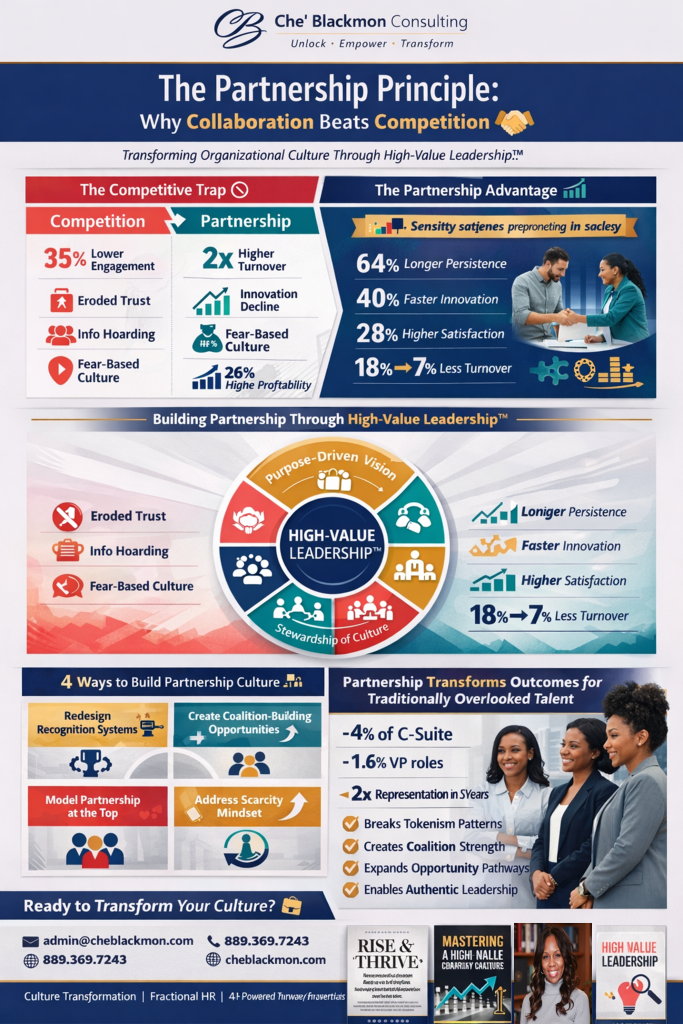
The Retain Wise Advantage: How Predictive Analytics Sees Turnover Before It Happens

By Che’ Blackmon, DBA Candidate | Founder & CEO, Che’ Blackmon Consulting

📚 Book Tie-In: Mastering a High-Value Company Culture — Data-Driven Culture Sections

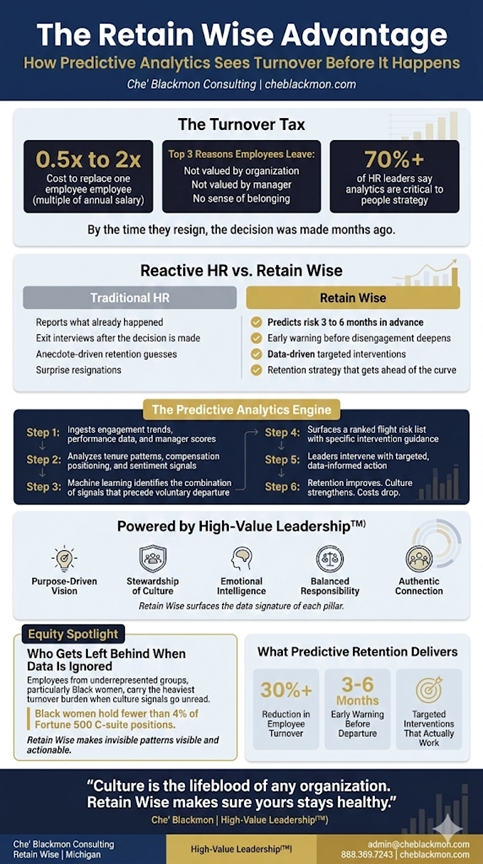
By the time an employee submits their resignation, the decision was usually made months earlier. The signs were there. The disengagement was building. The warning indicators were accumulating in plain sight. And yet, for most organizations, the first official notice of a departure comes as a surprise.

That surprise is expensive. The cost of replacing a single employee ranges from one-half to two times their annual salary, according to research from Gallup. For a mid-sized company experiencing ongoing turnover, those costs compound silently into millions of dollars annually in recruitment expenses, productivity loss, institutional knowledge gaps, and cultural disruption.

But what if you could see it coming? Not after the fact. Not during the exit interview. Three to six months before the resignation ever lands on anyone’s desk.

That is precisely the promise of Retain Wise, the AI-powered predictive analytics platform developed by Che’ Blackmon Consulting specifically for small and mid-sized organizations. Retain Wise does not simply report what has already happened inside your organization. It reads the patterns, analyzes the culture signals, and identifies flight risk before talent walks out the door. It is not reactive HR. It is strategic, data-driven people leadership at its most proactive.

This article explains how predictive analytics is transforming the way forward-thinking organizations understand and respond to employee turnover, what the data reveals about who bears the heaviest burden when turnover goes unaddressed, and why the integration of AI and culture strategy is no longer a future conversation. It is the present competitive advantage.

📉 The Turnover Crisis: What the Numbers Are Really Saying

Turnover has always been a business challenge. What is different now is the scale, the speed, and the compounding nature of the problem in a post-pandemic, multigenerational workforce.

According to the U.S. Bureau of Labor Statistics, millions of American workers voluntarily left their jobs every single month throughout 2022 and 2023, a sustained wave of departures that researchers began calling the Great Resignation. While the most extreme phase of that wave has passed, the underlying conditions that drove it have not.

Employee expectations have permanently shifted. Workers across every industry and generation now prioritize culture, leadership quality, flexibility, and sense of purpose alongside compensation. Research from McKinsey found that the top reasons employees left their jobs were not primarily about pay. They were about not feeling valued by their organization, not feeling valued by their manager, and not belonging to a community at work.

Read that again. The top drivers of voluntary turnover are cultural. They are relational. They are, at their core, a function of how people experience leadership on a daily basis.

“Culture is the lifeblood of any organization. It is not a feel-good concept. It is the secret sauce that makes or breaks the success of an organization.” — Mastering a High-Value Company Culture

This is the gap that no traditional HR metric can fully close. Annual engagement surveys capture sentiment at a single point in time. Exit interviews gather data from people who have already decided to leave. Performance reviews measure output but rarely measure belonging, psychological safety, or leadership trust.

The result is that most organizations are managing their talent retention strategy on a significant time delay. They are looking in the rearview mirror while their people are already halfway out the door.

🧠 What Is Predictive Analytics, and Why Does It Change Everything?

Predictive analytics is the use of data, statistical modeling, and machine learning algorithms to identify the likelihood of future outcomes based on historical and current patterns. In the context of employee turnover, predictive analytics ingests data from multiple organizational touchpoints and surfaces risk indicators that human observation alone would miss or interpret too late.

This is not a science fiction concept. It is a mature and rapidly expanding application of artificial intelligence that is already in use across healthcare, financial services, retail, and increasingly, human resources.

Retain Wise applies this capability specifically to the culture and people dynamics of small and mid-sized organizations, filling a critical gap in the market. Enterprise-scale corporations have had access to sophisticated HR analytics tools for years. The companies with 20 to 200 employees have largely been left without affordable, accessible, and actionable predictive intelligence about their own people.

🔍 How Predictive Analytics Identifies Flight Risk

Traditional HR data tells you what happened. Predictive analytics tells you what is about to happen if nothing changes. The distinction is fundamental.

An effective predictive model for employee turnover draws on a wide range of data inputs. These inputs can include engagement survey trends over time, performance review patterns and trajectory, absenteeism and attendance fluctuations, compensation positioning relative to internal peers and external market benchmarks, promotion history and velocity, manager effectiveness scores, team-level sentiment data, onboarding satisfaction and early tenure indicators, and organizational tenure benchmarks by role and department.

Individually, any one of these data points tells a limited story. But when a machine learning model analyzes them together, looking for the combination of signals that historically precede voluntary departures, it begins to surface something that no individual manager or HR generalist could reliably identify: the early pattern of disengagement that predicts turnover three to six months before it materializes.

“A strong, intentional culture propels tangible results. Such a culture does not come easy to create and maintain. It requires vision, strategy, and relentless commitment.” — Mastering a High-Value Company Culture

📊 The Difference Between Reporting and Predicting

Consider two organizations facing similar turnover challenges. The first organization has invested in a solid HR dashboard. Every month, leadership reviews a report showing last month’s turnover rate, the number of open positions, and the average time to fill each role. They see the problem clearly in the data.

But the data is describing what already happened. The employees who left are already gone. The knowledge they carried walked out with them. The team that depended on them is now stretched thin or operating without the coverage it needs.

The second organization uses Retain Wise. Six months before that same wave of departures, the platform flagged a cluster of risk indicators in a specific department: declining engagement trends among tenured employees, a manager effectiveness score that had been trending downward for two consecutive quarters, compensation data showing three employees at or below the 25th percentile for their roles relative to the external market, and an uptick in absenteeism patterns that the platform had learned to associate with pre-departure disengagement.

Leadership in the second organization had the information they needed to intervene. Not to apply a blanket fix to a vague culture problem. To have specific, targeted conversations with specific employees. To address the compensation gaps before the competition made a better offer. To invest in the manager’s development before the team reached a breaking point.

The resignation letters that arrived in the first organization never arrived in the second. That is the Retain Wise advantage.

🏭 Case Studies: Predictive Analytics in the Real World

🔧 The Automotive Supplier That Stopped the Bleed

There was a regional automotive supply company with approximately 120 employees that had been experiencing turnover rates exceeding 35% annually for three consecutive years. Leadership had responded each time the way most organizations respond: posting the open positions, interviewing candidates, extending offers, and repeating the cycle. Each year, the problem returned.

When the organization implemented predictive analytics monitoring, the data revealed a pattern that had been invisible to management. The highest-risk employees were not the newest hires, as leadership had assumed. They were the employees between two and four years of tenure who had been promoted once but were now stagnating. The predictive model identified a combination of signals: flat compensation relative to their increased responsibilities, infrequent recognition from their direct managers, and engagement scores that had dipped subtly across three consecutive quarterly pulse surveys.

With this intelligence, the company targeted specific interventions: a compensation review for mid-tenure employees in the flagged roles, a manager development series focused on recognition and career development conversations, and a structured stay interview process for employees who the model identified as at risk.

Turnover in the following 12 months dropped by more than half. The cost savings were measurable. The cultural impact was profound.

🏥 The Healthcare Organization That Found the Signal in the Noise

A regional healthcare organization was facing a staffing crisis that leadership attributed to the industry-wide nursing shortage. What the predictive data revealed was more specific and more actionable than a market-level problem.

The analytics platform identified that the turnover risk was concentrated not across the organization broadly, but within three specific units where a combination of leadership ineffectiveness indicators, high overtime load, and declining psychological safety scores created a predictable departure pattern. The market shortage was real. But it was being amplified by controllable internal conditions that the organization had the power to address.

Once the data identified the specific units and the specific risk factors, the organization was able to reallocate leadership development resources, address scheduling practices in the flagged units, and implement targeted retention conversations with employees the model identified as highest risk.

The data did not solve the problem automatically. Leaders still had to make the decisions and do the work. But the data told them exactly where to look, which meant that every intervention dollar spent was strategically targeted rather than broadly cast.

This is the core value proposition of data-driven culture leadership as articulated in Mastering a High-Value Company Culture: not simply identifying that a problem exists, but having the specific, actionable intelligence to address it where it is actually happening.

❤️ The Equity Dimension: What Predictive Analytics Reveals About Who Gets Left Behind

Any honest conversation about employee turnover and predictive people analytics must confront a difficult truth: the employees who are most likely to leave are often the employees whose departure signals have been most consistently ignored.

Black women in corporate America leave their organizations at disproportionately high rates not because of a lack of ambition or commitment. They leave because the conditions that predict departure, undervaluation, stagnant career advancement, exclusion from informal networks, inadequate recognition, and leadership relationships that do not see or support their full capability, are often present and unaddressed for years before the resignation arrives.

“The data instead points to systemic barriers including hiring bias, limited access to influential networks, lack of sponsorship, and inhospitable workplace cultures.” — Rise & Thrive: A Black Woman’s Blueprint for Leadership Excellence

A predictive analytics approach that is properly designed and equitably applied has the potential to disrupt this pattern in a meaningful way. When data surfaces that the employees with the highest flight risk in a given organization share a demographic pattern, that information creates an undeniable accountability signal for leadership that anecdote and individual performance reviews cannot produce.

Consider what this means in practice. When a predictive platform reveals that a disproportionate share of mid-tenure Black women employees are clustered in the highest-risk segments of the departure model, that is not merely a data point. It is an organizational diagnostic. It raises questions that demand answers. Are these employees being promoted at rates comparable to their peers? Are their compensation trajectories aligned with performance? Do their engagement scores reflect a sense of belonging, recognition, and leadership support?

Data does not carry bias in the same way human intuition does. When the pattern emerges in the numbers, it is harder to dismiss, explain away, or attribute to individual circumstances. It creates a basis for institutional accountability.

💡 From Data to Equity: The Leadership Responsibility

In Rise and Thrive: A Black Woman’s Blueprint for Leadership Excellence, the concept of purposeful navigation is explored in depth. It describes the exhausting labor of operating in environments that require extraordinary skill and resilience to advance, not because of a lack of capability but because of systems that were not designed with Black women’s success in mind.

Predictive analytics, used with intention and equity as an explicit design criterion, can become a tool that finally makes those invisible patterns visible at the organizational level. It is not a substitute for the deeper cultural work of building inclusive, high-value environments. But it can be the instrument that makes the systemic patterns undeniable and therefore actionable.

Organizations that use Retain Wise have the ability to segment their turnover risk data in ways that surface equity patterns. That capability is not a threat to leadership. It is a gift. It replaces the organizational blind spots that allow inequity to persist with specific, targeted information that empowers leaders to intervene.
🌟 The High-Value Leadership™ Connection: Data Meets Culture

Predictive analytics is not a replacement for the human dimensions of leadership. It is the instrument that makes those human dimensions more precise and more accountable.

The High-Value Leadership™ framework built into the core of Che’ Blackmon Consulting’s approach is grounded in five interconnected pillars: Purpose-Driven Vision, Stewardship of Culture, Emotional Intelligence, Balanced Responsibility, and Authentic Connection. Each of these pillars has a data signature.

When Purpose-Driven Vision is present, employees can articulate how their work connects to the organizational mission. Engagement data reflects that clarity. When it is absent, data shows a particular pattern of disengagement that begins to emerge in the two to three year tenure window.

When Stewardship of Culture is operating effectively, organizational norms reinforce the stated values and leaders model the behaviors they expect. When misalignment exists between espoused values and lived experience, that gap surfaces in sentiment data, manager effectiveness scores, and the cultural trust measures that predict pre-departure disengagement.

Emotional Intelligence as a leadership competency shapes the quality of manager-employee relationships, which are consistently among the top predictors of voluntary turnover across every research study on the topic. Employees do not leave companies. They leave managers. And the data shows exactly which manager relationships carry the highest departure risk.

Balanced Responsibility and Authentic Connection show up in psychological safety scores, in the patterns of who speaks up in team meetings and who does not, in the recognition data and in the career development conversation frequency metrics. Every dimension of the High-Value Leadership™ framework has measurable data that a predictive model can track.

“High-value leadership is characterized through purpose-driven vision, stewardship of culture, emotional intelligence, balanced responsibility, and authentic connection.” — High-Value Leadership: Transforming Organizations Through Purposeful Culture

Retain Wise does not exist in isolation from culture strategy. It was built as the data layer that makes culture strategy specific, targeted, and accountable. The platform surfaces the signals. The High-Value Leadership™ framework provides the response architecture. Together, they represent an approach to people management that is both rigorous and deeply human.

🚀 Current Trends: Why This Moment Demands Predictive People Intelligence

🤖 The AI Transformation of HR

The integration of artificial intelligence into human resources is not a distant trend. According to Deloitte’s Global Human Capital Trends Report, more than 70% of HR leaders reported that analytics capabilities were important or very important to their organizations’ people strategy. The adoption rate among small and mid-sized businesses, however, has lagged significantly behind enterprise-scale organizations, creating both a challenge and an opportunity.

Retain Wise was specifically designed to close that gap. The predictive capability that Fortune 500 companies have deployed in their talent retention strategies for years is now accessible to the companies that arguably need it most: the growing organizations that cannot afford the catastrophic cost of unmanaged turnover but have also not had access to the analytical tools to address it proactively.

💼 The Multigenerational Workforce Complexity

Today’s workforce spans five generations, each with distinct expectations, motivations, and engagement patterns. Gen Z employees who entered the workforce during and after the pandemic have markedly different expectations around flexibility, purpose alignment, and manager transparency than Baby Boomer colleagues who may be in their final years before retirement. Gen X professionals in mid-career bring a particular set of advancement expectations that, when unmet, translate to departure risk in a predictable pattern.

Managing across this complexity requires more than generational stereotypes and one-size-fits-all engagement initiatives. It requires the kind of granular, individualized risk intelligence that predictive analytics provides. A well-designed model accounts for generational patterns in the data while remaining specific enough to flag individual-level risk without generalizing.

🌍 The Values-Led Business Imperative

Organizations that lead with explicit values and demonstrate measurable commitment to those values through culture, policy, and people practices attract better talent, retain that talent longer, and outperform their competitors on engagement metrics. This is not opinion. Research from Glassdoor, Harvard Business Review, and multiple independent workforce studies consistently confirms the business case for high-value culture as a retention strategy.

But values without accountability measures are aspirational statements. Retain Wise provides the accountability infrastructure that turns cultural commitments into trackable, improvable outcomes. It answers the question that too many organizations avoid: are the values we say we have actually producing the culture we claim to be building?

✅ Actionable Takeaways

For Business Leaders and CEOs:

  1. Calculate the true cost of your current turnover. Take your average annual salary for departing roles, multiply it by 1.5, and multiply that by the number of employees who left in the past 12 months. That number is the financial case for investing in predictive retention strategy.
  2. Stop relying solely on exit interviews. By the time an employee is sitting in an exit interview, the decision has been made and the knowledge transfer opportunity has passed. Shift your investment upstream to early warning systems and proactive retention intervention.
  3. Ask whether your culture data is predictive or retrospective. If your current HR analytics only describe what happened last quarter, you are operating without the forward visibility your business needs.
  4. Invest in manager effectiveness as a retention lever. The single most predictable driver of voluntary turnover is the quality of the manager relationship. Identify which manager relationships in your organization carry the highest risk and invest in development with urgency.
  5. Make equity an explicit dimension of your retention strategy. Analyze your turnover data by demographic patterns. If certain groups are departing at disproportionate rates, that is an organizational signal that demands a targeted organizational response.

For HR and People Operations Professionals:

  • Position your function as predictive, not reactive. The organizations that see HR as a strategic partner are the ones where people professionals have shifted from reporting what happened to anticipating what is coming. Build your case for predictive analytics investment with cost data and competitive benchmarking.
  • Integrate culture signals into your data infrastructure. Engagement scores, manager effectiveness data, and sentiment trends are not soft inputs. They are predictive variables. Ensure your data architecture captures them consistently and uses them in your risk assessments.
  • Build stay interview processes now. Stay interviews with high-performing, at-risk employees are one of the highest-return investments in retention strategy. They generate both intelligence and goodwill. Implement them before the predictive model flags the risk, not after.
  • Use data to surface equity patterns. Predictive analytics that does not include an equity lens is an incomplete tool. Ensure that your turnover risk analysis disaggregates data in ways that reveal whether certain groups are disproportionately represented in high-risk segments.
  • Connect retention outcomes to organizational performance metrics. Make the business case visible. Turnover reduction translates directly to cost savings, productivity gains, and customer satisfaction improvements. Quantify those relationships and communicate them to leadership regularly.

🗣️ Discussion Questions for Readers

Whether you are reading this as an organizational leader, an HR professional, or someone navigating the impact of turnover in your own team, these questions are worth sitting with carefully.

  1. How much of your current HR data describes what already happened, versus helping you anticipate what is about to happen? What would change in your organization if you had six months of early warning before your highest-risk departures?
  2. When you think about the employees who left your organization in the past two years, what patterns do you notice? Were there demographic patterns? Tenure patterns? Manager relationship patterns? What did those patterns tell you, and what did the organization do in response?
  3. How does your organization’s lived culture compare to its stated culture? Where is the gap largest? And do you have the data to know, or are you operating on assumption and anecdote?
  4. If you analyzed your turnover data by demographic segment today, what do you think you would find? And if you found a disproportionate departure rate among Black women or other historically underrepresented professionals, what would your organization be prepared to do differently?
  5. What would it mean for your organization to move from reactive people management to predictive people strategy? What investment would that require, and what would the return on that investment look like over 12 to 24 months?

👟 Next Steps for Readers

Recognition is the first step. The organizations that close the gap between knowing and acting are the ones that will outperform their competition in talent retention and culture health for the decade ahead.

Here are three concrete steps to begin your journey from reactive to predictive people strategy.

  1. Read the foundational work. Mastering a High-Value Company Culture provides the complete strategic framework for building organizational environments where the data-driven culture practices described in this article can take root. High-Value Leadership: Transforming Organizations Through Purposeful Culture gives you the leadership philosophy and behavioral architecture that translates predictive intelligence into purposeful action. Rise and Thrive: A Black Woman’s Blueprint for Leadership Excellence speaks directly to the equity dimensions of culture leadership that this article addresses. All three are available through Che’ Blackmon Consulting.
  2. Conduct a retention risk audit. Before investing in predictive technology, conduct a structured review of your last 24 months of turnover data. Identify the patterns: by tenure, by role, by department, by demographic group, and by manager. That manual analysis will both surface immediate insights and make the case for a more sophisticated predictive infrastructure.
  3. Start the conversation. If you are ready to explore how Retain Wise can bring predictive people analytics to your organization, the conversation begins with understanding your specific context, your current data infrastructure, and your most pressing people challenges. Retain Wise was built for organizations exactly like yours.

🤝 Ready to See Turnover Before It Happens?

Che’ Blackmon Consulting is the home of Retain Wise, Michigan’s first AI-powered culture transformation platform designed specifically for small and mid-sized organizations. Built on more than 24 years of progressive HR and organizational leadership experience, doctoral-level research in AI-enhanced predictive analytics for culture transformation, and the High-Value Leadership™ methodology, Retain Wise gives your organization the forward visibility it needs to retain your best people before the exit interview ever happens.

The cost of doing nothing is already showing up in your financials, your team dynamics, and your organizational culture. The cost of acting now is a fraction of that. The question is not whether predictive analytics is the right investment. The question is how many more departure surprises your organization can afford.

Let’s see what the data can do for your people strategy.

📧 admin@cheblackmon.com   📞 888.369.7243   🌐 cheblackmon.com

Che’ Blackmon Consulting | Retain Wise | Fractional HR & Culture Transformation | Michigan

#RetainWise #PredictiveAnalytics #EmployeeRetention #HRStrategy #HighValueLeadership #CultureTransformation #PeopleAnalytics #TurnoverPrevention #FractionalHR #BlackWomenLead #WorkforcePlanning #HRLeadership #AIinHR #OrganizationalCulture #CheBlackmonConsulting

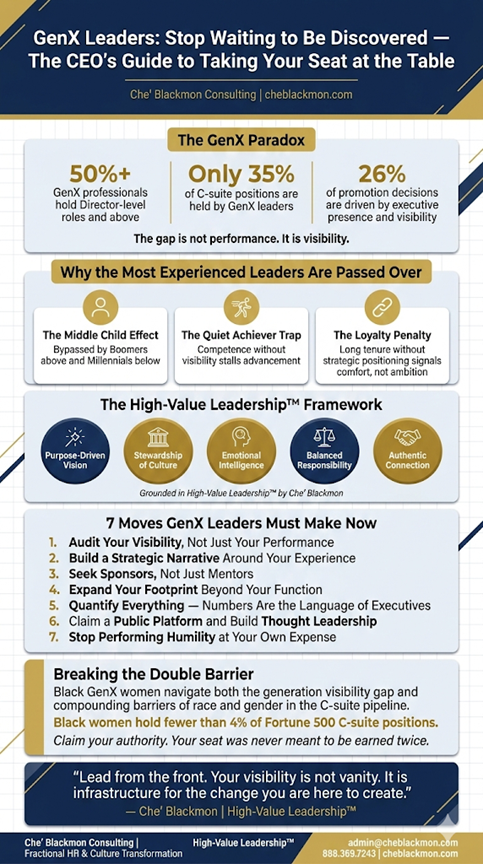
GenX Leaders: Stop Waiting to Be Discovered The CEO’s Guide to Taking Your Seat at the Table

By Che’ Blackmon, DBA Candidate | Founder & CEO, Che’ Blackmon Consulting

📚 Book Tie-In: High-Value Leadership: Transforming Organizations Through Purposeful Culture — Chapters on Purpose-Driven Direction and Trust-Based Empowerment

You have built the career. You have the experience, the institutional knowledge, the battle scars, and the results to prove it. You have watched younger colleagues get promoted around you, sat through meetings where your ideas were credited to someone else, and told yourself to be patient because your time was coming.

It is time to stop waiting.

Generation X, the 65 million Americans born roughly between 1965 and 1980, represents one of the most seasoned, resilient, and capable leadership cohorts in the modern workforce. Yet GenX professionals are also among the most chronically underestimated. Sandwiched between the massive cultural footprint of Baby Boomers and the loud market presence of Millennials, GenX leaders have spent decades doing the work without always receiving the recognition, promotion, or platform their contributions deserve.

This article is a direct conversation with GenX professionals who are done waiting to be discovered. It is a guide for stepping into your full leadership authority, building the visibility that executive presence requires, and creating the kind of organizational impact that makes you impossible to overlook. It also speaks to those within the GenX generation who carry an additional weight: Black women leaders who have navigated not just the generation gap but also the compounding barriers of race and gender in corporate spaces.

The seat at the table you have been waiting for? It is time to pull it up yourself.

🗺️ The GenX Paradox: Maximum Experience, Minimum Visibility

Here is a remarkable data point. According to research from the nonprofit Visier, Generation X makes up more than 50% of leadership roles at the Director level and above in most U.S. organizations. And yet GenX accounts for only about 35% of the C-suite. That gap is not accidental. It reflects a structural visibility problem that has followed this generation throughout its career.

GenX professionals entered the workforce in an era that rewarded competence, loyalty, and heads-down execution. They were trained to let the work speak for itself. They absorbed a professional culture that viewed self-promotion as unseemly and believed that doing an exceptional job would naturally lead to recognition and advancement. For many, it worked through the early stages of their careers.

But the rules changed. The executive suite increasingly rewards visibility, narrative, and strategic self-positioning alongside performance. Those who mastered the art of making their work known, building upward relationships, and being seen as strategic thinkers moved faster. Those who continued to lead with quiet competence found themselves consistently passed over.

“High-value leadership is not about commanding a room. It is about being so intentional, so purposeful, and so aligned in your values and your actions that people cannot help but follow.” — High-Value Leadership: Transforming Organizations Through Purposeful Culture

The paradox for GenX is real. The generation most experienced in navigating organizational complexity, managing multigenerational teams, and delivering sustained results is also the generation most likely to underinvest in the strategic visibility that executive advancement now requires.

Understanding that paradox is the first step. Dismantling it is the work.

🔍 Why GenX Gets Overlooked: The Structural Truth

Before we talk strategy, it is important to name the structural realities that have shaped the GenX leadership experience. This is not about assigning blame. It is about understanding the terrain so you can navigate it more effectively.

📌 The Middle Child Syndrome of the Workforce

Baby Boomers built the corporate infrastructure and held senior leadership positions well into the 2010s, often longer than previous generations due to improved health and financial uncertainty. When they finally began transitioning out, many organizations made a strategic leap directly to Millennials, investing heavily in the recruitment, development, and promotion of younger talent in response to market pressures around innovation and digital transformation.

GenX, once again, got lost in the middle. Too young to be the Boomer heir apparent, too experienced to be positioned as the fresh new talent, this generation has spent years watching leadership pipelines flow around them rather than through them.

📊 The Quiet Achiever Trap

Research consistently shows that visibility is one of the strongest predictors of promotion decisions, often outweighing performance scores when candidates are otherwise equally qualified. A study from the Center for Talent Innovation found that executive presence, defined broadly as the ability to project confidence, credibility, and command attention, accounts for as much as 26% of what it takes to get promoted to senior leadership.

GenX professionals, culturally conditioned to value substance over style, frequently underinvest in executive presence. They do the work. They solve the problems. They manage the teams. But they often fail to architect the narrative around that work in ways that register at the executive level.

🧠 The Loyalty Penalty

GenX is the generation that stayed. While Millennials became known for job hopping and Boomers for building empire-like tenure at single organizations, GenX professionals demonstrated a particular brand of organizational loyalty that often translated into being taken for granted.

In many cases, long tenure without explicit visibility and positioning strategies results in being perceived as part of the furniture rather than as a candidate for the next level. Organizations sometimes overlook their most tenured performers precisely because those performers have not actively signaled readiness for advancement.

❤️ The Double Burden: GenX Black Women in Corporate Spaces

No examination of GenX leadership and the visibility gap would be complete without explicitly addressing the experience of Black women within this generation. For Black GenX women in corporate America, the challenges described above are compounded in ways that cannot be ignored.

Black women who came of age professionally in the 1990s and early 2000s entered organizations that were largely unprepared to see them as future executives. They were often the first, the only, or one of very few in the rooms where decisions were made. They did everything right. They earned the degrees, built the competencies, delivered the results, and mentored others along the way. And they were still passed over.

“The data instead points to systemic barriers including hiring bias, limited access to influential networks, lack of sponsorship, and inhospitable workplace cultures.” — Rise & Thrive: A Black Woman’s Blueprint for Leadership Excellence

According to McKinsey’s Women in the Workplace report, Black women are promoted at lower rates than all other groups of women at nearly every stage of the corporate pipeline. The gap is most pronounced at the transition from individual contributor to manager and again at the transition into the C-suite. These are not soft data points. They represent the cumulative lived experience of an entire cohort of extraordinary professionals whose contributions have been systemically undervalued.

GenX Black women also face a phenomenon that researchers call the double bind. When they display the confidence, assertiveness, and strategic authority that are universally rewarded in male leaders, those same behaviors are frequently coded as aggressive, difficult, or threatening in Black women. When they lead with warmth, collaboration, and humility, those qualities are often interpreted as a lack of executive readiness.

There is no perfect performance that eliminates the bias. But there is a strategy. And that strategy begins with claiming your authority rather than waiting for it to be granted.

💡 Reclaiming the Narrative

In Rise and Thrive: A Black Woman’s Blueprint for Leadership Excellence, the concept of purposeful navigation is explored in depth. It is the practice of making strategic choices about visibility, advocacy, and positioning while remaining anchored in authenticity and integrity. For GenX Black women, purposeful navigation is not optional. It is the leadership competency that the moment demands.

This is not about playing a game whose rules were written by and for someone else. It is about understanding the terrain clearly enough to change it.

💼 Case Studies: GenX Leaders Who Stopped Waiting

🏭 The Operations Leader Who Rewrote Her Story

There was a mid-sized manufacturing organization where a veteran operations director had spent 14 years building one of the company’s most consistently high-performing departments. Her teams routinely outperformed their quarterly targets. Her attrition numbers were the envy of peers across the organization. She was respected, well-liked, and completely invisible to the senior leadership team when VP-level openings arose.

What changed was not her performance. What changed was her strategy. She began requesting time on the quarterly leadership agenda to present her department’s results directly to the executive team rather than allowing those results to be filtered through her direct supervisor. She started writing a brief monthly internal newsletter that connected her team’s operational wins to the company’s stated strategic priorities. She requested a meeting with the CEO to share her perspective on a company-wide challenge she had identified. Within 18 months, she was promoted to VP of Operations.

The work was always there. What changed was the visibility of the work, and the intentionality of the positioning.

🏥 The HR Director Who Claimed Her Expertise Publicly

There was a regional healthcare organization where a long-tenured HR director had developed a sophisticated understanding of how culture directly impacted patient outcomes, staff retention, and organizational performance. She had the data. She had the analysis. She had a framework. But she kept it largely internal, presenting her insights in department-level meetings without ever positioning herself as a thought leader beyond the organization.

A mentor challenged her to take her expertise public. She began writing brief LinkedIn articles on the intersection of HR strategy and healthcare outcomes. She submitted a proposal to speak at a regional industry conference. She connected her internal frameworks to published research and started citing those connections explicitly in executive presentations.

The result was twofold. Externally, she began building a reputation as a subject matter expert in healthcare culture and HR strategy. Internally, the executive team’s perception of her shifted from competent director to strategic thought leader. Both pathways mattered.

🌟 The High-Value Leadership™ Framework for GenX Advancement

In High-Value Leadership: Transforming Organizations Through Purposeful Culture, a distinction is drawn between leaders who manage organizations and leaders who transform them. GenX professionals, with their depth of experience and their cross-functional perspective, are uniquely positioned to be the latter. But transformation requires more than competence. It requires the three pillars of High-Value Leadership™ operating simultaneously.

1️⃣ Purpose-Driven Direction

High-value leaders do not simply manage the work. They articulate a vision that gives the work meaning. For GenX professionals looking to claim their executive seat, this means developing and communicating a point of view about where the organization needs to go and why. Not just at the department level. At the enterprise level.

This is the shift from being a manager of a function to being a strategic voice in the room. It requires asking bigger questions, connecting operational realities to organizational strategy, and being willing to put a stake in the ground with a perspective.

2️⃣ Trust-Based Empowerment

GenX leaders are exceptionally skilled at this pillar, often without realizing it. Their experience managing through multiple organizational cycles, their capacity for empathy built from years of navigating complexity, and their natural tendency toward collaborative problem-solving are all expressions of trust-based empowerment.

The advancement opportunity here is to make this strength visible. Document how your leadership approach has driven team performance. Quantify engagement, retention, and productivity outcomes. Tell the story of how you lead, not just what your teams produce.

3️⃣ Cultural Alignment

Mastering a High-Value Company Culture makes the case that culture is the lifeblood of any organization. GenX leaders who have lived through multiple culture cycles within their organizations carry rare institutional wisdom about what builds culture, what destroys it, and what it takes to sustain it through leadership transitions, market disruptions, and generational shifts.

This wisdom is extraordinarily valuable. It is also frequently underarticulated. Claim it. Make your perspective on culture a consistent part of your leadership narrative, both internally and externally.

🚀 The Strategic Visibility Blueprint: 7 Moves GenX Leaders Must Make Now

The following strategies are not theoretical. They are practical, evidence-based moves that GenX professionals can begin implementing immediately, regardless of their current title or organizational context.

📈 Move 1: Audit Your Visibility, Not Just Your Performance

Most GenX professionals can recite their performance metrics. Fewer can articulate exactly how visible they are to the people who make promotion decisions. Conduct a visibility audit. Identify the top five decision-makers whose perception of you most directly influences your advancement. Assess honestly how much direct interaction you have with each of them, whether they can specifically describe your contributions and strategic perspective, and whether they think of you when executive opportunities arise.

If the answer to any of these is no or rarely, that is your starting point.

📝 Move 2: Build a Strategic Narrative

Your experience is not self-explanatory. In a world saturated with information and competing priorities, even the most impressive career history requires a clear, compelling narrative to land with impact. Develop a three-sentence leadership positioning statement that communicates who you are, what you uniquely bring, and what organizational problem you are specifically positioned to solve at the next level.

Use this narrative consistently: in executive conversations, in your professional profiles, in how you introduce yourself in new relationships, and in how you frame your contributions in leadership meetings.

🤝 Move 3: Sponsor, Not Just Mentor

Research from Catalyst and Harvard Business Review consistently shows that sponsorship, having someone with organizational power who actively advocates for your advancement in rooms you are not in, is one of the most significant predictors of promotion for historically underrepresented professionals.

GenX leaders often become excellent mentors. The next level is identifying and cultivating sponsors. This requires building upward relationships intentionally, demonstrating your executive readiness directly to senior leaders, and being specific with your advocates about what opportunities you are seeking.

🌎 Move 4: Expand Your Footprint Beyond Your Function

One of the most common visibility limitations for GenX professionals is organizational siloing. You are brilliant within your function, but unknown across the enterprise. Seek cross-functional projects, enterprise-level committees, or organizational initiatives that place you in proximity to senior leaders and peers outside your direct domain.

Every cross-functional project is also a visibility opportunity. Treat it as one.

📊 Move 5: Quantify Everything

GenX leaders often describe their contributions in qualitative terms: built a great team, improved culture, strengthened relationships. Quantification is the language of executive leadership. Translate your impact into numbers wherever possible. Turnover reduction percentages. Engagement score increases. Revenue protected or generated. Cost reductions. Time to productivity improvements.

Numbers are not a substitute for the full story of your leadership. But they are the credibility anchors that make the story land with decision-makers.

🎙️ Move 6: Claim a Public Platform

Thought leadership is no longer the exclusive domain of published academics and keynote speakers. LinkedIn, industry associations, local business organizations, and professional conferences all offer GenX leaders platforms to demonstrate their expertise beyond the walls of their current organization.

Start where you are. A short LinkedIn article. A panel discussion at an industry event. A guest post in a trade publication. Each public expression of your expertise builds external credibility that reinforces your internal positioning.

🗣️ Move 7: Stop Performing Humility at Your Own Expense

This one is particularly important for Black women and other professionals from underrepresented groups. Humility is a leadership virtue. Self-erasure is not. There is a meaningful difference between leading with humility, which means remaining open, collaborative, and grounded, and performing humility as a strategy to avoid the discomfort of being seen.

When you minimize your contributions in meetings, deflect credit for results your leadership produced, or frame your ideas as tentative suggestions rather than informed perspectives, you are not being humble. You are training the people around you to underestimate you.

Own your expertise. Speak with the authority you have earned. Lead from your full self.

“Authentic leadership — bringing your whole self to your role — correlates with higher engagement, innovation, and organizational performance. When you lead authentically, you not only enhance your own effectiveness but potentially transform the environment for others.” — Rise & Thrive: A Black Woman’s Blueprint for Leadership Excellence

💡 Current Trends GenX Leaders Must Leverage

The organizational landscape of 2025 and beyond is presenting a set of conditions that are uniquely favorable for GenX advancement. Those who understand these trends and position themselves accordingly will find the most significant opportunities of their careers opening now.

🤖 The AI Integration Moment

Artificial intelligence is reshaping every sector of the economy, and organizations are urgently seeking leaders who can bridge the gap between technological capability and human organizational dynamics. GenX leaders, who came of age professionally during the personal computing revolution and the early internet era, have an underappreciated advantage here. They understand technology adoption cycles. They have lived through organizational transformations driven by technological disruption. They know what it looks like when technology is implemented without the change management infrastructure to support it.

The leader who can position AI adoption within a robust culture and people strategy framework is extraordinarily valuable in this moment. That leader is often GenX.

💼 The Multigenerational Leadership Demand

Today’s workforce spans five generations simultaneously, from the youngest Gen Z entrants to the most senior Baby Boomer holdovers. Managing across that spectrum requires a level of interpersonal sophistication, contextual intelligence, and organizational patience that is genuinely rare.

GenX leaders, by virtue of their position in the generational middle, often possess an intuitive capacity for this kind of bridging leadership. They can communicate credibly with Boomers and with Gen Z. They understand both analog and digital organizational cultures. They have managed up and managed down across generational divides for decades. This is a specific and valuable leadership competency. Name it. Claim it.

🌍 The Values-Led Business Imperative

Organizations across every sector are under increasing pressure from employees, customers, investors, and communities to lead with explicit values and to demonstrate measurable commitment to those values through their culture, policies, and people practices. This is precisely the terrain on which the High-Value Leadership™ methodology was built.

GenX leaders who have invested in their understanding of culture as a strategic driver and who can articulate how their leadership approach creates environments where values are lived rather than stated are exceptionally well-positioned for this moment.

✅ Actionable Takeaways

For GenX Leaders Ready to Advance:

  1. Complete a visibility audit this week. Identify your top five organizational decision-makers and honestly assess your current level of strategic visibility with each one.
  2. Write your leadership positioning statement. Three sentences. What you bring, what you have built, and what organizational challenge you are built to solve at the next level.
  3. Identify one cross-functional opportunity in the next 30 days. A committee, a project, a working group. Somewhere that places you in proximity to leaders outside your immediate reporting structure.
  4. Quantify your most significant contribution from the past 12 months. Express it in numbers. Practice stating it out loud in one sentence.
  5. Begin building your public platform. One article, one conference proposal, one speaking opportunity. Start with what is closest and most achievable.

For GenX Black Women Navigating Additional Barriers:

  • Name what is happening. Distinguishing bias from performance feedback is not always simple, but it is essential. Build relationships with mentors and sponsors who can help you see your situation clearly and advocate for you strategically.
  • Document your contributions in real time. Keep a running record of your results, your ideas, and the moments when your contributions were credited to others. This record protects you and positions you.
  • Invest in your external brand. Your visibility outside your organization insulates you from internal political dynamics and creates alternative pathways when organizational structures prove resistant to your advancement.
  • Find your people. Community is not a luxury. It is a strategic resource. Connect with other GenX Black women leaders who understand the terrain and can offer support, insight, and solidarity.
  • Lead from the front, not the back. Resist the pull toward invisible leadership. Your visibility is not vanity. It is infrastructure for the change you are here to create.

🗣️ Discussion Questions for Readers

Whether you are reading this as a GenX leader mapping your next career chapter or as an organizational decision-maker thinking about your leadership pipeline, the following questions are worth sitting with.

  1. Where in your career have you been waiting to be discovered rather than actively positioning yourself for advancement? What would shift if you stopped waiting?
  2. How would you describe your current visibility with the people who make the decisions that matter most to your career trajectory? What specific actions would change that picture?
  3. In what ways does your organization’s culture reward or penalize visible leadership, particularly for women and professionals of color? What is your responsibility in that dynamic?
  4. If you were to define your leadership legacy at this stage of your career, what would it say? And does the way you currently show up in your organization reflect that legacy?
  5. What is one strategic move from this article that you could realistically begin in the next two weeks? Who would you need to involve, and what would success look like?

👟 Next Steps for Readers

Awareness is the beginning. Commitment is what follows.

If this article has named something you have been feeling for a while, that recognition is important information. It means you are ready for the next chapter. Here are three concrete steps to move from recognition to action.

  1. Read the foundational work. High-Value Leadership: Transforming Organizations Through Purposeful Culture provides the complete framework for the leadership approach described in this article. Mastering a High-Value Company Culture offers the strategic blueprint for building and sustaining the organizational environments where GenX leaders can thrive. Rise and Thrive: A Black Woman’s Blueprint for Leadership Excellence speaks directly to the unique navigation required of Black women leaders at every stage of the advancement journey. All three are available through Che’ Blackmon Consulting.
  2. Conduct your visibility audit this week. Not next month. This week. Use the framework from Move 1 in this article and be rigorously honest with yourself about what you find.
  3. Start the conversation. If you are ready to think strategically about your leadership trajectory, your organizational culture, or your advancement as a GenX professional, bring that conversation to someone who understands the terrain.

🤝 Ready to Stop Waiting and Start Leading?

Che’ Blackmon Consulting partners with professionals and organizations who are ready for real transformation. With more than 24 years of progressive HR and organizational leadership experience, doctoral-level research in AI-enhanced culture transformation, and a practice grounded in the High-Value Leadership™ methodology, Che’ Blackmon brings both the strategic depth and the human insight that today’s GenX leaders need.

Whether you are an individual leader ready to claim your next chapter, an organization looking to develop and advance your experienced talent pipeline, or an executive team ready to invest in the culture that retains your best people, the work begins with a conversation.

Your seat at the table is waiting. Take it.

📧 admin@cheblackmon.com   📞 888.369.7243   🌐 cheblackmon.com

Che’ Blackmon Consulting | Fractional HR & Culture Transformation | Michigan

#GenXLeaders #ExecutiveLeadership #HighValueLeadership #LeadershipDevelopment #CareerAdvancement #BlackWomenLead #CultureTransformation #PeopleStrategy #VisibilityStrategy #WomenInLeadership #GenXProfessionals #HRLeadership #OrganizationalCulture #TakeYourSeat #CheBlackmonConsulting

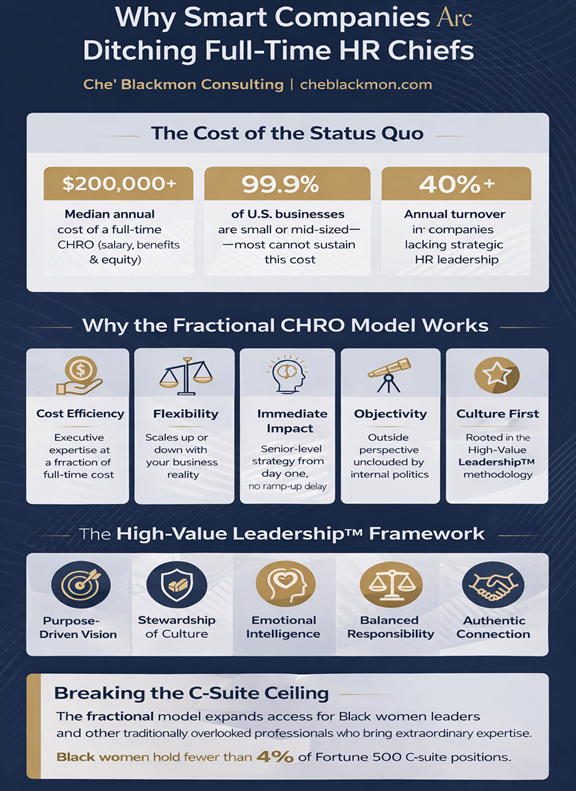
The Fractional CHRO Revolution: Why Smart Companies Are Ditching Full-Time HR Chiefs

By Che’ Blackmon, DBA Candidate | Founder & CEO, Che’ Blackmon Consulting

📚 Book Tie-In: High-Value Leadership: Transforming Organizations Through Purposeful Culture

Something is shifting in boardrooms across the country. Business owners and CEOs who once believed a full-time Chief Human Resources Officer was the gold standard are now asking a different question. The question is no longer whether they can afford great HR leadership. The real question is whether they can afford to overpay for it.

Enter the Fractional CHRO. Executive-level HR strategy, delivered at a fraction of the cost, with the flexibility that today’s business environment demands. For small and mid-sized companies, this model is not a compromise. It is a competitive advantage.

This article explores why the Fractional CHRO model is gaining serious momentum, who benefits most, and what it means for the future of strategic people leadership. We will also look at why this shift carries particular significance for traditionally overlooked professionals, including Black women, who bring extraordinary value to organizations that are finally ready to see it.

📈 The Changing Landscape of HR Leadership

The traditional model of HR leadership was built around a simple premise: large companies needed a full-time HR executive on staff to manage people strategy. That model made sense when the average company had thousands of employees, a dedicated HR department, and a budget to match.

Today, however, the landscape looks very different.

According to the Society for Human Resource Management (SHRM), small and mid-sized businesses, typically defined as those with fewer than 500 employees, represent 99.9% of all U.S. employer firms. Yet the vast majority of these companies cannot justify or sustain the cost of a full-time CHRO, whose median salary often exceeds $200,000 annually when benefits, bonuses, and equity are factored in.

At the same time, the demand for sophisticated people strategy has never been higher. Post-pandemic workforce shifts, evolving employee expectations, generational dynamics, and AI-driven workplace changes have made culture and talent strategy mission-critical for businesses of every size.

“Culture is the lifeblood of any organization.” — Che’ Blackmon, Mastering a High-Value Company Culture

The fractional model bridges this gap elegantly. It allows companies to access C-suite HR expertise on a part-time, contract, or project basis, paying only for what they need when they need it.

🔍 What Exactly Is a Fractional CHRO?

A Fractional CHRO is a seasoned human resources executive who partners with organizations in a part-time or contract capacity to provide strategic HR leadership. Unlike a consultant who delivers a one-time report and disappears, a Fractional CHRO becomes embedded in the leadership team. They attend strategy sessions, advise on people decisions, lead culture initiatives, and drive the kind of organizational transformation that moves a business forward.

The scope of work can include a wide range of responsibilities.

  • Developing and executing people strategy aligned with business goals
  • Building or restructuring HR infrastructure and processes
  • Advising on talent acquisition, retention, and workforce planning
  • Leading culture transformation initiatives
  • Guiding compliance, employee relations, and policy development
  • Coaching senior leaders on people management best practices
  • Preparing growing organizations for the complexity that comes with scale

What makes the fractional model particularly powerful is the intentionality behind it. In High-Value Leadership: Transforming Organizations Through Purposeful Culture, the case is made that true leadership is not about occupying a seat. It is about driving purpose-driven vision, stewarding culture, and creating environments where both people and organizations can thrive together. A Fractional CHRO brings exactly that, without the overhead.

💼 Why Smart Companies Are Making the Shift

💰 1. Cost Efficiency Without Sacrificing Quality

A growing company with 50 to 150 employees does not need a full-time CHRO every single week of the year. What it does need is strategic HR leadership during critical moments: a hiring surge, a culture concern, a reorganization, a compliance challenge, or a leadership conflict. A fractional engagement delivers that expertise precisely when and where it is needed most.

Companies that have made this shift often report accessing senior-level strategic guidance at a fraction of the annual cost of a full-time hire. For growing businesses operating with lean budgets, that savings is transformational.

🏋️ 2. Flexibility That Matches Business Reality

Business cycles are unpredictable. Startups scale quickly. Seasonal businesses fluctuate. Acquisitions create sudden complexity. A fractional model allows companies to scale HR support up or down based on what the business actually needs in a given season, rather than being locked into a fixed salary and headcount regardless of the circumstances.

One company in the professional services industry, for example, engaged a Fractional CHRO during a rapid growth phase in which they onboarded thirty new employees in six months. The fractional leader developed their onboarding infrastructure, created a manager development program, and built an employee handbook from scratch, all within a defined engagement. When the initial phase was complete, the relationship transitioned to a lighter advisory capacity. That kind of flexibility simply does not exist in a traditional full-time model.

🧠 3. Senior-Level Expertise, Immediately

Hiring a full-time CHRO from the external market is expensive, time-consuming, and risky. It can take months to find the right candidate, and even longer for them to learn the business before contributing at a strategic level. A Fractional CHRO, by contrast, steps in immediately with deep experience across industries and organizational contexts, ready to diagnose, strategize, and execute from day one.

This is especially critical for companies navigating people crises, such as toxic culture concerns, high turnover, or leadership team dysfunction. Speed of intervention matters enormously in those moments.

🔭 4. Objectivity That Drives Real Change

An experienced Fractional CHRO brings something else that internal hires often struggle to deliver: an outside perspective unclouded by internal politics or historical baggage. They can assess culture honestly, name problems directly, and recommend bold solutions that an internally positioned leader might avoid out of self-preservation.

In Mastering a High-Value Company Culture, the importance of leaders who are willing to act on what they discover, rather than simply describe the problem, is a central theme. Fractional CHROs are uniquely positioned to serve that function.

🌟 Case Studies in Action

🏭 The Manufacturing Company That Could Not Retain Anyone

There was a manufacturing company with approximately 80 employees that was experiencing turnover in excess of 40% annually. Leadership assumed the problem was compensation. A Fractional CHRO was brought in and conducted a thorough culture and engagement assessment. What the data revealed was that the real driver of attrition was a combination of frontline supervisors who lacked people management skills and an absence of any structured onboarding process.

Within six months of engagement, the Fractional CHRO implemented a supervisor training program, redesigned the onboarding experience, and introduced a stay interview process to surface concerns before they became resignations. Turnover dropped significantly. The company never would have identified those root causes through a compensation analysis alone.

🏥 The Healthcare Organization Scaling Too Fast

A regional healthcare organization experiencing rapid growth found itself with an HR team that was entirely transactional, focused on processing paperwork and answering policy questions, but offering no strategic guidance to leadership. Senior leaders were making critical people decisions, including promotions, terminations, and compensation changes, without consistent frameworks or guidance.

A Fractional CHRO was brought in to build the infrastructure the organization needed to support its growth responsibly. She developed a leadership competency model, standardized the performance management process, and created an equitable compensation framework. She also worked with the executive team to define and articulate the organization’s core values in a way that could actually shape behavior, not just decorate a wall. The result was a more cohesive leadership team and a culture that could withstand continued growth.

This mirrors the foundational argument in High-Value Leadership: that authentic leadership drives organizational transformation not through policies and procedures alone, but through the intentional creation of environments where people can thrive.

❤️ The Human Side: Impact on Traditionally Overlooked Professionals

No conversation about the Fractional CHRO revolution is complete without addressing its implications for professionals who have historically been shut out of the C-suite, most particularly Black women.

The statistics are sobering. Research consistently shows that Black women hold fewer than 4% of C-suite positions in Fortune 500 companies, 1.6% of VP roles, and just 1.4% of executive-level positions. These numbers exist not because of a lack of ambition, talent, or capability. They reflect the cumulative weight of systemic barriers: unconscious bias in hiring, limited access to sponsorship, and organizational cultures that too often reward conformity over contribution.

“The numbers tell a stark story about the state of Black women’s representation in leadership — yet the pipeline isn’t broken by a lack of ambition. It is broken by systemic barriers.” — Rise & Thrive: A Black Woman’s Blueprint for Leadership Excellence

The Fractional CHRO model disrupts this dynamic in meaningful ways.

🚪 1. An Alternative Path to Executive-Level Impact

For a Black woman with decades of HR expertise who has been repeatedly passed over for the CHRO title, the fractional model offers a powerful alternative. She does not have to wait for an organization to finally recognize her worth. She can build her own practice, serve multiple clients at a senior level, and command rates that reflect the true value of her expertise.

This is not a consolation prize. For many practitioners, it is a liberating and more lucrative path than the traditional corporate climb.

📌 2. A Seat at the Table, Without the Politics

Black women in corporate HR roles often face a painful paradox. They are expected to advocate for inclusive culture while navigating an environment that is itself not fully inclusive of them. They are asked to lead diversity initiatives while experiencing the very inequities they are trying to address.

The fractional model reshapes that dynamic. As a Fractional CHRO engaged on a contractual basis, a practitioner enters with explicit authority, a defined scope, and a direct reporting relationship to leadership. The nature of the engagement often affords greater latitude to speak candidly, challenge assumptions, and recommend bold action without the risk of organizational retaliation.

🌞 3. A Model That Values Results Over Relationships

One of the most persistent challenges Black women face in corporate advancement is that promotion decisions are often driven as much by informal relationships and social capital as they are by performance. This system disadvantages those who have been historically excluded from the networks where those relationships are built.

The fractional model shifts the currency of value. Clients engage a Fractional CHRO because of demonstrated expertise and measurable results. The work speaks loudly. And when a Black woman with twenty-plus years of transforming organizations steps into a fractional engagement, her track record is undeniable.

In Rise and Thrive: A Black Woman’s Blueprint for Leadership Excellence, the concept of authentic leadership is explored in depth, including the reality that many Black women are urged to code-switch, to minimize their cultural identity in order to be accepted. The fractional model, particularly when practiced through an independent consultancy, allows practitioners to lead from their full selves, bringing their authentic voice, lived experience, and unique perspective as strengths rather than liabilities.

💡 What This Means for Your Organization

If you lead a company with 20 to 200 employees and you do not yet have a strategic HR leader in place, you are likely feeling the consequences without always knowing the cause. High turnover. Managers who are overwhelmed. Inconsistent people practices. A culture that has drifted away from what you intended it to be.

The Fractional CHRO model was designed for exactly this moment.

Here is what a strategic fractional engagement can accomplish for your organization.

  • Diagnose the root causes of your people challenges with clarity and precision
  • Build the HR infrastructure and processes your organization needs to scale with confidence
  • Develop your managers and leaders to lead with both accountability and empathy
  • Create a culture that attracts the talent you want and retains the people you cannot afford to lose
  • Align your people strategy with your business strategy so that both move in the same direction

📋 Current Trends and Best Practices

The fractional executive model is not a fringe concept. It is rapidly becoming an industry standard, particularly in the post-pandemic business environment where agility, cost-consciousness, and access to senior expertise are all paramount.

According to research from Deloitte’s Global Human Capital Trends Report, organizations that invest in building human-centered, agile HR practices consistently outperform those that treat HR as a purely administrative function. The Fractional CHRO model operationalizes exactly that philosophy.

Several emerging best practices define the most effective fractional HR engagements.

  • Clear scope definition: The most successful engagements begin with explicit agreement on priorities, deliverables, and boundaries of authority.
  • Executive sponsorship: The Fractional CHRO must have direct access to and support from the CEO or a senior leadership team to drive meaningful change.
  • Data-informed strategy: High-value fractional leaders use people analytics, engagement data, and turnover patterns to ground their recommendations in evidence rather than assumption.
  • Culture-first orientation: Strategy without culture alignment is fragile. The best Fractional CHROs understand that systems and processes must be supported by an organizational culture that reinforces the desired behaviors.
  • Technology integration: In today’s environment, AI-powered tools for talent analytics, engagement measurement, and predictive workforce planning are becoming essential components of forward-thinking HR strategy.

That last point is worth emphasizing. The integration of AI into people strategy is no longer a future conversation. It is happening now. Companies that are working with Fractional CHROs who understand how to leverage AI-enhanced analytics to identify culture risks and predict turnover before it happens are gaining a significant competitive advantage.

✅ Actionable Takeaways

For Business Leaders and CEOs:

  1. Audit your current HR function. Is it strategic or purely transactional? If your HR is focused entirely on compliance and administration, you are likely underinvesting in the people strategy that drives performance.
  2. Calculate the true cost of your people challenges. Turnover, disengagement, and leadership dysfunction have measurable price tags. Compare those costs to the investment of a fractional HR engagement.
  3. Consider your growth stage. If you are scaling, restructuring, or navigating a culture challenge, a Fractional CHRO can provide the strategic leadership you need precisely when you need it most.
  4. Prioritize culture intentionally. Culture does not manage itself. As articulated in Mastering a High-Value Company Culture, a high-value culture requires vision, strategy, and relentless commitment from leadership.

For HR and People Professionals:

  • Explore the fractional path as a career strategy. If you have senior-level HR expertise and a desire for flexibility, autonomy, and impact, the fractional model may offer more of all three than the traditional corporate track.
  • Invest in your strategic positioning. Fractional leaders win engagements based on credibility, track record, and the clarity of their value proposition. Document your results. Quantify your impact.
  • Build your network intentionally. Many fractional opportunities come through referrals and relationships. Be visible in the spaces where your ideal clients are present.
  • Own your expertise unapologetically. This is particularly important for Black women and other professionals from traditionally marginalized groups. Your experience is your asset. Lead with it.

🗣️ Discussion Questions for Readers

Whether you are reading this as a business leader, an HR professional, or someone navigating your own leadership journey, the following questions are worth sitting with.

  • What would it mean for your organization to have access to senior-level HR strategy without the commitment of a full-time executive? What would you prioritize first?
  • In what ways is your current people strategy aligned with your business goals, and where are the gaps?
  • If you are a Black woman or another professional from a traditionally underrepresented group, how might the fractional model change the trajectory of your career?
  • What does your organization’s culture communicate to employees about who belongs and who is valued? Does the culture you have match the culture you intended to build?
  • How is your organization currently preparing for the intersection of AI and people strategy? Is this a conversation happening at the leadership level?

👟 Next Steps for Readers

Awareness is the first step. Action is where transformation happens.

If this article has resonated with you, here are three concrete next steps to consider.

  1. Take an honest look at your organization’s people strategy. Not the policy manual. Not the org chart. Ask yourself whether your culture, your leadership practices, and your HR infrastructure are genuinely positioned to help your organization thrive. If the honest answer is no, or not yet, that is important information.
  2. Read the work. High-Value Leadership: Transforming Organizations Through Purposeful Culture, Mastering a High-Value Company Culture, and Rise and Thrive: A Black Woman’s Blueprint for Leadership Excellence each offer practical frameworks, real-world insights, and actionable strategies that go deeper than this article can. They are available through Che’ Blackmon Consulting.
  3. Start a conversation. Whether you are a CEO looking for fractional HR leadership, an HR professional curious about the fractional model, or an organizational leader ready to invest in culture transformation, the conversation is the beginning of everything.

🤝 Ready to Transform Your Organization?

Che’ Blackmon Consulting partners with forward-thinking companies and leaders to build high-value cultures, develop purposeful leaders, and deliver strategic HR expertise through fractional and advisory engagements. With more than 24 years of progressive HR leadership experience across manufacturing, automotive, healthcare, and professional services, and with a doctoral candidacy focused on AI-enhanced predictive analytics for culture transformation, Che’ Blackmon brings both the depth of practice and the breadth of perspective that today’s organizations need.

You do not have to navigate your people challenges alone. And you do not have to overpay for the leadership it takes to solve them.

Let’s build something extraordinary together.

📧 admin@cheblackmon.com   📞 888.369.7243   🌐 cheblackmon.com

Che’ Blackmon Consulting | Fractional HR & Culture Transformation | Michigan

#FractionalCHRO #HRLeadership #HighValueLeadership #CultureTransformation #FractionalHR #PeopleStrategy #ExecutiveLeadership #BlackWomenLead #HRStrategy #WorkplaceculTure #LeadershipDevelopment #SmallBusinessHR #OrganizationalCulture #CHROrevolution #CheBlackmonConsulting

The Wellness ROI: Why Healthy Leaders Build Healthy Companies 💪🌱

By Che’ Blackmon, DBA Candidate | Founder & CEO, Che’ Blackmon Consulting

What if the best investment you could make in your organization’s success was investing in your own wellness? Not the wellness programs with free fruit baskets or yoga mats gathering dust in the break room. I’m talking about the real, transformative kind of wellness that starts at the top. The kind that ripples through every level of your company and shows up in your bottom line.

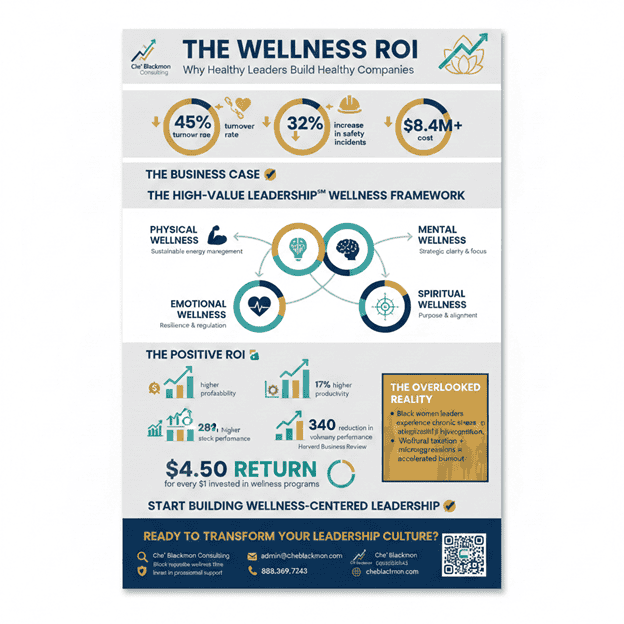
Here’s a truth many executives resist: your personal wellness directly impacts organizational performance. When leaders are depleted, disengaged, or running on fumes, their teams feel it. When leaders thrive, organizations flourish. The data is clear. Companies with healthy, engaged leaders see 21% higher profitability and 17% higher productivity than those led by burned out, chronically stressed executives.

Yet leadership wellness remains one of the most overlooked drivers of organizational success. This oversight is even more pronounced for traditionally overlooked leaders, particularly Black women executives who navigate unique stressors including cultural taxation, microaggressions, and the exhausting labor of being “the only one” in the room. The cost of ignoring leadership wellness? Billions in lost productivity, failed culture transformation initiatives, and talented leaders walking out the door.

The Hidden Cost of Unhealthy Leadership 📉💸

Leadership wellness isn’t a luxury. It’s a business imperative. When executives neglect their physical, mental, and emotional health, the consequences cascade throughout the organization in measurable ways.

Consider the manufacturing company where the executive team prided themselves on being “available 24/7” and working through weekends. On the surface, this looked like dedication. In reality, they were modeling unsustainable behaviors that employees replicated throughout the organization. Within eighteen months, the company faced turnover rates exceeding 45%, safety incidents increased by 32%, and employee engagement scores plummeted to the bottom quartile. The direct costs? Over $8.4 million in recruitment, training, workers’ compensation claims, and lost productivity.

The research backs this up. Studies show that stressed leaders make poorer decisions, struggle with emotional regulation, and create environments where psychological safety diminishes. Their teams experience higher rates of burnout, increased conflict, and decreased innovation. The irony? Leaders often believe they’re demonstrating commitment through self-sacrifice when they’re actually undermining the very outcomes they’re trying to achieve.

The Unique Burden for Traditionally Overlooked Leaders 🎯

For Black women in leadership, the wellness equation includes additional variables that many organizations fail to acknowledge. Research from the American Psychological Association reveals that Black women executives experience chronic stress at rates significantly higher than their white counterparts, driven by persistent workplace discrimination, lack of mentorship and sponsorship, and the pressure to represent an entire demographic while navigating predominantly white, male corporate spaces.

These leaders face what researchers call “John Henryism,” a pattern of high effort coping with chronic stressors that leads to accelerated wear and tear on the body and mind. They work twice as hard to receive half the recognition. They carry the invisible weight of being scrutinized more intensely, having their competence questioned more frequently, and managing the emotional labor of making others comfortable with their presence in leadership.

The cost is staggering. Not just to these talented leaders who deserve better, but to organizations losing brilliant minds, innovative thinking, and leadership capacity they desperately need. When companies ignore these realities, they lose not only individual leaders but entire communities of potential talent who see the burnout patterns and opt out before even entering the pipeline.

Understanding True Leadership Wellness 🧠❤️

Leadership wellness goes far beyond the absence of illness or the presence of a gym membership. It encompasses the complete integration of physical vitality, mental clarity, emotional resilience, and spiritual grounding that enables leaders to show up as their best selves consistently.

In my work developing High-Value Leadership frameworks, I’ve identified four critical dimensions that healthy leaders actively cultivate:

  • Physical Wellness: Not just exercise, but sustainable energy management, quality sleep, proper nutrition, and the ability to recognize and respond to your body’s signals before they become crises.
  • Mental Wellness: Cognitive capacity for strategic thinking, decision-making under pressure, creative problem-solving, and the mental spaciousness to see beyond immediate firefighting.
  • Emotional Wellness: Self-awareness, emotional regulation, empathy, the ability to navigate difficult conversations, and resilience in the face of setbacks without bypassing genuine processing of challenges.
  • Spiritual Wellness: Connection to purpose, alignment with values, meaning-making in work, and the capacity to maintain perspective during turbulent times.

These dimensions don’t exist in isolation. They interact and reinforce each other. A leader who consistently sleeps four hours a night will struggle with emotional regulation. An executive disconnected from their deeper purpose will find it difficult to inspire others authentically. Leaders who ignore their mental health needs will eventually hit walls that impact every aspect of their leadership effectiveness.

The Measurable ROI of Leader Wellness 📊✨

Let’s talk numbers because that’s the language that gets attention in boardrooms. Organizations that prioritize leadership wellness see returns that go straight to the bottom line.

Research from the Harvard Business Review demonstrates that companies with wellness-focused leadership development programs experience 28% higher stock performance over time compared to industry peers. Deloitte’s research shows organizations with strong wellness cultures report 11% higher revenue growth and are 2.5 times more likely to be high-performing organizations.

But the returns extend beyond financial metrics. There was a healthcare organization struggling with physician burnout rates exceeding 60%, threatening both patient care quality and accreditation status. When they implemented a comprehensive leadership wellness initiative starting with their C-suite and cascading through medical directors, the transformation was remarkable. Within two years, physician burnout dropped to 28%, patient satisfaction scores increased by 17 points, and medical error rates decreased by 41%. The financial impact? A positive ROI of $4.50 for every dollar invested in the wellness program.

The Ripple Effect on Organizational Culture 🌊

Healthy leaders create healthy cultures. When executives model sustainable work practices, prioritize recovery and renewal, and demonstrate vulnerability around their own wellness journeys, they give permission for everyone else to do the same.

Consider the technology company where the CEO openly shared their commitment to therapy, regular exercise, and unplugging on weekends. This transparency shifted the entire organizational narrative around wellness from weakness to wisdom. Middle managers felt empowered to set boundaries. Individual contributors stopped glorifying overwork. The company saw voluntary turnover drop by 34%, engagement scores rise to the 87th percentile, and innovation metrics improve significantly as people had the mental and emotional capacity to think creatively rather than simply react to constant urgency.

The data is unequivocal. Organizations with healthy leaders experience lower healthcare costs, reduced absenteeism, higher retention rates, stronger employer brands, and more resilient teams capable of navigating uncertainty without fracturing. These outcomes don’t happen by accident. They result from intentional choices that leaders make about how they steward their own wellness and model those practices throughout the organization.

Practical Strategies for Leadership Wellness 🔧💡

Understanding the importance of leadership wellness matters little without practical application. Here are evidence-based strategies that high-performing leaders use to maintain their wellness while driving organizational results.

Build Non-Negotiable Wellness Routines ⏰

Healthy leaders treat wellness activities with the same commitment they give to board meetings or strategic planning sessions. These aren’t items that get bumped when calendars fill up. They’re foundational practices that enable everything else.

Start with sleep. Research consistently shows that leaders who prioritize seven to eight hours of quality sleep demonstrate better judgment, improved emotional regulation, and enhanced creative problem-solving. Block your sleep schedule like you block meeting time. Protect it fiercely.

Movement matters. This doesn’t require marathon training or extreme fitness regimens. It means regular physical activity that gets your heart rate up, reduces stress hormones, and clears mental fog. Whether it’s walking, swimming, dancing, or strength training, find what you enjoy and do it consistently. Schedule it. Show up for it. Model it for your team.

Mindfulness and meditation practices offer another powerful tool. Even ten minutes daily of focused breathing, meditation, or mindful reflection can significantly reduce stress, improve focus, and enhance decision-making capacity. Leaders who maintain these practices report greater clarity, better emotional regulation, and improved ability to stay present during challenging conversations.

Create Boundaries That Serve You and Your Organization 🛡️

Boundaries aren’t barriers to productivity. They’re enablers of sustainable high performance. Leaders who establish and maintain clear boundaries around their time, energy, and availability create space for recovery, reflection, and renewal.

This means learning to say no strategically. Not every meeting requires your presence. Not every decision needs your input. Not every crisis demands your personal intervention. Trust your team. Delegate meaningfully. Create space in your calendar for deep work, strategic thinking, and restoration.

Technology boundaries matter too. The expectation of constant availability destroys wellness and models unsustainable practices for your entire organization. Establish clear communication protocols. Define true emergencies versus things that can wait. Turn off notifications during focused work time and personal time. Your team will adapt, and they’ll appreciate the permission to do the same.

Invest in Professional Support 🤝

High-performing athletes have coaches, trainers, nutritionists, and sports psychologists supporting their performance. Why should high-performing leaders be any different? Professional support isn’t admission of weakness. It’s strategic investment in your most important asset: yourself.

Therapy and counseling provide invaluable support for processing stress, developing emotional intelligence, and maintaining mental health. Executive coaching offers outside perspective, accountability, and strategic guidance for both professional development and personal wellness. Peer support groups connect you with other leaders navigating similar challenges, reducing isolation and providing community.

For Black women leaders especially, finding culturally competent support makes a significant difference. Therapists, coaches, and mentors who understand the unique challenges of navigating corporate spaces as a Black woman can provide validation, strategies, and support that generic programs miss entirely. Don’t settle for support that doesn’t truly see and understand your experience.

Cultivate Authentic Connection and Community 👥💖

Leadership can be lonely, particularly at senior levels. Isolation erodes wellness, increases stress, and limits perspective. Intentionally building and maintaining authentic connections becomes essential for sustained leadership effectiveness.

This includes personal relationships outside of work that remind you of your identity beyond your title. Friendships that have nothing to do with business deals or networking. Family time that’s truly present and engaged. Community involvement that connects you to purpose larger than quarterly earnings.

It also means fostering genuine connection within your professional sphere. Building relationships with peers based on mutual support rather than competition. Creating space for vulnerable conversations about the real challenges of leadership. Finding or creating communities where you can be fully yourself without performance or pretense.

Building Organizational Systems That Support Leader Wellness 🏢🌟

Individual leader wellness practices matter, but they’re not enough. Organizations must create systems and structures that support rather than undermine leadership wellness.

Redesign How Leadership Work Gets Done 🔄

Many organizations structure leadership roles in ways that guarantee burnout. Unrealistic spans of control, constant context switching, back-to-back meetings with no processing time, expectation of immediate responses to all communications. These aren’t signs of importance. They’re design flaws.

Organizations serious about leader wellness audit how leadership work actually happens. They examine meeting cultures and eliminate wasteful gatherings. They create focused time blocks for strategic thinking. They establish communication protocols that respect recovery time. They distribute decision-making authority so everything doesn’t bottleneck at the top.

One professional services firm reduced executive meetings by 40% through rigorous evaluation of whether gatherings actually required executive presence or could be handled differently. They implemented “focus Fridays” where no meetings were scheduled, giving leaders uninterrupted time for deep work. Within six months, leader satisfaction scores increased by 31%, and strategic initiative completion rates improved by 27%.

Make Wellness Part of Leadership Development 📚

Leadership development programs typically focus on strategy, finance, operations, and people management. Rarely do they address the personal sustainability required to lead effectively over time. This gap sets leaders up for failure.

Progressive organizations integrate wellness into leadership development from the start. They teach new leaders about energy management, stress physiology, and the neuroscience of decision-making. They provide training on emotional intelligence, self-awareness, and resilience building. They normalize conversations about mental health, work-life integration, and sustainable performance.

This proves particularly critical for developing diverse leadership pipelines. When organizations equip Black women and other traditionally overlooked leaders with not just technical skills but also tools for managing the unique stressors they face, retention and advancement improve dramatically. Development programs that acknowledge and address these realities, rather than pretending everyone faces identical challenges, create pathways for diverse talent to not just survive but thrive in leadership roles.

Measure and Reward Sustainable Leadership 📈

What gets measured gets managed. What gets rewarded gets repeated. If organizations want healthy leadership, they must measure wellness indicators and build them into performance evaluation and compensation systems.

This includes tracking leader burnout indicators, team engagement scores, voluntary turnover rates in leader’s organizations, and sustainability metrics like vacation usage and reasonable working hours. It means evaluating leaders not just on what results they achieve but how they achieve them. Leaders who drive results through unsustainable practices that burn out their teams should not be rewarded the same as leaders who deliver outcomes while building healthy, engaged, resilient teams.

Recognition and advancement criteria should explicitly include modeling healthy leadership practices. Taking vacation time should be celebrated, not stigmatized. Setting boundaries should be seen as mature leadership, not lack of commitment. Leaders who invest in their wellness and create cultures where others can do the same deserve promotion over those who achieve short-term gains through long-term destructive practices.

The Future of Leadership Wellness 🚀🔮

The pandemic fundamentally shifted conversations about work, wellness, and sustainability. Leaders who emerged from that crucible understand that the old playbook of sacrificing health for results no longer works, if it ever truly did. The future belongs to organizations that integrate wellness into their leadership DNA.

We’re seeing emergence of predictive analytics that identify burnout risk before it becomes crisis. AI-powered tools that help leaders optimize their schedules for energy and effectiveness rather than simply cramming in maximum commitments. Virtual reality applications for stress management and mindfulness practice. Wearable technology that provides real-time biofeedback on stress physiology.

But technology alone won’t solve this. The real shift requires cultural transformation that values human sustainability as much as quarterly performance. It demands courage from leaders to model different ways of working. It necessitates organizations making hard choices to support leader wellness even when it conflicts with short-term convenience or traditional expectations.

For organizations committed to diversity, equity, and inclusion, leader wellness must be a central component of those efforts. You cannot build truly inclusive cultures while ignoring the disproportionate wellness burdens placed on Black women and other marginalized leaders. Real DEI work addresses not just representation but also the conditions that enable diverse leaders to sustain their careers and thrive long-term.

The Investment That Pays Dividends 💰🌈

Leadership wellness isn’t self-indulgence. It’s strategic imperative. The leaders who will navigate the complexity and uncertainty ahead are those who have cultivated the physical vitality, mental clarity, emotional resilience, and spiritual grounding to sustain themselves and their teams through whatever comes.

Organizations that invest in leadership wellness see measurable returns in every metric that matters: financial performance, employee engagement, innovation capacity, retention rates, and competitive positioning. They build cultures where people want to work, not just because of what they do but because of how they do it.

The question isn’t whether your organization can afford to prioritize leadership wellness. The question is whether you can afford not to. Because the leaders you’re burning out today are the ones you’ll desperately need tomorrow. The culture you’re creating through unsustainable leadership practices today will determine whether you can attract and retain the talent you need to compete in the future.

Healthy leaders build healthy companies. It’s time we started acting like we believe it.

Reflection Questions for Your Leadership Team 💭🗣️

  • What leadership wellness practices are we currently modeling, and what message do those practices send to our organization?
  • How do our organizational systems and structures support or undermine leadership sustainability?
  • What wellness burdens do our traditionally overlooked leaders carry that we haven’t acknowledged or addressed?
  • If we measured the ROI of our current leadership wellness investments, what would the numbers reveal?
  • What would need to change in our culture for sustainable leadership practices to become the norm rather than the exception?
  • How are we integrating wellness into our leadership development programs and succession planning?
  • What specific commitments are we willing to make as a leadership team to prioritize our own wellness and model healthy practices?

Next Steps: Building Your Wellness-Centered Leadership Culture 🎯

For Individual Leaders:

  • Conduct a personal wellness audit across all four dimensions: physical, mental, emotional, and spiritual. Identify your biggest gaps and commit to one actionable change in each area.
  • Schedule non-negotiable wellness activities in your calendar for the next month and protect them as fiercely as you protect board meetings.
  • Identify one boundary you need to establish or reinforce to protect your wellness and communicate it clearly to your team this week.
  • Research and reach out to at least three professional support resources (therapist, coach, peer group) that could support your wellness journey.

For Organizations:

  • Assess your current leadership wellness initiatives. Are they cosmetic (fruit baskets) or substantive (systemic support)? Identify gaps and develop a comprehensive strategy.
  • Audit how leadership work actually gets done in your organization. Where are the design flaws that guarantee burnout? Create an action plan to address the top three.
  • Review your leadership development programs and performance evaluation criteria. Are you teaching and rewarding sustainable leadership or inadvertently promoting destructive practices?
  • Establish baseline wellness metrics for your leadership team and set targets for improvement. Include these in your organizational scorecard alongside traditional performance measures.
  • Specifically examine the wellness burdens placed on your traditionally overlooked leaders. Develop targeted support systems that address their unique challenges rather than pretending one size fits all.

Partner with Che’ Blackmon Consulting 🤝✨

Building a wellness-centered leadership culture requires more than good intentions. It demands strategic expertise, proven frameworks, and ongoing support. At Che’ Blackmon Consulting, we specialize in helping organizations transform their leadership cultures through our proprietary High-Value Leadership methodology.

Our fractional HR and culture transformation services include:

  • Leadership wellness assessments and strategic planning
  • Culture transformation initiatives that prioritize sustainable leadership
  • AI-powered predictive analytics for identifying wellness risks before they become crises
  • Executive coaching for sustainable high performance
  • Leadership development programs that integrate wellness from the ground up
  • Specialized support for organizations committed to creating environments where traditionally overlooked leaders thrive

Whether you’re a small business looking to build a healthy leadership culture from the start or an established organization ready to transform unsustainable practices, we have solutions tailored to your needs.

Ready to Build Healthier Leadership? 🌟

Let’s talk about creating a leadership wellness strategy that drives real results.

📧 admin@cheblackmon.com

📞 888.369.7243

🌐 cheblackmon.com

Che’ Blackmon, DBA Candidate, is the Founder & CEO of Che’ Blackmon Consulting, a fractional HR and culture transformation consultancy serving organizations across Michigan and beyond. With over 24 years of progressive HR leadership experience, she specializes in helping companies build High-Value Cultures where leaders and teams thrive sustainably. She is the author of “High-Value Leadership: Transforming Organizations Through Purposeful Culture,” “Mastering a High-Value Company Culture,” and “Rise & Thrive: A Black Woman’s Blueprint for Leadership Excellence.”

#LeadershipWellness #ExecutiveHealth #HighValueLeadership #OrganizationalCulture #LeadershipDevelopment #WellnessROI #SustainableLeadership #BlackWomenLeaders #DiversityAndInclusion #CultureTransformation #ExecutiveCoaching #LeadershipExcellence #WorkplaceWellbeing #HealthyLeadership #CorporateWellness #InclusiveLeadership #LeadershipMindset #OrganizationalWellness #ProfessionalDevelopment #LeadershipMatters

Love Day Special: Celebrating the Teams That Make Work Worth It ❤️

By Che’ Blackmon, DBA Candidate | Founder & CEO, Che’ Blackmon Consulting

Valentine’s Day often brings to mind romantic relationships, chocolates, and roses. Yet there’s another kind of love that deserves equal celebration: the professional bonds that transform ordinary workplaces into extraordinary teams. When we talk about High-Value Leadership™, we’re talking about creating environments where people genuinely care about each other’s success, where trust runs deep, and where the collective achievement matters more than individual glory. This is workplace love in its truest, most professional form.

For Black women navigating corporate spaces, these team relationships carry particular weight. We often enter environments where we’re the “only” or among very few. The quality of our workplace relationships directly impacts our ability to thrive, advance, and bring our authentic selves to work. When teams operate with genuine care and mutual support rather than superficial tolerance, everything changes. As I explore in “Rise & Thrive: A Black Woman’s Blueprint for Leadership Excellence,” authentic connection in professional settings isn’t a nice-to-have; it’s essential for sustainable success.

This Love Day, let’s celebrate the teams that make work worth it. The colleagues who challenge us to grow, the leaders who clear paths for our advancement, the peers who cover our backs during difficult seasons, and the direct reports who remind us why leadership matters. These relationships form the foundation of high-value cultures where both people and organizations flourish together.

The Love That Drives Performance 💪

When we talk about workplace love, we’re not discussing inappropriate office romances or forced friendships. We’re describing something far more powerful: psychological safety, mutual respect, genuine care for colleagues’ wellbeing, and commitment to collective success. This kind of professional love transforms organizational performance in measurable ways.

Research from MIT’s Human Dynamics Laboratory found that the single most important predictor of team productivity is how team members interact. Teams with high-quality connections (characterized by mutual trust, positive regard, and emotional carrying capacity) consistently outperform teams with equivalent talent but lower-quality relationships. Google’s famous Project Aristotle reached similar conclusions: psychological safety, the feeling that you can take interpersonal risks without fear of punishment or embarrassment, matters more than individual intelligence or expertise.

There was a technology company struggling with innovation despite hiring brilliant engineers. Their technical capabilities were impressive, but their culture was cutthroat and competitive. Engineers hoarded information, avoided asking for help, and rarely collaborated across specialties. Leadership decided to intentionally build what they called “caring culture” through structured team-building, vulnerability exercises, and reward systems that prioritized collective achievement. Within eighteen months, innovation metrics improved 47%. Employee retention among top performers increased by 33%. The difference wasn’t new talent; it was new relationships characterized by genuine professional care and mutual support.

As I discuss in “High-Value Leadership: Transforming Organizations Through Purposeful Culture,” authentic connection is one of the five pillars of High-Value Leadership™. Leaders who build real relationships at all levels of the organization create cultures where people feel seen, valued, and motivated to contribute their best work. This isn’t soft skill fluff; it’s strategic wisdom backed by decades of organizational research and real-world results.

When Teams Become Family (The Good Kind) 👨‍👩‍👧‍👦

The phrase “we’re like family” can trigger warranted skepticism in workplace contexts. Too often it’s used to justify unreasonable demands or boundary violations. However, there’s a healthy version of workplace family that deserves celebration: teams that show up for each other during difficult times, celebrate each other’s victories, hold space for vulnerability, and commit to each other’s growth and development.

Think about the teams where people genuinely look out for one another. The colleague who notices you’re overwhelmed and quietly redistributes work. The manager who remembers your parent is ill and gives you flexibility without requiring you to ask. The peer who celebrates your promotion even though they wanted it too. The direct report who tells you honestly when your leadership approach isn’t working. These behaviors reflect professional love: choosing the other person’s wellbeing and success even when it’s inconvenient or difficult.

For Black women in corporate spaces, finding this kind of team feels particularly precious. Research from Catalyst shows that Black women face unique challenges including higher rates of being mistaken for administrative staff, having their authority questioned, and receiving less credit for collaborative work. In teams characterized by genuine care and respect, these microaggressions decrease significantly. Colleagues actively interrupt bias, share credit generously, and create space for Black women’s voices and leadership. The difference between working on a team that tolerates you and one that genuinely values you is profound.

There was a healthcare organization that implemented “care pods” where small cross-functional teams met weekly not to discuss work tasks but to check in on each other’s wellbeing, share challenges, and offer support. Initially met with skepticism, these pods became sacred space where staff could be honest about struggles with burnout, family challenges, or professional frustrations. The organization tracked outcomes and found that units with highly engaged care pods had 28% lower turnover, 35% higher patient satisfaction scores, and significantly better staff resilience metrics during the pandemic. The investment in professional care paid measurable dividends.

The Leadership Love Language 💼

Just as Gary Chapman’s “Five Love Languages” describes how people express and receive love in romantic relationships, there are distinct ways leaders demonstrate professional care and teams experience feeling valued. Understanding these leadership love languages helps us both give and receive appreciation more effectively.

Words of Affirmation

Some team members thrive on verbal recognition and specific feedback. They need to hear “that presentation was excellent” or “your analysis changed my thinking.” For Black women, who often receive less recognition than similarly performing peers, words of affirmation carry extra weight. Specific, public acknowledgment of contributions combats invisibility and validates expertise. High-value leaders master the art of meaningful affirmation that goes beyond generic praise to recognize specific contributions and their impact.

Acts of Service

Actions speak louder than words for many professionals. Leaders who demonstrate care through service might clear obstacles blocking their team’s progress, take administrative burdens off someone’s plate, or personally advocate for resources the team needs. There was a director who noticed her team spending hours on manual data compilation. Rather than simply acknowledging their frustration, she worked with IT to automate the process, freeing up twenty hours weekly for more strategic work. Her team felt profoundly valued because she invested her political capital and time in solving their problem.

Quality Time

In our calendars-packed work culture, giving someone your undivided attention is a powerful expression of care. Leaders who practice the quality time love language schedule regular one-on-ones and actually show up present, phones down, listening actively. They create space for career development conversations that aren’t rushed. They remember what team members shared previously and follow up. For professionals from underrepresented backgrounds, having a leader who consistently makes time signals that your development matters and your perspective is valued.

Gifts (Opportunities)

In professional contexts, gifts take the form of opportunities: the chance to lead a high-visibility project, an invitation to present to executives, sponsorship for a development program, or a stretch assignment that builds new capabilities. Leaders who understand this love language actively look for opportunities to give their team members experiences that accelerate growth. They think strategically about who would benefit from which opportunity and make intentional matches. As I emphasize in “Mastering a High-Value Company Culture,” investing in people’s development is how you build sustainable high-value cultures.

Physical Touch (Professional Boundaries)

In workplace contexts, this translates to appropriate expressions of human connection and solidarity: the fist bump after a big win, the supportive hand on a shoulder during a difficult moment, or the team huddle before a major presentation. These gestures must always respect professional boundaries and individual comfort levels, but for some people, appropriate physical expressions of solidarity strengthen team bonds. The key is reading cues, respecting boundaries, and never making physical contact a requirement for belonging.

Understanding your own leadership love language and those of your team members creates more effective appreciation. When recognition doesn’t land, it’s often not lack of effort but mismatch in language. The leader who gives public praise to someone who values quality time might miss the mark. The team member who needs words of affirmation might not fully receive acts of service. High-value leaders learn to express care in the languages their team members understand and value.

Breaking Isolation: Coalition Building as Love in Action 🤝

For professionals from traditionally overlooked backgrounds, particularly Black women, workplace isolation is more than uncomfortable; it’s career limiting. When you’re the only person who looks like you in meetings, when your experiences go unrecognized, when you lack advocates who understand your challenges, professional growth becomes exponentially harder. Coalition building, the intentional formation of supportive professional relationships, is love in action.

Research from the Center for Talent Innovation shows that Black women are more likely than any other group to report feeling stalled in their careers, with 28% saying their career advancement has stalled compared to 13% of white women. This stalling isn’t due to lack of ambition or capability; it’s often due to lack of sponsorship, advocacy, and coalitions. When organizations build cultures where coalition formation is encouraged and supported, everyone benefits but the impact on underrepresented professionals is transformative.

There was a financial services firm that deliberately created “advocacy circles” where senior leaders committed to actively sponsoring emerging talent from underrepresented backgrounds. Unlike traditional mentoring, which is often passive, sponsorship requires active advocacy: recommending people for opportunities, using social capital to open doors, and sharing institutional knowledge that helps navigate organizational politics. The firm tracked outcomes and found that professionals with active sponsors advanced to leadership positions at twice the rate of those without. More importantly, participants reported feeling genuinely supported and valued rather than isolated and invisible.

In “Rise & Thrive,” I discuss the critical importance of building strategic alliances and finding your people in corporate spaces. This isn’t about networking for superficial gain; it’s about finding genuine professional relationships that sustain you through challenges, celebrate your wins, and help you navigate organizational complexities. When Black women support each other rather than competing for limited seats, when allies use their privilege to create opportunities, when leaders actively work to break isolation, that’s workplace love manifesting as tangible career impact.

Tough Love: Feedback as Care 📝

True professional love includes tough conversations. The colleague who tells you when your presentation missed the mark. The leader who gives you critical feedback on a project. The peer who lets you know your approach is creating unintended problems. These honest conversations, delivered with care and respect, are profound expressions of professional love because they prioritize your growth over comfort.

However, research shows significant disparities in how feedback is delivered across demographic groups. Black women are more likely to receive vague feedback, personality-based criticism rather than behavior-specific guidance, and evaluation that questions their capability rather than addressing specific performance issues. When feedback is delivered with genuine care for development rather than as criticism or dismissal, it transforms from potentially harmful to profoundly helpful.

High-Value Leadership™ emphasizes balanced accountability: maintaining high standards within psychologically safe environments. This means giving honest feedback while also creating conditions where people can receive it constructively. The leader who says “I care about your success too much to let this slide” before difficult feedback signals that the conversation comes from care rather than criticism. The peer who follows tough feedback with “How can I support you in addressing this?” demonstrates that honesty and support aren’t contradictory.

There was a manufacturing company that implemented “growth conversations” replacing traditional performance reviews. These quarterly dialogues focused on development rather than evaluation, with structured frameworks ensuring feedback was specific, actionable, and delivered with genuine care for growth. Managers received training on delivering feedback without bias and creating psychological safety. The company tracked results and found that engagement scores improved 31%, internal mobility increased 42%, and employees consistently rated these conversations as more valuable than previous review processes. The shift from evaluative to developmental feedback, grounded in genuine care for people’s growth, transformed how the organization approached talent development.

Celebrating Wins Together: The Joy of Collective Success 🎉

One of the clearest indicators of healthy team relationships is how people respond to each other’s successes. In competitive cultures characterized by scarcity mindset, one person’s win feels like another’s loss. In high-value cultures built on genuine professional care, celebrating others’ victories comes naturally because collective success matters more than individual glory.

When a colleague gets promoted, do people genuinely celebrate or quietly resent? When a team member wins an award, does the team share pride or feel overlooked? When someone lands a major account, does everyone feel the victory or just the individual? These questions reveal the quality of professional relationships and the health of organizational culture. Teams that genuinely love and support each other experience collective joy in individual triumphs.

For Black women whose successes are often minimized or attributed to factors other than capability and hard work, having colleagues who genuinely celebrate achievements matters enormously. When your team makes your promotion their win, when your presentation success feels like a collective triumph, when your award is celebrated as team validation, you experience true belonging. This celebratory culture doesn’t happen automatically; it requires intentional cultivation by leaders committed to abundance thinking and collective success.

There was a consulting firm that created “win walls” in every department where team members posted not just client victories but also personal professional achievements, colleague recognitions, and team milestones. During monthly gatherings, teams celebrated these wins together, with colleagues sharing what others’ successes meant to them. This practice normalized celebration, made recognition collective rather than hierarchical, and built cultures where people genuinely wanted each other to succeed. The firm found that teams with highly engaged win walls had stronger collaboration metrics, better client satisfaction scores, and lower voluntary turnover. The practice of collective celebration strengthened professional bonds and reinforced that everyone’s success matters.

When Teams Carry Each Other: Support During Hard Seasons 🌧️

The truest test of team relationships comes during difficult seasons. When someone faces personal crisis, health challenges, family emergencies, or professional setbacks, how does the team respond? In transactional workplace cultures, people are on their own during hard times. In high-value cultures characterized by genuine professional care, teams show up for each other when it matters most.

This support takes many forms. Colleagues quietly covering responsibilities so someone can attend to family needs. Teams rallying to help a struggling member meet deadlines. Leaders creating flexibility during personal crises without requiring detailed justification. Peers checking in regularly during difficult periods not to gossip but to offer genuine support. These acts of professional solidarity strengthen bonds and create cultures where people feel safe being human.

For Black women who often feel pressure to appear strong and invulnerable at work, having teams that create space for vulnerability and struggle is particularly valuable. Research shows that Black women face “strong Black woman” stereotypes that make showing weakness feel risky. When teams normalize struggle and create genuine support systems, these stereotypes lose their power. People can be honest about challenges without fear of being perceived as weak or less capable.

There was a technology company where an engineer faced a family medical crisis requiring frequent absences over several months. Rather than treating this as a performance problem, the team restructured responsibilities, created backup systems, and maintained full salary and benefits throughout the crisis. Team members sent regular messages of support, covered workload without complaint, and celebrated when the crisis resolved and the engineer returned. Years later, this engineer became one of the company’s most loyal and productive contributors, and the story of how the team showed up became part of organizational lore about what their culture values. The investment in caring for people during hard times paid dividends in loyalty, engagement, and cultural strength.

Building the Kind of Team Culture Worth Celebrating 🏗️

Creating teams characterized by genuine professional care and mutual support doesn’t happen accidentally. It requires intentional cultivation by leaders committed to High-Value Leadership™ principles. Here are practical strategies for building cultures where workplace relationships thrive:

Model Vulnerability and Authenticity

Leaders set the tone for team relationships. When leaders share appropriate struggles, admit mistakes, and show humanity, they give permission for others to do the same. This doesn’t mean oversharing or making yourself the center of attention; it means being genuine about challenges and showing that perfection isn’t required. As I discuss in my work on High-Value Leadership™, authentic connection starts with leaders willing to be real.

Create Structured Opportunities for Connection

Don’t leave relationship building to chance. Create regular opportunities for team members to connect as humans, not just as functional roles. This might include team lunches without work agendas, walking meetings, virtual coffee chats, or structured sharing time in team meetings. The key is making connection an expected part of team culture rather than an afterthought.

Reward Collaborative Behavior

What gets recognized gets repeated. If you only celebrate individual achievement, you’ll get individual competitors. If you recognize and reward people who help others succeed, share knowledge generously, and prioritize team wins, you’ll build collaborative cultures. Make supporting colleagues a valued and visible part of what success looks like in your organization.

Address Relationship Damage Quickly

When team relationships fracture due to conflict, misunderstanding, or breach of trust, address it promptly. Unresolved relationship damage festers and spreads, poisoning team culture. High-value leaders facilitate difficult conversations, help people repair breaches, and sometimes make tough decisions about team members whose behavior damages relationships beyond repair.

Build Inclusive Practices That Combat Isolation

For professionals from underrepresented backgrounds, feeling included and valued requires intentional practice. This means ensuring all voices are heard in meetings, distributing high-visibility opportunities equitably, interrupting bias when it occurs, and creating formal structures like employee resource groups or mentoring programs that combat isolation. In “Rise & Thrive,” I outline specific strategies for creating inclusive environments where Black women and other traditionally overlooked professionals can thrive.

Make Appreciation a Regular Practice

Don’t wait for Valentine’s Day or annual reviews to express appreciation. Build regular practices of recognition and gratitude into team rhythms. This might include starting meetings with appreciations, creating channels for peer recognition, or establishing rituals that normalize expressing thanks and acknowledging contributions. When appreciation becomes routine rather than rare, it strengthens relationship bonds and reinforces positive culture.

Key Takeaways 🔑

As we celebrate Love Day, let’s honor the professional relationships that make work meaningful and productive:

  1. Workplace love, defined as genuine care, mutual respect, and commitment to collective success, drives measurable performance improvements including higher innovation, better retention, and increased productivity.
  2. High-quality team relationships characterized by psychological safety and authentic connection create environments where everyone, particularly traditionally overlooked professionals, can thrive.
  3. Leaders demonstrate care through different “love languages” including words of affirmation, acts of service, quality time, meaningful opportunities, and appropriate professional connection.
  4. Coalition building and active sponsorship combat isolation for Black women and other underrepresented professionals, creating tangible career advancement opportunities.
  5. Honest feedback delivered with genuine care for development, rather than criticism, accelerates growth and strengthens professional relationships.
  6. Teams that celebrate collective success and support each other during difficult seasons build bonds that enhance both individual wellbeing and organizational performance.
  7. Creating cultures worth celebrating requires intentional leadership practices including modeling vulnerability, creating connection opportunities, rewarding collaboration, and addressing relationship damage promptly.

Discussion Questions 💭

Reflect on these questions individually or discuss them with your team:

  • Think about a team or colleague that made work feel meaningful. What specific behaviors or qualities created that experience? How might you cultivate those same qualities in your current professional relationships?
  • Which “leadership love language” (words, actions, time, opportunities, appropriate connection) do you most value receiving? Which do you default to giving? Is there a mismatch that might be affecting your relationships?
  • For leaders: How does your team celebrate individual and collective wins? Are celebrations authentic and inclusive, or do they feel performative or leave people out?
  • For professionals from underrepresented backgrounds: Do you have genuine allies and sponsors who actively advocate for you? If not, what would it take to build those coalitions? If yes, how might you pay that forward?
  • How does your organization handle difficult seasons when team members face personal or professional challenges? Does the culture create space for vulnerability and support, or is there pressure to hide struggle?
  • What’s one concrete practice you could implement in the next month to strengthen professional relationships on your team?

Next Steps: Expressing Professional Appreciation 👣

This Love Day, move beyond reflection to action. Here are specific ways to express professional appreciation and strengthen team relationships:

Write Three Specific Thank You Messages: Identify three colleagues, direct reports, or leaders who have impacted your professional life. Write specific, detailed messages explaining exactly what they did that mattered and how it affected you or the organization. Be concrete rather than generic. Send these messages this week.

Identify Your Team’s Love Language: Pay attention to how your team members respond to different forms of appreciation. Do they light up at public recognition or prefer private feedback? Do they value time investment or tangible opportunities? Adjust your appreciation style to match what each person values.

Create a Team Ritual: Propose one small ritual that builds team connection. This might be starting meetings with appreciations, establishing weekly coffee chats, creating a recognition channel, or implementing “win of the week” sharing. Start small and build consistency.

Reach Out to Someone Isolated: Think about colleagues who might feel isolated or overlooked in your organization, particularly those from underrepresented backgrounds. Reach out with genuine interest in their experience and perspective. Offer specific support if appropriate, or simply listen and validate.

Audit Your Team Culture: If you’re a leader, conduct an honest assessment of your team’s relationship health. Do people support each other or compete? Is vulnerability safe or risky? Are celebrations authentic and inclusive? Identify one area for improvement and create a specific action plan.

Be the Support You Wish You Had: Think about what you wish colleagues had done for you during challenging times. Commit to being that person for others. Look for opportunities to cover workload, offer flexibility, or simply check in with genuine care when someone is struggling.

Final Thoughts 💡

This Love Day, as candy hearts and roses dominate the cultural conversation, let’s also celebrate the professional love that sustains us: the teams that make hard work feel meaningful, the colleagues who see our potential and help us reach it, the leaders who invest in our growth, and the cultures where everyone can bring their authentic selves and thrive.

These relationships aren’t fluffy feel-good extras; they’re the foundation of high-performing organizations. When we invest in building genuine professional care, mutual respect, and collective commitment, we create cultures where innovation flourishes, people stay and grow, and work feels like something more than just a paycheck. We create environments worthy of celebration not just on Valentine’s Day but every day.

For Black women and other professionals from traditionally overlooked backgrounds, these relationships are particularly crucial. They’re the difference between surviving and thriving, between feeling isolated and feeling genuinely valued, between stalled careers and accelerated advancement. When organizations get team relationships right, when they build cultures characterized by authentic care and mutual support, everyone benefits but the impact on those who have historically been marginalized is transformative.

As I’ve learned through twenty-four years of building and transforming organizational cultures, the teams that make work worth it aren’t accidents. They’re the result of intentional leadership, consistent practice, and genuine commitment to each other’s success. They reflect High-Value Leadership™ principles in action: purpose-driven vision, stewardship of culture, emotional intelligence, balanced accountability, and authentic connection.

So this Love Day, take time to appreciate the teams that make your work meaningful. Express gratitude to colleagues who show up for you. Commit to being the kind of team member others are grateful to work with. And if you’re a leader, dedicate yourself to building cultures where genuine professional care thrives and everyone can bring their best selves to work.

The teams worth celebrating are the ones we intentionally create through daily choices to care, support, challenge, and champion each other. That’s the kind of workplace love that deserves recognition every single day.

Ready to Build Teams That Thrive? 🌟

At Che’ Blackmon Consulting, we specialize in transforming organizational cultures and building high-value teams where genuine professional care drives measurable results. Whether you’re looking to:

  • Strengthen team relationships and build psychological safety
  • Create inclusive cultures where diverse talent thrives
  • Develop leadership capabilities that foster authentic connection
  • Transform competitive dynamics into collaborative partnerships
  • Build strategic HR infrastructure that supports relational culture

We bring over two decades of progressive HR leadership experience combined with cutting-edge research in organizational transformation. Our High-Value Leadership™ methodology has helped organizations across industries build cultures where both people and businesses flourish together.

Let’s talk about how to build teams worth celebrating in your organization. We offer complimentary consultation calls to explore your needs and discuss how we can support your culture transformation journey.

Contact Che’ Blackmon Consulting Today:

📧 Email: admin@cheblackmon.com

📞 Phone: 888.369.7243

🌐 Website: cheblackmon.com

About the Author 👩🏾‍💼

Che’ Blackmon is the Founder and CEO of Che’ Blackmon Consulting, a Michigan-based fractional HR and culture transformation consultancy. With 24+ years of progressive HR leadership experience across manufacturing, automotive, healthcare, and professional services sectors, she has consistently delivered measurable results including 9% engagement increases, 60% safety improvements, and successful culture transformations for organizations ranging from startups to Fortune 500 companies.

Currently pursuing a Doctor of Business Administration (DBA) in Organizational Leadership at National University, Che’ is developing Michigan’s first AI-powered culture transformation platform that predicts employee turnover 3-6 months in advance. Her dissertation research focuses on AI-enhanced predictive analytics for culture transformation and employee retention.

Che’ is the published author of three books on leadership and organizational culture: “High-Value Leadership: Transforming Organizations Through Purposeful Culture,” “Mastering a High-Value Company Culture,” and “Rise & Thrive: A Black Woman’s Blueprint for Leadership Excellence.” She hosts the twice-weekly podcast “Unlock, Empower, Transform with Che’ Blackmon” and the “Rise & Thrive” YouTube series.

Her work focuses on creating high-value cultures where both people and organizations thrive, with particular attention to advancing opportunities for Black women and other traditionally overlooked professionals in corporate spaces.

#LoveDay #ValentinesDay #TeamAppreciation #WorkplaceCulture #HighValueLeadership #TeamExcellence #LeadershipDevelopment #PsychologicalSafety #TeamLove #OrganizationalCulture #ProfessionalAppreciation #EmployeeEngagement #TeamSuccess #LeadershipMatters #CelebrateTeams

The Partnership Principle: Why Collaboration Beats Competition 🤝

By Che’ Blackmon, DBA Candidate | Founder & CEO, Che’ Blackmon Consulting

In a world that often glorifies individual achievement and competitive advantage, there’s a powerful truth that many organizations overlook: collaboration, not competition, is the real driver of sustainable success. As I wrote in “High-Value Leadership: Transforming Organizations Through Purposeful Culture,” culture is not built through command and control; it is cultivated through environments where people and organizations thrive together. The partnership principle embodies this philosophy. It recognizes that when we shift from a zero-sum mindset to one of collective growth, everyone wins.

For Black women in corporate spaces, this principle carries particular significance. Too often, we’re pitted against one another in environments where representation is scarce and opportunities feel limited. We’re told there’s only room for one at the table. Yet the partnership principle challenges this scarcity mindset. It invites us to build coalitions, amplify each other’s voices, and create new tables where collaboration becomes our collective strength.

The Competitive Trap: Why It Fails Organizations 🚫

Traditional workplace cultures have long operated on the assumption that competition drives performance. Leaders pit teams against each other. Individuals hoard information to protect their positions. Success is measured by who climbs fastest, not by what the collective achieves. This approach might yield short-term gains, but research consistently shows it creates long-term damage to organizational health and innovation capacity.

There was a manufacturing company that implemented a forced ranking system, requiring managers to identify the bottom 10% of performers each quarter for potential termination. The intention was to drive excellence through competition. Instead, the policy created a culture of fear and mistrust. Team members stopped sharing best practices. They withheld information that could help colleagues succeed. Innovation plummeted because people were too afraid to take risks that might reflect poorly in rankings. Within two years, the company’s employee engagement scores dropped 35%, and turnover among top performers doubled.

This scenario illustrates what happens when competition becomes the organizing principle. People focus on self-preservation rather than collective progress. As I discuss in “Mastering a High-Value Company Culture,” culture is the lifeblood of any organization. When that lifeblood is poisoned by cutthroat competition, the entire organization suffers. Collaboration withers. Trust erodes. The very innovation that competition was supposed to inspire gets stifled.

For traditionally overlooked groups, particularly Black women, competitive workplace cultures create additional barriers. When representation is already limited, competition for the few available leadership positions can become intense and isolating. Some organizations unconsciously pit Black women against each other, creating what scholars call “competitive victimhood,” where individuals feel they must prove they deserve opportunities more than others who share their identity. This dynamic is both exhausting and counterproductive, preventing the coalition-building that could transform organizational culture.

The Partnership Advantage: What Research Reveals 📊

Extensive research across industries demonstrates that collaborative cultures outperform competitive ones on virtually every meaningful metric. A Stanford study found that when people work collaboratively, they persist 64% longer on challenging tasks and report higher engagement and lower fatigue. Google’s Project Aristotle, which analyzed hundreds of teams to identify what makes them effective, found that psychological safety (the belief that you can take risks without punishment) was the number one predictor of team success. You cannot build psychological safety in a culture where people view each other as threats.

The partnership principle isn’t about eliminating accountability or lowering standards. Rather, it’s about creating what Brené Brown calls “brave spaces” where people can challenge each other, share diverse perspectives, and innovate together. High-value leadership, as I outline in my work, maintains high standards within psychologically safe environments. These aren’t contradictory goals; they’re complementary ones.

Consider the technology company that deliberately shifted from individual to team-based performance metrics. Rather than ranking engineers against each other, they measured success by collective output, knowledge sharing, and cross-functional collaboration. The results were remarkable. Innovation cycles accelerated by 40%. Employee satisfaction scores increased by 28%. Voluntary turnover among high performers dropped from 18% to 7% annually. The partnership principle transformed not just metrics but the lived experience of work.

Research on diverse teams provides additional evidence for the partnership principle. McKinsey’s extensive studies on diversity show that companies in the top quartile for ethnic diversity are 36% more likely to outperform peers on profitability. However, this diversity dividend only materializes when organizations build inclusive cultures where diverse voices are genuinely valued and collaboration is rewarded. Simply having diverse representation without the partnership principle yields minimal benefits. The magic happens when people from different backgrounds work together toward shared goals, bringing their unique perspectives and experiences to solve complex problems collaboratively.

Building Partnership Cultures: Practical Strategies 🏗️

Redesign Recognition and Reward Systems

Most organizations inadvertently reinforce competitive behavior through their recognition programs. When you only celebrate individual achievements, when bonuses are tied to outperforming colleagues, when promotion decisions hinge on being better than others rather than contributing to collective success, you send clear messages about what matters. The partnership principle requires deliberately redesigning these systems to reward collaboration.

Progressive organizations are creating team-based incentives that tie rewards to collective outcomes. They’re recognizing “collaboration champions” who actively help others succeed. They’re measuring leaders not just on their team’s results but on their contributions to cross-functional initiatives. These aren’t small tweaks; they represent fundamental shifts in how success is defined and rewarded.

Create Intentional Coalition-Building Opportunities

Partnership doesn’t happen automatically. It requires intentional structure and support. Organizations committed to the partnership principle create formal mechanisms for collaboration. This might include cross-functional project teams, mentoring circles that connect people across departments, or innovation labs where diverse employees collaborate on strategic challenges.

For Black women and other underrepresented groups, these coalition-building opportunities are particularly crucial. Employee resource groups can serve as powerful platforms for partnership when they’re properly resourced and integrated into business strategy. Rather than positioning these groups as separate or marginal, forward-thinking companies engage them as strategic partners in shaping culture, developing talent, and driving innovation. As I emphasize in “Rise & Thrive: A Black Woman’s Blueprint for Leadership Excellence,” authentic leadership requires bringing your whole self to your role. Organizations that enable this authenticity through supportive partnerships unlock tremendous potential.

Model Partnership at the Top

Culture cascades from leadership. If executives compete visibly, hoard information, or undermine each other, that behavior permeates the organization. The partnership principle must be modeled at the top. This means executives publicly celebrating each other’s successes, collaborating transparently on strategic initiatives, and demonstrating that helping colleagues succeed is valued as highly as individual achievement.

There was a financial services firm where the CEO intentionally restructured executive team meetings to emphasize partnership. Instead of departmental updates designed to showcase individual accomplishments, meetings focused on collaborative problem-solving around organizational challenges. Each executive was assigned a peer accountability partner from a different function. Their performance reviews included 360-degree feedback specifically on collaborative behaviors. These structural changes signaled that partnership wasn’t optional rhetoric; it was expected practice.

Address the Scarcity Mindset Directly

For the partnership principle to take root, organizations must address the scarcity mindset that fuels competition. This mindset assumes limited resources, opportunities, and recognition. It creates zero-sum thinking where one person’s gain becomes another’s loss. Leaders must actively counter this narrative by demonstrating abundance thinking through their decisions and communications.

This is especially important for creating inclusive environments where Black women and other minorities can thrive. When there’s only one Black woman in senior leadership, the message sent to others is clear: there’s only room for one. Organizations committed to the partnership principle intentionally expand representation, create multiple pathways to leadership, and celebrate when diverse talent succeeds together rather than positioning individuals as singular tokens. As I discuss in my doctoral research on AI-enhanced predictive analytics for culture transformation, organizations can use data to identify and address these patterns before they become entrenched.

The Partnership Principle in Action: Real-World Impact 💼

When organizations genuinely embrace the partnership principle, the results are transformative. Consider the healthcare organization that implemented a collaborative care model, requiring physicians, nurses, and support staff to work in integrated teams rather than hierarchical silos. Patient outcomes improved by 22%. Staff satisfaction increased by 31%. Medical errors decreased by 45%. The partnership principle didn’t just make work better; it literally saved lives.

Or examine the professional services firm that created a formal sponsorship program pairing senior leaders with high-potential employees from underrepresented backgrounds. Unlike traditional mentoring, which is often passive, this program required sponsors to actively advocate for their partners, share opportunities, and facilitate meaningful connections. Within three years, representation of Black women in director-level roles doubled. More importantly, employee engagement among participants increased 40%, and the organization reported stronger client relationships because diverse teams brought richer perspectives to client challenges.

These examples illustrate what becomes possible when organizations move beyond competitive frameworks toward partnership models. The shift isn’t just philosophical; it has measurable business impact. Companies with collaborative cultures report higher innovation rates, stronger employee retention, better customer satisfaction, and improved financial performance. The partnership principle isn’t idealistic naiveté; it’s strategic wisdom backed by evidence.

Personal Practice: Living the Partnership Principle 🌟

While organizational culture change requires leadership commitment, individuals can embody the partnership principle regardless of their formal authority. Your personal practice matters. It creates ripples that influence those around you and gradually shifts culture from the ground up.

Start by examining your default mindset. When a colleague succeeds, is your first reaction celebration or comparison? When you have valuable information, do you share it generously or hoard it strategically? When someone asks for help, do you see it as an opportunity or an imposition? Your honest answers reveal whether you’re operating from scarcity or abundance thinking. The partnership principle requires choosing abundance consistently, even when scarcity feels safer.

As Black women navigating corporate spaces, living the partnership principle means actively supporting other Black women rather than viewing them as competition for limited opportunities. It means using whatever platform you have to amplify others’ voices. It means sharing lessons from your journey, making introductions that benefit others, and celebrating collective progress. In “Rise & Thrive,” I emphasize that your leadership journey isn’t about fitting into existing structures but transforming them. Partnership is how we create that transformation together.

Practical actions to embody the partnership principle include regularly offering to help colleagues without expecting immediate reciprocity, publicly crediting others for their contributions to your work, seeking input from diverse perspectives before making decisions, and volunteering to connect people who could benefit from knowing each other. These aren’t grand gestures; they’re daily practices that signal your commitment to collaboration over competition. Over time, these small actions compound into significant culture shifts.

Overcoming Partnership Challenges 🎯

Embracing the partnership principle isn’t without challenges. Some people will view your collaborative approach as weakness or naiveté. In competitive environments, generosity can be exploited. Setting boundaries becomes essential. Partnership doesn’t mean being a doormat or letting others take credit for your work. It means approaching relationships with generosity while maintaining healthy boundaries.

Black women often face particular challenges in this regard. We navigate stereotypes about being either too aggressive or too accommodating, too competitive or too collaborative. The partnership principle helps us transcend these false binaries. We can be both strong and collaborative, both ambitious and supportive. High-value leadership, as I define it in my work, embraces these complexities rather than forcing us into narrow boxes.

Another challenge is organizational inertia. Even when individuals embrace partnership, entrenched systems may reward competitive behavior. In these situations, finding allies becomes crucial. Seek out others who share your values. Build coalition incrementally. Document the positive outcomes of collaborative approaches. Present the business case for partnership to leaders who can influence broader culture change. Transformation rarely happens overnight, but persistence pays off.

Remember too that partnership doesn’t require perfect agreement or constant harmony. Healthy partnerships involve constructive conflict and honest feedback. The goal isn’t eliminating disagreement but ensuring it happens within a foundation of mutual respect and shared purpose. As I discuss in “Mastering a High-Value Company Culture,” strong cultures can hold space for diverse viewpoints precisely because they’re built on trust and partnership rather than competition.

Looking Forward: The Future of Work is Collaborative 🚀

As we move deeper into the 21st century, the partnership principle isn’t just morally right; it’s strategically imperative. The challenges facing organizations today require collaborative solutions. Climate change, technological disruption, global pandemics, and social justice movements all demand that we work together across differences. No individual, team, or even organization can solve these complex problems alone. Partnership becomes not just preferable but necessary for survival.

The rise of remote and hybrid work models makes partnership both more challenging and more essential. Without physical proximity, we must be more intentional about building connections, sharing information, and creating collaborative spaces. Technology enables new forms of partnership, but it requires deliberate effort to prevent digital isolation and competition for visibility in virtual environments.

Younger generations entering the workforce increasingly prioritize collaboration, purpose, and inclusive culture over traditional markers of individual success. They’re less interested in climbing ladders at others’ expense and more focused on collective impact. Organizations that cling to competitive models will struggle to attract and retain talent. Those that embrace the partnership principle position themselves for long-term success in an evolving landscape.

For Black women and other underrepresented groups, the future of work holds both challenges and opportunities. As organizations grapple with diversity, equity, and inclusion, the partnership principle offers a framework for moving beyond tokenism toward genuine belonging. When we build cultures where collaboration is valued more than competition, where multiple people can succeed simultaneously, where difference is leveraged as strength rather than minimized as threat, everyone benefits. The rising tide truly lifts all boats.

Key Takeaways 🔑

The partnership principle transforms organizations by replacing competitive scarcity with collaborative abundance. Here are the essential insights to remember:

  1. Competition creates short-term gains but long-term organizational damage through eroded trust, reduced innovation, and increased turnover.
  2. Research consistently shows collaborative cultures outperform competitive ones on engagement, innovation, retention, and financial metrics.
  3. Partnership requires redesigning systems to reward collaboration, creating intentional coalition-building opportunities, and modeling collaborative behavior at leadership levels.
  4. For Black women and other underrepresented groups, partnership offers paths beyond tokenism toward genuine belonging and shared success.
  5. Individual practice matters; you can embody partnership principles regardless of formal authority through daily actions that prioritize collective success.
  6. Partnership doesn’t eliminate accountability or conflict; it creates foundations of trust and respect that enable productive disagreement and high standards.
  7. The future of work increasingly demands collaborative approaches to solve complex challenges that no individual or organization can address alone.

Discussion Questions 💭

Reflect on these questions individually or discuss them with your team:

  • How does your organization currently balance competition and collaboration? What systems or practices reinforce competitive behavior, and what supports partnership?
  • Think about a recent situation where you defaulted to competitive rather than collaborative thinking. What drove that choice? How might a partnership approach have changed the outcome?
  • For underrepresented professionals: What barriers have you experienced to building partnerships in your workplace? What support would help you engage more fully in collaborative relationships?
  • How might your team redesign one existing process or practice to better reflect the partnership principle? What would success look like?
  • Who in your organization exemplifies the partnership principle? What specific behaviors make them effective collaborative leaders?

Next Steps: Taking Action 👣

Understanding the partnership principle is valuable, but transformation requires action. Here’s how to begin:

Conduct a Personal Audit: Over the next week, notice when you default to competitive versus collaborative thinking. What patterns emerge? What triggers competitive impulses? Use this awareness to make conscious choices aligned with partnership values.

Practice Visible Generosity: Commit to three specific acts of professional generosity this month. Share credit publicly for collaborative work. Make an introduction that benefits someone else. Offer expertise to a colleague without expecting immediate reciprocity. Notice how these actions influence your relationships and your mindset.

Start Team Conversations: If you lead a team, facilitate discussion about the partnership principle using the questions provided above. Invite team members to identify where competitive dynamics undermine collective success. Co-create agreements about how you want to work together differently.

Build Strategic Alliances: Identify two to three colleagues who share your commitment to collaborative culture. Meet regularly to support each other, share resources, and strategize about how to influence broader organizational change. Coalition-building accelerates transformation.

Measure What Matters: If you have influence over performance management, advocate for metrics that capture collaborative contributions. Propose recognition programs that celebrate partnership. Use data to demonstrate the business case for collaboration in your context.

Final Thoughts 💡

The partnership principle represents a fundamental shift in how we think about success, leadership, and organizational culture. It challenges deeply ingrained assumptions about scarcity, competition, and individual achievement. Embracing it requires courage, especially in environments still dominated by competitive dynamics.

Yet the evidence is clear: collaboration beats competition. Organizations built on partnership principles are more innovative, more resilient, and more human. They create space for diverse talent to thrive. They solve complex problems more effectively. They build cultures where people don’t just survive but genuinely flourish.

For Black women and other professionals from traditionally overlooked backgrounds, the partnership principle offers particular promise. It creates pathways beyond tokenism toward genuine belonging and shared leadership. It enables us to build coalitions that transform culture rather than adapting to fit into limiting structures. It allows us to bring our whole selves to our work and to succeed not despite our differences but because of them.

The shift from competition to collaboration won’t happen overnight. It requires sustained effort, intentional practice, and systemic change. But every partnership you build, every generous act you practice, every collaborative success you create moves your organization closer to this vision. Culture transformation begins with individual choices that compound into collective momentum.

As I’ve learned through twenty-four years of transforming organizational cultures, change is always possible when we commit to it together. The partnership principle isn’t just a nice idea; it’s a practical framework for building organizations worthy of the talent and dedication people bring to their work. It’s how we create high-value cultures where both individuals and organizations thrive.

The question isn’t whether the partnership principle works. Research and practice confirm it does. The question is whether you’re ready to embrace it, to model it in your own leadership, and to help build organizations where collaboration truly beats competition. Your answer matters. The impact you create through partnership will ripple far beyond what you can see.

Ready to Transform Your Organization’s Culture? 🌈

At Che’ Blackmon Consulting, we specialize in helping organizations shift from competitive cultures to collaborative ones that drive sustainable success. Whether you’re looking to:

  • Develop high-value leadership capabilities across your organization
  • Build inclusive cultures where diverse talent thrives
  • Transform competitive dynamics into collaborative partnerships
  • Leverage AI-enhanced predictive analytics to prevent turnover and strengthen culture
  • Create strategic HR infrastructure that supports your business goals

We bring over two decades of progressive HR leadership experience combined with cutting-edge research in organizational transformation. Our approach is grounded in proven methodologies, informed by real-world results, and customized to your unique context and challenges.

Let’s talk about how the partnership principle can transform your organization. We offer complimentary consultation calls to explore your needs and discuss how we can support your culture transformation journey.

Contact Che’ Blackmon Consulting Today:

📧 Email: admin@cheblackmon.com

📞 Phone: 888.369.7243

🌐 Website: cheblackmon.com

About the Author 👩🏾‍💼

Che’ Blackmon is the Founder and CEO of Che’ Blackmon Consulting, a Michigan-based fractional HR and culture transformation consultancy. With 24+ years of progressive HR leadership experience across manufacturing, automotive, healthcare, and professional services sectors, she has consistently delivered measurable results including 9% engagement increases, 60% safety improvements, and successful culture transformations for organizations ranging from startups to Fortune 500 companies.

Currently pursuing a Doctor of Business Administration (DBA) in Organizational Leadership at National University, Che’ is developing Michigan’s first AI-powered culture transformation platform that predicts employee turnover 3-6 months in advance. Her dissertation research focuses on AI-enhanced predictive analytics for culture transformation and employee retention.

Che’ is the published author of three books on leadership and organizational culture: “High-Value Leadership: Transforming Organizations Through Purposeful Culture,” “Mastering a High-Value Company Culture,” and “Rise & Thrive: A Black Woman’s Blueprint for Leadership Excellence.” She hosts the twice-weekly podcast “Unlock, Empower, Transform with Che’ Blackmon” and the “Rise & Thrive” YouTube series.

#PartnershipPrinciple #HighValueLeadership #OrganizationalCulture #CollaborationOverCompetition #LeadershipDevelopment #CultureTransformation #HRLeadership #ExecutiveLeadership #BlackWomenInLeadership #InclusiveLeadership #WorkplaceCulture #TeamCollaboration #LeadershipExcellence #PsychologicalSafety #BusinessTransformation