Veterans Day Week: What Military Leadership Teaches Us About Building High-Value Organizations

By Che’ Blackmon, DBA Candidate | Founder & CEO, Che’ Blackmon Consulting

A 19-year-old on a night patrol can usually tell you exactly why the mission matters. Many employees who have been with a company for 19 years cannot tell you what their company is trying to do. That gap is less about intelligence or commitment. It comes from how the two kinds of organizations lead. This Veterans Day Week, we honor those who served, and we also look closely at the leadership habits that military service builds, because those habits line up well with what makes an organization high-value.

🇺🇸 Why Veterans Day Week Is a Leadership Conversation

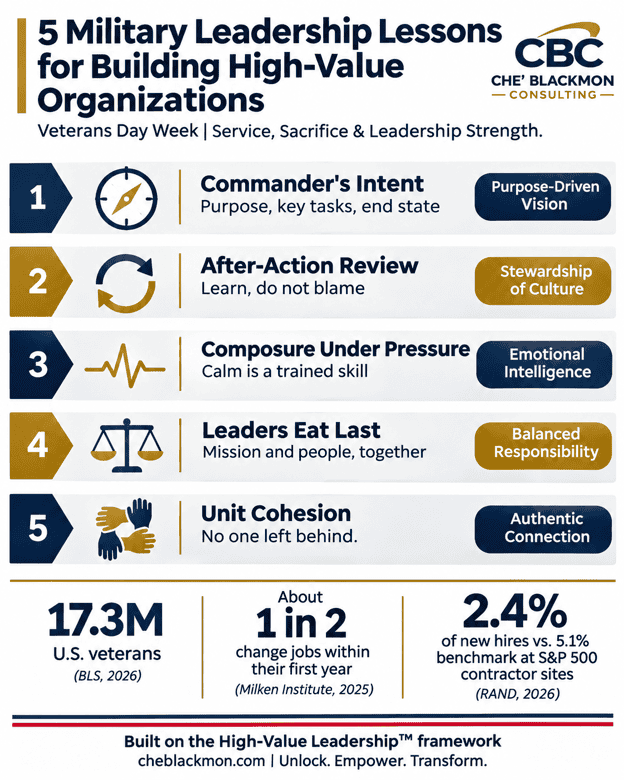
The veteran workforce is large, skilled, and often underused. The Bureau of Labor Statistics (2026) reported 17.3 million veterans in 2025, with a veteran unemployment rate of 3.5% compared with 4.2% for nonveterans. Getting hired is not the hard part. The hard part is keeping and growing that talent. A Milken Institute report found that about half of the roughly 200,000 veterans who leave the military each year are in a different job within twelve months, and about two thirds believe they are underemployed (Hines et al., 2025). The same authors point to a repeated disconnect: people who led teams under extreme pressure in uniform often do not reach senior civilian roles (Hines et al., 2025).

Corporate follow-through is uneven too. A 2026 RAND analysis of S&P 500 companies found that nearly 80% described veteran programs in voluntary materials, but veterans made up only 2.4% of new hires at those companies’ federal contractor sites, compared with a 5.1% national planning benchmark (Zuo & Wenger, 2026). The researchers also noted that companies rarely report whether veterans stay, get promoted, or move into management (Zuo & Wenger, 2026). Recognizing veterans is not enough. Organizations get the most when they learn from how veterans lead.

🧭 Lesson 1: Commander’s Intent Turns Purpose Into Action

In military planning, commander’s intent is a short statement of the purpose of an operation, the key tasks, and what success looks like at the end. Its value shows up when plans fall apart. When conditions change, people who understand the intent can adapt without waiting for permission. This maps directly to the Purpose-Driven Vision pillar of High-Value Leadership™. A vision statement on the lobby wall does nothing at 2:00 a.m. when a line goes down. A clear, repeated intent statement gives a supervisor what they need to make a good call on their own.

Best practice: Before your next project kickoff or shift start, give a three-line brief: Why we are doing this. The two or three things that must happen. What done looks like. Then ask one team member to say it back in their own words.

🔁 Lesson 2: The After-Action Review Builds a Learning Culture

Military units hold after-action reviews (AARs) built around four questions. What was supposed to happen? What actually happened? Why was there a difference? What will we keep doing or change? The ground rule is that rank stays outside the room, so the point is learning and not blame. This is the Stewardship of Culture pillar in practice. Leaders who protect honest debriefs are building a culture where problems come to the surface early, which is cheaper than finding them late.

🧠 Lesson 3: Composure Under Pressure Is a Teachable Skill

Employers often name composure under pressure as one of the strengths veterans bring, along with mission focus and problem solving (Hines et al., 2025). That composure does not come from personality alone. It comes from rehearsal, clear roles, and practice regulating emotion while stress is high. This is the Emotional Intelligence pillar. Leaders can build the same strength through scenario drills, pre-briefs before difficult conversations, and naming the emotional temperature of a room before deciding anything.

⚖️ Lesson 4: “Leaders Eat Last” Balances the Mission and the People

Many military units follow a custom where junior members eat first and leaders eat last. The custom carries a principle: the mission matters, and the people doing it matter equally. This is Balanced Responsibility. Organizations that push results while neglecting people lose the people, and organizations that care for people without clear results lose direction. Military leaders are trained to hold both.

🤝 Lesson 5: Cohesion Is Built on Purpose

Unit cohesion is more than friendship. It comes from shared purpose, shared hardship, and the confidence that no one will be left behind. This reflects Authentic Connection. In civilian workplaces, that loss of belonging can be part of why veterans leave early. Research from the Employee Benefit Research Institute (2025) found that veteran workers were more likely than nonveterans to intend to stay with their current employer and to prefer longer tenure with one employer. The loyalty is there. The work is to give it a culture where it belongs.

📈 Current Trends Leaders Should Watch

The veteran talent pool is changing. SHRM reported that the veteran labor force has shrunk by more than 40% since 2000, and veterans now make up about 5% of employed people (Society for Human Resource Management [SHRM], 2025). The same analysis found that veterans ages 16 to 54 are more than twice as likely as nonveterans to have a disability, 15.2% compared with 6.3% (SHRM, 2025). That makes accommodation readiness and accessible onboarding part of a serious veteran strategy. Meanwhile, HR Dive reported that many veteran programs had been housed under DEI initiatives, which leaves them exposed during the current pullback from DEI (Colvin, 2026). RAND likewise found that high-quality corporate disclosures about veteran programs fell sharply in 2025 and the first half of 2026 (Zuo & Wenger, 2026). Organizations that tie veteran integration to core talent and culture strategy, and not to a program that can be cut, will be the ones to keep this talent.

🏭 Composite Scenario: From Turnover to Ownership

The following is a composite scenario drawn from common patterns in manufacturing culture work. Details and figures are illustrative.

A 600-person manufacturer was losing more than a third of its second-shift new hires within the first 90 days. Exit feedback kept repeating the same complaint: “Nobody told me why anything mattered.” Leadership took three military-inspired steps. Every shift began with a three-line intent brief. Supervisors ran 15-minute weekly after-action reviews with no blame and no rank in the room. Veteran supervisors were paired with newer team leaders in a peer coaching group.

After two quarters, first-90-day turnover on second shift fell from 38% to 24%. Near-miss safety reporting rose by 40%. In this case that was good news, because it showed people trusted that reporting problems was safe. Supervisors also said they spent less time chasing approvals, because their teams understood the intent well enough to act. The equipment and the pay scale stayed the same. Only the leadership habits changed.

⚠️ A Myth to Retire

Military leadership is often confused with rigid command and control. Modern military doctrine leans the other way. It favors decentralized execution, trust, and initiative within clear intent. Organizations that borrow only the hierarchy will miss the point. The real lesson is to make purpose clear enough that people can act without waiting to be told.

✅ Actionable Takeaways for This Week

  1. Write a commander’s intent for one current priority. Keep it to three lines and share it with your team by Wednesday.
  2. Run one after-action review on a recent project. Use the four questions and leave titles outside the room.
  3. Audit your veteran retention data. Check whether you can see how veterans stay, advance, and reach management, and not only how many you hire.
  4. Ask a veteran on your team what leadership practice from their service they wish your organization used. Listen without defending.
  5. Check your onboarding for accessibility. Make sure accommodation conversations are routine and not reactive.

💬 Discussion Questions

  1. If your front-line team lost contact with leadership for a full shift, how well would they understand the intent behind their work?
  2. Where does your organization debrief to learn, and where does it debrief to assign blame?
  3. What does your data show about whether veterans in your organization advance into leadership roles?
  4. Which High-Value Leadership™ pillar is your organization’s strongest, and which one would a veteran employee notice is missing?

🚀 Next Steps for Readers

Share this article with one leader who supervises veterans or hires for front-line roles. Pick one practice from this article and try it before Friday. Then follow along all week as the Veterans Day series continues with veteran integration, transferable skills, the service mindset, and leadership legacy. To build these practices into your culture in a structured way, join the High-Value Leadership™ Intensive waitlist.

📚 References

Bureau of Labor Statistics. (2026, April 28). Employment situation of veterans: 2025 [News release]. U.S. Department of Labor. https://www.bls.gov/news.release/archives/vet_04282026.htm

Colvin, C. (2026, September 16). Veterans caught in the middle on anti-DEI efforts, research says. HR Dive. https://www.hrdive.com/news/veterans-retention-2026/830566/

Employee Benefit Research Institute. (2025, January 9). Satisfaction after service: Findings from a focus on veterans in the 2024 Workplace Wellness Survey [Issue brief]. https://www.ebri.org/content/satisfaction-after-service–findings-from-a-focus-on-veterans-in-the-2024-workplace-wellness-survey

Hines, G., Spitaletta, S., & Flaum, L. (2025). Saluting service and bolstering business: Redefining employer investments in veterans. Milken Institute. https://milkeninstitute.org/sites/default/files/2025-10/SalutingServiceBolsteringBusinessRedefiningEmployer.pdf

Society for Human Resource Management. (2025, November 10). New SHRM research spotlights veterans as America’s hidden talent [Press release]. https://www.shrm.org/in/about/press-room/new-shrm-research-spotlights-veterans-as-america-s-hidden-talent

Zuo, G., & Wenger, J. B. (2026). What can public data tell us about corporate support for veterans? RAND. https://www.rand.org/news/press/2026/09/corporate-support-for-veterans-is-widespread-but-public.html


Ready to build a high-value organization that leads with purpose, discipline, and care? Che’ Blackmon Consulting partners with leaders to turn culture into a competitive advantage.

📧 admin@cheblackmon.com | 📞 888.369.7243 | 🌐 cheblackmon.com

The Money Conversation: Talking Compensation Without Awkwardness 💰

By Che’ Blackmon, Founder & CEO, Che’ Blackmon Consulting


Let’s be honest: most of us would rather discuss almost anything else—our weekend plans, the weather, even politics—before we willingly talk about money at work. Yet compensation conversations are the cornerstone of professional growth, organizational fairness, and personal financial security. The awkwardness surrounding these discussions isn’t just uncomfortable; it’s costly, particularly for those already navigating systemic barriers in corporate spaces.

Why the Silence Costs Us All

The reluctance to discuss compensation stems from deeply rooted cultural taboos, power dynamics, and fear of professional consequences. We’ve been socialized to believe that talking about money is impolite, greedy, or unprofessional. This silence, however, perpetuates pay inequities and keeps talented professionals from achieving their full earning potential.

Consider this: women earn approximately 84 cents for every dollar earned by men, and Black women earn just 67 cents for every dollar earned by white, non-Hispanic men. These gaps don’t narrow by accident. They persist because of the very awkwardness we’re addressing—the discomfort that prevents honest dialogue about what we’re worth and what we’re paid.

In High-Value Leadership: Transforming Organizations Through Purposeful Culture, I discuss how transformational leaders create environments where difficult conversations become catalysts for positive change. Compensation transparency is one of those conversations. When organizations cultivate cultures that normalize these discussions, everyone benefits—from entry-level employees to the C-suite.

The Cultural Conditioning That Keeps Us Quiet 🤫

From childhood, many of us receive mixed messages about money. “Don’t ask people what they make.” “Be grateful for what you have.” “Asking for more seems greedy.” These well-intentioned lessons create professional adults who struggle to advocate for their worth.

For Black women and other traditionally overlooked professionals, these challenges compound. Research shows that Black women face unique stereotyping when negotiating—they’re often perceived as “aggressive” or “difficult” for demonstrating the same assertiveness that earns white male colleagues respect. This double standard creates a minefield: speak up and risk being labeled; stay silent and accept less than you deserve.

A major technology company discovered this firsthand when conducting an internal pay equity audit. They found that their highest-performing Black female engineers were consistently paid 12-18% less than their male counterparts with identical experience and performance ratings. The disparity wasn’t intentional; it resulted from years of those women avoiding compensation conversations out of fear, while their male colleagues negotiated freely and frequently.

Breaking the Awkwardness: A Framework for Success ✨

1. Prepare With Data, Not Emotion

The most effective compensation conversations are grounded in market research, performance metrics, and tangible contributions. Before initiating the discussion, gather:

  • Industry salary benchmarks for your role, experience level, and geographic location
  • Documentation of your achievements: quantifiable results, completed projects, exceeded targets
  • Expansion of responsibilities you’ve taken on since your last compensation review
  • Market movement: how your industry and role have evolved

This preparation transforms the conversation from personal (“I need more money”) to professional (“Based on market data and my contributions, here’s the compensation alignment I’m seeking”).

2. Choose Timing Strategically

There’s an art to when you raise compensation discussions. Optimal times include:

  • Annual review cycles (but don’t wait for your manager to initiate)
  • After completing a significant project or achievement
  • When taking on expanded responsibilities
  • During market shifts that affect your role’s value

One mid-sized manufacturing organization implemented quarterly “career conversations” separate from performance reviews. This normalized ongoing dialogue about growth, development, and compensation, removing much of the tension from annual review discussions.

3. Frame the Conversation Properly

Language matters enormously. Compare these approaches:

Less Effective: “I really need a raise. My rent went up and things are expensive.”

More Effective: “I’d like to discuss compensation alignment. Based on my research, professionals in similar roles with comparable experience are earning 15-20% more. Given my contributions to the recent product launch and the expanded team leadership I’ve assumed, I believe a salary adjustment to [specific number] reflects market value and my impact.”

The second approach is professional, data-driven, and positions you as someone who understands their value and the broader market context.

4. Practice the Uncomfortable Silence

After stating your case, stop talking. The silence will feel unbearable, but resist the urge to fill it with justifications, apologies, or backtracking. This is where many professionals—especially women—undermine their own negotiations by talking themselves down from their initial request.

There was a company whose HR director noticed a pattern: male candidates averaged 23 seconds of silence after stating their salary expectations, while female candidates averaged 7 seconds before adding qualifiers like “but I’m flexible” or “that might be too high.” Those extra 16 seconds of confidence translated to an average difference of $8,400 in starting salaries.

Special Considerations for Black Women and Traditionally Overlooked Professionals 🎯

In Rise & Thrive: A Black Woman’s Blueprint for Leadership Excellence, I address the unique navigation required when you’re breaking barriers while building your career. Compensation conversations require additional strategic thinking when you’re already managing stereotypes and biases.

The Preparation Tax

Black women often need to be twice as prepared to be considered equally credible. While this reality is frustrating, acknowledging it allows you to plan accordingly:

  • Anticipate potential objections and prepare responses
  • Bring documentation that white colleagues might not need
  • Have external validation ready (market studies, competitive offers, industry benchmarks)
  • Consider having allies or mentors review your approach beforehand

The Collaboration Strategy

Building coalitions with other professionals navigating similar challenges creates strength in numbers. When multiple team members approach leadership about compensation equity concerns—backed by data—it’s harder to dismiss as individual complaints.

A healthcare organization faced this when six Black women in their nursing leadership team simultaneously requested compensation reviews. Rather than approaching individually (where concerns might be deflected), they presented collective data showing systematic pay disparities. The organization conducted a comprehensive audit and implemented corrective adjustments within 90 days.

The Documentation Discipline

Keep meticulous records of your accomplishments, contributions, and any verbal commitments about compensation. Documentation protects you and provides irrefutable evidence when memories become selective.

Creating a Culture That Welcomes These Conversations 🏢

As a doctoral candidate researching organizational transformation and someone who has spent over two decades in progressive HR leadership, I’ve seen how the right culture changes everything. Organizations serious about equity must actively cultivate environments where compensation conversations are normalized, not penalized.

In Mastering a High-Value Company Culture, I outline how purposeful culture transformation requires intentional systems and practices. Here’s how organizations can reduce awkwardness around compensation:

Implement Transparent Salary Bands

When employees understand the compensation range for their role and what it takes to progress, mystery and guesswork disappear. Buffer, Whole Foods, and others have pioneered radical transparency, publishing salaries internally or even publicly.

Train Managers in Compensation Conversations

Most managers receive little training in discussing money. They’re as uncomfortable as employees, which creates defensive, awkward exchanges. Investing in manager development around compensation discussions improves outcomes for everyone.

Conduct Regular Pay Equity Audits

Proactive organizations don’t wait for problems to surface. They regularly analyze compensation data by gender, race, and other demographics, addressing disparities before they become legal or reputational issues.

Establish Clear Compensation Philosophies

When organizations articulate how they determine pay—market positioning, internal equity, performance impact—employees have a framework for understanding their compensation and requesting adjustments.

A regional financial services company implemented these practices after discovering their employee engagement scores around “fair compensation” were 30 points below industry benchmarks. Within 18 months of creating transparency, conducting audits, and training managers, those scores increased by 28 points, and voluntary turnover decreased by 34%.

The Script: What to Actually Say 📝

Let’s get practical. Here are frameworks for different compensation scenarios:

Requesting a Raise During Your Review:

“Thank you for the positive feedback on my performance this year. I’d like to discuss compensation. Based on my contributions—specifically [achievement 1], [achievement 2], and [achievement 3]—along with market research showing similar roles in our industry range from $X to $Y, I’m requesting a salary adjustment to $[specific amount]. This aligns with both my performance and market value. What are your thoughts?”

Addressing a Pay Disparity You’ve Discovered:

“I’ve become aware of compensation differences between my role and similar positions. I’d like to understand our compensation philosophy and discuss alignment. My research indicates [provide specific data]. Can we schedule time to review my compensation in relation to internal equity and market rates?”

Negotiating a New Job Offer:

“I’m excited about this opportunity. Based on my experience, the responsibilities we’ve discussed, and market rates for this role, I was expecting compensation in the range of $X to $Y. Is there flexibility in the current offer?”

Following Up After a “No”:

“I appreciate you considering my request. Can you help me understand what specific criteria or accomplishments would support a compensation increase? I’d like to establish clear goals we can revisit in [timeframe].”

When the Answer is No: Strategic Next Steps 🚀

Not every compensation request results in immediate salary increases. How you handle “no” determines your long-term success:

  1. Request Specificity: “What exactly would need to change for this conversation to have a different outcome?”
  2. Establish Timeline: “When can we revisit this discussion? What milestones should I focus on?”
  3. Explore Alternatives: If base salary isn’t negotiable, consider bonuses, additional PTO, professional development funds, flexible work arrangements, or expanded responsibilities that position you for future increases.
  4. Assess Honestly: Is this a temporary “not now” or a permanent ceiling? If you’re consistently undervalued despite strong performance and market data, it might be time to explore opportunities elsewhere.

One professional services firm found that employees who engaged in these strategic follow-up conversations after initial denials had a 73% success rate in securing increases within six months, compared to 31% who simply accepted the initial “no” without further discussion.

The Ripple Effect: How Your Conversation Helps Others 🌊

When you successfully navigate compensation conversations, you create pathways for others. This is especially significant for traditionally overlooked professionals who benefit when predecessors normalize these discussions and demonstrate effective strategies.

Every time you negotiate successfully, you:

  • Challenge bias about who “should” ask for more money
  • Create precedent for fair compensation in your role
  • Model confidence for junior colleagues watching your example
  • Contribute data that helps organizations identify and correct systemic issues

Your willingness to have uncomfortable conversations today makes them less uncomfortable for everyone tomorrow.

The Organizational Imperative 💼

For leaders and organizations reading this: compensation awkwardness isn’t just an employee problem. It’s an organizational dysfunction that costs you talent, engagement, and competitive advantage.

High-value organizations, as I define them in my work on purposeful culture transformation, recognize that compensation transparency and fairness aren’t nice-to-haves—they’re fundamental to building trust, attracting top talent, and achieving sustainable success.

When employees believe they’re paid fairly and have clear paths to increased compensation, they:

  • Invest more deeply in their work
  • Stay with organizations longer
  • Refer high-quality candidates
  • Contribute more innovative thinking
  • Build stronger client relationships

Conversely, compensation secrecy and inequity create toxic cultures where talent exits, performance suffers, and employer brand deteriorates.

Moving Forward: Your Action Plan ✅

The awkwardness around money conversations doesn’t disappear overnight, but it diminishes with practice and preparation. Here’s your roadmap:

This Week:

  • Research market rates for your role using Glassdoor, Payscale, salary.com, and industry reports
  • Document your accomplishments and quantifiable contributions from the past year
  • Identify the appropriate person and timing for your compensation conversation

This Month:

  • Practice your compensation conversation script with a trusted mentor or friend
  • Gather any additional documentation needed to support your request
  • Schedule the conversation with your manager

This Quarter:

  • Have the compensation conversation
  • Follow up strategically based on the outcome
  • If employed in a leadership role, audit your team’s compensation for equity
  • Share learnings with your professional network to help others navigate similar conversations

Discussion Questions & Reflection 💭

  1. What specific fears or concerns have prevented you from initiating compensation conversations in your career? Where do those fears originate?
  2. How might your organization’s culture currently support or hinder open discussions about compensation? What’s one change that would make the biggest difference?
  3. For leaders: When was the last time you proactively addressed compensation equity within your team? What prompted that review, and what did you discover?
  4. What role does mentorship play in helping traditionally overlooked professionals navigate compensation conversations more effectively? How can senior leaders better support this?
  5. How do you balance gratitude for your current opportunity with advocacy for fair compensation? Are these truly in conflict?

Your Next Steps With Che’ Blackmon Consulting 🌟

If you’re ready to transform how your organization approaches compensation, culture, and equity—or if you’re a professional who wants personalized support navigating these crucial conversations—let’s talk.

Che’ Blackmon Consulting specializes in:

  • Culture transformation strategies that address systemic inequities
  • Leadership development for executives committed to purposeful change
  • Compensation equity audits and remediation strategies
  • Executive coaching for professionals navigating career advancement
  • AI-powered predictive analytics for organizational transformation

Whether you’re building Michigan’s next high-value culture or positioning yourself for leadership excellence, we’re here to help you unlock potential, empower change, and transform outcomes.


Ready to have better conversations about compensation and culture?

📧 Email: admin@cheblackmon.com
📞 Phone: 888.369.7243
🌐 Web: cheblackmon.com

Let’s unlock the uncomfortable conversations that lead to transformational outcomes—for individuals, organizations, and entire industries.


Che’ Blackmon is the founder and CEO of Che’ Blackmon Consulting, a DBA candidate at National University, and the author of multiple books on leadership and organizational culture including “High-Value Leadership: Transforming Organizations Through Purposeful Culture” and “Rise & Thrive: A Black Woman’s Blueprint for Leadership Excellence.” With over 24 years of progressive HR leadership experience, she specializes in culture transformation and empowering traditionally overlooked talent to rise and thrive in corporate spaces.

#CompensationEquity #PayTransparency #SalaryNegotiation #BlackWomenInBusiness #WageGap #HighValueLeadership #HRLeadership #OrganizationalCulture #PayEquity #WomenInLeadership #DiversityAndInclusion #CompensationStrategy #LeadershipDevelopment #CultureTransformation #ProfessionalDevelopment #CareerAdvancement #ExecutiveCoaching #HRConsulting #WorkplaceEquity #CorporateCulture #BlackWomenLeaders #SalaryTransparency #FairPay #DEI #EmployeeEngagement #TalentRetention #LeadershipExcellence #HRTransformation #RiseAndThrive #CheBlackmon

Beyond the Holiday Party: Meaningful Year-End Recognition 🎁

Why the most impactful recognition happens long after the confetti settles


December arrives with its predictable rhythm: hastily planned holiday parties, generic gift cards distributed in breakrooms, and year-end bonuses announced with varying degrees of fanfare. Leadership checks the “employee appreciation” box, employees smile politely, and by January 3rd, everyone has forgotten the whole thing happened.

This isn’t recognition. It’s ritual.

Real recognition—the kind that actually motivates people, strengthens retention, and builds high-value culture—requires something far more intentional than catered appetizers and a Secret Santa exchange. It requires leaders who understand that meaningful recognition isn’t about the event. It’s about being truly seen.

The Recognition Gap Nobody Talks About 👀

A professional services firm discovered something troubling during their year-end review process. While preparing annual awards and bonuses, leadership realized they’d been recognizing the same people repeatedly—the visible performers whose work happened in high-profile meetings and client-facing roles.

Meanwhile, the people who kept operations running smoothly, who mentored junior staff without being asked, who solved problems before they became crises—these contributors remained invisible. When they disaggregated the recognition data by demographics, the pattern became stark: women and people of color were significantly underrepresented in both formal awards and informal acknowledgment.

This wasn’t malicious. It was worse—it was unconscious. Leadership genuinely believed they were recognizing contributions fairly. The data told a different story.

This recognition gap reflects a broader truth about organizational culture: we tend to see and celebrate work that looks like what we’ve traditionally valued, performed by people who look like those we’ve traditionally promoted. Everything else becomes background noise, no matter how essential.

Understanding Meaningful Recognition 💎

Recognition isn’t a single act. It’s a system of seeing, acknowledging, and valuing contributions in ways that matter to the recipient—not just the giver.

As I discuss in High-Value Leadership: Transforming Organizations Through Purposeful Culture, high-value leaders understand that recognition serves multiple purposes simultaneously: it reinforces desired behaviors, communicates organizational values, strengthens psychological safety, and demonstrates that contributions are noticed and matter.

But here’s what most leaders miss: recognition must be specific, timely, authentic, and equitable to achieve any of these purposes. Generic praise distributed indiscriminately accomplishes nothing except checking a box.

Meaningful recognition has four essential characteristics:

Specificity: “Great job this year” means nothing. “Your redesign of the supply chain tracking system reduced errors by 23% and saved the company $340,000” means everything. Specific recognition demonstrates that you actually understand what the person did and why it mattered.

Timeliness: Waiting until December to acknowledge contributions from March means you weren’t really paying attention. The most powerful recognition happens close to the achievement, when the effort and impact are still fresh and meaningful.

Authenticity: People can smell performative recognition from across the building. If you’re reading from a script written by HR about someone you barely know, everyone recognizes the theater. Authentic recognition comes from genuine observation and appreciation.

Equity: Recognition systems that consistently overlook certain people while repeatedly celebrating others create resentment, disengagement, and turnover. Equitable recognition requires intentional examination of who gets seen and who remains invisible.

The Traditionally Overlooked: Recognition Disparities That Drain Talent 📉

Black women navigate a particularly complex recognition landscape in corporate spaces. Research consistently shows they receive less recognition for equivalent or superior performance compared to their white counterparts—and when they do receive recognition, it’s often qualified, comparative, or backhanded.

As I detail in Rise & Thrive: A Black Woman’s Blueprint for Leadership Excellence, Black women in corporate environments frequently experience what I call “contribution invisibility”—their work gets absorbed into team achievements without individual acknowledgment, or worse, attributed to others entirely.

There was a technology company where a Black woman product manager led a complete platform overhaul that increased user engagement by 47%. During the year-end recognition event, leadership praised “the team” for the successful launch but specifically named three white male engineers for their “innovative thinking.” The product manager who conceived the strategy, secured stakeholder buy-in, and managed the entire initiative? Never mentioned.

She left three months later. In her exit interview, she said something that leadership should have found devastating: “I can accept not being celebrated. What I can’t accept is being erased.”

Common recognition gaps affecting Black women and other marginalized groups:

The “Team Player” Trap: While white men get recognized for “leadership” and “strategic thinking,” Black women disproportionately receive praise for being “team players” or “supportive”—language that codes their contributions as secondary rather than primary. This pattern appears consistently in performance reviews and recognition narratives.

Credit Redistribution: Ideas proposed by Black women that are initially dismissed but later praised when repeated by white colleagues. This isn’t just frustrating—it’s a form of intellectual theft that year-end recognition ceremonies often reinforce by celebrating the repeater rather than the originator.

The Emotional Labor Invisibility: Black women frequently shoulder enormous emotional labor—mentoring other people of color, serving on diversity committees, managing racial dynamics in team settings—without recognition or compensation. This work is treated as optional volunteer activity rather than valuable organizational contribution.

The Perfection Penalty: Research shows that Black women must perform at higher levels than white colleagues to receive equivalent recognition. They’re held to stricter standards while receiving less grace for mistakes, creating an exhausting dynamic where exceptional performance yields ordinary acknowledgment.

The Public-Private Recognition Gap: Some leaders privately acknowledge Black women’s contributions but fail to do so publicly, where it would actually advance their careers. This private praise without public advocacy maintains the status quo while making leadership feel better about their equity efforts.

Rethinking Year-End Recognition: A Strategic Approach 🎯

Move Beyond the Annual Event

The biggest mistake organizations make is treating recognition as a once-a-year event rather than an ongoing practice. By the time December arrives, most of the year’s contributions have been forgotten or misattributed.

A manufacturing company shifted their approach by implementing quarterly recognition reviews where leadership teams specifically examined: Who contributed significantly this quarter? Whose work might we have overlooked? When we look at who we’re recognizing, what patterns do we see by department, role, and demographics?

This systematic examination surfaced contributions that would have otherwise remained invisible. The facilities manager who redesigned the shift handoff process, reducing errors and improving safety. The HR coordinator who quietly resolved dozens of interpersonal conflicts before they escalated. The junior accountant whose process improvements saved twelve hours weekly across the finance team.

These contributions rarely made it into annual recognition ceremonies because they weren’t flashy. But they were essential.

Create Multiple Recognition Channels

Different people value different forms of recognition. Some appreciate public celebration. Others prefer private acknowledgment. Some value tangible rewards. Others want developmental opportunities or increased responsibility.

As I outline in Mastering a High-Value Company Culture, high-value cultures offer multiple pathways for recognition that respect individual preferences while maintaining equity and transparency.

Recognition options to consider:

Public celebration: Team meetings, company-wide communications, recognition events, awards ceremonies. Best for: people who value visibility and public affirmation. Caution: can feel performative if not authentic; some find public attention uncomfortable.

Private acknowledgment: One-on-one conversations, handwritten notes, personal emails from leadership. Best for: people who value sincere, personal connection over public display. Caution: without public recognition, contributions may remain invisible to others who make promotion decisions.

Tangible rewards: Bonuses, gifts, extra time off, professional development budgets, equipment upgrades. Best for: people who value concrete demonstrations of appreciation. Caution: can feel transactional if unaccompanied by genuine acknowledgment; must be equitably distributed.

Developmental opportunities: High-visibility projects, stretch assignments, conference attendance, mentorship from senior leaders, inclusion in strategic planning. Best for: ambitious professionals seeking career advancement. Caution: can be exploitative if presented as “recognition” when it’s actually additional unpaid work.

Increased autonomy: Flexible work arrangements, decision-making authority, reduced micromanagement, trust to set own priorities. Best for: experienced professionals who value independence and self-direction. Caution: must be offered equitably—not just to people who “look like” leaders.

The key is offering recognition in forms that matter to the recipient, not just what’s convenient for leadership.

Implement Recognition Audits

Just as culture requires regular auditing, so does recognition. Before planning any year-end recognition activities, conduct a systematic examination of who’s been recognized throughout the year.

Audit questions:

  • Who received recognition (formal and informal) this year? What patterns emerge by race, gender, department, and role?
  • Whose contributions might we have overlooked? Who does essential work that rarely gets visibility?
  • What types of contributions do we celebrate? What valuable work remains unrecognized because it doesn’t fit our traditional definition of achievement?
  • How does recognition correlate with advancement? Do the people we recognize most frequently also get promoted, or is recognition a substitute for actual career progression?
  • What feedback have employees provided about recognition? Do marginalized groups report feeling adequately recognized?

There was a healthcare organization that discovered through their recognition audit that 73% of their annual awards went to people in client-facing roles despite these positions representing only 34% of their workforce. Operations, IT, and support functions—where women and people of color were disproportionately concentrated—received minimal recognition despite being essential to organizational success.

The audit forced an uncomfortable conversation about what the organization truly valued. Did they value only work that happened in front of clients? Or did they value all the work required to deliver excellent client experiences? Their recognition patterns suggested the former even while their stated values claimed the latter.

The Psychology of Meaningful Recognition 🧠

Recognition isn’t just nice—it’s neurologically powerful. When done well, recognition activates reward centers in the brain, releases dopamine, and creates positive associations that motivate continued high performance.

But here’s what makes recognition complicated: its impact depends entirely on whether the recipient experiences it as authentic and fair.

Research from organizational psychology reveals several key insights:

Specificity matters more than magnitude: A specific acknowledgment of particular contributions creates more lasting impact than large but generic praise. The brain responds more strongly to evidence that someone actually noticed and understood your work than to grand but vague statements.

Equity affects everyone: When recognition is distributed inequitably, it doesn’t just harm those who are overlooked—it undermines motivation across the organization. People notice who gets celebrated and who doesn’t. When patterns emerge, even those who benefit from inequity begin to question the value of recognition.

Authenticity cannot be faked: The human brain is remarkably sophisticated at detecting genuine versus performative emotion. When leaders deliver recognition they don’t actually feel, recipients sense the disconnect. This performative recognition often does more harm than no recognition at all.

Timeliness creates causality: Recognition delivered close to the achievement helps the brain establish clear connections between behavior and reward. When months pass between contribution and acknowledgment, the psychological impact diminishes significantly.

Public recognition has amplifying effects: Being recognized in front of peers creates social capital, increases perceived status, and signals to others that certain contributions are valued. This is why the public-private recognition gap disproportionately harms marginalized groups—private praise doesn’t advance careers the way public acknowledgment does.

Designing Year-End Recognition That Actually Matters 🏆

Step 1: Conduct a Mid-Year Recognition Review (November)

Don’t wait until the last minute. In November, gather leadership to systematically review the year’s contributions:

  • Create a comprehensive list of significant achievements, innovations, and contributions across all departments
  • Identify whose work might have been overlooked or undervalued
  • Analyze patterns in who’s been recognized throughout the year
  • Gather input from managers about contributions they’ve observed
  • Review feedback from employees about who helped them succeed

Step 2: Disaggregate and Examine Patterns

Break down your recognition data by demographics, department, and role type. Look for:

  • Overrepresentation or underrepresentation of particular groups
  • Departments or functions that receive disproportionate recognition
  • Types of contributions that consistently get overlooked
  • Patterns in language used to describe different people’s achievements

If you find disparities—and you almost certainly will—don’t ignore them or explain them away. Investigate why these patterns exist and commit to correcting them.

Step 3: Develop Specific Recognition Plans

For each person you plan to recognize:

Write specific acknowledgments: Detail what they did, the impact it had, and why it mattered. Avoid generic praise.

Choose appropriate recognition form: Consider the individual’s preferences and what would be meaningful to them specifically.

Prepare genuine delivery: If you’re delivering recognition publicly, practice until you can speak authentically rather than reading a script. Your genuine appreciation matters more than polished performance.

Connect to values: Explicitly link their contribution to organizational values, showing how their work exemplifies what the company claims to prioritize.

Step 4: Create Surprise Recognition Moments

The most memorable recognition often happens outside formal ceremonies. Consider:

Leadership visits: Senior leaders personally visiting teams to acknowledge specific contributions. Not scripted tours—genuine conversations about their work.

Peer recognition programs: Structured opportunities for colleagues to recognize each other, with leadership visibility and support.

“Caught doing good” acknowledgments: Spontaneous recognition when leaders observe excellent work, delivered immediately rather than saved for later.

Handwritten notes: Personal messages from executives to employees whose work they genuinely appreciate—specific, authentic, and unexpected.

Step 5: Make Recognition Development-Focused

The most powerful year-end recognition includes forward-looking elements:

“Your work redesigning our customer intake process reduced response time by 40% and demonstrated strategic thinking that we want to see in our next generation of leaders. In the coming year, we’re offering you [specific developmental opportunity] to further develop these capabilities.”

This approach recognizes past contributions while investing in future potential—a combination that’s especially powerful for talented people who’ve felt stuck.

Case Study: Retail Company’s Recognition Transformation 🛍️

A regional retail company with twelve locations had always celebrated year-end with a dinner event where the CEO presented awards to “top performers.” The same people won repeatedly: store managers with the highest sales numbers.

An employee survey revealed low morale and a troubling trend: high turnover among assistant managers and team leads—roles where women and people of color were concentrated. Exit interviews consistently mentioned feeling “undervalued” and “invisible.”

Leadership brought in external consultation to examine their recognition practices. The findings were revealing:

What they discovered:

  • Sales-focused recognition ignored essential non-sales contributions
  • Store managers got credit for team performance without acknowledging who actually drove results
  • Women in assistant manager roles consistently exceeded performance metrics but rarely received recognition
  • Black employees reported that their contributions were frequently attributed to others
  • The holiday dinner felt performative—leadership barely knew the award recipients

What they changed:

Quarterly recognition reviews: Leadership teams specifically examined contributions across all functions, not just sales. They asked: Whose problem-solving prevented crises? Who mentored struggling team members? Who improved processes? Who maintained morale during difficult periods?

Peer nomination process: Employees could nominate colleagues for recognition, with specific examples required. This surfaced contributions leadership hadn’t observed.

Multiple recognition tiers: Not just “top performer” but categories like Innovation, Mentorship, Customer Experience, Team Leadership, and Problem-Solving—ensuring diverse contributions were celebrated.

Manager accountability: Managers were evaluated on whether they effectively recognized their teams. Recognition became a leadership competency, not an optional nicety.

Ongoing acknowledgment: Shifted from annual event to monthly recognition spotlights, quarterly awards, and spontaneous acknowledgment when warranted.

Results after 18 months:

  • Assistant manager turnover decreased by 52%
  • Employee engagement scores increased by 31 percentage points
  • First Black woman promoted to regional manager
  • Recognition became distributed across diverse contributors rather than concentrated among the same few people
  • Employees reported feeling “seen” and “valued” at significantly higher rates

The holiday event still happened, but it was no longer the only recognition. It became one element in a comprehensive system of seeing and valuing contributions year-round.

Special Considerations for Remote and Hybrid Teams 💻

Remote work has complicated recognition in ways many leaders haven’t addressed. The informal hallway conversations, spontaneous acknowledgments, and casual observations that drove recognition in office environments don’t translate automatically to virtual settings.

Remote recognition requires more intentionality:

Visibility challenges: Remote workers, particularly women and people of color, often experience heightened invisibility. Their contributions happen off-screen while visible performers dominate video meetings. Leaders must actively seek out remote workers’ contributions rather than relying on passive observation.

Timezone inequities: Recognition that happens during meetings excludes people working different hours. Consider recorded acknowledgments, written recognition, and structured programs that don’t depend on synchronous participation.

Digital exhaustion: Adding another video meeting for recognition may feel like burden rather than reward. Explore asynchronous recognition methods: personalized video messages, company-wide communications, digital badges with meaningful descriptions.

Loss of casual positive feedback: The micro-moments of acknowledgment that happened naturally in offices—”great point in that meeting,” “thanks for jumping in on this”—disappear remotely unless leaders deliberately create them through chat, email, and intentional check-ins.

The Hidden Costs of Poor Recognition 💸

Leaders often treat recognition as a “nice to have” rather than a strategic imperative. This is financially shortsighted.

Poor recognition drives turnover: Gallup research shows that lack of recognition is among the top reasons people leave organizations. The cost of replacing a skilled employee ranges from 50% to 200% of their annual salary when you factor in recruiting, onboarding, lost productivity, and institutional knowledge loss.

Poor recognition kills discretionary effort: People who feel unrecognized do exactly what’s required—nothing more. You lose the innovation, problem-solving, and extra effort that distinguishes high-performing organizations from mediocre ones.

Poor recognition creates inequitable cultures: When recognition systems consistently overlook marginalized groups, you signal that certain people’s contributions matter less. This drives away diverse talent and limits your organization’s potential.

Poor recognition undermines other investments: You can spend millions on development programs, competitive compensation, and workplace amenities—but if people don’t feel genuinely seen and valued, none of it matters. Recognition is the foundation that makes other investments worthwhile.

There was a technology company that couldn’t understand why they had such high turnover among women engineers despite paying market rates and offering generous benefits. An organizational culture assessment revealed the answer: women’s contributions were systematically overlooked in recognition programs while men received frequent acknowledgment for equivalent or lesser achievements. Pay and benefits couldn’t compensate for feeling professionally invisible.

Making Recognition Equitable: Practical Strategies ⚖️

Implement structured nomination processes: Rather than leaving recognition to leadership memory, create systems where anyone can nominate colleagues with specific examples of contributions. Review nominations for patterns and blind spots.

Use specific criteria: Define what you’re recognizing clearly. “Innovation” is vague. “Implemented new process that improved efficiency or created new solution to existing problem” is specific. Specific criteria reduce bias.

Include diverse decision-makers: Recognition decisions made by homogeneous leadership groups tend to favor people who look like them. Diverse panels make more equitable recognition decisions.

Track and audit: Just like culture audits, recognition requires systematic examination. Track who gets recognized quarterly, disaggregate by demographics, and investigate disparities.

Train managers on bias: Managers often unconsciously overlook contributions from people who don’t match their mental image of “high performer.” Training on recognition bias helps managers see more clearly.

Separate performance reviews from recognition: Performance reviews focus on improvement areas. Recognition celebrates achievements. When combined, recognition feels diluted and conditional.

Create clear pathways from recognition to advancement: If recognition doesn’t connect to career progression, it’s just nice words. Ensure that recognized contributors receive developmental opportunities, increased responsibility, and advancement consideration.

Beyond December: Building Year-Round Recognition Culture 🌟

The most effective recognition happens throughout the year, not just at year-end. High-value cultures build recognition into their regular operating rhythm.

Weekly team meetings: Reserve five minutes for acknowledgment—team members recognize each other’s contributions from the past week with specific examples.

Monthly spotlights: Feature one person’s contributions each month in company communications, with detailed description of their work and impact.

Quarterly reviews: Leadership specifically examines who’s been recognized and who might be overlooked, ensuring equitable distribution.

Anniversary acknowledgments: Recognize work anniversaries with specific reflection on that person’s contributions over their tenure—not generic “congratulations on five years” messages.

Project completion celebrations: When major projects conclude successfully, acknowledge everyone who contributed—not just the visible leaders but the support staff, technical experts, and behind-the-scenes problem-solvers.

Spontaneous recognition: The most powerful acknowledgment often happens in the moment—immediately after observing excellent work, problem-solving, or contribution.

As I emphasize in High-Value Leadership, transformational leaders understand that recognition is not an event—it’s a practice woven into organizational culture through consistent, intentional, equitable acknowledgment of contributions that matter.

Discussion Questions for Your Leadership Team 💭

  1. When we review our year-end recognition plans, whose contributions might we be overlooking? What work is essential to our success but rarely gets celebrated?
  2. If we disaggregated our recognition data by race and gender, what patterns would we find? Are we comfortable with those patterns?
  3. How do Black women and other marginalized groups experience recognition in our organization? Have we asked them directly?
  4. What’s the gap between private acknowledgment and public recognition in our organization? Who receives private praise but lacks the public advocacy that advances careers?
  5. Do we recognize diverse types of contributions, or only work that fits traditional definitions of achievement?
  6. How does our recognition system connect to actual career advancement? Or is recognition a substitute for opportunity?
  7. What would it take to shift from annual recognition events to year-round recognition culture?

Your Year-End Recognition Action Plan 📋

Immediate Actions (Next 2 Weeks):

  1. Conduct recognition audit: Review who’s been recognized this year and examine patterns
  2. Identify overlooked contributors: Who did essential work that hasn’t been acknowledged?
  3. Gather specific examples: Collect detailed information about contributions you plan to recognize
  4. Survey employees: Ask how they prefer to be recognized
  5. Review recognition budget: Ensure resources align with stated commitment to appreciation

Short-Term Actions (Next 30 Days):

  1. Develop specific recognition plans for year-end
  2. Train managers on equitable recognition practices
  3. Create multiple recognition channels to accommodate different preferences
  4. Prepare authentic, specific acknowledgments for recognized contributors
  5. Plan both public and private recognition moments

Long-Term Culture Shift (Next 6 Months):

  1. Implement quarterly recognition reviews
  2. Establish peer nomination process
  3. Create manager accountability for team recognition
  4. Build recognition into regular meeting rhythms
  5. Track recognition data and audit for equity
  6. Connect recognition to developmental opportunities and career advancement

Partner with Che’ Blackmon Consulting: Building Recognition into High-Value Culture ✨

Recognition isn’t separate from culture—it’s one of the most powerful ways culture gets communicated and reinforced. When you recognize certain contributions and overlook others, you’re teaching everyone what you actually value versus what you claim to value.

Che’ Blackmon Consulting helps organizations build recognition systems that:

  • Surface contributions from traditionally overlooked groups
  • Connect recognition to career advancement and development