GenX Leaders: Stop Waiting to Be Discovered The CEO’s Guide to Taking Your Seat at the Table

By Che’ Blackmon, DBA Candidate | Founder & CEO, Che’ Blackmon Consulting

📚 Book Tie-In: High-Value Leadership: Transforming Organizations Through Purposeful Culture — Chapters on Purpose-Driven Direction and Trust-Based Empowerment

You have built the career. You have the experience, the institutional knowledge, the battle scars, and the results to prove it. You have watched younger colleagues get promoted around you, sat through meetings where your ideas were credited to someone else, and told yourself to be patient because your time was coming.

It is time to stop waiting.

Generation X, the 65 million Americans born roughly between 1965 and 1980, represents one of the most seasoned, resilient, and capable leadership cohorts in the modern workforce. Yet GenX professionals are also among the most chronically underestimated. Sandwiched between the massive cultural footprint of Baby Boomers and the loud market presence of Millennials, GenX leaders have spent decades doing the work without always receiving the recognition, promotion, or platform their contributions deserve.

This article is a direct conversation with GenX professionals who are done waiting to be discovered. It is a guide for stepping into your full leadership authority, building the visibility that executive presence requires, and creating the kind of organizational impact that makes you impossible to overlook. It also speaks to those within the GenX generation who carry an additional weight: Black women leaders who have navigated not just the generation gap but also the compounding barriers of race and gender in corporate spaces.

The seat at the table you have been waiting for? It is time to pull it up yourself.

🗺️ The GenX Paradox: Maximum Experience, Minimum Visibility

Here is a remarkable data point. According to research from the nonprofit Visier, Generation X makes up more than 50% of leadership roles at the Director level and above in most U.S. organizations. And yet GenX accounts for only about 35% of the C-suite. That gap is not accidental. It reflects a structural visibility problem that has followed this generation throughout its career.

GenX professionals entered the workforce in an era that rewarded competence, loyalty, and heads-down execution. They were trained to let the work speak for itself. They absorbed a professional culture that viewed self-promotion as unseemly and believed that doing an exceptional job would naturally lead to recognition and advancement. For many, it worked through the early stages of their careers.

But the rules changed. The executive suite increasingly rewards visibility, narrative, and strategic self-positioning alongside performance. Those who mastered the art of making their work known, building upward relationships, and being seen as strategic thinkers moved faster. Those who continued to lead with quiet competence found themselves consistently passed over.

“High-value leadership is not about commanding a room. It is about being so intentional, so purposeful, and so aligned in your values and your actions that people cannot help but follow.” — High-Value Leadership: Transforming Organizations Through Purposeful Culture

The paradox for GenX is real. The generation most experienced in navigating organizational complexity, managing multigenerational teams, and delivering sustained results is also the generation most likely to underinvest in the strategic visibility that executive advancement now requires.

Understanding that paradox is the first step. Dismantling it is the work.

🔍 Why GenX Gets Overlooked: The Structural Truth

Before we talk strategy, it is important to name the structural realities that have shaped the GenX leadership experience. This is not about assigning blame. It is about understanding the terrain so you can navigate it more effectively.

📌 The Middle Child Syndrome of the Workforce

Baby Boomers built the corporate infrastructure and held senior leadership positions well into the 2010s, often longer than previous generations due to improved health and financial uncertainty. When they finally began transitioning out, many organizations made a strategic leap directly to Millennials, investing heavily in the recruitment, development, and promotion of younger talent in response to market pressures around innovation and digital transformation.

GenX, once again, got lost in the middle. Too young to be the Boomer heir apparent, too experienced to be positioned as the fresh new talent, this generation has spent years watching leadership pipelines flow around them rather than through them.

📊 The Quiet Achiever Trap

Research consistently shows that visibility is one of the strongest predictors of promotion decisions, often outweighing performance scores when candidates are otherwise equally qualified. A study from the Center for Talent Innovation found that executive presence, defined broadly as the ability to project confidence, credibility, and command attention, accounts for as much as 26% of what it takes to get promoted to senior leadership.

GenX professionals, culturally conditioned to value substance over style, frequently underinvest in executive presence. They do the work. They solve the problems. They manage the teams. But they often fail to architect the narrative around that work in ways that register at the executive level.

🧠 The Loyalty Penalty

GenX is the generation that stayed. While Millennials became known for job hopping and Boomers for building empire-like tenure at single organizations, GenX professionals demonstrated a particular brand of organizational loyalty that often translated into being taken for granted.

In many cases, long tenure without explicit visibility and positioning strategies results in being perceived as part of the furniture rather than as a candidate for the next level. Organizations sometimes overlook their most tenured performers precisely because those performers have not actively signaled readiness for advancement.

❤️ The Double Burden: GenX Black Women in Corporate Spaces

No examination of GenX leadership and the visibility gap would be complete without explicitly addressing the experience of Black women within this generation. For Black GenX women in corporate America, the challenges described above are compounded in ways that cannot be ignored.

Black women who came of age professionally in the 1990s and early 2000s entered organizations that were largely unprepared to see them as future executives. They were often the first, the only, or one of very few in the rooms where decisions were made. They did everything right. They earned the degrees, built the competencies, delivered the results, and mentored others along the way. And they were still passed over.

“The data instead points to systemic barriers including hiring bias, limited access to influential networks, lack of sponsorship, and inhospitable workplace cultures.” — Rise & Thrive: A Black Woman’s Blueprint for Leadership Excellence

According to McKinsey’s Women in the Workplace report, Black women are promoted at lower rates than all other groups of women at nearly every stage of the corporate pipeline. The gap is most pronounced at the transition from individual contributor to manager and again at the transition into the C-suite. These are not soft data points. They represent the cumulative lived experience of an entire cohort of extraordinary professionals whose contributions have been systemically undervalued.

GenX Black women also face a phenomenon that researchers call the double bind. When they display the confidence, assertiveness, and strategic authority that are universally rewarded in male leaders, those same behaviors are frequently coded as aggressive, difficult, or threatening in Black women. When they lead with warmth, collaboration, and humility, those qualities are often interpreted as a lack of executive readiness.

There is no perfect performance that eliminates the bias. But there is a strategy. And that strategy begins with claiming your authority rather than waiting for it to be granted.

💡 Reclaiming the Narrative

In Rise and Thrive: A Black Woman’s Blueprint for Leadership Excellence, the concept of purposeful navigation is explored in depth. It is the practice of making strategic choices about visibility, advocacy, and positioning while remaining anchored in authenticity and integrity. For GenX Black women, purposeful navigation is not optional. It is the leadership competency that the moment demands.

This is not about playing a game whose rules were written by and for someone else. It is about understanding the terrain clearly enough to change it.

💼 Case Studies: GenX Leaders Who Stopped Waiting

🏭 The Operations Leader Who Rewrote Her Story

There was a mid-sized manufacturing organization where a veteran operations director had spent 14 years building one of the company’s most consistently high-performing departments. Her teams routinely outperformed their quarterly targets. Her attrition numbers were the envy of peers across the organization. She was respected, well-liked, and completely invisible to the senior leadership team when VP-level openings arose.

What changed was not her performance. What changed was her strategy. She began requesting time on the quarterly leadership agenda to present her department’s results directly to the executive team rather than allowing those results to be filtered through her direct supervisor. She started writing a brief monthly internal newsletter that connected her team’s operational wins to the company’s stated strategic priorities. She requested a meeting with the CEO to share her perspective on a company-wide challenge she had identified. Within 18 months, she was promoted to VP of Operations.

The work was always there. What changed was the visibility of the work, and the intentionality of the positioning.

🏥 The HR Director Who Claimed Her Expertise Publicly

There was a regional healthcare organization where a long-tenured HR director had developed a sophisticated understanding of how culture directly impacted patient outcomes, staff retention, and organizational performance. She had the data. She had the analysis. She had a framework. But she kept it largely internal, presenting her insights in department-level meetings without ever positioning herself as a thought leader beyond the organization.

A mentor challenged her to take her expertise public. She began writing brief LinkedIn articles on the intersection of HR strategy and healthcare outcomes. She submitted a proposal to speak at a regional industry conference. She connected her internal frameworks to published research and started citing those connections explicitly in executive presentations.

The result was twofold. Externally, she began building a reputation as a subject matter expert in healthcare culture and HR strategy. Internally, the executive team’s perception of her shifted from competent director to strategic thought leader. Both pathways mattered.

🌟 The High-Value Leadership™ Framework for GenX Advancement

In High-Value Leadership: Transforming Organizations Through Purposeful Culture, a distinction is drawn between leaders who manage organizations and leaders who transform them. GenX professionals, with their depth of experience and their cross-functional perspective, are uniquely positioned to be the latter. But transformation requires more than competence. It requires the three pillars of High-Value Leadership™ operating simultaneously.

1️⃣ Purpose-Driven Direction

High-value leaders do not simply manage the work. They articulate a vision that gives the work meaning. For GenX professionals looking to claim their executive seat, this means developing and communicating a point of view about where the organization needs to go and why. Not just at the department level. At the enterprise level.

This is the shift from being a manager of a function to being a strategic voice in the room. It requires asking bigger questions, connecting operational realities to organizational strategy, and being willing to put a stake in the ground with a perspective.

2️⃣ Trust-Based Empowerment

GenX leaders are exceptionally skilled at this pillar, often without realizing it. Their experience managing through multiple organizational cycles, their capacity for empathy built from years of navigating complexity, and their natural tendency toward collaborative problem-solving are all expressions of trust-based empowerment.

The advancement opportunity here is to make this strength visible. Document how your leadership approach has driven team performance. Quantify engagement, retention, and productivity outcomes. Tell the story of how you lead, not just what your teams produce.

3️⃣ Cultural Alignment

Mastering a High-Value Company Culture makes the case that culture is the lifeblood of any organization. GenX leaders who have lived through multiple culture cycles within their organizations carry rare institutional wisdom about what builds culture, what destroys it, and what it takes to sustain it through leadership transitions, market disruptions, and generational shifts.

This wisdom is extraordinarily valuable. It is also frequently underarticulated. Claim it. Make your perspective on culture a consistent part of your leadership narrative, both internally and externally.
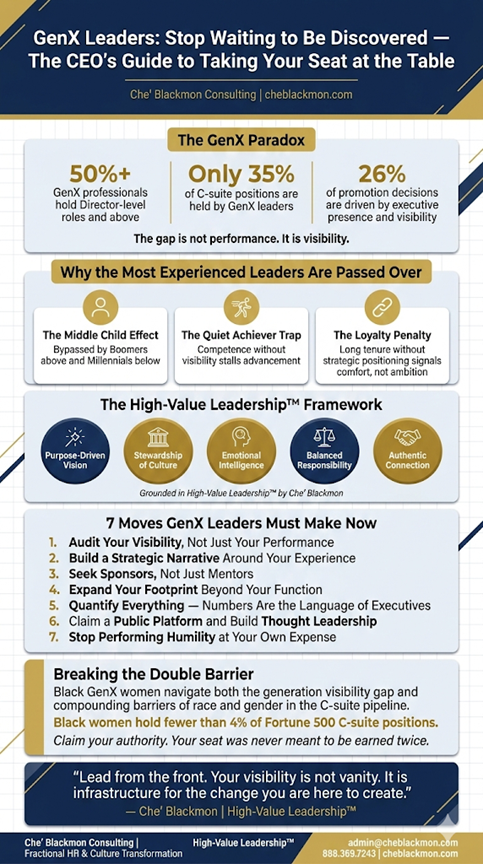
🚀 The Strategic Visibility Blueprint: 7 Moves GenX Leaders Must Make Now

The following strategies are not theoretical. They are practical, evidence-based moves that GenX professionals can begin implementing immediately, regardless of their current title or organizational context.

📈 Move 1: Audit Your Visibility, Not Just Your Performance

Most GenX professionals can recite their performance metrics. Fewer can articulate exactly how visible they are to the people who make promotion decisions. Conduct a visibility audit. Identify the top five decision-makers whose perception of you most directly influences your advancement. Assess honestly how much direct interaction you have with each of them, whether they can specifically describe your contributions and strategic perspective, and whether they think of you when executive opportunities arise.

If the answer to any of these is no or rarely, that is your starting point.

📝 Move 2: Build a Strategic Narrative

Your experience is not self-explanatory. In a world saturated with information and competing priorities, even the most impressive career history requires a clear, compelling narrative to land with impact. Develop a three-sentence leadership positioning statement that communicates who you are, what you uniquely bring, and what organizational problem you are specifically positioned to solve at the next level.

Use this narrative consistently: in executive conversations, in your professional profiles, in how you introduce yourself in new relationships, and in how you frame your contributions in leadership meetings.

🤝 Move 3: Sponsor, Not Just Mentor

Research from Catalyst and Harvard Business Review consistently shows that sponsorship, having someone with organizational power who actively advocates for your advancement in rooms you are not in, is one of the most significant predictors of promotion for historically underrepresented professionals.

GenX leaders often become excellent mentors. The next level is identifying and cultivating sponsors. This requires building upward relationships intentionally, demonstrating your executive readiness directly to senior leaders, and being specific with your advocates about what opportunities you are seeking.

🌎 Move 4: Expand Your Footprint Beyond Your Function

One of the most common visibility limitations for GenX professionals is organizational siloing. You are brilliant within your function, but unknown across the enterprise. Seek cross-functional projects, enterprise-level committees, or organizational initiatives that place you in proximity to senior leaders and peers outside your direct domain.

Every cross-functional project is also a visibility opportunity. Treat it as one.

📊 Move 5: Quantify Everything

GenX leaders often describe their contributions in qualitative terms: built a great team, improved culture, strengthened relationships. Quantification is the language of executive leadership. Translate your impact into numbers wherever possible. Turnover reduction percentages. Engagement score increases. Revenue protected or generated. Cost reductions. Time to productivity improvements.

Numbers are not a substitute for the full story of your leadership. But they are the credibility anchors that make the story land with decision-makers.

🎙️ Move 6: Claim a Public Platform

Thought leadership is no longer the exclusive domain of published academics and keynote speakers. LinkedIn, industry associations, local business organizations, and professional conferences all offer GenX leaders platforms to demonstrate their expertise beyond the walls of their current organization.

Start where you are. A short LinkedIn article. A panel discussion at an industry event. A guest post in a trade publication. Each public expression of your expertise builds external credibility that reinforces your internal positioning.

🗣️ Move 7: Stop Performing Humility at Your Own Expense

This one is particularly important for Black women and other professionals from underrepresented groups. Humility is a leadership virtue. Self-erasure is not. There is a meaningful difference between leading with humility, which means remaining open, collaborative, and grounded, and performing humility as a strategy to avoid the discomfort of being seen.

When you minimize your contributions in meetings, deflect credit for results your leadership produced, or frame your ideas as tentative suggestions rather than informed perspectives, you are not being humble. You are training the people around you to underestimate you.

Own your expertise. Speak with the authority you have earned. Lead from your full self.

“Authentic leadership — bringing your whole self to your role — correlates with higher engagement, innovation, and organizational performance. When you lead authentically, you not only enhance your own effectiveness but potentially transform the environment for others.” — Rise & Thrive: A Black Woman’s Blueprint for Leadership Excellence

💡 Current Trends GenX Leaders Must Leverage

The organizational landscape of 2025 and beyond is presenting a set of conditions that are uniquely favorable for GenX advancement. Those who understand these trends and position themselves accordingly will find the most significant opportunities of their careers opening now.

🤖 The AI Integration Moment

Artificial intelligence is reshaping every sector of the economy, and organizations are urgently seeking leaders who can bridge the gap between technological capability and human organizational dynamics. GenX leaders, who came of age professionally during the personal computing revolution and the early internet era, have an underappreciated advantage here. They understand technology adoption cycles. They have lived through organizational transformations driven by technological disruption. They know what it looks like when technology is implemented without the change management infrastructure to support it.

The leader who can position AI adoption within a robust culture and people strategy framework is extraordinarily valuable in this moment. That leader is often GenX.

💼 The Multigenerational Leadership Demand

Today’s workforce spans five generations simultaneously, from the youngest Gen Z entrants to the most senior Baby Boomer holdovers. Managing across that spectrum requires a level of interpersonal sophistication, contextual intelligence, and organizational patience that is genuinely rare.

GenX leaders, by virtue of their position in the generational middle, often possess an intuitive capacity for this kind of bridging leadership. They can communicate credibly with Boomers and with Gen Z. They understand both analog and digital organizational cultures. They have managed up and managed down across generational divides for decades. This is a specific and valuable leadership competency. Name it. Claim it.

🌍 The Values-Led Business Imperative

Organizations across every sector are under increasing pressure from employees, customers, investors, and communities to lead with explicit values and to demonstrate measurable commitment to those values through their culture, policies, and people practices. This is precisely the terrain on which the High-Value Leadership™ methodology was built.

GenX leaders who have invested in their understanding of culture as a strategic driver and who can articulate how their leadership approach creates environments where values are lived rather than stated are exceptionally well-positioned for this moment.

✅ Actionable Takeaways

For GenX Leaders Ready to Advance:

  1. Complete a visibility audit this week. Identify your top five organizational decision-makers and honestly assess your current level of strategic visibility with each one.
  2. Write your leadership positioning statement. Three sentences. What you bring, what you have built, and what organizational challenge you are built to solve at the next level.
  3. Identify one cross-functional opportunity in the next 30 days. A committee, a project, a working group. Somewhere that places you in proximity to leaders outside your immediate reporting structure.
  4. Quantify your most significant contribution from the past 12 months. Express it in numbers. Practice stating it out loud in one sentence.
  5. Begin building your public platform. One article, one conference proposal, one speaking opportunity. Start with what is closest and most achievable.

For GenX Black Women Navigating Additional Barriers:

  • Name what is happening. Distinguishing bias from performance feedback is not always simple, but it is essential. Build relationships with mentors and sponsors who can help you see your situation clearly and advocate for you strategically.
  • Document your contributions in real time. Keep a running record of your results, your ideas, and the moments when your contributions were credited to others. This record protects you and positions you.
  • Invest in your external brand. Your visibility outside your organization insulates you from internal political dynamics and creates alternative pathways when organizational structures prove resistant to your advancement.
  • Find your people. Community is not a luxury. It is a strategic resource. Connect with other GenX Black women leaders who understand the terrain and can offer support, insight, and solidarity.
  • Lead from the front, not the back. Resist the pull toward invisible leadership. Your visibility is not vanity. It is infrastructure for the change you are here to create.

🗣️ Discussion Questions for Readers

Whether you are reading this as a GenX leader mapping your next career chapter or as an organizational decision-maker thinking about your leadership pipeline, the following questions are worth sitting with.

  1. Where in your career have you been waiting to be discovered rather than actively positioning yourself for advancement? What would shift if you stopped waiting?
  2. How would you describe your current visibility with the people who make the decisions that matter most to your career trajectory? What specific actions would change that picture?
  3. In what ways does your organization’s culture reward or penalize visible leadership, particularly for women and professionals of color? What is your responsibility in that dynamic?
  4. If you were to define your leadership legacy at this stage of your career, what would it say? And does the way you currently show up in your organization reflect that legacy?
  5. What is one strategic move from this article that you could realistically begin in the next two weeks? Who would you need to involve, and what would success look like?

👟 Next Steps for Readers

Awareness is the beginning. Commitment is what follows.

If this article has named something you have been feeling for a while, that recognition is important information. It means you are ready for the next chapter. Here are three concrete steps to move from recognition to action.

  1. Read the foundational work. High-Value Leadership: Transforming Organizations Through Purposeful Culture provides the complete framework for the leadership approach described in this article. Mastering a High-Value Company Culture offers the strategic blueprint for building and sustaining the organizational environments where GenX leaders can thrive. Rise and Thrive: A Black Woman’s Blueprint for Leadership Excellence speaks directly to the unique navigation required of Black women leaders at every stage of the advancement journey. All three are available through Che’ Blackmon Consulting.
  2. Conduct your visibility audit this week. Not next month. This week. Use the framework from Move 1 in this article and be rigorously honest with yourself about what you find.
  3. Start the conversation. If you are ready to think strategically about your leadership trajectory, your organizational culture, or your advancement as a GenX professional, bring that conversation to someone who understands the terrain.

🤝 Ready to Stop Waiting and Start Leading?

Che’ Blackmon Consulting partners with professionals and organizations who are ready for real transformation. With more than 24 years of progressive HR and organizational leadership experience, doctoral-level research in AI-enhanced culture transformation, and a practice grounded in the High-Value Leadership™ methodology, Che’ Blackmon brings both the strategic depth and the human insight that today’s GenX leaders need.

Whether you are an individual leader ready to claim your next chapter, an organization looking to develop and advance your experienced talent pipeline, or an executive team ready to invest in the culture that retains your best people, the work begins with a conversation.

Your seat at the table is waiting. Take it.

📧 admin@cheblackmon.com   📞 888.369.7243   🌐 cheblackmon.com

Che’ Blackmon Consulting | Fractional HR & Culture Transformation | Michigan

#GenXLeaders #ExecutiveLeadership #HighValueLeadership #LeadershipDevelopment #CareerAdvancement #BlackWomenLead #CultureTransformation #PeopleStrategy #VisibilityStrategy #WomenInLeadership #GenXProfessionals #HRLeadership #OrganizationalCulture #TakeYourSeat #CheBlackmonConsulting

🌍 Cross-Cultural Competence: Leading in a Global Workplace 🌐

By Che’ Blackmon, DBA Candidate | Founder & CEO, Che’ Blackmon Consulting

✨ Introduction: The New Reality of Leadership

The workplace has changed. Today’s leaders navigate teams that span continents, cultures, and communication styles. Whether your organization operates across international borders or serves a diverse local community, cross-cultural competence has become essential for effective leadership. This is not merely about being polite or politically correct. It is about building the kind of purposeful culture that drives results.

As I discuss in High-Value Leadership: Transforming Organizations Through Purposeful Culture, leaders who understand the intersection of culture and performance create environments where every team member can contribute their best work. Cross-cultural competence amplifies this principle by ensuring that cultural differences become sources of strength rather than barriers to success.

🔍 Understanding Cross-Cultural Competence

Cross-cultural competence refers to the ability to understand, communicate with, and effectively interact with people across cultures. It involves awareness of your own cultural worldview, knowledge of different cultural practices and worldviews, and the skills to bridge differences respectfully and productively.

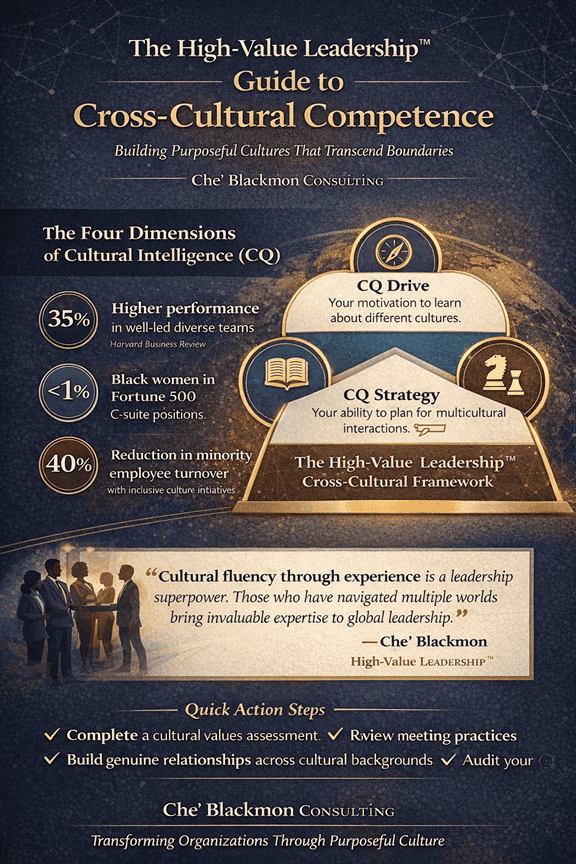
Research from the Harvard Business Review indicates that culturally diverse teams outperform homogeneous ones by up to 35% when led effectively. However, the same research shows that poorly managed diverse teams underperform significantly. The difference lies in leadership competence.

The Four Dimensions of Cultural Intelligence

Dr. Soon Ang and Dr. Linn Van Dyne’s research on Cultural Intelligence (CQ) identifies four key capabilities. First, CQ Drive represents your motivation and interest in learning about different cultures. Second, CQ Knowledge encompasses your understanding of cultural similarities and differences. Third, CQ Strategy involves your ability to plan for multicultural interactions. Fourth, CQ Action reflects your capability to adapt behavior appropriately in different cultural contexts.

👩🏾‍💼 The Overlooked Perspective: Black Women in Global Leadership

Discussions about cross-cultural competence often focus on national cultures while overlooking the unique experiences of those who navigate multiple cultural identities daily. Black women in corporate spaces, for instance, bring invaluable perspectives to global leadership conversations.

In Rise & Thrive: A Black Woman’s Blueprint for Leadership Excellence, I explore how Black women have historically developed sophisticated cultural navigation skills out of necessity. These skills, including code-switching, reading organizational dynamics, and building coalitions across differences, translate directly into cross-cultural leadership capabilities.

McKinsey’s research on diversity in leadership consistently shows that companies with diverse leadership teams, including representation of Black women at senior levels, demonstrate stronger financial performance and innovation. Yet Black women remain severely underrepresented in global leadership roles, holding less than 1% of C-suite positions in Fortune 500 companies.

Leveraging Lived Experience as Leadership Capital

Leaders from traditionally overlooked backgrounds often possess what I call “cultural fluency through experience.” Having navigated predominantly white corporate spaces while maintaining connections to their communities of origin, these leaders develop nuanced abilities to bridge cultural gaps, recognize unspoken dynamics, and create inclusive environments.

Organizations seeking to build cross-cultural competence should recognize and leverage this expertise rather than expecting assimilation. When Black women and other underrepresented leaders are empowered to lead authentically, they model the kind of cultural bridge-building that global organizations require.

📊 Case Studies: Cross-Cultural Leadership in Action

Case Study 1: Manufacturing Meets Global Markets

Consider a mid-sized automotive supplier that expanded operations to include facilities in Mexico and partnerships in Germany. Initially, the company experienced significant friction. American managers interpreted Mexican colleagues’ relationship-building communication style as inefficient. German partners found American directness abrasive.

The turning point came when leadership invested in cross-cultural training and, critically, elevated leaders from each location into strategic decision-making roles. By creating space for different communication styles and decision-making approaches, the company reduced conflict, improved supplier relationships, and increased production efficiency by 22% within 18 months.

Case Study 2: Healthcare System Transformation

A regional healthcare system serving a rapidly diversifying patient population struggled with patient satisfaction scores and staff turnover. Exit interviews revealed that employees from minority backgrounds felt their cultural insights were dismissed, while patients reported feeling misunderstood by care providers.

The organization implemented a comprehensive culture transformation initiative. This included elevating diverse voices into leadership councils, creating cultural liaison positions, and revising hiring practices to value cultural competence alongside clinical skills. Within two years, patient satisfaction scores increased by 15%, and staff turnover among minority employees dropped by 40%.

🛠️ Building Your Cross-Cultural Competence: Practical Strategies

In Mastering a High-Value Company Culture, I outline principles for creating organizational cultures that bring out the best in people. These principles apply directly to cross-cultural leadership.

Strategy 1: Develop Cultural Self-Awareness

Before you can effectively lead across cultures, you must understand your own cultural programming. Examine your assumptions about time, hierarchy, communication, and conflict. Consider how your background shapes what you consider “professional” or “appropriate.” Many workplace norms that seem universal are actually culturally specific.

Action Step: Complete a cultural values assessment such as the Intercultural Development Inventory or CQ Assessment. Reflect on three situations where your cultural assumptions may have influenced your leadership decisions.

Strategy 2: Practice Active Cultural Learning

Cross-cultural competence requires ongoing education. Study the cultural backgrounds of your team members and stakeholders. Learn about communication styles, decision-making preferences, and values that may differ from your own. Approach this learning with humility and genuine curiosity rather than treating it as a checklist exercise.

Action Step: Identify one cultural group you work with regularly but know little about. Commit to learning about their cultural context through reading, conversation, and observation. Seek out content created by members of that community rather than outside observers.

Strategy 3: Create Inclusive Communication Practices

Effective cross-cultural leaders adapt their communication styles while creating space for diverse communication preferences. This means being explicit about expectations rather than assuming shared understanding, allowing multiple channels for input, and recognizing that silence may indicate disagreement or contemplation depending on cultural context.

Action Step: Review your team meeting practices. Do they favor those comfortable with verbal debate? Add written input options, structured reflection time, and alternative ways for team members to contribute ideas.

Strategy 4: Build Diverse Leadership Pipelines

Organizations cannot develop cross-cultural competence through training alone. They must ensure that leadership teams reflect the diversity of their workforce, customer base, and global reach. This requires intentional efforts to identify, develop, and promote leaders from underrepresented backgrounds, including Black women and other traditionally overlooked groups.

Action Step: Audit your organization’s leadership pipeline. Where are the gaps in representation? What barriers exist for advancement? Create specific initiatives to address these gaps with accountability measures and timelines.

📈 Current Trends and Best Practices

The landscape of cross-cultural leadership continues to evolve. Several trends are shaping best practices in this field.

Remote Work and Virtual Teams. The shift to remote and hybrid work has intensified the need for cross-cultural competence. Leaders now manage teams they may never meet in person, across multiple time zones and cultural contexts. Research from GitLab and Buffer indicates that successful remote teams prioritize explicit communication, documentation, and asynchronous work practices that accommodate different working styles and schedules.

Intersectionality in Leadership Development. Progressive organizations recognize that cultural identity is multifaceted. Effective cross-cultural development programs address intersectionality, understanding that a Black woman executive, a first-generation college graduate manager, or an LGBTQ+ team leader from a conservative region each bring unique perspectives and face distinct challenges.

Data-Driven Culture Assessment. Leading organizations use analytics to measure cultural competence and inclusion. This includes tracking promotion rates across demographic groups, analyzing engagement survey results by cultural background, and monitoring retention patterns. Data provides accountability and helps identify systemic barriers that individual good intentions cannot overcome.

Psychological Safety as Foundation. Research by Dr. Amy Edmondson and others demonstrates that psychological safety, the belief that one can speak up without punishment or humiliation, is essential for cross-cultural teams to thrive. Creating environments where team members can bring their authentic cultural selves without fear enables the innovation and collaboration that diverse teams promise.

💡 Actionable Takeaways

To strengthen your cross-cultural leadership competence, focus on these key actions:

1. Commit to Self-Examination. Regularly assess your own cultural biases and assumptions. Seek feedback from colleagues with different backgrounds about how your leadership style lands across cultures.

2. Invest in Relationships. Build genuine connections with team members from different cultural backgrounds. Move beyond surface-level interactions to understand their perspectives, values, and experiences.

3. Amplify Overlooked Voices. Actively create space for Black women, people of color, and other traditionally marginalized groups to contribute and lead. Recognize that their cultural navigation expertise is an organizational asset.

4. Adapt Your Leadership Style. Develop flexibility in how you communicate, make decisions, and provide feedback. What works in one cultural context may not work in another.

5. Make Systemic Changes. Individual competence matters, but sustainable change requires systemic attention to policies, practices, and structures that may inadvertently disadvantage certain cultural groups.

6. Measure and Adjust. Track outcomes related to cultural competence and inclusion. Use data to identify what is working and what needs adjustment.

🎯 Conclusion: Leadership That Transcends Boundaries

Cross-cultural competence is not an optional skill for today’s leaders. It is fundamental to building the high-value organizational cultures that drive sustainable success. When leaders embrace cultural differences as opportunities rather than obstacles, they unlock innovation, engagement, and performance that homogeneous thinking cannot achieve.

For those who have been traditionally overlooked in leadership conversations, particularly Black women navigating corporate spaces, know that your cultural fluency is a superpower. Your experience bridging worlds, adapting to different contexts, and bringing your full self despite resistance positions you uniquely for the global leadership challenges ahead.

The path forward requires both individual growth and organizational transformation. As I emphasize throughout my work, purposeful culture does not happen by accident. It requires intentional leadership, consistent action, and unwavering commitment to bringing out the best in every person, regardless of their cultural background.

❓ Discussion Questions for Reflection

1. What cultural assumptions have you brought into leadership situations that you later recognized were not universal? How did this recognition change your approach?

2. How does your organization currently leverage the cultural expertise of Black women and other traditionally overlooked leaders? What opportunities exist to do this more effectively?

3. Think about a cross-cultural conflict or misunderstanding you have witnessed. What cultural factors may have contributed to the disconnect? How might a culturally competent leader have approached the situation differently?

4. What barriers exist in your organization that may prevent culturally diverse leaders from advancing into senior positions? What specific steps could address these barriers?

5. How can you personally commit to growing your cross-cultural competence over the next six months? What specific learning activities and relationship-building efforts will you pursue?

🚀 Your Next Steps

Building cross-cultural competence is a journey, not a destination. Start where you are, commit to growth, and take consistent action. Whether you are an emerging leader seeking to develop your capabilities or an executive aiming to transform your organizational culture, the time to begin is now.

Consider exploring additional resources such as Mastering a High-Value Company Culture and High-Value Leadership: Transforming Organizations Through Purposeful Culture for deeper insights into building cultures where all people thrive. For Black women and other leaders from traditionally overlooked backgrounds, Rise & Thrive: A Black Woman’s Blueprint for Leadership Excellence offers specific guidance for navigating corporate spaces while leading authentically.

🤝 Partner with Che’ Blackmon Consulting

Ready to transform your organization’s culture and develop cross-cultural leadership capabilities? Che’ Blackmon Consulting offers fractional HR leadership, culture transformation consulting, and executive coaching designed to create workplaces where every person can contribute their best work.

📧 Email: admin@cheblackmon.com

📞 Phone: 888.369.7243

🌐 Website: cheblackmon.com

Let’s build purposeful cultures together. ✨

#HighValueLeadership #CrossCulturalCompetence #GlobalLeadership #DiversityAndInclusion #CultureTransformation #BlackWomenInLeadership #LeadershipDevelopment #WorkplaceCulture #InclusiveLeadership #HRLeadership #OrganizationalCulture #ExecutiveLeadership #CulturalIntelligence #PurposefulCulture #WomenInLeadership

The Culture Catalyst: How One Leader Can Spark Organization-Wide Change 🔥

By Che’ Blackmon, DBA Candidate & Founder, Che’ Blackmon Consulting

Have you ever wondered why some leaders seem to effortlessly create positive waves throughout their entire organization while others struggle to effect even the smallest changes? The answer lies not in authority or budget, but in understanding how individual leadership choices cascade through organizational systems. This is the power of the culture catalyst—a leader who, by shifting their mindset and approach, inspires organization-wide transformation.

In my work with executives and organizations across manufacturing, healthcare, and professional services, I have witnessed firsthand how one leader’s commitment to authentic, purposeful culture can fundamentally reshape how people work. The question is not whether you have the power to create change. The question is whether you are ready to become the culture catalyst your organization needs.

What Is a Culture Catalyst? 🧪

A culture catalyst is a leader who understands that organizational culture is not something that happens to an organization—it is something that is intentionally created through consistent, aligned actions and decisions. Unlike a charismatic figure who inspires through personality alone, a culture catalyst creates systemic change by modeling high-value behaviors and establishing clear expectations that ripple through every level of the organization.

The culture catalyst operates from a foundation of purpose. In my book Mastering a High-Value Company Culture, I emphasize that high-value cultures are built on clarity about who we are, what we stand for, and why our work matters. A culture catalyst is deeply committed to bringing that vision to life daily.

Culture catalysts share several key characteristics. They communicate with authenticity and transparency. They hold themselves and others accountable to shared values. They listen deeply and create psychological safety where people feel comfortable taking intelligent risks. Most importantly, they understand that their role is not to have all the answers, but to ask the right questions and create the conditions where teams can solve problems together.

The Multiplier Effect of Leadership Integrity 💫

One of the most powerful truths about leadership is that your integrity—the alignment between your words and actions—is not a personal virtue. It is a catalyst for organizational transformation. When your team observes that you genuinely live the values you speak about, something shifts. Trust increases. Engagement improves. People become willing to bring their full selves to their work.

Consider a manufacturing facility where a newly promoted operations director arrived to find an organization struggling with safety compliance and engagement. Rather than implementing a top-down mandate, this leader began by walking the production floor every single day, listening to frontline employees, and most importantly, following the exact same safety protocols she expected from others. There were no shortcuts for leadership. No exceptions. Within six months, safety incidents had declined significantly, and employees began taking ownership of safety initiatives themselves. Why? Because the leader had made safety a lived value, not a policy.

This is the multiplier effect. Your individual commitment to integrity does not simply improve your own leadership—it gives permission for integrity to flourish at every level of the organization. People take cues from leadership. When they see you holding yourself to the same standard you hold them to, they internalize that standard. When they see you admitting mistakes and learning from them, they become more willing to take intelligent risks. When they see you staying committed to organizational values even when it is financially difficult, they understand what you truly value.

This is especially important in conversations about diversity, equity, and inclusion. Black women in particular often navigate corporate spaces where the dominant culture has never genuinely prioritized them. A culture catalyst who is committed to building truly inclusive organizations does not just say the right things. She or he actively creates space for historically overlooked voices to be heard. She or he examines systems and processes to ensure they do not inadvertently exclude. Most importantly, she or he holds this commitment even when there is no external pressure to do so. That consistency is what changes culture.

The Hidden Barriers Facing Overlooked Leaders 🚧

If culture catalysts are so powerful, why are some leaders unable to create meaningful change? Often, the answer lies in how organizational systems can inadvertently suppress the very contributions we need most. This is particularly true for Black women and other traditionally overlooked talent in corporate spaces.

Consider the subtle but significant barriers. A Black woman leader might offer an innovative approach to solving a process problem, only to have her idea overlooked until a colleague—typically someone who looks like the existing power structure—proposes a similar idea and receives credit and advancement. Over time, that leader might internalize the message that her contributions are not valued. Her engagement decreases. Her willingness to speak up diminishes. The organization loses a potential culture catalyst because the system did not create space for her brilliance to be recognized.

In my research and work with organizations, I have observed that the most critical barrier is not a lack of talent or capability among overlooked populations. The barrier is a lack of intentional systems to recognize and amplify that talent. I address this extensively in my e-book Rise and Thrive: A Black Woman’s Blueprint for Leadership Excellence, which explores how women of color can navigate these systems while staying true to their authentic selves.

A true culture catalyst recognizes this. She or he actively works to dismantle the hidden systems that prevent talented people from being seen, heard, and valued. This might mean implementing blind resume review processes, creating mentorship programs specifically designed to develop overlooked talent, or conducting regular check-ins to ensure that great ideas are being attributed and recognized regardless of who proposes them. These actions signal that the organization is serious about building a culture where all talent can thrive.

Real-World Examples of Culture Catalysts at Work 📊

To make this tangible, let me share some general examples of how culture catalysts have created real transformation in their organizations.

Example One: From Compliance to Commitment

A healthcare organization was struggling with low engagement scores, particularly among clinical staff. Employees felt like they were simply complying with policies rather than being part of a meaningful mission. A new HR leader began shifting the conversation. In every meeting, she started by reminding people why the organization exists and how their individual work connects to that mission. She invited frontline staff to meetings that had previously been leadership-only. She implemented a system where frontline employees could propose changes directly, knowing those proposals would receive genuine consideration.

The result? Engagement scores increased by twelve percent over two years. More importantly, employees began taking initiative to solve problems without being asked. Clinical staff started mentoring newer team members. Retention improved. The culture shifted from compliance to ownership because one leader decided to treat people as partners in the mission rather than workers executing a job.

Example Two: Creating Space for Overlooked Talent

A manufacturing organization had a diverse workforce, but leadership positions were predominantly filled by one demographic group. A new operations manager made a conscious decision to change this pattern, not through quotas, but through visibility and opportunity. She began rotating people from non-traditional leadership backgrounds into temporary leadership roles. She provided explicit mentorship. She made sure that when these emerging leaders made mistakes, they were coached rather than punished, while also ensuring they received the same high expectations as any other leader.

Over three years, three of these talented individuals were promoted into permanent leadership roles. The organization’s leadership team became more diverse. Innovation increased because teams now had varied perspectives solving problems. The culture shifted because one leader believed that leadership talent exists throughout the organization and created the systems to surface it.

Example Three: Turning Around a Team Facing Burnout

A department head inherited a team that had experienced significant turnover and whose remaining members were exhausted. Her predecessor had managed through fear and high pressure. She made a conscious choice to enter the role differently. She conducted listening sessions with every team member to understand what had driven people away and what would help people stay. She implemented clearer decision-making processes so people understood not just what decisions were made, but why. She protected her team from unnecessary organizational chaos, filtering what needed their attention from what did not.

Within eighteen months, turnover had stabilized. The team’s productivity metrics improved. People began volunteering to take on stretch assignments. The shift in culture happened because one leader decided that the way she led would be fundamentally different from what came before.

The Four Pillars of a Culture Catalyst 🏛️

Based on my research and experience, culture catalysts operate from four foundational pillars. Understanding these pillars is essential if you want to become a catalyst in your own organization.

Pillar One: Clarity of Purpose

Culture catalysts are crystal clear about why the organization exists and what it stands for. This clarity is not something that lives only in mission statements on the wall. It lives in daily decisions. A leader with clarity of purpose asks questions like: Does this decision align with who we say we are? Is this action consistent with our values? Am I making this choice because it is easy or because it is right? When clarity of purpose guides decisions, employees see that the organization’s values are not merely aspirational—they are operational.

Pillar Two: Authentic Communication

Culture catalysts communicate with transparency and vulnerability. They do not pretend to have all the answers. They share what they know and what they do not know. They explain their thinking process when making decisions. They acknowledge mistakes and talk about what they learned. This kind of communication creates psychological safety. It sends the message that it is acceptable to be human at work. In my book High-Value Leadership: Transforming Organizations Through Purposeful Culture, I emphasize that authentic communication is not a soft skill. It is a fundamental driver of business outcomes because it enables trust, and trust enables everything else.

Pillar Three: Intentional Accountability

Culture catalysts hold themselves and others accountable to shared standards, but they do so in a way that grows people rather than diminishing them. Accountability means clear expectations. It means honest feedback delivered with the intent to help someone improve. It means consequences for choices, delivered with respect. It also means that leaders hold themselves to the same standard they hold their teams to. This kind of accountability builds trust. It signals that standards matter because people matter.

Pillar Four: Inclusive Excellence

Culture catalysts understand that their organizations are stronger when the full spectrum of talent is visible, valued, and developed. Inclusive excellence is not about lowering standards or practicing preferential treatment. It is about recognizing that talent looks different and comes from different backgrounds. It is about removing barriers that have historically prevented certain populations from being seen and heard. It is about creating mentorship and advancement pathways that work for people with different starting points. When a leader commits to inclusive excellence, she or he signals that the organization values innovation, different perspectives, and the full humanity of every person.

Current Trends in Culture Transformation 🌐

As we move deeper into 2026 and beyond, several trends are reshaping how culture catalysts operate.

AI and Human-Centered Leadership

Artificial intelligence is transforming how organizations operate, from automating routine tasks to providing predictive insights about employee engagement and retention. Culture catalysts are leveraging these tools not to replace human connection, but to free up time and energy for more meaningful leadership work. Data can now surface which employees are at risk of leaving, but a culture catalyst uses that data to have deeper conversations and create more supportive environments. Technology becomes a tool for human-centered leadership, not a replacement for it.

The Rise of Purpose-Driven Organizations

Employees, particularly younger workers, want to work for organizations that stand for something beyond profit. Culture catalysts are responding by ensuring that organizational purpose is clear, authentic, and embedded in daily operations. This is not performative corporate social responsibility. This is genuine commitment to making a positive impact. Organizations led by culture catalysts are finding that when people understand how their work contributes to meaningful outcomes, engagement and retention improve dramatically.

Building Cultures of Psychological Safety

In complex, rapidly changing business environments, organizations need people who are willing to speak up, take intelligent risks, and challenge ideas. Culture catalysts understand that this kind of innovation only happens when psychological safety is present. People need to feel confident that they can make a mistake, propose an unconventional idea, or say no to an unreasonable request without facing career consequences. Leaders are increasingly creating explicit structures to build this safety, from psychological safety assessments to training in how to respond to bad news without blaming.

Actionable Steps to Become a Culture Catalyst 🎯

If you are ready to become a culture catalyst in your organization, here are specific actions you can take immediately.

One: Define Your Core Values and Practice Them

Before you can model values for others, you need to be crystal clear about what your core values are. What do you believe about people? What do you believe about work? What do you believe about integrity? Once you have clarity, practice living those values daily. This is not theoretical work. This is real. In every decision you make, every interaction you have, every meeting you run, ask yourself: Is this aligned with my values? Am I modeling what I expect from others? When your team observes this consistency over time, they will begin to internalize those values themselves.

Two: Listen More Than You Talk

One of the most underrated leadership skills is listening. Culture catalysts listen with genuine curiosity. They ask questions and then resist the urge to fill silence with their own opinions. They listen to understand, not to prepare their rebuttal. Make a commitment to spend time listening to frontline employees, to people in underrepresented groups, to people whose voices have been overlooked. Ask them what barriers they experience. Ask them what would help them do their best work. Then actually act on what you hear. When people feel genuinely heard, they become more engaged, more committed, and more willing to go above and beyond.

Three: Examine Your Systems for Hidden Bias

Culture catalysts understand that even well-intentioned systems can perpetuate bias and exclude overlooked talent. Take time to examine your hiring process. Who typically advances? Does it follow a predictable pattern based on background, school, demographic characteristics? Examine your feedback systems. Do certain groups receive harsher feedback or less specific developmental guidance? Examine your promotion timelines. Is there a pattern in who gets promoted quickly and who gets stuck? Once you identify these patterns, work systematically to change them. This might mean blind resume review. This might mean structured interviews. This might mean diverse hiring panels. This might mean explicit mentorship programs. The key is that you are being intentional about removing barriers that prevent talent from being seen.

Four: Create Psychological Safety Explicitly

Do not assume that psychological safety will happen naturally. Create it intentionally. This means establishing group norms about how mistakes are treated. It means responding to bad news with curiosity rather than blame. It means protecting people who speak up with unconventional ideas. It means acknowledging when you do not know something. It means asking for help from people at all levels. Small actions send powerful signals about whether it is safe to take risks in your organization.

Five: Invest in Your Own Development

Culture catalysts understand that leadership development is not a one-time event. It is an ongoing journey. Invest in your own learning. Read. Take courses. Work with a mentor or coach. Join peer learning groups. Stay curious about organizational psychology, human behavior, and culture transformation. The more you understand yourself and how systems work, the more effective you become at catalyzing change. Importantly, make your own learning visible. Let your team see you wrestling with difficult concepts. Let them see you trying new approaches and adjusting when something does not work. This signals that learning is valued and that growth is always possible.

The Ripple Effect of One Leader’s Commitment 🌊

One of the most beautiful aspects of culture catalysts is the ripple effect of their commitment. You do not need buy-in from the entire organization to start shifting culture. You do not need permission from the C-suite. You simply need to commit to leading differently in your own sphere of influence.

When you, as a leader, commit to treating people with respect and transparency, something shifts in your team. People become more trusting. They become more willing to contribute ideas. They become more engaged. That shift spreads. Your team members begin treating each other differently. They begin holding each other accountable to higher standards of respect and collaboration. That energy spreads to other departments. Other leaders notice. The organization begins to shift.

This is especially true when culture catalysts intentionally work to create space for overlooked talent. When a leader commits to identifying and developing talented people from underrepresented backgrounds, that sends a powerful signal throughout the organization. It creates new possibilities. It changes who people see as capable of leadership. Over time, the organization becomes genuinely more diverse and more innovative because people who were previously invisible are now visible and contributing their full talents.

Do not underestimate the power of your individual commitment. Your leadership matters. Your willingness to model different behaviors, ask different questions, and make different decisions ripples far beyond what you can see in any given moment.

Key Takeaways 📌

A culture catalyst is a leader who creates organization-wide transformation through integrity, clarity of purpose, and authentic communication.

Your individual commitment to high standards of integrity does not just improve your own leadership. It gives permission for integrity to flourish at every level of your organization.

Culture catalysts intentionally work to identify and develop talent from traditionally overlooked populations, recognizing that competitive advantage comes from accessing the full spectrum of human talent.

The four pillars of culture catalysts are clarity of purpose, authentic communication, intentional accountability, and inclusive excellence.

You do not need buy-in from the entire organization to start shifting culture. You simply need to commit to leading differently in your own sphere of influence.

The ripple effect of one leader’s commitment is profound and far-reaching.

Discussion Questions for Your Leadership Team 💭

What core values do you want to model as a leader, and are you currently practicing them consistently across all your decisions and interactions?

Who in your organization has talent that remains underutilized or invisible, and what specific actions could you take to help that talent become visible?

What hidden barriers exist in your hiring, feedback, and promotion systems, and how might those barriers prevent talented people from advancing?

How do your team members currently experience psychological safety in your organization, and what specific actions could you take to strengthen it?

What would change in your organization if you committed to leading with the same authenticity and vulnerability you expect from others?

How are you currently investing in your own development as a leader, and what would it mean to make that development a visible, ongoing commitment?

Next Steps: Ready to Catalyze Change? 🚀

Culture transformation is not something that happens overnight, and it is not something you need to figure out alone. If you are ready to become a culture catalyst in your organization, Che’ Blackmon Consulting can help.

Che’ Blackmon Consulting specializes in working with leaders and organizations to build high-value cultures that attract, develop, and retain exceptional talent. With over twenty-four years of progressive HR leadership experience across manufacturing, healthcare, and professional services, Che’ brings deep expertise in culture transformation, inclusive talent development, and predictive analytics for employee retention.

Our services include fractional HR consulting, executive coaching focused on culture leadership, organizational assessments to identify hidden barriers, talent development programs, and customized training designed specifically for your organization’s needs. We work with organizations ranging from twenty to two hundred employees, combining our High-Value Leadership methodology with data-driven insights to create sustainable culture change.

Whether you are ready for a full organizational transformation or you want to start by working with your leadership team, we can design an approach that fits your needs and your timeline. Our goal is simple: to help you become the culture catalyst your organization needs.

Connect with Che’ Blackmon Consulting

📧 Email: admin@cheblackmon.com

📞 Phone: 888.369.7243

🌐 Website: cheblackmon.com

Your organization needs what you have to offer. The question is not whether you have the power to create change. The question is whether you are ready to step into your role as a culture catalyst. We are here to support you on that journey.

Here’s to building organizations where everyone can thrive. 💚

#CultureTransformation #LeadershipDevelopment #OrganizationalCulture #InclusiveLeadership #DiverseLeadership #WomenInLeadership #BlackWomenLeaders #HighValueLeadership #AuthenticLeadership #TalentDevelopment #EmployeeEngagement #CultureChange #LeadershipExcellence #CorporateCulture #TeamLeadership

The Money Conversation: Talking Compensation Without Awkwardness 💰

By Che’ Blackmon, Founder & CEO, Che’ Blackmon Consulting


Let’s be honest: most of us would rather discuss almost anything else—our weekend plans, the weather, even politics—before we willingly talk about money at work. Yet compensation conversations are the cornerstone of professional growth, organizational fairness, and personal financial security. The awkwardness surrounding these discussions isn’t just uncomfortable; it’s costly, particularly for those already navigating systemic barriers in corporate spaces.

Why the Silence Costs Us All

The reluctance to discuss compensation stems from deeply rooted cultural taboos, power dynamics, and fear of professional consequences. We’ve been socialized to believe that talking about money is impolite, greedy, or unprofessional. This silence, however, perpetuates pay inequities and keeps talented professionals from achieving their full earning potential.

Consider this: women earn approximately 84 cents for every dollar earned by men, and Black women earn just 67 cents for every dollar earned by white, non-Hispanic men. These gaps don’t narrow by accident. They persist because of the very awkwardness we’re addressing—the discomfort that prevents honest dialogue about what we’re worth and what we’re paid.

In High-Value Leadership: Transforming Organizations Through Purposeful Culture, I discuss how transformational leaders create environments where difficult conversations become catalysts for positive change. Compensation transparency is one of those conversations. When organizations cultivate cultures that normalize these discussions, everyone benefits—from entry-level employees to the C-suite.

The Cultural Conditioning That Keeps Us Quiet 🤫

From childhood, many of us receive mixed messages about money. “Don’t ask people what they make.” “Be grateful for what you have.” “Asking for more seems greedy.” These well-intentioned lessons create professional adults who struggle to advocate for their worth.

For Black women and other traditionally overlooked professionals, these challenges compound. Research shows that Black women face unique stereotyping when negotiating—they’re often perceived as “aggressive” or “difficult” for demonstrating the same assertiveness that earns white male colleagues respect. This double standard creates a minefield: speak up and risk being labeled; stay silent and accept less than you deserve.

A major technology company discovered this firsthand when conducting an internal pay equity audit. They found that their highest-performing Black female engineers were consistently paid 12-18% less than their male counterparts with identical experience and performance ratings. The disparity wasn’t intentional; it resulted from years of those women avoiding compensation conversations out of fear, while their male colleagues negotiated freely and frequently.

Breaking the Awkwardness: A Framework for Success ✨

1. Prepare With Data, Not Emotion

The most effective compensation conversations are grounded in market research, performance metrics, and tangible contributions. Before initiating the discussion, gather:

  • Industry salary benchmarks for your role, experience level, and geographic location
  • Documentation of your achievements: quantifiable results, completed projects, exceeded targets
  • Expansion of responsibilities you’ve taken on since your last compensation review
  • Market movement: how your industry and role have evolved

This preparation transforms the conversation from personal (“I need more money”) to professional (“Based on market data and my contributions, here’s the compensation alignment I’m seeking”).

2. Choose Timing Strategically

There’s an art to when you raise compensation discussions. Optimal times include:

  • Annual review cycles (but don’t wait for your manager to initiate)
  • After completing a significant project or achievement
  • When taking on expanded responsibilities
  • During market shifts that affect your role’s value

One mid-sized manufacturing organization implemented quarterly “career conversations” separate from performance reviews. This normalized ongoing dialogue about growth, development, and compensation, removing much of the tension from annual review discussions.

3. Frame the Conversation Properly

Language matters enormously. Compare these approaches:

Less Effective: “I really need a raise. My rent went up and things are expensive.”

More Effective: “I’d like to discuss compensation alignment. Based on my research, professionals in similar roles with comparable experience are earning 15-20% more. Given my contributions to the recent product launch and the expanded team leadership I’ve assumed, I believe a salary adjustment to [specific number] reflects market value and my impact.”

The second approach is professional, data-driven, and positions you as someone who understands their value and the broader market context.

4. Practice the Uncomfortable Silence

After stating your case, stop talking. The silence will feel unbearable, but resist the urge to fill it with justifications, apologies, or backtracking. This is where many professionals—especially women—undermine their own negotiations by talking themselves down from their initial request.

There was a company whose HR director noticed a pattern: male candidates averaged 23 seconds of silence after stating their salary expectations, while female candidates averaged 7 seconds before adding qualifiers like “but I’m flexible” or “that might be too high.” Those extra 16 seconds of confidence translated to an average difference of $8,400 in starting salaries.

Special Considerations for Black Women and Traditionally Overlooked Professionals 🎯

In Rise & Thrive: A Black Woman’s Blueprint for Leadership Excellence, I address the unique navigation required when you’re breaking barriers while building your career. Compensation conversations require additional strategic thinking when you’re already managing stereotypes and biases.

The Preparation Tax

Black women often need to be twice as prepared to be considered equally credible. While this reality is frustrating, acknowledging it allows you to plan accordingly:

  • Anticipate potential objections and prepare responses
  • Bring documentation that white colleagues might not need
  • Have external validation ready (market studies, competitive offers, industry benchmarks)
  • Consider having allies or mentors review your approach beforehand

The Collaboration Strategy

Building coalitions with other professionals navigating similar challenges creates strength in numbers. When multiple team members approach leadership about compensation equity concerns—backed by data—it’s harder to dismiss as individual complaints.

A healthcare organization faced this when six Black women in their nursing leadership team simultaneously requested compensation reviews. Rather than approaching individually (where concerns might be deflected), they presented collective data showing systematic pay disparities. The organization conducted a comprehensive audit and implemented corrective adjustments within 90 days.

The Documentation Discipline

Keep meticulous records of your accomplishments, contributions, and any verbal commitments about compensation. Documentation protects you and provides irrefutable evidence when memories become selective.

Creating a Culture That Welcomes These Conversations 🏢

As a doctoral candidate researching organizational transformation and someone who has spent over two decades in progressive HR leadership, I’ve seen how the right culture changes everything. Organizations serious about equity must actively cultivate environments where compensation conversations are normalized, not penalized.

In Mastering a High-Value Company Culture, I outline how purposeful culture transformation requires intentional systems and practices. Here’s how organizations can reduce awkwardness around compensation:

Implement Transparent Salary Bands

When employees understand the compensation range for their role and what it takes to progress, mystery and guesswork disappear. Buffer, Whole Foods, and others have pioneered radical transparency, publishing salaries internally or even publicly.

Train Managers in Compensation Conversations

Most managers receive little training in discussing money. They’re as uncomfortable as employees, which creates defensive, awkward exchanges. Investing in manager development around compensation discussions improves outcomes for everyone.

Conduct Regular Pay Equity Audits

Proactive organizations don’t wait for problems to surface. They regularly analyze compensation data by gender, race, and other demographics, addressing disparities before they become legal or reputational issues.

Establish Clear Compensation Philosophies

When organizations articulate how they determine pay—market positioning, internal equity, performance impact—employees have a framework for understanding their compensation and requesting adjustments.

A regional financial services company implemented these practices after discovering their employee engagement scores around “fair compensation” were 30 points below industry benchmarks. Within 18 months of creating transparency, conducting audits, and training managers, those scores increased by 28 points, and voluntary turnover decreased by 34%.

The Script: What to Actually Say 📝

Let’s get practical. Here are frameworks for different compensation scenarios:

Requesting a Raise During Your Review:

“Thank you for the positive feedback on my performance this year. I’d like to discuss compensation. Based on my contributions—specifically [achievement 1], [achievement 2], and [achievement 3]—along with market research showing similar roles in our industry range from $X to $Y, I’m requesting a salary adjustment to $[specific amount]. This aligns with both my performance and market value. What are your thoughts?”

Addressing a Pay Disparity You’ve Discovered:

“I’ve become aware of compensation differences between my role and similar positions. I’d like to understand our compensation philosophy and discuss alignment. My research indicates [provide specific data]. Can we schedule time to review my compensation in relation to internal equity and market rates?”

Negotiating a New Job Offer:

“I’m excited about this opportunity. Based on my experience, the responsibilities we’ve discussed, and market rates for this role, I was expecting compensation in the range of $X to $Y. Is there flexibility in the current offer?”

Following Up After a “No”:

“I appreciate you considering my request. Can you help me understand what specific criteria or accomplishments would support a compensation increase? I’d like to establish clear goals we can revisit in [timeframe].”

When the Answer is No: Strategic Next Steps 🚀

Not every compensation request results in immediate salary increases. How you handle “no” determines your long-term success:

  1. Request Specificity: “What exactly would need to change for this conversation to have a different outcome?”
  2. Establish Timeline: “When can we revisit this discussion? What milestones should I focus on?”
  3. Explore Alternatives: If base salary isn’t negotiable, consider bonuses, additional PTO, professional development funds, flexible work arrangements, or expanded responsibilities that position you for future increases.
  4. Assess Honestly: Is this a temporary “not now” or a permanent ceiling? If you’re consistently undervalued despite strong performance and market data, it might be time to explore opportunities elsewhere.

One professional services firm found that employees who engaged in these strategic follow-up conversations after initial denials had a 73% success rate in securing increases within six months, compared to 31% who simply accepted the initial “no” without further discussion.

The Ripple Effect: How Your Conversation Helps Others 🌊

When you successfully navigate compensation conversations, you create pathways for others. This is especially significant for traditionally overlooked professionals who benefit when predecessors normalize these discussions and demonstrate effective strategies.

Every time you negotiate successfully, you:

  • Challenge bias about who “should” ask for more money
  • Create precedent for fair compensation in your role
  • Model confidence for junior colleagues watching your example
  • Contribute data that helps organizations identify and correct systemic issues

Your willingness to have uncomfortable conversations today makes them less uncomfortable for everyone tomorrow.

The Organizational Imperative 💼

For leaders and organizations reading this: compensation awkwardness isn’t just an employee problem. It’s an organizational dysfunction that costs you talent, engagement, and competitive advantage.

High-value organizations, as I define them in my work on purposeful culture transformation, recognize that compensation transparency and fairness aren’t nice-to-haves—they’re fundamental to building trust, attracting top talent, and achieving sustainable success.

When employees believe they’re paid fairly and have clear paths to increased compensation, they:

  • Invest more deeply in their work
  • Stay with organizations longer
  • Refer high-quality candidates
  • Contribute more innovative thinking
  • Build stronger client relationships

Conversely, compensation secrecy and inequity create toxic cultures where talent exits, performance suffers, and employer brand deteriorates.

Moving Forward: Your Action Plan ✅

The awkwardness around money conversations doesn’t disappear overnight, but it diminishes with practice and preparation. Here’s your roadmap:

This Week:

  • Research market rates for your role using Glassdoor, Payscale, salary.com, and industry reports
  • Document your accomplishments and quantifiable contributions from the past year
  • Identify the appropriate person and timing for your compensation conversation

This Month:

  • Practice your compensation conversation script with a trusted mentor or friend
  • Gather any additional documentation needed to support your request
  • Schedule the conversation with your manager

This Quarter:

  • Have the compensation conversation
  • Follow up strategically based on the outcome
  • If employed in a leadership role, audit your team’s compensation for equity
  • Share learnings with your professional network to help others navigate similar conversations

Discussion Questions & Reflection 💭

  1. What specific fears or concerns have prevented you from initiating compensation conversations in your career? Where do those fears originate?
  2. How might your organization’s culture currently support or hinder open discussions about compensation? What’s one change that would make the biggest difference?
  3. For leaders: When was the last time you proactively addressed compensation equity within your team? What prompted that review, and what did you discover?
  4. What role does mentorship play in helping traditionally overlooked professionals navigate compensation conversations more effectively? How can senior leaders better support this?
  5. How do you balance gratitude for your current opportunity with advocacy for fair compensation? Are these truly in conflict?

Your Next Steps With Che’ Blackmon Consulting 🌟

If you’re ready to transform how your organization approaches compensation, culture, and equity—or if you’re a professional who wants personalized support navigating these crucial conversations—let’s talk.

Che’ Blackmon Consulting specializes in:

  • Culture transformation strategies that address systemic inequities
  • Leadership development for executives committed to purposeful change
  • Compensation equity audits and remediation strategies
  • Executive coaching for professionals navigating career advancement
  • AI-powered predictive analytics for organizational transformation

Whether you’re building Michigan’s next high-value culture or positioning yourself for leadership excellence, we’re here to help you unlock potential, empower change, and transform outcomes.


Ready to have better conversations about compensation and culture?

📧 Email: admin@cheblackmon.com
📞 Phone: 888.369.7243
🌐 Web: cheblackmon.com

Let’s unlock the uncomfortable conversations that lead to transformational outcomes—for individuals, organizations, and entire industries.


Che’ Blackmon is the founder and CEO of Che’ Blackmon Consulting, a DBA candidate at National University, and the author of multiple books on leadership and organizational culture including “High-Value Leadership: Transforming Organizations Through Purposeful Culture” and “Rise & Thrive: A Black Woman’s Blueprint for Leadership Excellence.” With over 24 years of progressive HR leadership experience, she specializes in culture transformation and empowering traditionally overlooked talent to rise and thrive in corporate spaces.

#CompensationEquity #PayTransparency #SalaryNegotiation #BlackWomenInBusiness #WageGap #HighValueLeadership #HRLeadership #OrganizationalCulture #PayEquity #WomenInLeadership #DiversityAndInclusion #CompensationStrategy #LeadershipDevelopment #CultureTransformation #ProfessionalDevelopment #CareerAdvancement #ExecutiveCoaching #HRConsulting #WorkplaceEquity #CorporateCulture #BlackWomenLeaders #SalaryTransparency #FairPay #DEI #EmployeeEngagement #TalentRetention #LeadershipExcellence #HRTransformation #RiseAndThrive #CheBlackmon

Culture Ghosts: Exorcising Toxic Behaviors from Your Organization 👻

When the Past Haunts Your Present Success

Every organization has them. Those lingering behaviors, unspoken rules, and toxic patterns that float through hallways like spectral remnants of a dysfunctional past. These culture ghosts—invisible yet powerfully present—sabotage innovation, drain talent, and create environments where excellence suffocates under the weight of “how things have always been done.”

The cost? Staggering. 💸

Recent Gallup research reveals that actively disengaged employees (often victims of toxic culture) cost U.S. companies up to $605 billion annually in lost productivity. For Black women professionals, who navigate additional layers of bias and microaggressions, these ghostly behaviors create particularly treacherous terrain. MIT Sloan research shows that toxic culture is 10.4 times more likely than compensation to predict employee turnover—and for traditionally overlooked talent, this multiplier effect intensifies.

Identifying Your Organization’s Phantoms 🔍

Culture ghosts manifest in various forms, each leaving distinct traces of dysfunction in their wake. Understanding their signatures helps leaders recognize what needs exorcising.

The Ghost of Selective Transparency haunts organizations where information flows freely to some while others remain perpetually in the dark. There was a Fortune 500 tech company where critical project updates routinely bypassed women of color on the team. Despite holding senior positions, these professionals discovered major strategic shifts through hallway conversations rather than formal channels. The result? Diminished influence, reduced project success rates, and eventual talent exodus.

The Phantom of Performative Inclusion appears when diversity initiatives exist on paper but lack substance. Organizations celebrate Black History Month with enthusiasm yet maintain leadership pipelines that mysteriously exclude Black talent from advancement opportunities. As highlighted in “Rise & Thrive: A Black Woman’s Blueprint for Leadership Excellence,” authentic inclusion requires systemic change, not seasonal gestures.

The Specter of Unexamined Privilege manifests when certain groups enjoy unearned advantages while others face invisible barriers. Consider how “executive presence” often codes for conformity to white, masculine leadership styles, effectively excluding those who lead differently but equally effectively.

The Haunting Impact on Traditionally Overlooked Talent 🎯

Black women in corporate spaces often serve as organizational canaries in the coal mine—experiencing toxic culture’s effects first and most intensely. According to Lean In’s 2023 Women in the Workplace study, Black women leaders face the steepest drop-off at every level of advancement, with only 4% reaching C-suite positions despite comprising 7.4% of the U.S. population.

These culture ghosts create what researchers call “emotional tax”—the heightened state of awareness and additional effort required to navigate biased environments. The Center for Talent Innovation found that 58% of Black professionals experience this tax regularly, leading to decreased engagement, innovation, and retention. The ripple effects extend beyond individual impact. Organizations hemorrhage talent, lose market insights from diverse perspectives, and ultimately compromise their competitive advantage. As “Mastering a High-Value Company Culture” emphasizes, cultural excellence requires creating environments where all talent thrives, not just the traditionally privileged few.

The Exorcism Toolkit: Banishing Toxic Behaviors 🛠️

Removing culture ghosts requires deliberate, sustained action. Here’s your practical roadmap for organizational transformation:

1. Conduct a Cultural Séance (Assessment) Start with brutal honesty. Deploy anonymous culture assessments that specifically probe for toxic behaviors. Ask pointed questions about psychological safety, advancement barriers, and microaggression frequency. Disaggregate data by demographics to identify disparate impacts. Numbers don’t lie—even when leaders might.

2. Name Your Ghosts Publicly Acknowledgment precedes change. There was a global consulting firm that transformed its culture by publicly identifying five specific toxic behaviors plaguing their organization, including “brilliant jerks get promoted” and “work-life balance is for the weak.” Naming these ghosts stripped them of their power and created accountability for change.

3. Install Ghost Detectors (Systems) Create mechanisms that surface toxic behaviors in real-time:

  • Anonymous reporting systems with guaranteed investigation protocols
  • Regular pulse surveys tracking cultural health metrics
  • Exit interview analyses examining patterns by demographic groups
  • Mentorship programs pairing traditionally overlooked talent with senior sponsors who actively advocate for their advancement

4. Perform Regular Cleansing Rituals Culture change requires repetition and reinforcement. Institute monthly “culture checks” where teams explicitly discuss behavioral norms. Celebrate ghost-busting victories when toxic patterns get disrupted. Make cultural health as measurable and valued as financial performance.

Building Ghost-Resistant Cultures 🏗️

Prevention beats intervention every time. “High-Value Leadership: Transforming Organizations Through Purposeful Culture” outlines the framework for creating environments inherently resistant to toxic behaviors.

Psychological Safety as Foundation Amy Edmondson’s research at Harvard Business School demonstrates that psychological safety—the belief that one can speak up without risk of punishment or humiliation—serves as toxic culture’s greatest antidote. Organizations with high psychological safety see 47% higher performance outcomes and significantly improved retention of diverse talent.

Radical Accountability Architecture There was a healthcare organization that eliminated their ghost of favoritism by implementing “accountability pods”—cross-functional groups responsible for calling out toxic behaviors regardless of hierarchy. Senior leaders faced the same consequences as entry-level employees for cultural violations. The result? 73% improvement in employee trust scores within eighteen months.

Inclusive Decision-Making Structures Ghosts thrive in shadows. Illuminate decision-making processes by requiring diverse representation in all strategic discussions. One manufacturing company mandated that no decision affecting more than 50 employees could proceed without input from at least three traditionally overlooked perspectives. Innovation metrics soared 34% within one year.

The ROI of Exorcism 💰

Banishing culture ghosts delivers measurable returns:

  • Increased Innovation: BCG research shows companies with above-average diversity scores report 45% higher innovation revenue
  • Enhanced Retention: Eliminating toxic culture reduces turnover costs—often 50-200% of annual salary per departed employee
  • Improved Performance: Gallup finds that highly engaged teams (those in healthy cultures) show 21% greater profitability
  • Market Advantage: McKinsey’s Diversity Wins report demonstrates that companies in the top quartile for ethnic diversity outperform peers by 36% in profitability

For Black women professionals specifically, ghost-free environments unlock extraordinary potential. Research from the National Women’s Law Center shows that closing opportunity gaps for Black women could add $300 billion to the U.S. economy annually.

Current Trends in Cultural Transformation 📈

Today’s leading organizations employ cutting-edge approaches to maintain ghost-free cultures:

AI-Powered Bias Detection: Companies like Textio use artificial intelligence to identify biased language in job postings, performance reviews, and internal communications—catching ghosts before they materialize.

Cultural Heat Mapping: Organizations create visual representations of cultural health across departments, identifying toxic hotspots requiring immediate intervention.

Reverse Mentoring Programs: Senior leaders learn from junior employees, particularly those from traditionally overlooked backgrounds, disrupting power dynamics that enable ghostly behaviors.

Transparency Dashboards: Public scorecards tracking diversity metrics, promotion rates by demographic, and pay equity data leave nowhere for ghosts to hide.

Your Ghost-Hunting Action Plan 🎬

Week 1-2: Assessment Phase

  • Deploy anonymous culture survey
  • Analyze exit interview data from past twelve months
  • Interview five traditionally overlooked employees about their experiences

Week 3-4: Identification Phase

  • Compile list of top five culture ghosts
  • Map impact on different demographic groups
  • Calculate financial cost of each toxic behavior

Week 5-8: Intervention Design

  • Create targeted interventions for each identified ghost
  • Establish success metrics and accountability structures
  • Secure leadership commitment and resources

Week 9-12: Implementation Launch

  • Roll out pilot interventions in highest-impact areas
  • Communicate transparently about the journey
  • Celebrate early wins while maintaining long-term focus

Ongoing: Vigilance and Maintenance

  • Monthly culture pulse checks
  • Quarterly ghost-hunting audits
  • Annual comprehensive culture assessment

Discussion Questions for Your Leadership Team 💭

  1. Which culture ghosts have we been reluctant to acknowledge in our organization? What makes them comfortable to ignore?
  2. How might our traditionally overlooked employees experience our culture differently than our majority groups? Have we ever asked?
  3. What systems currently reward or enable toxic behaviors, even unintentionally?
  4. If we eliminated our biggest culture ghost, what specific business outcomes would improve? Can we quantify this impact?
  5. Who in our organization has the most to lose from culture change? How do we address their resistance?
  6. What would our Black women employees say about our culture if guaranteed complete anonymity and no retaliation?
  7. How do we measure cultural health with the same rigor we measure financial performance?

Next Steps: From Haunted to High-Value 🚀

Culture transformation isn’t a spectator sport. Every leader, at every level, must actively participate in the exorcism process. Start small but start today. Identify one ghost—just one—and commit to its elimination within ninety days.

Remember, culture ghosts don’t disappear through wishful thinking or corporate prayers. They require deliberate action, sustained commitment, and often, external expertise to fully banish. As outlined in “Mastering a High-Value Company Culture,” lasting transformation happens when organizations move beyond performative gestures to systemic change.

The most successful ghost-hunting expeditions often benefit from experienced guides who’ve navigated these terrains before. Leaders who recognize patterns invisible to those immersed in the daily haunting. Professionals who bring both the flashlight to illuminate shadows and the tools to banish what lurks within them.


Ready to exorcise the toxic behaviors haunting your organization?

Che’ Blackmon Consulting specializes in transforming haunted cultures into high-value environments where all talent thrives—especially those traditionally overlooked. We bring proven frameworks, measurable approaches, and the courage to name what others won’t.

Don’t let culture ghosts cost you another day of innovation, another quarter of profits, or another exceptional employee who deserved better.

Begin your transformation journey:

📧 admin@cheblackmon.com
📞 888.369.7243
🌐 cheblackmon.com

Because every organization deserves to be ghost-free, and every professional deserves to thrive in the light.

#HighValueLeadership, #CorporateCulture, #ToxicWorkplace, #LeadershipDevelopment, #DiversityAndInclusion, #BlackWomenLead, #CultureTransformation, #InclusiveLeadership, #WorkplaceCulture, #OrganizationalChange, #PsychologicalSafety, #ExecutiveLeadership, #CulturalExcellence, #DEI, #BlackExcellence, #WomenInLeadership, #CultureChange, #LeadershipCoaching, #BusinessTransformation, #WorkplaceWellbeing