

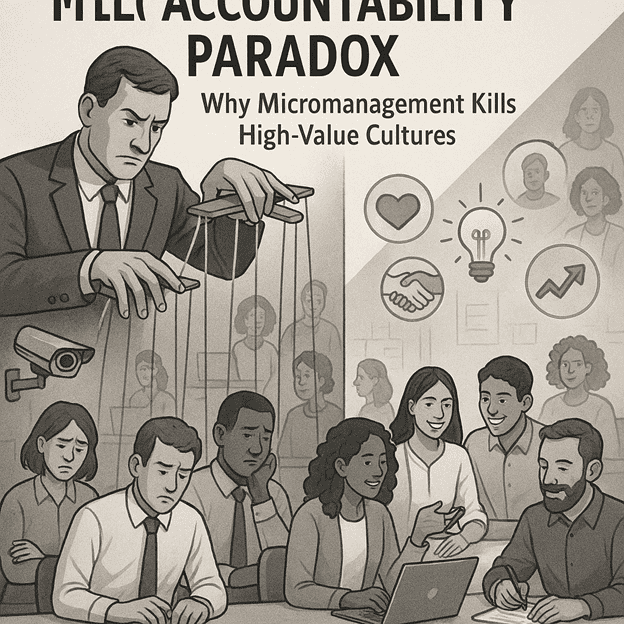
Here’s the paradox destroying workplace cultures: The tighter managers grip control, the less accountability they actually create. Micromanagement doesn’t produce excellence—it produces compliance, resentment, and talent exodus. For Black women and other traditionally overlooked employees who already face heightened scrutiny, micromanagement becomes a particularly toxic force that drives them from organizations that desperately need their perspectives.
The Illusion of Control vs. Real Accountability 🎭
Real accountability thrives in high-trust environments. Micromanagement thrives in fear-based ones. The difference? About $450 billion in annual productivity losses, according to research from the American Psychological Association.
There was a financial services firm that installed keystroke monitoring software to ensure “productivity.” Within six months, their top performers—including three high-potential Black women who’d been thriving—left for competitors. The monitoring didn’t catch a single case of time theft. It did successfully communicate that the company didn’t trust its employees to do their jobs.
As outlined in “High-Value Leadership,” accountability isn’t about surveillance—it’s about clarity of expectations, authority to execute, and ownership of outcomes. When leaders confuse control with accountability, they create the exact opposite of what they intend.
The Hidden Tax on Traditionally Overlooked Talent 💰
Research from Harvard Business Review reveals that Black women and other underrepresented employees experience micromanagement at rates 1.5 times higher than their white male counterparts. The impact compounds:
The Scrutiny Multiplier 🔍: Already under microscopes, micromanagement adds another layer of surveillance that becomes suffocating.
The Competence Question ❓: Constant oversight implies incompetence, reinforcing stereotypes about capability.
The Innovation Killer 💡: When every decision requires approval, creative problem-solving dies.
The Energy Drain 🔋: Managing up consumes energy that could fuel actual performance.
The Trust Erosion 💔: Being micromanaged while watching others receive autonomy sends clear messages about perceived potential.
There was a tech company where Black women engineers were required to submit daily progress reports while their white male peers gave weekly updates. The company insisted this was “developmental support.” The real result? A 70% turnover rate among Black women engineers within two years.
Understanding Why Leaders Default to Micromanagement 🤔
Micromanagement isn’t really about control—it’s about fear. Leaders micromanage when they fear:
- Failure will reflect on them
- They’ll become irrelevant if not involved in everything
- Their value isn’t visible without constant intervention
- Mistakes will happen if they’re not watching
- Others won’t meet their standards
For leaders promoted from individual contributor roles—particularly those from traditionally overlooked backgrounds who’ve had to be perfect to advance—the temptation to micromanage intensifies. They’ve succeeded through personal excellence. Now they must succeed through others.
The Real Cost Analysis 📊
What Micromanagement Actually Produces:
- 69% decrease in employee engagement (Gallup)
- 28% reduction in creative output (Journal of Applied Psychology)
- 3x higher turnover rates (SHRM)
- 39% drop in productivity (University of California study)
- 50% increase in stress-related health claims (American Institute of Stress)
What Accountability Actually Produces:
- 33% increase in innovation metrics ⬆️
- 50% higher employee engagement scores ⬆️
- 25% better customer satisfaction ratings ⬆️
- 21% increase in profitability ⬆️
- 40% reduction in turnover ⬇️
The math is clear. Micromanagement is expensive incompetence masquerading as diligence.
The TRUST Framework for Real Accountability 🤝
Building accountability without micromanagement requires systematic trust-building:
T – Transparent Expectations 📋
Clear, measurable objectives that define success without dictating methods. This means:
- Written goals with specific outcomes
- Defined decision-making authority
- Explicit success metrics
- Regular check-in schedules (not constant surveillance)
There was a healthcare organization that replaced hourly check-ins with weekly outcome reviews. Productivity increased 40% in three months.
R – Resources and Authority 🛠️
Providing tools, training, and decision-making power to achieve objectives. This includes:
- Budget authority within defined limits
- Access to necessary technology and support
- Decision rights that match responsibilities
- Freedom to develop solutions
U – Unobstructed Communication 💬
Creating channels for support without surveillance:
- Open-door policies that employees actually use
- Regular but not excessive check-ins
- Problem-solving support vs. problem-prevention interference
- Two-way feedback loops
S – Systematic Recognition 🏆
Acknowledging both outcomes and autonomy:
- Celebrating results, not just activity
- Recognizing innovative approaches
- Crediting good judgment calls
- Rewarding successful risk-taking
T – Trust-Building Actions 🌱
Demonstrating faith through behavior:
- Stepping back after delegating
- Asking for outcomes, not play-by-plays
- Supporting decisions even when different from yours
- Accepting productive failure as learning
Breaking the Micromanagement Cycle 🔄
For Leaders Struggling to Let Go:
Week 1: Awareness Building 👁️
- Track every time you request updates or check work
- Note triggers that drive control impulses
- Ask team members about their experience
- Identify your specific fears
Week 2: Gradual Release 🎈
- Choose one low-risk area to stop monitoring
- Extend check-in intervals by 50%
- Ask “what” not “how” questions
- Practice sitting with discomfort
Month 1: System Building 🏗️
- Define clear outcome metrics
- Create accountability structures that don’t require your involvement
- Establish peer accountability systems
- Celebrate autonomous successes
Quarter 1: Culture Shift 🌊
- Model vulnerability about your own mistakes
- Share decision-making authority publicly
- Recognize innovation that happened without you
- Measure outcomes, not activities
The Special Case of High-Potential Overlooked Talent 💎
As discussed in “Rise & Thrive,” traditionally overlooked employees, particularly Black women, need sponsors who provide air cover, not supervisors who provide surveillance. This means:
Strategic Protection 🛡️: Shielding them from organizational bias while giving them room to excel.
Visible Autonomy 👀: Publicly demonstrating trust so others recognize their capability.
Failure Permission ✅: Creating space for the same learning opportunities afforded to others.
Resource Access 🔑: Ensuring they have tools for success without hovering over usage.
There was a manufacturing company where a Black woman operations manager was constantly second-guessed by her supervisor. A new VP gave her full autonomy over a struggling division. Within one year, she turned it into the company’s most profitable unit. She’d always had the capability—she just needed the trust.
Current Trends Reshaping Accountability 🚀
Results-Only Work Environments (ROWE): Companies focusing solely on outcomes, not hours or methods.
AI-Enabled Accountability: Using technology for outcome tracking, not surveillance.
Peer Accountability Models: Teams managing their own performance without hierarchical oversight.
Psychological Safety Metrics: Measuring trust levels as predictors of performance.
Autonomous Team Structures: Self-managing teams with collective accountability.
Creating Accountability Without Micromanagement ⚡
Organizational Level:
Policy Changes:
- Eliminate unnecessary approval layers ❌
- Extend decision-making authority down the hierarchy ⬇️
- Remove surveillance technology 🚫
- Restructure reporting to focus on outcomes 📈
Cultural Shifts:
- Reward managers who develop autonomous teams 🌟
- Celebrate failures that led to learning 📚
- Share stories of successful delegation 📖
- Model trust from the C-suite 👔
Team Level:
Structural Changes:
- Implement peer accountability partnerships 🤝
- Create transparent progress dashboards 📊
- Establish team-owned metrics 📏
- Rotate leadership responsibilities 🔄
Process Improvements:
- Replace status meetings with problem-solving sessions 💡
- Shift from approval-seeking to notification protocols 📢
- Move from individual to team accountability 👥
- Change from activity reports to outcome celebrations 🎉
Individual Level:
For Leaders:
- Define what success looks like, not how to achieve it ✅
- Ask for help with problems, not prevention of problems 🆘
- Measure impact, not effort 📊
- Trust until proven otherwise 💚
For Employees:
- Proactively communicate outcomes 📣
- Take ownership of problems and solutions 🎯
- Build peer accountability relationships 🤝
- Document impact, not just activity 📈
The Breakthrough Moment 💫
There was a retail chain where store managers were required to submit 47 different reports weekly. A new CEO eliminated 45 of them, keeping only sales and customer satisfaction metrics. The result?
- 30% improvement in both metrics within six months ⬆️
- 50% reduction in manager turnover ⬇️
- 25% increase in employee satisfaction 😊
- 40% more time for managers to actually manage ⏰
The paradox resolved: Less control created more accountability.
Building Trust-Based Accountability in Practice 🏗️
As outlined in “Mastering a High-Value Company Culture,” sustainable accountability comes from alignment, not surveillance. Here’s how:
Start with Why: Connect individual work to organizational purpose, making accountability internal.
Define the What: Be crystal clear about outcomes while flexible about methods.
Provide the Resources: Ensure people have what they need to succeed.
Measure What Matters: Track outcomes that connect to business goals, not activity metrics.
Celebrate Success: Recognize achievement and autonomous problem-solving.
Discussion Questions 💭
- Where in your organization does micromanagement masquerade as “support” or “development”?
- How might your traditionally overlooked talent thrive with more autonomy and trust?
- What fears drive micromanagement in your leadership team?
- Which systems create accountability without surveillance in your organization?
- How would productivity change if you eliminated half your reporting requirements?
Your Next Steps 🎯
Start by auditing your accountability systems. How many actually measure outcomes versus activity? How many require unnecessary approvals? Where does oversight add value versus create bottlenecks?
Choose one area where you can immediately increase autonomy. Define clear outcomes, provide necessary resources, then step back. Document what happens. Most leaders are surprised to find performance improves when they loosen control.
Remember: Accountability isn’t about watching people work—it’s about creating conditions where excellent work is inevitable.
Ready to Build True Accountability? 🚀
Che’ Blackmon Consulting helps organizations transform from surveillance-based compliance to trust-based excellence. We specialize in creating accountability systems that unleash potential, especially for traditionally overlooked talent.
Our Accountability Transformation Services Include:
- Micromanagement assessment and culture analysis
- Trust-based accountability system design
- Leadership behavior transformation programs
- Outcome-focused measurement frameworks
- Autonomous team development
- Cultural trust building initiatives
Stop managing every move. Start managing for breakthrough results.
📧 Email: admin@cheblackmon.com
📞 Phone: 888.369.7243
🌐 Website: cheblackmon.com
Because real accountability happens when people own outcomes, not when someone owns them.
#Micromanagement #LeadershipDevelopment #AccountabilityMatters #WorkplaceCulture #TrustBasedLeadership #EmployeeEngagement #DiversityAndInclusion #OrganizationalPsychology #HighValueLeadership #ToxicWorkplace #PsychologicalSafety #BlackWomenInLeadership #ManagementMistakes #ProductivityHacks #CultureTransformation