

By Che’ Blackmon, DBA Candidate | Founder & CEO, Che’ Blackmon Consulting
For years, the business case for diversity, equity, and inclusion was framed as a moral argument. Organizations were told it was the right thing to do. They were asked to look at representation gaps, acknowledge historical inequities, and commit to change because fairness demanded it. That case remains true. But it is also incomplete. Because the data has now accumulated to the point where the business case for inclusive leadership is not just ethical. It is empirical, financial, and strategic.
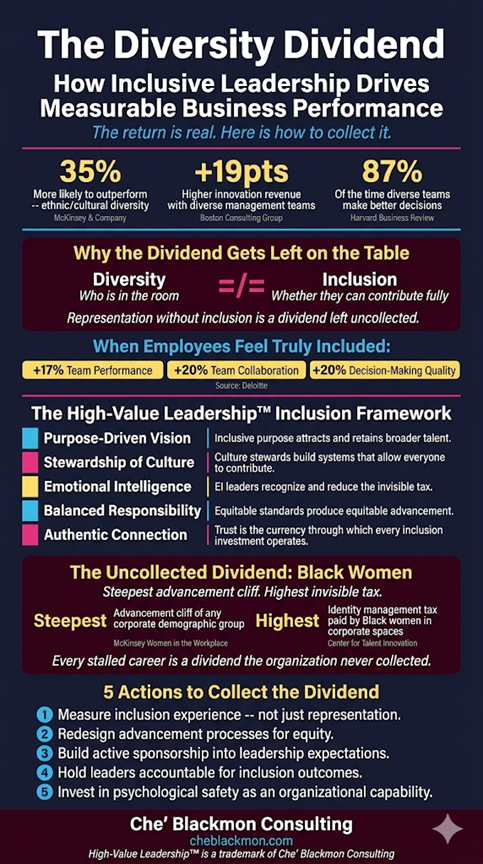
The diversity dividend is real. It shows up in revenue performance, in innovation rates, in decision quality, in talent retention, and in the resilience of organizations that can draw on the full range of human perspective rather than the narrow band of experience that homogeneous leadership teams represent. Companies in the top quartile for gender diversity are 15 to 25 percent more likely to achieve above-average financial returns, according to McKinsey and Company. Companies in the top quartile for ethnic and cultural diversity are 35 percent more likely to outperform their peers. These are not soft metrics. They are business results.
This article makes the case that inclusive leadership is not a program to be launched or a goal to be checked off. It is a strategic discipline that requires the same rigor, accountability, and investment that organizations apply to any other driver of performance. It is also deeply connected to the culture and leadership infrastructure that determines whether the diversity dividend can be collected at all, or whether it evaporates because the organization built representation without building the conditions for that representation to thrive.
📈 Defining the Diversity Dividend: What the Research Actually Shows
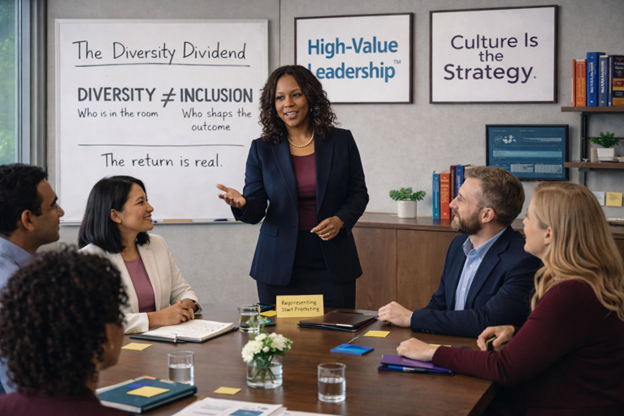
The phrase diversity dividend is not rhetorical. It describes a measurable premium in organizational performance that results from the strategic inclusion of diverse perspectives, backgrounds, and experiences at every level of decision-making. It is different from diversity as representation, which measures who is in the room. The dividend is produced when those people are genuinely included in the conversation, when their perspectives actually shape the decisions, and when the culture has been built to make that kind of authentic contribution possible.
The research base for this claim is extensive and spans more than two decades of organizational study. McKinsey and Company’s Diversity Wins report found that organizations with more than 30 percent women in executive roles were significantly more likely to outperform those with fewer women in leadership. The Boston Consulting Group found that companies with above-average diversity on their management teams reported innovation revenue 19 percentage points higher than companies with below-average diversity. Harvard Business Review research found that diverse teams make better decisions 87 percent of the time compared to individual decision-makers, and that cognitively diverse teams solve complex problems faster than homogeneous ones.
Deloitte’s research on inclusive leadership found that when employees feel included in their organization, team performance improves by 17 percent, team collaboration improves by 20 percent, and decision-making quality improves by 20 percent. These gains are not abstract. They translate directly into the metrics that determine organizational success: speed to market, product quality, client retention, and financial performance.
💡 Diversity without inclusion is representation without return. The dividend is paid only when people can fully bring their expertise, perspective, and voice to the work.
The mechanism behind these outcomes is well-established in organizational behavior research. Diverse teams bring a broader range of information, challenge assumptions that homogeneous teams accept uncritically, generate more options before converging on solutions, and are less susceptible to the groupthink dynamics that produce catastrophic organizational failures. When those diverse perspectives are genuinely included, the quality of organizational reasoning improves at every level.
🔍 The Gap Between Diversity and Inclusion: Why the Dividend Gets Left on the Table
Most organizations that have invested in diversity initiatives have discovered a frustrating reality: representation does not automatically produce inclusion, and inclusion does not automatically produce the performance outcomes the research promises. The gap between having diverse people and deriving value from their diversity is where most inclusion strategies fail, and understanding that gap is essential to closing it.
🚨 The Presence Trap
There was a manufacturing organization that invested significantly in recruiting a diverse workforce and achieved meaningful representation improvements at the individual contributor and mid-management levels. Its survey data, however, told a different story. Black employees and employees from other underrepresented groups consistently reported feeling that their ideas were less likely to be taken seriously, that they were excluded from informal decision-making conversations, and that advancement criteria were applied inconsistently across demographic lines. The organization had hired for diversity and then failed to build the conditions that allow diversity to contribute. The dividend was available. The infrastructure to collect it was absent.
This pattern is extraordinarily common. Organizations mistake the presence of diverse talent for the inclusion of diverse talent. They celebrate demographic milestones while ignoring the experience data that would tell them whether those milestones are translating into genuine participation, authentic contribution, and equitable advancement. Representation is a necessary condition for the diversity dividend. It is not a sufficient one.
📋 The Inclusion Infrastructure Deficit
Genuine inclusion requires structural conditions that most organizations have not built. It requires psychological safety, the belief that speaking up, disagreeing, and contributing authentically will not result in professional consequences. It requires consistent accountability, the assurance that the same standards apply to everyone regardless of who they know or what they look like. It requires transparent processes for advancement and recognition, so that the informal favoritism and proximity bias that have historically shaped organizational outcomes are replaced by visible, equitable criteria.
In High-Value Leadership: Transforming Organizations Through Purposeful Culture, the argument is made that authentic connection and stewardship of culture are leadership responsibilities that directly produce or undermine the psychological safety required for inclusion to function. Leaders who model intellectual humility, who actively solicit dissenting views, who credit contributions equitably, and who make their decision-making criteria transparent are the human infrastructure through which the diversity dividend becomes collectible.
There was a professional services organization that had a stated commitment to inclusion but whose actual culture rewarded conformity. Employees who challenged dominant perspectives in strategy meetings were labeled as difficult rather than engaged. Managers who had built informal networks of similar-background colleagues routinely bypassed formal nomination processes for high-visibility assignments. The organization’s diversity metrics looked adequate. Its inclusion experience data told the truth. When leadership invested in a culture realignment that addressed psychological safety, equitable processes, and manager accountability, engagement scores for underrepresented employees improved significantly within 18 months.
✨ The Compounded Reality: Black Women and the Uncollected Dividend
No group in the American corporate workforce carries the weight of the inclusion gap more acutely than Black women. They enter organizations with credentials, competence, and the strategic resilience that comes from navigating systems not designed for their advancement. They contribute, lead, and deliver results at rates that consistently exceed the recognition and advancement they receive. And the organizations that fail to include them fully are not just making an equity error. They are making a business error, leaving a measurable dividend uncollected.
🚨 The Advancement Cliff
McKinsey and Company’s Women in the Workplace research has documented for consecutive years that Black women face the steepest advancement cliff of any demographic group in corporate America. They are the least likely to receive sponsorship from senior leaders who can advocate for their advancement in rooms they are not in. They are the most likely to have their ideas credited to others. They are the most likely to be assessed as strong performers but not leadership material, a distinction that reflects the gap between performance evaluation systems that measure output and advancement criteria that measure cultural fit with leadership teams that do not reflect their identity.
The organizational cost of this pattern is not abstract. Every Black woman whose career progression is artificially stalled represents a loss of strategic leadership capacity at a career stage when her institutional knowledge, relationship equity, and functional expertise are at their most valuable. Every departure that results from that stalled trajectory represents a recruitment and development investment that produces no return. Every organization that perpetuates this pattern is systematically excluding some of its most experienced contributors from the rooms where its most consequential decisions are made.
💡 The Invisible Tax
Beyond the structural barriers, Black women in corporate environments pay what researchers have described as an invisible tax: the additional cognitive and emotional labor required to navigate workplaces that were not designed for their presence. This includes code-switching, the perpetual management of how one is perceived across racial and gender lines simultaneously. It includes the hypervisibility that makes Black women simultaneously more scrutinized and less sponsored. It includes the experience of having their competence questioned at levels their peers do not encounter, requiring a constant standard of proof that depletes the professional energy that should be directed toward contribution and development.
This invisible tax has measurable outcomes. Research from the Center for Talent Innovation found that Black women are significantly more likely than their peers to report exhaustion from managing their identity at work, and significantly more likely to consider leaving their current employer as a result. The organizations that address this tax structurally, through psychological safety investments, equitable recognition systems, and active sponsorship programs, are the organizations that retain the Black women whose full contribution is available to produce the diversity dividend.
📚 Rise & Thrive Connection: In Rise & Thrive: A Black Woman’s Blueprint for Leadership Excellence, the strategies for navigating these structural realities are addressed with both candor and practical depth. The SHIELD Resilience Framework offers Black women a personal and professional toolkit for thriving in environments that require resilience alongside excellence. If you are navigating this reality, that work was written for this season of your career.
🏗️ How High-Value Leadership™ Collects the Dividend
The High-Value Leadership™ framework, built on Purpose-Driven Vision, Stewardship of Culture, Emotional Intelligence, Balanced Responsibility, and Authentic Connection, is the leadership architecture through which the diversity dividend moves from research finding to organizational reality. Each pillar creates specific conditions that either enable or inhibit the full contribution of diverse talent.
Purpose-Driven Vision and the Inclusive Why 🎯
Organizations whose purpose is genuinely inclusive, whose stated mission reflects a commitment to the full human experience rather than a narrow demographic slice of it, attract and retain a broader range of talent. More importantly, they create a shared framework of meaning that makes diversity coherent rather than cosmetic. Purpose-Driven Vision in a High-Value Leadership™ context is not a tagline that happens to include inclusive language. It is a North Star that actually guides decision-making, resource allocation, and leadership behavior across the entire organization.
Stewardship of Culture and the Inclusion Infrastructure 🌱
Culture stewardship is where the diversity dividend is either built or lost. The leader who actively monitors the health of their team’s inclusion experience, who intervenes when exclusion patterns emerge, who redesigns processes when they produce inequitable outcomes, and who holds themselves and others accountable to inclusion standards is the leader who creates the conditions that allow diverse talent to contribute fully. Mastering a High-Value Company Culture makes the case that culture is not built by programs. It is built by the daily decisions of leaders who understand that every choice they make is a cultural signal.
Emotional Intelligence and the Empathy Infrastructure 🧠
Daniel Goleman’s research established that emotional intelligence accounts for the majority of leadership effectiveness. In the context of inclusive leadership, EI is the capacity to understand and navigate the emotional landscape of a diverse team, to recognize when a team member is experiencing the invisible tax described above, to respond to that experience with empathy rather than dismissal, and to create interactions that feel safe for authentic expression across difference. Leaders with high EI are the leaders whose diverse team members stay, grow, and contribute at their full capacity.
Balanced Responsibility and the Equity Standard ⚖️
The diversity dividend is only collectible when the standards of excellence and accountability apply equally to everyone, and when the rewards for meeting those standards, recognition, advancement, and opportunity, are distributed equitably. Balanced Responsibility in the High-Value Leadership™ framework means holding high performance standards in a psychologically safe environment where everyone has an equal opportunity to meet them. It means that underperformance is addressed regardless of who is underperforming, and that excellence is recognized regardless of who is excelling.
Authentic Connection and the Trust Foundation 🤝
Trust is the currency through which every other inclusion investment operates. Diverse team members who do not trust that their organization is genuinely committed to their equitable advancement will not provide the full contribution that the diversity dividend requires. They will perform at a level sufficient to protect their employment while reserving their highest value for environments that actually deserve it. Authentic connection, the fifth pillar of High-Value Leadership™, is built through consistent, transparent, and genuinely reciprocal leadership relationships. It is the foundation on which everything else rests.
🌈 The diversity dividend is not a bonus paid for doing inclusion right. It is the natural return on an organizational investment in building a culture where every person can bring their full contribution to the work.
📉 What Inclusive Organizations Are Actually Doing Differently
The organizations that consistently collect the diversity dividend are not the ones with the most sophisticated DEI programs. They are the ones where inclusion is embedded in how decisions are made, how people are developed, and how leadership accountability is measured. Here is what that looks like in practice.
There was a healthcare organization that redesigned its promotion process after recognizing that its informal nomination system consistently produced a finalist pool that did not reflect the diversity of its workforce. It replaced subjective manager nominations with structured competency assessments, added sponsorship requirements for all high-potential program participants, and implemented demographic reporting for every stage of the promotion pipeline. Within two years, representation in senior clinical leadership improved significantly and engagement scores for underrepresented employees rose toward parity with the broader workforce.
There was a nonprofit organization that integrated inclusion metrics into its leadership performance evaluation system for the first time, making manager accountability for team inclusion experience a factor in annual performance reviews. Leaders who had previously treated DEI as a compliance obligation began treating it as a leadership competency, because it was now measured and consequential. Team engagement scores for Black employees and other employees of color improved in those managers’ units, and voluntary turnover in those groups declined.
There was an automotive organization that implemented a structured reverse mentoring program pairing senior leaders with junior professionals from underrepresented groups, not as a nicety but as a development requirement. Senior leaders reported that the perspective shift produced by those relationships changed how they made decisions about team composition, project assignments, and advancement nominations. The organization’s internal diversity advancement metrics improved noticeably over the program’s first two years.
The common thread across all three is structural change to the systems that determine who advances, who contributes, and who is held accountable for inclusion outcomes. Programs create awareness. Systems create change.
🛠️ Actionable Takeaways: Collecting Your Organization’s Diversity Dividend
✅ For Organizational Leaders and HR Professionals
1. Measure Inclusion Experience Separately From Representation
Representation metrics tell you who is in the organization. Inclusion experience metrics tell you whether they can contribute fully. Disaggregate your engagement survey data by race, gender, and career level. Ask specific questions about psychological safety, recognition equity, and advancement fairness. The gaps you find are where the dividend is being left uncollected.
2. Redesign Advancement Processes for Equity
Audit every stage of your promotion and advancement process for informal bias. Who nominates candidates? What criteria are applied? How are nominations reviewed? Where are the demographic disparities in each stage? Redesigning for equity does not mean lowering standards. It means ensuring the same standards apply to everyone and that advancement pathways are visible to everyone.
3. Build Active Sponsorship Into Your Culture
Mentorship advises. Sponsorship advocates. Ensure that your highest-potential professionals from underrepresented groups have sponsors who actively advocate for their advancement in rooms they are not in. Make sponsorship a leadership expectation, not an optional gesture.
4. Hold Leaders Accountable for Inclusion Outcomes
What gets measured gets managed. Add inclusion metrics to your leadership performance evaluation system. Hold managers accountable for the engagement and advancement of underrepresented team members, not just for the output metrics that capture only part of their leadership impact.
5. Invest in Psychological Safety as an Organizational Capability
Psychological safety does not emerge from good intentions. It is built through consistent leadership behavior over time. Train your managers in the specific practices that build safety: soliciting dissent, crediting contributions accurately, responding to disagreement without defensiveness, and modeling intellectual humility. Measure it. Improve it.
✨ For Individual Professionals Navigating Inclusive Leadership Environments
Document Your Contributions and Quantify Your Impact
The diversity dividend depends on organizations being able to see and value your contribution. Do not assume visibility will come automatically, particularly in environments where Black women and other underrepresented professionals are systematically underseen. Build your evidence base, document your outcomes, and make your impact visible and specific.
Seek Sponsors, Not Just Mentors
The research is clear that sponsorship drives advancement in ways that mentorship alone cannot. Identify leaders in your organization who have both the authority and the willingness to advocate for your advancement. Invest in those relationships with the same intentionality you bring to every other strategic priority.
💬 Discussion Questions for Leaders and Teams
Use these questions to generate meaningful conversations within your organization, leadership team, or professional development community.
- When you look at your organization’s representation data alongside your inclusion experience data for the same demographic groups, what gaps do you see? What do those gaps tell you about where the diversity dividend is being left uncollected?
- Is your organization’s advancement process designed primarily for equity or primarily for efficiency? What would it look like to redesign it so that both criteria were equally weighted?
- What specific actions are your senior leaders taking to sponsor rather than simply mentor high-potential professionals from underrepresented groups? How is that sponsorship measured and recognized?
- For Black women and other professionals navigating the invisible tax of identity management at work: what one structural change in your organization would most meaningfully reduce that tax? And who has the authority to make it?
- If your organization’s diversity dividend is currently uncollected, what is the estimated annual cost of that uncollected return in turnover, disengagement, missed innovation, and foregone talent?
🚦 Next Steps: From Diversity Initiative to Inclusive Performance Strategy
The diversity dividend is available to every organization willing to build the conditions required to collect it. Here is a practical path forward.
- Conduct a disaggregated analysis of your engagement, advancement, and retention data by race, gender, and career level simultaneously. Find the gap between your representation metrics and your inclusion experience metrics.
- Audit your advancement and promotion processes for informal bias. Identify the stages where disparities emerge and commit to structural redesign of those stages.
- Build active sponsorship into your leadership expectations and measure it. Track how many high-potential professionals from underrepresented groups have sponsors who are actively advocating for their advancement.
- Add inclusion outcomes to your leadership performance evaluation framework. Make manager accountability for inclusion experience a measured and consequential leadership competency.
- Invest in psychological safety as an organizational capability. Train your managers, measure safety by team and manager, and hold leaders accountable for the culture their behavior produces.
- If you are a Black woman or member of another underrepresented group navigating these dynamics: Rise and Thrive: A Black Woman’s Blueprint for Leadership Excellence was written for exactly this professional journey. The SHIELD Resilience Framework within that work provides both the personal tools and the strategic clarity to navigate these environments with purpose and power.
🚀 Ready to Collect Your Organization’s Diversity Dividend?
Che’ Blackmon Consulting partners with organizations and leaders who are ready to move from diversity as representation to inclusion as a performance strategy. Whether you are diagnosing the gap between your representation data and your inclusion experience, redesigning your advancement processes for equity, or developing the High-Value Leadership™ competencies that make the diversity dividend collectible, we bring the frameworks, experience, and tools to help your organization perform at its full potential.
📧 admin@cheblackmon.com 📞 888.369.7243 🌐 cheblackmon.com
About the Author
Che’ Blackmon is a doctoral candidate in Organizational Leadership (DBA), the Founder and CEO of Che’ Blackmon Consulting, and a recognized expert in culture transformation, fractional HR leadership, and high-value leadership development. With more than 24 years of progressive HR leadership experience spanning manufacturing, automotive, healthcare, nonprofit, quick-service, and professional services industries, she has built a body of work dedicated to engineering cultures where every person, at every career stage and across every identity, can contribute fully and advance equitably. She is the author of Mastering a High-Value Company Culture, High-Value Leadership: Transforming Organizations Through Purposeful Culture, and the e-book Rise and Thrive: A Black Woman’s Blueprint for Leadership Excellence. Che’ is the creator of the proprietary High-Value Leadership™ framework and the host of the Unlock, Empower, Transform podcast.
© 2025 Che’ Blackmon Consulting. All rights reserved. | High-Value Leadership™ is a trademark of Che’ Blackmon Consulting.
#DiversityDividend #InclusiveLeadership #DEI #HighValueLeadership #CompanyCulture #BlackWomenLead #WorkplaceBias #OrganizationalPerformance #HRLeadership #CultureTransformation #EmployeeEngagement #WorkplaceInclusion #LeadershipDevelopment #FractionalHR #CheBlackmonConsulting