


By Che’ Blackmon, DBA Candidate | Founder & CEO, Che’ Blackmon Consulting
📚 Book Tie-In: Mastering a High-Value Company Culture | High-Value Leadership™ | Rise & Thrive
“Generation X did not have helicopter parents, participation trophies, or onboarding programs that held their hands. They had responsibility. Ambiguity. And the uncommon ability to figure it out anyway. That is not a liability. That is a superpower.”
There is a generation quietly holding corporate America together right now. They are not trending on social media. They do not have an entire marketing ecosystem built around their preferences. They are not the subject of the latest workplace study on how to attract and retain them. But they are absolutely essential. They are Generation X, born roughly between 1965 and 1980, and the organizational cultures that have lasted through recessions, technology revolutions, global disruptions, and generational upheaval were very often built on their watch.
This is not a think piece about generational conflict. It is not a comparison exercise designed to elevate one generation at the expense of another. It is a recognition, long overdue, of what the GenX leadership experience actually produced: a cohort of deeply resilient, operationally grounded, emotionally intelligent, and culturally fluent leaders who built organizations designed to endure. It is time to study that superpower, name it explicitly, and learn from it before it walks out the door.

🗺️ Who Is Generation X, Really?
Generation X grew up between two massive cultural forces. On one side were the Baby Boomers, a generation shaped by post-war optimism and institutional loyalty, who built their careers on the expectation that hard work and company allegiance would be rewarded with stability and upward mobility. On the other side came the Millennials, a generation raised with affirmation, technological fluency from birth, and organizational expectations centered around purpose and flexibility.
Gen X landed in the middle. And that middle position produced something remarkable. They came of age during a period of significant social and economic disruption. Divorce rates were climbing. Both parents were increasingly in the workforce. The term “latchkey kid” was coined largely to describe their experience of coming home to an empty house, managing their own time, and making their own decisions long before adulthood officially arrived. They watched institutions fail. Corporate downsizing in the late 1980s and early 1990s taught them early that company loyalty was not always reciprocal. They adapted. They became self-sufficient. They learned to lead without a roadmap.
“Gen X did not wait for someone to create the path. They made one. And in doing so, they built organizational cultures designed to survive uncertainty.”
By the time Gen X entered the workforce in meaningful numbers, they had already developed a set of leadership capabilities that took others decades to build. They were adaptable because change had been their constant. They were pragmatic because idealism had been tested in their formative years. They were skeptical of authority not out of disrespect but out of experience with institutions that had not always earned the trust placed in them. And they were intensely results-focused because they learned early that outcomes mattered more than appearances.
Today, many Gen X professionals are in or approaching the peak of their organizational influence. They hold senior leadership, executive, and C-suite roles across industries. They are the generation bridging retiring Boomer leaders and emerging Millennial and Gen Z talent. Their institutional knowledge, cultural intelligence, and hard-earned resilience make them uniquely positioned to shape what organizational culture looks like for the next generation. But only if organizations recognize and leverage what they bring to the table.
💪 The Resilience Framework: What Gen X Actually Built
Resilience is a word that gets used a lot in leadership circles. It gets applied broadly, defined loosely, and celebrated without much examination of where it actually comes from. For Gen X leaders, resilience was not a workshop they attended. It was a lived curriculum. And the organizational cultures they built reflect that curriculum in deeply practical ways.
In Mastering a High-Value Company Culture, the foundation is clear: culture is not an accident. It is built through intentional design, consistent reinforcement, and continuous evolution. Gen X leaders understood this intuitively because they lived the consequences of cultures that were left unmanaged. They watched organizations collapse under poor leadership. They navigated environments where values were stated but never practiced. And when they were finally in positions to build something themselves, they built differently.
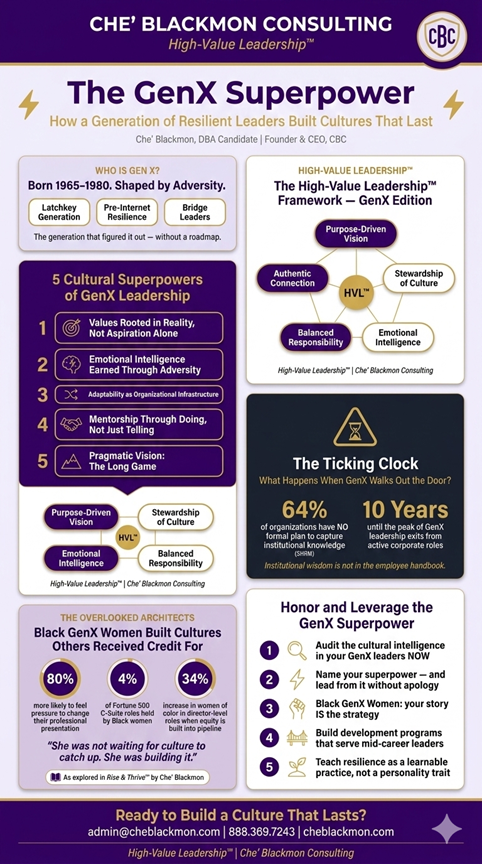
🔧 The Five Cultural Contributions of GenX Leadership
1. 🎯 Values Rooted in Reality, Not Aspiration Alone
Gen X leaders tend to build cultures where values are tested under pressure rather than simply declared in a strategic planning session. There was a company that went through a significant financial contraction and watched its entire executive team hold firm to its stated commitment to transparency, communicating openly with employees about what was happening and why, and making decisions that reflected the company’s stated people-first value even when the financial pressure to do otherwise was immense. That leadership team was almost entirely composed of Gen X leaders who had personally experienced what it felt like to be on the receiving end of corporate dishonesty during workforce restructurings in their early careers. They built the culture they had wished existed.
This is a defining characteristic of Gen X culture architecture: the values they instill are informed by what they experienced when values failed. The result is organizational cultures where accountability is not performative and where stated values are actually tested against real decisions.
2. 🧠 Emotional Intelligence Earned Through Adversity
Before emotional intelligence became a leadership competency that appeared on every 360-degree feedback form, Gen X leaders were developing it the old-fashioned way. Growing up in environments that often required them to read rooms, manage conflict independently, and navigate complicated family and social dynamics gave them an emotional vocabulary that showed up powerfully in their professional lives.
Research by Daniel Goleman, cited throughout the High-Value Leadership™ framework, consistently identifies emotional intelligence as a primary differentiator between average and exceptional leaders. Gen X leaders frequently demonstrate high levels of self-awareness, empathy, and relational management not because they were trained in those skills early in their careers but because those skills were survival tools long before they entered a boardroom. The organizations they lead tend to have lower rates of toxic leadership behaviors and higher rates of psychological safety precisely because their leaders understand, from personal experience, what it costs people when those things are absent.
3. 🔄 Adaptability as Organizational Infrastructure
Gen X entered the workforce before email was universal. They mastered email, then mastered the internet, then mastered mobile technology, then mastered social media platforms, then began mastering artificial intelligence tools, all within a single career. They did not grow up with technology; they grew alongside it, which means they developed the capacity to adapt to technological change rather than simply assuming fluency from birth.
This adaptability translated directly into how they build organizational cultures. There was a manufacturing organization whose leadership team, predominantly Gen X, navigated four major operational technology transitions over a 12-year period without significant talent attrition or cultural fracture. The reason, according to those inside the organization, was that leadership modeled adaptability rather than mandating it. They communicated openly about what was changing and why. They acknowledged the discomfort of transition rather than dismissing it. And they remained focused on the outcomes that mattered to the organization while being flexible about the processes used to achieve them. That is not a coincidence. That is Gen X culture in action.
4. 🤝 Mentorship Through Doing, Not Just Telling
Gen X leaders are frequently described by those who work for them as leaders who teach by example. This reflects a cultural orientation shaped by their own developmental experience. Many Gen X professionals did not have robust mentorship structures available to them early in their careers. They figured things out by watching, by doing, by failing, and by iterating. When they became leaders with the opportunity to invest in others, they tended to create mentorship relationships that were substantive and skills-based rather than ceremonial.
In High-Value Leadership: Transforming Organizations Through Purposeful Culture, authentic connection is identified as one of the five pillars of High-Value Leadership™. For Gen X leaders, that authentic connection frequently manifests as a genuine investment in the development of the people around them, not because a company policy requires it but because they understand from their own experience what a difference a real advocate makes in someone’s trajectory.
5. 📈 Pragmatic Vision: The Long Game
Gen X leaders are often unfairly characterized as cynical. The more accurate description is pragmatic. They have watched enough organizational cycles to understand that vision without execution is simply a well-written document. They build cultures oriented around sustainable performance rather than short-term optics. They are skeptical of trends that prioritize appearance over impact. And they have a long enough career horizon behind them to recognize the difference between initiatives that produce lasting change and programs that produce a quarterly report footnote.
This pragmatic orientation produces cultures built for endurance. The organizations shaped by Gen X leaders tend to have strong operational foundations, clear decision-making frameworks, and a resistance to the kind of reactive culture pivots that destabilize organizations every time a new workplace study makes headlines. That is not rigidity. That is the institutional memory of a generation that has seen what happens when organizations abandon substance for style.
✊🏽 The Overlooked Architects: Black GenX Women in Corporate America
Any honest examination of Generation X leadership must include a direct and specific conversation about Black Gen X women in corporate spaces. Because if the GenX experience was defined by navigating institutional structures without adequate support, the Black GenX woman’s experience was that same journey with an additional set of barriers that her white counterparts, and frequently her Black male counterparts, did not face in the same way.
As explored in Rise & Thrive: A Black Woman’s Blueprint for Leadership Excellence, Black women in professional environments navigate what researchers describe as double jeopardy, facing compounding barriers related to both race and gender simultaneously. For Black Gen X women, this played out in workplaces that were not yet having consistent public conversations about diversity, equity, or inclusion. DEI as an organizational practice did not have its current institutional visibility in the early and mid-career years of most Black Gen X professionals. They were navigating environments shaped by implicit bias and structural inequity long before those terms were part of the mainstream corporate vocabulary.
“Black Gen X women did not wait for the organization to make space for them. Many of them built the space themselves, and then held the door open for everyone who came after.”
And yet, Black Gen X women produced an extraordinary generation of organizational leaders. They built careers in industries that were not designed with their advancement in mind. They developed cultural fluency that spanned race, gender, class, and institutional dynamics simultaneously. They became adept at leading across difference precisely because they had to lead through it every single day. The skills they developed navigating predominantly white corporate environments while maintaining their identity, their integrity, and their professional effectiveness represent some of the most sophisticated leadership capabilities in the modern workforce.
📊 The Numbers Behind the Narrative
Research from the Center for Talent Innovation found that Black women in the United States are 80 percent more likely than white women to report needing to change how they present themselves in order to be viewed as leadership material. This statistic describes the experience of an entire generation of Black Gen X women who spent decades in organizations that required them to code-switch, minimize their cultural identity, and perform a version of professionalism defined entirely by people who looked nothing like them.
Despite these barriers, Black Gen X women have climbed. Many are now in the senior leadership positions they were told, directly or indirectly, were not meant for them. And the organizational cultures they are now in positions to shape carry the imprint of everything they learned navigating systems that were not built for their success. They build cultures with equity as infrastructure rather than initiative because they lived the cost of inequitable systems firsthand. They build cultures that prioritize psychological safety because they spent years in environments where speaking up as a Black woman carried real professional risk. They build cultures that develop talent intentionally because they know what it means to be talented and overlooked.
There was a company that promoted a Black woman into its Chief Human Resources Officer role after she had spent nearly two decades in mid-level HR positions where her contributions consistently shaped organizational outcomes without producing corresponding advancement. When she finally had the organizational authority to build culture at scale, she redesigned the company’s leadership pipeline from the ground up, creating structured equity reviews at every promotion checkpoint and instituting executive sponsorship programs specifically designed for high-potential employees from underrepresented backgrounds. Within two years, the representation of women of color in director-level roles and above increased by 34 percent. The culture she built was informed by everything she had experienced as someone who had been systematically underestimated.
That is what Black Gen X women bring to organizational leadership. Not just competence. Not just resilience. A comprehensive, experientially earned understanding of how organizations either include or exclude their people, and the vision and determination to build something better.
⏰ The Ticking Clock: What Happens When GenX Walks Out the Door
Here is the reality that organizations need to confront with urgency. The eldest Gen X professionals are now in their late 50s. The youngest are in their mid-40s. Within the next decade, this generation will begin a significant transition out of active organizational leadership. And when they go, they will take with them something that cannot be replicated by a technology platform, a consulting engagement, or a succession planning document.
They will take the institutional memory of what it actually took to build the organizational cultures that have lasted.
This is not a sentimental observation. It is a strategic risk. Research from Deloitte’s Global Human Capital Trends report consistently identifies knowledge transfer and leadership succession as top organizational vulnerabilities. Many organizations are excellent at documenting operational processes. They are far less effective at capturing and transferring the cultural knowledge that lives inside their most experienced leaders. The judgment calls. The relational intelligence. The hard-won understanding of how an organization’s values play out under pressure. These things are not in the employee handbook.
“Organizations that fail to capture Gen X institutional wisdom before it exits are not just losing leaders. They are losing the cultural architecture those leaders spent decades building.”
There was a professional services organization that lost three senior Gen X partners within an 18-month period to retirement. Each of them had been with the firm for more than 20 years. Each of them had relationships, institutional knowledge, and cultural credibility that had taken decades to develop. The organization had robust technical knowledge transfer protocols. What it did not have was a system for capturing the cultural and relational intelligence those leaders carried. Within three years of their departure, the firm’s scores on belonging, trust in leadership, and employee engagement had declined measurably. The leaders who replaced them were technically capable. They simply had not yet earned the kind of cultural authority that only comes from time, consistency, and demonstrated commitment to the people around you.
The lesson is not that Gen X leaders are irreplaceable. Every generation produces capable leaders. The lesson is that the cultural wisdom they carry is not automatically transmitted through promotion. It must be intentionally captured, shared, and institutionalized before it walks out the door.
🏛️ The High-Value Leadership™ Framework Through a GenX Lens
The High-Value Leadership™ framework, developed through decades of organizational leadership experience and grounded in both research and practice, identifies five core pillars that define transformational cultural leadership: Purpose-Driven Vision, Stewardship of Culture, Emotional Intelligence, Balanced Responsibility, and Authentic Connection. When examined through the lens of GenX leadership experience, each pillar maps directly onto the capabilities this generation developed through lived experience.
Purpose-Driven Vision 🎯
Gen X leaders did not always enter the workforce with the luxury of asking whether their work was meaningful. They entered because work was necessary. But the experience of building careers in environments that were sometimes deeply misaligned with their personal values gave many of them a clarity about purpose that they now bring with unusual force to their organizations. They know what it costs an organization to operate without a genuine ‘why’ because they worked inside organizations that had none. The purpose-driven cultures they build are not aspirational exercises. They are intentional corrections.
Stewardship of Culture 🌱
Stewardship implies responsibility for something that does not belong to you alone but has been entrusted to your care. Gen X leaders understand this intuitively. They inherited organizational cultures they did not design, navigated them with varying degrees of success, and emerged with a clear sense of what they would preserve, what they would change, and what they would never allow on their watch. Their stewardship of culture is active, not passive. They do not let culture drift because they know from experience how quickly drift becomes dysfunction.
Emotional Intelligence 🤝
As noted earlier, emotional intelligence for many Gen X leaders was not a professional development curriculum. It was a life skill developed out of necessity. Their capacity for self-regulation, empathy, and relational management tends to be high because it was tested early and often. The organizations they lead benefit from this in measurable ways: lower rates of interpersonal conflict escalation, higher rates of team psychological safety, and leaders who are more likely to address performance issues constructively rather than punitively.
Balanced Responsibility ⚖️
Gen X leaders are frequently the leaders who refuse to accept the premise that high standards and human-centered culture are mutually exclusive. They hold people accountable. They expect results. And they do so within cultures they have intentionally designed to be fair, transparent, and supportive of genuine growth. This balance reflects their experience in organizations where accountability was often applied inequitably and where high standards were sometimes wielded as instruments of control rather than tools for development.
Authentic Connection 🗣️
Authentic connection for Gen X leaders tends to be relational rather than performative. They are not always the loudest voices in the room. They are not always the most polished communicators on a stage. But they build the kind of trust with their teams that produces real loyalty and real discretionary effort because they show up consistently and genuinely. Their connections are earned over time and held with care. In a professional landscape increasingly dominated by digital communication and surface-level engagement, the depth of relational trust that Gen X leaders build is a significant competitive and cultural advantage.
📈 Current Trends: Where GenX Leadership Is Most Needed Right Now
🤖 AI and the Human Element
Artificial intelligence is transforming organizational operations at a pace that is creating genuine cultural disruption. Gen X leaders, who have navigated multiple waves of technological transformation, are uniquely positioned to help organizations integrate AI capabilities without losing the human elements that define a high-value culture. They understand that technology is a tool, not a culture strategy, and they have the credibility and experience to hold that line even when the pressure to automate everything is intense.
🏠 The Multigenerational Workforce
Organizations today are managing five generations in the workforce simultaneously: Traditionalists, Baby Boomers, Generation X, Millennials, and Generation Z. Gen X leaders are the generation best positioned to bridge these groups because they understand each of them from direct experience. They worked for Boomer leaders. They now lead Millennial and Gen Z employees. They speak multiple generational languages and can translate organizational culture across generational expectations in ways that no other cohort can replicate.
🌎 The Purpose Economy
Increasingly, employees at every level are demanding that organizations articulate a genuine purpose and demonstrate alignment between that purpose and actual organizational decisions and behaviors. Gen X leaders, who built their most durable cultural contributions around exactly that alignment, are already ahead of this trend. They have been building purpose-driven cultures since before the term became a conference keynote staple. Organizations that tap into that experience rather than sidelining it will have a significant advantage in building cultures that attract and retain purpose-oriented talent.
🔄 Leadership Succession and Knowledge Transfer
As noted in the previous section, the organizational knowledge transition risk associated with Gen X leadership exits is real and pressing. Organizations that are investing now in structured knowledge transfer, mentorship architectures, and cultural documentation are positioning themselves to preserve the cultural investments Gen X leaders have made. Those that are not are building on a foundation they may not fully understand until it begins to erode.
✅ Actionable Takeaways: Honoring and Leveraging the GenX Superpower
🔎 For Organizations: See What You Have Before You Lose It
The most urgent action most organizations can take right now is a genuine audit of the cultural intelligence currently living inside their Gen X leadership cohort. Conduct stay interviews with senior Gen X leaders specifically focused on what cultural knowledge they carry and how it can be institutionalized. Build formal knowledge transfer protocols that go beyond operational documentation to include cultural practices, relational frameworks, and leadership judgment developed over decades.
🎯 For Gen X Leaders: Name Your Superpower
Many Gen X leaders have spent their careers building remarkable things while being told to be less cynical, more enthusiastic, or better at self-promotion in the Millennial style. The invitation here is to name, explicitly, what your generational experience has produced and to lead from that strength without apology. Your pragmatism is strategic intelligence. Your resilience is institutional wisdom. Your relational depth is a competitive advantage. Lead accordingly.
✊🏽 For Black GenX Women: Your Story Is the Strategy
If you are a Black Gen X woman who has spent decades navigating corporate spaces that were not designed for your success and building organizational cultures that were more equitable, more inclusive, and more human than what you inherited, that experience is not background context. It is your most powerful leadership credential. The organizational cultures you have built from that experience, and the ones you are still in positions to build, carry wisdom that no consulting framework or leadership model can fully replicate. Name it. Teach it. Build from it without reservation.
📊 For HR and People Leaders: Build Bridges, Not Boundaries
Gen X is often the generation least served by organizational development programs designed either for early-career professionals or for those approaching retirement. There is a significant gap in targeted development, recognition, and engagement strategies for mid-career and senior Gen X professionals. Closing that gap is not just an equity issue. It is a retention and cultural continuity issue. Organizations that invest in the ongoing development and recognition of their Gen X leaders will retain the cultural architecture those leaders represent.
🌱 For All Leaders: Resilience Is Teachable
One of the most valuable contributions Gen X leaders can make to the next generation of professionals is the explicit teaching of resilience not as a personality trait but as a learnable practice. The capacity to adapt to ambiguity, maintain values under pressure, lead through change without losing sight of what matters, and build something durable through adversity can all be developed and modeled. Gen X leaders who are intentional about teaching those skills are building a cultural legacy that will outlast their tenure.
🔬 Research Corner: What the Data Tells Us About GenX Leadership
- A 2023 Gallup study found that Gen X workers report the highest levels of engagement among all generational cohorts when placed in roles with genuine autonomy and clear purpose alignment. This finding is consistent with the generational orientation toward independence and outcomes that defined their formative years.
- Research from the Harvard Business Review found that leaders with high levels of “adversity quotient”, the capacity to navigate and grow through significant challenges, produced organizations with significantly stronger cultural resilience scores. Gen X leaders score disproportionately high on adversity quotient measures.
- McKinsey & Company’s research on organizational culture transformation consistently identifies middle management as the single most important layer for cultural change. Gen X leaders, who disproportionately occupy this layer, are therefore the pivot point for most large-scale cultural transformations currently underway in corporate America.
- The Center for Creative Leadership found that leaders who experienced significant career adversity in their formative professional years demonstrated stronger empathy, higher psychological safety scores in their teams, and greater willingness to advocate for underrepresented talent than leaders who experienced linear career progression.
- According to SHRM research, 64 percent of organizations report having no formal plan for capturing institutional knowledge from senior leaders approaching retirement or transition. This gap represents one of the most significant and underaddressed cultural risks in the modern workforce.
💬 Discussion Questions for Leaders and Teams
Use these questions to spark meaningful conversations in your organization about the GenX leadership legacy and what it means for your culture going forward.
- Who are the Gen X leaders in your organization whose cultural contributions are most significant? Have you explicitly named and recognized those contributions?
- What institutional knowledge currently lives inside your most experienced leaders that does not exist anywhere in your documented processes or cultural frameworks? What would it take to capture and transfer it?
- How does your organization’s leadership development program account for the mid-career professional experience? Are Gen X leaders being developed and invested in, or primarily deployed?
- In what ways has the resilience built by adversity, whether generational or identity-based, shaped the cultures in your organization? What would it look like to study and intentionally replicate those cultural contributions?
- For Black Gen X women in your organization: are their organizational contributions visible, recognized, and being built upon? Or have they been building cultures others receive credit for?
- What would your organizational culture lose if your three most experienced Gen X leaders departed tomorrow? What are you doing today to ensure that loss does not happen by surprise?
🚀 Next Steps for Readers
Insight without action is just a good read. Here is how to move from this article into meaningful work:
- Identify one Gen X leader in your organization or network whose cultural contributions have gone unrecognized and create a deliberate opportunity to name and honor that work publicly.
- Schedule a knowledge transfer conversation with a senior Gen X leader in your organization this month. Ask them specifically: what do you know about how this culture works that is not written down anywhere?
- If you are a Gen X leader yourself, take one hour this week to document three organizational lessons you have learned that you have never formally shared with your team or organization.
- Explore the frameworks and tools in Mastering a High-Value Company Culture and High-Value Leadership: Transforming Organizations Through Purposeful Culture for the deeper methodology behind every principle in this article.
- If you are a Black woman navigating or leading in corporate spaces, Rise & Thrive: A Black Woman’s Blueprint for Leadership Excellence was written to honor your journey and give you the framework and language to build from everything you have already earned. It is available now.
- Assess your organization’s succession and cultural transfer readiness with the same rigor you apply to financial succession planning. The cultural balance sheet matters as much as the financial one.
🤝 Ready to Build a Culture That Lasts?
| Che’ Blackmon Consulting partners with organizations and leaders who are serious about building cultures that outlast any single leader’s tenure. Through fractional HR strategy, culture diagnostics, leadership development, and the High-Value Leadership™ System, CBC delivers the frameworks and implementation support that transform organizations from the inside out. 📧 admin@cheblackmon.com 📞 888.369.7243 🌐 cheblackmon.com |
© Che’ Blackmon Consulting | High-Value Leadership™ | All Rights Reserved
#GenXLeadership #HighValueLeadership #CultureTransformation #OrganizationalResilience #HRLeadership
#WorkplaceCulture #LeadershipDevelopment #BlackWomenLead #InclusiveLeadership #GenerationalLeadership
#CompanyCulture #KnowledgeTransfer #PurposeDrivenLeadership #ExecutiveLeadership #CheBlackmon
#FractionalHR #CultureFirst #ResilienceInLeadership #WorkplaceEquity #HighValueCulture