


When Zoom Fatigue Meets the Hunger for Real Connection
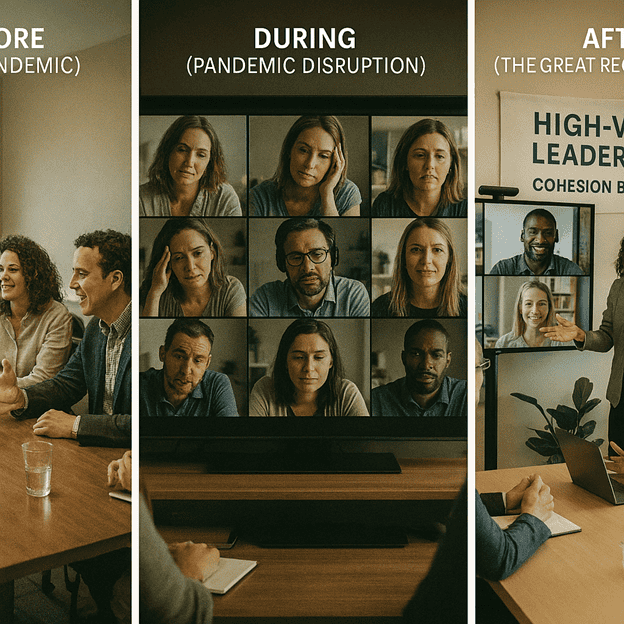
Remember March 2020? One week you were grabbing coffee with colleagues, collaborating at whiteboards, and having impromptu hallway conversations that solved problems in five minutes. The next week, everyone was home, staring at gallery view, trying to figure out how to unmute.
We thought it was temporary.
Now, years later, we’re in a different reality. Some teams are fully remote. Others are hybrid. Some have returned to offices. But here’s what’s universal: the connections that held teams together before the pandemic—those aren’t coming back automatically.
The casual trust-building that happened over lunch? Gone. The cultural osmosis that new employees absorbed by being physically present? Missing. The relationships that made difficult conversations easier and innovation faster? Frayed or broken.
And for Black women and other traditionally overlooked employees who were already navigating workplace isolation, exclusion from informal networks, and the emotional labor of being “the only”—the pandemic’s disconnection compounded challenges that existed long before COVID-19. 💔
Leaders are asking: How do we rebuild what was lost? How do we create cohesion when people aren’t in the same place? How do we build culture when the old culture-building methods no longer apply?
The answer isn’t “return to office” mandates or forced fun Zoom happy hours. It’s something deeper, more intentional, and frankly, more necessary: The Great Reconnection.
This is about rebuilding team cohesion deliberately, equitably, and sustainably for the world we’re actually working in—not the one we left behind.
Let’s explore how to reconnect teams in ways that honor what we’ve learned, address what we’ve lost, and build something better than what existed before.
What We Actually Lost (And What We Didn’t) 📉
Before we rebuild, let’s be honest about what broke.
What the Pandemic Disrupted:
Informal Relationship Building
The coffee chats, lunch conversations, and post-meeting hallway debriefs where relationships deepened and trust built—these evaporated overnight. For new employees who started remotely, they never experienced these connections at all.
Cultural Transmission
New hires used to learn organizational culture by observation—how people interact, what’s really valued, how decisions get made. In remote environments, this cultural knowledge transfer became invisible or nonexistent.
Spontaneous Collaboration
The “hey, can I ask you something?” moments that led to quick problem-solving, knowledge sharing, and serendipitous innovation—these required more effort remotely and often just didn’t happen.
Social Capital for Those Without Access
Even before the pandemic, Black women and other marginalized employees often lacked access to informal networks where real decisions happened. Remote work made these invisible networks even more invisible—and even more powerful.
Boundaries Between Work and Life
For many, particularly women and caretakers, the pandemic erased boundaries. Work invaded homes. “Always on” became the expectation. The mental health impact continues.
But Here’s What the Pandemic Revealed:
Flexibility is Possible
Organizations that claimed remote work was impossible proved it wasn’t. This opened possibilities for people with disabilities, caretakers, and those who thrive outside traditional office environments.
Productivity Doesn’t Require Presenteeism
Results matter more than where or when work happens. This was always true; the pandemic just made it undeniable.
Commutes and Office Politics Were Costly
Particularly for Black women who spend emotional energy code-switching, navigating microaggressions, and managing office dynamics—remote work reduced some of that exhausting labor.
Meetings Could Have Been Emails
We learned to be more intentional about what requires synchronous time and what doesn’t. That’s valuable.
What We Learned Can’t Be Unlearned
Employees experienced autonomy, flexibility, and work-life integration. Many won’t—and shouldn’t have to—give that up to rebuild connection.
The question isn’t whether to rebuild cohesion. It’s how to rebuild it in ways that honor what we’ve learned while addressing what we’ve lost.
Why Traditional Team-Building Won’t Work Anymore 🚫
Let’s address the elephant in the Zoom room: most traditional team-building approaches are failing in post-pandemic environments.
The Mandatory Return-to-Office Approach
“We need people back in the office to rebuild culture.” This ignores that:
- Flexibility is now a retention issue, not a perk
- Forced proximity doesn’t create genuine connection
- The people most harmed by inflexible mandates are often caretakers, people with disabilities, and those who face discrimination in office environments
- Culture is what you build, not where you build it
Research from Gartner shows that proximity bias—favoring employees who are physically present—increases in hybrid environments. Black women and other remote workers get disadvantaged in visibility, opportunities, and advancement.
The Forced Fun Approach
Virtual happy hours, mandatory team games, synchronized coffee breaks. These rarely build genuine connection and often create resentment, especially among employees juggling caregiving or managing Zoom fatigue.
The “Just Like Before” Approach
Trying to recreate 2019’s team dynamics in 2025 ignores that people, priorities, and possibilities have changed. Nostalgia isn’t a strategy.
The One-Size-Fits-All Approach
What builds connection for extroverts might exhaust introverts. What works for local employees might exclude distributed team members. What feels inclusive to some might feel performative to others.
The Technology-Will-Save-Us Approach
Collaboration tools, virtual reality meetings, team apps—technology enables connection but doesn’t create it. Connection is human; technology is infrastructure.
So if these approaches don’t work, what does?
The High-Value Framework for Post-Pandemic Cohesion 🎯
High-Value Leadership: Transforming Organizations Through Purposeful Culture teaches that cohesion isn’t about proximity—it’s about psychological safety, shared purpose, and genuine belonging.
Post-pandemic team cohesion requires four foundational elements:
1. Intentional Connection Architecture
Pre-pandemic, connection happened organically through physical proximity. Post-pandemic, connection must be architecturally designed into how teams work.
This means:
- Structured Relationship-Building: Regular one-on-ones, team rituals, and dedicated connection time that’s protected, not optional
- Purposeful Meeting Design: Clear intentions for when synchronous time is needed and what should be asynchronous
- Connection Metrics: Tracking relationship health, trust levels, and belonging as rigorously as tracking productivity
- Distributed-First Design: Designing for remote participants first, then adapting for in-person, rather than the reverse
A technology company redesigned their team structure post-pandemic around “connection pods”—small, stable groups of 4-6 people who met weekly for 30 minutes with no agenda other than connection. Not to discuss work. Not to problem-solve. Just to see each other as humans. These pods cut across departments and levels, deliberately mixing people who wouldn’t normally interact.
Result? Employee engagement scores rose 40%, retention improved significantly, and cross-functional collaboration increased because people had relationships beyond their immediate teams.
Implementation Tip: Design connection into your calendar as deliberately as you design project time. Make it non-negotiable, not optional when there’s “extra time.”
2. Equity in Access and Visibility
Pre-pandemic informal networks already excluded many. Post-pandemic remote and hybrid work either amplifies that exclusion or creates opportunity to democratize access—depending on how it’s designed.
Black women in corporate spaces face a specific challenge post-pandemic: we’re often remote (by choice or necessity), which can reduce some microaggression exposure but also reduces visibility to leadership, access to mentors and sponsors, and inclusion in informal networks where decisions happen.
There was a financial services firm that noticed their promotion rates shifted dramatically post-pandemic. Remote employees—disproportionately women and people of color—were promoted at lower rates than in-office employees, despite equal or better performance metrics. The issue? Proximity bias. Leaders were unconsciously favoring people they saw in person.
They addressed it by:
- Making all-hands and leadership meetings hybrid with equal engagement for remote and in-person participants
- Implementing “remote-first” communication norms where everything was documented digitally, not just discussed in hallways
- Requiring leaders to track their one-on-one time with remote vs. in-office employees and address imbalances
- Creating explicit criteria for promotions that didn’t include “office presence”
Implementation Tip: Audit who has access to informal conversations, mentorship, visibility opportunities, and face time with leadership. If patterns emerge showing certain groups are excluded, redesign access intentionally.
3. Psychological Safety Across Distance
Psychological safety—the belief that you can speak up, take risks, disagree, and be yourself without fear of punishment—is harder to build and easier to lose when teams aren’t physically together.
Why? Because trust is built through micro-interactions over time. A smile. A supportive comment after a mistake. Body language that says “I’ve got your back.” These are harder to read through screens or in asynchronous communication.
For Black women, psychological safety requires even more intentionality. Research from Catalyst shows Black women are the least likely demographic to feel they belong at work, the least likely to have sponsors, and the most likely to experience isolation. Remote work can either amplify that isolation or—if designed well—reduce it by minimizing some in-person bias.
A consulting firm rebuilt psychological safety post-pandemic through:
- Vulnerability Modeling: Leaders shared personal challenges, admitted mistakes, and discussed their own pandemic struggles in team meetings
- Structured Check-Ins: Every meeting started with a genuine “how are you?” round with permission to be honest, not performative
- Brave Spaces: Monthly forums where team members could discuss difficult topics—bias, burnout, caregiving challenges—with facilitator support
- Rapid Response to Harm: When someone experienced bias or exclusion, leadership addressed it immediately and transparently
Implementation Tip: Don’t assume psychological safety exists. Measure it through anonymous surveys, listen to what marginalized employees say about their experience, and intervene when safety is compromised.
4. Purpose-Driven Cohesion
The strongest teams aren’t bonded by forced fun—they’re bonded by shared purpose, mutual respect, and collective impact.
Mastering a High-Value Company Culture emphasizes that culture is what you’re building together, not just how you interact while building it. Post-pandemic cohesion must be anchored in meaningful work, not manufactured closeness.
This means:
- Clarifying team mission and how each person contributes
- Celebrating wins collectively and publicly
- Making impact visible so people see how their work matters
- Creating opportunities for collaboration on meaningful projects
- Building communities of practice around shared interests and expertise
A healthcare organization rebuilt cohesion by creating “impact circles”—voluntary groups focused on solving real organizational challenges. A circle focused on patient experience. Another on operational efficiency. Another on health equity. Employees joined based on interest, worked on real problems, and presented solutions to leadership.
Result? People built relationships through meaningful collaboration. The work mattered beyond the relationships, and the relationships deepened because the work mattered.
Implementation Tip: Don’t just build connection for connection’s sake. Build it through purposeful work that creates collective meaning.
The Rise & Thrive Strategy: Reconnection as Empowerment 💪🏾
Rise & Thrive: A Black Woman’s Blueprint for Leadership Excellence addresses something particularly relevant here: for Black women, “team cohesion” has always been complex.
We’ve experienced team cohesion that includes us performatively but excludes us meaningfully. We’ve been on teams where we’re expected to bring “diversity” but our expertise is questioned. We’ve built relationships with colleagues who are friendly in private but silent when we face bias publicly.
So when we talk about “The Great Reconnection,” Black women are asking: Reconnection to what? To cultures that never fully included us? To dynamics that exhausted us?
The answer must be: No. We’re not rebuilding what was. We’re building what should have been.
Post-pandemic reconnection is an opportunity to:
Design Inclusion Intentionally
Remote and hybrid work removes some physical barriers. Use this opportunity to ensure Black women have equal access to leadership, equal visibility for contributions, equal opportunity for advancement.
Redistribute Emotional Labor
Black women have historically carried disproportionate emotional labor—supporting others, managing office dynamics, code-switching. Reconnection should redistribute that labor equitably, not assume we’ll resume carrying it.
Center Well-Being
Reconnection shouldn’t mean returning to unsustainable hustle culture. It should mean building sustainable ways of working that honor our full humanity—our caregiving responsibilities, our mental health needs, our boundaries.
Create Authentic Belonging
Not “cultural fit” (which often means “similarity to those already here”) but genuine belonging where we can bring our full selves, our unique perspectives, and our authentic leadership.
Build Sponsorship, Not Just Mentorship
Cohesion that benefits Black women includes leaders who actively sponsor us for opportunities, advocate for our advancement, and open doors that have historically been closed.
The Great Reconnection, done right, isn’t about returning to pre-pandemic norms. It’s about creating post-pandemic cultures where everyone—especially those previously excluded—can genuinely belong and thrive.
Best Practices From Organizations Getting It Right 📊
Current research from Gallup, Microsoft’s Work Trend Index, and McKinsey reveals patterns among organizations successfully rebuilding cohesion:
They Embrace Flexible Work as Permanent
The highest-performing post-pandemic organizations don’t treat flexibility as temporary. They’ve redesigned work around outcomes, autonomy, and trust—not location and hours.
Practice: Offer flexibility by default. Require justification for inflexibility, not the reverse. Design roles for remote success first, then adapt for hybrid/in-person as needed.
They Over-Communicate and Over-Clarify
In distributed environments, communication that feels like “too much” is actually sufficient. Assumptions and unspoken expectations destroy cohesion.
Practice: Repeat important information through multiple channels. Document decisions transparently. Create space for questions. Assume nothing is obvious.
They Invest in Technology That Enables Connection
Not just Zoom. But asynchronous collaboration tools, virtual whiteboarding, team recognition platforms, and digital spaces for informal connection.
Practice: Evaluate tools based on whether they create equity between remote and in-person team members. If remote employees have degraded experiences, the tool isn’t working.
They Design Hybrid for Equity
When some team members are in-person and others are remote, the risk of two-tiered systems is high. Equitable hybrid design ensures remote participants aren’t second-class.
Practice: “Remote-first” meeting norms even in hybrid settings—everyone on their own screen during video calls (even if in the same office), digital collaboration boards everyone can access, documentation of hallway conversations.
They Measure Connection, Not Just Output
High-performing organizations track relationship health, belonging scores, psychological safety metrics, and connection quality—not just productivity and deliverables.
Practice: Regular pulse surveys asking: “Do you feel connected to your team?” “Do you feel your contributions are valued?” “Do you have relationships at work where you can be authentic?” Use data to improve.
They Create Intentional In-Person Moments
When teams do gather physically, it’s purposeful—focused on activities that benefit from being together (relationship building, strategic planning, creative collaboration) rather than routine work that can happen remotely.
Practice: Design in-person time for maximum relational value. Don’t waste precious face-to-face time on information sharing that could be asynchronous. Use it for connection, collaboration, and culture-building.
They Prioritize Manager Development
Middle managers are the frontline of reconnection. They need training, support, and resources to build cohesion in hybrid/remote environments.
Practice: Invest heavily in manager development focused on: leading distributed teams, building psychological safety remotely, inclusive facilitation, recognizing and addressing bias, supporting well-being.
They Address Proximity Bias Explicitly
Organizations that acknowledge proximity bias exists are better positioned to mitigate it. Those that pretend it doesn’t struggle.
Practice: Name proximity bias openly. Track promotion and opportunity distribution by work location. Train leaders to recognize and interrupt bias. Hold leaders accountable for equitable treatment of remote and in-person employees.
Practical Strategies for Rebuilding Cohesion 🛠️
Ready to reconnect your team? Here are actionable approaches:
Strategy 1: Rituals That Create Rhythm
Consistent, meaningful rituals create predictability and connection even when people aren’t physically together.
Examples:
- Weekly team check-ins starting with personal shares (not just work updates)
- Monthly “learning lunches” where someone teaches the team something they’re passionate about
- Quarterly in-person gatherings (if geographically feasible) focused on relationship building
- Daily asynchronous “wins” channel where team members share successes
- “First Friday” virtual coffees in small randomized groups
Implementation: Start small. One ritual, done consistently, builds more cohesion than multiple sporadic efforts. Get team input on what feels meaningful, not mandated.
Strategy 2: Connection Roles and Responsibilities
Designate specific team members (on rotation) to facilitate connection—not just the leader’s job.
Examples:
- “Connection Captain” who plans monthly team activities
- “Recognition Champion” who highlights team member contributions weekly
- “Onboarding Buddy” for each new hire, responsible for cultural integration
- “Wellness Advocate” who checks in on team well-being and flags concerns
Implementation: Rotate these roles so everyone contributes to culture-building. Provide resources and support. Recognize this work as valuable, not “extra.”
Strategy 3: Structured Vulnerability
Psychological safety grows when leaders model vulnerability and create structured opportunities for authenticity.
Examples:
- “Failure Fridays” where team members share something that didn’t work and what they learned
- Leadership sharing their own challenges, mistakes, and growth areas publicly
- “Whole Person” check-ins where people share what’s happening in their lives, not just work
- Team retrospectives that include “what’s working for me” and “what’s hard for me” reflections
Implementation: Start with leadership modeling. Make vulnerability voluntary but encouraged. Create clear agreements about confidentiality and respect.
Strategy 4: Cross-Functional Connection
Cohesion within teams matters, but cross-organizational relationships prevent silos and build broader connection.
Examples:
- “Coffee Roulette” programs matching random employees across departments for virtual coffee
- Cross-functional project teams working on real organizational challenges
- Internal mentorship programs connecting people from different areas
- “Shadowing days” where employees experience other departments’ work
- Communities of practice around shared interests (ERGs, hobbies, professional development)
Implementation: Make these programs opt-in but highly encouraged. Provide work time for participation. Celebrate connections that form and collaborate that emerges.
Strategy 5: Recognition and Celebration
Shared celebration builds collective identity and reinforces what matters.
Examples:
- Public recognition in team meetings for specific contributions (not generic praise)
- Peer-to-peer recognition platforms where employees appreciate each other
- Milestone celebrations (work anniversaries, project completions, personal achievements)
- “Impact stories” where employees share how their work made a difference
- Team wins celebrated collectively, not just individual achievements
Implementation: Make recognition specific, frequent, and equitable. Ensure recognition reaches all team members, not just the most visible. Celebrate learning and effort, not just results.
Strategy 6: Equity Audits and Adjustments
Regularly assess whether reconnection efforts are working for everyone, especially those historically excluded.
Examples:
- Quarterly surveys asking marginalized employees specifically about belonging and connection
- Analysis of who participates in connection activities and who doesn’t—investigate barriers
- Tracking who gets face time with leadership, mentorship, and visibility opportunities
- Exit interviews asking specifically about connection and belonging
- Inclusion council reviewing cohesion strategies through equity lens
Implementation: Don’t just collect data—act on it. When disparities emerge, address them immediately and transparently. Make equity in connection a measurable goal.
When Physical Return Makes Sense (And When It Doesn’t) 🏢
Let’s address the contentious question: Should teams return to physical offices?
The answer: It depends—and it should be determined by purpose, not nostalgia.
Physical presence may support cohesion when:
- The work genuinely requires in-person collaboration (physical prototyping, hands-on training, etc.)
- Teams are co-located and commutes are reasonable
- Office environments are inclusive, accessible, and psychologically safe for all employees
- In-person time is designed for maximum relational value, not routine tasks
- Flexibility is maintained for those with caregiving, disabilities, or other needs
- The organization invests in making offices worth commuting to
Physical presence may harm cohesion when:
- It’s mandated without clear purpose, breeding resentment
- Remote employees are excluded or disadvantaged
- Offices aren’t inclusive spaces (accessibility barriers, code-switching pressure, microaggressions)
- Commute costs disproportionately burden lower-paid employees
- Presenteeism gets rewarded over actual performance
- Flexibility disappears, driving away talent who thrived remotely
For Black women specifically, the return-to-office question is layered:
- Does in-person presence reduce some isolation, or does it increase emotional labor?
- Will I have more or less access to leadership and opportunities in-office?
- Is the office environment psychologically safe, or is remote work a buffer from daily microaggressions?
- Will my flexibility needs be accommodated, or will I be penalized for them?
There’s no universal answer. The right approach is flexibility by default, intentionality always, and equity non-negotiable.
Common Pitfalls to Avoid ⚠️
As you rebuild cohesion, watch for these mistakes:
Pitfall #1: Assuming Connection Happens Automatically
Pre-pandemic, proximity created some organic connection. Post-pandemic, connection must be designed, facilitated, and protected.
Solution: Make connection-building explicit work with dedicated time, resources, and accountability.
Pitfall #2: Prioritizing Extroverts’ Needs
Loud, visible, social connection feels like “team cohesion” but exhausts introverts and neurodiverse team members.
Solution: Offer multiple ways to connect—some social, some work-focused, some large group, some one-on-one, some synchronous, some asynchronous.
Pitfall #3: Ignoring Proximity Bias
Hybrid teams without intentional equity design advantage in-office employees and disadvantage remote employees.
Solution: Explicitly name and address proximity bias. Design for remote-first. Track and correct disparities in opportunities and advancement.
Pitfall #4: Underestimating Pandemic Trauma
People experienced loss, isolation, stress, and change. Reconnection must honor that, not dismiss it.
Solution: Create space for people to process what they’ve been through. Don’t rush to “normal.” Build in healing alongside connection.
Pitfall #5: One-Size-Fits-All Approaches
What builds connection for one person or team may not work for another.
Solution: Offer options. Get team input. Iterate based on what actually works, not what leadership thinks should work.
Pitfall #6: Forgetting About New Employees
People who joined during/after the pandemic never experienced pre-pandemic culture. They need intentional integration.
Solution: Create robust onboarding focused on relationships, not just logistics. Assign mentors/buddies. Over-communicate culture explicitly rather than assuming they’ll “pick it up.”
Pitfall #7: Neglecting Manager Support
Managers are expected to rebuild cohesion without training, resources, or their own support systems.
Solution: Invest heavily in manager development, peer support for managers, and reducing manager burnout. They can’t build team cohesion if they’re drowning.
Discussion Questions for Leadership Teams 💬
Use these to facilitate meaningful conversations:
- On a scale of 1-10, how connected do we think our teams feel right now? What evidence do we have for that assessment?
- What worked about our pre-pandemic culture, and what do we absolutely not want to rebuild? Be specific.
- Who on our teams might be experiencing isolation or exclusion that we’re not seeing? How do we find out and address it?
- What assumptions are we making about what people need to feel connected? Have we actually asked them?
- How are we measuring team cohesion and belonging? Are we tracking it as rigorously as productivity?
- If our Black women employees, remote workers, or other marginalized team members were asked whether they feel genuinely included in our reconnection efforts—what would they say?
- What would have to change for cohesion to exist regardless of where or when people work?
Next Steps: Your Reconnection Roadmap 🗺️
This Week:
- Survey your team on how connected they currently feel and what would increase connection
- Identify 1-2 current practices that might be excluding some team members
- Have individual conversations with team members about their connection needs
This Month:
- Implement one consistent team ritual focused on connection
- Audit proximity bias—who’s getting opportunities, visibility, and access to leadership?
- Train managers on building cohesion in distributed/hybrid environments
- Create or refresh onboarding to explicitly build relationships for new hires
This Quarter:
- Design intentional in-person time (if applicable) focused on high-value connection activities
- Launch cross-functional connection initiatives (mentorship, coffee roulette, communities of practice)
- Measure psychological safety and belonging, especially for marginalized employees
- Adjust work design to support both flexibility and connection
This Year:
- Build connection metrics into performance management and organizational health assessments
- Create sustainable rituals and structures that maintain cohesion long-term
- Develop manager capability in leading connected, distributed teams
- Make equity in connection a measurable organizational priority
- Celebrate reconnection wins while continuing to improve
Partner With Che’ Blackmon Consulting 🤝
Rebuilding team cohesion in post-pandemic environments isn’t something you improvise. It requires expertise in culture transformation, inclusive design, distributed team dynamics, and leadership development—especially ensuring that reconnection efforts truly include everyone, particularly those traditionally overlooked.
Che’ Blackmon Consulting partners with organizations committed to building cohesive, high-performing teams where everyone genuinely belongs—regardless of where, when, or how they work. We bring deep expertise in designing connection architecturally, centering equity in hybrid work, and transforming cultures to thrive in our new reality.
We can help you:
- Assess current team cohesion and identify disconnection drivers
- Design connection strategies that work for distributed, hybrid, and in-person teams
- Train leaders to build psychological safety and belonging remotely
- Address proximity bias and ensure equitable experiences for all employees
- Create rituals, structures, and systems that sustain cohesion long-term
- Center marginalized voices in reconnection design
- Measure and improve belonging as organizational health metric
The strongest teams post-pandemic aren’t trying to recreate 2019. They’re building something better—more flexible, more equitable, more intentional, and more human.
Ready to lead The Great Reconnection and build cohesion that includes everyone?
📧 admin@cheblackmon.com
📞 888.369.7243
🌐 cheblackmon.com
We’re not going back to how things were. We’re moving forward to how things should be—where teams are connected not by proximity, but by purpose, psychological safety, and genuine belonging. That’s the reconnection worth building. ✨
#TeamCohesion #HybridWork #HighValueLeadership #RemoteWork #PostPandemic #PsychologicalSafety #InclusiveLeadership #FutureOfWork #OrganizationalCulture #WorkplaceConnection #DiversityAndInclusion #LeadershipDevelopment #EmployeeEngagement #HybridTeams #WorkplaceBelonging