

“A mentor is someone who sees more talent and ability within you, than you see in yourself, and helps bring it out of you.” – Bob Proctor
When marketing executive Tamara received yet another piece of career advice from her mentor—”You should consider applying for the VP role”—she felt both grateful and frustrated. This was their third conversation about the same opportunity. Her mentor, a well-intentioned senior leader, offered excellent guidance but never took the next crucial step: actually advocating for her candidacy with the hiring committee.
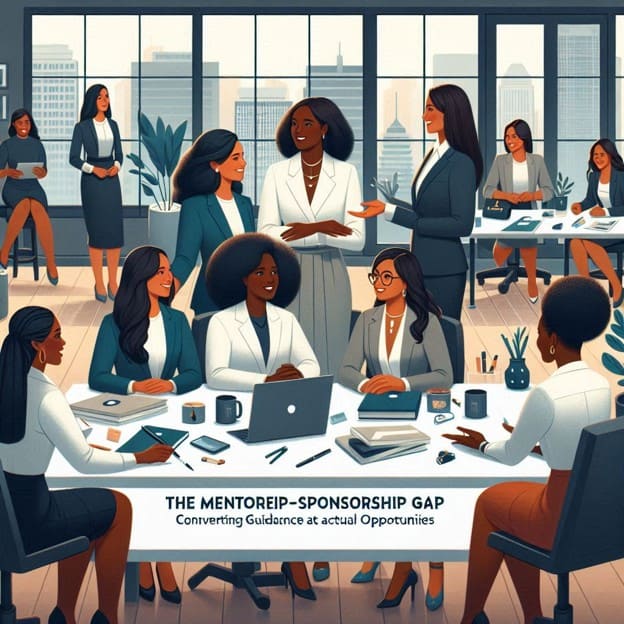
Tamara’s story illustrates one of the most persistent barriers to Black women’s advancement in corporate America: the mentorship-sponsorship gap. While 71% of Black women report having mentors, only 36% have sponsors—executives who actively use their influence to create opportunities and advance careers. This 35-percentage-point gap represents millions of lost opportunities, stalled careers, and untapped potential.
The difference between mentorship and sponsorship isn’t just semantic—it’s the difference between receiving advice and receiving advancement. Mentors guide and counsel. Sponsors advocate and act. In today’s competitive corporate landscape, guidance without advocacy often equals career stagnation, particularly for Black women who face additional systemic barriers to advancement.
Understanding the Critical Distinction
Mentorship: The Foundation
Mentorship provides essential psychological and developmental support. Mentors share wisdom, offer feedback, help navigate challenges, and provide emotional encouragement. This relationship is typically private, focused on personal development, and built around regular conversations that help mentees grow their skills and confidence.
Key Mentorship Activities:
- Sharing career experiences and lessons learned
- Providing feedback on performance and development areas
- Offering guidance on organizational navigation
- Serving as a sounding board for ideas and concerns
- Building confidence through encouragement and support
Sponsorship: The Catalyst
Sponsorship involves active advocacy using one’s organizational capital to create opportunities for another person. Sponsors don’t just advise—they act. They recommend protégés for promotions, include them in high-visibility projects, connect them to influential networks, and put their own reputation on the line to advance another’s career.
Key Sponsorship Activities:
- Advocating for promotions and advancement opportunities
- Recommending for stretch assignments and high-profile projects
- Making strategic introductions to influential decision-makers
- Defending protégés during challenging situations
- Creating visibility through speaking and presentation opportunities
As I discussed in “High-Value Leadership: Transforming Organizations Through Purposeful Culture,” transformative leadership requires moving beyond individual development to systemic impact. Sponsorship embodies this principle by translating individual potential into organizational advancement.
The Data Behind the Gap
The Stark Reality
Research from the Center for Talent Innovation reveals troubling disparities in sponsorship:
- 71% of Black women have mentors (similar to other groups)
- Only 36% have sponsors (significantly lower than white women at 48% and white men at 54%)
- Black women with sponsors are 65% more likely to be promoted than those without
- Organizations with strong sponsorship cultures see 30% higher retention of high-potential diverse talent
The Compound Effect
The sponsorship gap doesn’t just affect individual careers—it compounds across generations. When Black women lack sponsors, they’re less likely to become senior leaders who can sponsor others, creating a self-perpetuating cycle of underrepresentation.
McKinsey’s research shows that for every 100 men promoted to manager, only 58 Black women are promoted to the same level. At the senior level, the gap widens dramatically: for every 100 men promoted to senior leadership, only 28 Black women reach the same level.
Why the Gap Exists
Structural Barriers
Homophily in Networks People naturally gravitate toward others who share similar backgrounds and experiences. Since senior leadership remains predominantly white and male, informal sponsorship relationships often develop along similar demographic lines.
Risk Aversion Sponsorship requires putting one’s reputation on the line. Some potential sponsors hesitate to advocate for Black women due to conscious or unconscious concerns about how their advocacy might be perceived or whether their protégé will succeed.
Visibility Challenges Black women often work in functions or roles with less direct exposure to senior leadership, making it harder to develop the relationships that typically lead to sponsorship.
The Performance-Advocacy Disconnect Many organizations assume high performance automatically leads to advancement, failing to recognize that advocacy is often the missing link between talent and opportunity.
Cultural and Systemic Factors
The “Prove It Again” Syndrome Research by Joan Williams shows that Black women face higher standards for proving their competence and are more likely to have their mistakes amplified while their successes are minimized. This dynamic makes potential sponsors more cautious about advocacy.
Stereotyping and Bias Implicit biases about leadership potential can influence sponsor selection, often unconsciously excluding Black women from consideration for high-visibility opportunities.
Organizational Culture Companies with weak accountability for diversity outcomes often see sponsorship as optional rather than essential for talent development and business success.
Learning from Dave Ulrich’s Stakeholder Value Framework
Dave Ulrich’s evolution of the HR Business Partner model offers valuable insights for addressing the mentorship-sponsorship gap. His shift toward “stakeholder value” creation provides a framework for understanding how sponsorship can be reframed as a business imperative rather than a diversity initiative.
Ulrich’s emphasis on “human capability” rather than just “human capital” aligns perfectly with effective sponsorship. As he notes, organizations must create “marketplace value through talent + leadership + organization + HR function.” Sponsorship directly contributes to this equation by:
Optimizing Talent: Ensuring high-potential individuals receive opportunities that match their capabilities Developing Leadership: Creating diverse leadership pipelines that enhance organizational capability Strengthening Organization: Building inclusive cultures that attract and retain top talent Enhancing HR Function: Demonstrating measurable impact on talent development and business outcomes
When framed through Ulrich’s stakeholder value lens, sponsorship becomes not just the right thing to do, but the smart business strategy for creating competitive advantage.
Case Study: The Transformation at Tech Innovators Inc.
When Jessica Chen joined Tech Innovators Inc. as VP of Human Resources, she inherited a classic mentorship-sponsorship gap problem. The company had robust mentoring programs with high participation rates, but promotion rates for Black women remained significantly below other groups.
Jessica’s analysis revealed that while 78% of Black women employees had mentors, only 29% had sponsors. More telling, the company’s mentoring program was essentially “advice without advocacy”—lots of guidance but little concrete action to advance careers.
Phase 1: Diagnostic Assessment (Months 1-3)
Mentorship Program Audit
- Reviewed existing mentor-mentee relationships and outcomes
- Analyzed promotion patterns and advancement timelines
- Conducted surveys to understand mentee satisfaction and needs
- Interviewed mentors about their role understanding and comfort levels
Sponsorship Mapping
- Identified existing informal sponsorship relationships
- Analyzed correlation between sponsorship and advancement outcomes
- Assessed senior leader willingness and capability to sponsor
- Reviewed organizational systems that support or hinder sponsorship
Cultural Assessment
- Evaluated organizational accountability for diversity outcomes
- Assessed senior leadership commitment to inclusive advancement
- Analyzed decision-making processes for promotions and opportunities
- Reviewed communication patterns and visibility structures
Phase 2: Strategic Intervention (Months 4-12)
Sponsor Development Program Rather than focusing solely on developing protégés, Jessica created a comprehensive program to develop effective sponsors:
Sponsor Training Modules:
- Understanding the difference between mentoring and sponsoring
- Identifying high-potential talent across diverse backgrounds
- Building effective advocacy skills and strategies
- Managing risk and building business cases for advancement
- Measuring sponsorship effectiveness and impact
Accountability Systems:
- Included sponsorship activities in leadership performance evaluations
- Created dashboards tracking sponsorship relationships and outcomes
- Established peer accountability groups for senior leaders
- Implemented recognition programs for effective sponsors
Structural Changes:
- Modified promotion processes to require sponsor advocacy, not just manager approval
- Created cross-functional project opportunities specifically for high-potential Black women
- Established “visibility circuits” ensuring diverse talent exposure to senior leadership
- Implemented talent review processes that explicitly discussed sponsorship needs
Phase 3: Cultural Integration (Months 13-24)
System Embedding:
- Integrated sponsorship expectations into leadership job descriptions
- Created succession planning processes that required diverse sponsor relationships
- Established mentoring-to-sponsorship transition protocols
- Built sponsorship success stories into organizational narrative
Measurement and Adjustment:
- Tracked promotion rates, retention, and engagement metrics
- Collected qualitative feedback on relationship quality and effectiveness
- Adjusted program components based on outcomes and participant feedback
- Scaled successful practices across additional organizational levels
Results After Two Years
The transformation at Tech Innovators Inc. demonstrated the power of converting mentorship into sponsorship:
Quantitative Outcomes:
- Black women’s promotion rates increased by 73%
- Sponsorship participation among Black women rose from 29% to 67%
- Retention rates for high-potential Black women improved by 45%
- Overall employee engagement scores increased across all demographics
Qualitative Changes:
- Increased confidence and career satisfaction among Black women employees
- Enhanced reputation as an employer of choice for diverse talent
- Improved innovation metrics attributed to more diverse leadership perspectives
- Stronger succession pipeline with diverse representation at all levels
The Strategic Conversion Framework
Step 1: Assessment and Mapping
Current State Analysis Begin by understanding your organization’s existing mentorship and sponsorship landscape:
Relationship Audit:
- Map current mentoring relationships and assess their effectiveness
- Identify existing sponsorship relationships (formal and informal)
- Analyze promotion patterns and advancement outcomes
- Survey employees about their career development experiences
Capability Assessment:
- Evaluate senior leaders’ understanding of sponsorship vs. mentorship
- Assess willingness and ability to serve as effective sponsors
- Identify organizational barriers to effective sponsorship
- Review systems and processes that support or hinder advancement
Gap Analysis:
- Compare mentorship participation rates across demographic groups
- Identify sponsorship gaps by level, function, and demographic
- Analyze correlation between sponsorship and advancement outcomes
- Assess organizational readiness for sponsorship culture change
Step 2: Strategic Design and Development
Sponsor Development Program Design
Core Curriculum:
- Sponsorship vs. Mentorship: Understanding the critical differences
- Talent Recognition: Identifying high-potential diverse talent
- Advocacy Skills: Building effective business cases for advancement
- Risk Management: Addressing concerns and building confidence
- Impact Measurement: Tracking and communicating sponsorship effectiveness
Practical Components:
- Sponsor-protégé matching based on career goals and organizational needs
- Regular training sessions with scenario-based learning
- Peer learning groups for sponsors to share experiences and strategies
- Resource tools including advocacy templates and opportunity databases
Accountability Mechanisms:
- Clear expectations and role definitions for sponsors
- Regular check-ins and progress tracking systems
- Integration into performance management and leadership development
- Recognition and reward systems for effective sponsorship
Step 3: Implementation and Integration
Phased Rollout Strategy
Phase 1: Pilot Program (Months 1-6)
- Select high-commitment sponsors and protégés for initial cohort
- Implement core training and matching processes
- Establish measurement systems and feedback mechanisms
- Document early wins and lessons learned
Phase 2: Expansion (Months 7-12)
- Scale program to additional organizational levels and functions
- Refine processes based on pilot program feedback
- Integrate sponsorship into existing talent development systems
- Build organizational awareness and culture change momentum
Phase 3: Institutionalization (Months 13+)
- Embed sponsorship expectations into leadership competencies
- Create sustainable systems that operate independently
- Establish continuous improvement and evolution processes
- Measure long-term impact on organizational capability and culture
Practical Strategies for Converting Relationships
For Potential Protégés
Building Sponsor-Worthy Relationships
1. Demonstrate Value Creation Move beyond seeking help to actively providing value:
- Share industry insights and market intelligence
- Offer unique perspectives on organizational challenges
- Contribute innovative solutions and creative thinking
- Support organizational initiatives and strategic priorities
2. Make Advocacy Easy Help potential sponsors by providing them with advocacy tools:
- Document your achievements and impact with specific metrics
- Prepare clear career goal statements and advancement rationales
- Create brief bio summaries highlighting unique value proposition
- Identify specific opportunities where advocacy would be valuable
3. Build Strategic Relationships Focus on developing relationships with individuals who have:
- Decision-making authority or significant influence
- Access to advancement opportunities and strategic initiatives
- Commitment to diversity and inclusion outcomes
- Track record of successful talent development and advocacy
Practical Example: The Documentation Strategy
Sarah, a Black woman finance director, transformed her mentoring relationship into sponsorship by implementing a systematic documentation approach:
Monthly Achievement Summaries: Sarah created one-page summaries highlighting her contributions, impact metrics, and business value creation.
Opportunity Alerts: She researched upcoming leadership opportunities and provided her mentor with specific talking points about her qualifications.
Success Story Portfolio: Sarah compiled case studies of her problem-solving and leadership capabilities, making it easy for her mentor to advocate with concrete examples.
Strategic Value Propositions: She connected her career advancement to organizational needs, showing how her promotion would solve business challenges.
The result? Within eight months, her mentor had transitioned to active sponsorship, recommending Sarah for two stretch assignments and ultimately advocating for her promotion to VP level.
For Potential Sponsors
Developing Effective Advocacy Skills
1. Understand the Business Case Effective sponsorship requires clear rationale that aligns with organizational objectives:
- Connect protégé advancement to business needs and strategic priorities
- Identify specific ways protégé’s unique capabilities add organizational value
- Prepare data-driven arguments for advancement opportunities
- Anticipate and address potential concerns or objections
2. Create Systematic Opportunities Move beyond informal advocacy to systematic opportunity creation:
- Include protégés in high-visibility meetings and strategic discussions
- Recommend for stretch assignments and cross-functional projects
- Facilitate introductions to influential decision-makers and stakeholders
- Nominate for speaking opportunities, awards, and recognition programs
3. Build Advocacy Coalitions Strengthen impact by developing support networks:
- Partner with other senior leaders to co-sponsor high-potential talent
- Create peer accountability groups focused on diversity advancement
- Share sponsorship strategies and best practices with leadership colleagues
- Build organizational systems that support and reward effective sponsorship
Case Study: The Coalition Approach
When Michael Rodriguez, a white male executive, decided to sponsor Keisha, a high-potential Black woman manager, he recognized that solo advocacy might be less effective than building broader support.
Coalition Building Strategy:
- Peer Engagement: Michael discussed Keisha’s potential with three other senior leaders, building consensus about her capabilities
- Cross-Functional Support: He partnered with leaders from different departments to create diverse advancement opportunities
- Data Sharing: Michael compiled and shared Keisha’s performance metrics and impact data with the broader leadership team
- Opportunity Coordination: The coalition coordinated to ensure Keisha received multiple development opportunities and increased visibility
Results:
- Keisha received stretch assignments from three different departments
- Her visibility with senior leadership increased dramatically
- She was promoted ahead of the typical timeline
- The coalition approach became a model for other sponsorship relationships
Organizational Systems and Culture Change
Creating Sponsorship-Supportive Infrastructure
Policy and Process Integration
Performance Management Systems:
- Include sponsorship activities in leadership competency models
- Incorporate protégé advancement outcomes into sponsor performance evaluations
- Create recognition programs that celebrate effective sponsorship
- Establish mentoring-to-sponsorship transition criteria and processes
Talent Development Processes:
- Integrate sponsorship requirements into succession planning
- Create diverse candidate slate requirements for advancement opportunities
- Establish protégé advocacy protocols for promotion discussions
- Build sponsorship relationship tracking into talent management systems
Organizational Communication:
- Share sponsorship success stories and impact metrics
- Communicate expectations for leadership sponsorship behaviors
- Provide training and resources for effective sponsor development
- Create transparency around advancement processes and sponsor advocacy
Measuring and Sustaining Impact
Key Performance Indicators
Individual Level Metrics:
- Sponsorship relationship development and quality
- Career advancement velocity and trajectory changes
- Protégé engagement, satisfaction, and retention rates
- Sponsor effectiveness and advocacy skill development
Organizational Level Metrics:
- Demographic representation across leadership levels
- Promotion rate equity across different groups
- Succession pipeline diversity and strength
- Cultural inclusion and belonging indicators
Business Impact Metrics:
- Innovation and creativity indicators
- Employee engagement and retention outcomes
- Market performance and competitive positioning
- Customer satisfaction and loyalty measures
Overcoming Common Obstacles
Addressing Sponsor Hesitation
Risk Management Strategies
1. The Reputation Risk Concern Some potential sponsors worry about the impact on their credibility if protégés don’t succeed.
Solution: Provide sponsor training on protégé selection criteria, development strategies, and success factors. Create support systems that help sponsors make informed decisions and provide ongoing guidance.
2. The Time and Energy Investment Busy executives may feel they lack bandwidth for effective sponsorship.
Solution: Develop efficient sponsorship models that integrate into existing leadership activities. Provide tools, templates, and processes that make advocacy easier and more systematic.
3. The Organizational Politics Navigation Leaders may worry about potential backlash or conflicts related to diversity advocacy.
Solution: Build organizational commitment at the C-suite level. Create accountability systems that make diversity advancement a shared leadership responsibility rather than individual choice.
Building Protégé Readiness
Development Prerequisites
1. Performance Excellence Protégés must demonstrate consistent high performance and business impact.
Development Strategy: Create skill-building opportunities, provide feedback and coaching, establish clear performance standards and expectations.
2. Strategic Thinking Effective protégés understand organizational dynamics and can contribute to strategic discussions.
Development Strategy: Provide exposure to strategic planning processes, offer cross-functional experiences, create opportunities for business acumen development.
3. Relationship Building Successful protégés can build and maintain professional relationships across organizational levels.
Development Strategy: Facilitate networking opportunities, provide communication skill development, create peer learning and collaboration experiences.
Future Trends and Evolution
Technology-Enhanced Sponsorship
AI-Powered Matching Advanced algorithms can analyze compatibility factors, career goals, and organizational needs to optimize sponsor-protégé matching for maximum effectiveness.
Digital Advocacy Platforms Technology platforms can facilitate opportunity sharing, track advocacy activities, and measure sponsorship relationship effectiveness in real-time.
Virtual Sponsorship Networks Remote and hybrid work environments create opportunities for sponsorship relationships that transcend geographic boundaries and traditional organizational structures.
Inclusive Sponsorship Models
Reverse Sponsorship Junior employees can sponsor senior leaders for learning about emerging trends, technology adoption, and cultural shifts.
Peer Sponsorship Networks Lateral advocacy relationships where colleagues at similar levels advocate for each other’s advancement and opportunity access.
Community-Based Sponsorship External sponsorship relationships through professional associations, alumni networks, and industry connections.
The Multiplication Effect
Creating Sustainable Change
When mentorship successfully converts to sponsorship, it creates multiplication effects that extend far beyond individual relationships:
Individual Impact:
- Accelerated career advancement and increased opportunities
- Enhanced confidence, engagement, and career satisfaction
- Expanded professional networks and relationship capital
- Improved leadership skills and organizational influence
Organizational Impact:
- Stronger leadership pipelines with diverse representation
- Enhanced innovation and problem-solving capabilities
- Improved employee engagement and retention rates
- Competitive advantage through diverse perspectives and capabilities
Systemic Impact:
- Cultural shifts toward inclusive leadership and advancement
- Reduced barriers and increased opportunities for underrepresented talent
- Enhanced organizational reputation and employer brand
- Long-term sustainability of diversity and inclusion progress
As I emphasized in “Rise & Thrive: A Black Woman’s Blueprint for Leadership Excellence,” individual success becomes most meaningful when it creates pathways for others. Converting mentorship to sponsorship embodies this principle by transforming guidance into tangible advancement opportunities that benefit individuals, organizations, and entire communities.
Conclusion: From Advice to Advocacy
The mentorship-sponsorship gap represents one of the most significant barriers to Black women’s advancement in corporate America, but it’s also one of the most addressable. Unlike some systemic barriers that require long-term cultural change, the gap between mentorship and sponsorship can be closed through intentional relationship development, organizational system changes, and leadership commitment.
The transformation requires moving beyond good intentions to strategic action. Mentors must evolve into sponsors. Organizations must create systems that support and reward advocacy. Leaders must understand that sponsorship isn’t just about helping individuals—it’s about building organizational capability and competitive advantage.
Remember, as I discussed throughout “Mastering a High-Value Company Culture,” sustainable change requires both individual commitment and systemic transformation. Converting mentorship to sponsorship creates the bridge between personal development and organizational advancement that too many talented Black women are missing.
The gap is real, but it’s not permanent. With intentional effort, strategic focus, and sustained commitment, we can transform advice into advocacy, guidance into opportunity, and potential into advancement. The result isn’t just individual success—it’s organizational transformation that benefits everyone.
The question isn’t whether your organization can afford to close the mentorship-sponsorship gap. It’s whether you can afford to keep it open.
Discussion Questions and Next Steps
For Individual Reflection:
- Do you currently have mentors, sponsors, or both? How might you convert mentoring relationships into sponsorship opportunities?
- What unique value do you bring that could make sponsorship attractive to senior leaders?
- How might you begin building advocacy-worthy relationships in your current environment?
For Potential Sponsors:
- What prevents you from moving beyond mentoring to active sponsorship and advocacy?
- How could you identify high-potential protégés who would benefit from your sponsorship?
- What organizational support would help you become a more effective sponsor?
For Organizational Leaders:
- How might your current mentoring programs be converted into sponsorship initiatives?
- What systems and accountability measures could support more effective sponsorship in your organization?
- How could you measure the business impact of closing the mentorship-sponsorship gap?
Next Steps:
- Assess your organization’s current mentorship and sponsorship landscape using the framework provided
- Identify potential sponsor-protégé relationships that could be developed or enhanced
- Design training and support systems that help mentors transition to effective sponsors
- Create accountability measures that reward and recognize effective sponsorship
- Establish metrics to track the conversion from mentorship to sponsorship and its impact on advancement
Ready to transform your mentoring relationships into career-changing sponsorship opportunities? The frameworks outlined here provide the foundation, but lasting change requires committed action and strategic implementation.
📞 Ready to unlock your authentic leadership advantage? Contact: admin@cheblackmon.com | Call: 888.369.7243
Get the Complete Blueprint Master the frameworks from this week’s articles with “Rise & Thrive: A Black Woman’s Blueprint for Leadership Excellence” – your strategic guide to authentic leadership that drives results.
🔗 Get Your Copy: https://adept-solutions-llc-2.kit.com/products/rise-thrive-a-black-womans-bluepri
Join the Academy Want deeper transformation? Join the waitlist for Rise & Thrive Academy – the premier leadership development experience for Black women ready to leverage their authentic advantage.
🔗 Join the Waitlist: https://adept-solutions-llc-2.kit.com/6b1638bc22
#BlackWomenLeadership #Mentorship #Sponsorship #CareerAdvancement #ProfessionalDevelopment #WomenInLeadership #LeadershipDevelopment #ExecutiveSponsorship #CorporateAdvancement #DiversityAndInclusion #TalentDevelopment #WorkplaceAdvocacy #InclusiveLeadership #CareerGrowth #LeadershipOpportunities