


By Che’ Blackmon, DBA Candidate | Founder & CEO, Che’ Blackmon Consulting
In a world that often glorifies individual achievement and competitive advantage, there’s a powerful truth that many organizations overlook: collaboration, not competition, is the real driver of sustainable success. As I wrote in “High-Value Leadership: Transforming Organizations Through Purposeful Culture,” culture is not built through command and control; it is cultivated through environments where people and organizations thrive together. The partnership principle embodies this philosophy. It recognizes that when we shift from a zero-sum mindset to one of collective growth, everyone wins.
For Black women in corporate spaces, this principle carries particular significance. Too often, we’re pitted against one another in environments where representation is scarce and opportunities feel limited. We’re told there’s only room for one at the table. Yet the partnership principle challenges this scarcity mindset. It invites us to build coalitions, amplify each other’s voices, and create new tables where collaboration becomes our collective strength.
The Competitive Trap: Why It Fails Organizations 🚫
Traditional workplace cultures have long operated on the assumption that competition drives performance. Leaders pit teams against each other. Individuals hoard information to protect their positions. Success is measured by who climbs fastest, not by what the collective achieves. This approach might yield short-term gains, but research consistently shows it creates long-term damage to organizational health and innovation capacity.
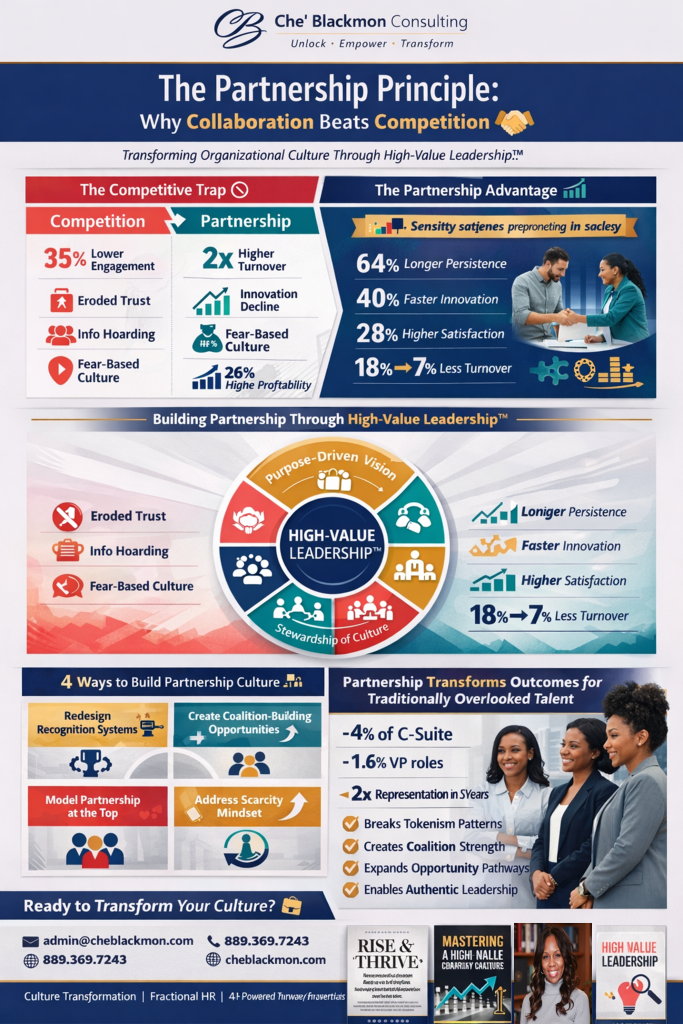
There was a manufacturing company that implemented a forced ranking system, requiring managers to identify the bottom 10% of performers each quarter for potential termination. The intention was to drive excellence through competition. Instead, the policy created a culture of fear and mistrust. Team members stopped sharing best practices. They withheld information that could help colleagues succeed. Innovation plummeted because people were too afraid to take risks that might reflect poorly in rankings. Within two years, the company’s employee engagement scores dropped 35%, and turnover among top performers doubled.
This scenario illustrates what happens when competition becomes the organizing principle. People focus on self-preservation rather than collective progress. As I discuss in “Mastering a High-Value Company Culture,” culture is the lifeblood of any organization. When that lifeblood is poisoned by cutthroat competition, the entire organization suffers. Collaboration withers. Trust erodes. The very innovation that competition was supposed to inspire gets stifled.
For traditionally overlooked groups, particularly Black women, competitive workplace cultures create additional barriers. When representation is already limited, competition for the few available leadership positions can become intense and isolating. Some organizations unconsciously pit Black women against each other, creating what scholars call “competitive victimhood,” where individuals feel they must prove they deserve opportunities more than others who share their identity. This dynamic is both exhausting and counterproductive, preventing the coalition-building that could transform organizational culture.
The Partnership Advantage: What Research Reveals 📊
Extensive research across industries demonstrates that collaborative cultures outperform competitive ones on virtually every meaningful metric. A Stanford study found that when people work collaboratively, they persist 64% longer on challenging tasks and report higher engagement and lower fatigue. Google’s Project Aristotle, which analyzed hundreds of teams to identify what makes them effective, found that psychological safety (the belief that you can take risks without punishment) was the number one predictor of team success. You cannot build psychological safety in a culture where people view each other as threats.
The partnership principle isn’t about eliminating accountability or lowering standards. Rather, it’s about creating what Brené Brown calls “brave spaces” where people can challenge each other, share diverse perspectives, and innovate together. High-value leadership, as I outline in my work, maintains high standards within psychologically safe environments. These aren’t contradictory goals; they’re complementary ones.
Consider the technology company that deliberately shifted from individual to team-based performance metrics. Rather than ranking engineers against each other, they measured success by collective output, knowledge sharing, and cross-functional collaboration. The results were remarkable. Innovation cycles accelerated by 40%. Employee satisfaction scores increased by 28%. Voluntary turnover among high performers dropped from 18% to 7% annually. The partnership principle transformed not just metrics but the lived experience of work.
Research on diverse teams provides additional evidence for the partnership principle. McKinsey’s extensive studies on diversity show that companies in the top quartile for ethnic diversity are 36% more likely to outperform peers on profitability. However, this diversity dividend only materializes when organizations build inclusive cultures where diverse voices are genuinely valued and collaboration is rewarded. Simply having diverse representation without the partnership principle yields minimal benefits. The magic happens when people from different backgrounds work together toward shared goals, bringing their unique perspectives and experiences to solve complex problems collaboratively.
Building Partnership Cultures: Practical Strategies 🏗️
Redesign Recognition and Reward Systems
Most organizations inadvertently reinforce competitive behavior through their recognition programs. When you only celebrate individual achievements, when bonuses are tied to outperforming colleagues, when promotion decisions hinge on being better than others rather than contributing to collective success, you send clear messages about what matters. The partnership principle requires deliberately redesigning these systems to reward collaboration.
Progressive organizations are creating team-based incentives that tie rewards to collective outcomes. They’re recognizing “collaboration champions” who actively help others succeed. They’re measuring leaders not just on their team’s results but on their contributions to cross-functional initiatives. These aren’t small tweaks; they represent fundamental shifts in how success is defined and rewarded.
Create Intentional Coalition-Building Opportunities
Partnership doesn’t happen automatically. It requires intentional structure and support. Organizations committed to the partnership principle create formal mechanisms for collaboration. This might include cross-functional project teams, mentoring circles that connect people across departments, or innovation labs where diverse employees collaborate on strategic challenges.
For Black women and other underrepresented groups, these coalition-building opportunities are particularly crucial. Employee resource groups can serve as powerful platforms for partnership when they’re properly resourced and integrated into business strategy. Rather than positioning these groups as separate or marginal, forward-thinking companies engage them as strategic partners in shaping culture, developing talent, and driving innovation. As I emphasize in “Rise & Thrive: A Black Woman’s Blueprint for Leadership Excellence,” authentic leadership requires bringing your whole self to your role. Organizations that enable this authenticity through supportive partnerships unlock tremendous potential.
Model Partnership at the Top
Culture cascades from leadership. If executives compete visibly, hoard information, or undermine each other, that behavior permeates the organization. The partnership principle must be modeled at the top. This means executives publicly celebrating each other’s successes, collaborating transparently on strategic initiatives, and demonstrating that helping colleagues succeed is valued as highly as individual achievement.
There was a financial services firm where the CEO intentionally restructured executive team meetings to emphasize partnership. Instead of departmental updates designed to showcase individual accomplishments, meetings focused on collaborative problem-solving around organizational challenges. Each executive was assigned a peer accountability partner from a different function. Their performance reviews included 360-degree feedback specifically on collaborative behaviors. These structural changes signaled that partnership wasn’t optional rhetoric; it was expected practice.
Address the Scarcity Mindset Directly
For the partnership principle to take root, organizations must address the scarcity mindset that fuels competition. This mindset assumes limited resources, opportunities, and recognition. It creates zero-sum thinking where one person’s gain becomes another’s loss. Leaders must actively counter this narrative by demonstrating abundance thinking through their decisions and communications.
This is especially important for creating inclusive environments where Black women and other minorities can thrive. When there’s only one Black woman in senior leadership, the message sent to others is clear: there’s only room for one. Organizations committed to the partnership principle intentionally expand representation, create multiple pathways to leadership, and celebrate when diverse talent succeeds together rather than positioning individuals as singular tokens. As I discuss in my doctoral research on AI-enhanced predictive analytics for culture transformation, organizations can use data to identify and address these patterns before they become entrenched.
The Partnership Principle in Action: Real-World Impact 💼
When organizations genuinely embrace the partnership principle, the results are transformative. Consider the healthcare organization that implemented a collaborative care model, requiring physicians, nurses, and support staff to work in integrated teams rather than hierarchical silos. Patient outcomes improved by 22%. Staff satisfaction increased by 31%. Medical errors decreased by 45%. The partnership principle didn’t just make work better; it literally saved lives.
Or examine the professional services firm that created a formal sponsorship program pairing senior leaders with high-potential employees from underrepresented backgrounds. Unlike traditional mentoring, which is often passive, this program required sponsors to actively advocate for their partners, share opportunities, and facilitate meaningful connections. Within three years, representation of Black women in director-level roles doubled. More importantly, employee engagement among participants increased 40%, and the organization reported stronger client relationships because diverse teams brought richer perspectives to client challenges.
These examples illustrate what becomes possible when organizations move beyond competitive frameworks toward partnership models. The shift isn’t just philosophical; it has measurable business impact. Companies with collaborative cultures report higher innovation rates, stronger employee retention, better customer satisfaction, and improved financial performance. The partnership principle isn’t idealistic naiveté; it’s strategic wisdom backed by evidence.
Personal Practice: Living the Partnership Principle 🌟
While organizational culture change requires leadership commitment, individuals can embody the partnership principle regardless of their formal authority. Your personal practice matters. It creates ripples that influence those around you and gradually shifts culture from the ground up.
Start by examining your default mindset. When a colleague succeeds, is your first reaction celebration or comparison? When you have valuable information, do you share it generously or hoard it strategically? When someone asks for help, do you see it as an opportunity or an imposition? Your honest answers reveal whether you’re operating from scarcity or abundance thinking. The partnership principle requires choosing abundance consistently, even when scarcity feels safer.
As Black women navigating corporate spaces, living the partnership principle means actively supporting other Black women rather than viewing them as competition for limited opportunities. It means using whatever platform you have to amplify others’ voices. It means sharing lessons from your journey, making introductions that benefit others, and celebrating collective progress. In “Rise & Thrive,” I emphasize that your leadership journey isn’t about fitting into existing structures but transforming them. Partnership is how we create that transformation together.
Practical actions to embody the partnership principle include regularly offering to help colleagues without expecting immediate reciprocity, publicly crediting others for their contributions to your work, seeking input from diverse perspectives before making decisions, and volunteering to connect people who could benefit from knowing each other. These aren’t grand gestures; they’re daily practices that signal your commitment to collaboration over competition. Over time, these small actions compound into significant culture shifts.

Overcoming Partnership Challenges 🎯
Embracing the partnership principle isn’t without challenges. Some people will view your collaborative approach as weakness or naiveté. In competitive environments, generosity can be exploited. Setting boundaries becomes essential. Partnership doesn’t mean being a doormat or letting others take credit for your work. It means approaching relationships with generosity while maintaining healthy boundaries.
Black women often face particular challenges in this regard. We navigate stereotypes about being either too aggressive or too accommodating, too competitive or too collaborative. The partnership principle helps us transcend these false binaries. We can be both strong and collaborative, both ambitious and supportive. High-value leadership, as I define it in my work, embraces these complexities rather than forcing us into narrow boxes.
Another challenge is organizational inertia. Even when individuals embrace partnership, entrenched systems may reward competitive behavior. In these situations, finding allies becomes crucial. Seek out others who share your values. Build coalition incrementally. Document the positive outcomes of collaborative approaches. Present the business case for partnership to leaders who can influence broader culture change. Transformation rarely happens overnight, but persistence pays off.
Remember too that partnership doesn’t require perfect agreement or constant harmony. Healthy partnerships involve constructive conflict and honest feedback. The goal isn’t eliminating disagreement but ensuring it happens within a foundation of mutual respect and shared purpose. As I discuss in “Mastering a High-Value Company Culture,” strong cultures can hold space for diverse viewpoints precisely because they’re built on trust and partnership rather than competition.
Looking Forward: The Future of Work is Collaborative 🚀
As we move deeper into the 21st century, the partnership principle isn’t just morally right; it’s strategically imperative. The challenges facing organizations today require collaborative solutions. Climate change, technological disruption, global pandemics, and social justice movements all demand that we work together across differences. No individual, team, or even organization can solve these complex problems alone. Partnership becomes not just preferable but necessary for survival.
The rise of remote and hybrid work models makes partnership both more challenging and more essential. Without physical proximity, we must be more intentional about building connections, sharing information, and creating collaborative spaces. Technology enables new forms of partnership, but it requires deliberate effort to prevent digital isolation and competition for visibility in virtual environments.
Younger generations entering the workforce increasingly prioritize collaboration, purpose, and inclusive culture over traditional markers of individual success. They’re less interested in climbing ladders at others’ expense and more focused on collective impact. Organizations that cling to competitive models will struggle to attract and retain talent. Those that embrace the partnership principle position themselves for long-term success in an evolving landscape.
For Black women and other underrepresented groups, the future of work holds both challenges and opportunities. As organizations grapple with diversity, equity, and inclusion, the partnership principle offers a framework for moving beyond tokenism toward genuine belonging. When we build cultures where collaboration is valued more than competition, where multiple people can succeed simultaneously, where difference is leveraged as strength rather than minimized as threat, everyone benefits. The rising tide truly lifts all boats.
Key Takeaways 🔑
The partnership principle transforms organizations by replacing competitive scarcity with collaborative abundance. Here are the essential insights to remember:
- Competition creates short-term gains but long-term organizational damage through eroded trust, reduced innovation, and increased turnover.
- Research consistently shows collaborative cultures outperform competitive ones on engagement, innovation, retention, and financial metrics.
- Partnership requires redesigning systems to reward collaboration, creating intentional coalition-building opportunities, and modeling collaborative behavior at leadership levels.
- For Black women and other underrepresented groups, partnership offers paths beyond tokenism toward genuine belonging and shared success.
- Individual practice matters; you can embody partnership principles regardless of formal authority through daily actions that prioritize collective success.
- Partnership doesn’t eliminate accountability or conflict; it creates foundations of trust and respect that enable productive disagreement and high standards.
- The future of work increasingly demands collaborative approaches to solve complex challenges that no individual or organization can address alone.
Discussion Questions 💭
Reflect on these questions individually or discuss them with your team:
- How does your organization currently balance competition and collaboration? What systems or practices reinforce competitive behavior, and what supports partnership?
- Think about a recent situation where you defaulted to competitive rather than collaborative thinking. What drove that choice? How might a partnership approach have changed the outcome?
- For underrepresented professionals: What barriers have you experienced to building partnerships in your workplace? What support would help you engage more fully in collaborative relationships?
- How might your team redesign one existing process or practice to better reflect the partnership principle? What would success look like?
- Who in your organization exemplifies the partnership principle? What specific behaviors make them effective collaborative leaders?
Next Steps: Taking Action 👣
Understanding the partnership principle is valuable, but transformation requires action. Here’s how to begin:
Conduct a Personal Audit: Over the next week, notice when you default to competitive versus collaborative thinking. What patterns emerge? What triggers competitive impulses? Use this awareness to make conscious choices aligned with partnership values.
Practice Visible Generosity: Commit to three specific acts of professional generosity this month. Share credit publicly for collaborative work. Make an introduction that benefits someone else. Offer expertise to a colleague without expecting immediate reciprocity. Notice how these actions influence your relationships and your mindset.
Start Team Conversations: If you lead a team, facilitate discussion about the partnership principle using the questions provided above. Invite team members to identify where competitive dynamics undermine collective success. Co-create agreements about how you want to work together differently.
Build Strategic Alliances: Identify two to three colleagues who share your commitment to collaborative culture. Meet regularly to support each other, share resources, and strategize about how to influence broader organizational change. Coalition-building accelerates transformation.
Measure What Matters: If you have influence over performance management, advocate for metrics that capture collaborative contributions. Propose recognition programs that celebrate partnership. Use data to demonstrate the business case for collaboration in your context.
Final Thoughts 💡
The partnership principle represents a fundamental shift in how we think about success, leadership, and organizational culture. It challenges deeply ingrained assumptions about scarcity, competition, and individual achievement. Embracing it requires courage, especially in environments still dominated by competitive dynamics.
Yet the evidence is clear: collaboration beats competition. Organizations built on partnership principles are more innovative, more resilient, and more human. They create space for diverse talent to thrive. They solve complex problems more effectively. They build cultures where people don’t just survive but genuinely flourish.
For Black women and other professionals from traditionally overlooked backgrounds, the partnership principle offers particular promise. It creates pathways beyond tokenism toward genuine belonging and shared leadership. It enables us to build coalitions that transform culture rather than adapting to fit into limiting structures. It allows us to bring our whole selves to our work and to succeed not despite our differences but because of them.
The shift from competition to collaboration won’t happen overnight. It requires sustained effort, intentional practice, and systemic change. But every partnership you build, every generous act you practice, every collaborative success you create moves your organization closer to this vision. Culture transformation begins with individual choices that compound into collective momentum.
As I’ve learned through twenty-four years of transforming organizational cultures, change is always possible when we commit to it together. The partnership principle isn’t just a nice idea; it’s a practical framework for building organizations worthy of the talent and dedication people bring to their work. It’s how we create high-value cultures where both individuals and organizations thrive.
The question isn’t whether the partnership principle works. Research and practice confirm it does. The question is whether you’re ready to embrace it, to model it in your own leadership, and to help build organizations where collaboration truly beats competition. Your answer matters. The impact you create through partnership will ripple far beyond what you can see.
Ready to Transform Your Organization’s Culture? 🌈
At Che’ Blackmon Consulting, we specialize in helping organizations shift from competitive cultures to collaborative ones that drive sustainable success. Whether you’re looking to:
- Develop high-value leadership capabilities across your organization
- Build inclusive cultures where diverse talent thrives
- Transform competitive dynamics into collaborative partnerships
- Leverage AI-enhanced predictive analytics to prevent turnover and strengthen culture
- Create strategic HR infrastructure that supports your business goals
We bring over two decades of progressive HR leadership experience combined with cutting-edge research in organizational transformation. Our approach is grounded in proven methodologies, informed by real-world results, and customized to your unique context and challenges.
Let’s talk about how the partnership principle can transform your organization. We offer complimentary consultation calls to explore your needs and discuss how we can support your culture transformation journey.
Contact Che’ Blackmon Consulting Today:
📧 Email: admin@cheblackmon.com
📞 Phone: 888.369.7243
🌐 Website: cheblackmon.com
About the Author 👩🏾💼
Che’ Blackmon is the Founder and CEO of Che’ Blackmon Consulting, a Michigan-based fractional HR and culture transformation consultancy. With 24+ years of progressive HR leadership experience across manufacturing, automotive, healthcare, and professional services sectors, she has consistently delivered measurable results including 9% engagement increases, 60% safety improvements, and successful culture transformations for organizations ranging from startups to Fortune 500 companies.
Currently pursuing a Doctor of Business Administration (DBA) in Organizational Leadership at National University, Che’ is developing Michigan’s first AI-powered culture transformation platform that predicts employee turnover 3-6 months in advance. Her dissertation research focuses on AI-enhanced predictive analytics for culture transformation and employee retention.
Che’ is the published author of three books on leadership and organizational culture: “High-Value Leadership: Transforming Organizations Through Purposeful Culture,” “Mastering a High-Value Company Culture,” and “Rise & Thrive: A Black Woman’s Blueprint for Leadership Excellence.” She hosts the twice-weekly podcast “Unlock, Empower, Transform with Che’ Blackmon” and the “Rise & Thrive” YouTube series.
#PartnershipPrinciple #HighValueLeadership #OrganizationalCulture #CollaborationOverCompetition #LeadershipDevelopment #CultureTransformation #HRLeadership #ExecutiveLeadership #BlackWomenInLeadership #InclusiveLeadership #WorkplaceCulture #TeamCollaboration #LeadershipExcellence #PsychologicalSafety #BusinessTransformation