

By Che’ Blackmon Founder & CEO, Che’ Blackmon Consulting DBA Candidate in Organizational Leadership
In organizational leadership, trust is not a soft skill relegated to team building exercises and annual retreats. It is the fundamental currency of high performance. Without trust, even the most brilliant strategies collapse under the weight of organizational dysfunction, political maneuvering, and cultural toxicity. Yet trust remains one of the most misunderstood and poorly cultivated elements of corporate success.
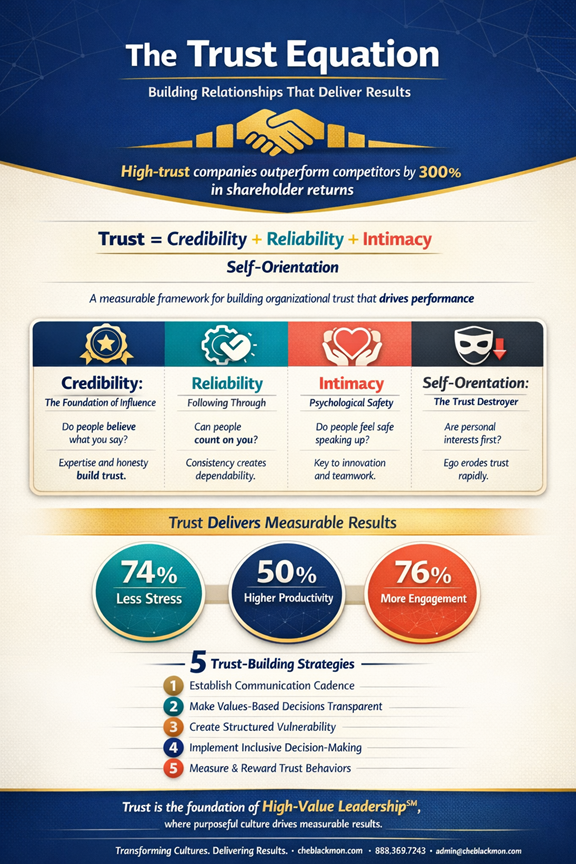
Consider this: According to research from the Harvard Business Review, employees at high-trust companies report 74% less stress, 50% higher productivity, and 76% more engagement than those at low-trust organizations. The financial implications are equally compelling. Companies with high-trust cultures outperform their competitors by nearly 300% in total shareholder returns. Trust is not abstract. It translates directly to your bottom line, your retention metrics, and your ability to attract and develop exceptional talent.
This article explores the trust equation as both a leadership framework and a strategic imperative for organizational transformation, drawing from research in organizational behavior, decades of HR leadership experience across manufacturing and automotive sectors, and practical insights from building high-value company cultures that deliver measurable results.
💎 Understanding the Trust Equation
The trust equation, originally developed by David Maister, Charles Green, and Robert Galford, provides a mathematical framework for understanding what builds and erodes trust in professional relationships:
Trust = (Credibility + Reliability + Intimacy) ÷ Self-Orientation
Let’s examine each component and its implications for organizational leadership.
🎯 Credibility: The Foundation of Influence
Credibility answers the question: Do people believe what you say? In organizational contexts, credibility emerges from demonstrated expertise, consistent communication of accurate information, and the willingness to admit when you don’t have all the answers. Leaders with credibility don’t pretend to be infallible. They acknowledge complexity, cite sources, and make decisions based on data rather than ego.
There was a manufacturing company facing chronic quality issues that threatened a major automotive contract. The CEO could have deflected blame or manufactured optimistic projections. Instead, she brought the entire leadership team together, presented unvarnished production data, acknowledged the severity of the situation, and outlined a realistic 90-day improvement plan with weekly transparency reports to all stakeholders. Her credibility soared not because she had easy answers but because she refused to insult their intelligence with corporate spin.
For traditionally overlooked employees, particularly Black women navigating predominantly white corporate spaces, credibility faces additional barriers. Research from the Center for Talent Innovation reveals that Black women must often work harder to establish credibility, facing what scholars call the credibility tax. They are more likely to have their expertise questioned, their accomplishments attributed to external factors like affirmative action, and their leadership capabilities doubted. Building credibility in these environments requires not just competence but strategic visibility, calculated risk-taking, and the cultivation of sponsors who can amplify your expertise.
⚙️ Reliability: Following Through on Commitments
Reliability asks: Can people count on you to do what you said you would do? This seems straightforward until you recognize how frequently leaders make commitments they cannot keep. Every cancelled one-on-one meeting, every delayed decision, every forgotten promise erodes the reliability component of trust. Reliability compounds over time. Leaders who consistently deliver on small commitments build reserves of trust that sustain them through inevitable failures on larger initiatives.
Consider the experience of a technology startup that promised its engineering team flexible work arrangements, then abruptly mandated full-time office attendance when venture capital funding arrived. The policy reversal destroyed reliability overnight. Engineers who had structured their lives around flexibility felt betrayed. Within six months, the company lost 40% of its technical talent, delaying product launches and damaging its reputation in the competitive talent market.
The lesson is clear: leaders must underpromise and overdeliver rather than making grandiose commitments they lack the authority or resources to fulfill. Reliability requires realistic assessment of capacity, transparent communication about constraints, and the courage to say no when you cannot responsibly commit.
For Black women and other marginalized groups, unreliable leadership has particularly devastating effects. When leaders promise diversity initiatives, mentorship programs, or pathways to advancement but fail to follow through, it confirms suspicions that inclusion efforts are performative rather than genuine. This erosion of trust creates what organizational psychologists call minority stress, the additional cognitive and emotional burden of navigating predominantly white institutions while managing constant microaggressions and broken promises.
🤝 Intimacy: Creating Psychological Safety
Intimacy in the trust equation does not refer to personal closeness but to the safety people feel when they share concerns, admit mistakes, or voice dissenting opinions. Organizations with high intimacy are characterized by psychological safety, the belief that you won’t be punished or humiliated for speaking up. Research by Dr. Amy Edmondson at Harvard Business School demonstrates that psychological safety is the strongest predictor of team effectiveness, innovation, and learning velocity.
Leaders create intimacy through vulnerability. When a senior executive admits uncertainty, acknowledges a failed initiative, or asks for help, it signals that imperfection is acceptable. This permission to be human cascades through the organization. Teams become willing to surface problems early rather than hiding them until they metastasize into crises.
There was a healthcare organization whose culture punished dissent so aggressively that nurses stopped reporting medication errors, fearing retaliation. Patient safety incidents increased by 300% over two years before the board intervened, replacing the executive team with leaders trained in high-reliability organizations. The new leadership implemented anonymous reporting systems, held monthly listening sessions, and publicly celebrated employees who identified process failures. Within 18 months, reported incidents increased (a positive indicator of transparency) while actual patient harm decreased by 60%.
For Black women in corporate environments, psychological safety is often absent. Research published in the Journal of Vocational Behavior found that Black women report the lowest levels of psychological safety among all demographic groups, navigating what scholars describe as a concrete ceiling rather than a glass one. They face penalty for displaying too much emotion or too little, for being too assertive or insufficiently confident. This impossible calculus makes authentic participation exhausting. Leaders building trust with diverse teams must recognize that intimacy requires dismantling the informal penalties that punish difference.
🎭 Self-Orientation: The Trust Destroyer
Self-orientation is the denominator in the trust equation, which means it has multiplicative destructive power. High self-orientation appears when leaders prioritize their own interests, ego, or advancement over the needs of their teams and organizations. It manifests in credit-stealing, blame-shifting, political maneuvering, and decisions that optimize personal visibility rather than organizational outcomes.
The mathematics are unforgiving. A leader might score highly on credibility, reliability, and intimacy, but if self-orientation is high, trust collapses. Employees can forgive occasional incompetence. They rarely forgive self-serving behavior masquerading as leadership.
Consider the executive who championed a major operational improvement project, celebrated publicly when it succeeded, but privately blamed the implementation team when components failed. His credibility, initially high due to technical expertise, evaporated as employees recognized his pattern of claiming credit while deflecting accountability. Within a year, his department experienced the highest turnover rate in the company.
Reducing self-orientation requires uncomfortable self-awareness. It means asking: Am I making this decision because it’s right for the organization or because it makes me look good? Am I promoting this person because they’re the best candidate or because they’re loyal to me? Am I pushing this initiative because it solves a real problem or because I want to be associated with innovation? These questions are difficult precisely because self-interest is often unconscious, rationalized through elaborate justifications that disguise ego as strategy.
For traditionally overlooked employees, high self-orientation among leaders translates to tokenism, performative diversity, and the perpetuation of exclusive networks that maintain power for existing elites. When leaders prioritize their own comfort over systemic change, diversity initiatives become box-checking exercises rather than genuine transformation.
🏗️ Building Trust in Organizational Transformation
The trust equation provides a diagnostic framework, but organizational transformation requires systematic application of trust-building principles. In my work developing AI-enhanced predictive analytics for culture transformation, one pattern emerges consistently: companies that successfully transform their cultures prioritize trust metrics as early indicators of systemic health.
Traditional engagement surveys measure satisfaction after the fact. Advanced predictive models identify trust erosion 3 to 6 months before it manifests in turnover, absenteeism, or productivity declines. These systems track communication patterns, response times to employee concerns, consistency between stated values and resource allocation, and the distribution of opportunities across demographic groups.
There was a professional services firm that implemented trust metrics alongside traditional performance indicators. They discovered that teams with the highest billable hours had the lowest trust scores, indicating that short-term revenue optimization was destroying long-term sustainability. The firm restructured incentives to reward trust-building behaviors like mentorship, knowledge sharing, and collaborative problem-solving. Within 18 months, both trust scores and revenue increased, disproving the false dichotomy between relationship investment and financial performance.
🌟 Trust as the Foundation of High-Value Culture
A high-value company culture, as articulated in my books “Mastering a High-Value Company Culture” and “High-Value Leadership: Transforming Organizations Through Purposeful Culture,” is fundamentally built on trust. You cannot have accountability without trust. You cannot have innovation without trust. You cannot have diversity and inclusion without trust. Every positive organizational attribute depends on this foundation.
High-value cultures are characterized by several trust-dependent attributes. First, they exhibit high challenge and high support, creating environments where people are pushed to excellence while knowing they will be supported through inevitable struggles. Second, they demonstrate transparency in decision-making, helping employees understand the logic behind strategic choices even when those choices are difficult. Third, they maintain consistency between espoused values and actual practices, ensuring that mission statements reflect reality rather than aspirational fiction.
The automotive sector provides powerful examples of trust-based transformation. When the Detroit Lions underwent cultural transformation under their current leadership, they didn’t just change personnel. They fundamentally altered the trust dynamics of the organization. Leaders established credibility through transparent communication about the rebuilding process. They demonstrated reliability by following through on development commitments to players. They created intimacy by acknowledging past failures and vulnerability. They reduced self-orientation by making decisions based on long-term team success rather than short-term wins that would boost individual reputations.
The results speak for themselves. From chronic underperformance to championship contention, the Lions transformed not through individual talent alone but through building a trust-based culture that maximized collective capability. This same blueprint applies across industries. Trust is not sector-specific. It is the universal foundation of organizational excellence.

🚀 Practical Strategies for Building Trust
Understanding the trust equation intellectually is necessary but insufficient. Leaders must translate framework into action through deliberate practices that build trust systematically. The following strategies have proven effective across organizations ranging from 20 to 2,000 employees.
1️⃣ Establish Communication Cadence and Consistency
Trust requires predictability. Establish regular communication rhythms and maintain them religiously. Weekly team meetings at the same time. Monthly all-hands presentations. Quarterly strategic updates. The specific frequency matters less than consistency. When leaders cancel repeatedly or reschedule based on their convenience rather than team needs, reliability erodes.
Beyond meetings, establish response time norms. If you commit to responding to employee questions within 24 hours, honor that commitment even when the response is “I’m still working on this and will have an update by Friday.” Silence breeds anxiety and speculation. Predictable communication, even when the message is difficult, builds trust.
2️⃣ Make Values-Based Decisions Transparent
When you make difficult decisions, explain the values-based reasoning behind them. Don’t just announce the decision. Walk people through the trade-offs you considered, the criteria you used, and how your choice aligns with organizational values. This transparency builds credibility and helps employees develop better judgment for their own decisions.
There was a company that needed to reduce headcount during an economic downturn. The CEO could have issued a terse announcement and moved on. Instead, she held a company-wide meeting where she explained the financial realities, the alternatives she had considered (reduced hours, executive pay cuts, delayed expansion), the decision-making framework she used (preserving technical talent critical to future growth), and the severance packages she had negotiated. She took questions for two hours. While the decision was painful, trust actually increased because employees understood the logic and saw that the choice, while difficult, was made with integrity.
3️⃣ Create Structured Vulnerability
Psychological safety requires leaders to model vulnerability first. Create structured opportunities to share challenges, admit mistakes, and ask for help. In leadership team meetings, start with a round where each person shares one area where they’re struggling. In all-hands meetings, acknowledge recent failures and what you learned from them. In one-on-one conversations, ask for feedback on your leadership and demonstrate you value the input by acting on it.
Vulnerability must be genuine rather than performative. Employees recognize the difference between authentic admission of difficulty and calculated humility designed to seem relatable. The test is whether you’re willing to be vulnerable about things that might genuinely affect how people perceive your competence, not just safe admissions that everyone already knows.
4️⃣ Implement Inclusive Decision-Making Processes
Trust erodes when decisions consistently favor the same people or perspectives. Implement processes that ensure diverse voices influence outcomes. This might mean rotating who leads strategic initiatives, deliberately seeking input from junior employees before senior ones speak (to avoid groupthink), or using anonymous feedback mechanisms when hierarchy might suppress honest communication.
For Black women and other traditionally overlooked employees, inclusive processes are not optional nice-to-haves. They are essential to building trust that the organization genuinely values their perspectives rather than tokenizing their presence. As I outline in “Rise & Thrive: A Black Woman’s Blueprint for Leadership Excellence,” Black women must often navigate the additional burden of representing their entire demographic while fighting assumptions about their capabilities. Leaders who build trust create systems that distribute voice and influence based on merit and insight rather than proximity to power.
5️⃣ Measure and Reward Trust-Building Behaviors
Organizations get what they measure and reward. If you measure only individual performance, you incentivize self-orientation. If you measure team outcomes, collaboration, mentorship, and knowledge sharing, you incentivize trust-building behaviors. Incorporate trust metrics into performance evaluations. Recognize and promote leaders who develop others, not just those who deliver short-term results.
Advanced analytics can track these behaviors systematically. Communication pattern analysis can identify leaders who hoard information versus those who share generously. Network analysis can reveal who serves as connectors across organizational silos. Turnover analysis can identify which leaders retain and develop talent versus which ones churn through people in pursuit of results.
⚠️ Trust Barriers for Traditionally Overlooked Populations
While the trust equation applies universally, its application is not neutral. Traditionally overlooked populations, particularly Black women, face systemic barriers that complicate trust-building in corporate environments. Understanding these barriers is essential for leaders committed to genuine inclusion rather than performative diversity.
🚧 The Double Bind of Assertiveness
Black women face what researchers call the double bind: behaviors that build trust when exhibited by white men are interpreted as threatening or inappropriate when exhibited by Black women. Assertiveness becomes aggression. Confidence becomes arrogance. Direct communication becomes unprofessional. This impossible calculus means Black women must expend enormous cognitive energy calculating how to communicate in ways that build rather than erode trust, often requiring them to soften language, add qualifiers, and perform deference that undermines their own credibility.
Leaders who want to build trust with Black women must recognize this dynamic and actively work against it. This means intervening when you observe differential reactions to similar behaviors across demographic groups. It means examining your own reactions when a Black woman communicates directly. It means creating explicit permission for assertiveness rather than forcing women of color to navigate an invisible maze of racial and gender expectations.
🚧 The Sponsorship Gap
Trust-building in organizations happens partly through formal channels but significantly through informal networks and sponsorship relationships. Research from the Center for Talent Innovation shows that Black women are significantly less likely to have sponsors who advocate for them in promotion discussions, connect them to high-visibility projects, and provide air cover when they take risks.
This sponsorship gap compounds over time. Without sponsors, Black women have fewer opportunities to demonstrate competence on high-stakes projects, which means they build less credibility, which means they’re less likely to attract sponsors. The cycle perpetuates itself. Leaders who want to build trust must deliberately sponsor talented Black women, using their own credibility to amplify theirs.
🚧 The Authenticity Penalty
Psychological safety, the intimacy component of trust, requires authenticity. Yet Black women in predominantly white corporate spaces often feel pressure to code-switch, downplay cultural identity, and perform whiteness to fit in. Research published in the Journal of Applied Psychology found that this pressure to suppress authentic identity creates chronic stress, reduces job satisfaction, and increases turnover intentions.
Leaders who want to build trust must create environments where cultural authenticity is not just tolerated but celebrated. This means examining dress codes that penalize natural hair. It means recognizing that effective communication takes many forms beyond the white, middle-class norms that dominate corporate America. It means understanding that inclusivity is not requiring everyone to assimilate but rather expanding organizational norms to accommodate diverse ways of being professional.
🔮 The Future of Trust: AI-Enhanced Culture Transformation
As organizations become more complex and distributed, maintaining trust at scale requires technological augmentation. My doctoral research focuses on AI-enhanced predictive analytics for culture transformation, specifically identifying trust erosion before it manifests in turnover. These systems represent the next frontier in proactive organizational development.
Advanced analytics can track communication patterns that indicate declining trust. When response times to employee questions increase, when meeting attendance drops, when collaboration decreases, when informal social connections weaken, these patterns predict turnover 3 to 6 months in advance. This early warning system allows leaders to intervene before valuable employees disengage completely.
More importantly, predictive analytics can identify disparities in how trust-building behaviors are distributed across demographic groups. If Black women receive fewer mentorship opportunities, less access to high-visibility projects, or slower responses to their ideas, data surfaces these patterns in ways that anecdotal evidence cannot. This creates accountability for inclusive practices.
The goal is not to replace human judgment but to augment it. Leaders need data to identify patterns they might miss, early warning signals that prevent crises, and objective measures of progress toward cultural goals. AI becomes a tool for building more trustworthy organizations, not replacing the fundamentally human work of relationship-building.
💡 Key Takeaways
The trust equation provides a powerful framework for understanding and building the most critical element of organizational success. Trust is not a soft skill. It is the hard infrastructure that enables everything else: innovation, accountability, collaboration, retention, and financial performance.
For leaders committed to transformation, the path forward is clear. Build credibility through competence and honesty. Demonstrate reliability by following through on commitments. Create intimacy through psychological safety and vulnerability. Reduce self-orientation by prioritizing organizational success over personal advancement. These are not abstract principles. They are daily practices that compound into cultural transformation.
For traditionally overlooked populations, particularly Black women navigating corporate spaces, building and experiencing trust requires confronting systemic barriers that complicate every element of the equation. Leaders who want to create genuinely inclusive cultures must recognize these barriers and actively work to dismantle them through policy, practice, and personal intervention.
The future belongs to organizations that make trust a strategic priority, measuring it, rewarding it, and building it systematically. In an era of increasing organizational complexity, distributed work, and demographic diversity, trust is not optional. It is the competitive advantage that separates high-performing cultures from those that merely survive.
💬 Discussion Questions for Your Leadership Team
Use these questions to spark meaningful conversations about trust in your organization:
1. Where does our organization score highest in the trust equation: credibility, reliability, or intimacy? Where do we score lowest? What specific behaviors contribute to each score?
2. How do we know if self-orientation is influencing our leadership decisions? What systems do we have in place to surface when leaders prioritize personal success over organizational outcomes?
3. Do all employees experience the same levels of trust in our organization, or do traditionally overlooked populations face additional barriers? How would we know?
4. What would it look like to measure trust as rigorously as we measure financial performance? What metrics would we track? How would we use that data?
5. If we implemented one trust-building practice consistently for the next 90 days, which would have the greatest impact on our culture? What prevents us from starting today?
6. How does our promotion and reward system incentivize trust-building behaviors versus individual achievement? What would need to change to better align incentives with our cultural values?
7. When was the last time someone on our leadership team admitted a mistake publicly? What does that tell us about psychological safety at the top of our organization?
🎯 Next Steps: From Insight to Action
Reading about trust is useful. Building it requires action. Here are concrete steps you can take this week:
Conduct a trust audit. Survey your team anonymously using the trust equation framework. Ask employees to rate leadership on credibility, reliability, intimacy, and self-orientation. Compare results across demographic groups to identify disparities.
Establish communication norms. Define and commit to specific communication rhythms: response times, meeting cadences, transparency expectations. Share these norms publicly and hold yourself accountable.
Create structured vulnerability. In your next leadership team meeting, start with a round where each person shares one area where they’re currently struggling. Model the behavior you want to see cascade through the organization.
Review recent decisions through a trust lens. Examine the last three significant decisions your leadership team made. For each, evaluate: Did we communicate the values-based reasoning? Did we follow through on related commitments? Did we involve diverse perspectives? Did we prioritize organizational success over individual advancement?
Identify and address barriers for marginalized employees. Conduct listening sessions with Black women and other traditionally overlooked groups in your organization. Ask specifically about trust barriers they face. Commit to addressing at least one systemic barrier within 90 days.
Measure what matters. Add trust metrics to your organizational dashboard. Track them as rigorously as revenue, productivity, and customer satisfaction. Make trust a standing agenda item in leadership meetings.
🤝 Work with Che’ Blackmon Consulting
Building trust at scale requires expertise, systems, and accountability. Che’ Blackmon Consulting helps organizations transform their cultures through:
✨ AI-Enhanced Culture Transformation: Predictive analytics that identify trust erosion 3 to 6 months before it manifests in turnover, giving you time to intervene proactively.
✨ Fractional HR Leadership: Strategic HR guidance for companies with 20 to 200 employees who need senior-level expertise without full-time overhead.
✨ Executive Coaching for Black Women Leaders: Specialized support for navigating the unique challenges of building credibility, trust, and influence in predominantly white corporate spaces.
✨ Culture Transformation Consulting: Systematic approaches to building high-value cultures that deliver measurable results in engagement, retention, and performance.
✨ Leadership Development: Training and workshops based on proven frameworks from “High-Value Leadership,” “Mastering a High-Value Company Culture,” and “Rise & Thrive.”
Ready to build a trust-based culture that drives results?
📧 Email: admin@cheblackmon.com
📞 Phone: 888.369.7243
🌐 Website: cheblackmon.com
Let’s transform your organization together. Because trust is not a luxury. It is the foundation of everything you want to achieve.
About the Author
Che’ Blackmon is the Founder and CEO of Che’ Blackmon Consulting, a Michigan-based culture transformation consultancy. She is a DBA candidate in Organizational Leadership at National University, where her dissertation research focuses on AI-enhanced predictive analytics for culture transformation and employee turnover prevention. With 24+ years of progressive HR leadership experience across manufacturing, automotive, healthcare, and professional services, Che’ has delivered measurable results including 9% increases in employee engagement, 60% improvements in safety metrics, and 96% ratification rates in workplace organization negotiations.
She is the author of three books on leadership and organizational culture: “High-Value Leadership: Transforming Organizations Through Purposeful Culture,” “Mastering a High-Value Company Culture,” and “Rise & Thrive: A Black Woman’s Blueprint for Leadership Excellence.” She hosts the twice-weekly podcast “Unlock, Empower, Transform with Che’ Blackmon” and produces the weekly YouTube series “Rise & Thrive.”
#Leadership #TrustEquation #OrganizationalCulture #HighValueLeadership #CultureTransformation #HR #PeopleAndCulture #ExecutiveLeadership #ChangeManagement #EmployeeEngagement #TrustInLeadership #DiversityAndInclusion #PsychologicalSafety #LeadershipDevelopment #OrganizationalDevelopment #HRLeadership #CorporateCulture #WorkplaceCulture #BusinessLeadership #LeadershipStrategy