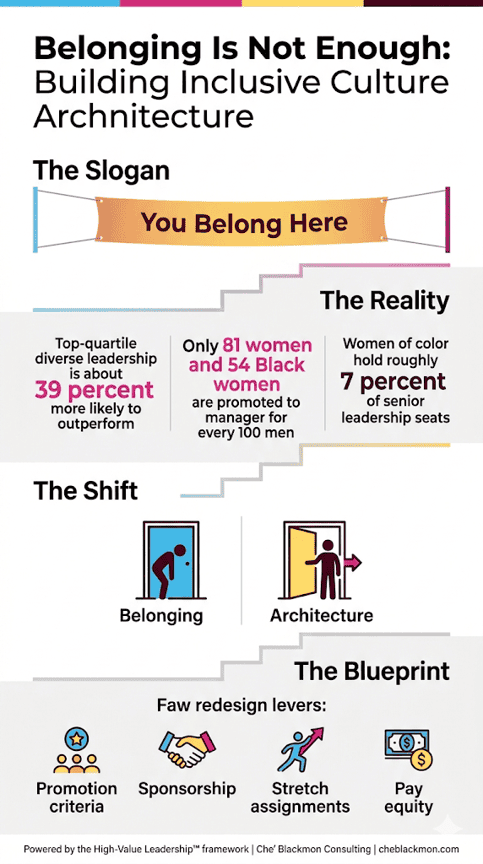
From Combat Leadership to Corporate Boardrooms: Transferable Skills Military Leaders Bring to Business

By Che’ Blackmon, DBA Candidate | Founder & CEO, Che’ Blackmon Consulting

At twenty four, she was responsible for forty people, millions of dollars in equipment, and decisions that could not wait until morning. Six years later, sitting across from a hiring panel, she was asked a simple question: “Do you have any leadership experience?”

She paused. Not because she lacked an answer, but because she had too many, and none of them were written in the language of the room.

That moment plays out in conference rooms every week. It is not a talent problem. It is a translation problem, and on this Veterans Day, it is worth asking whether our organizations are fluent enough to recognize the leaders already sitting in front of them.

🇺🇸 Why This Veterans Day Calls for More Than a Thank You

Gratitude matters. But a social media post and a lunch on November 11 do not change what happens to veterans on November 12.

The most recent federal labor data tells a story that deserves a closer look. In 2025, there were 17.3 million veterans in the United States, and their unemployment rate rose from 3.0 percent to 3.5 percent. The rate for women veterans climbed to 4.6 percent, and Black veterans faced an unemployment rate of 5.0 percent, compared with 3.3 percent for White veterans (U.S. Bureau of Labor Statistics, 2026). The veterans with the least access to opportunity are the very groups whose numbers are growing. Women are projected to grow from 11 percent of all veterans to 18 percent by 2048, while the share of Black veterans is expected to rise from 13 percent to 15 percent (Schaeffer, 2023).

Getting hired is also not the finish line. A study in the Journal of Veterans Studies followed roughly 3,000 post 9/11 veterans three years after they left the military. Roughly one third were underemployed even though they were satisfied with their pay, and another 10 percent were both underemployed and dissatisfied. That second group earned between $11,000 and $24,000 less than their peers. They were also four times more likely to leave their jobs (Davenport et al., 2024).

Read that again from an executive’s chair. Organizations are recruiting proven leaders, placing them below their capability, paying them accordingly, and then watching them walk out the door. That is not a veteran problem. That is a culture problem.

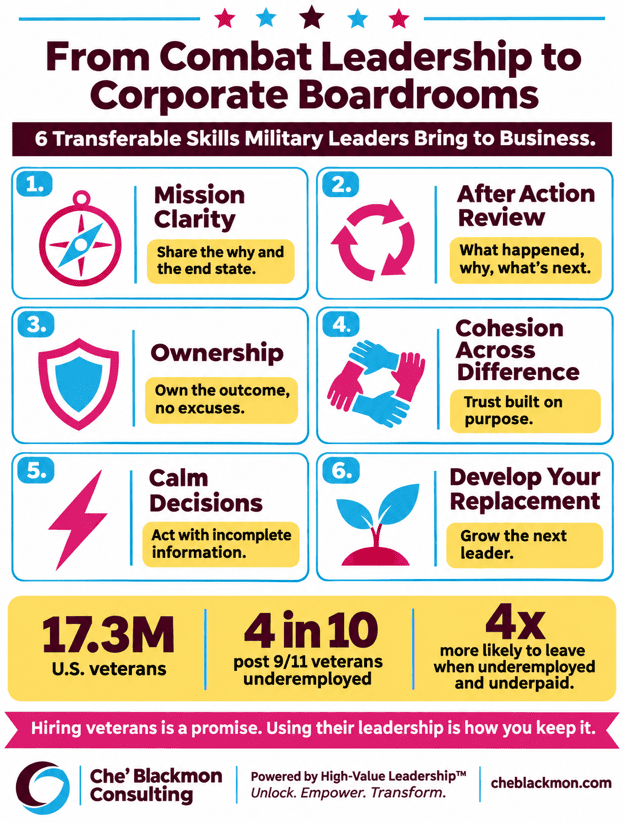
🎖️ Six Transferable Skills Military Leaders Bring to Business

Military leadership is not a personality type. It is a set of practiced, repeatable disciplines. Here are six that translate directly into business value when an organization knows how to use them.

🧭 1. Mission Clarity Through Commander’s Intent

Military leaders are trained to communicate not only the task but the purpose and the desired end state. When the plan falls apart (and it always does), the team still knows what success looks like and can adapt without waiting for permission.

In business: This is the difference between a strategy that lives in a slide deck and one that lives in daily decisions. Leaders who explain the “why” create teams that make sound calls when the boss is not in the room.

🔁 2. The After Action Review

Four questions drive this practice: What was supposed to happen? What actually happened? Why was there a difference? What will we do differently next time? The review is about learning, not blame, and rank is set aside at the table.

In business: Few tools build psychological safety and continuous improvement faster. Teams that debrief honestly fix problems in weeks instead of repeating them for years.

🛡️ 3. Ownership Without Excuses

In uniform, “that’s not my job” is rarely an option. Leaders own the outcome, including the parts they did not personally touch.

In business: Accountability is one of the most requested and least practiced leadership behaviors. Veterans often arrive already fluent in it, and they can model it for peers who have only heard it described.

🤝 4. Building Cohesion Across Difference

Military units bring together people from every region, background, and belief system, and then require them to trust one another completely. Cohesion is not optional. It is built on purpose.

In business: Inclusion is not a program. It is a daily leadership skill, and many veterans have practiced it under far higher stakes than a quarterly review.

⚡ 5. Calm Decisions With Incomplete Information

Military leaders learn to act on the best available information, set a clear direction, and adjust as new facts arrive.

In business: Markets, technology, and workforce expectations are changing faster than most annual plans. Leaders who can decide steadily in ambiguity are a competitive advantage.

🌱 6. Developing Your Replacement

In many units, a leader is expected to prepare someone to step into the role at a moment’s notice. Developing others is part of the job description, not a favor.

In business: Weak succession pipelines are a quiet risk in nearly every industry. Leaders who are wired to grow the next leader strengthen the bench without being asked.
👩🏾‍✈️ The Overlooked Advantage: Black Women Who Served

If veterans face a translation gap, Black women veterans often face a double one. They must translate their military experience into civilian language, and they must also push past the bias that so many Black women encounter in corporate spaces.

The same directness that earned respect in uniform can be mislabeled as “too aggressive” in a conference room. The same composure under pressure can be read as “distant.” Leadership that would be called decisive in someone else is too often questioned in her.

The data reflects that gap. Women veterans and Black veterans both experience higher unemployment than veterans overall (U.S. Bureau of Labor Statistics, 2026), and Black women sit where those two realities meet. Yet these are leaders who have already proven resilience, sacrifice, and purpose under conditions most executives will never face. This is a theme I explore throughout Rise & Thrive: A Black Woman’s Blueprint for Leadership Excellence, and it bears repeating here. When organizations overlook Black women who served, they are not only failing a group of employees. They are leaving some of their strongest leadership talent unused.

📊 Case in Point: A Manufacturer That Stopped Losing Its Veterans

The following is a composite scenario drawn from patterns common across manufacturing and automotive environments. The figures are illustrative.

🏭 The Challenge

Consider a midsized manufacturer that made a public commitment to hiring veterans. Recruiting went well. Retention did not. Eighteen months into the effort, 41 percent of veteran hires had left within their first year.

Exit interviews told a consistent story. Former squad leaders and logistics officers had been placed in entry level roles because hiring managers could not connect their experience to job requirements. One departing employee summed it up: “I led people in service. Here, nobody asked what I could do.”

🔧 The Intervention

Leadership treated the problem as a culture issue rather than a recruiting issue, and made three changes.

  1. Skills translation in hiring. Interview panels were trained to map military roles to civilian ones, so a platoon sergeant was evaluated as a frontline supervisor, not as an applicant with “no corporate experience.”
  2. Sponsorship, not just mentorship. Every veteran hire was paired with a senior leader who was accountable for advocating for that person’s growth, with intentional attention to women and veterans of color.
  3. After action reviews, plant wide. Veteran employees were invited to lead short debriefs after major production runs, turning their expertise into a shared leadership practice.

📈 The Results

Within twelve months, first year turnover among veteran hires dropped from 41 percent to 19 percent. Six veterans were promoted into supervisory roles, including two Black women who had previously been placed two levels below their experience. On the production lines that adopted after action reviews, recordable safety incidents fell by 22 percent.

The lesson is simple. Hiring veterans is a promise. Using their leadership is how an organization keeps it. This sits at the heart of High-Value Leadership™: culture is not what a company announces, it is what people experience every day, and high value cultures make sure every person’s full capability is seen and put to work.

🧠 Current Trends and Best Practices

  • Skills based hiring is replacing degree and title screening. This shift opens the door for veterans, but only if job descriptions and interview guides describe skills in plain language that military experience can map to.
  • Retention and promotion are the real metrics. Counting veteran hires is easy. Tracking how many stay, how many are promoted, and how their pay compares to peers tells you whether your culture is working.
  • Sponsorship closes gaps that mentorship cannot. Advice is helpful. Advocacy changes careers, especially for women and people of color.
  • Veteran employee resource groups need executive sponsors. Groups that include military spouses and are tied to business goals tend to influence decisions, not just host events.
  • Stereotypes cost talent. Assumptions that veterans are rigid, only fit for security or operations roles, or carry unmanaged trauma keep strong leaders out of strategic seats.

✅ Actionable Takeaways You Can Use This Week

  • Pull your numbers. How many veterans have you hired in the last two years? How many are still with you, and how many have been promoted?
  • Rewrite one job posting. Replace jargon and title requirements with the actual skills the role needs, such as leading teams, managing resources, and making decisions under pressure.
  • Run one after action review. Pick a recent project and walk your team through the four questions. Keep it blame free.
  • Ask a better question. Sit down with a veteran on your team and ask, “What did you lead in service that we have not asked you to lead here?”
  • Name a sponsor. Choose one veteran, especially a woman of color, and assign a senior leader to actively advocate for her next opportunity.

💬 Discussion Questions

  • Where in your hiring process could a proven military leader be screened out for lacking “corporate experience”?
  • Which of the six transferable skills is your organization weakest in today, and who on your team already has it?
  • How would your culture change if every team used an after action review after major projects?
  • What would it take for Black women veterans in your organization to be seen, sponsored, and promoted at the level of their experience?

🚀 Next Steps for Readers

  • Share this article with a hiring manager or HR partner and talk through one change you can make before year end.
  • Read High-Value Leadership: Transforming Organizations Through Purposeful Culture to build a culture where every person’s capability is visible and valued.
  • Join the High-Value Leadership Intensive waitlist to work through these practices with other leaders committed to purposeful culture.
  • Subscribe to The Blackmon Brief on Substack for weekly culture insights every Monday.

📚 References

Davenport, K. E., Morgan, N. R., Balotti, B. A., Aronson, K. R., & Perkins, D. F. (2024). Underemployment, compensation dissatisfaction, job turnover, and salary change: How are post-9/11 veterans doing three years after leaving the US military? Journal of Veterans Studies, 10(3), 1–18. https://doi.org/10.21061/jvs.v10i3.542

Schaeffer, K. (2023, November 8). The changing face of America’s veteran population. Pew Research Center. https://www.pewresearch.org/short-reads/2023/11/08/the-changing-face-of-americas-veteran-population/

U.S. Bureau of Labor Statistics. (2026, April 28). Employment situation of veterans: 2025 [News release]. U.S. Department of Labor. https://www.bls.gov/news.release/vet.nr0.htm

🤝 Let’s Build Your High-Value Culture Together

To every veteran reading this: thank you for your service, and thank you for the leadership you bring to every room you enter. To every executive: the leaders you need may already be on your payroll. Che’ Blackmon Consulting helps organizations build cultures where talent like this is recognized, developed, and retained. Let’s talk about what that looks like for your team.

📧 admin@cheblackmon.com  |  📞 888.369.7243  |  🌐 cheblackmon.com

Unlock. Empower. Transform.

#VeteransDay #VeteransInBusiness #MilitaryLeadership #HireVeterans #LeadershipDevelopment #HighValueLeadership #CompanyCulture #WomenVeterans #BlackWomenInLeadership #TalentRetention #HRLeadership #CheBlackmonConsulting
Veterans Day Week: What Military Leadership Teaches Us About Building High-Value Organizations

By Che’ Blackmon, DBA Candidate | Founder & CEO, Che’ Blackmon Consulting

A 19-year-old on a night patrol can usually tell you exactly why the mission matters. Many employees who have been with a company for 19 years cannot tell you what their company is trying to do. That gap is less about intelligence or commitment. It comes from how the two kinds of organizations lead. This Veterans Day Week, we honor those who served, and we also look closely at the leadership habits that military service builds, because those habits line up well with what makes an organization high-value.

🇺🇸 Why Veterans Day Week Is a Leadership Conversation

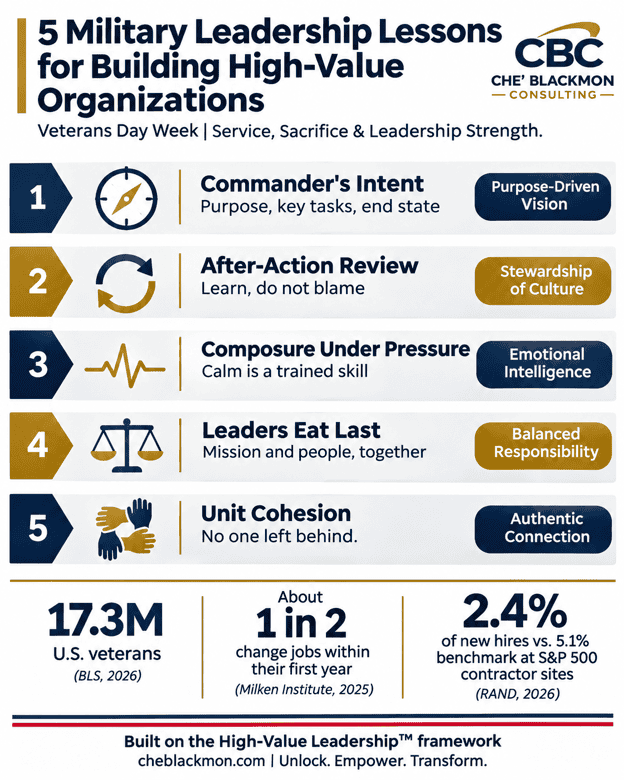
The veteran workforce is large, skilled, and often underused. The Bureau of Labor Statistics (2026) reported 17.3 million veterans in 2025, with a veteran unemployment rate of 3.5% compared with 4.2% for nonveterans. Getting hired is not the hard part. The hard part is keeping and growing that talent. A Milken Institute report found that about half of the roughly 200,000 veterans who leave the military each year are in a different job within twelve months, and about two thirds believe they are underemployed (Hines et al., 2025). The same authors point to a repeated disconnect: people who led teams under extreme pressure in uniform often do not reach senior civilian roles (Hines et al., 2025).

Corporate follow-through is uneven too. A 2026 RAND analysis of S&P 500 companies found that nearly 80% described veteran programs in voluntary materials, but veterans made up only 2.4% of new hires at those companies’ federal contractor sites, compared with a 5.1% national planning benchmark (Zuo & Wenger, 2026). The researchers also noted that companies rarely report whether veterans stay, get promoted, or move into management (Zuo & Wenger, 2026). Recognizing veterans is not enough. Organizations get the most when they learn from how veterans lead.

🧭 Lesson 1: Commander’s Intent Turns Purpose Into Action

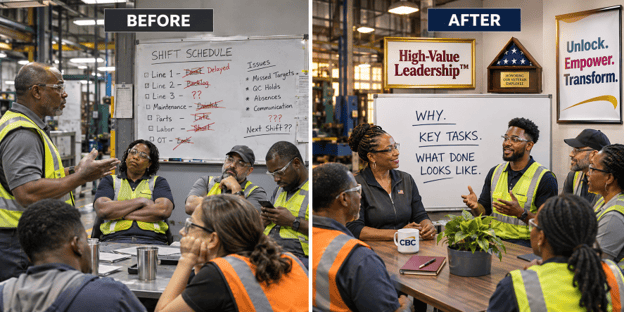
In military planning, commander’s intent is a short statement of the purpose of an operation, the key tasks, and what success looks like at the end. Its value shows up when plans fall apart. When conditions change, people who understand the intent can adapt without waiting for permission. This maps directly to the Purpose-Driven Vision pillar of High-Value Leadership™. A vision statement on the lobby wall does nothing at 2:00 a.m. when a line goes down. A clear, repeated intent statement gives a supervisor what they need to make a good call on their own.

Best practice: Before your next project kickoff or shift start, give a three-line brief: Why we are doing this. The two or three things that must happen. What done looks like. Then ask one team member to say it back in their own words.

🔁 Lesson 2: The After-Action Review Builds a Learning Culture

Military units hold after-action reviews (AARs) built around four questions. What was supposed to happen? What actually happened? Why was there a difference? What will we keep doing or change? The ground rule is that rank stays outside the room, so the point is learning and not blame. This is the Stewardship of Culture pillar in practice. Leaders who protect honest debriefs are building a culture where problems come to the surface early, which is cheaper than finding them late.

🧠 Lesson 3: Composure Under Pressure Is a Teachable Skill

Employers often name composure under pressure as one of the strengths veterans bring, along with mission focus and problem solving (Hines et al., 2025). That composure does not come from personality alone. It comes from rehearsal, clear roles, and practice regulating emotion while stress is high. This is the Emotional Intelligence pillar. Leaders can build the same strength through scenario drills, pre-briefs before difficult conversations, and naming the emotional temperature of a room before deciding anything.

⚖️ Lesson 4: “Leaders Eat Last” Balances the Mission and the People

Many military units follow a custom where junior members eat first and leaders eat last. The custom carries a principle: the mission matters, and the people doing it matter equally. This is Balanced Responsibility. Organizations that push results while neglecting people lose the people, and organizations that care for people without clear results lose direction. Military leaders are trained to hold both.

🤝 Lesson 5: Cohesion Is Built on Purpose

Unit cohesion is more than friendship. It comes from shared purpose, shared hardship, and the confidence that no one will be left behind. This reflects Authentic Connection. In civilian workplaces, that loss of belonging can be part of why veterans leave early. Research from the Employee Benefit Research Institute (2025) found that veteran workers were more likely than nonveterans to intend to stay with their current employer and to prefer longer tenure with one employer. The loyalty is there. The work is to give it a culture where it belongs.

📈 Current Trends Leaders Should Watch

The veteran talent pool is changing. SHRM reported that the veteran labor force has shrunk by more than 40% since 2000, and veterans now make up about 5% of employed people (Society for Human Resource Management [SHRM], 2025). The same analysis found that veterans ages 16 to 54 are more than twice as likely as nonveterans to have a disability, 15.2% compared with 6.3% (SHRM, 2025). That makes accommodation readiness and accessible onboarding part of a serious veteran strategy. Meanwhile, HR Dive reported that many veteran programs had been housed under DEI initiatives, which leaves them exposed during the current pullback from DEI (Colvin, 2026). RAND likewise found that high-quality corporate disclosures about veteran programs fell sharply in 2025 and the first half of 2026 (Zuo & Wenger, 2026). Organizations that tie veteran integration to core talent and culture strategy, and not to a program that can be cut, will be the ones to keep this talent.

🏭 Composite Scenario: From Turnover to Ownership

The following is a composite scenario drawn from common patterns in manufacturing culture work. Details and figures are illustrative.

A 600-person manufacturer was losing more than a third of its second-shift new hires within the first 90 days. Exit feedback kept repeating the same complaint: “Nobody told me why anything mattered.” Leadership took three military-inspired steps. Every shift began with a three-line intent brief. Supervisors ran 15-minute weekly after-action reviews with no blame and no rank in the room. Veteran supervisors were paired with newer team leaders in a peer coaching group.

After two quarters, first-90-day turnover on second shift fell from 38% to 24%. Near-miss safety reporting rose by 40%. In this case that was good news, because it showed people trusted that reporting problems was safe. Supervisors also said they spent less time chasing approvals, because their teams understood the intent well enough to act. The equipment and the pay scale stayed the same. Only the leadership habits changed.

⚠️ A Myth to Retire

Military leadership is often confused with rigid command and control. Modern military doctrine leans the other way. It favors decentralized execution, trust, and initiative within clear intent. Organizations that borrow only the hierarchy will miss the point. The real lesson is to make purpose clear enough that people can act without waiting to be told.

✅ Actionable Takeaways for This Week

  1. Write a commander’s intent for one current priority. Keep it to three lines and share it with your team by Wednesday.
  2. Run one after-action review on a recent project. Use the four questions and leave titles outside the room.
  3. Audit your veteran retention data. Check whether you can see how veterans stay, advance, and reach management, and not only how many you hire.
  4. Ask a veteran on your team what leadership practice from their service they wish your organization used. Listen without defending.
  5. Check your onboarding for accessibility. Make sure accommodation conversations are routine and not reactive.

💬 Discussion Questions

  1. If your front-line team lost contact with leadership for a full shift, how well would they understand the intent behind their work?
  2. Where does your organization debrief to learn, and where does it debrief to assign blame?
  3. What does your data show about whether veterans in your organization advance into leadership roles?
  4. Which High-Value Leadership™ pillar is your organization’s strongest, and which one would a veteran employee notice is missing?

🚀 Next Steps for Readers

Share this article with one leader who supervises veterans or hires for front-line roles. Pick one practice from this article and try it before Friday. Then follow along all week as the Veterans Day series continues with veteran integration, transferable skills, the service mindset, and leadership legacy. To build these practices into your culture in a structured way, join the High-Value Leadership™ Intensive waitlist.

📚 References

Bureau of Labor Statistics. (2026, April 28). Employment situation of veterans: 2025 [News release]. U.S. Department of Labor. https://www.bls.gov/news.release/archives/vet_04282026.htm

Colvin, C. (2026, September 16). Veterans caught in the middle on anti-DEI efforts, research says. HR Dive. https://www.hrdive.com/news/veterans-retention-2026/830566/

Employee Benefit Research Institute. (2025, January 9). Satisfaction after service: Findings from a focus on veterans in the 2024 Workplace Wellness Survey [Issue brief]. https://www.ebri.org/content/satisfaction-after-service–findings-from-a-focus-on-veterans-in-the-2024-workplace-wellness-survey

Hines, G., Spitaletta, S., & Flaum, L. (2025). Saluting service and bolstering business: Redefining employer investments in veterans. Milken Institute. https://milkeninstitute.org/sites/default/files/2025-10/SalutingServiceBolsteringBusinessRedefiningEmployer.pdf

Society for Human Resource Management. (2025, November 10). New SHRM research spotlights veterans as America’s hidden talent [Press release]. https://www.shrm.org/in/about/press-room/new-shrm-research-spotlights-veterans-as-america-s-hidden-talent

Zuo, G., & Wenger, J. B. (2026). What can public data tell us about corporate support for veterans? RAND. https://www.rand.org/news/press/2026/09/corporate-support-for-veterans-is-widespread-but-public.html


Ready to build a high-value organization that leads with purpose, discipline, and care? Che’ Blackmon Consulting partners with leaders to turn culture into a competitive advantage.

📧 admin@cheblackmon.com | 📞 888.369.7243 | 🌐 cheblackmon.com

Belonging Is Not Enough: The Business Case for Truly Inclusive Culture Architecture

By Che’ Blackmon, DBA Candidate | Founder & CEO, Che’ Blackmon Consulting

🌈 Inclusive Culture Architecture | Pride Month

Walk into almost any company today and you will find the word everywhere. It lives on the careers page. It shows up in the values painted on the lobby wall. It gets repeated in onboarding decks and quarterly town halls. You belong here. The phrase is meant to feel warm, and for many people it does. Yet for some of the very people it claims to welcome, belonging has started to feel like a promise the building was never designed to keep.

🏗️ When the Welcome Mat Hides a Locked Door

Belonging became the headline of inclusion work for a good reason. It captures something representation alone cannot. You can hire a more diverse team and still leave people feeling like guests in someone else’s house. So leaders reached for belonging as the next frontier, and that instinct was right. The problem is where many stopped.

Here is the quiet flaw in the way belonging often gets used. It asks the individual to adjust to a culture that was built without them in mind. Fit in. Find your people. Bring your whole self, as long as your whole self matches the unwritten rules already in place. Belonging, framed this way, becomes one more thing the overlooked have to earn. The pressure to assimilate gets rebranded as inclusion.

This matters most for the people who have always been asked to do the adjusting. Across manufacturing, automotive, healthcare, non-profit, quick-service, and professional services settings, Black women in corporate spaces have learned to read a room, soften an idea, and carry the emotional cost of being the only one at the table. A culture can tell them they belong while every system around them quietly says prove it again.

📊 The Business Case Is Stronger Than the Slogans

The financial argument for inclusion is not soft, and it is not new. In its 2023 analysis of more than a thousand companies across two dozen countries, McKinsey & Company found that organizations in the top quartile for gender and for ethnic diversity in leadership were roughly 39 percent more likely to outperform their peers on profitability than companies in the bottom quartile (McKinsey & Company, 2023). That figure has climbed steadily across a decade of study. The relationship is an association rather than a guarantee, yet the pattern is consistent enough that ignoring it has become its own kind of risk.

The cost of getting it wrong shows up just as clearly. A 2023 peer reviewed study of workplace ostracism found that when people are subtly pushed to the margins, their basic need to belong is thwarted, and the fallout is measurable: lower job satisfaction, a stronger intention to quit, weaker loyalty, and even higher reported depression (Brison & Caesens, 2023). Exclusion, in other words, is not only unkind. It is expensive, and the invoice arrives through turnover, disengagement, and lost institutional knowledge.

🪜 The Broken Rung Black Women Keep Hitting

If belonging programs alone solved the problem, the promotion data would show it. It does not. The 2024 Women in the Workplace report, the tenth edition of the study by McKinsey & Company and LeanIn.Org, describes a broken rung at the very first step into management. For every 100 men promoted to manager, only 81 women advance. For Black women, that number falls to 54 (McKinsey & Company & LeanIn.Org, 2024). Women of color hold only about 7 percent of senior leadership seats, a number that has barely moved in years.

The daily experience tells the same story. Women who absorb three or more microaggressions are far more likely to burn out and to seriously consider leaving, with the data pointing to several times the risk of their peers (McKinsey & Company & LeanIn.Org, 2024). Black women in corporate spaces often carry an extra weight that rarely appears in an engagement survey: being mistaken for someone else of the same race, having their competence quietly questioned, or feeling judged for how they speak.

Put the pieces together and the limit of belonging language becomes obvious. You cannot affirm your way out of a structural problem. Telling a Black woman she belongs while the promotion machinery routes opportunity around her is asking her to feel at home in a house whose stairs keep collapsing under her feet. The warmth is real. The architecture is broken.

🧱 From Belonging to Architecture

Belonging is a feeling. Architecture is a structure. That single distinction reframes the entire conversation. Feelings can be nurtured with intention and care, and they should be. Structures, though, have to be designed, inspected, and rebuilt when they fail. Inclusive culture architecture asks a harder and more useful question than do people feel welcome. It asks how is opportunity actually distributed here, and who built the rules.

That means looking at the load bearing walls of an organization. How are promotion criteria written and applied. Who gets the high visibility projects that lead to advancement. Who has a sponsor with real influence, not just a mentor with kind words. How are pay, feedback, and meeting norms designed, and who gets interrupted while someone else gets credit. These are not vibes. They are decisions, and decisions can be redesigned.

This is where the High-Value Leadership™ framework earns its place. Its Stewardship of Culture pillar treats culture as something a leader designs and maintains on purpose, the way a steward tends a property rather than hoping the weather cooperates. Paired with the Authentic Connection pillar, it pushes leaders past the comfortable slogan toward the uncomfortable audit. Belonging asks people to fit the building. Architecture asks the building to fit the people.

🏢 Case Study: The Company That Redesigned the Room

Consider an organization in the professional services space that had spent two years investing heavily in belonging. There were affinity groups, listening sessions, and a values statement that named inclusion in bold letters. Engagement scores looked respectable. Leaders felt proud. Yet a closer look at the exit data told a different story, because women of color were leaving at nearly twice the rate of their colleagues, and the talent pipeline into management had quietly narrowed to almost no one who looked like the clients they served.

Rather than launch another awareness campaign, the leadership team stopped asking people to fit and started auditing the structure itself. They examined who received stretch assignments and found the choices ran on familiarity rather than merit. They rewrote vague promotion criteria into clear and observable standards. They built a sponsorship program that paired emerging Black women leaders with senior leaders who held real budget and real decision power, and they tracked the outcomes the same way they tracked revenue.

The results showed up in the numbers that matter. Within eighteen months, voluntary turnover among women of color fell by roughly a third, internal promotion rates for the group rose, and the management pipeline began to reflect the workforce and the market. The belonging programs had not been wrong. They had simply been asked to carry weight that only architecture could hold. The shift, anchored in deliberate Stewardship of Culture, turned good intentions into a measurable result.

✅ What You Can Do This Week

  1. Audit one process, not your whole culture.Pull the last two years of promotions and ask a hard question. Did opportunity flow evenly, or did it follow familiarity? One honest data pull beats a dozen value statements.
  2. Separate mentors from sponsors.A mentor gives advice. A sponsor spends political capital on your behalf. Identify which Black women on your team have real sponsors, and close the gap on purpose.
  3. Make your promotion criteria observable.Replace words like leadership presence with specific, written, and measurable standards so the rules stop living in people’s heads.
  4. Track stretch assignments like you track budget.Visibility work leads to advancement. Watch who gets it for the next quarter and notice the pattern.
  5. Ask a quieter question in your next survey.Move past do you feel you belong and ask whether people believe the path to advancement is fair. The gap between those two answers is your real work.

💬 Discussion Questions

  • Where in your organization does belonging language outpace structural change?
  • If you mapped how your last five promotions actually happened, what would the map reveal?
  • Who are the Black women on your team, and do they have sponsors with real influence or only mentors with kind words?
  • What is one load bearing process you could redesign this quarter instead of asking people to adapt to it?

👣 Next Steps for Readers

Start with a single audit rather than a sweeping initiative. Choose promotions, sponsorship, or stretch assignments, and look at the real data for the past two years. Bring the findings to your leadership team and frame the conversation around architecture rather than blame. Then pick one structure to redesign, set a measurable goal, and revisit it in ninety days. Inclusive culture is not built in a town hall. It is built in the quiet decisions you are willing to change.

🤝 Work With Che’ Blackmon Consulting

If you are ready to move from belonging slogans to inclusive culture architecture that produces measurable results, Che’ Blackmon Consulting partners with leaders to design cultures worth staying for. Let us build the structure together.

📧 admin@cheblackmon.com    📞 888.369.7243    🌐

cheblackmon.com

📚 References

Brison, N., & Caesens, G. (2023). The relationship between workplace ostracism and organizational dehumanization: The role of need to belong and its outcomes. Psychologica Belgica, 63(1). https://doi.org/10.5334/pb.1215

McKinsey & Company. (2023). Diversity matters even more: The case for holistic impact. https://www.mckinsey.com/featured-insights/diversity-and-inclusion/diversity-matters-even-more

McKinsey & Company, & LeanIn.Org. (2024). Women in the workplace 2024: The 10th-anniversary report. https://www.mckinsey.com/featured-insights/diversity-and-inclusion/women-in-the-workplace-2024

#InclusiveLeadership #CultureArchitecture #BlackWomenInLeadership #BelongingAtWork #HighValueLeadership #DEI #PrideMonth #FractionalHR #OrganizationalCulture #LeadershipDevelopment

Earth Day Leadership: Building Cultures That Are Sustainable by Design 🌱

By Che’ Blackmon, DBA Candidate | Founder & CEO, Che’ Blackmon Consulting

Every April 22nd, the world pauses to honor the planet. Companies post green gradients. Executives quote Indigenous wisdom on LinkedIn. Internal newsletters showcase volunteer clean-ups. And then, like clockwork, April 23rd arrives and most organizations return to the exact operating rhythms that exhaust their people, deplete their communities, and compromise the very planet they just pledged to protect.

Earth Day is not a marketing moment. It is a leadership mirror.

If sustainability is only something your organization performs on April 22nd, you do not have a sustainability strategy. You have a sustainability season. And the same principle applies to your culture. A workplace cannot be environmentally sustainable on the outside while being humanly extractive on the inside.

🌍 The data is clear. IBM research found that 67 percent of workers are more willing to apply for jobs with environmentally sustainable companies, and roughly one in three accepted a lower salary to work for a socially responsible employer. PwC’s global study across 95 countries found that 19 percent of workers value ESG policies as much as or more than their salary. Gallup’s State of the Global Workplace 2026 report confirms that disengagement is now costing the world economy $10 trillion annually in lost productivity. Sustainable cultures are not a soft priority. They are a business imperative.

🌲 Redefining Sustainability in the Workplace

When most leaders hear the word sustainability, they think solar panels, recycling bins, and carbon offsets. Those matter. But true organizational sustainability is far broader. It is the capacity of an organization to endure, perform, and renew itself without depleting the resources it depends on. Those resources include the planet. They also include the people.

In my book Mastering a High Value Company Culture, I wrote that culture is the lifeblood of any organization. A culture that drains its employees to the point of burnout is no more sustainable than a factory that drains a local watershed. Both practices may produce short term output. Neither practice can continue indefinitely. And in the end, both practices leave the environment they touched weaker than they found it.

Sustainable by design means something specific. It means that your culture, your policies, your leadership practices, and your operational rhythms are built from the ground up to renew the people and the planet they interact with. Not after the fact. Not as an add on. By design.

♻️ The Three Pillars of True Workplace Sustainability

ESG frameworks typically break sustainability into three categories. Environmental, social, and governance. For our purposes, we can translate those same three categories directly into the language of culture.

  • Environmental Sustainability. Are your operational practices reducing your organization’s ecological footprint? Are you conscious of energy use, waste, and the physical environments your employees work in every day?
  • Human Sustainability. Are your people being renewed or depleted by their work? Are workloads, schedules, and expectations designed to allow people to thrive across a career, not survive a quarter?
  • Ethical Sustainability. Are your decisions, governance practices, and leadership behaviors aligned with the values you claim publicly? Or is there a gap between the plaque in the lobby and the conversations that happen behind closed doors?

A truly sustainable organization performs well across all three. Weakness in any one area eventually compromises the other two.

🌿 The Five Pillars of High-Value Leadership™ as a Sustainability Blueprint

In High Value Leadership: Transforming Organizations Through Purposeful Culture, I introduced the five pillars that form the foundation of leadership built to last. Each pillar, when practiced consistently, creates the conditions for a sustainable culture. Consider how they map onto the sustainability conversation.

1️⃣ Purpose-Driven Vision

Organizations with clear environmental and social purpose outperform their peers. Research shows that when employees believe their work has special meaning, they are 56 percent more likely to experience innovation opportunities. A purpose driven vision is not a poster. It is a compass that guides every decision from supply chain sourcing to employee wellbeing.

2️⃣ Stewardship of Culture

Stewardship is the sustainability pillar dressed in a different name. A steward does not exploit. A steward tends, protects, and leaves the land better than she found it. The same is true of culture. Leaders who see themselves as stewards rather than owners make decisions that renew the culture rather than extract from it.

3️⃣ Emotional Intelligence

Burnout is the cultural equivalent of soil erosion. It happens slowly, then suddenly, and leaves the landscape unable to produce. Emotionally intelligent leaders read the signals early, adjust the workload, and restore the conditions for growth before depletion becomes the norm.

4️⃣ Balanced Responsibility

True sustainability requires honest accountability. Are the consequences of your decisions borne equitably across your workforce? Or are certain employees shouldering disproportionate weight? The frontline worker standing all day in a hot manufacturing plant bears a different cost than the executive in the climate controlled office.

5️⃣ Authentic Connection

Sustainable organizations are built on real relationships, not transactional ones. When people feel authentically connected to their leaders, their colleagues, and their work, they invest discretionary effort that no policy can mandate. That discretionary effort is the renewable energy source of any thriving culture.

📈 2026 Trends Every Leader Should Understand

The landscape has shifted dramatically in the last three years. Leaders still operating from a 2015 playbook are losing ground fast. A few realities to internalize.

  1. Global engagement is at its lowest since 2020. Gallup reports that global employee engagement fell to 20 percent in 2025, its lowest point in five years. This is not a minor dip. It is a structural warning sign.
  2. Retention is directly tied to ESG credibility. Companies with strong ESG practices experience 24 percent less turnover in low turnover industries and 59 percent less turnover in high turnover industries. Employees who believe their company makes a positive impact on the world are 11 times more likely to stay long term.
  3. Generation Z and Millennials are voting with their feet. Deloitte data shows 40 percent of Millennial and Gen Z workers choose their employers based on sustainability credentials. This is the talent pipeline every organization is fighting for.
  4. Purpose outperforms performative gestures. The World Economic Forum reports that nearly half of companies surveyed cite lack of employee engagement as their primary obstacle to achieving sustainability goals. Top down mandates without cultural buy in simply do not work.
  5. HR is now an ESG function. Leading organizations now embed sustainability accountability directly into HR leadership roles, recognizing that human sustainability and environmental sustainability are inseparable.

🏭 Practical Examples: What Sustainable Culture Looks Like in Action

Example One: The Manufacturing Plant That Rebuilt Its Shift Model

There was a manufacturing organization facing a quiet crisis. Voluntary turnover on second and third shifts was climbing. Workers were describing their schedules as a health hazard. Leadership had invested heavily in environmental sustainability initiatives, including solar roof panels and waste reduction programs. Those efforts were real. The recognition in industry publications was real. But inside the building, the humans running the operation were being depleted by rotating schedules that ignored the science of circadian rhythm, family structure, and long term health.

The plant leadership made a decision that felt counterintuitive. They slowed down long enough to listen. Cross shift listening sessions revealed that the workforce was not asking for less work. They were asking for schedules that honored their humanity. Within a year of redesigning the shift model with employee input and adding flexibility bands for family needs, turnover dropped by double digits and production stability improved. The organization learned that you cannot market an environmentally sustainable operation while running a humanly extractive one.

Example Two: The Healthcare Organization That Paired Green with Grace

There was a healthcare organization that had invested significantly in reducing medical waste and transitioning to energy efficient equipment across its facilities. Leadership was proud of the environmental metrics. They were less proud of the burnout numbers among their clinical staff, particularly among nurses of color who consistently reported feeling unseen and overworked.

The leadership team realized that their ESG strategy had a blind spot. Environmental sustainability without human sustainability was incomplete. They added two new workforce commitments to their ESG framework. First, a clinical workload cap tied to patient acuity. Second, a formal mentorship program for nurses of color, designed to address the invisible labor they carried. Within eighteen months, both retention and patient outcomes improved measurably. The environmental story became more credible because it was now matched by a human story worth telling.

Example Three: The Professional Services Firm That Stopped Performing Sustainability

There was a professional services firm whose sustainability report was a marketing masterpiece. Glossy photos. Impressive metrics. A dedicated Chief Sustainability Officer. And yet, the firm’s internal engagement scores were in steady decline, and exit interviews repeatedly surfaced the same theme. Employees felt that the firm’s external ESG commitments were louder than its internal culture.

The turning point came when leadership invited a blunt cultural audit. The audit revealed that the firm was using sustainability as a recruiting hook without living it as a daily practice. The leadership team rebuilt the ESG strategy from the inside out, starting with policies on PTO utilization, meeting load, and inclusive advancement. The external metrics did not change overnight. But the internal culture did. And within two years, engagement, retention, and client satisfaction all moved in the same direction at the same time. Upward.

💜 The Sustainability Conversation That Centers the Traditionally Overlooked

Before we continue, there is a dimension of this conversation that deserves explicit attention. When organizations talk about sustainability, they often talk about protecting the planet for future generations. That is noble. But who, exactly, are we centering when we talk about future generations? The lived experience of environmental and organizational harm has never been equally distributed.

“The master’s tools will never dismantle the master’s house.” — Audre Lorde

In Rise and Thrive: A Black Woman’s Blueprint for Leadership Excellence, I wrote about the invisible labor that Black women carry in corporate environments. The code switching. The hypervigilance. The emotional cost of representing an entire demographic while simultaneously being expected to perform excellence. That labor is a form of extraction that rarely shows up on an ESG dashboard. But it is real. It depletes. And it undermines the very sustainability claims organizations make publicly.

McKinsey’s Women in the Workplace 2025 report, published in partnership with LeanIn.org, continues to document what many of us already knew. Only 60 Black women are promoted to their first management role for every 100 men promoted. Women of color, and Black women in particular, are among the most likely to report frequent burnout and exclusion. When a culture extracts disproportionately from any one group, it is not sustainable. It is simply postponing the reckoning.

Environmental justice and workplace justice share a common principle. Those closest to the harm must be closest to the solution. An ESG strategy that claims to honor people and the planet, while continuing to overlook the women of color who hold so many organizations together, is not a sustainability strategy. It is a selective one.

What Leaders Can Do Differently

  • Audit your ESG strategy through an equity lens. Ask who is included in the planning, who is counted in the metrics, and who bears the cost of the decisions being made.
  • Measure human sustainability the way you measure environmental sustainability. Track burnout, invisible labor, promotion equity, and retention by demographic with the same rigor you track carbon emissions.
  • Create real pathways for voice. Employee resource groups, listening sessions, and trusted third party cultural audits can surface the truths your standard surveys miss.
  • Invest in the leadership pipeline for traditionally overlooked employees. Retention is an ESG metric. So is advancement. Both require deliberate investment, not hopeful intention.

✅ Actionable Takeaways: A Sustainable by Design Playbook

If you are ready to move from Earth Day performance to sustainable by design practice, here is a starting framework.

🧭 Step One: Expand Your Definition of Sustainability

Write down what your organization currently tracks under the heading of sustainability. Then ask whether human sustainability metrics are included. If the answer is no, your definition is incomplete.

🧭 Step Two: Integrate ESG into HR, Not Around It

The most advanced organizations now treat HR leadership and sustainability leadership as interdependent functions. Your workforce is your primary environment. Treat it as one.

🧭 Step Three: Listen Before You Legislate

Cross departmental listening sessions, skip level meetings, and anonymous feedback channels will reveal whether your stated values match your lived culture. The gap between the two is where sustainability initiatives quietly fail.

🧭 Step Four: Build Renewal Into the Operating Rhythm

Review your meeting load, PTO utilization rates, on call expectations, and after hours communication norms. A culture that never allows renewal is not a culture. It is a conveyor belt with people on it.

🧭 Step Five: Measure Culture With the Same Rigor as Carbon

Engagement scores, eNPS, promotion equity, and retention by demographic belong on the same dashboard as energy use and waste reduction metrics. Culture is a business metric. Sustainability is a cultural metric. Treat both accordingly.

💬 Discussion Questions for Your Leadership Team

If you lead a team, an HR function, or an executive suite, bring these questions to your next leadership meeting.

  1. If your organization had to measure human sustainability with the same rigor as environmental sustainability, what would the scorecard look like?
  2. Where in your current operating model is renewal built in, and where is it missing entirely?
  3. Are your ESG metrics evenly representative of all employee demographics, or are certain voices systematically missing from the data?
  4. What invisible labor are your traditionally overlooked employees carrying, and how is that depletion showing up in retention or engagement trends?
  5. If Earth Day came every week instead of once a year, what would your organization need to change about how it operates?

🚀 Next Steps for Readers

  • Conduct a dual audit. Review your environmental sustainability practices and your cultural sustainability practices side by side. Identify where they reinforce each other and where they contradict.
  • Interview five tenured employees. Ask what the organization does that helps them renew. Ask what depletes them. Their answers are your cultural sustainability audit.
  • Disaggregate your retention data. Review turnover by demographic, department, and tenure. Sustainability requires knowing who is staying, who is leaving, and why.
  • Align your next ESG report with the five pillars. Purpose-Driven Vision. Stewardship of Culture. Emotional Intelligence. Balanced Responsibility. Authentic Connection. Any of these five pillars that are missing from your ESG narrative signal a gap worth closing.
  • Commit publicly to one human sustainability metric this year. Choose one. Announce it. Measure it. Report on it next Earth Day.

🌟 A Final Word

Earth Day is not about trees alone. It is about legacy. It is about whether the world our workers inherit, including the workplaces they spend the majority of their waking hours inside, will be healthier, fairer, and more regenerative than the ones we received. Environmental stewardship and human stewardship are not two separate conversations. They are one conversation with two expressions.

“We do not inherit the earth from our ancestors. We borrow it from our children.” — Native American Proverb

The same is true of culture. The workplaces we build today are borrowed from the people who will lead them tomorrow. Sustainable by design is not a slogan. It is an obligation. And it starts with leaders who are willing to look at their culture through the same honest lens they would apply to their carbon footprint.

🤝 Ready to Work With Che’ Blackmon Consulting?

If your organization is ready to move beyond Earth Day gestures and build a culture that is sustainable by design, let’s talk. Che’ Blackmon Consulting partners with manufacturing, automotive, healthcare, nonprofit, quick service, and professional services organizations to build cultures where both the people and the planet can thrive.

Services include:

  • Fractional HR leadership and executive consulting
  • Culture transformation and Engagement Architecture
  • High-Value Leadership™ development and coaching
  • ESG and human sustainability integration strategy
  • Inclusive leadership and equity driven retention programs

Let’s connect:

📧 admin@cheblackmon.com

📞 888.369.7243

🌐 cheblackmon.com

Unlock. Empower. Transform.™

© Che’ Blackmon Consulting. High-Value Leadership™ is a trademark of Che’ Blackmon Consulting.

#EarthDay #HighValueLeadership #SustainableLeadership #ESG #CompanyCulture #HRLeadership #EmployeeEngagement #WorkplaceCulture #CorporateSustainability #BlackWomenInLeadership #PurposeDrivenLeadership #PeopleFirst #FutureOfWork #OrganizationalCulture #UnlockEmpowerTransform

Absenteeism Is a Symptom, Not a Problem: Finding the Culture Root Cause 📚

By Che’ Blackmon, DBA Candidate | Founder & CEO, Che’ Blackmon Consulting

Every Monday morning, somewhere in America, a plant manager stares at a call-out list and sighs. Another round of unplanned absences. Another scramble for coverage. Another day of overtime, stretched coworkers, and missed production targets. The easy response is to blame the people who did not show up. The harder, more honest response is to ask a different question:

What is our culture telling people when they decide whether or not to come to work today?

Absenteeism is rarely the real problem. It is almost always the symptom of something deeper. And for organizations willing to look beneath the surface, the absence data sitting in your HRIS is one of the most honest cultural audits you will ever receive.

📊 The numbers do not lie. The CDC estimates that absenteeism costs U.S. employers $225.8 billion annually in lost productivity, or roughly $1,685 per employee, per year. The national absence rate climbed to 3.2 percent in 2024 and has continued to trend upward in 2025 and 2026. Meanwhile, Gallup research shows that highly engaged teams experience 81 percent lower absenteeism than their disengaged counterparts.

🩺 The Misdiagnosis That Costs Organizations Millions

Most organizations treat absenteeism the way a patient might treat a fever. They reach for the quickest fix. Stricter attendance policies. Points systems. Progressive discipline. Last chance agreements. And while those tools have their place, none of them address the underlying infection.

In over twenty four years of HR leadership across manufacturing, automotive, healthcare, nonprofit, quick service, and professional services environments, one truth has held constant. When people repeatedly choose not to come to work, they are communicating something. The question is whether leadership is listening.

In my book Mastering a High Value Company Culture, I wrote that culture is the lifeblood of any organization. A fever does not exist without a reason. Neither does a chronic absenteeism pattern. When organizations skip the diagnostic step and jump straight to discipline, they end up with a workforce that either learns to manipulate the point system or simply walks out the door altogether. Neither outcome solves the real problem.

🔍 What Absenteeism Is Actually Telling You

Unplanned absence patterns function as an unfiltered data stream on your culture. Think of them as anonymous employee feedback, written in behavior instead of words. Here i