By Che’ Blackmon, DBA Candidate | Founder & CEO, Che’ Blackmon Consulting
Most business cards end up in a drawer. Some end up in the trash before the parking lot.
A book ends up on a desk. It gets passed down the hall, quoted in a meeting you never attended, and pulled off a shelf six months later when a budget finally opens. It is the only business card a prospect will pay for, keep, and hand to their boss.
That is not a reason to write a book for vanity. It is a reason to understand what a book actually does for a leader’s authority, and why the leaders who use their books well are having very different conversations than the leaders who do not.
📇 The Business Card Problem Every Expert Faces
Here is the hard truth about how buyers decide today: most of the decision happens before you are invited into the room.
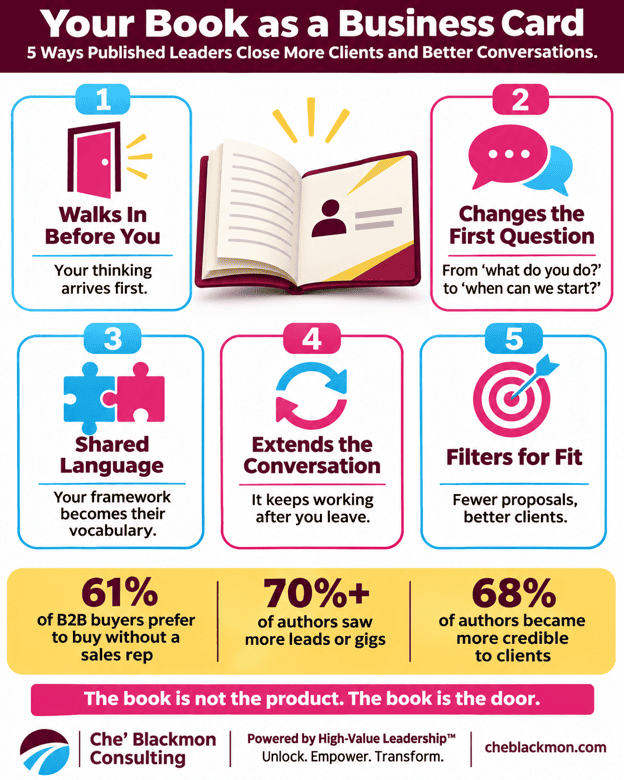
A 2024 survey of 632 business buyers found that 61 percent prefer a buying experience with no sales representative involved at all, and 73 percent actively avoid suppliers whose outreach feels irrelevant (Gartner, 2025). Buyers are researching quietly, comparing options on their own, and forming opinions about your expertise long before your first call.
That changes the job of a credential. A title tells people where you sit. A bio tells people where you have been. Neither one lets a buyer test how you think. A book does. It lets a prospect spend three hours inside your thinking, on their own time, with no pitch and no pressure. By the time they reach out, they are not asking whether you know what you are doing. They are asking when you can start.

📚 What the Research Says About Published Leaders
For years, the case for writing a business book was mostly anecdotal. That is changing. A 2024 study of 301 published nonfiction authors, led by author and analyst Josh Bernoff with a team of publishing industry sponsors, offers one of the most detailed looks yet at what books actually return (Bernoff, 2024).
The findings challenge the idea that a book is about book sales:
- More than 70 percent of authors reported an increase in leads or paid opportunities after publishing.
- 68 percent said they became more credible to prospects and clients.
- 61 percent said their personal brand became more valuable.
- About one in three saw increases in speaking fees and consulting work.
- Among authors who earned consulting revenue connected to their book, the median was $50,000, with workshops ($40,000) and speeches ($30,000) close behind.
Read that from a business owner’s chair. For most authors, the book was not the product. The book was the door. The revenue came from the conversations the book made possible.
There is an important caution in the same study. Fewer than half of authors reached the success they expected in changing opinions or selling copies. A book does not build authority on its own. It builds authority when the leader puts it to work.
🔑 Five Ways a Book Works as a Business Card That Never Gets Thrown Away
🚪 1. It Walks Into the Room Before You Do
A book travels where you cannot. It sits on the desk of an executive who has never met you and speaks for you in a leadership team meeting you will never attend. When the invitation finally comes, the room already has a sense of your voice.
In practice: Send a signed copy before a first meeting, not after it. Mark one chapter that speaks to the problem the prospect named.
🧭 2. It Changes the First Question
Without a book, first conversations often start with “So, tell me what you do.” With a book, they start with “I read your chapter on accountability. Can we talk about what that would look like here?” That is a different conversation. It is shorter, deeper, and closer to a decision.
In practice: Ask every new contact, “Did anything in the book land for you?” Their answer tells you where the real need lives.
🧱 3. It Turns Your Method Into a Shared Language
Frameworks are hard to buy when they live only in your head. In a book, they become vocabulary a whole team can use. When a client’s leaders start using your terms in their own meetings, your method has moved from your slides into their culture. That is the moment a consultant becomes a partner.
In practice: Name your core framework clearly and repeat it the same way across your book, your talks, and your proposals.
🔁 4. It Extends the Conversation After You Leave
A great meeting fades by Friday. A book keeps working. It answers the questions people were too busy to ask, and it gives the person who championed you something to hand the skeptics.
In practice: After a discovery call, send a short note pointing to two pages that answer the concern raised. You are giving your internal champion ammunition.
🎯 5. It Filters for Fit
Not every prospect is your client, and a book helps both sides figure that out early. Leaders who read your work and disagree with your values will self select out. Leaders who read it and feel seen will arrive ready to work. Fewer proposals, better clients.
In practice: Track how many new clients mention the book in their first conversation. That number is your real return.
👩🏾💼 Why a Book Carries Even More Weight for Black Women Leaders
For many Black women in corporate spaces, credibility is not granted once. It is requested again in every new room. Women of color hold only 7 percent of executive suite roles in corporate America (McKinsey & Company & LeanIn.Org, 2024), and the same research has documented for years that Black women are more likely to have their competence and authority questioned.
When your expertise is doubted out loud, a book offers something powerful: third party proof that you did not have to argue for in the moment. It is permanent, public, and reviewable. It shifts the conversation from “Can she do this?” to “How did she build this?”
This is a theme I return to throughout Rise & Thrive: A Black Woman’s Blueprint for Leadership Excellence. Visibility is not vanity. For leaders who have been overlooked, documented expertise is a strategy for being seen accurately. A book is one of the clearest ways to claim your expertise out loud and in writing, at the same time.
That matters for organizations too. If your company wants a stronger pipeline of Black women leaders, encourage and fund their thought leadership. Sponsor the article, the white paper, the conference talk, and yes, the book. You are investing in their visibility and in your culture’s credibility at once.
📊 Case in Point: A Consultancy That Stopped Chasing Clients
The following is a composite scenario drawn from patterns common across professional services and healthcare consulting. The figures are illustrative.
🏢 The Challenge
Consider a small culture and leadership consultancy led by a Black woman principal with two decades of experience across healthcare and professional services. Her results were strong, yet her pipeline was exhausting. She was writing long proposals for nearly every inquiry, winning about 22 percent of them, and waiting an average of 94 days from first call to signed agreement.
Most first meetings were spent proving she was qualified. Prospects who did hire her often said the same thing afterward: “We had no idea how deep your approach went until we started working together.”
🔧 The Intervention
She published a practical book built around her signature framework for purposeful culture and made it the center of her business development, not a side project.
- Book first, proposal second. Every qualified inquiry received a signed copy with a short note and one marked chapter before the discovery call.
- One framework, one language. Her book, keynote, website, and proposals all used the same named method, so prospects heard a consistent story everywhere they met her.
- Champion kits. After each discovery call, her internal champion received a one page summary of the framework and two chapter references to share with the executive team.
- Teaching, not pitching. She hosted a quarterly roundtable where leaders discussed one chapter, which kept past prospects in conversation without a sales message.
📈 The Results
Within twelve months, her proposal win rate rose from 22 percent to 41 percent. The average time from first call to signed agreement dropped from 94 days to 58. Her average engagement size grew by about 30 percent, because clients arrived wanting the full method instead of a single workshop. And for the first time, more than half of new inquiries came through referrals from people who had read the book.
The lesson is simple. The book did not replace her expertise. It made her expertise visible before the first handshake. This is a core idea within High-Value Leadership™: authority is built through consistent, purposeful value that people can experience for themselves.
📖 Three Books, Three Different Doors
A body of work does more than a single title, because each book opens a different conversation. Here is how that plays out across the CBC library.
- Mastering a High-Value Company Culture opens the operational conversation. It speaks to the leader asking, “Where do we even start?”
- High-Value Leadership: Transforming Organizations Through Purposeful Culture opens the executive conversation. It speaks to the leader asking, “How do we lead culture as a strategy, not a program?”
- Rise & Thrive: A Black Woman’s Blueprint for Leadership Excellence opens the personal conversation. It speaks to the leader asking, “How do I rise without shrinking who I am?”
When you have more than one piece of published work, think of them as a set of keys. Hand the one that fits the door in front of you.
🧠 Current Trends and Best Practices
- Buyers are educating themselves first. With most business buyers preferring to research without a salesperson, your published thinking is now your first meeting.
- The book is the hub, not the whole wheel. The strongest authors turn each chapter into articles, talks, workshops, and short videos so the ideas meet buyers wherever they are.
- Depth beats volume. A focused, practical book on one problem builds more authority than a broad book on everything.
- Proof is shifting from claims to evidence. Readers trust books that include research, real frameworks, and measurable outcomes over books built on personal opinion alone.
- Authority must be activated. The research is clear that a book left on a shelf does little. A book placed in the right hands at the right moment does a great deal.
✅ Actionable Takeaways You Can Use This Week
- Audit your first five minutes. Think about your last three first meetings. How much time did you spend proving you were qualified? That is the time a book can give back.
- Name your framework. Write your core method in one sentence and give it a name you will use everywhere.
- Pick your “business card chapter.” If you are already published, choose the chapter that best answers your ideal client’s most common problem, and lead with it.
- Send before you meet. For your next important first meeting, send your book or a short written piece of your thinking ahead of time.
- Track the mentions. Start a simple list of every client or prospect who references your writing. That list is your authority return.
- Sponsor someone’s voice. If you lead a team, ask one overlooked leader, especially a Black woman on your team, what she would write about if she had the time and support. Then help her find both.
💬 Discussion Questions
- What do your prospects or stakeholders need to believe about your expertise before they say yes, and where are they learning it today?
- If someone read only your published work, what would they conclude about how you lead?
- Which idea in your work deserves to become a named framework that others can use?
- How might documented expertise change the way Black women leaders in your organization are seen, sponsored, and promoted?
- What is one conversation you keep having that a single chapter could have for you?
🚀 Next Steps for Readers
- Share this article with a colleague who has a book inside them and keeps putting it off.
- Read High-Value Leadership: Transforming Organizations Through Purposeful Culture to see how purposeful authority and culture strategy work together.
- Join the High-Value Leadership Intensive waitlist to build your leadership platform alongside other leaders committed to purposeful culture.
- Subscribe to The Blackmon Brief on Substack for weekly culture insights every Monday.
📚 References
Bernoff, J. (2024). A comprehensive study of business book ROI. Gotham Ghostwriters, Amplify Publishing Group, Smith Publicity, & Thought Leadership Leverage. https://gothamghostwriters.com/a-comprehensive-study-of-business-book-roi/
Gartner. (2025, June 25). Gartner sales survey finds 61% of B2B buyers prefer a rep-free buying experience [Press release]. https://www.gartner.com/en/newsroom/press-releases/2025-06-25-gartner-sales-survey-finds-61-percent-of-b2b-buyers-prefer-a-rep-free-buying-experience
McKinsey & Company & LeanIn.Org. (2024). Women in the workplace 2024: The 10th-anniversary report. https://www.mckinsey.com/featured-insights/diversity-and-inclusion/women-in-the-workplace
🤝 Let’s Put Your Expertise to Work
Your expertise deserves to be seen before you ever say a word. Whether you are building your own authority platform or building a culture where every leader’s voice is visible, Che’ Blackmon Consulting can help you get there with purpose. Let’s talk about what that looks like for you and your team.
📧 admin@cheblackmon.com | 📞 888.369.7243 | 🌐 cheblackmon.com
Unlock. Empower. Transform.
#ThoughtLeadership #BusinessBooks #AuthorityBuilding #ExecutivePresence #PersonalBrand #ConsultingBusiness #HighValueLeadership #BlackWomenInLeadership #LeadershipDevelopment #ClientAcquisition #PublishedAuthor #CheBlackmonConsulting