

By Che’ Blackmon, DBA Candidate | Founder & CEO, Che’ Blackmon Consulting
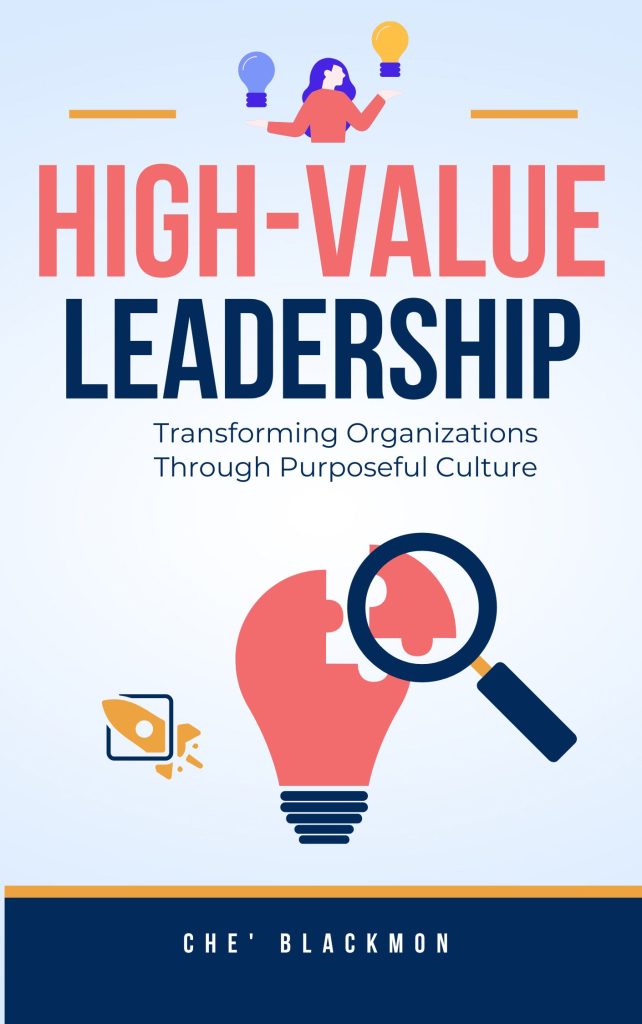
📚 Book Tie-In: High-Value Leadership: Transforming Organizations Through Purposeful Culture
Something is shifting in boardrooms across the country. Business owners and CEOs who once believed a full-time Chief Human Resources Officer was the gold standard are now asking a different question. The question is no longer whether they can afford great HR leadership. The real question is whether they can afford to overpay for it.
Enter the Fractional CHRO. Executive-level HR strategy, delivered at a fraction of the cost, with the flexibility that today’s business environment demands. For small and mid-sized companies, this model is not a compromise. It is a competitive advantage.
This article explores why the Fractional CHRO model is gaining serious momentum, who benefits most, and what it means for the future of strategic people leadership. We will also look at why this shift carries particular significance for traditionally overlooked professionals, including Black women, who bring extraordinary value to organizations that are finally ready to see it.

📈 The Changing Landscape of HR Leadership
The traditional model of HR leadership was built around a simple premise: large companies needed a full-time HR executive on staff to manage people strategy. That model made sense when the average company had thousands of employees, a dedicated HR department, and a budget to match.
Today, however, the landscape looks very different.
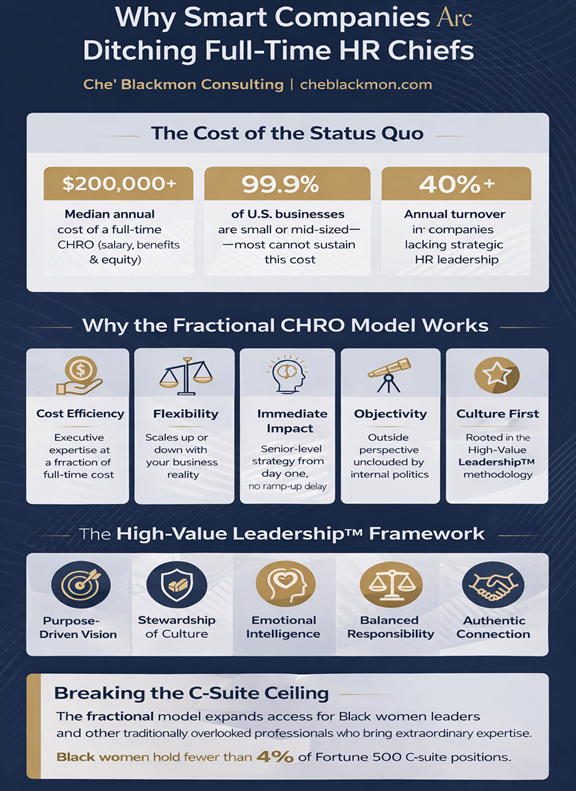
According to the Society for Human Resource Management (SHRM), small and mid-sized businesses, typically defined as those with fewer than 500 employees, represent 99.9% of all U.S. employer firms. Yet the vast majority of these companies cannot justify or sustain the cost of a full-time CHRO, whose median salary often exceeds $200,000 annually when benefits, bonuses, and equity are factored in.
At the same time, the demand for sophisticated people strategy has never been higher. Post-pandemic workforce shifts, evolving employee expectations, generational dynamics, and AI-driven workplace changes have made culture and talent strategy mission-critical for businesses of every size.
“Culture is the lifeblood of any organization.” — Che’ Blackmon, Mastering a High-Value Company Culture
The fractional model bridges this gap elegantly. It allows companies to access C-suite HR expertise on a part-time, contract, or project basis, paying only for what they need when they need it.
🔍 What Exactly Is a Fractional CHRO?
A Fractional CHRO is a seasoned human resources executive who partners with organizations in a part-time or contract capacity to provide strategic HR leadership. Unlike a consultant who delivers a one-time report and disappears, a Fractional CHRO becomes embedded in the leadership team. They attend strategy sessions, advise on people decisions, lead culture initiatives, and drive the kind of organizational transformation that moves a business forward.
The scope of work can include a wide range of responsibilities.
- Developing and executing people strategy aligned with business goals
- Building or restructuring HR infrastructure and processes
- Advising on talent acquisition, retention, and workforce planning
- Leading culture transformation initiatives
- Guiding compliance, employee relations, and policy development
- Coaching senior leaders on people management best practices
- Preparing growing organizations for the complexity that comes with scale
What makes the fractional model particularly powerful is the intentionality behind it. In High-Value Leadership: Transforming Organizations Through Purposeful Culture, the case is made that true leadership is not about occupying a seat. It is about driving purpose-driven vision, stewarding culture, and creating environments where both people and organizations can thrive together. A Fractional CHRO brings exactly that, without the overhead.
💼 Why Smart Companies Are Making the Shift
💰 1. Cost Efficiency Without Sacrificing Quality
A growing company with 50 to 150 employees does not need a full-time CHRO every single week of the year. What it does need is strategic HR leadership during critical moments: a hiring surge, a culture concern, a reorganization, a compliance challenge, or a leadership conflict. A fractional engagement delivers that expertise precisely when and where it is needed most.
Companies that have made this shift often report accessing senior-level strategic guidance at a fraction of the annual cost of a full-time hire. For growing businesses operating with lean budgets, that savings is transformational.
🏋️ 2. Flexibility That Matches Business Reality
Business cycles are unpredictable. Startups scale quickly. Seasonal businesses fluctuate. Acquisitions create sudden complexity. A fractional model allows companies to scale HR support up or down based on what the business actually needs in a given season, rather than being locked into a fixed salary and headcount regardless of the circumstances.
One company in the professional services industry, for example, engaged a Fractional CHRO during a rapid growth phase in which they onboarded thirty new employees in six months. The fractional leader developed their onboarding infrastructure, created a manager development program, and built an employee handbook from scratch, all within a defined engagement. When the initial phase was complete, the relationship transitioned to a lighter advisory capacity. That kind of flexibility simply does not exist in a traditional full-time model.
🧠 3. Senior-Level Expertise, Immediately
Hiring a full-time CHRO from the external market is expensive, time-consuming, and risky. It can take months to find the right candidate, and even longer for them to learn the business before contributing at a strategic level. A Fractional CHRO, by contrast, steps in immediately with deep experience across industries and organizational contexts, ready to diagnose, strategize, and execute from day one.
This is especially critical for companies navigating people crises, such as toxic culture concerns, high turnover, or leadership team dysfunction. Speed of intervention matters enormously in those moments.
🔭 4. Objectivity That Drives Real Change
An experienced Fractional CHRO brings something else that internal hires often struggle to deliver: an outside perspective unclouded by internal politics or historical baggage. They can assess culture honestly, name problems directly, and recommend bold solutions that an internally positioned leader might avoid out of self-preservation.
In Mastering a High-Value Company Culture, the importance of leaders who are willing to act on what they discover, rather than simply describe the problem, is a central theme. Fractional CHROs are uniquely positioned to serve that function.
🌟 Case Studies in Action
🏭 The Manufacturing Company That Could Not Retain Anyone
There was a manufacturing company with approximately 80 employees that was experiencing turnover in excess of 40% annually. Leadership assumed the problem was compensation. A Fractional CHRO was brought in and conducted a thorough culture and engagement assessment. What the data revealed was that the real driver of attrition was a combination of frontline supervisors who lacked people management skills and an absence of any structured onboarding process.
Within six months of engagement, the Fractional CHRO implemented a supervisor training program, redesigned the onboarding experience, and introduced a stay interview process to surface concerns before they became resignations. Turnover dropped significantly. The company never would have identified those root causes through a compensation analysis alone.
🏥 The Healthcare Organization Scaling Too Fast
A regional healthcare organization experiencing rapid growth found itself with an HR team that was entirely transactional, focused on processing paperwork and answering policy questions, but offering no strategic guidance to leadership. Senior leaders were making critical people decisions, including promotions, terminations, and compensation changes, without consistent frameworks or guidance.
A Fractional CHRO was brought in to build the infrastructure the organization needed to support its growth responsibly. She developed a leadership competency model, standardized the performance management process, and created an equitable compensation framework. She also worked with the executive team to define and articulate the organization’s core values in a way that could actually shape behavior, not just decorate a wall. The result was a more cohesive leadership team and a culture that could withstand continued growth.
This mirrors the foundational argument in High-Value Leadership: that authentic leadership drives organizational transformation not through policies and procedures alone, but through the intentional creation of environments where people can thrive.
❤️ The Human Side: Impact on Traditionally Overlooked Professionals
No conversation about the Fractional CHRO revolution is complete without addressing its implications for professionals who have historically been shut out of the C-suite, most particularly Black women.
The statistics are sobering. Research consistently shows that Black women hold fewer than 4% of C-suite positions in Fortune 500 companies, 1.6% of VP roles, and just 1.4% of executive-level positions. These numbers exist not because of a lack of ambition, talent, or capability. They reflect the cumulative weight of systemic barriers: unconscious bias in hiring, limited access to sponsorship, and organizational cultures that too often reward conformity over contribution.
“The numbers tell a stark story about the state of Black women’s representation in leadership — yet the pipeline isn’t broken by a lack of ambition. It is broken by systemic barriers.” — Rise & Thrive: A Black Woman’s Blueprint for Leadership Excellence
The Fractional CHRO model disrupts this dynamic in meaningful ways.
🚪 1. An Alternative Path to Executive-Level Impact
For a Black woman with decades of HR expertise who has been repeatedly passed over for the CHRO title, the fractional model offers a powerful alternative. She does not have to wait for an organization to finally recognize her worth. She can build her own practice, serve multiple clients at a senior level, and command rates that reflect the true value of her expertise.
This is not a consolation prize. For many practitioners, it is a liberating and more lucrative path than the traditional corporate climb.
📌 2. A Seat at the Table, Without the Politics
Black women in corporate HR roles often face a painful paradox. They are expected to advocate for inclusive culture while navigating an environment that is itself not fully inclusive of them. They are asked to lead diversity initiatives while experiencing the very inequities they are trying to address.
The fractional model reshapes that dynamic. As a Fractional CHRO engaged on a contractual basis, a practitioner enters with explicit authority, a defined scope, and a direct reporting relationship to leadership. The nature of the engagement often affords greater latitude to speak candidly, challenge assumptions, and recommend bold action without the risk of organizational retaliation.
🌞 3. A Model That Values Results Over Relationships
One of the most persistent challenges Black women face in corporate advancement is that promotion decisions are often driven as much by informal relationships and social capital as they are by performance. This system disadvantages those who have been historically excluded from the networks where those relationships are built.
The fractional model shifts the currency of value. Clients engage a Fractional CHRO because of demonstrated expertise and measurable results. The work speaks loudly. And when a Black woman with twenty-plus years of transforming organizations steps into a fractional engagement, her track record is undeniable.
In Rise and Thrive: A Black Woman’s Blueprint for Leadership Excellence, the concept of authentic leadership is explored in depth, including the reality that many Black women are urged to code-switch, to minimize their cultural identity in order to be accepted. The fractional model, particularly when practiced through an independent consultancy, allows practitioners to lead from their full selves, bringing their authentic voice, lived experience, and unique perspective as strengths rather than liabilities.
💡 What This Means for Your Organization
If you lead a company with 20 to 200 employees and you do not yet have a strategic HR leader in place, you are likely feeling the consequences without always knowing the cause. High turnover. Managers who are overwhelmed. Inconsistent people practices. A culture that has drifted away from what you intended it to be.
The Fractional CHRO model was designed for exactly this moment.
Here is what a strategic fractional engagement can accomplish for your organization.
- Diagnose the root causes of your people challenges with clarity and precision
- Build the HR infrastructure and processes your organization needs to scale with confidence
- Develop your managers and leaders to lead with both accountability and empathy
- Create a culture that attracts the talent you want and retains the people you cannot afford to lose
- Align your people strategy with your business strategy so that both move in the same direction
📋 Current Trends and Best Practices
The fractional executive model is not a fringe concept. It is rapidly becoming an industry standard, particularly in the post-pandemic business environment where agility, cost-consciousness, and access to senior expertise are all paramount.
According to research from Deloitte’s Global Human Capital Trends Report, organizations that invest in building human-centered, agile HR practices consistently outperform those that treat HR as a purely administrative function. The Fractional CHRO model operationalizes exactly that philosophy.
Several emerging best practices define the most effective fractional HR engagements.
- Clear scope definition: The most successful engagements begin with explicit agreement on priorities, deliverables, and boundaries of authority.
- Executive sponsorship: The Fractional CHRO must have direct access to and support from the CEO or a senior leadership team to drive meaningful change.
- Data-informed strategy: High-value fractional leaders use people analytics, engagement data, and turnover patterns to ground their recommendations in evidence rather than assumption.
- Culture-first orientation: Strategy without culture alignment is fragile. The best Fractional CHROs understand that systems and processes must be supported by an organizational culture that reinforces the desired behaviors.
- Technology integration: In today’s environment, AI-powered tools for talent analytics, engagement measurement, and predictive workforce planning are becoming essential components of forward-thinking HR strategy.
That last point is worth emphasizing. The integration of AI into people strategy is no longer a future conversation. It is happening now. Companies that are working with Fractional CHROs who understand how to leverage AI-enhanced analytics to identify culture risks and predict turnover before it happens are gaining a significant competitive advantage.
✅ Actionable Takeaways
For Business Leaders and CEOs:
- Audit your current HR function. Is it strategic or purely transactional? If your HR is focused entirely on compliance and administration, you are likely underinvesting in the people strategy that drives performance.
- Calculate the true cost of your people challenges. Turnover, disengagement, and leadership dysfunction have measurable price tags. Compare those costs to the investment of a fractional HR engagement.
- Consider your growth stage. If you are scaling, restructuring, or navigating a culture challenge, a Fractional CHRO can provide the strategic leadership you need precisely when you need it most.
- Prioritize culture intentionally. Culture does not manage itself. As articulated in Mastering a High-Value Company Culture, a high-value culture requires vision, strategy, and relentless commitment from leadership.
For HR and People Professionals:
- Explore the fractional path as a career strategy. If you have senior-level HR expertise and a desire for flexibility, autonomy, and impact, the fractional model may offer more of all three than the traditional corporate track.
- Invest in your strategic positioning. Fractional leaders win engagements based on credibility, track record, and the clarity of their value proposition. Document your results. Quantify your impact.
- Build your network intentionally. Many fractional opportunities come through referrals and relationships. Be visible in the spaces where your ideal clients are present.
- Own your expertise unapologetically. This is particularly important for Black women and other professionals from traditionally marginalized groups. Your experience is your asset. Lead with it.
🗣️ Discussion Questions for Readers
Whether you are reading this as a business leader, an HR professional, or someone navigating your own leadership journey, the following questions are worth sitting with.
- What would it mean for your organization to have access to senior-level HR strategy without the commitment of a full-time executive? What would you prioritize first?
- In what ways is your current people strategy aligned with your business goals, and where are the gaps?
- If you are a Black woman or another professional from a traditionally underrepresented group, how might the fractional model change the trajectory of your career?
- What does your organization’s culture communicate to employees about who belongs and who is valued? Does the culture you have match the culture you intended to build?
- How is your organization currently preparing for the intersection of AI and people strategy? Is this a conversation happening at the leadership level?
👟 Next Steps for Readers
Awareness is the first step. Action is where transformation happens.
If this article has resonated with you, here are three concrete next steps to consider.
- Take an honest look at your organization’s people strategy. Not the policy manual. Not the org chart. Ask yourself whether your culture, your leadership practices, and your HR infrastructure are genuinely positioned to help your organization thrive. If the honest answer is no, or not yet, that is important information.
- Read the work. High-Value Leadership: Transforming Organizations Through Purposeful Culture, Mastering a High-Value Company Culture, and Rise and Thrive: A Black Woman’s Blueprint for Leadership Excellence each offer practical frameworks, real-world insights, and actionable strategies that go deeper than this article can. They are available through Che’ Blackmon Consulting.
- Start a conversation. Whether you are a CEO looking for fractional HR leadership, an HR professional curious about the fractional model, or an organizational leader ready to invest in culture transformation, the conversation is the beginning of everything.
🤝 Ready to Transform Your Organization?
Che’ Blackmon Consulting partners with forward-thinking companies and leaders to build high-value cultures, develop purposeful leaders, and deliver strategic HR expertise through fractional and advisory engagements. With more than 24 years of progressive HR leadership experience across manufacturing, automotive, healthcare, and professional services, and with a doctoral candidacy focused on AI-enhanced predictive analytics for culture transformation, Che’ Blackmon brings both the depth of practice and the breadth of perspective that today’s organizations need.
You do not have to navigate your people challenges alone. And you do not have to overpay for the leadership it takes to solve them.
Let’s build something extraordinary together.
📧 admin@cheblackmon.com 📞 888.369.7243 🌐 cheblackmon.com
Che’ Blackmon Consulting | Fractional HR & Culture Transformation | Michigan
#FractionalCHRO #HRLeadership #HighValueLeadership #CultureTransformation #FractionalHR #PeopleStrategy #ExecutiveLeadership #BlackWomenLead #HRStrategy #WorkplaceculTure #LeadershipDevelopment #SmallBusinessHR #OrganizationalCulture #CHROrevolution #CheBlackmonConsulting