

By Che’ Blackmon, DBA Candidate | Founder & CEO, Che’ Blackmon Consulting
📚 Book Tie-In: High-Value Leadership: Transforming Organizations Through Purposeful Culture — Chapters on Purpose-Driven Direction and Trust-Based Empowerment
You have built the career. You have the experience, the institutional knowledge, the battle scars, and the results to prove it. You have watched younger colleagues get promoted around you, sat through meetings where your ideas were credited to someone else, and told yourself to be patient because your time was coming.
It is time to stop waiting.
Generation X, the 65 million Americans born roughly between 1965 and 1980, represents one of the most seasoned, resilient, and capable leadership cohorts in the modern workforce. Yet GenX professionals are also among the most chronically underestimated. Sandwiched between the massive cultural footprint of Baby Boomers and the loud market presence of Millennials, GenX leaders have spent decades doing the work without always receiving the recognition, promotion, or platform their contributions deserve.
This article is a direct conversation with GenX professionals who are done waiting to be discovered. It is a guide for stepping into your full leadership authority, building the visibility that executive presence requires, and creating the kind of organizational impact that makes you impossible to overlook. It also speaks to those within the GenX generation who carry an additional weight: Black women leaders who have navigated not just the generation gap but also the compounding barriers of race and gender in corporate spaces.
The seat at the table you have been waiting for? It is time to pull it up yourself.

🗺️ The GenX Paradox: Maximum Experience, Minimum Visibility
Here is a remarkable data point. According to research from the nonprofit Visier, Generation X makes up more than 50% of leadership roles at the Director level and above in most U.S. organizations. And yet GenX accounts for only about 35% of the C-suite. That gap is not accidental. It reflects a structural visibility problem that has followed this generation throughout its career.
GenX professionals entered the workforce in an era that rewarded competence, loyalty, and heads-down execution. They were trained to let the work speak for itself. They absorbed a professional culture that viewed self-promotion as unseemly and believed that doing an exceptional job would naturally lead to recognition and advancement. For many, it worked through the early stages of their careers.
But the rules changed. The executive suite increasingly rewards visibility, narrative, and strategic self-positioning alongside performance. Those who mastered the art of making their work known, building upward relationships, and being seen as strategic thinkers moved faster. Those who continued to lead with quiet competence found themselves consistently passed over.
“High-value leadership is not about commanding a room. It is about being so intentional, so purposeful, and so aligned in your values and your actions that people cannot help but follow.” — High-Value Leadership: Transforming Organizations Through Purposeful Culture
The paradox for GenX is real. The generation most experienced in navigating organizational complexity, managing multigenerational teams, and delivering sustained results is also the generation most likely to underinvest in the strategic visibility that executive advancement now requires.
Understanding that paradox is the first step. Dismantling it is the work.
🔍 Why GenX Gets Overlooked: The Structural Truth
Before we talk strategy, it is important to name the structural realities that have shaped the GenX leadership experience. This is not about assigning blame. It is about understanding the terrain so you can navigate it more effectively.
📌 The Middle Child Syndrome of the Workforce
Baby Boomers built the corporate infrastructure and held senior leadership positions well into the 2010s, often longer than previous generations due to improved health and financial uncertainty. When they finally began transitioning out, many organizations made a strategic leap directly to Millennials, investing heavily in the recruitment, development, and promotion of younger talent in response to market pressures around innovation and digital transformation.
GenX, once again, got lost in the middle. Too young to be the Boomer heir apparent, too experienced to be positioned as the fresh new talent, this generation has spent years watching leadership pipelines flow around them rather than through them.
📊 The Quiet Achiever Trap
Research consistently shows that visibility is one of the strongest predictors of promotion decisions, often outweighing performance scores when candidates are otherwise equally qualified. A study from the Center for Talent Innovation found that executive presence, defined broadly as the ability to project confidence, credibility, and command attention, accounts for as much as 26% of what it takes to get promoted to senior leadership.
GenX professionals, culturally conditioned to value substance over style, frequently underinvest in executive presence. They do the work. They solve the problems. They manage the teams. But they often fail to architect the narrative around that work in ways that register at the executive level.
🧠 The Loyalty Penalty
GenX is the generation that stayed. While Millennials became known for job hopping and Boomers for building empire-like tenure at single organizations, GenX professionals demonstrated a particular brand of organizational loyalty that often translated into being taken for granted.
In many cases, long tenure without explicit visibility and positioning strategies results in being perceived as part of the furniture rather than as a candidate for the next level. Organizations sometimes overlook their most tenured performers precisely because those performers have not actively signaled readiness for advancement.
❤️ The Double Burden: GenX Black Women in Corporate Spaces
No examination of GenX leadership and the visibility gap would be complete without explicitly addressing the experience of Black women within this generation. For Black GenX women in corporate America, the challenges described above are compounded in ways that cannot be ignored.
Black women who came of age professionally in the 1990s and early 2000s entered organizations that were largely unprepared to see them as future executives. They were often the first, the only, or one of very few in the rooms where decisions were made. They did everything right. They earned the degrees, built the competencies, delivered the results, and mentored others along the way. And they were still passed over.
“The data instead points to systemic barriers including hiring bias, limited access to influential networks, lack of sponsorship, and inhospitable workplace cultures.” — Rise & Thrive: A Black Woman’s Blueprint for Leadership Excellence
According to McKinsey’s Women in the Workplace report, Black women are promoted at lower rates than all other groups of women at nearly every stage of the corporate pipeline. The gap is most pronounced at the transition from individual contributor to manager and again at the transition into the C-suite. These are not soft data points. They represent the cumulative lived experience of an entire cohort of extraordinary professionals whose contributions have been systemically undervalued.
GenX Black women also face a phenomenon that researchers call the double bind. When they display the confidence, assertiveness, and strategic authority that are universally rewarded in male leaders, those same behaviors are frequently coded as aggressive, difficult, or threatening in Black women. When they lead with warmth, collaboration, and humility, those qualities are often interpreted as a lack of executive readiness.
There is no perfect performance that eliminates the bias. But there is a strategy. And that strategy begins with claiming your authority rather than waiting for it to be granted.
💡 Reclaiming the Narrative
In Rise and Thrive: A Black Woman’s Blueprint for Leadership Excellence, the concept of purposeful navigation is explored in depth. It is the practice of making strategic choices about visibility, advocacy, and positioning while remaining anchored in authenticity and integrity. For GenX Black women, purposeful navigation is not optional. It is the leadership competency that the moment demands.
This is not about playing a game whose rules were written by and for someone else. It is about understanding the terrain clearly enough to change it.
💼 Case Studies: GenX Leaders Who Stopped Waiting
🏭 The Operations Leader Who Rewrote Her Story
There was a mid-sized manufacturing organization where a veteran operations director had spent 14 years building one of the company’s most consistently high-performing departments. Her teams routinely outperformed their quarterly targets. Her attrition numbers were the envy of peers across the organization. She was respected, well-liked, and completely invisible to the senior leadership team when VP-level openings arose.
What changed was not her performance. What changed was her strategy. She began requesting time on the quarterly leadership agenda to present her department’s results directly to the executive team rather than allowing those results to be filtered through her direct supervisor. She started writing a brief monthly internal newsletter that connected her team’s operational wins to the company’s stated strategic priorities. She requested a meeting with the CEO to share her perspective on a company-wide challenge she had identified. Within 18 months, she was promoted to VP of Operations.
The work was always there. What changed was the visibility of the work, and the intentionality of the positioning.
🏥 The HR Director Who Claimed Her Expertise Publicly
There was a regional healthcare organization where a long-tenured HR director had developed a sophisticated understanding of how culture directly impacted patient outcomes, staff retention, and organizational performance. She had the data. She had the analysis. She had a framework. But she kept it largely internal, presenting her insights in department-level meetings without ever positioning herself as a thought leader beyond the organization.
A mentor challenged her to take her expertise public. She began writing brief LinkedIn articles on the intersection of HR strategy and healthcare outcomes. She submitted a proposal to speak at a regional industry conference. She connected her internal frameworks to published research and started citing those connections explicitly in executive presentations.
The result was twofold. Externally, she began building a reputation as a subject matter expert in healthcare culture and HR strategy. Internally, the executive team’s perception of her shifted from competent director to strategic thought leader. Both pathways mattered.
🌟 The High-Value Leadership™ Framework for GenX Advancement
In High-Value Leadership: Transforming Organizations Through Purposeful Culture, a distinction is drawn between leaders who manage organizations and leaders who transform them. GenX professionals, with their depth of experience and their cross-functional perspective, are uniquely positioned to be the latter. But transformation requires more than competence. It requires the three pillars of High-Value Leadership™ operating simultaneously.
1️⃣ Purpose-Driven Direction
High-value leaders do not simply manage the work. They articulate a vision that gives the work meaning. For GenX professionals looking to claim their executive seat, this means developing and communicating a point of view about where the organization needs to go and why. Not just at the department level. At the enterprise level.
This is the shift from being a manager of a function to being a strategic voice in the room. It requires asking bigger questions, connecting operational realities to organizational strategy, and being willing to put a stake in the ground with a perspective.
2️⃣ Trust-Based Empowerment
GenX leaders are exceptionally skilled at this pillar, often without realizing it. Their experience managing through multiple organizational cycles, their capacity for empathy built from years of navigating complexity, and their natural tendency toward collaborative problem-solving are all expressions of trust-based empowerment.
The advancement opportunity here is to make this strength visible. Document how your leadership approach has driven team performance. Quantify engagement, retention, and productivity outcomes. Tell the story of how you lead, not just what your teams produce.
3️⃣ Cultural Alignment
Mastering a High-Value Company Culture makes the case that culture is the lifeblood of any organization. GenX leaders who have lived through multiple culture cycles within their organizations carry rare institutional wisdom about what builds culture, what destroys it, and what it takes to sustain it through leadership transitions, market disruptions, and generational shifts.
This wisdom is extraordinarily valuable. It is also frequently underarticulated. Claim it. Make your perspective on culture a consistent part of your leadership narrative, both internally and externally.
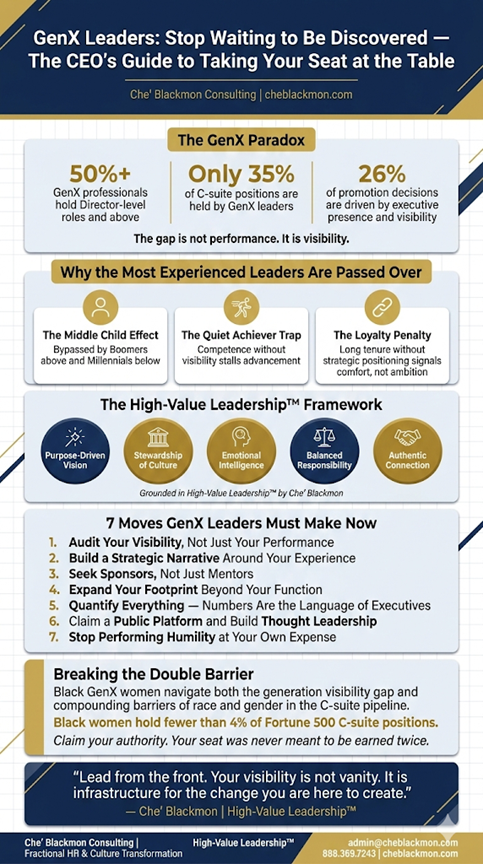
🚀 The Strategic Visibility Blueprint: 7 Moves GenX Leaders Must Make Now
The following strategies are not theoretical. They are practical, evidence-based moves that GenX professionals can begin implementing immediately, regardless of their current title or organizational context.
📈 Move 1: Audit Your Visibility, Not Just Your Performance
Most GenX professionals can recite their performance metrics. Fewer can articulate exactly how visible they are to the people who make promotion decisions. Conduct a visibility audit. Identify the top five decision-makers whose perception of you most directly influences your advancement. Assess honestly how much direct interaction you have with each of them, whether they can specifically describe your contributions and strategic perspective, and whether they think of you when executive opportunities arise.
If the answer to any of these is no or rarely, that is your starting point.
📝 Move 2: Build a Strategic Narrative
Your experience is not self-explanatory. In a world saturated with information and competing priorities, even the most impressive career history requires a clear, compelling narrative to land with impact. Develop a three-sentence leadership positioning statement that communicates who you are, what you uniquely bring, and what organizational problem you are specifically positioned to solve at the next level.
Use this narrative consistently: in executive conversations, in your professional profiles, in how you introduce yourself in new relationships, and in how you frame your contributions in leadership meetings.
🤝 Move 3: Sponsor, Not Just Mentor
Research from Catalyst and Harvard Business Review consistently shows that sponsorship, having someone with organizational power who actively advocates for your advancement in rooms you are not in, is one of the most significant predictors of promotion for historically underrepresented professionals.
GenX leaders often become excellent mentors. The next level is identifying and cultivating sponsors. This requires building upward relationships intentionally, demonstrating your executive readiness directly to senior leaders, and being specific with your advocates about what opportunities you are seeking.
🌎 Move 4: Expand Your Footprint Beyond Your Function
One of the most common visibility limitations for GenX professionals is organizational siloing. You are brilliant within your function, but unknown across the enterprise. Seek cross-functional projects, enterprise-level committees, or organizational initiatives that place you in proximity to senior leaders and peers outside your direct domain.
Every cross-functional project is also a visibility opportunity. Treat it as one.
📊 Move 5: Quantify Everything
GenX leaders often describe their contributions in qualitative terms: built a great team, improved culture, strengthened relationships. Quantification is the language of executive leadership. Translate your impact into numbers wherever possible. Turnover reduction percentages. Engagement score increases. Revenue protected or generated. Cost reductions. Time to productivity improvements.
Numbers are not a substitute for the full story of your leadership. But they are the credibility anchors that make the story land with decision-makers.
🎙️ Move 6: Claim a Public Platform
Thought leadership is no longer the exclusive domain of published academics and keynote speakers. LinkedIn, industry associations, local business organizations, and professional conferences all offer GenX leaders platforms to demonstrate their expertise beyond the walls of their current organization.
Start where you are. A short LinkedIn article. A panel discussion at an industry event. A guest post in a trade publication. Each public expression of your expertise builds external credibility that reinforces your internal positioning.
🗣️ Move 7: Stop Performing Humility at Your Own Expense
This one is particularly important for Black women and other professionals from underrepresented groups. Humility is a leadership virtue. Self-erasure is not. There is a meaningful difference between leading with humility, which means remaining open, collaborative, and grounded, and performing humility as a strategy to avoid the discomfort of being seen.
When you minimize your contributions in meetings, deflect credit for results your leadership produced, or frame your ideas as tentative suggestions rather than informed perspectives, you are not being humble. You are training the people around you to underestimate you.
Own your expertise. Speak with the authority you have earned. Lead from your full self.
“Authentic leadership — bringing your whole self to your role — correlates with higher engagement, innovation, and organizational performance. When you lead authentically, you not only enhance your own effectiveness but potentially transform the environment for others.” — Rise & Thrive: A Black Woman’s Blueprint for Leadership Excellence
💡 Current Trends GenX Leaders Must Leverage
The organizational landscape of 2025 and beyond is presenting a set of conditions that are uniquely favorable for GenX advancement. Those who understand these trends and position themselves accordingly will find the most significant opportunities of their careers opening now.
🤖 The AI Integration Moment
Artificial intelligence is reshaping every sector of the economy, and organizations are urgently seeking leaders who can bridge the gap between technological capability and human organizational dynamics. GenX leaders, who came of age professionally during the personal computing revolution and the early internet era, have an underappreciated advantage here. They understand technology adoption cycles. They have lived through organizational transformations driven by technological disruption. They know what it looks like when technology is implemented without the change management infrastructure to support it.
The leader who can position AI adoption within a robust culture and people strategy framework is extraordinarily valuable in this moment. That leader is often GenX.
💼 The Multigenerational Leadership Demand
Today’s workforce spans five generations simultaneously, from the youngest Gen Z entrants to the most senior Baby Boomer holdovers. Managing across that spectrum requires a level of interpersonal sophistication, contextual intelligence, and organizational patience that is genuinely rare.
GenX leaders, by virtue of their position in the generational middle, often possess an intuitive capacity for this kind of bridging leadership. They can communicate credibly with Boomers and with Gen Z. They understand both analog and digital organizational cultures. They have managed up and managed down across generational divides for decades. This is a specific and valuable leadership competency. Name it. Claim it.
🌍 The Values-Led Business Imperative
Organizations across every sector are under increasing pressure from employees, customers, investors, and communities to lead with explicit values and to demonstrate measurable commitment to those values through their culture, policies, and people practices. This is precisely the terrain on which the High-Value Leadership™ methodology was built.
GenX leaders who have invested in their understanding of culture as a strategic driver and who can articulate how their leadership approach creates environments where values are lived rather than stated are exceptionally well-positioned for this moment.
✅ Actionable Takeaways
For GenX Leaders Ready to Advance:
- Complete a visibility audit this week. Identify your top five organizational decision-makers and honestly assess your current level of strategic visibility with each one.
- Write your leadership positioning statement. Three sentences. What you bring, what you have built, and what organizational challenge you are built to solve at the next level.
- Identify one cross-functional opportunity in the next 30 days. A committee, a project, a working group. Somewhere that places you in proximity to leaders outside your immediate reporting structure.
- Quantify your most significant contribution from the past 12 months. Express it in numbers. Practice stating it out loud in one sentence.
- Begin building your public platform. One article, one conference proposal, one speaking opportunity. Start with what is closest and most achievable.
For GenX Black Women Navigating Additional Barriers:
- Name what is happening. Distinguishing bias from performance feedback is not always simple, but it is essential. Build relationships with mentors and sponsors who can help you see your situation clearly and advocate for you strategically.
- Document your contributions in real time. Keep a running record of your results, your ideas, and the moments when your contributions were credited to others. This record protects you and positions you.
- Invest in your external brand. Your visibility outside your organization insulates you from internal political dynamics and creates alternative pathways when organizational structures prove resistant to your advancement.
- Find your people. Community is not a luxury. It is a strategic resource. Connect with other GenX Black women leaders who understand the terrain and can offer support, insight, and solidarity.
- Lead from the front, not the back. Resist the pull toward invisible leadership. Your visibility is not vanity. It is infrastructure for the change you are here to create.
🗣️ Discussion Questions for Readers
Whether you are reading this as a GenX leader mapping your next career chapter or as an organizational decision-maker thinking about your leadership pipeline, the following questions are worth sitting with.
- Where in your career have you been waiting to be discovered rather than actively positioning yourself for advancement? What would shift if you stopped waiting?
- How would you describe your current visibility with the people who make the decisions that matter most to your career trajectory? What specific actions would change that picture?
- In what ways does your organization’s culture reward or penalize visible leadership, particularly for women and professionals of color? What is your responsibility in that dynamic?
- If you were to define your leadership legacy at this stage of your career, what would it say? And does the way you currently show up in your organization reflect that legacy?
- What is one strategic move from this article that you could realistically begin in the next two weeks? Who would you need to involve, and what would success look like?
👟 Next Steps for Readers
Awareness is the beginning. Commitment is what follows.
If this article has named something you have been feeling for a while, that recognition is important information. It means you are ready for the next chapter. Here are three concrete steps to move from recognition to action.
- Read the foundational work. High-Value Leadership: Transforming Organizations Through Purposeful Culture provides the complete framework for the leadership approach described in this article. Mastering a High-Value Company Culture offers the strategic blueprint for building and sustaining the organizational environments where GenX leaders can thrive. Rise and Thrive: A Black Woman’s Blueprint for Leadership Excellence speaks directly to the unique navigation required of Black women leaders at every stage of the advancement journey. All three are available through Che’ Blackmon Consulting.
- Conduct your visibility audit this week. Not next month. This week. Use the framework from Move 1 in this article and be rigorously honest with yourself about what you find.
- Start the conversation. If you are ready to think strategically about your leadership trajectory, your organizational culture, or your advancement as a GenX professional, bring that conversation to someone who understands the terrain.
🤝 Ready to Stop Waiting and Start Leading?
Che’ Blackmon Consulting partners with professionals and organizations who are ready for real transformation. With more than 24 years of progressive HR and organizational leadership experience, doctoral-level research in AI-enhanced culture transformation, and a practice grounded in the High-Value Leadership™ methodology, Che’ Blackmon brings both the strategic depth and the human insight that today’s GenX leaders need.
Whether you are an individual leader ready to claim your next chapter, an organization looking to develop and advance your experienced talent pipeline, or an executive team ready to invest in the culture that retains your best people, the work begins with a conversation.
Your seat at the table is waiting. Take it.
📧 admin@cheblackmon.com 📞 888.369.7243 🌐 cheblackmon.com
Che’ Blackmon Consulting | Fractional HR & Culture Transformation | Michigan
#GenXLeaders #ExecutiveLeadership #HighValueLeadership #LeadershipDevelopment #CareerAdvancement #BlackWomenLead #CultureTransformation #PeopleStrategy #VisibilityStrategy #WomenInLeadership #GenXProfessionals #HRLeadership #OrganizationalCulture #TakeYourSeat #CheBlackmonConsulting